Table of Contents
- Beginner Scratch Projects (Ages 6-8 or First-Time Coders)
- Intermediate Scratch Projects (Ages 8-10 or 3-6 Months Experience)
- Advanced Scratch Projects (Ages 10 to 12 and Up, or 6+ Months Experience)
- Creative & Artistic Scratch Projects
- Educational Scratch Projects
- How these projects are taught in a live Scratch class
- Tips for Successfully Completing Scratch Projects
- How Parents Can Support Scratch Project Work
- Taking Scratch Projects Further
- Frequently Asked Questions
- Final Thoughts
- Related Posts
- Once Your Child Outgrows Scratch: Try These Programs
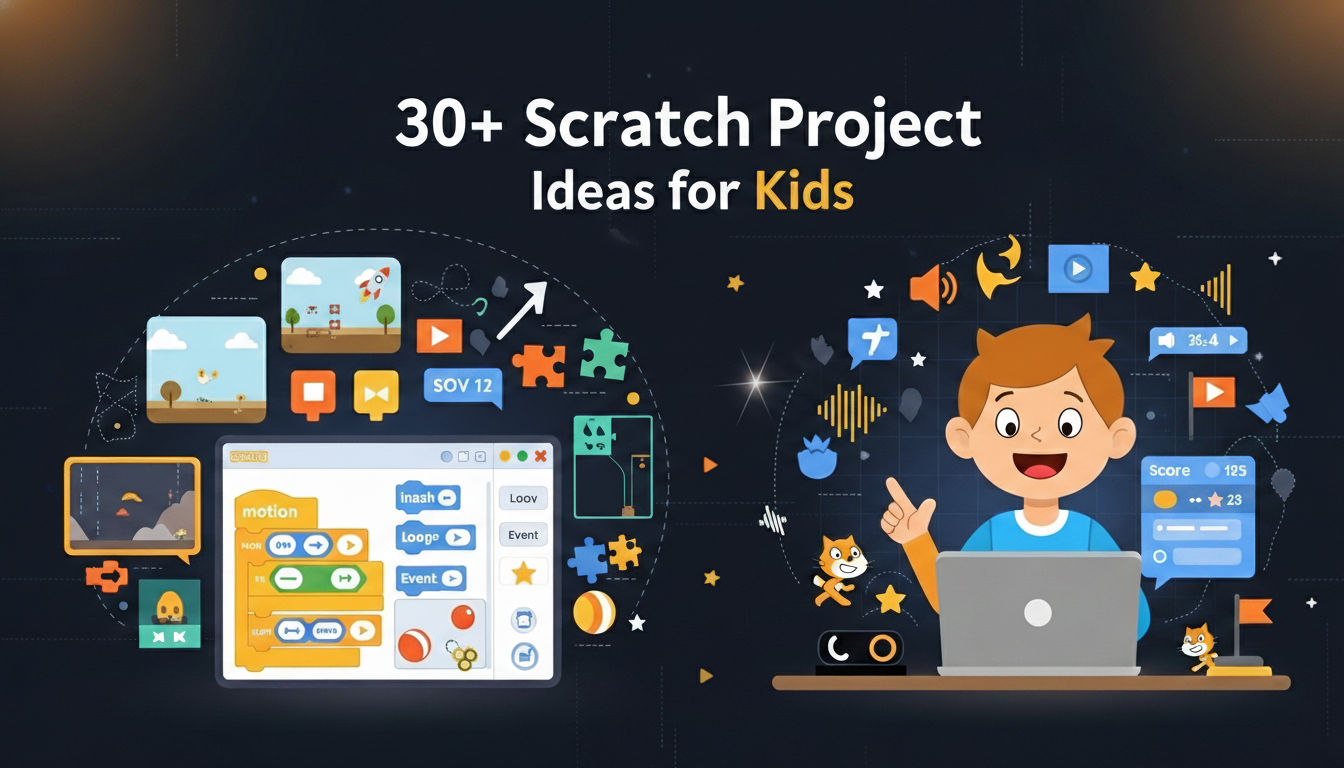
Here are 30+ Scratch project ideas for kids, sorted by level: simple starter projects for a first-time coder, intermediate game ideas for a child with a few months of Scratch, and advanced projects for 10 to 12 year olds and up. Every project says what it teaches, how long it takes and how to build it step by step, so "what should I make next?" has an answer.
Whether your child is a complete beginner, an intermediate coder ready for a real game, or an advanced Scratch user who has outgrown tutorials, start from the table below, build the project as written, then make it theirs with the ideas at the end of each one.
| Level | Typical age | Projects | Time each | What it needs |
|---|---|---|---|---|
| Starter | 6 to 8, or any first-time coder | 1 to 8: dancing sprite, greeting card, catching game, virtual pet, story, spiral, quiz, race | 30 minutes to 2 hours | Motion, looks, events, simple loops |
| Intermediate | 8 to 10, or 3 to 6 months of Scratch | 9 to 16: maze, platformer, quiz with scoring, paint program, whack-a-mole, music sequencer, Pong, Snake | 2 to 4 hours over a few sessions | Variables, conditionals, collisions, broadcasts |
| Advanced | 10 to 12 and up, or 6+ months of Scratch | 17 to 23: Flappy Bird, RPG, chatbot, calculator, Breakout, traffic simulation, two-player game | 4 to 8 hours or more | Clones, lists, maths, planning on paper first |
| Creative and educational | Any level | 24 to 35: generative art, animated story, music visualiser, maths game, typing test, geography quiz, solar system, Tic-Tac-Toe with AI, memory game, endless runner, tower defence, weather | Varies | Pick by interest, then by the blocks it needs |
Beginner Scratch Projects (Ages 6-8 or First-Time Coders)
Project 1: Dancing Sprite Animation
What it is: Create a character that dances across the stage with movement and costume changes set to music.
What they'll learn: Basic movement blocks, costume changes, simple loops
Time needed: 30-45 minutes
How to create it:
- Choose a character sprite from the library
- Go to Costumes tab and ensure your sprite has multiple costumes
- Use "glide to x: y:" blocks to move the character around
- Add "next costume" block inside a forever loop for dancing effect
- Include "turn 15 degrees" blocks for spinning moves
- Add music from Sounds library with "play sound until done"
Make it yours: Create custom costumes, choreograph specific dance sequences, add multiple dancers that interact.
Project 2: Interactive Greeting Card
What it is: Design a digital card where clicking different elements triggers messages, sounds, and animations.
What they'll learn: Click events, speech bubbles, background changes
Time needed: 30-60 minutes
How to create it:
- Choose backdrop matching your occasion (birthday, holiday)
- Add sprites for characters, decorations, or objects
- Use "when this sprite clicked" blocks to trigger actions
- Add "say [message] for 2 seconds" blocks for interactive messages
- Use "broadcast [message]" to make multiple sprites react together
- Include sound effects when sprites are clicked
Make it yours: Personalize messages, add hidden surprises that appear, create animations on clicks.
Project 3: Simple Catching Game
What it is: Control a basket to catch falling objects and earn points before they hit the ground.
What they'll learn: Variables for scoring, collision detection, random positioning
Time needed: 1-2 hours
How to create it:
- Create "score" variable (click Variables, Make a Variable)
- Make falling object sprite that starts at top with random x position
- Add "change y by -5" in forever loop to make it fall
- When y < -180 (bottom), reset: "go to x: (pick random -200 to 200) y: 180"
- Create basket sprite controlled by arrow keys: "when [right arrow] pressed, change x by 10"
- Use "if touching [basket]" to detect catches, "change score by 1" and reset object position
- Show score variable on screen
Make it yours: Add different objects worth different points, increase falling speed over time, add lives system.
Project 4: Virtual Pet
What it is: Care for a digital pet by feeding, playing, and monitoring its happiness and hunger levels.
What they'll learn: Multiple variables, conditionals for responses, simple AI
Time needed: 1-2 hours
How to create it:
- Create variables "hunger" and "happiness" (set to 50 at start)
- Choose pet sprite with different costumes for emotions
- Forever loop slowly decreases both variables: "change hunger by -0.5, wait 1 second"
- Create button sprites labeled "Feed," "Play," "Sleep"
- When "Feed" clicked: "change hunger by 20"
- Use "if hunger < 30" then "switch costume to sad" for visual feedback
- Add speech bubbles: "if hunger < 20, say I'm hungry!"
Make it yours: Add energy or cleanliness stats, create mini-games for playing, age your pet over time.
Project 5: Story Sequencer
What it is: Tell an interactive story that progresses through scenes with characters and dialogue.
What they'll learn: Scene transitions, broadcasting messages, timing control
Time needed: 1-2 hours
How to create it:
- Plan 3-5 scene story on paper first
- Create backdrops for each scene in Backdrop editor
- Add character sprites with "hide" blocks initially
- Use "when backdrop switches to [Scene1]" to trigger appearances
- Characters use "say" blocks for dialogue
- Add "wait" blocks to control timing between dialogue
- Create "Next" button that broadcasts "next scene" message
- Each backdrop responds to broadcast with "next backdrop"
Make it yours: Create branching stories with choice buttons, add sound effects, make clickable objects in scenes.
Project 6: Color Changing Spiral
What it is: Draw beautiful mathematical spirals that change colors as they grow across the screen.
What they'll learn: Pen tool extension, loops, color variables
Time needed: 45 minutes
How to create it:
- Add Pen extension (bottom left corner)
- Create sprite (can hide it with "hide" block)
- Use "erase all" to clear stage
- Add "pen down" to start drawing
- "repeat 360": "move 5 steps, turn 5 degrees, change pen color by 2"
- Experiment with different numbers for unique patterns
Make it yours: Try different turn angles for shapes, add keyboard controls for pen color, create multiple spirals.
Project 7: Name Quiz
What it is: Interactive quiz that asks questions and gives personalized responses based on answers.
What they'll learn: Asking for input, comparing strings, conditional feedback
Time needed: 30-45 minutes
How to create it:
- Use "ask [What's your name?] and wait" block
- Create response: "say (join [Hello ] and (answer))"
- Ask quiz questions: "ask [What is 5+3?] and wait"
- Check answer: "if (answer) = 8 then say Correct! else say Try again!"
- Create "score" variable to track correct answers
- Show final score at end
Make it yours: Create subject-specific quizzes (math, geography), add difficulty levels, give hints.
Project 8: Race Game
What it is: Race against the computer to reach the finish line first using keyboard controls.
What they'll learn: Keyboard controls, random movement for AI, win conditions
Time needed: 1 hour
How to create it:
- Create two car sprites at left side of stage
- Player car: "when [up arrow] pressed, change y by 5"
- Computer car in forever loop: "move (pick random 1 to 5) steps, wait 0.1 seconds"
- Detect finish: "if x position > 220 then broadcast [Race Over]"
- Create announcement sprite: "when I receive [Race Over], show, say Winner!"
Make it yours: Add obstacles, power-ups that boost speed, multiple lanes, countdown timer.
Intermediate Scratch Projects (Ages 8-10 or 3-6 Months Experience)
Project 9: Maze Game
What it is: Navigate a character through increasingly difficult mazes without touching the walls.
What they'll learn: Color collision detection, coordinate movement, level progression
Time needed: 2-3 hours
How to create it:
- Backdrop editor: draw maze walls in one bright color (blue)
- Create player sprite at maze entrance
- Arrow key controls: "when [right arrow] pressed, change x by 5"
- Wall detection: "if touching color [blue], change x by -5" (bounce back)
- Goal sprite at maze exit
- Win detection: "if touching [goal], broadcast [Level Complete], next backdrop"
- Design 3-5 backdrop mazes with increasing difficulty
Make it yours: Add patrolling enemies, collectible keys for doors, timer challenges, moving walls.
Project 10: Platformer Game
What it is: Jump across platforms, avoid enemies, and collect items in a side-scrolling adventure.
What they'll learn: Gravity simulation, jumping physics, platform collision
Time needed: 3-4 hours
How to create it:
- Create "Y-velocity" variable
- Forever loop gravity: "change Y-velocity by -1, change y by (Y-velocity)"
- Platform detection: "if touching color [green], set Y-velocity to 0"
- Jump: "when [space] pressed, if on platform, set Y-velocity to 15"
- Left/right movement: "when [arrow] pressed, change x by 5"
- Enemy sprite with basic patrol movement
- Lives system: "if touching [enemy], change lives by -1"
Make it yours: Add double-jump, collectible coins, moving platforms, boss battles.
Project 11: Quiz Game with Scoring
What it is: Multiple-choice quiz that tracks correct answers and shows final percentage score.
What they'll learn: Lists for data storage, string operations, calculations
Time needed: 2-3 hours
How to create it:
- Create lists: "Questions" and "Answers"
- Add 10 questions to Questions list, corresponding answers to Answers list
- Create variables: "score," "question number" (starts at 1)
- Loop through questions: "ask item (question number) of [Questions]"
- Check answer: "if (answer) = item (question number) of [Answers], change score by 1"
- Increment: "change question number by 1"
- Calculate percentage: "set result to ((score) / (length of Questions)) * 100"
- Display final score with encouraging message
Make it yours: Add timer per question, categories, difficulty levels, visual feedback for right/wrong.
Project 12: Drawing/Paint Program
What it is: Create digital art with different brush colors, sizes, and tools like an eraser.
What they'll learn: Mouse tracking, pen tool mastery, variable-controlled settings
Time needed: 2-3 hours
How to create it:
- Add Pen extension
- Create drawing sprite: forever loop "go to mouse pointer"
- Pen control: "if mouse down?, pen down, else pen up"
- Create color picker sprites (red, blue, green circles)
- When color clicked: "set pen color to [red value]"
- Size slider: create slider sprite, "set pen size to (x position) of slider"
- Eraser button: "set pen color to [backdrop color]"
- Clear button: "when clicked, erase all"
Make it yours: Add stamp tool, shape tools (circles, squares), save/load feature, fill bucket.
Project 13: Whack-a-Mole
What it is: Click appearing moles before they disappear to score points in timed gameplay.
What they'll learn: Cloning sprites, random timing, click detection
Time needed: 2-3 hours
How to create it:
- Create mole sprite and 6 hole sprites positioned across stage
- Mole clone spawning: "repeat 10: create clone of [mole], wait (pick random 1 to 3) secs"
- When clone starts: "go to (pick random hole position), show, wait 2 secs, hide, delete clone"
- Click detection: "when this sprite clicked, if visible, change score by 1, hide"
- Timer: "set time to 30, repeat until time = 0: wait 1 sec, change time by -1"
- End game: "broadcast [Game Over], stop all"
Make it yours: Add different mole types worth different points, increase speed over time, bonus rounds.
Project 14: Music Sequencer
What it is: Create music by clicking buttons that play different notes and record sequences.
What they'll learn: Sound blocks, timing loops, list for recording
Time needed: 2-3 hours
How to create it:
- Add Music extension
- Create 8 button sprites for different notes
- Each button plays note when clicked: "play note (60) for 0.5 beats"
- Record mode: create "recording" list
- When recording and button clicked: "add [note] to recording"
- Playback button: "repeat length of [recording]: play item (counter) for 0.5 beats"
- Clear button to reset recording
Make it yours: Add drum sounds, volume controls, save multiple recordings, export options.
Project 15: Pong Game
What it is: Classic two-player game where paddles hit a bouncing ball back and forth.
What they'll learn: Bounce physics, angle calculations, two-player controls
Time needed: 2-3 hours
How to create it:
- Ball sprite starts center, random direction: "point in direction (pick random -45 to 45)"
- Forever loop: "move 10 steps"
- Wall bounce: "if touching edge, turn 180 degrees"
- Paddle bounce: "if touching [paddle], point in direction (180 - direction)"
- Two paddles: Player 1 uses W/S keys, Player 2 uses up/down arrows
- Score zones: "if x < -230, change Player2 score by 1, reset ball"
- Win condition: "if score = 5, broadcast [Winner]"
Make it yours: Add speed increase each hit, power-ups, obstacles in middle, AI opponent.
Project 16: Snake Game
What it is: Control a growing snake that eats food while avoiding walls and its own tail.
What they'll learn: List-based movement, self-collision, growth mechanics
Time needed: 4 hours
How to create it:
- Create lists "Snake X" and "Snake Y" for body positions
- Add starting position to both lists
- Arrow key controls change direction variable
- Move: add new head position to front of lists, remove last item (unless food eaten)
- Food sprite at random position
- If snake head touches food: don't remove tail (grows), move food, add score
- Collision detection: if head touches body coordinates or edge, game over
Make it yours: Add speed levels, obstacles, different food types, multiplayer mode.
Advanced Scratch Projects (Ages 10 to 12 and Up, or 6+ Months Experience)
Project 17: Flappy Bird Clone
What it is: Guide a bird through gaps in pipes by tapping to flap upward against gravity.
What they'll learn: Continuous scrolling, gravity physics, procedural generation
Time needed: 3-4 hours
How to create it:
- Bird sprite with Y-velocity variable
- Forever: "change Y-velocity by -0.5 (gravity), change y by Y-velocity"
- Flap: "when space pressed, set Y-velocity to 8"
- Pipe clones spawn regularly with random gap positions
- Pipes move left continuously
- Collision: "if touching [pipe] or y < -170, game over"
- Score increases as pipes pass bird's x position
Make it yours: Add different obstacles, power-ups, day/night cycle, difficulty modes.
Project 18: RPG Adventure Game
What it is: Explore a world, collect items, battle enemies, and complete quests across multiple areas.
What they'll learn: Inventory systems, character stats, complex variables
Time needed: 6-8 hours
How to create it:
- Multiple backdrop scenes for different areas
- Lists for inventory items
- Variables: health, coins, experience
- Arrow key movement with backdrop transitions at edges
- Enemy sprites with health bars
- Battle system: "when touching enemy, broadcast [Battle], compare attack values"
- Items add to inventory when collected
- Shop system to spend coins
Make it yours: Add character leveling, skill trees, puzzle rooms, boss battles, story dialogue.
Project 19: Chatbot
What it is: Conversational AI that responds to questions with programmed answers and learning capability.
What they'll learn: String manipulation, pattern matching, AI basics
Time needed: 3-4 hours
How to create it:
- Ask: "What would you like to talk about?"
- Create lists for keywords and responses
- Check if answer contains keywords: "if (answer) contains [hello], say Hi there!"
- Default response for unknown inputs
- Learn feature: "add (answer) to [Learned Phrases] list"
- Context tracking with variables for last topic discussed
Make it yours: Add personality, emotions based on conversation, remember user preferences, topic categories.
Project 20: Calculator
What it is: Functional calculator with number buttons and operations that displays results.
What they'll learn: User input handling, mathematical operations, string-to-number conversion
Time needed: 2-3 hours
How to create it:
- Create 10 number button sprites (0-9)
- Create operation buttons (+, -, ×, ÷, =)
- Variables: "display," "stored number," "operation"
- Number clicked: "set display to (join (display) and [clicked number])"
- Operation clicked: "set stored number to (display), set operation to [+]"
- Equals clicked: perform calculation based on operation variable
- Display result on screen sprite
Make it yours: Add decimal point, clear button, memory functions, scientific operations.
Project 21: Breakout/Brick Breaker
What it is: Bounce a ball off a paddle to break bricks and clear levels.
What they'll learn: Ball physics, clone management, level design
Time needed: 3-4 hours
How to create it:
- Paddle follows mouse x position
- Ball bounces: "if touching [paddle], point in direction (180 - direction)"
- Create brick clones in grid formation at start
- Each brick: "when I start as clone, if touched by ball, change score by 10, delete clone"
- Ball speed increases slightly each paddle hit
- Lives system if ball reaches bottom
- Level complete when all bricks destroyed, load next brick pattern
Make it yours: Add power-ups (bigger paddle, multi-ball), unbreakable bricks, boss levels.
Project 22: Traffic Simulation
What it is: Simulate traffic flow with cars following rules, stopping at lights, and avoiding collisions.
What they'll learn: Complex systems, multiple agent behavior, emergent patterns
Time needed: 4-5 hours
How to create it:
- Create car clones spawning at regular intervals
- Each car moves forward continuously
- If touching car ahead: stop and wait
- Traffic light changes color on timer
- Cars stop at red light using color detection
- Turn lanes with direction-based movement
- Track statistics: cars passed, average speed
Make it yours: Add pedestrians, accidents with consequences, rush hour patterns, road conditions.
Project 23: Multiplayer Game (Same Computer)
What it is: Two players compete or cooperate using different keyboard controls on one computer.
What they'll learn: Dual input handling, shared game space logic
Time needed: 3-4 hours
How to create it:
- Player 1 sprite controlled by WASD keys
- Player 2 sprite controlled by arrow keys
- Both interact with same game elements
- Separate score/health variables for each player
- Collision between players triggers specific events
- Either competitive (race, battle) or cooperative (puzzle solving together)
- Win conditions for one or both players
Make it yours: Add character abilities, team challenges, special moves, split-screen view attempts.
Creative & Artistic Scratch Projects
Project 24: Generative Art
What it is: Code creates unique, random art patterns each time it runs.
What they'll learn: Pen tool mastery, random numbers, mathematical patterns
Time needed: 2 hours
How to create it:
- Use pen extension with random colors
- Create loops with random: "repeat 100: move (pick random 10 to 50) steps"
- Turn random angles, change sizes randomly
- Layer multiple shapes with transparency
- Create fractals with simple recursion concepts
Make it yours: Add user controls for complexity, save favorite patterns, animation over time.
Project 25: Animated Story
What it is: Multi-scene narrative with character dialogue, sound effects, and cinematic transitions.
What they'll learn: Story structure, timing, multimedia integration
Time needed: 4-6 hours
How to create it:
- Plan story arc with beginning, middle, end
- Create custom character sprites and backdrops
- Dialogue system with text bubbles and timing
- Scene transitions with fades or effects
- Background music and sound effects sync to action
- Optional: branching choices affect outcome
Make it yours: Record custom sounds, create original artwork, add Easter eggs.
Project 26: Music Visualizer
What it is: Graphics react and dance to music beats with colors and patterns.
What they'll learn: Sound-reactive programming, visual effects
Time needed: 2-3 hours
How to create it:
- Import or record music
- Create sprites that respond to sound timing
- Use clones for multiple visual elements
- Color changes sync to music beats
- Size and position changes create movement
- Pen tool draws trails and patterns
Make it yours: Add different visualization modes, user controls, record performances.
Educational Scratch Projects
Project 27: Math Practice Game
What it is: Generate random math problems, check answers, track progress and reward correct responses.
What they'll learn: Random number generation, answer validation, difficulty scaling
Time needed: 2 hours
How to create it:
- Variables: "number1," "number2," "correct answer," "score"
- Generate problem: "set number1 to (pick random 1 to 10)"
- Ask: "What is (number1) + (number2)?"
- Check: "if (answer) = (correct answer), change score by 1, say Correct!"
- Difficulty increases: after 5 correct, increase number range
- Show progress with visual feedback
Make it yours: Add multiple operations, timed challenges, achievement badges, leaderboard.
Project 28: Typing Speed Test
What it is: Display words/sentences for user to type, measuring speed and accuracy.
What they'll learn: Input comparison, timing, calculations
Time needed: 2-3 hours
How to create it:
- Create list of words or sentences
- Timer starts when first key pressed
- Display random item from list
- Compare typed input to displayed text
- Track: characters typed, errors made, time elapsed
- Calculate WPM: (characters / 5) / (time in minutes)
- Show accuracy percentage
Make it yours: Add difficulty levels, high score tracking, lessons for improvement.
Project 29: Geography Quiz
What it is: Interactive map where clicking countries/capitals tests knowledge with scoring.
What they'll learn: Coordinate detection, educational content creation
Time needed: 3 hours
How to create it:
- Import or draw world map as backdrop
- Create clickable region sprites over countries
- Ask: "Click on [Japan]"
- Detect clicks: "when this sprite clicked, if (country) = (correct answer), correct!"
- Track score and wrong answers
- Different modes: find country, name capital, match flags
Make it yours: Add hints, zoom features, continent categories, timed challenges.
Project 30: Solar System Simulator
What it is: Planets orbit the sun at different speeds with accurate relative motion.
What they'll learn: Circular motion, orbital mechanics, scale
Time needed: 3 hours
How to create it:
- Sun sprite at center
- Planet sprites at different distances
- Each planet rotates around sun: "turn 5 degrees, move to next position on circle"
- Different speeds for each planet (Mercury fast, Neptune slow)
- Click planets for facts
- Optional: accurate orbital paths using trigonometry
The maths behind a circular orbit is trigonometry: a planet at angle a on a circle of radius r sits at x = r times cos a and y = r times sin a. Older students can learn where those ratios come from in our beginner's guide to SOH CAH TOA.
Make it yours: Add moons, asteroid belt, zoom controls, time speed options.
Project 31: Tic-Tac-Toe with AI
What it is: Classic game where you play against a computer opponent that makes strategic moves.
What they'll learn: Game logic, AI decision-making, win condition checking
Time needed: 3-4 hours
How to create it:
- Create 9 position sprites for grid
- Track board state with list (9 items: empty, X, or O)
- Player clicks empty position to place X
- Computer AI checks: win moves first, block player wins second, random move otherwise
- Check win conditions after each move (rows, columns, diagonals)
- Detect draw when all positions filled
Make it yours: Add difficulty levels, score tracking, two-player mode, animations for wins.
Project 32: Memory Matching Game
What it is: Flip cards to find matching pairs, testing memory with time and move tracking.
What they'll learn: Clone management, list shuffling, matching logic
Time needed: 2-3 hours
How to create it:
- Create card sprite with different costumes for card backs and faces
- Generate pairs of matching cards using clones
- Shuffle positions randomly
- Click to flip: show costume for 2 seconds
- If two cards flipped match: keep revealed
- If don't match: flip back after showing
- Track moves and time
Make it yours: Add difficulty levels (more cards), themes, high score system, sound effects.
Project 33: Endless Runner
What it is: Character runs automatically, player jumps over obstacles that spawn infinitely.
What they'll learn: Scrolling backgrounds, obstacle generation, increasing difficulty
Time needed: 3-4 hours
How to create it:
- Character sprite auto-runs in place
- Ground and background scroll left continuously
- Obstacles spawn at right edge with random timing
- Jump mechanics: space bar adds upward velocity
- Collision with obstacle: game over
- Score increases continuously (distance traveled)
- Speed gradually increases over time
Make it yours: Add power-ups, different obstacle types, day/night cycle, character abilities.
Project 34: Tower Defense Game
What it is: Place defensive towers to stop enemies from reaching the end of a path.
What they'll learn: Pathfinding basics, multiple enemy management, resource systems
Time needed: 5-6 hours
How to create it:
- Draw path on backdrop that enemies follow
- Enemy clones spawn and follow path coordinates
- Click to place tower sprites (costs coins)
- Towers detect enemies in range and shoot
- Enemies have health, reduce when hit
- Enemy reaching end reduces player lives
- Earn coins when enemies defeated
Make it yours: Add tower upgrades, different enemy types, multiple paths, boss waves.
Project 35: Weather Simulator
What it is: Interactive simulation showing different weather conditions with controls for changes.
What they'll learn: Visual effects, particle systems, environmental simulation
Time needed: 2-3 hours
How to create it:
- Create buttons for weather types: sunny, rainy, snowy, stormy
- Rain: clone drops falling from top
- Snow: slower falling clones that drift side-to-side
- Storm: flashing backdrop with lightning, thunder sounds
- Sun: bright backdrop with moving sun sprite
- Temperature display changes with weather
- Wind effects move clouds across screen
Make it yours: Add seasonal changes, weather transitions, forecast predictions, climate data.
How these projects are taught in a live Scratch class
Every project on this list is one a child can build alone. In our live Scratch course, Scratch Coding for Kids, they build them with a mentor: ages 6 to 12, 3-4 months, 12-16 weeks, a batch of 5 to 10 children, two live classes a week, and a finished game or story at the end of every module.
The difference is not the projects, it is the feedback: a mentor who sees the child's blocks, asks "what happens if the sprite touches the edge?" and lets them find the answer. You can watch that for yourself in a free demo, or book a Priority Live Demo, a full class of about 45 to 60 minutes today or tomorrow.
Tips for Successfully Completing Scratch Projects
Plan before coding: Sketch your project on paper. List features you want. Break into small steps. Start with simplest version, add complexity later.
Start simple, build up: Get basic version working first. Test frequently as you add each feature. Don't try implementing everything at once.
Debug systematically: Test after adding each block. Use "say" blocks to check variable values. Break complex code into testable parts. Compare to working examples when stuck.
Learn from others: Remix projects to understand mechanics. Look inside featured projects for techniques. Ask Scratch community for help. Watch tutorials for specific features.
Understanding problem-solving and computational thinking helps kids approach projects more effectively, breaking challenges into manageable steps.
How Parents Can Support Scratch Project Work
Be available without hovering: Stay nearby if needed but don't watch constantly. Let them struggle productively before helping. Encourage problem-solving attempts first.
Ask guiding questions: "What are you trying to make happen?" "What have you tried so far?" "How could you test that part?" These prompt thinking without giving answers.
Celebrate milestones: Acknowledge completed projects, creative solutions, persistence through challenges, and improvement from previous work.
Encourage sharing: Show projects to family members. Share on Scratch platform for community feedback. Create portfolio documenting progress. Family coding nights where everyone shares creations.
Taking Scratch Projects Further
Share on Scratch platform: Publish projects for global community to see and play. Receive comments, feedback, and suggestions. Learn from viewer questions about how things work.
Create variations and series: Build multiple versions tweaking mechanics. Challenge yourself with constraints (make it in 50 blocks or less). Create series of related projects building on each other.
Document your work: Write project descriptions explaining what you made. Include instructions for players. Credit any resources used. Note what you learned for future reference.
Transition to text-based coding: When Scratch feels limiting, explore Python or JavaScript. Scratch concepts transfer directly, loops, variables, conditionals work the same. Many tutorials help make this transition smoothly.
For kids ready to explore beyond Scratch, learning about robotics, coding, and STEM kits provides hands-on experiences that complement screen-based programming.
Frequently Asked Questions
Start with simple animations like dancing sprites or greeting cards that teach basic sequencing, events, and loops without overwhelming complexity. Progress to catching games or virtual pets that introduce variables and conditionals. Avoid starting with complex games like platformers, master fundamentals through projects completable in one or two sessions first.
Beginner projects: 30 minutes to 2 hours. Intermediate projects: 2-4 hours over multiple sessions. Advanced projects: 4-8+ hours. Time varies by skill level, project complexity, and customization added. Breaking multi-hour projects into several sessions prevents fatigue and allows ideas to develop between sessions.
Yes, but tutorials teach mechanics first. Follow 2-3 tutorials to learn basics, then modify tutorials significantly to make them unique, finally create original projects using learned concepts. Most kids start combining ideas from multiple tutorials before creating fully original work. This guided-to-independent progression is natural and effective.
Beginner projects use basic sequencing, simple loops, and few variables. Advanced projects involve multiple sprites interacting, complex conditionals, lists, cloning, mathematical calculations, and sophisticated mechanics. Advanced projects require planning, systematic debugging, and combining multiple concepts simultaneously. Progression from beginner to advanced typically takes 6-12 months of consistent practice.
At 12, go straight to the advanced list: the Flappy Bird clone, the RPG adventure, the chatbot, the calculator, Breakout and Tic-Tac-Toe with a computer opponent. Each needs clones, lists or maths, which is what a 12 year old is ready for. When Scratch starts to feel limiting, that is the signal to begin Python.
Scratch first for children under about 11, because it removes typing and syntax and lets them learn loops, conditionals and variables by building games. From 11 to 13, move to Python; the concepts transfer directly. A 12 or 13 year old who has never coded and types comfortably can start with Python.
Modern Age Coders runs a live Scratch course for ages 6 to 12: 3-4 months, 12-16 weeks, batches of 5 to 10, every child building the projects on this list with a mentor. You can watch a free demo first, or book a Priority Live Demo, a full class of about 45 to 60 minutes, today or tomorrow.
Final Thoughts
These 30+ Scratch project ideas provide a complete roadmap from simple animations to complex games and applications. The key is matching projects to current skill level while gently pushing boundaries to build new capabilities.
Project-based learning proves more effective than passive tutorials because kids apply concepts in context, solve real problems, and create work they're proud to share.
Start with beginner projects even if your child has coding experience elsewhere: Scratch's unique blocks and features take time to master. Progress to intermediate and advanced projects as skills develop, always prioritizing completed projects over partially-built complex ones.
Remember that every programmer once created their first simple animation. Each project builds skills, confidence, and problem-solving abilities that transfer beyond Scratch. Encourage experimentation, celebrate creativity, and keep the focus on learning through building.
Related Posts
Minecraft vs Roblox: Which Teaches Kids to Code? Compare game-based coding platforms and discover which environment best supports your child's programming journey beyond Scratch.
Why Coding Is the New Literacy for Kids in 2025 Understand why programming skills are becoming as fundamental as reading and writing for children's future success.
Parents' Guide to Starting Coding Education at Home Practical strategies for supporting your child's coding journey from first projects through advanced programming skills.
Once Your Child Outgrows Scratch: Try These Programs
- Python & AI Classes for Kids and Teens: The natural next step after Scratch. Live online programs for ages 8 to 18, project-based.
- Coding Classes for Girls: Princess & Queen Coders inclusive batches with female mentors and a supportive learning environment.
- Java Programming for Kids & Teens: Master Java step by step from variables to OOP and real apps.
- AI & Machine Learning Course for Teens: Build chatbots, image recognition systems, and real AI projects.