Where can a Toronto student get a real math tutor?
Modern Age Coders gives Toronto students live online math tutoring from Grade 1 to Grade 12, one to one or in a class of fifteen to twenty at one level. Teens usually join Ontario Grade 12 University Math (MHF4U and MCV4U) or Waterloo Math Contests: Gauss to Euclid; younger children join a maths course for their age. The first class is free.
A drop in a math mark usually has a cause older than the test that revealed it. A Grade 11 student stuck on transformations is often missing a Grade 9 idea about slope; a Grade 4 child who freezes on word problems may simply never have been asked to explain a step aloud. This page walks through Ontario math the way a Toronto student meets it, sends you to our detailed page for each course code, and then does something a tutoring advert rarely does: it teaches a full lesson. We take a City of Toronto file of ferry ticket counts and use it to show why the average of a lopsided set of numbers can mislead, which is the heart of Grade 12 data management and a skill every adult needs.
Facts last verified 22 October 2026. Teaching is online; no Toronto branch is claimed.
Chosen by grade band, then confirmed in a free lesson where the teacher sees how the student actually reasons.

Number sense, fractions and patterns taught by asking the child to explain each step, the habit the Grade 3 and Grade 6 assessments reward.
See the syllabus
Ratios, integers, equations and early geometry, so a Toronto student walks into de-streamed Grade 9 math with algebra already familiar.
See the syllabus
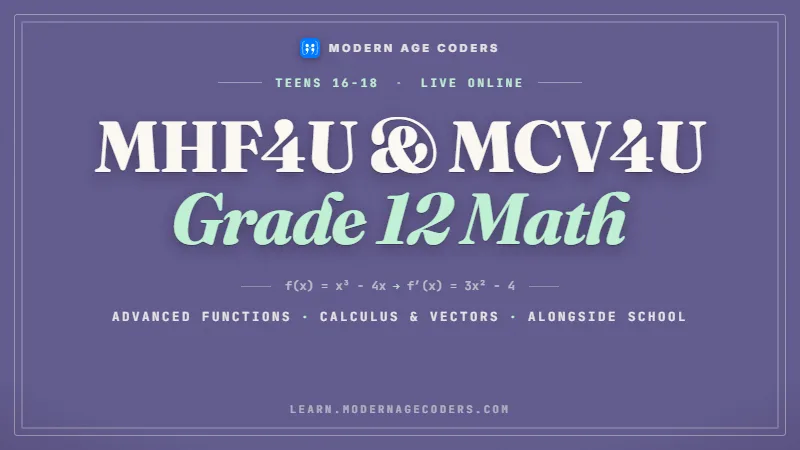
Advanced Functions and Calculus and Vectors taught alongside the school course. It does not grant an Ontario credit; the school does.
See the syllabus
Problem solving for the CEMC contests, from Gauss to Euclid, using original problems and the free CEMC archive.
See the syllabusBrowse the course atlas for more than one hundred options and use the coding roadmap to check prerequisites.
The four we are known for
These run underneath everything above. Every one is live and online, placed by ability rather than by age, and the first class is free.

Python, web and AI projects where the learner still owns the thinking.
See the syllabus
Automate the work you already do, then let AI carry part of it.
See the syllabus
Train a model, read what it learned, and be able to say why it is wrong.
See the syllabus
Run AI coding agents on real work without losing control of the codebase.
See the syllabusEvery Toronto public school teaches the Ontario curriculum, so the course codes are the same from Etobicoke to Scarborough. Each row sends you to a page that goes deep on one stage; this page stays with the Toronto picture.
| Grade band | What the student is taking | Read more |
|---|---|---|
| Grades 1 to 3 | Elementary math, then the EQAO Primary assessment, listed for 4 May to 8 June 2027 | Grade 3 practice |
| Grades 4 to 6 | Fractions, ratios, coding inside the Algebra strand, and the Junior assessment in the same 2027 window | Grade 6 practice, Grade 6 math and coding |
| Grade 9 | MTH1W, the de-streamed course issued in 2021, with the EQAO assessment from 12 January to 5 February 2027 | MTH1W explained, Grade 9 practice |
| Grade 11 | MCR3U Functions, which needs Grade 10 academic math first, or MCF3M Functions and Applications | MCR3U, MCF3M or MCR3U |
| Grade 12 | MHF4U Advanced Functions, MCV4U Calculus and Vectors, MDM4U Mathematics of Data Management | MHF4U, MCV4U, MDM4U |
Two rules in the course records shape a Toronto timetable more than any tutor can. MCR3U lists the Grade 10 academic course as its prerequisite, and the ministry says MHF4U must be taken before or at the same time as MCV4U. A student who wants calculus in Grade 12 therefore needs functions secured in Grade 11, and a weak Grade 11 term shows up again a year later. That is why our first question to a Toronto family is about the course before the one the student is in now.
MDM4U, the data management course, is easy to overlook, and it is the one this page leans on most. It is where students meet distributions, measures of centre and spread, and the habit of asking where a number came from. The ferry lesson below is a taste of that course, taught at a level a strong Grade 9 student can follow.
We teach alongside a student's school math course and we do not grant Ontario credits. Marks and credits for MCR3U, MHF4U, MCV4U, MDM4U and every other course come from the school. We are not connected with the Ontario Ministry of Education, EQAO or any Toronto school board.
The City of Toronto publishes ticket counts for the Island ferries as open data. We took every 2025 row, added up each day ourselves, and found a mean far above the median. The figures are our calculations from the City's file, not numbers the City publishes.
The dataset is called Toronto Island Ferry Ticket Counts, kept by the City's Fleet Services division. Its description says the counts are provided in 15 minute intervals and are updated hourly, and that the ferries operate year-round out of Jack Layton Ferry Terminal. Our download on 22 October 2026 held 284,387 rows, starting on 1 May 2015, each with a timestamp, a redemption count and a sales count. We used only redemptions, which are tickets used to board, and only calendar year 2025.
| Month of 2025 | Days with data | Mean per day | Median per day | Highest day |
|---|---|---|---|---|
| January | 30 | 571.0 | 586.5 | 829 |
| March | 31 | 877.6 | 838 | 1,518 |
| May | 31 | 3,769.5 | 3,180 | 12,436 |
| June | 30 | 7,992.2 | 5,947.5 | 18,242 |
| July | 31 | 11,784.0 | 10,124 | 24,341 |
| August | 31 | 12,283.3 | 12,020 | 21,160 |
| September | 30 | 5,555.7 | 4,384.5 | 19,598 |
| November | 30 | 983.2 | 874 | 2,288 |
| All of 2025 | 364 | 4,191.9 | 1,690 | 24,341 |
Look at the bottom row. The mean day in 2025 saw 4,191.9 redemptions, yet the median day saw only 1,690. Only 121 of the 364 days were above the mean at all, while 139 days had fewer than 1,000 redemptions. A short run of enormous summer days, 47 of them above 10,000, drags the mean upward. The median ignores how large those days were and simply finds the middle of the sorted list, so it describes an ordinary Toronto day far better.
The short program below reproduces our yearly figures. It reads the file line by line, keeps 2025, adds the 15-minute counts into one total per date, and prints the count of days, the mean, the median and the busiest date. It needs only Python 3 and the CSV in the same folder:import statistics
from collections import defaultdict
day_total = defaultdict(int)
with open("toronto-island-ferry-ticket-counts.csv", encoding="utf-8") as file:
next(file) # the first line holds the column names
for line in file:
_id, stamp, redeemed, sold = line.strip().split(",")
if stamp.startswith("2025-"):
day_total[stamp[:10]] += int(redeemed)
values = sorted(day_total.values())
print("days:", len(values))
print("mean:", round(statistics.mean(values), 1))
print("median:", statistics.median(values))
print("busiest:", max(day_total, key=day_total.get), values[-1])
Our lower quartile was 712.25 and our upper quartile 5,885.5. The gap from the median up to the upper quartile is more than four times the gap down to the lower quartile, the numerical signature of a right-skewed distribution.
In July 2025 the 23 weekdays averaged 9,881.9 redemptions and the 8 weekend days averaged 17,252.5. A student who reports one July average for the whole month has blended two different populations into one number.
The file has rows for 364 dates in 2025, not 365: nothing is dated 26 January. Before computing anything, a careful student decides whether that day was quiet, closed or simply missing, and says which assumption the answer depends on.
Contains information licensed under the Open Government Licence - Toronto. The file is used under that licence (licence, dataset page); every sum, mean and median on this page is ours. The City of Toronto does not endorse this page or our classes.
This is the kind of question we set a Toronto student after the ferry lesson. The data come from our sums for Saturday 12 July 2025, the busiest day in the 2025 file; the question and the solution are ours.
| Hour starting | Redemptions |
|---|---|
| 9:00 | 1,142 |
| 10:00 | 2,030 |
| 11:00 | 2,657 |
| 12:00 | 3,158 |
| 13:00 | 3,469 |
| 14:00 | 2,299 |
| 15:00 | 2,837 |
| 16:00 | 2,196 |
| Whole day | 24,341 |
Question. What share of the day's redemptions fell between 10:00 and 13:59? Is it fair to say that the ferry was busiest at lunchtime?
Step 1, add the four hours. 2,030 + 2,657 + 3,158 + 3,469 = 11,314 redemptions. These are four of our own hourly sums, so adding them is legitimate; we are not adding someone else's rounded figures to manufacture a total.
Step 2, divide by the day. 11,314 divided by 24,341 is about 0.465, so roughly 46.5 percent of the day's boarding happened in four of the twenty-four hours.
Step 3, test the claim. The single busiest hour began at 13:00, not at noon, and the 15:00 hour was busier than the 14:00 hour, so the pattern is not a smooth peak. A student who writes “busiest around midday, with a second rise mid-afternoon” has read the table; one who writes “busiest at lunch” has guessed. In MDM4U terms, the conclusion has to match the evidence, not the expectation.
Try it yourself. Using the table, find the mean redemptions per hour from 9:00 to 16:59 and compare it with the median of those eight hours. Which is larger, and why is the difference small here when it was huge across the whole year?
The Centre for Education in Mathematics and Computing at the University of Waterloo runs a contest for each grade. For a Toronto high school student the first of the 2027 math contests is the Pascal, Cayley and Fermat sitting.
| Contest | Who CEMC says may write it | Format | CEMC date |
|---|---|---|---|
| Pascal | Students in Grade 9 | 25 multiple-choice questions in 60 minutes | 23 or 24 February 2027 |
| Cayley | Students in Grade 10 | 25 multiple-choice questions in 60 minutes | 23 or 24 February 2027 |
| Fermat | Students in Grade 11 | 25 multiple-choice questions in 60 minutes | 23 or 24 February 2027 |
Twenty-five questions in an hour leaves under two and a half minutes each, and the later questions are written so that a direct calculation is too slow. What these contests reward is choosing a method before computing, which is the same judgement the ferry question asks for. CEMC puts it plainly on its contest pages: the contests are not tests or exams, and there is no passing or failing score.
No Toronto student can enter alone: CEMC takes entries only from schools. Where a student’s own school is not taking part, CEMC’s advice is to find another local school willing to let the student join.
CEMC keeps the last ten years of past contests free, with no registration. Real past papers come from CEMC’s own archive; our lessons use problems of our own.
Our pages on the Pascal, Cayley and Fermat go deeper, and the full ladder from Gauss to Euclid sits on our Waterloo contests page.
CEMC’s rule is that “all students must participate through their school”. We are not connected with CEMC or the University of Waterloo. We never reproduce their past problems or solutions; our contest classes use original problems, labelled as ours.
Our fees are printed in the fees section of this page, in the currency that matches where you are, so no figure appears in this text. What matters more is what the fee buys.
| Our live online class | Our 1-on-1 online | A private tutor at home | |
|---|---|---|---|
| Who is in the room | Fifteen to twenty students at one level, one teacher | One student, one teacher | One student, one tutor |
| Travel | None; join from a laptop at home | None | The tutor travels across the city, which takes time someone pays for |
| Pace | Set for the level, with questions answered live | Set entirely by the student | Set by the student |
| How it is charged | A monthly fee for eight live classes | A monthly fee, at times you choose | Usually by the hour, at the tutor's own rate |
| Good for | Steady progress through a course and contest practice | A specific gap, MCV4U, or exam weeks | Families who want someone physically at the table |
Neither format is right for everyone. A live class of fifteen to twenty works when a student is roughly on track and wants structure, practice and other students' questions to learn from. One-to-one is worth it when there is a specific hole, say logarithms in MHF4U, or when the student is far ahead. An in-home tutor solves a different problem, the wish for someone at the kitchen table, and families should weigh the travel built into that arrangement.
Whatever you choose, ask any tutor in Toronto the same three questions: which Ontario course code they are teaching to, how they check that the student understands rather than copies, and what happens in a week when the school test is on a topic they have not reached yet.
Treat the grades as rough markers. Where a student actually starts is decided in the free lesson, from the work they can explain.
Counting, place value and early patterns, with the child saying each step out loud.
Early Math FoundationsElementary Maths for Grades 1-5Fractions, ratio, integers and first equations, plus Gauss problems for children who enjoy a puzzle.
Middle School Mathematics MasteryMaths Through CodingMTH1W linear relations, then the Grade 10 academic algebra MCR3U depends on.
High School MathematicsWaterloo Math ContestsMCR3U, MHF4U, MCV4U and data management, taught beside the school course.
Ontario Grade 12 University MathStatistics & ProbabilityBecause the answer an AI gives is only as good as the question, and only a person who understands the math knows whether the question was right.
Give a chatbot the ferry file and ask for the average day, and it will happily report the mean. It will not stop to ask whether the mean is the right summary for a set of numbers that is mostly quiet winter days with a few huge summer ones. That decision is the mathematics, and it belongs to the student.
Our teachers ask students to predict before they calculate, show the step that matters, and explain the result in a sentence. Older students may check work with tools, but marked school work stays the student's own, and the thinking is never handed over.
Ontario math asks students to reason, model and communicate; those are exactly the parts a tool cannot do for them. The longer argument is in our essay on why thinking skills outlast any tool.
Lessons happen on a computer at home, so a student in North York and one in the Beaches can share a teacher without a commute.
Weekdays or weekends, flexible: choose your batch, or for a very personalised plan choose 1-on-1 at your convenience, weekend mornings or weekdays.
Toronto is on UTC-4 until 1 November 2026, then UTC-5 until 14 March 2027. Each invitation states the class in Toronto time, and we confirm again in the week of each change.
Teachers write the working on a shared screen and students write back, so the step where an error starts is visible, not hidden in a final answer.
Teachers plan from the Ontario course the student is taking, so a Grade 11 lesson follows MCR3U or MCF3M, not a generic syllabus.
The form takes a Toronto mobile on 647, 416, 437 or 942. Enter all ten digits and leave the country code to us.
The first lesson is a real lesson. It closes with a recommended course and level, and no payment card is needed.
No Toronto centre
Modern Age Coders has no tutoring centre in Toronto and claims none. Every lesson is live and online, taught from India, and a student needs a computer with a microphone and a steady connection.
Three lines, each shown in your own currency.
One complete live lesson at no charge, ending with a recommended course, level and class time.
The monthly fee for a live class of fifteen to twenty students working at the same stage.
The monthly fee for one teacher and one student, booked at times that suit you.
A Toronto student pays exactly what a student anywhere else in Canada pays. No payment is taken before the free lesson, and the pricing page explains missed classes and holidays.
Rated 4.9 across 547 Google reviews. These are real reviews, reproduced as written.
★★★★★
"The one step solution for my son. Modern Age Coders make learning coding so simple that kids love it. The teachers explain complex concepts clearly with practical exercises and interactive content."
Ria Mukherjee
Parent
★★★★★
"Modern Age Coders has been a game-changer for me. I struggled to grasp IT concepts and coding before joining, but their classes transformed everything. I can now confidently write complex programs with ease."
Samriddha Mondal
Student
★★★★★
"One of the most wonderful education centres out there. Education is not limited to school syllabus but focuses on skill development."
Vansh Agarwal
Student
★★★★★
"My child Dhairya is really enjoying the Modern Age Coders classes. This is his first online class and he eagerly looks forward to it. I can already see his improvement, and the teachers are very cooperative."
Sonam Oswal
Parent of Dhairya
★★★★★
"Modern Age Coders have wonderful teachers who teach in a clear, easy and practical way. The teacher boosts students' confidence and inspires them to learn without hesitation."
Sonu Goyal
Parent
★★★★★
"I highly recommend this computer coding class! The teachers are incredibly knowledgeable and passionate about coding."
Ritu Kedia
Parent
Tell us the grade and the course code if there is one. A Grade 2 child starts with a counting game; a Grade 12 student might start with a limit, or with the ferry file.
Short answers to what Toronto parents and students ask us most often.
We do, online rather than in person. There is no Toronto office; a student logs in from home and is taught live by a teacher, either in a class of fifteen to twenty or alone.
The fees section of this page shows the free first lesson, the monthly fee for a live class and the monthly fee for one-to-one, each in your own currency. No payment is taken before that free lesson.
A home tutor travels to you and usually charges by the hour. Our live class puts fifteen to twenty students at one level with one teacher, online, for a monthly fee, and our one-to-one option gives a student a teacher alone without anyone travelling.
Yes. Our Ontario Grade 12 University Math course runs alongside both. We do not grant Ontario credits; the credit and the mark come from the student's school.
Yes. Data management is taught one to one or inside our statistics course, and the ferry lesson on this page is an example of how we teach it.
With MTH1W, the de-streamed Grade 9 course. The free lesson checks linear relations and algebra first, because those carry into Grade 10 and MCR3U.
We teach the math the assessments draw on rather than drilling a format. EQAO lists the Grade 9 window as 12 January to 5 February 2027 and the Grade 3 and 6 window as 4 May to 8 June 2027.
Yes. CEMC lists those contests for 23 and 24 February 2027. Entry is arranged by the student's school; our part is the practice, using problems we write.
Weekdays or weekends, flexible: choose your batch, or for a very personalised plan choose 1-on-1 at your convenience, weekend mornings or weekdays. Times are confirmed in Toronto time.
Yes. Because lessons are online, a student in Oakville or Markham sits in the same class as one downtown, and the clock is the same Eastern time everywhere in the GTA.
For the whole country, start from our online math tutor page for Canada. Course by course, see MCR3U, MHF4U, MCV4U and MDM4U. For coding in the city, read coding and AI classes in Toronto.