Skip to content
Math tutor, Vancouver, British Columbia

Math tutor in Vancouver

Where does a Vancouver student find a live math tutor?

Modern Age Coders is an online math tutor for Vancouver students, teaching live with a real teacher from Grade 1 up to Pre-calculus 12 and Calculus 12, either one to one or in a group of fifteen to twenty at the same level. Senior students usually take Western Canada Grade 12 Math: Pre-calculus 12 and Math 30-1; contest fans take Waterloo Math Contests. Lesson one is free.

British Columbia splits its math courses earlier than many parents realise. After Mathematics 9, a Vancouver student chooses between Foundations of Mathematics and Pre-calculus 10 and Workplace Mathematics 10, and by Grade 11 the Foundations and Pre-calculus routes have separated. UBC’s requirements data lists Pre-Calculus 12 for Science, Applied Science (Engineering) and Commerce, so the choice made at fifteen shows up again at seventeen. This page lays out that pathway using the province’s own course descriptions, teaches one statistics lesson on the City of Vancouver’s public tree records, works a problem from scratch, then covers contests and how to judge tutoring prices.

Facts last verified 23 October 2026. Teaching is online; no Vancouver branch is claimed.

Math course picks for Vancouver

Where Vancouver students usually start

Each pick lines up with a stretch of the BC pathway. The free first lesson checks the fit by listening to how the student explains a problem.

Browse the course atlas for more than one hundred options and use the coding roadmap to check prerequisites.

The four we are known for

Python, AI, vibe coding and agentic coding

These run underneath everything above. Every one is live and online, placed by ability rather than by age, and the first class is free.

BC math in Vancouver

The BC math pathway a Vancouver student follows

Vancouver public schools teach the British Columbia curriculum. The course names and content phrases below come from curriculum.gov.bc.ca, read on 23 October 2026; quoted wording is the province’s and the summaries are ours.

BC secondary math courses on the provincial curriculum site, with one content phrase from each. Quoted phrases from curriculum.gov.bc.ca; the right-hand column is our summary
CourseOne phrase from its content listWhat it means for the student
Mathematics 9“statistics population versus sample, bias, ethics, sampling techniques, misleading stats”Statistics starts as critical reading: who was asked, and could the graph mislead?
Foundations of Mathematics and Pre-calculus 10Slope, systems of linear equations, primary trigonometric ratios and arithmetic sequencesThe shared Grade 10 course for students keeping both senior routes open
Pre-calculus 11“use of sine and cosine laws to solve non-right triangles, including ambiguous cases”Quadratics, radicals and rational expressions, then trigonometry beyond right angles
Foundations of Mathematics 11“measures of central tendency, standard deviation, confidence intervals, z-scores, distributions”Logic, statistics, optimization and the square-cube law of scale models
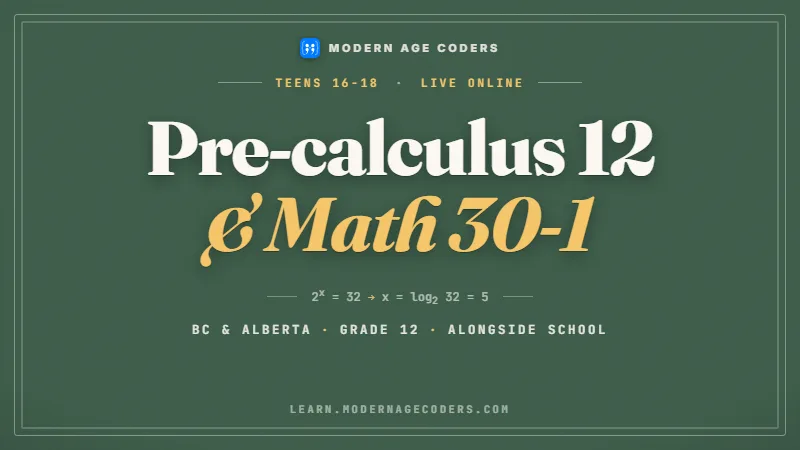
Pre-calculus 12“geometric sequences connecting to exponential functions”Transformations, logarithms, polynomials, series and radian trigonometry
Calculus 12Limits, derivatives and integralsRead our Calculus 12 tutor page for the full course
Statistics 12“Graphical methods should always be used to explore data.”Study design, distributions and correlation; the tree lesson below lives here

Two features of that list matter more than any single topic. First, Workplace Mathematics 10 sits beside the shared Grade 10 course, and Foundations 11 and Pre-calculus 11 run on separate tracks, so a family whose child moves off the Pre-calculus route should ask the school early what that means for Grade 12. Second, Statistics 12 exists as its own course in BC; its content list names the five-number summary, Chebyshev’s inequality, the 68-95-99.7 rule and correlation and causation, and it says outright that software should be used.

What UBC asks for

UBC’s own requirements data lists Pre-Calculus 12 under the Grade 12 requirements for Science, for Applied Science (Engineering) and for Commerce at the UBC Sauder School of Business. Our UBC Computer Science page covers the computing side.

Grade 9 is not a warm-up

Mathematics 9 already covers operations with rational numbers, exponent laws, polynomials, multi-step linear equations and two-variable linear relations. Students who are shaky on negative fractions here tend to stall when slope arrives in Grade 10.

Calculus is optional, not extra

Calculus 12 is a separate course from Pre-calculus 12. In the UBC requirements data we saved it appears once, as recommended for one program, and not at all for Science or Engineering. A student taking both in one year carries two heavy courses, which is where one-to-one help earns its keep.

What our lessons are, and are not

We teach alongside the course a Vancouver student is taking at school, and we do not grant BC credits; marks and credits for every course from Mathematics 9 to Calculus 12 come from the school. We are not connected with the BC Ministry of Education and Child Care, UBC, the City of Vancouver or any Vancouver school district.

Vancouver data lesson

A street tree 66 metres wide? Finding outliers in Vancouver’s public trees file

The City of Vancouver publishes its public tree inventory as open data. Statistics 12 students summarise the trunk diameters, set a fence for outliers and find out what one impossible number does to each statistic. Every figure here is ours.

The file is called Public trees. The City describes it as a listing of public trees on boulevards and public trees in parks, in the City of Vancouver, and warns that private trees are not included in the inventory and that it may be several years between updates for some attributes. Our export on 23 October 2026 held 184,268 rows, each with a genus, a species, a height in metres, a trunk diameter in centimetres and one of the city’s 22 local areas.

Five-number summary of trunk diameter, our calculation on the 183,791 trees with a diameter above zero. City of Vancouver Open Data, Public trees, downloaded 23 October 2026; quartiles by Python’s inclusive method
StatisticDiameter (cm)
Minimum0.6
First quartile, Q110.2
Median25.4
Third quartile, Q345.7
Maximum6,673.0
Interquartile range35.5
Upper fence, Q3 + 1.5 × IQR98.95
Mean32.48

The maximum is the first thing a careful student questions. A trunk 6,673 cm across is a tree more than 66 metres wide; the record, asset 68485, is a pin oak in Mount Pleasant, and the next largest tree in the file measures 779.0 cm. One extra digit typed at entry would explain it, but the file cannot tell us, so we flag it rather than fix it. What the value does is instructive: drop it, and the mean moves only from 32.48 to 32.45 cm, because one value among 183,791 has little pull on an average. The maximum and the range, though, are ruined by it.

The Python behind the table reads the export, keeps positive diameters, finds the quartiles and the fence, and counts what lies beyond it. Only the standard library is needed:import csv, statistics with open("public-trees.csv", encoding="utf-8-sig") as f: rows = list(csv.DictReader(f, delimiter=";")) sizes = sorted(float(r["diameter_cm"]) for r in rows if float(r["diameter_cm"]) > 0) q1, median, q3 = statistics.quantiles(sizes, n=4, method="inclusive") fence = q3 + 1.5 * (q3 - q1) print("five-number summary:", sizes[0], q1, median, q3, sizes[-1]) print("upper fence:", round(fence, 2)) print("trees beyond it:", sum(1 for s in sizes if s > fence)) print("mean:", round(statistics.mean(sizes), 2))

Outside the fence is not wrong

Our script finds 3,925 trees above the 98.95 cm fence. Almost all are simply big old trees, which Vancouver has plenty of. The 1.5 IQR rule marks values worth a second look, not values to delete, and students must say that in words.

Zeros are missing data

There are 477 rows with a diameter of 0 and 3 with a height of 0. A tree with no trunk is not a tiny tree; it is a measurement nobody recorded. Leaving zeros in would drag the first quartile down for no good reason.

Heights come in steps

The file holds only 84 distinct heights, and the eight commonest cover 93.7 percent of rows: 4.6, 7.6, 10.7, 13.7, 16.8 and 19.8 m lead. The steps are about 3 m apart, which we read as ten-foot bands converted to metres; that reading is ours, not the City’s.

Correlation, before and after cleaning

Across 183,788 trees with both measurements above zero, our correlation between diameter and height is r = 0.651. Keep only trees inside the fence and it rises to 0.755. For maples alone it is 0.807; for the Prunus genus, cherries and plums, 0.636. Thicker trees tend to be taller, but the height steps blur the pattern, and nothing here says diameter causes height: both grow with age, the lurking variable Statistics 12 warns about.

A follow-up session compares genera. Our medians are 22.9 cm for maples (Acer, the commonest of 171 genus labels, with 41,976 trees), 33.0 cm for Prunus and 36.8 cm for lindens (Tilia). Side-by-side box plots make that comparison in one picture. Contains information licensed under the Open Government Licence - Vancouver. We use the file under those terms, which permit commercial reuse (licence, dataset page). The City of Vancouver does not endorse this page or our classes.
A worked problem, ours

Worked problem: what one huge value does to a mean and a median

The nine diameters below are invented by us, not taken from the file, so the arithmetic can be done by hand. The method is the one the Vancouver data needs.

Question. A student measures nine trunks on one block, in centimetres: 8, 12, 15, 21, 25, 30, 38, 46 and 240. (a) Find the five-number summary and the interquartile range. (b) Use the 1.5 IQR rule to decide whether 240 is an outlier. (c) Compare the mean and the median with and without it, and say which you would report.

Step 1, order and split. The list is already in order. With nine values the median is the fifth, 25. Using the method our Python uses here (the median of each half, counting the middle value in both), Q1 is 15 and Q3 is 38. So the summary is 8, 15, 25, 38, 240, and the IQR is 38 minus 15, which is 23.

Step 2, build the fences. 1.5 times 23 is 34.5. The upper fence is 38 plus 34.5, or 72.5, and the lower fence is 15 minus 34.5, which is negative and so catches nothing. 240 is far beyond 72.5, so it is an outlier by this rule. Whether it is an error is a separate question, answered by going back to the tree.

Step 3, compare centres. With all nine values the mean is 435 divided by 9, about 48.33, nearly twice the median. Without 240 the mean is 195 divided by 8, about 24.38, and the median of the remaining eight is the average of 21 and 25, which is 23. The median barely moved; the mean halved. Report the median, and mention the outlier in a sentence.

Step 4, contrast with the city file. In our nine-tree example one outlier doubles the mean. In the Vancouver file a far wilder value moved the mean by three hundredths of a centimetre. The difference is the sample size: one value among nine carries a ninth of the weight; one among 183,791 carries almost none. That contrast is a Statistics 12 idea in one line.

Try it yourself. (1) Replace 240 with 60 and redo the fence test. (2) Find the standard deviation of the eight values without 240 and a z-score for 46, the Foundations 11 way. (3) Explain why a box plot shows the outlier clearly while a mean alone hides it. We go through answers in the free lesson.

Contests for Vancouver students

Math contests open to Vancouver students in 2026 to 2027

Most contests a Vancouver student writes are national, run by the Centre for Education in Mathematics and Computing (CEMC) at the University of Waterloo and the Canadian Mathematical Society (CMS). Dates are the organisers’ own, read on 22 October 2026.

Selected national math contests for 2026 to 2027 and how a Vancouver student enters. Dates as CEMC and the CMS list them
ContestOrganiserWho it is forDate
COMCCMSHigh school students; registration closed Thursday 22 October 2026Thursday 29 October 2026
Pascal, Cayley, FermatCEMCGrades 9, 10 and 1123 and 24 February 2027
Fryer, Galois, HypatiaCEMCGrades 9, 10 and 11, written solutions7 April 2027
EuclidCEMCFinal year of secondary school6 April 2027
GaussCEMCGrades 7 and 810 to 21 May 2027

The CMS path is the one that leads furthest. Its Canadian Open Mathematics Challenge feeds the Canadian Mathematical Olympiad: the CMS says approximately 100 to 120 top-ranking COMC students are invited to write the CMO or its junior version each March. Registration for the 2026 COMC closed on 22 October 2026, so a Vancouver student starting now should aim at the 2027 cycle and use the CEMC February contests as practice under time. Our COMC guide and CMO path page cover both steps.

Entry runs through schools

CEMC says all students must participate through their school. If a Vancouver school does not order a contest, CEMC suggests the student look for another local school willing to host them.

Practice that costs nothing

CEMC keeps the last ten years of its contests in a free archive with no sign-up, which is where we send students for timed practice between lessons.

Original problems only

Our contest lessons use problems we write ourselves, labelled as ours. We never copy CEMC’s or the CMS’s papers or solutions, and we are connected with neither organisation.

Math tutor price in Vancouver

Math tutor prices in Vancouver: what to compare before you choose

Our own fees sit in the fees section below and display in your local currency, so there are no figures in this text. Here is how to weigh one tutoring offer against another.

A comparison frame for Vancouver families. The descriptions of our formats are ours; we do not publish anyone else’s prices
Our group classOur one-to-oneWhat to ask elsewhere
Sessions per monthEight live classesEight live classes, at times you pickIs the price per hour, per session or per month?
Students per teacherFifteen to twenty at one levelOneIs the group set by level or by age?
CurriculumBC courses by name, from Mathematics 9 to Calculus 12The student’s own course and unitDoes the tutor know Foundations from Pre-calculus?
CommuteNoneNoneWho travels, and for how long?
TrialOne free live lessonOne free live lessonCan you see a lesson before paying?

The cheapest offer is not always the cheapest per hour of actual learning. A Vancouver family comparing options should count the sessions that will really happen in a busy school month, subtract travel, and then ask who does most of the solving in each session. We suggest a group class for steady progress through a course and one to one for a defined gap, such as logarithms in Pre-calculus 12, or for a student carrying Calculus 12 and Pre-calculus 12 in the same semester.

Learning ladder

From early number sense to Calculus 12

The grade labels are approximate. Placement depends on what the student can already explain, which the free lesson finds out.

Grades 1 to 3

Counting with reasons

Number sense, addition and subtraction strategies and early patterns, with every answer explained aloud.

Early Math FoundationsMental Maths for Kids
Grades 4 to 8

Fractions and ratio

Fractions, decimals, integers and first equations, the ground Mathematics 9 is built on.

Elementary Maths for Grades 1-5Middle School Mathematics Mastery
Grades 9 to 11

Choosing a route

Mathematics 9 and the shared Grade 10 course, then Pre-calculus 11 or Foundations 11 with a clear view of where each leads.

High School MathematicsStatistics & Probability
Grade 12

Pre-calculus and beyond

Pre-calculus 12, Calculus 12 or Statistics 12, with contest problems for students who want more.

Western Canada Grade 12 MathWaterloo Math Contests
Math and AI

Why a Vancouver student still has to understand the statistics

An AI tool will summarise a data file instantly. Whether the summary is honest is a human decision.

Ask a chatbot for the largest street tree in Vancouver and it may well report a trunk 66 metres wide without blinking. It has no reason to doubt the file. A student who has computed a fence, compared the maximum with the next value and thought about how a trunk is measured knows to stop and check.

That is why our teachers have students estimate before computing and write one sentence about what each result means. Teenagers meet AI tools only within the age limits we keep to, and treat them as a checker for finished work rather than a producer of it. Graded school assignments stay the student’s own work.

BC’s Grade 9 course asks students to spot misleading statistics; that habit is exactly what an AI summary needs from its reader. The longer argument is in why reasoning still matters when AI can answer.

Delivery

How live online math works from a Vancouver home

A student in Kitsilano and one in Renfrew-Collingwood can share one teacher without crossing the city.

Schedule

Weekdays or weekends, flexible: choose your batch, or for a very personalised plan choose 1-on-1 at your convenience, weekend mornings or weekdays.

Pacific time, now fixed

BC moved to permanent UTC-7 after clocks went forward on 8 March 2026, so Vancouver no longer falls back in November. India is 12 hours 30 minutes ahead all year, and every invitation is written in Pacific time.

Visible working

Students solve on a whiteboard the teacher can see in real time, so a sign error in line two is caught in line two.

BC course names

Teachers plan by the student’s course, so a Foundations 11 lesson and a Pre-calculus 11 lesson are not the same lesson.

Vancouver numbers

Mobiles on 604, 778, 236, 672 or 257 work in the form. Enter the ten digits; the +1 is added for you.

First lesson free

A full lesson with no charge and no card, finishing with a suggested course, level and lesson time.

No Vancouver office

We run no tutoring centre in Vancouver and claim none. Our teachers are in India and every lesson is live online; the student needs a computer, a microphone and a dependable internet connection.

Fees

Math tutoring fees for Vancouver families

Three lines, displayed in the currency of your location.

First classFree

One full live lesson at no charge, with a suggested course and level at the end.

Group tuition$140 CAD

The monthly fee for eight live classes with fifteen to twenty students at one stage.

Private tuition$210 CAD

The monthly fee for eight one-to-one lessons with a single teacher.

The fee in Vancouver is the same as anywhere else in Canada. Billing begins only once the free lesson is done and a course and time are agreed; holiday and missed-class rules are on the pricing page.

Reviews

Families on Google, in their own words

Rated 4.9 across 547 Google reviews. These are real reviews, reproduced as written.

★★★★★

"The one step solution for my son. Modern Age Coders make learning coding so simple that kids love it. The teachers explain complex concepts clearly with practical exercises and interactive content."

Ria Mukherjee

Parent

★★★★★

"Modern Age Coders has been a game-changer for me. I struggled to grasp IT concepts and coding before joining, but their classes transformed everything. I can now confidently write complex programs with ease."

Samriddha Mondal

Student

★★★★★

"One of the most wonderful education centres out there. Education is not limited to school syllabus but focuses on skill development."

Vansh Agarwal

Student

★★★★★

"My child Dhairya is really enjoying the Modern Age Coders classes. This is his first online class and he eagerly looks forward to it. I can already see his improvement, and the teachers are very cooperative."

Sonam Oswal

Parent of Dhairya

★★★★★

"Modern Age Coders have wonderful teachers who teach in a clear, easy and practical way. The teacher boosts students' confidence and inspires them to learn without hesitation."

Sonu Goyal

Parent

★★★★★

"I highly recommend this computer coding class! The teachers are incredibly knowledgeable and passionate about coding."

Ritu Kedia

Parent

Free placement class

Book a free math lesson in Vancouver

Give us the grade and the BC course name if there is one. A Grade 4 child might begin with fraction strips; a Statistics 12 student might begin with the tree file.

+1

FAQ

Vancouver math tutoring questions

Quick answers to what Vancouver families ask us most.

Do you offer a math tutor in Vancouver?

Yes, live online. We have no Vancouver centre. A teacher teaches each lesson in real time, to one student or to a group of fifteen to twenty at one level.

How much is a math tutor in Vancouver with you?

Scroll to the fees section: it lists a free first lesson, then a monthly price for group classes and another for one-to-one, shown in your own currency. Nothing is charged before that free lesson.

Should my child take Foundations 11 or Pre-calculus 11?

It depends on the goal. UBC lists Pre-Calculus 12 for Science, Engineering and Commerce. If those doors matter, ask the school which Grade 11 course it expects before Pre-calculus 12, and get help early.

Do you tutor Calculus 12?

Yes, alongside the school course. Our Calculus 12 tutor page sets out the content, and many students take it in the same year as Pre-calculus 12.

Can you help with Statistics 12?

Yes. The tree lesson on this page is a sample: five-number summaries, outlier fences and correlation, with Python doing the counting and the student doing the judging.

Will lessons give my teen a BC credit?

No. We do not grant BC credits. Every credit and mark comes from the student's school; our lessons support the school course.

Is the COMC still open for 2026?

No. The CMS set Thursday 22 October 2026 as the last registration day for the COMC on Thursday 29 October 2026. Students can prepare for the 2027 cycle and the CEMC February contests.

What time are lessons for Vancouver?

Weekdays or weekends, flexible: choose your batch, or for a very personalised plan choose 1-on-1 at your convenience, weekend mornings or weekdays. BC stays on UTC-7 all year, so the time does not jump in November.

Do you teach students in Burnaby, Richmond and North Vancouver?

Yes. Lessons are online, so students across Metro Vancouver join the same classes on the same Pacific clock.

My child is in Grade 8 and finds math hard. Where do we start?

With fractions, integers and equations, because Mathematics 9 builds on all three. The free lesson shows which of them needs attention first.

More for Vancouver and Canada

Other pages for Vancouver math students

For the country as a whole, see our online math tutor page for Canada; for the province, coding classes in British Columbia. Senior students can read Calculus 12 tutoring and high school math courses compared across Canada, and families teaching at home can read homeschool math and coding in BC.

Free classPriority demoCall us

Keep exploring Modern Age Coders

More maths tuition

Learn more

From the blog

Start here