Where can an Ottawa student get live online math tutoring?
Modern Age Coders gives Ottawa students live online math lessons from Grade 1 through Grade 12, one to one or in a class of 15 to 20 at a single level. For Grades 11 and 12 most choose Ontario Grade 12 University Math (MHF4U and MCV4U); contest-keen students choose Waterloo Math Contests: Gauss to Euclid; children choose a maths course for their age. A first lesson is free.
Ottawa has a calendar students can feel: long cold winters, warm summers, and a return of each on a fairly reliable schedule. Mathematics has a name for that kind of regular rise and fall, a periodic function, and Ontario students spend much of Grade 11 learning to model it with sine and cosine. This page follows periodic behaviour and rates of change through the Ontario courses, sends you to our detailed page for each stage, and then builds a model from real Ottawa data. The City of Ottawa publishes the daily temperature of Ottawa River water entering the Britannia water purification plant, for every year since 2005, and one year of it is enough to build, test and question a sinusoid the way MCR3U asks.
Facts last verified 22 October 2026. Teaching is online; no Ottawa branch is claimed.
Chosen by stage. The teacher in the free lesson confirms the fit, or suggests a better one.

Number sense, patterns and fractions taught through explanation, the base for the Grade 3 and Grade 6 assessments.
See the syllabus
MTH1W relations, Grade 10 trigonometry and algebra, and the Grade 11 functions work that sinusoids build on.
See the syllabus
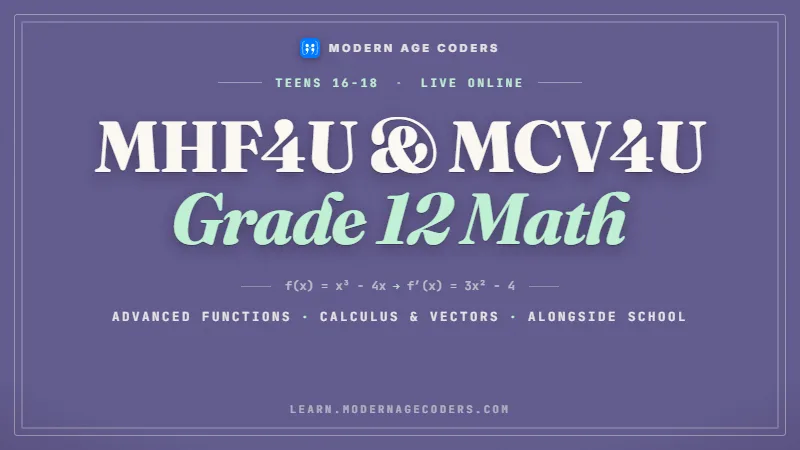
Advanced Functions and Calculus and Vectors beside the school course. It does not grant an Ontario credit; the school does.
See the syllabus
Preparation for Fermat, Hypatia and the other CEMC contests, using problems we write.
See the syllabusBrowse the course atlas for more than one hundred options and use the coding roadmap to check prerequisites.
The four we are known for
These run underneath everything above. Every one is live and online, placed by ability rather than by age, and the first class is free.

Python, web and AI projects where the learner still owns the thinking.
See the syllabus
Automate the work you already do, then let AI carry part of it.
See the syllabus
Train a model, read what it learned, and be able to say why it is wrong.
See the syllabus
Run AI coding agents on real work without losing control of the codebase.
See the syllabusOttawa public schools teach to the Ontario curriculum. Below, one family of ideas is followed through it, in our summary, with the page where we teach each stage.
| Stage | The idea at that stage | Our page |
|---|---|---|
| Grades 1 to 6 | Repeating patterns, then growing ones; EQAO assessments in Grades 3 and 6 from 4 May to 8 June 2027 | Grade 3, Grade 6 |
| Grades 7 to 9 | Rates and linear relations; in MTH1W, rate of change as the slope of a line; EQAO Grade 9 from 12 January to 5 February 2027 | MTH1W, Grade 9 practice |
| Grade 10 | Right-triangle trigonometry and quadratics; the academic course is the MCR3U prerequisite | Courses compared |
| Grade 11, MCR3U | Sinusoidal functions: amplitude, period, phase shift and midline, used to model repeating data | MCR3U, MCF3M or MCR3U |
| Grade 12, MHF4U | Trigonometric functions in radians, and average against instantaneous rates of change | MHF4U |
| Grade 12, MCV4U | The derivative as a limit of rates of change; MHF4U first or alongside | MCV4U, MDM4U |
Sinusoidal modelling is a place where Grade 11 students can lose marks without knowing why. The algebra of y = a cos(k(x − d)) + c is short, but each letter has to be read off a real situation: how high and low, how long one cycle lasts, where it peaks. A student who only memorises transformations struggles the moment the data are real, which is exactly when the course starts to matter.
The ministry lists Grade 10 academic math as the entry to MCR3U, and says MHF4U must come before or alongside MCV4U. For an Ottawa student planning Grade 12 calculus, that makes Grade 11 the hinge year: secure sinusoids and rates there, and both Grade 12 courses are much easier.
We teach next to the school math course and we do not grant Ontario credits; the school awards every credit and mark. We are not connected with the Ontario Ministry of Education, EQAO or any Ottawa school board.
The City of Ottawa publishes the daily temperature of raw river water at the Britannia water purification plant. We built a sinusoid from the 2025 column and compared it with every day of that year. The model and its errors are our calculations.
The City’s description is unusually exact. Each daily value is the average of two readings, recorded 12 hours apart, around 06:00 and 18:00, using a certified probe accurate to plus or minus half a degree. The intake sits approximately 427 m out from the plant, where 12 reinforced fibreglass bells on the last 29 m of pipe rest at an approximate depth of 10 m, with an intake capacity of 364 ML/day. The workbook we downloaded has one row per calendar day and one column for each year from 2005 to 2025; it has no row for 29 February, so leap days are absent.
| Measure | 2025 |
|---|---|
| Warmest day | 26.75 on 13 August (day 225) |
| Coldest day | 0.27 on 17 January (day 17) |
| Mean and median of the 365 days | 11.17 and 9.5 |
| Monthly means, January to March | 0.89, 1.02, 1.15 |
| Monthly means, July and August | 24.87 and 24.76 |
| Days at or above 20 degrees | 102 |
| Days at or below 1 degree | 47 |
From those numbers a Grade 11 student can write a model in four moves. The amplitude is half the range, (26.75 − 0.27) ÷ 2 = 13.24. The midline is the average of the extremes, 13.51. The period is one year, 365 days. And the curve peaks on day 225, so a cosine shifted right by 225 fits: T(d) = 13.24 cos(2π(d − 225) ÷ 365) + 13.51. The program below builds exactly that model from the workbook and measures how far it sits from the real temperatures:import datetime, math
import openpyxl # pip install openpyxl
sheet = openpyxl.load_workbook("2025_Ottawa_River_water_temperature.xlsx", read_only=True).worksheets[0]
rows = list(sheet.iter_rows(max_row=400, values_only=True))
header = next(i for i, row in enumerate(rows) if row[0] == "Date")
col = rows[header].index(2025)
temps = [row[col] for row in rows[header + 1:] if isinstance(row[0], datetime.datetime)]
amp = (max(temps) - min(temps)) / 2
mid = (max(temps) + min(temps)) / 2
peak_day = temps.index(max(temps)) + 1
def model(day):
return amp * math.cos(2 * math.pi * (day - peak_day) / 365) + mid
errors = [abs(temps[d - 1] - model(d)) for d in range(1, 366)]
print("amplitude", amp, "midline", mid, "peak on day", peak_day)
print("mean error, degrees:", round(sum(errors) / 365, 2))
Across all 365 days the model is off by 2.49 degrees on average. For a curve built from only two numbers and a date, that is respectable, and it captures the shape of the year.
In spring the model runs warm: on 1 June it predicts 17.60 degrees against 13.45 measured. The coldest day is 208 days before the warmest, not the 182.5 a symmetric sine wave assumes, so the river warms more slowly than it cools.
From January to March the monthly means stay between 0.89 and 1.15. River water at the intake cannot cool far below freezing, so the bottom of the curve is flat. A sinusoid has no flat parts, which is a limitation worth naming in any report.
Contains information licensed under the Open Government Licence - City of Ottawa (licence, Open Ottawa). The model, residuals and summaries are ours. The City of Ottawa does not endorse this page or our classes.
A calculus question with a twist, for an MHF4U or MCV4U student. The temperatures are the City of Ottawa’s 2025 values; the question and solution are ours.
| Date | 1 May | 17 May | 27 May | 31 May | 1 June | 2 June | 6 June | 16 June |
|---|---|---|---|---|---|---|---|---|
| Temperature | 7.25 | 13.0 | 12.6 | 14.2 | 13.45 | 13.6 | 16.65 | 19.6 |
Part (a), an average rate. From 1 May to 1 June the temperature rose from 7.25 to 13.45 degrees over 31 days, an average rate of change of (13.45 − 7.25) ÷ 31 = 0.20 degrees per day.
Part (b), narrowing in. MCV4U estimates an instantaneous rate with ever smaller intervals centred on the moment. Using 17 May and 16 June (15 days either side): (19.6 − 13.0) ÷ 30 = 0.22. Using 27 May and 6 June (5 days either side): (16.65 − 12.6) ÷ 10 ≈ 0.405.
Part (c), the twist. Using 31 May and 2 June (1 day either side): (13.6 − 14.2) ÷ 2 = −0.30. The river was not cooling in early June; day-to-day wobble in the measurements, each only accurate to half a degree, swamps the signal when the interval is tiny. With real data, shrinking the interval does not converge the way it does for a formula.
Part (d), use the model instead. Differentiate T(d) = 13.24 cos(2π(d − 225) ÷ 365) + 13.51 to get T′(d) = −13.24 × (2π ÷ 365) sin(2π(d − 225) ÷ 365). At d = 152, the angle is 2π(−73) ÷ 365 ≈ −1.257 radians and its sine is about −0.951, so T′(152) ≈ 13.24 × 0.01721 × 0.951 ≈ 0.217 degrees per day: close to the 15-day estimate, and far steadier than the 1-day one.
Try it yourself. On which day of the year does the model say the river warms fastest, and what is that rate? Compare it with the real temperatures a week either side of that day.
CEMC, the University of Waterloo centre behind the most widely written Canadian math contests, sets one paper for each grade. For a Grade 11 student in Ottawa there are two to plan around.
| Contest | Paper | Date |
|---|---|---|
| Fermat | 25 multiple-choice questions, 60 minutes | 23 or 24 February 2027 |
| Hypatia | 4 questions, a mix of answer only and full solution, 75 minutes | Wednesday 7 April 2027 |
The two papers test different strengths. Fermat rewards speed and the instinct to avoid long calculations; Hypatia rewards patient, complete reasoning that a marker can follow line by line, much like part (c) of the river problem, where the honest answer is that the data cannot support the calculation. Our Fermat preparation and Fryer, Galois and Hypatia guide cover each paper, and the Waterloo contests page covers every grade.
CEMC contests are written through schools; there is no individual entry. An Ottawa student whose school is not taking part can, on CEMC’s suggestion, ask another local school to host them.
CEMC’s past contests are free to download with no sign-up. We use them for timed practice and teach with original problems in class.
The Canadian Mathematical Society runs the COMC, held on 29 October 2026; its registration closed on 22 October. The COMC leads by invitation to the CMO. Our COMC guide explains the path.
CEMC’s rule is that “all students must participate through their school”. We are not connected with CEMC, the University of Waterloo or the Canadian Mathematical Society. We never reproduce their problems or solutions; our practice problems are original and labelled as ours.
Scroll down to Fees for our actual amounts, which display in your local currency. Below is a fair way to set them beside other math help in Ottawa.
| Live online class with us | One-to-one online with us | A tutor in your home | |
|---|---|---|---|
| Teacher time | Shared by 15 to 20 students at one level | Entirely one student’s | Entirely one student’s |
| Typical charge | One monthly fee, eight live classes | A higher monthly fee | Usually per hour, with travel built in |
| Best fit | A student broadly on track who wants weekly structure | A specific gap, an ambitious goal, exam weeks | A student who needs an adult in the room |
Whatever an Ottawa family chooses, the comparison only works in matching units, such as hours of live teaching each month. After that the questions that matter are about the teaching itself: whether the lessons follow the student’s actual Ontario course, whether anyone reads the practice between sessions, and whether the student is asked to explain or simply shown.
These bands are a sketch. The free lesson decides the real starting point from what a student can show.
Counting, place value and repeating patterns described in words.
Early Math FoundationsElementary Maths for Grades 1-5Fractions, ratio and rates, with Gauss-style puzzles for keen students.
Middle School Mathematics MasteryMiddle School Math CompetitionsMTH1W relations, then Grade 10 trigonometry and quadratics.
High School MathematicsMaths Through CodingMCR3U, MHF4U and MCV4U, plus Fermat and Hypatia practice.
Ontario Grade 12 University MathWaterloo Math ContestsIt will fit a curve. It will not tell you the curve is wrong in winter unless you already know to ask.
Give an AI tool the 2025 column and it can return a fitted sinusoid in seconds. It is much less likely to notice the flat winter floor, the lopsided spring, or that a one-day derivative from noisy data is meaningless. Seeing those things is mathematical judgement, and it belongs to the student.
Our lessons keep that judgement where it belongs: sketch the year first, estimate amplitude and period by eye, build the model by hand, and only then let software check. Work handed in for a school mark is the student’s own.
Ontario math asks students to model, reason and communicate. Software can draw the curve; deciding whether to trust it is still a person’s job. The longer argument is in why careful thinking still matters when software does the sums.
Kanata, Barrhaven, Orléans or the Glebe: lessons reach the student at home, which matters in an Ottawa February.
Weekdays or weekends, flexible: choose your batch, or for a very personalised plan choose 1-on-1 at your convenience, weekend mornings or weekdays.
Ottawa is on UTC-4 until 1 November 2026, then UTC-5 until 14 March 2027. Class times are given in Eastern time, and we confirm them again in each changeover week.
Graphs and steps go on a board both people can see, which lets a teacher spot the moment a period or a phase shift slips.
Lessons follow whichever Ontario course the student takes, MTH1W, MCR3U, MHF4U or MCV4U, at the school’s pace.
Ottawa numbers on 613, 343 or 753 work in the form. Enter ten digits; the +1 is supplied.
The first lesson is a genuine lesson at the right level, and it ends with a recommended course. No card is asked for.
No Ottawa centre
Modern Age Coders has no tutoring centre in Ottawa and claims none. Lessons are live and online, taught from India, and need a computer with a microphone and a steady connection.
Displayed in the currency that matches your location.
A full live lesson without charge, ending with our recommended course and level.
The monthly fee for a live class of 15 to 20 students at one level.
The monthly fee for a teacher working with one student at chosen times.
Ottawa families pay the same fee as any family in Canada. Billing waits until after the free lesson and until a course and time are agreed.
Rated 4.9 across 547 Google reviews. These are real reviews, reproduced as written.
★★★★★
"The one step solution for my son. Modern Age Coders make learning coding so simple that kids love it. The teachers explain complex concepts clearly with practical exercises and interactive content."
Ria Mukherjee
Parent
★★★★★
"Modern Age Coders has been a game-changer for me. I struggled to grasp IT concepts and coding before joining, but their classes transformed everything. I can now confidently write complex programs with ease."
Samriddha Mondal
Student
★★★★★
"One of the most wonderful education centres out there. Education is not limited to school syllabus but focuses on skill development."
Vansh Agarwal
Student
★★★★★
"My child Dhairya is really enjoying the Modern Age Coders classes. This is his first online class and he eagerly looks forward to it. I can already see his improvement, and the teachers are very cooperative."
Sonam Oswal
Parent of Dhairya
★★★★★
"Modern Age Coders have wonderful teachers who teach in a clear, easy and practical way. The teacher boosts students' confidence and inspires them to learn without hesitation."
Sonu Goyal
Parent
★★★★★
"I highly recommend this computer coding class! The teachers are incredibly knowledgeable and passionate about coding."
Ritu Kedia
Parent
Let us know the grade and, in high school, the course code. A seven-year-old might begin with a repeating-pattern puzzle; a Grade 11 student might begin with the river data.
What Ottawa parents and students most often ask us.
Yes, online only. There is no Ottawa office; a student learns live from home with a teacher, one to one or in a class of 15 to 20 at a single level.
Look at the Fees panel on this page: one free lesson, then a monthly class fee or a monthly one-to-one fee, displayed in your currency. Figures are kept out of this answer on purpose.
Tutors who visit Ottawa homes generally bill per hour for the visit. Our live class is online, with 15 to 20 students at one level and one teacher for a monthly fee; our one-to-one option gives one student a teacher alone, also for a monthly fee.
Yes. Building and testing a sinusoid from real data, like the river lesson on this page, is one of the ways we teach Grade 11 Functions.
Yes, as support beside the school course. We do not grant Ontario credits: the credit, and the mark, come from the school the student attends.
Yes. CEMC lists Fermat for 23 and 24 February 2027 and Hypatia for 7 April 2027. Students enter through their school, and we prepare them with original problems.
No. The Canadian Mathematical Society lists the 2026 COMC for 29 October, and registration closed on 22 October 2026.
Weekdays or weekends, flexible: choose your batch, or for a very personalised plan choose 1-on-1 at your convenience, weekend mornings or weekdays. We confirm each time in Eastern time.
Yes. Ottawa numbers on 613, 343 and 753 all work; type the ten digits without the leading 1.
Yes. Six is a common starting age; early lessons are brief and built around patterns, number sense and saying why an answer is right.