MFT / BAS / 01
Algebra foundations
Factoring and exponent laws, the tools every MCR3U unit uses.
Open the syllabusOntario · Grade 11 · MCR3U Functions
MCR3U is the Grade 11 course that opens the door to every Grade 12 university math course, and the one where function notation, inverses and the sine law first appear together. We set it out here from the ministry’s 2007 curriculum, solve an inverse function and an ambiguous-case triangle with every decision explained, and add twelve practice questions we wrote ourselves. Our teaching runs next to the school course; we do not grant Ontario credits, and the credit itself comes only from the school.
Teaching live online since 2020 · 10,000+ students · Following the school’s MCR3U outline
Quick answer
MCR3U is Functions, Ontario’s Grade 11 university-preparation math course: functions and their inverses, exponential functions, sequences and series, and trigonometry with sinusoidal graphs. It follows MPM2D and is the prerequisite for MHF4U. Modern Age Coders teaches MCR3U live online, in a batch or one to one, through our course High School Mathematics: Algebra to Calculus, then on to Grade 12.
Learn it with a teacher
Our Ontario course covers the Grade 12 sequence that MCR3U unlocks; the other two strengthen the Grade 11 base itself.
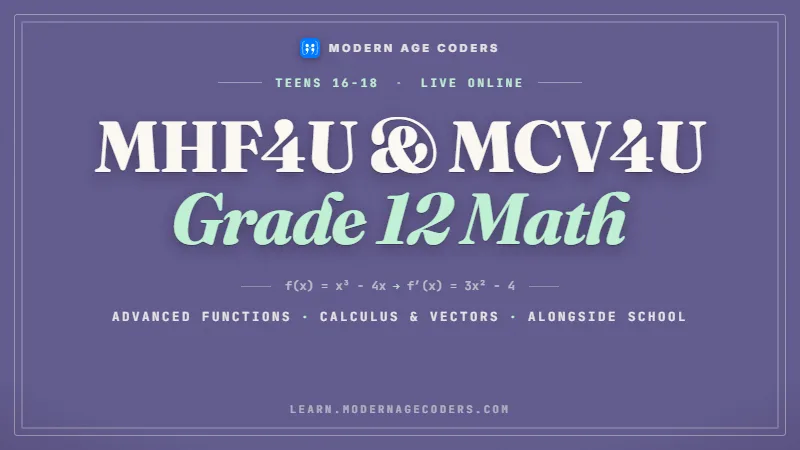
MFT / 01
Advanced Functions and Calculus and Vectors, for students planning past MCR3U, with Grade 11 gaps fixed along the way.
Open the syllabus →
MFT / 02
Quadratics, exponent laws and trigonometry rebuilt in order, at the pace of the student.
Open the syllabus →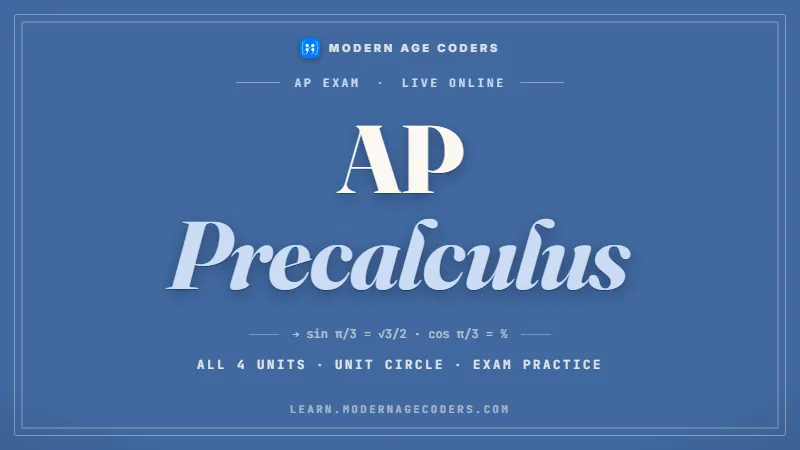
MFT / 03
Function families, inverses and sinusoids, taught a second way for students who want more practice.
Open the syllabus →The Ontario curriculum
The course description in the 2007 curriculum starts: “This course introduces the mathematical concept of the function by extending students’ experiences with linear and quadratic relations.” Later it adds that students “investigate inverse functions; and develop facility in determining equivalent algebraic expressions”. Four strands carry the expectations.
| Strand | From the expectations | What students actually do (our reading) |
|---|---|---|
| A. Characteristics of Functions | “demonstrate an understanding of functions, their representations, and their inverses”; equivalence when “simplifying polynomial, radical, and rational expressions” | Function notation, domain and range, inverses, transformations of parent functions, quadratics in every form, and rational expressions with restrictions |
| B. Exponential Functions | “evaluate powers with rational exponents”, then represent and solve problems with exponential functions | Exponent laws with fractional and negative exponents, growth and decay graphs, and spotting a constant ratio in a table |
| C. Discrete Functions | recursive sequences that “make connections to Pascal’s triangle”; arithmetic and geometric series; “solve problems involving compound interest and ordinary annuities” | Recursive and explicit formulas, sums of series, and the financial strand that most other provinces teach elsewhere |
| D. Trigonometric Functions | “prove simple trigonometric identities”; the sine law and cosine law; “periodic relationships and sinusoidal functions” | Angles up to 360 degrees, exact values, oblique triangles, the ambiguous case, and transformed sine and cosine graphs, all in degrees |
The first specific expectation asks students to “explain the meaning of the term function”, not just use one. Expect a test question that shows a relation as a table or a mapping diagram and asks for a reason, in words, why it is or is not a function.
Inverses are tied to an idea students already have. The curriculum asks them to “relate the process of determining the inverse of a function to their understanding of reverse processes”: undoing each operation in reverse order. Our first worked problem uses exactly that framing.
Strand A’s algebra expectations carry a footnote: the skills “are to be introduced as needed, and applied and consolidated, as appropriate, in solving problems throughout the course.” In practice, factoring and rational expressions are not one unit that ends; they are tested all year.
Rational expressions come with a specific demand: students simplify them and “state the restrictions on the variable values”. A correct simplification with the restrictions missing loses marks on almost every Ontario test we see.
According to the programme overview, Functions “builds on the concepts and skills developed in the Grade 9 and 10 academic mathematics courses” and prepares students for Grade 12 courses leading to university programs, “including science, engineering, social sciences, liberal arts, and education.”
That range is the point. MCR3U is not only for future engineers; it is the general-purpose university math course of Grade 11.
The course page gives “Prerequisite: Principles of Mathematics, Grade 10, Academic”, which is MPM2D, and the ministry’s current online record carries the same prerequisite and the year 2007.
Functions is a one-credit course. Ontario’s diploma rules ask for three math credits, one of them in Grade 11 or 12, so for many students MCR3U is also the course that completes the math requirement for graduation.
Source: Ontario Grades 11 and 12 mathematics curriculum (2007), programme overview and MCR3U pages, read 22 October 2026, with the MCR3U record on the ministry curriculum website checked the same day. Expectations that rely on symbols are summarised in our own words. Modern Age Coders works independently of the Ontario Ministry of Education.
What MCR3U unlocks
Every Grade 12 university-preparation math course in Ontario traces back to Functions. These are the prerequisite lines printed on each course page of the 2007 document.
| Grade 12 course | Type | Prerequisite as printed |
|---|---|---|
| MHF4U, Advanced Functions | University | “Functions, Grade 11, University Preparation, or Mathematics for College Technology, Grade 12, College Preparation” |
| MCV4U, Calculus and Vectors | University | No Grade 11 course named; Advanced Functions must come first or alongside, so MCR3U sits underneath it |
| MDM4U, Mathematics of Data Management | University | “Functions, Grade 11, University Preparation, or Functions and Applications, Grade 11, University/College Preparation” |
| MCT4C, Mathematics for College Technology | College | “Functions and Applications, Grade 11, University/College Preparation, or Functions, Grade 11, University Preparation” |
A student who passes MCR3U can take any of the four courses above. A student aiming at a university program that lists Advanced Functions or Calculus and Vectors needs MCR3U in Grade 11, because the alternative route to Advanced Functions goes through a Grade 12 college course first.
So the Grade 11 choice is the real decision point. Families who are unsure whether to choose MCR3U or the university/college course should look at the Grade 12 courses their teen might need, then work backwards.
University admission pages mostly list Grade 12 courses, so MCR3U rarely appears by name. It appears through them. Waterloo’s Mathematics program, for example, lists Advanced Functions and Calculus and Vectors among six Grade 12 courses, both of which depend on Functions.
The same Waterloo page names one Grade 11 course as recommended: “Grade 11 U Introduction to Computer Science”. For a Grade 11 student with Waterloo in mind, that is ICS3U alongside MCR3U. Our ICS3U help page covers the computer science side.
Sources, read 22 October 2026: Ontario Grades 11 and 12 mathematics curriculum (2007), course pages for MHF4U, MCV4U, MDM4U and MCT4C; University of Waterloo, Mathematics. Admission requirements change from year to year; read the university’s own page when your teen applies. Waterloo has no connection with this page.
Where marks go
These are patterns from our own MCR3U classes, written as a table so a student can check their last test against it. Each comes with the habit that fixes it.
| Topic | What goes wrong | The habit that fixes it |
|---|---|---|
| Function notation | Reading f−1(x) as 1/f(x) | Say “f inverse” aloud; the reciprocal is written 1/f(x) |
| Domain and range | Giving the domain of a quadratic as its x-intercepts | Ask which inputs are allowed, not where the graph crosses an axis |
| Transformations | Applying a horizontal stretch and shift to y = f(2x − 6) without factoring | Factor first: f(2(x − 3)), so the shift is 3, not 6 |
| Quadratics | Completing the square and losing the factor in front | Factor the leading coefficient out of both x terms before adding anything |
| Rational expressions | Cancelling terms instead of factors | Only whole factors cancel; write restrictions before cancelling |
| Exponents | Treating 82/3 as 8 × 2/3 | Root first, then power: the cube root of 8 is 2, squared is 4 |
| Sequences | Mixing up the recursive and the general term | Recursive uses the previous term; general uses n |
| Sine law | Giving one triangle when two exist | Compare a with b sin A every time the angle is not between the given sides |
Grade 10 students work with relations: graphs and equations, mostly of lines and parabolas. Grade 11 asks them to step back and talk about the object itself: what a function is, what its domain is, what its inverse does. Students who were strong at Grade 10 calculation can stumble here because the questions now ask for explanation.
We spend the first weeks making students say things in sentences: “this is a function because each input has exactly one output”. It feels slow, and it pays back through the whole year.
Trigonometry is strand D, the last of the four in the curriculum, and a school that follows that order reaches it right before the exam. It is also the strand with the most new vocabulary: reference angles, the CAST rule, the ambiguous case, period, amplitude, phase shift. Students meet it tired and with the least time to practise.
Starting trigonometry practice early, even ten minutes a week, changes the final exam more than any other single adjustment we suggest.
Worked problems, ours
Two problems we wrote, both at MCR3U test level: one from the first strand, one from the last. Each step states the reason for the step. Computer algebra confirmed the results.
Problem 1, an inverse. Let f(x) = 2(x − 3)2 + 1 with domain x ≥ 3. Find f−1(x), state its domain and range, and check your answer.
The swap-x-and-y method gives the same answer, but students who use it mechanically often keep the ± sign and never decide between roots. The reverse-process method forces that decision, because it asks what the original inputs were.
Problem 2, the ambiguous case. In triangle ABC, angle A = 40°, side a = 8 cm (opposite A) and side b = 10 cm. Find every possible value of angle B and side c, to two decimal places.
| If side a is | Triangles | Reason |
|---|---|---|
| shorter than b sin A | None | a cannot reach the third side |
| equal to b sin A | One (a right triangle) | a just touches the third side |
| between b sin A and b | Two | a can lean two ways, as in problem 2 |
| at least as long as b | One | the second position would put the angle on the wrong side |
In both problems the risky moment is a choice between two answers: the positive or negative root in the first, the acute or obtuse angle in the second. A student who knows where that choice hides stops losing marks to it.
The checks also match. A number in, a number back out for the inverse; the angle sum and the height comparison for the triangle. A check is part of the solution, not decoration.
For inverses, practise with linear, quadratic and simple square root functions, always writing the domain restriction first. For the ambiguous case, practise the height comparison on its own until it is automatic, then add the solving.
Questions 3 and 11 in the practice set below come from the same two families.
Practice, ours
We wrote these twelve questions for this page, three per strand, and checked each with a computer. They are not from any textbook, school or board. Use degrees throughout, as MCR3U does.
Answers, ours
The reasons are the part to study. An MCR3U marker looks for them, and they are what transfers to the next question.
Final exam, ours
Our checklist for the month before the Grade 11 Functions exam. Tick each line only when you can do it without notes. Ask the teacher first what share of the course mark the exam carries and which calculator is allowed.
| Strand | Skill | Self-test |
|---|---|---|
| A | Decide whether a relation is a function, and say why | Question 1 above, plus one graph and one equation of your own |
| A | Find an inverse and its domain and range | Problem 1 above, with a new restriction |
| A | Graph y = af(k(x − d)) + c from a parent function | Two transformations of a square root function |
| A | Simplify a rational expression with restrictions | Question 6 above, restrictions first |
| B | Evaluate rational exponents and graph an exponential | Question 7, then sketch y = 2(0.5)x |
| C | Move between recursive and general formulas | Question 9, then write its general term |
| C | Sum arithmetic and geometric series | Question 10, then a geometric series of your own |
| D | Exact values and angles up to 360° | Question 11 with three new angles |
| D | Sine law, cosine law and the ambiguous case | Problem 2 above, then one with no triangle |
| D | Graph and model a sinusoidal function | Question 12, then write an equation from a graph |
Credit and timing
Families searching for MCR3U online are sometimes after the credit and sometimes after a teacher. We provide the second.
The credit belongs to the institution that teaches and evaluates the course: the student’s secondary school, a board’s summer or night program, or a private school approved to grant Ontario credits. Modern Age Coders is a tutoring service. We teach alongside the course and do not grant Ontario credits.
For the diploma, the graduation requirements page lists “3 credits in mathematics (Grade 9, Grade 10 and 1 credit in Grade 11 or 12)” for students who started Grade 9 in 2024 or later, and “3 credits in mathematics (at least 1 credit in Grade 11 or 12)” for earlier starters (page updated September 02, 2026).
Three moments come up again and again: the first test on functions and inverses, when the course suddenly asks for explanations; the trigonometry unit near the end; and the summer before Grade 12, when a shaky Grade 11 base threatens Advanced Functions.
Students retaking MCR3U, at school or in summer school, also benefit from a second teacher who starts from the marks they lost the first time.
Ontario families book class times in Eastern time: UTC-4 until 1 November 2026, then UTC-5 through the winter until 14 March 2027. India time, where our teachers are based, is UTC+5:30, so India sits 10 hours 30 minutes ahead of Eastern time in winter and 9 hours 30 minutes ahead in summer. Northwestern Ontario families on a different local clock should tell us their zone when they book.
Where your teen is now
Our own stages, from teaching MCR3U. They help a parent see what kind of help a student needs right now.
| Stage | How it shows |
|---|---|
| 1. Calculator | Gets numerical answers from Grade 10 methods but cannot explain what a function or a domain is |
| 2. Translator | Moves between a table, a graph and an equation for the same function |
| 3. Reverser | Finds inverses by undoing steps, chooses the right root, catches the second triangle |
| 4. Ready for Grade 12 | Explains every step in words and checks every answer a second way |
Pick a question from your teen’s homework and ask: what would make this not a function? A student who can answer has understood the first unit.
A strong Grade 10 mark does not guarantee an easy Grade 11. The course changes from computing answers to explaining them, and that shift takes some students a few weeks.
Write the domain before you do anything else with a function. It decides which answers you keep.
When two answers appear, a root or an angle, stop and decide between them on purpose.
The catalogue
Every course here runs live online with one regular teacher, as a batch or as private lessons.
MFT / BAS / 01
Factoring and exponent laws, the tools every MCR3U unit uses.
Open the syllabusMFT / BAS / 02
For younger siblings, or gaps that go back further.
Open the syllabusMFT / BAS / 03
A head start on the Grade 12 Data Management course.
Open the syllabusMFT / CON / 01
Preparation for the CEMC math contests.
Open the syllabusMFT / CON / 02
Problem solving well beyond the course.
Open the syllabusMFT / CON / 03
For Grade 11 students also looking at US universities.
Open the syllabusMFT / COD / 01
For the Grade 11 timetable that pairs Functions with ICS3U.
Open the syllabusMFT / COD / 02
Generate sequences and graph functions in code.
Open the syllabusMFT / COD / 03
For younger learners who like to think with a computer.
Open the syllabusHow classes run
Weekdays or weekends, flexible: choose your batch, or for a very personalised plan choose 1-on-1 at your convenience, weekend mornings or weekdays.
Weekdays
After school on Eastern time, set when the batch is chosen.
Weekends
Morning classes on Eastern time, popular before unit tests.
1-on-1
Planned around the trig unit, the exam and summer school.
Units in the same order as class.
Explaining is practised every week.
Each lost mark becomes a short drill.
Transformations shown step by step.
Short sets, marked with comments.
Fifteen to twenty per batch, or one student.
Student work
Some of our math students also learn to code; here are a few of their projects. The student labs page shows more.

AI and ML
An AI nutrition coach that reads what you eat and works you toward a target.

AI and ML
A chatbot that answers mathematics and programming questions, built and deployed by a student.

AI and ML
An assistant that helps a young person recognise unsafe situations online.

Web app
A weather forecasting site with live conditions for any location.
Fees
Your first class is free. Afterwards, eight live classes a month are billed monthly with the currency code printed beside the fee, and you can leave after any month: there is no term to sign up for.
Free first class
Free
no card required
Group batch
$100 USD
a month, eight live classes
One to one
$150 USD
a month, eight live classes
What families say
Google reviews from families and students, quoted exactly.
★★★★★
"The one step solution for my son. Modern Age Coders make learning coding so simple that kids love it. The teachers explain complex concepts clearly with practical exercises and interactive content."
Ria Mukherjee
Parent
★★★★★
"Modern Age Coders has been a game-changer for me. I struggled to grasp IT concepts and coding before joining, but their classes transformed everything. I can now confidently write complex programs with ease."
Samriddha Mondal
Student
★★★★★
"One of the most wonderful education centres out there. Education is not limited to school syllabus but focuses on skill development."
Vansh Agarwal
Student
★★★★★
"My child Dhairya is really enjoying the Modern Age Coders classes. This is his first online class and he eagerly looks forward to it. I can already see his improvement, and the teachers are very cooperative."
Sonam Oswal
Parent of Dhairya
★★★★★
"Modern Age Coders have wonderful teachers who teach in a clear, easy and practical way. The teacher boosts students' confidence and inspires them to learn without hesitation."
Sonu Goyal
Parent
★★★★★
"I highly recommend this computer coding class! The teachers are incredibly knowledgeable and passionate about coding."
Ritu Kedia
Parent
Questions from Ontario families
MCR3U is Functions, Grade 11, University Preparation, in Ontario's 2007 mathematics curriculum for Grades 11 and 12. Its four strands cover characteristics of functions, exponential functions, discrete functions such as sequences and series, and trigonometric functions.
No. We teach alongside the student's school course and do not grant Ontario credits. The credit comes from the school or program that teaches and evaluates MCR3U. Our classes give the explanations and practice around it.
Principles of Mathematics, Grade 10, Academic, which is MPM2D. That is the prerequisite printed on the MCR3U page of the 2007 curriculum, and the ministry's current online record shows the same.
Advanced Functions (MHF4U) lists Functions, Grade 11, or the college course Mathematics for College Technology as its prerequisite. Data Management (MDM4U) and Mathematics for College Technology (MCT4C) both accept Functions. Calculus and Vectors needs Advanced Functions, so it depends on MCR3U too.
It is a real step up from Grade 10, mostly because it asks students to explain, not just calculate: what a function is, why an inverse needs a restricted domain, why a triangle has two solutions. Those are skills that improve with practice. We never promise a particular mark.
Yes. MCR3U is one credit, and the Ontario graduation requirements include three math credits with at least one in Grade 11 or 12. For many students, MCR3U is the course that meets that Grade 11 or 12 requirement.
All four strands, with extra time on trigonometry, because it is the last strand in the curriculum's order. Our checklist on this page lists ten skills to test without notes, from inverses and rational expressions to the ambiguous case and sinusoidal graphs.
Yes. A retake is a good time for a second teacher, because the lost marks from the first attempt show exactly where to start. We work alongside whatever school or summer program is delivering the course.
Weekdays or weekends, flexible: choose your batch, or for a very personalised plan choose 1-on-1 at your convenience, weekend mornings or weekdays. Most Ontario families book in Eastern time, and the clocks change on 1 November 2026 and 14 March 2027.
The first class is free. After that, families pay a monthly fee for eight live classes, with no long contract. The current figures for a batch and for private lessons are shown in the fees section of this page.
Elsewhere on this site
More reading for Ontario Grade 11 students.
Everything we have written for Canada.
Math help for every Canadian grade.
The Grade 11 course Waterloo recommends.
Live programming classes across the province.
Contests for Grade 11 students, explained.
One-to-one help in the eleventh grade.
The right-triangle ratios, before the sine law.
What happens in one of our live classes.
Start here
Let us know which MCR3U unit your teen is on and when the next test falls. If you can, send a photo of the last test; the first class will start from it.
Prefer to read first? How we teach explains our method, and the Canada math tutoring page covers the grades before and after.
WhatsApp us · +91 91233 66161 · connect@modernagecoders.com
Lessons happen live over video, with teachers working from India; nobody travels and no one visits your home. WhatsApp is the quickest way to reach us from Ontario.
A priority demo is a full class of about 45 to 60 minutes. After the class the mentor sends a written skill report and a personal learning roadmap on WhatsApp. If you enrol, the demo fee is adjusted against your first month's fee. Share your demo Order ID with us on WhatsApp and we take it off.
Book a priority demo