Waterloo Math Contests: Gauss to Euclid
One problem-solving toolkit, three grade tracks: from the first Gauss counting ideas to the clear, complete written solutions the Euclid asks for.
Syllabus updated October 2026
Questions? WhatsApp +91 91233 66161 or email connect@modernagecoders.com
Recordings are free with a Google sign-in. These recordings show how we teach, not the exact syllabus of this course.

Fees and enrolment
How to join Waterloo Math Contests: Gauss to Euclid
Choose how you want to pay, pick a plan and press Enrol. We then fix your class timing with you.
Rated 4.9 across 547 Google reviews.
How would you like to pay?
Pay once for 6 months and save 20%. Same live classes, same mentor, a lower price for every session.
Group Classes
6 months · 48 sessions
One payment for all 6 months
- Paying monthly
₹1,499 × 6 months = ₹8,994- You save
- ₹1,795 (20%)
- Per session
- ₹150
₹187
2 sessions a week · 15 to 20 students
Stop early? Every session you have not taken is refunded at ₹150. Refund policy
Enrol for 6 monthsMini Batch
6 months · 48 sessions
One payment for all 6 months
- Paying monthly
₹2,999 × 6 months = ₹17,994- You save
- ₹3,595 (20%)
- Per session
- ₹300
₹375
2 sessions a week · Up to 6 students
Stop early? Every session you have not taken is refunded at ₹300. Refund policy
Enrol for 6 monthsHow your 6-month price works
- Sessions
- 24 one-to-one sessions over 6 months, fully flexible timing
- Price per session
- ₹1,000 instead of
₹1,250 - Your 6-month fee
- ₹1,000 × 24 sessions = ₹24,000
- Paying monthly instead
₹4,999 × 6 months = ₹29,994- You save
- ₹5,994 (20%)
Everything in the monthly 1-on-1 plan is included: your own mentor, flexible timing, personal dashboard, class recordings, progress reports and parent-teacher meetings.
Stop early? Every session you have not taken is refunded at ₹1,000. Refund policy
Pay once for 6 months and save 25%. Same live classes, same mentor, a lower price for every session.
Group Classes
6 months · 48 sessions
One payment for all 6 months
- Paying monthly
$100 × 6 months = $600- You save
- $151 (25%)
- Per session
- $9.35
$12.50
2 sessions a week · 15 to 20 students
Stop early? Every session you have not taken is refunded at $9.35. Refund policy
Enrol for 6 monthsHow your 6-month price works
- Sessions
- 48 one-to-one sessions over 6 months, 2 sessions a week
- Price per session
- $14 instead of
$18.75 - Your 6-month fee
- $14 × 48 sessions = $672
- Paying monthly instead
$150 × 6 months = $900- You save
- $228 (25%)
Everything in the monthly 1-on-1 plan is included: your own mentor, flexible timing, personal dashboard, class recordings, progress reports and parent-teacher meetings.
Stop early? Every session you have not taken is refunded at $14. Refund policy
How enrolment works
Pick a plan
Group (15 to 20 students), Mini Batch (up to 6, India only) or 1-on-1 with your own mentor. Pay monthly, or for 6 months at once and save.
Press Enrol and pay
Fill in the student's name, email and phone, then pay securely: UPI, cards or net banking in India, or a debit or credit card from any other country.
Fix your class timing
After paying, WhatsApp or call +91 91233 66161 with the student's name and your preferred time. We confirm the batch or 1-on-1 slot and send the class link.
Start learning
Join your first live class at the time you chose. Your mentor takes it from there.
Want to see a class first? Book a Priority Demo: a live class of about 45 to 60 minutes with a mentor reserved for you. If you enrol, the demo fee is adjusted against your first month's fee. Share your demo Order ID with us on WhatsApp and we take it off.
Pay monthly and cancel any time, or pay for 6 months at once and save. Stop a 6-month plan early and every session left is refunded.
International Students (Outside India)
Billed monthly in US dollars, the same price in every country. Contact us with any questions.
Questions before you enrol? Talk to our team.
Ask about class timings, the right level for your child, what they need to know already, or payment. Parents and adult learners can reach us on WhatsApp, by email or by phone.
Our promise
The world's best learning experience, open to everyone.
- World-class instructorsEvery class is taught by an instructor who specialises in that exact field.
- No compromise on qualityEvery lesson, project and piece of feedback is held to the highest standard.
- Education for everyoneLearners aged 6 to 67, from first-time beginners to working professionals, in 25+ countries.
If you want the highest quality, Modern Age Coders is the right choice.
Book a Priority DemoHow long this course takes
This course runs 6 months (24 weeks) per season, joinable any month and timed to the CEMC contests each student will write at 2 live classes/week + weekly problem sets, written solutions and timed practice rounds. The range allows for background and pace: a complete beginner uses the full span, and a student with prior knowledge finishes sooner. The syllabus below is planned to the shorter end, with margin kept for revision.
For personalised duration planning, call +91 91233 66161 and we'll map a schedule to your goals.
At a glance
- Who it is for
- Students roughly aged 11 to 18 (Grades 7 to 12) who are comfortable with school math and want harder problems, in a Gauss track (Grades 7 and 8), a Grades 9 and 10 track and a Grades 11 and 12 track. Age: Roughly 11 to 18 (Grades 7 to 12). The track is chosen by grade and level after a short diagnostic.
- Prerequisites
- Comfortable with school math for the student's grade, and happy to spend time on a hard problem
- Format
- Live, interactive classes with a real teacher, never pre-recorded videos. Live classes run about one hour.
- Language
- English or Hindi, depending on the batch.
- Duration
- 6 months (24 weeks) per season, joinable any month and timed to the CEMC contests each student will write
- Weekly commitment
- 2 live classes/week + weekly problem sets, written solutions and timed practice rounds
- Class size
- Group batches of 15 to 20 students, mini batches of up to 6, or 1-on-1.
- Certificate
- Certificate from Modern Age Coders, awarded on passing the final assessment (this is not a CEMC certificate or result)
- Watch first
- Free recordings of real classes for ages 13 and up, free with a Google sign-in. These recordings show how we teach, not the exact syllabus of this course.
- Live demo
- Optional. Enrol directly on this page, or book a Priority Demo: a full live class of about 45 to 60 minutes with a mentor reserved for you.
- Questions
- WhatsApp +91 91233 66161 or email connect@modernagecoders.com.
How we teach
Deep understanding. Real projects. Expert guidance.
Learn coding, AI and maths through careful explanations, practical demonstrations, and hands-on problem-solving. Our instructors guide you from the foundations to advanced ideas, helping you understand what happens, why it happens, and how to build it yourself.
You will explore concepts step by step, write and improve code, investigate mistakes, ask questions, and apply your knowledge to meaningful projects. Lessons are designed around active participation, thoughtful feedback, and growing independence.
Expert-led live teaching, with practical participation built into every lesson.
- Students explain their thinking.
- Instructors demonstrate, then guide practice.
- Learners code, solve, or build during lessons.
- Questions and misconceptions get attention.
- Assignments receive useful feedback.
- Progress is checked before advancing.
Program Overview
The Centre for Education in Mathematics and Computing (CEMC) at the University of Waterloo runs a family of math contests "Designed by teams of expert mathematicians and educators for Grades 5 to 12". Each contest is matched to a grade. The Gauss Contest is for "Students in Grades 7 and 8.", and CEMC adds that "Motivated students in lower grades are welcome to write the contest." The Pascal, Cayley and Fermat Contests are for Grade 9, Grade 10 and Grade 11. The Fryer, Galois and Hypatia Contests are for the same three grades, with "4 questions; a mix of final answer-only and full-solution." The Euclid Contest is for "Students in their final year of secondary school or CÉGEP students." and has "10 questions; a mix of final answer only and full-solution." The CIMC is for Grades 9 and 10 and the CSMC for Grades 11 and 12 and CÉGEP students, each with "9 questions; 6 are answer only and 3 are full-solution."
For the 2026/27 contest year CEMC lists the CIMC and CSMC on Wednesday, November 18, 2026; the Pascal, Cayley and Fermat Contests on Tuesday, February 23, 2027 and Wednesday, February 24, 2027; the Euclid on Tuesday, April 6, 2027; the Fryer, Galois and Hypatia on Wednesday, April 7, 2027; and the Gauss from Monday, May 10, 2027 to Friday, May 21, 2027 (dates for North and South America). Students write through their school: CEMC says "It is not possible for students to individually register for a contest" and "all students must participate through their school."
This course teaches the mathematics behind all of these contests in three grade tracks, and it teaches the two skills they test in different ways: fast, accurate work on multiple-choice and answer-only questions, and full solutions that explain every step. Practice comes from two places: our own original problems written for each topic, and CEMC's free past contests, which CEMC publishes with no registration or fee and which students work where CEMC publishes them. We never copy CEMC problems into our materials. We teach the ideas and the habits, and we make no promise of scores, certificates of distinction, prizes, scholarships or admissions.
What Makes This Program Different
- Built around CEMC's contests by grade: Gauss for Grades 7 and 8, then Pascal, Cayley, Fermat, Fryer, Galois, Hypatia, CIMC, CSMC and Euclid
- Three grade tracks taught in separate batches, so every student works on problems at the right level
- Full-solution writing taught directly: stating the idea, showing every step and checking the answer, as the full-solution contests require
- Our own original problems for every topic, plus CEMC's free past contests used as practice where CEMC publishes them
- A timed practice round every month, in the format of the contest each student will write next
- Honest about entry and results: students write through their school, and we promise learning, not scores
Your Learning Journey
Career Progression
Detailed Course Curriculum
Explore the complete week-by-week breakdown of what you'll learn in this comprehensive program.
Topics Covered
- The CEMC contest family by grade, and which contests each student will write this year
- A short diagnostic to place each student on the Gauss, Grades 9 and 10, or Grades 11 and 12 track
- Multiple-choice, answer-only and full-solution questions, and what each one rewards
- Reading a problem twice: listing what is given, what is asked and what is hidden
- Trying small cases, drawing a diagram and making a table before calculating
- Starting an error log on day one
Projects You Build
- A personal starting profile: track, target contests for the year and ten solved warm-up problems
Practice & Assignments
Ten short original problems, each with the idea written in one sentence before the answer
Topics Covered
- Fractions, ratios, percentages and averages handled exactly
- Factoring and expanding to make calculations short
- Setting up an equation from a word problem
- Systems of two equations solved by substitution and elimination
- Working backwards and guess-and-check used on purpose
- Checking an answer by substituting it back
Projects You Build
- A word-problem pack of original problems, each solved with a clear equation and a check
Practice & Assignments
A first CEMC past contest at the student's level, from CEMC's site, attempted untimed with a written review
Assessment
Month 1 timed round: a short practice round of original problems
Topics Covered
- Systematic lists, tree diagrams and the multiplication rule
- Counting by complements: count what you do not want and subtract
- Angles in triangles, parallel lines and polygons
- Area and perimeter of composite figures
- The Pythagorean theorem and when to look for a right triangle
- Patterns and sequences: finding the rule and testing it
Projects You Build
- A counting and geometry problem set of original problems, with a labelled diagram for every geometry question
Practice & Assignments
Mixed problems timed at a few minutes each, then reviewed for method, not only answers
Topics Covered
- What a full solution looks like: the idea, every step and a final statement
- Writing in complete sentences with clear algebra and labelled diagrams
- Explaining why, not only what: justifying each step
- Multiple-choice technique: estimation, checking options and eliminating wrong ones
- Pacing a 60-minute, 25-question multiple-choice paper
- Reviewing a paper: sorting mistakes into careless, method and knowledge
Projects You Build
- Rewrite three of your own earlier answers as full solutions, then compare them with a model write-up
Practice & Assignments
One full-solution question each class, marked with written comments on clarity and completeness
Assessment
Phase 1 assessment: a timed round with multiple-choice and full-solution questions, reviewed question by question
Topics Covered
- Factors, multiples, primes and prime factorization
- Divisibility rules and why they work
- Greatest common factor and least common multiple in word problems
- Remainders and repeating patterns in long lists
- Digits and place value puzzles
- Choosing an organized list instead of guessing
Projects You Build
- An original number puzzle pack, each solution explained in two or three sentences
Practice & Assignments
Gauss-style multiple-choice sets of original problems, with a written check for every answer
Topics Covered
- Ratios and rates, including speed, distance and time
- Percent increase and decrease done in one step
- Averages: using the total instead of the list
- Writing and solving one-variable equations from words
- Simple patterns turned into algebraic rules
- Units and reasonableness checks
Projects You Build
- A ratio and rate problem set solved two ways: once with a table, once with an equation
Practice & Assignments
Timed sets of ten problems, with every miss logged and redone
Topics Covered
- Counting arrangements and choices with the multiplication rule
- Counting without double counting
- Simple probability as favourable outcomes over equally likely outcomes
- Probability with two dice, coins and spinners
- Logic puzzles and careful case checking
- Spotting a counting question inside a story
Projects You Build
- Design and solve three original counting problems for a classmate
Practice & Assignments
Counting and probability problems, each with a list or tree drawn first
Topics Covered
- Angle facts in triangles, quadrilaterals and regular polygons
- Area of triangles, trapezoids and circles, and shaded-region questions
- Surface area and volume of prisms and cylinders
- The Pythagorean theorem in two-step problems
- Coordinates on a grid: distance and area
- Drawing the diagram accurately before calculating
Projects You Build
- A shaded-region problem pack of original problems, each with a labelled diagram
Practice & Assignments
A full 60-minute, 25-question practice paper of original problems
Assessment
Gauss track assessment: a full timed paper reviewed question by question
Topics Covered
- Linear equations, systems and inequalities set up from words
- Factoring quadratics and the difference of squares
- Exponent laws and simplifying powers
- Substitution to make a hard expression simple
- Linear relations: slope, intercepts and lines on a grid
- Writing an algebra argument as a full solution
Projects You Build
- An original algebra problem set with full written solutions for the last three questions
Practice & Assignments
Mixed multiple-choice and answer-only problems of original design, timed and reviewed
Topics Covered
- Prime factorization and counting divisors
- Remainders and simple modular reasoning
- The multiplication rule, arrangements and selections
- Counting with restrictions, and counting by complements
- Probability from counting
- Organized casework and how to check every case is covered
Projects You Build
- A casework problem pack where each solution lists its cases clearly
Practice & Assignments
Counting problems at several minutes each, with the counting method named before the answer
Topics Covered
- Similar triangles and ratios of lengths and areas
- The Pythagorean theorem in two and three dimensions
- Circles: radius, chords and angles, with reasons given
- Coordinate geometry: distance, midpoint and area on the plane
- Justifying each geometry step in words
- Choosing between a coordinate approach and a pure geometry approach
Projects You Build
- Three original geometry problems solved with full written reasons
Practice & Assignments
Geometry full-solution questions in the style of the Fryer and Galois, marked with written comments
Topics Covered
- The answer-only and full-solution mix of the Fryer, Galois and CIMC
- Writing a full solution under time without losing clarity
- Showing that an answer is the only one, not just that it works
- Pacing a 60-minute, 25-question Pascal or Cayley style paper
- Partial progress on a hard question: writing down what you can prove
- Reviewing and rewriting a solution after feedback
Projects You Build
- A personal model-solution file: five of your own best full solutions, rewritten after feedback
Practice & Assignments
A full timed practice paper of original problems in the style of the student's next contest
Assessment
Grades 9 and 10 track assessment: a timed mixed paper plus one full solution marked in detail
Topics Covered
- Quadratic functions: vertex form, roots and the discriminant
- Systems of equations, including non-linear systems
- Functions and their graphs, and reading information from a graph
- Exponential and logarithmic equations
- Inequalities and how to prove one holds
- Writing a function argument as a full solution
Projects You Build
- An original functions problem set with full written solutions for every question
Practice & Assignments
Answer-only and full-solution questions of original design, timed and reviewed
Topics Covered
- Arithmetic and geometric sequences and their sums
- Divisibility, remainders and integer solutions
- Counting arrangements and selections, and the binomial coefficients
- Probability built from counting
- Recognizing a pattern and proving it holds in general
- Casework that is complete and clearly organized
Projects You Build
- A sequences and counting pack where each solution proves its pattern, not just finds it
Practice & Assignments
Mixed problems at the level of the later answer-only questions, with the idea written first
Topics Covered
- Trigonometric ratios, the sine law and the cosine law
- Trigonometric equations and identities
- Circle geometry with full reasons
- Coordinate geometry: lines, circles and distances
- Areas and lengths by more than one method
- Labelling a diagram so a written solution is easy to follow
Projects You Build
- Three original geometry problems, each solved by two different methods and written up in full
Practice & Assignments
Geometry and trigonometry full-solution questions, marked with written comments
Topics Covered
- Direct proof, proof by cases and proof by contradiction
- Proving that every case is covered, and that an answer is the only one
- Writing for a reader: definitions, steps and a clear conclusion
- The Euclid's mix of answer-only and full-solution questions over 2.5 hours
- The CSMC and Hypatia full-solution questions and how to earn partial marks
- Reviewing and rewriting a proof after feedback
Projects You Build
- A personal proof file: five of your own full solutions, each rewritten after detailed feedback
Practice & Assignments
A full timed practice paper of original problems in the style of the student's next contest
Assessment
Grades 11 and 12 track assessment: a timed mixed paper plus one proof marked in detail
Topics Covered
- Pacing a 60-minute, 25-question multiple-choice paper: Gauss, Pascal, Cayley and Fermat
- Pacing a 75-minute, 4-question paper: Fryer, Galois and Hypatia
- Pacing a 2-hour, 9-question paper: CIMC and CSMC
- Pacing a 2.5-hour, 10-question paper: Euclid
- Deciding when to move on from a stuck question
- Using CEMC's past contests from the last 10 years as timed practice on CEMC's site
Projects You Build
- Two full timed practice papers, each followed by a written pacing review
Practice & Assignments
One full timed paper a week at the student's level, then a careful review of every miss
Topics Covered
- Redoing every missed question unaided after a timed paper
- Reading the error log to find the real weak spot
- Targeted mini-lessons on each student's weakest topic
- Polishing full solutions: shorter, clearer and complete
- A short personal checklist for the last minutes of a paper
- Making sure the school has the student on its contest order
Projects You Build
- A personal weak-spot plan with three topics, each with a problem set completed
Practice & Assignments
Original problem sets on each student's weak topics
Assessment
Month 5 assessment: a full timed paper reviewed one to one with the teacher
Topics Covered
- Final timed papers in the exact format of the student's next contest
- Calm starts: reading the whole paper and choosing an order
- Checking answers and units in the last minutes
- Full-solution presentation one last time: idea, steps, conclusion
- Rest and practice balance in the last two weeks
- Reading CEMC's current instructions for the contest together
Projects You Build
- A final practice paper with a written contest-day plan
Practice & Assignments
Light, steady practice: short problems that keep skills sharp
Topics Covered
- Contest-day routine for the 2026/27 dates: CIMC and CSMC on November 18, 2026; Pascal, Cayley and Fermat on February 23 and 24, 2027; Euclid on April 6, 2027; Fryer, Galois and Hypatia on April 7, 2027; Gauss from May 10 to May 21, 2027
- After the contest: reviewing the paper once CEMC publishes it
- What the student learned from the contest, whatever the result
- Choosing the next contest in the CEMC calendar
- Moving up a track for the next season when ready
- Presenting a favourite solution of the season to the class
Projects You Build
- A next-contest plan based on the error log and the practice-paper history
Practice & Assignments
Write a full solution to your favourite problem of the season for a newer student
Assessment
Final assessment: a last timed paper plus a short conversation about the student's method choices
Projects You'll Build
Build a professional portfolio with A season of solved original problems, reviewed CEMC past contests, a file of the student's own full solutions, an error log and a practice-paper history real-world projects.
Weekly Learning Structure
Certification & Recognition
Technologies & Skills You'll Master
Comprehensive coverage of the entire modern web development stack.
Support & Resources
Career Outcomes & Opportunities
Transform your career with industry-ready skills and job placement support.
Prerequisites
Who Is This Course For?
Career Paths After Completion
Course Guarantees
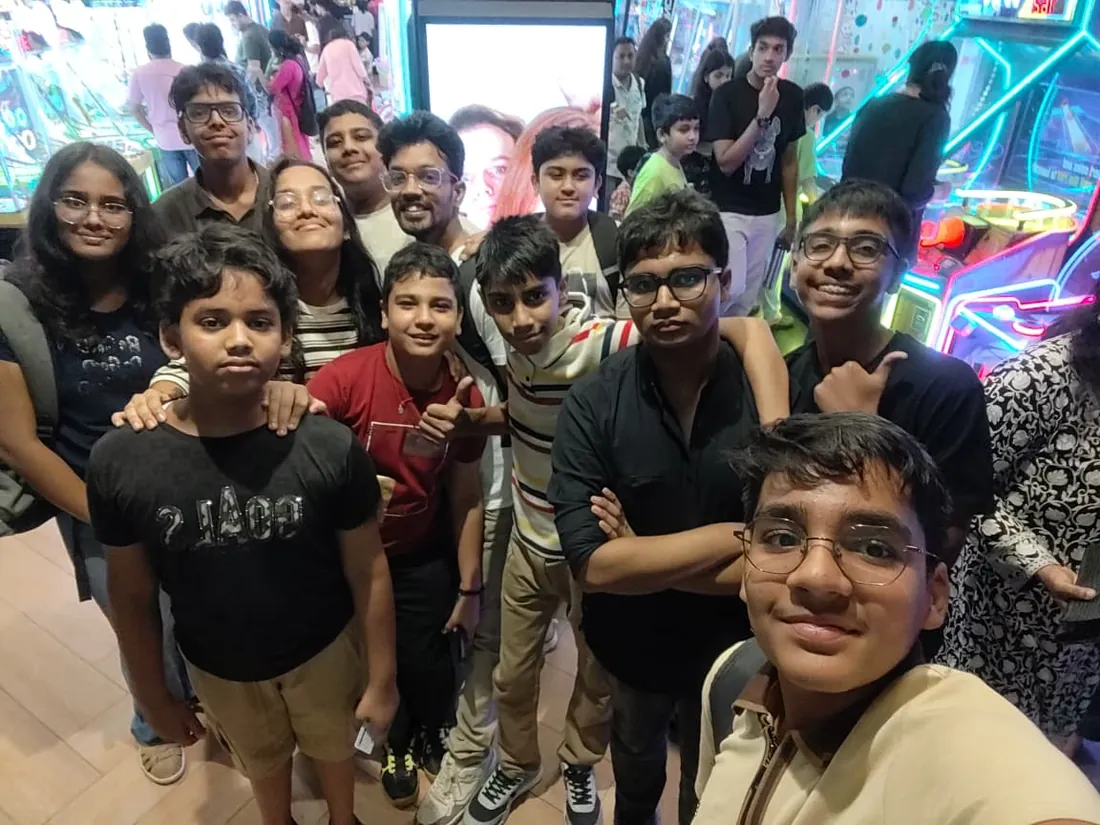
Real students. Real moments. Real joy.
These are our actual student meetups. No stock photos, no filters. Swipe through and meet the community you'll be joining.






































What families say
Straight from the parents and students who learn with us. Rated 4.9 across 547 Google reviews.
“Mivaan enjoys the class. He understands the concepts and completes his tasks with excitement. He started taking interest in coding… truly amazing class.”
“I absolutely love it here! I made new friends and learned important valuable coding skills while having the fun of my life. It's not just coding here, it's outings, bonding and most importantly preparing you for your future. Definitely five stars.”
“What stands out most is how excited my son is before every class. He looks forward to learning, problem-solving, and sharing what he's built. I've noticed a big boost in his confidence!”
“Modern Age Coders has been a game-changer for me! I struggled to grasp IT concepts and coding before joining, but their classes transformed everything. I'm now the topper in my class and can confidently write complex programs with ease.”
“Modern Age Coder have wonderful teachers who teach in a clear, easy and practical way. The teacher boosts students' confidence, keeps them updated with technology, and inspires them to learn without hesitation.”
“The one step solution for my son. Modern Age Coders make learning coding so simple that kids love it.”
“Coding classes here make learning very interesting and conceptual. The teachers teach us in a very easy-to-understand and efficient manner.”
“One of the most wonderful education centres out there. Education is not limited to school syllabus but focuses on skill development. Learning here has been a wonderful journey and still continuing.”
“I highly recommend this computer coding class! The teachers are incredibly knowledgeable and passionate about coding. They make every session engaging and insightful.”
“My child Dhairya is really enjoying the Modern Age Coder IT classes. This is his first online class, and he eagerly looks forward to it.”
“Very good classes. Don't worry about coding. They teach the best, especially Shivam sir.”
“Very good classes. Makes learning very easy and interactive.”
Hear it from our students
Real parents and students in their own words, on our public YouTube channel.
Straight answers about Waterloo Math Contests: Gauss to Euclid
- Who should take this course?
- Students roughly aged 11 to 18 (Grades 7 to 12) who are comfortable with school math and want harder problems, in a Gauss track (Grades 7 and 8), a Grades 9 and 10 track and a Grades 11 and 12 track. Age: Roughly 11 to 18 (Grades 7 to 12). The track is chosen by grade and level after a short diagnostic. It suits grade 7 and 8 students who enjoy puzzles and want to write the gauss with real preparation; students preparing for the pascal, cayley, fryer, galois or cimc; students preparing for the fermat, hypatia, csmc or euclid, including full-solution writing.
- What will they learn and build?
- The Centre for Education in Mathematics and Computing (CEMC) at the University of Waterloo runs a family of math contests "Designed by teams of expert mathematicians and educators for Grades 5 to 12". Each contest is matched to a grade.
- How deeply are topics covered?
- The course runs 6 months (24 weeks) per season, joinable any month and timed to the CEMC contests each student will write at 2 live classes/week + weekly problem sets, written solutions and timed practice rounds, across 3 phases listed week by week in the syllabus below.
- Who teaches it?
- Modern Age Coders mentors, who teach the live classes themselves. You can watch them at work in the free class recordings before you decide.
- How do practice, feedback and assessment work?
- Classwork in every session and homework after every class. A certificate from Modern Age Coders that you earn by passing the final assessment, with a free retest after revision if needed. It is not a CEMC certificate or result.
- What does it cost?
- Three monthly plans: a group batch, a mini batch and 1-on-1. Prices are shown in your currency in the plans section. Monthly billing, cancel any time.
- When can classes take place?
- Live classes are scheduled around your week. Group batches meet at a fixed weekly slot; 1-on-1 students choose their own. International students are scheduled in their own timezone. Ask on WhatsApp for the current slots.
- Can I watch the teaching before deciding?
- Yes. Full recordings of real 13 and up classes are free to watch, free with a Google sign-in. These recordings show how we teach, not the exact syllabus of this course. Some classes are in English and some in Hindi; everyone follows at their own pace. Watch a class end to end, like you are in it. Sessions are interactive and each moment builds on the last.
- Can I enroll without a live demo?
- Yes. Choose a plan on this page and enrol directly; a demo is not required. If you would like to see a full class with a mentor first, book a Priority Demo.
- How do I reach you with a question?
- WhatsApp +91 91233 66161, email connect@modernagecoders.com, or call +91 91233 66161. Tell us the student's age and what they have learned so far, and we will point you to the right plan and batch.
Common Questions About Waterloo Math Contests: Gauss to Euclid
Get answers to the most common questions about this comprehensive program
Still have questions? We're here to help!
Contact UsRelated Courses You May Like
Continue your learning journey with these recommended programs
 Competition Mathematics & Olympiad Training
Middle School Math Competitions: MATHCOUNTS, AMC 8 and Math Kangaroo Prep
Live online math competition prep for ages 10 to 14: number theory, counting, algebra and geometry p...
Explore Course Competition Mathematics & Olympiad Training
Maths Olympiad & Competition Course: AMC, AIME to IMO
One-year maths olympiad course: master number theory, combinatorics, algebra, geometry and inequalit...
Explore CourseRelated Articles & Guides
Deepen your knowledge with these hand-picked articles
 Education
14 min read
How Learning Coding Improves Mathematical Thinking in Children
Discover the research-backed connection between coding and math skills. Learn how programming develo...
Read Article Mathematics
8 min read
Abacus vs Vedic vs Mental Maths: A Clear Comparison
Abacus, Vedic maths, and mental maths compared: what each teaches, the right age, real worked exampl...
Read ArticleReady to start Waterloo Math Contests: Gauss to Euclid?
Book a Priority Demo to see a full live class with a mentor reserved for you, today or tomorrow. Or choose a plan and enrol now.
Questions? WhatsApp +91 91233 66161 or email connect@modernagecoders.com