Can a Surrey student get live math tutoring without travelling?
Yes. Modern Age Coders teaches math to students in Surrey, British Columbia, live over video, from Grade 1 to Pre-calculus 12, with a teacher for one student or for a group of fifteen to twenty at one level. Grade 12 students often join Western Canada Grade 12 Math: Pre-calculus 12 and Math 30-1. The opening lesson costs nothing.
The decision that shapes a Surrey teenager’s math most is made quietly in Grade 9, when families choose a Grade 10 course. BC offers Workplace Mathematics 10 and Foundations of Mathematics and Pre-calculus 10, and in Grade 11 the Foundations and Pre-calculus courses go separate ways. Neither route is a lesser one, but they lead to different places. This page explains both from the province’s own course content, then spends most of its length on mathematics itself: a geometry lesson on the City of Surrey’s dog off-leash areas that touches area, perimeter and optimization, a fencing problem worked by hand, the Fraser Valley Math Kangaroo and the CEMC contests, and a plain account of what tutoring in Surrey costs a family.
Facts last verified 23 October 2026. Teaching is online; no Surrey branch is claimed.
Each is tied to a stage of BC math. The teacher in the free lesson confirms the choice after hearing the student work through a problem.
Place value, operations, fractions and measurement, taught by asking a child to explain the method as well as the answer.
See the syllabus
Mathematics 9, either Grade 10 course, then Foundations 11 or Pre-calculus 11, with the reasoning written out line by line.
See the syllabus
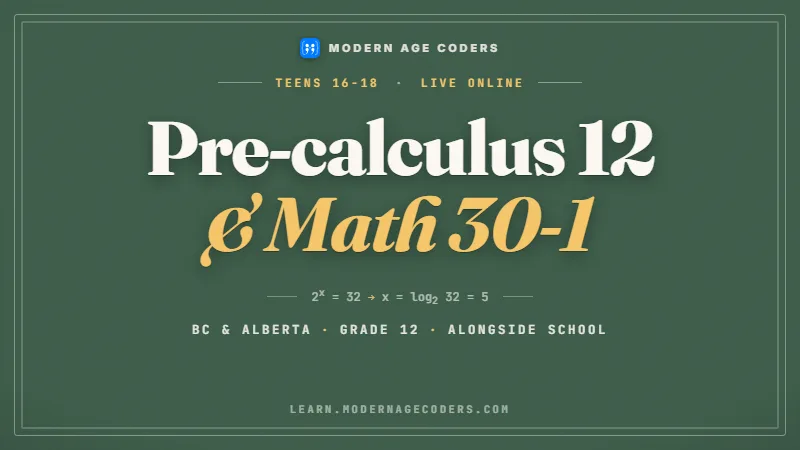
Pre-calculus 12 support paced to the school course: transformations, logarithms, series and trigonometry. Credits stay with the school.
See the syllabus

Puzzle-style problems we write ourselves for the Gauss, Pascal and Math Kangaroo kind of student, plus the free CEMC archive.
See the syllabusBrowse the course atlas for more than one hundred options and use the coding roadmap to check prerequisites.
The four we are known for
These run underneath everything above. Every one is live and online, placed by ability rather than by age, and the first class is free.

Python, web and AI projects where the learner still owns the thinking.
See the syllabus

Automate the work you already do, then let AI carry part of it.
See the syllabus

Train a model, read what it learned, and be able to say why it is wrong.
See the syllabus

Run AI coding agents on real work without losing control of the codebase.
See the syllabusSurrey’s public schools follow the British Columbia curriculum. We copied the content phrases below from the province’s curriculum website on 23 October 2026; the plain-language column is our own summary.
| Course | From the content list | In plain terms |
|---|---|---|
| Workplace Mathematics 10 | “surface area and volume including prisms and cylinders, formula manipulation” | Applied measurement, graphs, probability by experiment and personal finance |
| Foundations of Mathematics and Pre-calculus 10 | “slope: positive, negative, zero, and undefined” | Linear functions, systems, polynomials, exponents and right-triangle trigonometry |
| Foundations of Mathematics 11 | “maximizing area or volume while minimizing perimeter” | Logic and proof, statistics, optimization, scale models and compound interest |
| Pre-calculus 11 | Quadratic functions, radical and rational expressions, sine and cosine laws | The algebra and trigonometry Pre-calculus 12 builds on |
The shared Grade 10 course is the wider door: its content includes slope, systems solved “by inspection, substitution, elimination”, arithmetic sequences and the primary trigonometric ratios. Workplace Mathematics 10 covers useful ground too, including metric and imperial conversions and the volume of cylinders, but it is a different course with a different emphasis. Because school course requirements vary, we always tell a Surrey family to ask the counsellor which Grade 11 courses each Grade 10 choice allows before the timetable is set.
Its content opens with “forms of mathematical reasoning”: logic, conjecturing, inductive and deductive thinking, proofs, game and puzzle analysis and counter-examples. Students who like arguments over algebra often find it the more interesting Grade 11 course.
Quadratics in several forms, radicals with domain restrictions and extraneous roots, rational expressions with non-permissible values, then the sine and cosine laws. Gaps from Grade 10 factoring surface here first.
For the senior years, our Calculus 12 tutor page covers calculus, and math courses compared across Canada sets Pre-calculus 12 beside Ontario and Alberta equivalents.
Our teaching supports the course a Surrey student is taking at school. We do not grant BC credits; every credit and final mark comes from the school. We have no connection with the BC Ministry of Education and Child Care, the City of Surrey or the Surrey school district.
The City of Surrey maps its dog off-leash areas as polygons in its open data. Foundations 11 students compute each area and perimeter from the corner coordinates, then compare shapes with one ratio. All the numbers below are our calculations.
The layer is called Park Dog Off Leash Areas, and its summary reads simply: this dataset includes dog off-leash areas in Surrey. We queried it on 23 October 2026 and received 22 polygons, every one marked as operating. Each polygon is a list of corner points in metres, east and north, in the city’s map projection, which is exactly what a student needs to work out area and perimeter from first principles.
| Off-leash area | Area (m²) | Perimeter (m) | Compactness |
|---|---|---|---|
| Dogwood Park | 85,586.6 | 1,272.1 | 0.665 |
| Tynehead Park | 24,012.2 | 1,703.1 | 0.104 |
| East View Trail Park | 13,404.1 | 676.5 | 0.368 |
| Clayton Dog-Off-Leash Park | 12,222.9 | 454.4 | 0.744 |
| Bolivar Park | 5,592.2 | 289.2 | 0.840 |
| Nicomekl Off Leash Park, main area | 3,538.1 | 224.4 | 0.883 |
| Joe Brown Park, large dogs | 3,186.6 | 268.2 | 0.557 |
| Joe Brown Park, small dogs | 1,243.8 | 173.6 | 0.519 |
Across all 22 polygons our areas run from 622.2 to 85,586.6 square metres, with a median of 5,392.5, and they add up to 213,749 square metres, about 21.4 hectares. That total is our own sum of our own areas, not a City figure. Our shoelace results agree with the area the City stores for each polygon to within 0.0002 percent, a good check that the method and the units are right.
The shoelace formula adds up cross products of neighbouring corners and halves the result. This program applies it to every ring of every polygon and prints the area, perimeter and compactness:import json, math
def signed_area(ring):
total = 0
for (x1, y1), (x2, y2) in zip(ring, ring[1:]):
total += x1 * y2 - x2 * y1
return total / 2
def perimeter(ring):
return sum(math.dist(a, b) for a, b in zip(ring, ring[1:]))
with open("offleash_26910.json", encoding="utf-8") as f:
areas = json.load(f)["features"]
for park in areas:
rings = park["geometry"]["rings"]
area = abs(sum(signed_area(r) for r in rings))
edge = sum(perimeter(r) for r in rings)
ratio = 4 * math.pi * area / edge ** 2
print(park["attributes"]["DESCRIPTION"], round(area, 1), round(edge, 1), round(ratio, 3))
Tynehead’s area is a strip along the park, and its ratio of 0.104 says so. Its perimeter of 1,703.1 m is 2.75 times the perimeter of a square with the same area, which would need only 619.8 m of fence.
East View Trail Park is stored as three rings: an outer boundary of 14,383.4 square metres and two holes of 357.2 and 622.1. The signs in the shoelace sum handle this automatically, and the area left is 13,404.1. Students should explain why.
Joe Brown Park has separate polygons for large dogs and small dogs, 3,186.6 and 1,243.8 square metres. Counting parks and counting polygons give different answers, and a good report says which one it means.
A ratio near 1 means the shape encloses a lot of area for its edge; a ratio near 0 means a lot of edge. Nicomekl’s main area, at 0.883, is rounder than a square; Tynehead, at 0.104, is a corridor. The ratio says nothing about how pleasant a park is for a dog. It answers one geometric question, and students are expected to keep it to that question.
Contains information licensed under the Open Government License - City of Surrey. We use the layer on those terms, which allow commercial use (licence, dataset page). The City of Surrey does not endorse this page or our classes.
Our own problem, at Foundations 11 level, answering the question the off-leash table raises: for a fixed amount of fence, which shape encloses most?
Question. A city crew has 240 m of fencing for a new off-leash area. (a) If the area is a rectangle, which width gives the largest area? (b) How much more would a circle enclose? (c) Bolivar Park’s off-leash polygon has a perimeter of 289.2 m and an area of 5,592.2 square metres. Is it more or less efficient than a square with the same perimeter?
Step 1, write the area as a function. If the width is w, the length is 120 minus w, because two widths and two lengths make 240. The area is A(w) = w(120 − w), a quadratic that opens downward with zeros at 0 and 120.
Step 2, find the maximum. The vertex sits halfway between the zeros, at w = 60, so the best rectangle is a 60 by 60 square with area 3,600 square metres. A table shows the symmetry: widths 20, 40, 60, 80 and 100 give 2,000, 3,200, 3,600, 3,200 and 2,000.
Step 3, try a circle. A circumference of 240 m gives a radius of 240 divided by 2π, about 38.197 m, and an area of about 4,583.7 square metres, roughly 27 percent more than the square. Of all shapes with a given perimeter the circle encloses the most, which is why the compactness ratio is built so that a circle scores exactly 1.
Step 4, judge Bolivar. A square with a 289.2 m perimeter has sides of 72.3 m and an area of about 5,227.3 square metres. Bolivar’s polygon encloses 5,592.2, more than that square, which matches its compactness of 0.840 being above a square’s 0.785. A circle with the same perimeter would enclose about 6,655.6.
Try it yourself. (1) If one side of the rectangle is a river and needs no fence, what dimensions maximise the area now? (2) Find the compactness of a 30 by 120 rectangle. (3) Explain in two sentences why a long, thin park can still be a sensible design. We take answers in the free lesson.
Surrey students have one well-known contest close by and several national ones through school. Each date is as published by the contest’s organiser when we checked on 22 October 2026.
| Contest | Grades | Format, as the organiser states it | Date |
|---|---|---|---|
| Math Kangaroo, Fraser Valley contest | Grades 1 to 12, six versions | Grades 5 to 12: 30 multiple-choice questions in 75 minutes | Sunday 21 March 2027, UFV Abbotsford campus |
| Pascal, Cayley, Fermat (CEMC) | Grades 9, 10, 11 | 25 multiple-choice questions in 60 minutes | 23 and 24 February 2027 |
| Gauss (CEMC) | Grades 7 and 8 | 25 multiple-choice questions in 60 minutes | 10 to 21 May 2027 |
The University of the Fraser Valley page says students from grades 1 to 12 are welcome to write the Kangaroo, with different versions for grades 1-2, 3-4, 5-6, 7-8, 9-10 and 11-12. Younger children get shorter papers: 18 questions in 45 minutes for Grades 1 and 2, and 24 questions in 60 minutes for Grades 3 and 4. Questions are arranged in increasing difficulty, so the last ten are where preparation shows. Our Math Kangaroo Canada preparation page goes through the format by level.
Because the Kangaroo starts at Grade 1, it is often a Surrey child’s first contest. We prepare young students with puzzles, not drills, and never with past papers we have copied.
CEMC says all students must participate through their school. A student whose school does not run Pascal or Gauss can ask another local school to host them, as CEMC suggests.
Every contest problem we teach with is written by us and marked as ours. We are not connected with Math Kangaroo, the University of the Fraser Valley or CEMC.
The fees section below shows our prices in your own currency, so none are typed here. This section is about what to check behind any price you are quoted.
| Check | With us | Why it matters |
|---|---|---|
| Lessons a month | Eight live classes | Price per lesson is the only fair comparison |
| Class size | Fifteen to twenty at one level, or one to one | A mixed-level room slows everyone |
| Course knowledge | Workplace 10, both Grade 10 routes, Foundations 11, Pre-calculus 11 and 12 | Foundations and Pre-calculus need different lessons |
| Travel | None; lessons on a home computer | A drive across Surrey adds an hour that nobody bills but someone pays for |
| Free trial | One full live lesson | You see the teaching before deciding |
A rough rule we give Surrey parents: work out the cost of one lesson that actually happens, then ask how many minutes of it the student spends solving. A group class at one level gives structure and steady practice for a student who is roughly on track. One to one makes sense for a single hard gap, a student switching routes between Grade 10 and Grade 11, or the weeks before a Pre-calculus 12 final.
Grade bands are approximate. The free lesson places a student by what they can explain, not by age alone.
Counting, place value and simple measurement, plus Kangaroo-style puzzles for curious children.
Early Math FoundationsMental Maths for KidsFractions, decimals, area and perimeter, integers and first equations before Mathematics 9.
Elementary Maths for Grades 1-5Middle School Mathematics MasteryMathematics 9, either Grade 10 course, then Foundations 11 or Pre-calculus 11 with the next step in view.
High School MathematicsMaths Through CodingPre-calculus 12, with Calculus 12 or contest work alongside for students who want more.
Western Canada Grade 12 MathWaterloo Math ContestsChoosing the right formula, checking the units and deciding what the number means.
An AI assistant will happily compute an area from a list of coordinates. Give it the East View Trail Park polygon and it may add the holes instead of subtracting them, or treat degrees as metres, and print a confident wrong answer. Only someone who understands why the shoelace formula carries signs will notice.
Our teachers ask Surrey students to estimate first, compute second and explain third. AI tools come in only for older students, within the age rules we follow, and only to check work the student has already done. School assignments that are marked stay entirely the student’s work.
Foundations 11 lists counter-examples and proof among its first topics, which is a good description of what a student must do to an AI answer. The longer argument is in why thinking skills matter in an AI world.
Surrey is spread out, from Whalley and Guildford to Cloverdale and South Surrey. Online lessons remove the drive.
Weekdays or weekends, flexible: choose your batch, or for a very personalised plan choose 1-on-1 at your convenience, weekend mornings or weekdays.
Since 8 March 2026 BC has stayed on UTC-7, so Surrey lesson times no longer move in November or March. India is 12 hours 30 minutes ahead, and invitations are written in Pacific time.
Each student writes on a shared board in view of the teacher, which shows the exact step where a method goes wrong.
Teachers know whether a Grade 11 student is in Foundations or Pre-calculus and plan accordingly, because the two courses differ.
The form accepts 604, 778, 236, 672 and 257 mobiles. Type the full ten digits; the country code is already set.
Lesson one is a proper lesson at no cost. It ends with a suggested course, level and time; no card is asked for.
No Surrey centre
Modern Age Coders has no learning centre in Surrey and does not claim one. Our teachers teach live online from India; a student needs a computer, a microphone and a reliable internet connection.
Three lines, each in your local currency.
A full live lesson for free, finishing with a recommended course and level.
The monthly fee for eight live group classes, fifteen to twenty students at one stage.
The monthly fee for eight lessons with a teacher of your own.
Surrey families pay the same as every other Canadian family. We bill only after the free lesson, once a course and a time are agreed; holidays and missed classes are explained on the pricing page.
Rated 4.9 across 547 Google reviews. These are real reviews, reproduced as written.
★★★★★
"The one step solution for my son. Modern Age Coders make learning coding so simple that kids love it. The teachers explain complex concepts clearly with practical exercises and interactive content."
Ria Mukherjee
Parent
★★★★★
"Modern Age Coders has been a game-changer for me. I struggled to grasp IT concepts and coding before joining, but their classes transformed everything. I can now confidently write complex programs with ease."
Samriddha Mondal
Student
★★★★★
"One of the most wonderful education centres out there. Education is not limited to school syllabus but focuses on skill development."
Vansh Agarwal
Student
★★★★★
"My child Dhairya is really enjoying the Modern Age Coders classes. This is his first online class and he eagerly looks forward to it. I can already see his improvement, and the teachers are very cooperative."
Sonam Oswal
Parent of Dhairya
★★★★★
"Modern Age Coders have wonderful teachers who teach in a clear, easy and practical way. The teacher boosts students' confidence and inspires them to learn without hesitation."
Sonu Goyal
Parent
★★★★★
"I highly recommend this computer coding class! The teachers are incredibly knowledgeable and passionate about coding."
Ritu Kedia
Parent
Let us know the grade, and from Grade 10 which course. A Grade 2 child might start with shape puzzles; a Foundations 11 student might start with the off-leash polygons.
What Surrey parents and students most often ask us.
Yes, online. There is no building in Surrey. A teacher teaches live, one to one or to a group of fifteen to twenty at one level, and the student joins from home.
See the fees section on this page: a free first lesson, then a monthly group fee or a monthly one-to-one fee, shown in your currency. No payment is taken before the free lesson.
Ask the school counsellor what each choice allows in Grade 11 before deciding. The shared Foundations and Pre-calculus 10 course covers slope, systems and trigonometry and keeps more routes open; we can help a student who is worried about it.
Yes. Logic, statistics, optimization and scale models are all in it, and the off-leash lesson on this page is the kind of problem we use.
Yes, beside the school course. Factoring, radicals, rational expressions and trigonometry in Grade 11, then functions, logarithms and series in Grade 12.
No. We do not grant BC credits. The school awards every credit and mark; we teach alongside it.
The University of the Fraser Valley lists its Fraser Valley contest for Sunday 21 March 2027 at its Abbotsford campus, for Grades 1 to 12 in six versions.
Weekdays or weekends, flexible: choose your batch, or for a very personalised plan choose 1-on-1 at your convenience, weekend mornings or weekdays. The clock in Surrey is fixed at UTC-7 now, so times hold steady through winter.
Yes. Because lessons are online, students across the Fraser Valley and Metro Vancouver join the same classes on Pacific time.
Often, yes, when the class starts where the child actually is. The free lesson finds that point, usually in fractions or multiplication facts.
Start with our online math tutor page for Canada or the province page, coding classes in British Columbia. Young contest fans can read Math Kangaroo preparation, and home-educating parents will find our BC homeschool math and coding guide useful.