HADV / F / 01
Algebra foundations
Equations, indices and factorising until they are automatic.
Open the syllabusNew South Wales · Mathematics Advanced · Live online
Mathematics Advanced is the calculus course most NSW students take into Year 12, and it is changing under their feet. A new syllabus written in 2024 takes over from the 2017 one, with Year 12 teaching starting in Term 4 of 2026 and the first exam on it in 2027. Students who understand why a derivative works, rather than which rule to apply, ride out that kind of change easily. That understanding is what we teach.
Read from the 2024 syllabus · Calculus taught from first principles · Lessons in NSW afternoon hours
In short
HSC Mathematics Advanced is the NSW calculus-based course, now governed by the Mathematics Advanced 11-12 Syllabus (2024). It covers functions, trigonometry, calculus, exponentials and logarithms, sequences and series, statistics and financial mathematics. The HSC exam is one 100-mark written paper of 3 hours plus 10 minutes reading time, with a reference sheet and approved calculators. We tutor it online, live, for Year 11 and Year 12.
Where to begin
Algebra that never wobbles, then calculus taught as an idea, then the statistics Year 12 leans on.
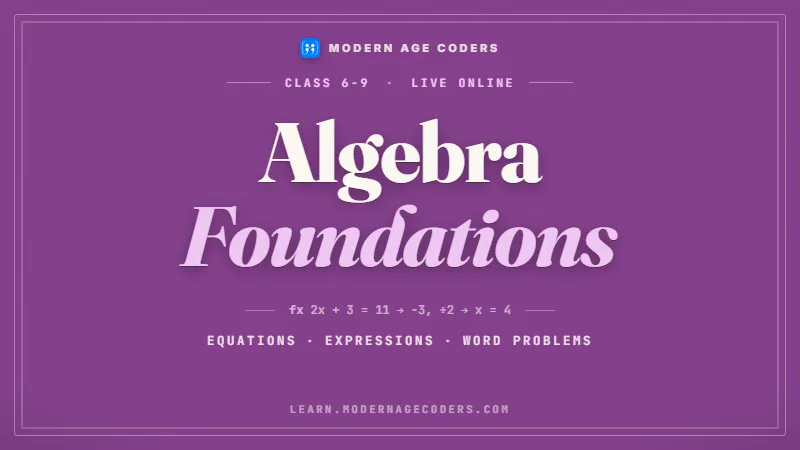
HADV / 01
Factorising, indices and rearranging without hesitation, because every calculus mark in the paper rests on algebra done cleanly.
Open the syllabus →
HADV / 02
Graphs, trigonometry and the derivative built up in order, matching the way Advanced moves from Year 11 to Year 12.
Open the syllabus →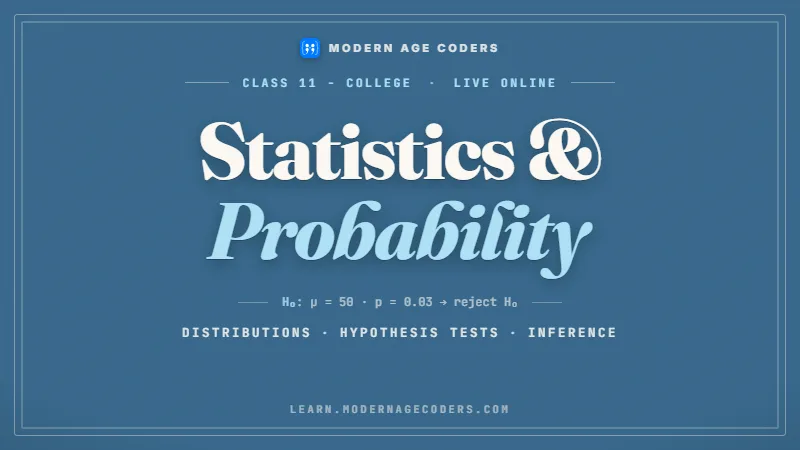
HADV / 03
Discrete and continuous random variables, expectation and spread, the Year 12 statistics focus area in full.
Open the syllabus →What the 2024 syllabus contains
The focus areas below are NESA's own, from the course structure of the new syllabus. Read on the NSW Curriculum site, checked on 7 October 2026.
| Area of study | Year 11 focus areas | Year 12 focus areas |
|---|---|---|
| Functions | Working with functions; Graph transformations | Further graph transformations and modelling |
| Trigonometric functions | Trigonometry and measure of angles; Trigonometric identities and equations | None listed for Year 12 |
| Calculus | Introduction to differentiation | Differential calculus; Integral calculus; Applications of calculus |
| Exponential and logarithmic functions | Exponential and logarithmic functions | None listed for Year 12 |
| Statistical analysis | Probability and data | Random variables |
| Sequences and series | None listed for Year 11 | Sequences and series |
| Financial mathematics | None listed for Year 11 | Financial mathematics |
Read the table from left to right and a pattern appears. Year 11 lays down the language: functions, angles, logarithms, a first look at the derivative. Year 12 then spends most of its time in calculus, with three separate focus areas devoted to it, and uses that calculus to model growth, motion and accumulation.
NESA lists the Year 11 course as course number 11255 and the Year 12 course as 15255, each worth 2 units and 120 indicative hours. Year 12 Advanced has Year 11 Advanced as its prerequisite, so a shaky Year 11 is not something a student can leave behind.
The timing matters for anyone in Year 11 or 12 right now. NESA says the new syllabus "is to be implemented from 2026", with teaching for Year 12 starting in Term 4 of 2026 and the first HSC examination on it in 2027. The NSW Government page for the 2017 syllabus warns that it "will not be available after December 2026".
In practice, revision guides and worked solutions printed for the 2017 course still teach a lot of useful mathematics, but their topic lists no longer match. Sequences and series, for example, now sits as its own Year 12 area of study. Students should plan revision from the 2024 focus areas and borrow older material only where the content lines up.
Sources: NSW Curriculum, Mathematics Advanced 11-12 Syllabus (2024), overview and course structure; NSW Government, Mathematics Advanced Stage 6 Syllabus (2017). Checked on 7 October 2026.
How the HSC paper is built
NESA publishes the examination specification with the syllabus. Everything in the table is quoted from it, checked on 7 October 2026.
| Feature | What NESA specifies |
|---|---|
| Marks | A written paper worth 100 marks |
| Time | 3 hours plus 10 minutes reading time |
| Support | A reference sheet will be provided; NESA-approved calculators may be used |
| Section I | Objective-response questions to the value of 10 marks |
| Section II | 90 marks; questions may contain parts; there will be 37 to 42 items |
| Longer items | At least two items will be worth 4 or 5 marks |
| Scope | Based on the Year 12 course; the Year 11 course is assumed knowledge and may be examined |
Ninety of the hundred marks sit in Section II, spread over 37 to 42 items. That works out to an average of a little over two marks per item, which tells a student what the paper rewards: short, correct chains of reasoning, written so a marker can follow each step.
The two or more items worth 4 or 5 marks are where preparation shows. A student who sets out a derivative, states what it means in context and then answers the question asked collects those marks steadily; a student who jumps straight to a number usually loses half of them.
Three hours for 100 marks is roughly 1.8 minutes per mark. We teach students to use that number as a budget during practice papers: an item worth 3 marks should take around five and a half minutes, and anything running far past that is a sign to move on and return later.
The 2026 HSC written exams start on 13 October 2026 and finish no later than 5 November 2026, according to NESA's key dates. A student sitting the first exam on the new syllabus in 2027 should expect a similar window and check NESA's 2027 timetable once it is released.
Sources: NSW Curriculum, Mathematics Advanced HSC examinations; NESA, 2026 HSC key dates. Checked on 7 October 2026.
The idea worth owning
Introduction to differentiation is a Year 11 focus area, and everything in Year 12 calculus is built on it. The cleanest way to understand it is to watch a difference quotient settle down as the gap shrinks.
Take a curve and a point on it. Choose a second point a horizontal distance h further along. The straight line through both is a secant, and its slope is the change in y divided by h.
Make h smaller and recalculate. The second point slides towards the first, and the secant swings closer to the line that only touches the curve there.
If the slopes approach one fixed number as h gets smaller, that number is the gradient of the tangent: the derivative at that point.
A worked example, written by us for practice. Take y = x cubed at the point x = 2, where y = 8. The secant slope to the point x = 2 + h is ((2 + h) cubed minus 8) divided by h. Expanding the bracket and dividing by h gives 12 + 6h + h squared, so the table below can be checked by hand as well as by calculator.
| h | Second point x | Secant slope | Gap from 12 |
|---|---|---|---|
| 1 | 3 | 19 | 7 |
| 0.1 | 2.1 | 12.61 | 0.61 |
| 0.01 | 2.01 | 12.0601 | 0.0601 |
| 0.001 | 2.001 | 12.006001 | 0.006001 |
| -0.01 | 1.99 | 11.9401 | -0.0599 |
The slopes close in on 12 from above when h is positive and from below when h is negative, and the gap shrinks roughly in proportion to h. That is exactly what the algebra predicted: 12 + 6h + h squared tends to 12 as h tends to 0, so the gradient of the tangent at x = 2 is 12.
The power rule would have said 3 times 2 squared, which is also 12. The point of the table is not to replace the rule but to make it believable. A student who has watched the slopes settle can explain in words what a derivative is, and that explanation is what earns the method marks on a "show that" question.
The same table carries straight into Year 12. Differential calculus asks for rates of change and stationary points; Applications of calculus asks what those rates mean for a real quantity. Each is the limit of a difference quotient in disguise, which is why we return to this idea whenever a student gets lost in a long derivative.
There is a programming version too. A few lines of Python can print this table for any function and any h, and watching the numbers in real time cements the idea in a way a printed page cannot. We use that for students who also enjoy coding, never as a substitute for the written method the exam wants.
School-based assessment
Alongside the exam, every school runs its own assessment program. The rules below are NESA's, checked on 7 October 2026.
| Year | What NESA requires |
|---|---|
| Year 11 | A grade for each student on the Common Grade Scale for Preliminary courses; components Knowledge and understanding of course content 50% and Skills in Working mathematically 50% |
| Year 12 | A school-based assessment mark for each student; the same two components at 50% each |
| Both years | Schools set the number, type and weighting of tasks, subject to a limit of one take-home task worth no more than 15% |
| Guidance | Individual tasks should carry a weighting between 10% and 40% |
Half the school mark is labelled Skills in Working mathematically, which in the 2024 syllabus means communicating reasoning, understanding and fluency, and problem solving. That is good news for students who can explain a method in clear sentences, and bad news for students who have memorised procedures without knowing why they work. The difference quotient above is one small example of the explanation habit we build.
NESA limits each program to one take-home task worth no more than 15%, a change made with generative AI in mind. Most marks therefore come from tasks done in class or under exam conditions. We teach with our own problems and never complete, edit or check work that a school will assess; our job is to make sure the student can do it unaided on the day.
Source: NSW Curriculum, Mathematics Advanced school-based assessment. Checked on 7 October 2026.
Getting there
A student's starting stage depends on what they can do without help, not on the calendar.
| When | Stage | The sign it is secure |
|---|---|---|
| Year 10 | 1. Algebra | Expands, factorises and rearranges formulas with no sign slips |
| Year 11 | 2. Functions | Sketches a transformed graph and explains each change |
| Year 11 into 12 | 3. Calculus | Explains a derivative as the limit of secant slopes |
| Year 12 | 4. Exam writing | Sets out a 5-mark item so a stranger could follow it |
Graph transformations and logarithms usually expose gaps in index laws and rearranging. A few weeks of focused algebra repair often unlocks the whole Year 11 course faster than pushing on.
Trigonometry is the other common bottleneck. Students who learn the unit circle as a picture rather than a list of values make far fewer errors with identities and equations.
Students who enjoy the proof side of calculus can move into Mathematics Extension 1, which builds directly on Advanced.
Advanced also supports computing: the rates of change and modelling skills here reappear in HSC Software Engineering and any later data or AI study.
The catalogue
Grouped by how they support the course. Every card opens a full syllabus.
HADV / F / 01
Equations, indices and factorising until they are automatic.
Open the syllabusHADV / F / 02
Functions, trigonometry and calculus taught in a sensible order.
Open the syllabusHADV / F / 03
For a student who needs to rebuild Year 8 and 9 skills first.
Open the syllabusHADV / C / 01
Built for the US AP exam, and full of differentiation and integration practice that overlaps Advanced.
Open the syllabusHADV / C / 02
Random variables, distributions and data, the statistical half of Year 12.
Open the syllabusHADV / C / 03
Interest, annuities and growth, close to the Financial mathematics focus area.
Open the syllabusHADV / S / 01
Problem solving for students who want harder questions than the syllabus sets.
Open the syllabusHADV / S / 02
Python used to explore functions, limits and data.
Open the syllabusHADV / S / 03
A first taste of calculus and linear algebra at university pace.
Open the syllabusHow lessons run
Our tutors work from India. From early October to early April, while NSW runs on daylight saving, Sydney sits five and a half hours ahead of India time; for the rest of the year the gap is four and a half hours. A 4.30 pm lesson in Sydney in summer therefore starts at 11 am for the tutor, which makes after-school lessons easy to staff.
After school, weekdays
The usual rhythm through Year 11 and Year 12.
Saturday or Sunday morning
For longer sessions on a single focus area.
Holiday blocks
Short intensive runs before trials or the HSC.
Each new technique starts with why it works, so it survives a question worded in an unfamiliar way.
Students practise setting out solutions the way markers read them, line by line.
Past-style items done against a minutes-per-mark budget, then reviewed together.
Advanced students at a matching level, each one asked to explain their reasoning aloud.
One student, one tutor, for a focus area that needs repair.
We never promise a band. The marks are earned by the student.
Student work
Personal work, not school assessment. More are collected in our student labs.

AI and ML
An AI nutrition coach that reads what you eat and works you toward a target.

AI and ML
A chatbot that answers mathematics and programming questions, built and deployed by a student.

AI and ML
An assistant that helps a young person recognise unsafe situations online.

Web app
A weather forecasting site with live conditions for any location.
Fees
A single monthly fee in US dollars, the same for every family outside India. Nothing to join and nothing owed beyond the month in progress.
Free first class
USD 0
no card required
Group batch
USD 100
a month, billed in US dollars
One to one
USD 150
a month, billed in US dollars
What families say
Copied word for word from Google, as parents and students wrote them.
★★★★★
"The one step solution for my son. Modern Age Coders make learning coding so simple that kids love it. The teachers explain complex concepts clearly with practical exercises and interactive content."
Ria Mukherjee
Parent
★★★★★
"Modern Age Coders has been a game-changer for me. I struggled to grasp IT concepts and coding before joining, but their classes transformed everything. I can now confidently write complex programs with ease."
Samriddha Mondal
Student
★★★★★
"One of the most wonderful education centres out there. Education is not limited to school syllabus but focuses on skill development."
Vansh Agarwal
Student
★★★★★
"My child Dhairya is really enjoying the Modern Age Coders classes. This is his first online class and he eagerly looks forward to it. I can already see his improvement, and the teachers are very cooperative."
Sonam Oswal
Parent of Dhairya
★★★★★
"Modern Age Coders have wonderful teachers who teach in a clear, easy and practical way. The teacher boosts students' confidence and inspires them to learn without hesitation."
Sonu Goyal
Parent
★★★★★
"I highly recommend this computer coding class! The teachers are incredibly knowledgeable and passionate about coding."
Ritu Kedia
Parent
Questions about Advanced
It is the NSW calculus-based mathematics course for Year 11 and Year 12, now set by the Mathematics Advanced 11-12 Syllabus (2024). It covers functions, trigonometry, calculus, exponential and logarithmic functions, sequences and series, statistical analysis and financial mathematics.
NESA says the 2024 syllabus is implemented from 2026, with Year 12 teaching starting in Term 4 of 2026 and the first HSC exam in 2027. The 2017 syllabus page states it will not be available after December 2026. The school will confirm which course a student is enrolled in.
3 hours plus 10 minutes reading time, for a written paper worth 100 marks. A reference sheet is provided and NESA-approved calculators may be used.
Section I has objective-response questions worth 10 marks. Section II is worth 90 marks across 37 to 42 items, and at least two items are worth 4 or 5 marks.
NESA states the exam is based on the Year 12 course and that the Year 11 course is assumed knowledge and may be examined.
It is the slope of a secant line between two points on a curve: the change in y divided by the horizontal gap h. As h shrinks towards zero, the difference quotient approaches the gradient of the tangent, which is the derivative at that point.
NESA sets two components at 50% each: knowledge and understanding of course content, and skills in working mathematically. Schools may set only one take-home task, worth no more than 15%.
No, and nobody honestly can. We teach the mathematics and the exam technique; the result depends on the work the student does.
We teach the mathematics behind them with our own problems. We do not write, edit or check any work that a school will mark.
Usually after school or on weekend mornings in NSW time, which falls in the late morning or early afternoon for our tutors. The weekly time is agreed after the free class.
Related pages
The next course up, the computing courses beside it, and the national picture.
Proof, vectors and combinatorics on top of Advanced.
The applied course, for a student weighing the switch.
The newest computing course in the NSW HSC.
NESA, the stages, and every NSW page in one place.
Maths support for every year level and state.
Our method, set out plainly.
Start here
Tell us the year level, the focus area and where marks are slipping. The free lesson works on that topic with our own problems.
Prefer to read first? Every course syllabus sits on the course atlas, our approach is on how we teach, and the competitions calendar lists maths contests across the year.
WhatsApp us · +91 91233 66161 · connect@modernagecoders.com
WhatsApp is the quickest way to reach us. Our number starts with +91 because the school is based in India; there is no NSW office.
A priority demo is a full class of about 45 to 60 minutes. After the class the mentor sends a written skill report and a personal learning roadmap on WhatsApp. If you enrol, the demo fee is adjusted against your first month's fee. Share your demo Order ID with us on WhatsApp and we take it off.
Book a priority demo