HKDSE Maths: Compulsory Part, M1 and M2 Exam Prep
The Compulsory Part and your Extended Part module taught one to one in English, one central idea and one original worked example at a time, so method marks come from understanding.
Syllabus updated November 2026
Questions? WhatsApp +91 91233 66161 or email connect@modernagecoders.com
Recordings are free with a Google sign-in. These recordings show how we teach, not the exact syllabus of this course.
Fees and enrolment
How to join HKDSE Maths: Compulsory Part, M1 and M2 Exam Prep
Choose how you want to pay, pick a plan and press Enrol. We then fix your class timing with you.
Rated 4.9 across 547 Google reviews.
How would you like to pay?
Pay once for 6 months and save 20%. Same live classes, same mentor, a lower price for every session.
How your 6-month price works
- Sessions
- 24 one-to-one sessions over 6 months, fully flexible timing
- Price per session
- ₹1,000 instead of
₹1,250 - Your 6-month fee
- ₹1,000 × 24 sessions = ₹24,000
- Paying monthly instead
₹4,999 × 6 months = ₹29,994- You save
- ₹5,994 (20%)
Everything in the monthly 1-on-1 plan is included: your own mentor, flexible timing, personal dashboard, class recordings, progress reports and parent-teacher meetings.
Stop early? Every session you have not taken is refunded at ₹1,000. Refund policy
Pay once for 6 months and save 25%. Same live classes, same mentor, a lower price for every session.
How your 6-month price works
- Sessions
- 48 one-to-one sessions over 6 months, 2 sessions a week
- Price per session
- $14 instead of
$18.75 - Your 6-month fee
- $14 × 48 sessions = $672
- Paying monthly instead
$150 × 6 months = $900- You save
- $228 (25%)
Everything in the monthly 1-on-1 plan is included: your own mentor, flexible timing, personal dashboard, class recordings, progress reports and parent-teacher meetings.
Stop early? Every session you have not taken is refunded at $14. Refund policy
Pay once for 6 months and save 25%. Same live classes, same mentor, a lower price for every session.
How your 6-month price works
- Sessions
- 48 one-to-one sessions over 6 months, 2 sessions a week
- Price per session
- $19.60 instead of
$26.25 - Your 6-month fee
- $941
- Paying monthly instead
$210 × 6 months = $1,260- You save
- $319 (25%)
Everything in the monthly 1-on-1 plan is included: your own mentor, flexible timing, personal dashboard, class recordings, progress reports and parent-teacher meetings.
Stop early? Every session you have not taken is refunded at $19.60. Refund policy
How enrolment works
Pick a plan
This course is taught 1-on-1 only: private live classes with your own mentor, about one hour each. Pay monthly, or for 6 months at once and save.
Press Enrol and pay
Fill in the student's name, email and phone, then pay securely: UPI, cards or net banking in India, or a debit or credit card from any other country.
Fix your class timing
After paying, WhatsApp or call +91 91233 66161 with the student's name and your preferred time. We confirm the batch or 1-on-1 slot and send the class link.
Start learning
Join your first live class at the time you chose. Your mentor takes it from there.
Want to see a class first? Book a Priority Demo: a live class of about 45 to 60 minutes with a mentor reserved for you. If you enrol, the demo fee is adjusted against your first month's fee. Share your demo Order ID with us on WhatsApp and we take it off.
Pay monthly and cancel any time, or pay for 6 months at once and save. Stop a 6-month plan early and every session left is refunded.
International Students (Outside India)
Billed monthly in US dollars, the same price in every country. Contact us with any questions.
Questions before you enrol? Talk to our team.
Ask about class timings, the right level for your child, what they need to know already, or payment. Parents and adult learners can reach us on WhatsApp, by email or by phone.
Our promise
The world's best learning experience, open to everyone.
- World-class instructorsEvery class is taught by an instructor who specialises in that exact field.
- No compromise on qualityEvery lesson, project and piece of feedback is held to the highest standard.
- Education for everyoneLearners aged 6 to 67, from first-time beginners to working professionals, in 25+ countries.
If you want the highest quality, Modern Age Coders is the right choice.
Book a Priority DemoHow long this course takes
This course runs 12 months (48 weeks), joinable any month; most students start in S5 so the full year ends before the April HKDSE papers at 2 live one to one classes a week + about 3 to 4 hours of written practice a week, rising to full timed papers in the final month. The range allows for background and pace: a complete beginner uses the full span, and a student with prior knowledge finishes sooner. The syllabus below is planned to the shorter end, with margin kept for revision.
For personalised duration planning, call +91 91233 66161 and we'll map a schedule to your goals.
At a glance
- Who it is for
- S4 to S6 students (about ages 15 to 18) taking HKDSE Mathematics, Compulsory Part with Module 1 or Module 2.
- Prerequisites
- Secure junior secondary (S1 to S3) mathematics. The first-month diagnostic finds any gaps and the mentor closes them inside the course
- Format
- Live, interactive online classes in English with a real mentor, never pre-recorded videos. Live classes run about one hour.
- Language
- English or Hindi, depending on the batch.
- Duration
- 12 months (48 weeks), joinable any month; most students start in S5 so the full year ends before the April HKDSE papers
- Weekly commitment
- 2 live one to one classes a week + about 3 to 4 hours of written practice a week, rising to full timed papers in the final month
- Class size
- Taught 1-on-1 only: every class is a private session with your own mentor.
- Certificate
- Certificate from Modern Age Coders, awarded on passing the final assessment (this is not an HKEAA document or an HKDSE result)
- Watch first
- Free recordings of real classes for ages 13 and up, free with a Google sign-in. These recordings show how we teach, not the exact syllabus of this course.
- Live demo
- Optional. Enrol directly on this page, or book a Priority Demo: a full live class of about 45 to 60 minutes with a mentor reserved for you.
- Questions
- WhatsApp +91 91233 66161 or email connect@modernagecoders.com.
How we teach
Deep understanding. Real projects. Expert guidance.
Learn coding, AI and maths through careful explanations, practical demonstrations, and hands-on problem-solving. Our instructors guide you from the foundations to advanced ideas, helping you understand what happens, why it happens, and how to build it yourself.
You will explore concepts step by step, write and improve code, investigate mistakes, ask questions, and apply your knowledge to meaningful projects. Lessons are designed around active participation, thoughtful feedback, and growing independence.
Expert-led live teaching, with practical participation built into every lesson.
- Students explain their thinking.
- Instructors demonstrate, then guide practice.
- Learners code, solve, or build during lessons.
- Questions and misconceptions get attention.
- Assignments receive useful feedback.
- Progress is checked before advancing.
Program Overview
Mathematics is one of the core subjects of the Hong Kong Diploma of Secondary Education (HKDSE). The exam is set by the Hong Kong Examinations and Assessment Authority (HKEAA), and the curriculum by the Curriculum Development Council with the Education Bureau (EDB). The curriculum has a Compulsory Part and an Extended Part, and the Extended Part has two modules: Module 1 (Calculus and Statistics), usually called M1, and Module 2 (Algebra and Calculus), usually called M2. A candidate takes either the Compulsory Part only, or the Compulsory Part plus one of the two modules, never both. We are an independent online academy: we are not part of the HKEAA or the EDB.
The Compulsory Part is examined in two papers. Paper 1 is conventional written questions, worth 65 percent and lasting 2 hours 15 minutes: Section A(1) has 8 to 11 elementary questions (35 marks), Section A(2) has 4 to 7 harder questions (35 marks) and Section B has 4 to 7 questions (35 marks). Paper 2 is multiple choice, worth 35 percent and lasting 1 hour 15 minutes. Calculators may be used. Each module is a single 2 hour 30 minute paper worth 100 percent of the module: Section A has 8 to 12 short questions (50 marks) and Section B has 3 to 5 long questions (50 marks). The M1 paper prints statistical tables where needed, and the M2 paper provides trigonometric formulas.
The two modules share their calculus but differ in what surrounds it. M1 adds the statistics: conditional probability and Bayes' theorem, discrete random variables, the binomial, Poisson and normal distributions, sampling distributions and confidence intervals for a population mean. M2 adds the algebra: mathematical induction, the binomial theorem, more trigonometry, determinants, matrices, systems of linear equations and vectors, with deeper calculus such as limits, first principles and integration by parts. M2 usually suits students heading towards engineering, physics or mathematics, and M1 usually suits students heading towards business, economics or the life sciences, though each school and each university course has its own advice. In 2026, 3,655 candidates sat M1 and 7,979 sat M2, according to the HKEAA's results release.
The course runs for twelve months. Months 1 to 6 rebuild the Compulsory Part in exam order: quadratics, exponentials and logarithms, polynomials, sequences, inequalities and linear programming, coordinate geometry, circles, trigonometry, counting, probability and statistics. Months 7 to 9 are the shared Extended Part core: the binomial expansion, the number e, limits, differentiation and integration. Months 10 and 11 split by module: M1 students study probability distributions and confidence intervals, M2 students study matrices, linear systems and vectors. Month 12 is full timed practice on Paper 1, Paper 2 and the module paper. Every two-week block teaches one central idea with one original worked example, solved step by step.
All practice is written by us in the HKDSE style: we never copy, adapt or reproduce HKEAA past-paper questions. Because the course is one to one, the mentor follows your child's school scheme and module, slows down where marks are being lost and moves faster where they are not. We promise teaching and practice, never a grade, a level or a university place.
What Makes This Program Different
- Taught one to one in English by a mentor who follows your school's scheme of work and your chosen module
- Built on the real papers: Paper 1 is 65 percent, Paper 2 multiple choice is 35 percent, and the module is one 2 hour 30 minute paper
- Both modules covered: the shared calculus for everyone, then M1 statistics or M2 algebra and vectors for the student who takes it
- Every two-week block has one original worked example checked step by step, with the transferable idea written down
- Method marks taken seriously: every solution is written out the way a marker reads it
- No HKEAA past-paper question is ever reproduced; every practice question is our own
Your Learning Journey
Career Progression
Detailed Course Curriculum
Explore the complete week-by-week breakdown of what you'll learn in this comprehensive program.
For a quadratic x^2 + bx + c = 0 with roots p and q, the roots add to -b and multiply to c. This lets you find expressions such as p^2 + q^2 without solving the equation, using p^2 + q^2 = (p + q)^2 - 2pq. The trap is solving with the formula and carrying messy surds through every step when the question only asks about a symmetric expression.
Topics Covered
- Solving quadratics by factorisation, the formula and the graph
- The discriminant: two, one or no real roots
- Complex numbers as the roots when the discriminant is negative
- Sum and product of roots, and symmetric expressions in the roots
- Forming a quadratic equation from given roots
- Quadratic functions: vertex, axis of symmetry and completing the square
- A diagnostic set of our own questions to find each student's starting point
Worked Example
Problem. p and q are the roots of x^2 - 6x + 4 = 0. (a) Find p^2 + q^2. (b) Form a quadratic equation in x whose roots are p^2 and q^2.
- From the equation, p + q = 6 and pq = 4.
- p^2 + q^2 = (p + q)^2 - 2pq = 36 - 8 = 28.
- The new roots p^2 and q^2 have sum 28 and product (pq)^2 = 16.
- So the equation is x^2 - 28x + 16 = 0.
Answer. (a) 28 (b) x^2 - 28x + 16 = 0
The idea to keep. When a question asks about a symmetric expression of the roots, write it in terms of their sum and product before doing anything else.
Projects You Build
- A one-page quadratics sheet: the discriminant cases, sum and product of roots, and three questions written by the student with full solutions
Practice & Assignments
The diagnostic set in 40 minutes, then twelve quadratic questions with every step written out
A logarithm answers the question: what power gives this number? The laws of logarithms turn products into sums, so log2 x + log2 (x - 2) = 3 becomes x(x - 2) = 8. The trap is keeping every algebraic solution, when a logarithm only exists for positive inputs and some solutions must be rejected.
Topics Covered
- Rational indices and the laws of indices
- Exponential functions and their graphs
- Logarithms as the inverse of exponentials, and their graphs
- The laws of logarithms and the change of base
- Solving exponential equations by taking logarithms
- Solving logarithmic equations and rejecting invalid roots
- Applications: growth, decay and the history of logarithms
Worked Example
Problem. Solve log2 x + log2 (x - 2) = 3.
- Combine the logarithms: log2 [x(x - 2)] = 3.
- Remove the logarithm: x(x - 2) = 2^3 = 8.
- So x^2 - 2x - 8 = 0, which factorises to (x - 4)(x + 2) = 0, giving x = 4 or x = -2.
- log2 (x - 2) needs x - 2 > 0, so x = -2 is rejected. Check x = 4: log2 4 + log2 2 = 2 + 1 = 3.
Answer. x = 4
The idea to keep. After solving a logarithmic equation, check every root against the condition that each logarithm's input is positive.
Projects You Build
- A laws of logarithms card with one original example of each law and one equation with a rejected root
Practice & Assignments
Fifteen exponential and logarithmic equations in 35 minutes, each root checked
Assessment
Month 1 check: 35 minutes of original Paper 1 Section A style questions on quadratics, exponentials and logarithms, marked for method
The remainder theorem says that when f(x) is divided by (x - a) the remainder is f(a), and the factor theorem says (x - a) is a factor exactly when f(a) = 0. Two facts about a polynomial with two unknown coefficients give two equations, which you solve together. The trap is writing f(1) when the divisor is (x + 1), which needs f(-1).
Topics Covered
- Division of polynomials and the division algorithm
- The remainder theorem
- The factor theorem and factorising cubics
- Finding unknown coefficients from given remainders and factors
- HCF and LCM of polynomials, and rational functions
- Simultaneous equations with one linear and one quadratic equation
- Equations that reduce to quadratics
Worked Example
Problem. f(x) = 2x^3 + ax^2 - 7x + b. (x - 2) is a factor of f(x), and the remainder when f(x) is divided by (x + 1) is 12. Find a and b, and the other factor of f(x).
- f(2) = 0: 16 + 4a - 14 + b = 0, so 4a + b = -2.
- f(-1) = 12: -2 + a + 7 + b = 12, so a + b = 7.
- Subtract: 3a = -9, so a = -3 and b = 10.
- Divide 2x^3 - 3x^2 - 7x + 10 by (x - 2) to get 2x^2 + x - 5. Check: (x - 2)(2x^2 + x - 5) expands back to the cubic.
Answer. a = -3, b = 10, and f(x) = (x - 2)(2x^2 + x - 5)
The idea to keep. Each fact about a factor or a remainder is one substitution and one equation, so two facts fix two unknowns.
Projects You Build
- A polynomial question bank: six original remainder and factor questions written and fully solved by the student
Practice & Assignments
Twelve polynomial and equation questions in 35 minutes, with the substitution written in every line
A geometric sequence multiplies by the same ratio r each time, and when r is between -1 and 1 its sum to infinity is a / (1 - r). Questions often ask for the least number of terms whose sum passes a value, which needs logarithms to solve an inequality in n. The trap is forgetting that dividing by the logarithm of a number less than 1 reverses the inequality.
Topics Covered
- Direct, inverse, joint and partial variations
- Arithmetic sequences: general term and sum
- Geometric sequences: general term and sum
- Sum to infinity of a geometric sequence
- Solving inequalities in n with logarithms
- Real-life applications: savings, depreciation and growth
Worked Example
Problem. A geometric sequence has first term 81 and common ratio 2/3. (a) Find its sum to infinity. (b) Find the least n for which the sum of the first n terms is greater than 230.
- Sum to infinity = 81 / (1 - 2/3) = 81 / (1/3) = 243.
- The sum of n terms is 243(1 - (2/3)^n), so we need 243(1 - (2/3)^n) > 230.
- That gives (2/3)^n < 13/243. Take logarithms: n log(2/3) < log(13/243).
- log(2/3) is negative, so dividing reverses the inequality: n > log(13/243) / log(2/3), which is about 7.22.
- The least integer is n = 8. Check: the sum of 7 terms is about 228.8 and of 8 terms about 233.5.
Answer. (a) 243 (b) n = 8
The idea to keep. When you divide both sides by the logarithm of a number less than 1, the inequality sign turns round.
Projects You Build
- A sequences formula sheet with one original real-life problem for each formula, solved in full
Practice & Assignments
Ten variation and sequence questions in 30 minutes, including two least n questions
Assessment
Phase 1 test: 50 minutes of original Paper 1 style questions across Sections A(1), A(2) and B on all Phase 1 topics
In a linear programming problem the constraints mark out a feasible region, and a linear objective takes its greatest and least values at the vertices of that region. So you find the corner points and test each one. The trap is testing points inside the region, or forgetting a vertex on an axis.
Topics Covered
- Compound linear inequalities in one unknown
- Quadratic inequalities by graph and by algebra
- Graphs of linear inequalities in two unknowns
- Setting up constraints from a word problem
- Finding the vertices of the feasible region
- Optimising a linear objective at the vertices, including integer solutions
Worked Example
Problem. A workshop makes x tables and y chairs. The constraints are x + y <= 8, 2x + y <= 12, x >= 0 and y >= 0. Profit is P = 30x + 20y dollars. Find the maximum profit and where it occurs.
- The vertices of the feasible region are (0, 0), (0, 8), (6, 0) and the meeting point of x + y = 8 and 2x + y = 12.
- Subtracting the two equations gives x = 4, so y = 4: the vertex is (4, 4).
- Test each vertex: P(0, 8) = 160, P(4, 4) = 200, P(6, 0) = 180, P(0, 0) = 0.
- The greatest value is 200 at (4, 4).
Answer. Maximum profit 200 dollars, at x = 4 and y = 4
The idea to keep. A linear objective is greatest at a corner of the feasible region, so list every vertex and test each one.
Projects You Build
- An original linear programming problem from a real situation, set up, graphed and solved by the student
Practice & Assignments
Eight inequality and linear programming questions in 35 minutes
Writing a quadratic in vertex form shows its turning point at once, and a transformation then moves that point in a predictable way. y = f(x + 3) shifts the graph 3 units left, and subtracting 1 shifts it 1 unit down. The trap is shifting right for f(x + 3) because the sign looks positive.
Topics Covered
- Functions, domain and co-domain, and function notation
- Vertex form by completing the square
- Translations: y = f(x) + k and y = f(x + h)
- Reflections in the axes and enlargements along the axes
- Reading the effect of a transformation on the vertex
- Solving equations and inequalities graphically
Worked Example
Problem. f(x) = x^2 - 4x + 7. (a) Write f(x) in vertex form and give the vertex. (b) Find the vertex of y = f(x + 3) - 1 and write that function in expanded form.
- Complete the square: x^2 - 4x + 7 = (x - 2)^2 + 3, so the vertex is (2, 3).
- f(x + 3) moves the graph 3 units left, so the vertex moves to (-1, 3).
- Subtracting 1 moves it 1 unit down, to (-1, 2).
- Expanded: (x + 3)^2 - 4(x + 3) + 7 - 1 = x^2 + 2x + 3, and its vertex form (x + 1)^2 + 2 confirms (-1, 2).
Answer. (a) f(x) = (x - 2)^2 + 3, vertex (2, 3) (b) vertex (-1, 2), y = x^2 + 2x + 3
The idea to keep. Track one key point, the vertex, through each transformation, and check by expanding.
Projects You Build
- A transformations poster: one parent graph shown under six transformations, with the effect on the vertex written beside each
Practice & Assignments
Ten function and transformation questions in 30 minutes, five of them multiple choice
Assessment
Month 3 check: 40 minutes of original Paper 1 and Paper 2 style questions on inequalities, linear programming and transformations
A circle's equation x^2 + y^2 + Dx + Ey + F = 0 can be read for its centre (-D/2, -E/2) and its radius. A tangent at a point is perpendicular to the radius there, so its slope is the negative reciprocal of the radius slope. The trap is using the centre's coordinates in the tangent's equation instead of the point of contact.
Topics Covered
- Slope, intercepts and the forms of a straight line's equation
- Parallel and perpendicular lines
- The equation of a circle in standard and general form
- Finding the centre and radius from the general form
- Intersections of a line and a circle, using the discriminant
- Tangents to a circle at a given point
Worked Example
Problem. The circle C has equation x^2 + y^2 - 6x + 4y - 12 = 0. (a) Find its centre and radius. (b) Show that P(6, 2) lies on C and find the equation of the tangent to C at P.
- Centre (-D/2, -E/2) = (3, -2). Radius = sqrt(9 + 4 + 12) = sqrt(25) = 5.
- Substitute P: 36 + 4 - 36 + 8 - 12 = 0, so P lies on C.
- Slope of the radius from (3, -2) to (6, 2) is 4/3, so the tangent's slope is -3/4.
- Tangent: y - 2 = -3/4 (x - 6), which gives 3x + 4y - 26 = 0. Check: its distance from the centre is |9 - 8 - 26| / 5 = 5, the radius.
Answer. (a) centre (3, -2), radius 5 (b) 3x + 4y - 26 = 0
The idea to keep. A tangent is perpendicular to the radius at the point of contact, and its distance from the centre equals the radius, which gives a free check.
Projects You Build
- A coordinate geometry sheet with every line and circle formula and one original example of each
Practice & Assignments
Ten line and circle questions in 35 minutes, each tangent checked by the distance test
A locus is the path of a point that obeys a rule. The locus of points equidistant from two fixed points is the perpendicular bisector of the segment joining them, and its equation can be found either from the geometry or by squaring the distance condition. The trap is forgetting to square both distances before simplifying, which leaves square roots that do not cancel.
Topics Covered
- Chords, arcs and angles in a circle
- Angles in the same segment and cyclic quadrilaterals
- Tangent properties and the alternate segment theorem
- Writing geometric proofs with reasons
- Describing a locus in words and sketching it
- Finding the equation of a locus algebraically
Worked Example
Problem. Find the equation of the locus of a point P(x, y) that moves so that it is always equidistant from A(1, 2) and B(5, -4).
- Set PA^2 = PB^2: (x - 1)^2 + (y - 2)^2 = (x - 5)^2 + (y + 4)^2.
- Expand and cancel x^2 and y^2: -2x + 1 - 4y + 4 = -10x + 25 + 8y + 16.
- Collect terms: 8x - 12y - 36 = 0, so 2x - 3y - 9 = 0.
- Check: the midpoint of AB is (3, -1), and 6 + 3 - 9 = 0, so the locus passes through it, as a perpendicular bisector should.
Answer. 2x - 3y - 9 = 0, the perpendicular bisector of AB
The idea to keep. Square the distance condition first, and the squared terms cancel to leave a straight line.
Projects You Build
- A proof portfolio: four circle-property proofs written with a reason on every line
Practice & Assignments
Six circle-property proofs and four locus questions in 40 minutes
Assessment
Phase 2 test: 50 minutes of original Paper 1 and Paper 2 style questions on inequalities, graphs, lines, circles and loci
A trigonometric equation like 2 sin^2 x - sin x - 1 = 0 is a quadratic in sin x, so you factorise first and then find every angle in the range. Sine is positive in the first and second quadrants and negative in the third and fourth. The trap is stopping at the first angle the calculator gives and missing the others.
Topics Covered
- Graphs of sine, cosine and tangent, and their periods
- Solving trigonometric equations in a given range
- Trigonometric equations that are quadratic in sin x or cos x
- The sine rule, the cosine rule and the area of a triangle
- Heron's formula
- Three-dimensional problems: angles between lines and planes
Worked Example
Problem. Solve 2 sin^2 x - sin x - 1 = 0 for 0 degrees <= x < 360 degrees.
- Treat it as a quadratic in sin x: (2 sin x + 1)(sin x - 1) = 0.
- So sin x = 1 or sin x = -1/2.
- sin x = 1 gives x = 90 degrees.
- sin x = -1/2 is negative, so x is in the third or fourth quadrant: x = 180 + 30 = 210 degrees or x = 360 - 30 = 330 degrees.
Answer. x = 90, 210 or 330 degrees
The idea to keep. Factorise a trigonometric quadratic first, then use the quadrant signs to find every angle in the range.
Projects You Build
- A three-dimensional problem the student designs from a real object, such as a tent or a ramp, with every angle worked out
Practice & Assignments
Ten trigonometric equations and four three-dimensional problems in 40 minutes
Use permutations when order matters and combinations when it does not. For an at least condition, it is often quicker to count everything and subtract the cases that fail. The trap is adding cases that overlap, or counting an ordered arrangement where only a selection was asked for.
Topics Covered
- The addition and multiplication rules of counting
- Permutations of distinct objects, with and without restrictions
- Combinations and the notation nCr
- At least and at most conditions by complement
- Arrangements in a row with objects together or apart
- Choosing a counting method from the wording
Worked Example
Problem. A committee of 5 is chosen from 6 boys and 4 girls. In how many ways can it be chosen if it must include at least 2 girls?
- All committees: 10C5 = 252.
- Committees with no girls: 6C5 = 6.
- Committees with exactly one girl: 4C1 x 6C4 = 4 x 15 = 60.
- At least two girls: 252 - 6 - 60 = 186.
Answer. 186
The idea to keep. For an at least condition, count everything and subtract the few cases that fail.
Projects You Build
- A counting decision chart: order or no order, restriction or none, direct count or complement, with one original example per branch
Practice & Assignments
Twelve counting questions in 30 minutes, each with the method named before the calculation
Assessment
Month 5 check: 40 minutes of original questions on trigonometry and counting, mixing Paper 1 and Paper 2 styles
Conditional probability asks for a probability inside a smaller world: given that event B has happened, P(A given B) = P(A and B) / P(B). Counting with combinations handles drawing without replacement neatly. The trap is dividing by the size of the whole sample space when the question has already told you that B happened.
Topics Covered
- Set language and notation for events
- The addition law and mutually exclusive events
- The multiplication law and independent events
- Conditional probability
- Probability using permutations and combinations
- Tree diagrams for drawing with and without replacement
Worked Example
Problem. A bag holds 4 red and 3 blue balls. Two balls are drawn at random without replacement. (a) Find the probability that they are the same colour. (b) Given that they are the same colour, find the probability that both are red.
- Number of ways to choose 2 balls: 7C2 = 21.
- Both red: 4C2 = 6 ways. Both blue: 3C2 = 3 ways. Same colour: 9 ways.
- P(same colour) = 9/21 = 3/7.
- Given same colour, only those 9 ways count, and 6 of them are both red: 6/9 = 2/3.
Answer. (a) 3/7 (b) 2/3
The idea to keep. Given that something happened, shrink the sample space to just those outcomes before dividing.
Projects You Build
- An original probability set of six questions written by the student, each checked by listing outcomes or a tree
Practice & Assignments
Twelve probability questions in 35 minutes, half of them conditional
The Compulsory Part uses the population standard deviation: the square root of the mean of the squared distances from the mean. Adding a constant to every value moves the mean but leaves the spread unchanged, while multiplying every value by k multiplies the standard deviation and the range by k. The trap is adding the constant to the standard deviation too.
Topics Covered
- Range, inter-quartile range and box-and-whisker diagrams
- Population standard deviation for grouped and ungrouped data
- Variance as the square of the standard deviation
- Standard scores and simple applications of the normal distribution
- The effect of adding a constant or multiplying by a constant on the mean and spread
- Survey design, sampling techniques and misleading statistics
Worked Example
Problem. The data set is 4, 7, 7, 9, 13. (a) Find the mean, the variance and the population standard deviation. (b) Every value is doubled and then 5 is added. Find the new mean, standard deviation and range.
- Mean = 40 / 5 = 8.
- Squared distances from 8: 16, 1, 1, 1, 25, with total 44. Variance = 44 / 5 = 8.8.
- Standard deviation = sqrt(8.8), about 2.97.
- New values 2x + 5: mean = 2(8) + 5 = 21. Standard deviation = 2(2.97), about 5.93. Range = 2(9) = 18, since adding 5 changes neither spread nor range.
Answer. (a) mean 8, variance 8.8, standard deviation about 2.97 (b) mean 21, standard deviation about 5.93, range 18
The idea to keep. Shifting data moves its centre, scaling data stretches its spread, and only the scaling touches the standard deviation.
Projects You Build
- A short statistics investigation on data the student collects, with a box-and-whisker diagram and a comment on one misleading graph
Practice & Assignments
Ten dispersion questions in 30 minutes, five of them multiple choice
Assessment
Phase 3 test: an original Compulsory Part practice set in the HKDSE format, one Paper 1 style section and one Paper 2 multiple-choice section, timed
The binomial expansion writes (a + b)^n as a sum whose terms use nCr. To find one coefficient in a product of two expansions, list the low-order terms of each and pair up the powers that add to the one you want. M2 students also learn mathematical induction here, which proves a statement for every positive integer by proving a first case and a step. The trap is forgetting a pairing, or the sign from a negative term.
Topics Covered
- The expansion of (a + b)^n for a positive integer n
- The general term and nCr coefficients
- Finding a particular coefficient in a product of expansions
- Summation notation
- M2: the binomial theorem and its proof
- M2: the principle of mathematical induction and writing a full induction proof
- M2: odd and even functions
Worked Example
Problem. Find the coefficient of x^2 in the expansion of (1 + 2x)^5 (1 - x)^3.
- (1 + 2x)^5 = 1 + 10x + 40x^2 + ...
- (1 - x)^3 = 1 - 3x + 3x^2 - x^3.
- x^2 terms come from three pairings: 1 x 3x^2, 10x x (-3x) and 40x^2 x 1.
- Coefficient = 3 - 30 + 40 = 13.
Answer. 13
The idea to keep. For one coefficient in a product, write the first few terms of each factor and pair the powers that make the target.
Projects You Build
- A binomial and induction sheet: the general term, three coefficient questions and, for M2, two complete induction proofs written by the student
Practice & Assignments
Ten binomial questions in 30 minutes; M2 students add three induction proofs
The number e is about 2.718, and functions of the form A e^(kt) model continuous growth and decay. To find when such a quantity reaches a value, divide by A and take natural logarithms. The trap is taking logarithms before dividing by A, which leaves a logarithm of a sum that cannot be split.
Topics Covered
- The number e and the natural logarithm ln
- Exponential growth and decay models
- Solving equations with e and ln
- M1: reducing relations to linear form and reading graphs on a logarithmic scale
- M2: radian measure and the functions cosec, sec and cot
- M2: compound angle formulas, double angle formulas and sum-to-product and product-to-sum formulas
Worked Example
Problem. A bacteria count grows as N(t) = 200 e^(0.035t), where t is in hours. (a) Find t when N = 500, to 1 decimal place. (b) Find the doubling time, to 1 decimal place.
- Divide by 200 first: e^(0.035t) = 2.5.
- Take natural logarithms: 0.035t = ln 2.5, so t = ln 2.5 / 0.035, about 26.2 hours.
- Doubling means e^(0.035t) = 2, so t = ln 2 / 0.035.
- That is about 19.8 hours, whatever the starting count.
Answer. (a) about 26.2 hours (b) about 19.8 hours
The idea to keep. Isolate the exponential before taking logarithms, and the doubling time of A e^(kt) is always ln 2 / k.
Projects You Build
- A growth and decay model the student builds from real data, fitted and used to make one prediction
Practice & Assignments
Ten exponential and logarithm questions in 30 minutes; M2 students add six compound angle identities
Assessment
Month 7 check: 40 minutes of original module Section A style short questions on binomial expansion, e and logarithms (and induction and trigonometry for M2)
The derivative is the limit of the slope of a chord as the chord shrinks to a point: f'(x) is the limit as h tends to 0 of [f(x + h) - f(x)] / h. M2 students must find derivatives from first principles; M1 students need to recognise the idea and then use the rules. The trap in first-principles work is letting h become 0 before the h in the denominator has cancelled.
Topics Covered
- The intuitive idea of a limit and limits of simple functions
- The derivative as the slope of a tangent
- M2: finding derivatives from first principles
- Derivatives of polynomials, exponential and logarithmic functions
- The sum, product, quotient and chain rules
- M2: derivatives of trigonometric functions and implicit differentiation
- The second derivative
Worked Example
Problem. Find the derivative of f(x) = 1/(x + 1) from first principles.
- f(x + h) - f(x) = 1/(x + h + 1) - 1/(x + 1).
- Combine over a common denominator: [(x + 1) - (x + h + 1)] / [(x + h + 1)(x + 1)] = -h / [(x + h + 1)(x + 1)].
- Divide by h: -1 / [(x + h + 1)(x + 1)]. The h in the denominator has now cancelled.
- Let h tend to 0: f'(x) = -1/(x + 1)^2.
Answer. f'(x) = -1/(x + 1)^2
The idea to keep. Simplify until the h on the bottom cancels, and only then let h tend to 0.
Projects You Build
- A differentiation rules sheet with one original example of each rule and the most common slip beside it
Practice & Assignments
Fifteen derivatives in 30 minutes using every rule; M2 students add two first-principles questions
To find the greatest or least value of a quantity, write it as a function of one variable, set the derivative to zero and test the stationary points, keeping the variable inside its allowed range. The second derivative or a sign test then tells a maximum from a minimum. The trap is keeping a stationary point that makes no physical sense, such as a box with no base.
Topics Covered
- Equations of tangents and normals
- Increasing and decreasing functions
- Stationary points, local maxima and minima, and points of inflexion
- Global maximum and minimum on an interval
- Optimisation problems from real situations
- Rates of change, including related rates
- M2: curve sketching with asymptotes
Worked Example
Problem. Equal squares of side x cm are cut from the corners of a 30 cm by 30 cm card, and the sides are folded up to make an open box. Find the value of x that gives the greatest volume, and that volume.
- The base is (30 - 2x) by (30 - 2x) and the height is x, so V = x(30 - 2x)^2 with 0 < x < 15.
- Differentiate: dV/dx = (30 - 2x)(30 - 6x).
- dV/dx = 0 gives x = 15 or x = 5. x = 15 leaves no base, so it is rejected.
- dV/dx changes from positive to negative at x = 5, so it is a maximum: V = 5 x 20^2 = 2000.
Answer. x = 5 cm, greatest volume 2000 cm^3
The idea to keep. Write the quantity in one variable, state its allowed range, and reject stationary points outside it.
Projects You Build
- An original optimisation problem from a real object, set up, solved and checked with a table of values
Practice & Assignments
Eight application questions in 40 minutes, two of them full module Section B length
Assessment
Phase 4 test: 50 minutes of original module paper questions, Section A short and Section B long, on binomial expansion, e and differentiation
Integration reverses differentiation, so every answer can be checked by differentiating it. When an integrand contains a function and the derivative of its inside, substitution turns it into a simple power. The trap is forgetting the constant of integration, which the question then needs in order to fit a curve through a given point.
Topics Covered
- Indefinite integrals as antiderivatives
- Integrals of powers, exponentials and 1/x
- Integration by substitution
- M2: integrals of trigonometric functions and integration by parts
- Finding the constant from a given point
- Applications: finding a curve from its gradient and a quantity from its rate of change
Worked Example
Problem. The slope of a curve at any point is dy/dx = x(x^2 + 1)^3, and the curve passes through (0, 1). Find its equation and the value of y when x = 1.
- Let u = x^2 + 1, so du = 2x dx and x dx = du / 2.
- The integral of x(x^2 + 1)^3 dx is the integral of u^3 du / 2 = u^4 / 8 + C = (x^2 + 1)^4 / 8 + C.
- At (0, 1): 1 = 1/8 + C, so C = 7/8.
- y = (x^2 + 1)^4 / 8 + 7/8. When x = 1: y = 16/8 + 7/8 = 23/8.
Answer. y = (x^2 + 1)^4 / 8 + 7/8, and y = 23/8 when x = 1
The idea to keep. Spot the inside function and its derivative together, substitute, and always use the given point to fix the constant.
Projects You Build
- An integration methods sheet: when to substitute, when to use parts (M2) and one original example of each, each checked by differentiating
Practice & Assignments
Fifteen integrals in 35 minutes, every answer checked by differentiation
A definite integral adds up thin strips, so the area between two curves is the integral of the top curve minus the bottom curve between their meeting points. M1 adds the trapezoidal rule for estimating integrals, and M2 adds volumes of solids of revolution. The trap is integrating each curve separately without checking which one is on top.
Topics Covered
- Definite integrals and their properties
- Definite integration by substitution
- Area under a curve and area between two curves
- M1: the trapezoidal rule and whether it over- or under-estimates
- M2: volumes of solids of revolution about the axes
- M2: definite integrals of odd and even functions
Worked Example
Problem. Find the area of the region enclosed by y = x^2 and y = 2x + 3.
- Meeting points: x^2 = 2x + 3, so x^2 - 2x - 3 = 0 and x = -1 or x = 3.
- Between them the line is on top (at x = 0, 3 > 0), so the area is the integral from -1 to 3 of (2x + 3 - x^2) dx.
- An antiderivative is x^2 + 3x - x^3/3.
- At 3: 9 + 9 - 9 = 9. At -1: 1 - 3 + 1/3 = -5/3. Area = 9 - (-5/3) = 32/3.
Answer. 32/3 square units
The idea to keep. Find where the curves meet, decide which is on top, and integrate top minus bottom once.
Projects You Build
- For M1: a trapezoidal rule spreadsheet showing how the estimate improves as strips are added. For M2: a volume of revolution worked from a sketch to the answer
Practice & Assignments
Ten definite integration questions in 40 minutes, including two Section B length questions
Assessment
Month 9 check: 45 minutes of original module paper questions on integration, Sections A and B
Bayes' theorem turns a probability around: from the chance a test is positive given a fault, to the chance of a fault given a positive test. When the fault is rare, most positives can be false alarms, so the answer is often far smaller than people expect. The trap is reading P(positive given fault) as if it were P(fault given positive).
Topics Covered
- Conditional probability and independence
- The law of total probability
- Bayes' theorem with a tree diagram
- Discrete random variables and probability distributions
- Expectation E(X) and variance Var(X)
- E(aX + b) and Var(aX + b)
Worked Example
Problem. 2 percent of chips from a factory are faulty. A test shows positive for 95 percent of faulty chips and for 4 percent of good chips. A chip tests positive. Find the probability that it is faulty, to 3 significant figures.
- P(faulty and positive) = 0.02 x 0.95 = 0.019.
- P(good and positive) = 0.98 x 0.04 = 0.0392.
- P(positive) = 0.019 + 0.0392 = 0.0582.
- P(faulty given positive) = 0.019 / 0.0582, about 0.326.
Answer. About 0.326
The idea to keep. When the condition is rare, false positives from the large group can outnumber true positives, so always find P(positive) in full.
Projects You Build
- A Bayes' theorem explainer: one original medical or quality-control scenario, with a tree diagram and a plain-English conclusion
Practice & Assignments
Ten conditional probability and expectation questions in 35 minutes
The binomial distribution counts successes in a fixed number of independent trials, and the Poisson distribution counts events in a fixed interval when they happen at a steady average rate. For at least questions it is quicker to subtract the small cases from 1. The trap is choosing the wrong model because the words fixed number of trials or average rate were not read carefully.
Topics Covered
- Bernoulli trials and the binomial distribution
- Mean np and variance np(1 - p)
- The Poisson distribution with mean lambda
- Mean and variance of a Poisson distribution
- Choosing between binomial and Poisson from the context
- Applications combining both distributions
Worked Example
Problem. (a) A help desk receives calls at an average of 3 per hour, modelled by a Poisson distribution. Find the probability of at least 2 calls in an hour. (b) 20 percent of a shop's customers pay by cash. For 10 customers, find the probability that at most 1 pays by cash, and the mean and variance of the number who do.
- (a) P(X >= 2) = 1 - P(0) - P(1) = 1 - e^(-3) - 3e^(-3) = 1 - 4e^(-3), about 0.801.
- (b) Y is binomial with n = 10, p = 0.2. P(Y = 0) = 0.8^10, about 0.107.
- P(Y = 1) = 10 x 0.2 x 0.8^9, about 0.268, so P(Y <= 1) is about 0.376.
- Mean = np = 2 and variance = np(1 - p) = 1.6.
Answer. (a) about 0.801 (b) about 0.376, mean 2, variance 1.6
The idea to keep. Read the context for the model, then use 1 minus the small cases for any at least question.
Projects You Build
- A distributions card: binomial and Poisson side by side, with the conditions for each and one original example
Practice & Assignments
Ten binomial and Poisson questions in 35 minutes, two of them Section B length
Assessment
Month 10 check (M1): 45 minutes of original M1 questions on conditional probability, Bayes' theorem and the binomial and Poisson distributions
A square matrix has an inverse exactly when its determinant is not zero. So to find when a matrix with a parameter is singular, expand its determinant, set it to zero and solve. The trap is a sign slip in the 3 by 3 expansion, which follows the pattern plus, minus, plus along the top row.
Topics Covered
- Determinants of 2 by 2 and 3 by 3 matrices
- Properties of determinants
- Matrix addition, scalar multiplication and matrix multiplication
- The identity matrix and why matrix multiplication is not commutative
- Inverses of 2 by 2 and 3 by 3 matrices
- Singular and non-singular matrices
Worked Example
Problem. For which value of k is the matrix with rows (1, 2, k), (0, 1, 3) and (2, k, 1) singular?
- Expand along the top row: 1 x (1 x 1 - 3 x k) - 2 x (0 x 1 - 3 x 2) + k x (0 x k - 1 x 2).
- This is (1 - 3k) - 2(-6) + k(-2) = 1 - 3k + 12 - 2k.
- So the determinant is 13 - 5k.
- Singular means determinant 0, so k = 13/5.
Answer. k = 13/5
The idea to keep. Singular means zero determinant, so expand carefully with the plus, minus, plus signs and solve.
Projects You Build
- A matrices sheet: determinant patterns, the 2 by 2 inverse shortcut and one original 3 by 3 inverse worked in full
Practice & Assignments
Twelve determinant and matrix questions in 35 minutes
A system of three linear equations in three unknowns has a unique solution when its coefficient determinant is not zero. When the determinant is zero, row operations show whether the equations contradict each other (no solution) or agree (infinitely many solutions). The trap is stopping at determinant zero and saying no solution without checking the constants.
Topics Covered
- Writing a system of linear equations in matrix form
- Solving by Gaussian elimination
- Cramer's rule for unique solutions
- Using the determinant to decide whether a solution is unique
- Systems with a parameter: unique, none or infinitely many solutions
- Writing an infinite family of solutions in terms of a parameter
Worked Example
Problem. Consider x + y + z = 1, x + 2y + 3z = 2, x + 3y + az = b. (a) For which a is there a unique solution? (b) When a = 5, find b for which the system has infinitely many solutions, and give them.
- The coefficient determinant works out to a - 5, so there is a unique solution exactly when a is not 5.
- With a = 5, take row 3 minus 2 times row 2 plus row 1: the left side becomes 0x + 0y + 0z and the right side becomes b - 4 + 1 = b - 3.
- So 0 = b - 3: if b is not 3 there is no solution, and if b = 3 there are infinitely many.
- With b = 3, subtract row 1 from row 2: y + 2z = 1, so y = 1 - 2z, and then x = 1 - y - z = z. Writing z = t: x = t, y = 1 - 2t, z = t.
Answer. (a) a is not 5 (b) b = 3, with solutions x = t, y = 1 - 2t, z = t for any real t
The idea to keep. A zero determinant only says the solution is not unique; row operations on the constants decide between none and infinitely many.
Projects You Build
- A decision chart for linear systems, from the determinant to unique, none or infinitely many, with one original system for each case
Practice & Assignments
Eight linear-system questions in 40 minutes, three of them with a parameter
Assessment
Month 10 check (M2): 45 minutes of original M2 questions on determinants, matrices and systems of linear equations
Any normal variable becomes the standard normal Z by subtracting the mean and dividing by the standard deviation, and the M1 paper prints the table of standard normal probabilities. A probability between two values is the area between their two z values. The trap is dividing by the variance instead of the standard deviation.
Topics Covered
- The shape and properties of the normal distribution
- Standardisation: Z = (X - mean) / standard deviation
- Reading the standard normal table printed in the paper
- Probabilities between, above and below given values
- Working backwards from a probability to a value or a parameter
- Applications of the normal distribution
Worked Example
Problem. Heights of a group of students are normally distributed with mean 165 cm and standard deviation 6 cm. Find the probability that a student chosen at random is between 160 cm and 175 cm tall.
- Standardise 175: z = (175 - 165) / 6, about 1.67.
- Standardise 160: z = (160 - 165) / 6, about -0.83.
- From the table, P(Z < 1.67) is about 0.9525 and P(Z < -0.83) is about 0.2033.
- P(160 < X < 175) is about 0.9525 - 0.2033 = 0.7492, so about 0.749 (0.750 if the z values are not rounded first).
Answer. About 0.749
The idea to keep. Turn every value into a z score with the standard deviation, then a between probability is a difference of two table values.
Projects You Build
- A normal distribution sheet with a sketch for every type of question and one original example of each
Practice & Assignments
Ten normal distribution questions in 35 minutes, including two that work backwards
The mean of a random sample of size n varies from sample to sample, and its standard deviation is the population standard deviation divided by the square root of n. A 95 percent confidence interval for the population mean is the sample mean plus or minus 1.96 of those standard errors. The trap is dividing by n instead of the square root of n.
Topics Covered
- Populations, samples and the sampling distribution of the sample mean
- Point estimates and unbiased estimators
- The standard error of the sample mean
- Confidence intervals for a population mean
- Interpreting a confidence interval in words
- Choosing a sample size for a required width
Worked Example
Problem. The time students spend on homework has standard deviation 6 minutes. A random sample of 36 students has mean 52.4 minutes. (a) Find a 95 percent confidence interval for the population mean. (b) What is the least sample size that makes the interval no wider than plus or minus 1.5 minutes?
- Standard error = 6 / sqrt(36) = 1.
- 95 percent interval: 52.4 plus or minus 1.96 x 1, which is (50.44, 54.36).
- For (b) we need 1.96 x 6 / sqrt(n) <= 1.5, so sqrt(n) >= 7.84 and n >= 61.47.
- The least whole sample size is 62.
Answer. (a) (50.44, 54.36) minutes (b) 62 students
The idea to keep. The standard error shrinks with the square root of n, so halving the width needs four times the sample.
Projects You Build
- A sampling experiment: the student draws many samples from a known population in a spreadsheet and plots how the sample means spread
Practice & Assignments
Eight estimation questions in 35 minutes, two of them full Section B length
Assessment
Month 11 check (M1): 50 minutes of original M1 questions on the normal distribution, sampling and confidence intervals
The scalar product of two vectors equals the product of their lengths times the cosine of the angle between them, and it can also be found from the components. Putting the two together gives the angle between any two vectors. The trap is forgetting that a zero scalar product means the vectors are perpendicular, which many questions rely on.
Topics Covered
- Vectors in two and three dimensions, and the unit vectors i, j and k
- Addition, subtraction and scalar multiples
- Magnitude and unit vectors
- Position vectors and division of a line segment
- The scalar product, its properties and the angle between two vectors
- Perpendicular vectors and projections
Worked Example
Problem. a = 2i - j + 2k and b = i + 2j + 2k. Find the angle between a and b, to 1 decimal place.
- a . b = 2 x 1 + (-1) x 2 + 2 x 2 = 2 - 2 + 4 = 4.
- |a| = sqrt(4 + 1 + 4) = 3 and |b| = sqrt(1 + 4 + 4) = 3.
- cos(angle) = 4 / (3 x 3) = 4/9.
- angle = about 63.6 degrees.
Answer. About 63.6 degrees
The idea to keep. Compute the scalar product two ways, from components and from lengths, and set them equal to find the angle.
Projects You Build
- A vectors sheet with every formula and an original three-dimensional problem on a real object, solved with vectors
Practice & Assignments
Ten vector and scalar product questions in 35 minutes
The vector product of two vectors is a vector perpendicular to both, and its length is the area of the parallelogram they span. So the area of a triangle is half the length of the cross product of two of its side vectors. The trap is a sign slip in the middle component of the cross product.
Topics Covered
- The vector product and its properties
- Area of a parallelogram and a triangle from vectors
- The scalar triple product and the volume of a parallelepiped
- Showing points are collinear or coplanar
- Perpendicular distance and projections in three dimensions
- Section B style vector proofs
Worked Example
Problem. A(1, 0, 2), B(3, 1, 1) and C(2, 4, 0) are points in space. Find the area of triangle ABC, to 2 decimal places.
- AB = (2, 1, -1) and AC = (1, 4, -2).
- AB x AC = (1 x (-2) - (-1) x 4, (-1) x 1 - 2 x (-2), 2 x 4 - 1 x 1) = (2, 3, 7).
- |AB x AC| = sqrt(4 + 9 + 49) = sqrt(62).
- Area = sqrt(62) / 2, about 3.94.
Answer. About 3.94 square units
The idea to keep. The length of a cross product is a parallelogram's area, so a triangle is half of it.
Projects You Build
- An original vector investigation: the student checks whether four chosen points are coplanar and finds a volume
Practice & Assignments
Eight vector product questions in 40 minutes, two of them full Section B length
Assessment
Month 11 check (M2): 50 minutes of original M2 questions on vectors, scalar and vector products and their applications
Paper 2 is multiple choice: 1 hour 15 minutes, worth 35 percent, and a quick algebraic rewrite often beats a long calculation. Paper 1 rewards full method across Sections A(1), A(2) and B in 2 hours 15 minutes. The trap in Paper 2 is spending three minutes on one question, and in Paper 1 it is writing an answer without the working that earns the method marks.
Topics Covered
- Paper 2 timing and choosing when to move on
- Eliminating options and checking with a quick substitution
- Paper 1 Section A(1), A(2) and B: where marks are won and lost
- Writing working so a marker can follow every step
- Calculator habits, accuracy and degrees of accuracy
- Turning the error log into a revision list
Worked Example
Problem. If log 2 = a and log 3 = b, then log 0.0144 = (A) 2a + 2b - 4 (B) 4a + 2b - 2 (C) 4a + 2b - 4 (D) 4a + b - 4
- 0.0144 = 144 / 10000.
- 144 = 2^4 x 3^2, so log 144 = 4a + 2b.
- log 10000 = 4.
- So log 0.0144 = 4a + 2b - 4, which is option (C).
Answer. (C) 4a + 2b - 4
The idea to keep. Rewrite the number as a fraction of prime powers and powers of 10, and the logarithm laws do the rest.
Projects You Build
- A full original Paper 1 and Paper 2 practice set, reviewed question by question and turned into a revision list
Practice & Assignments
One timed Paper 2 practice set and one timed Paper 1 practice set, both original and marked
The M1 and M2 papers each last 2 hours 30 minutes, with short Section A questions and 3 to 5 long Section B questions worth 50 marks together. Long questions build in parts, and later parts often use an earlier result, so a student who is stuck on part (a) should take its result as given and carry on. The trap is leaving the rest of a long question blank because one early part did not work out.
Topics Covered
- Module paper timing: Section A short questions and Section B long questions
- Using a given result to continue a long question
- Presenting proofs and long calculations clearly
- Mixed questions joining calculus with statistics (M1) or algebra (M2)
- Full-length original mock papers under exam conditions
- Exam week: the 2027 timetable and a calm routine
Worked Example
Problem. Find the stationary point of y = x e^(-x/2) for x > 0 and show that it is a maximum. Give the y value to 3 decimal places.
- Use the product rule: dy/dx = e^(-x/2) - (x/2) e^(-x/2) = e^(-x/2)(1 - x/2).
- e^(-x/2) is never 0, so dy/dx = 0 gives x = 2.
- For x a little less than 2, 1 - x/2 > 0; for x a little more, 1 - x/2 < 0. So dy/dx changes from positive to negative, which is a maximum.
- y = 2e^(-1) = 2/e, about 0.736.
Answer. A maximum at (2, 2/e), with y about 0.736
The idea to keep. Factor out the exponential, which is never zero, so the stationary points come from the simpler factor alone.
Projects You Build
- Two complete original mock papers for the student's module, each reviewed and turned into a final revision plan
Practice & Assignments
Full timed module papers under exam conditions until pacing and accuracy are steady
Assessment
Final assessment: a full original mock of the module paper (2 hours 30 minutes) plus a timed Compulsory Part practice set, marked and reviewed; passing earns the certificate
Projects You'll Build
Build a professional portfolio with Twenty-eight original worked examples, each checked before publication (every student studies twenty-four of them, depending on module), formula and method sheets, an error log and a full record of monthly timed checks real-world projects.
Weekly Learning Structure
Certification & Recognition
Technologies & Skills You'll Master
Comprehensive coverage of the entire modern web development stack.
Support & Resources
Career Outcomes & Opportunities
Transform your career with industry-ready skills and job placement support.
Prerequisites
Who Is This Course For?
Career Paths After Completion
Course Guarantees
Real students. Real moments. Real joy.
These are our actual student meetups. No stock photos, no filters. Swipe through and meet the community you'll be joining.







































What families say
Straight from the parents and students who learn with us. Rated 4.9 across 547 Google reviews.
“Mivaan enjoys the class. He understands the concepts and completes his tasks with excitement. He started taking interest in coding… truly amazing class.”
“I absolutely love it here! I made new friends and learned important valuable coding skills while having the fun of my life. It's not just coding here, it's outings, bonding and most importantly preparing you for your future. Definitely five stars.”
“What stands out most is how excited my son is before every class. He looks forward to learning, problem-solving, and sharing what he's built. I've noticed a big boost in his confidence!”
“Modern Age Coders has been a game-changer for me! I struggled to grasp IT concepts and coding before joining, but their classes transformed everything. I'm now the topper in my class and can confidently write complex programs with ease.”
“Modern Age Coder have wonderful teachers who teach in a clear, easy and practical way. The teacher boosts students' confidence, keeps them updated with technology, and inspires them to learn without hesitation.”
“The one step solution for my son. Modern Age Coders make learning coding so simple that kids love it.”
“Coding classes here make learning very interesting and conceptual. The teachers teach us in a very easy-to-understand and efficient manner.”
“One of the most wonderful education centres out there. Education is not limited to school syllabus but focuses on skill development. Learning here has been a wonderful journey and still continuing.”
“I highly recommend this computer coding class! The teachers are incredibly knowledgeable and passionate about coding. They make every session engaging and insightful.”
“My child Dhairya is really enjoying the Modern Age Coder IT classes. This is his first online class, and he eagerly looks forward to it.”
“Very good classes. Don't worry about coding. They teach the best, especially Shivam sir.”
“Very good classes. Makes learning very easy and interactive.”
Hear it from our students
Real parents and students in their own words, on our public YouTube channel.
Straight answers about HKDSE Maths: Compulsory Part, M1 and M2 Exam Prep
- Who should take this course?
- S4 to S6 students (about ages 15 to 18) taking HKDSE Mathematics, Compulsory Part with Module 1 or Module 2. It suits s4 to s6 students taking hkdse mathematics with m1 or m2 who want the whole course taught in order; students deciding between m1 and m2 who want to see both before they commit; students who understand the ideas but lose marks on long questions and written method.
- What will they learn and build?
- Mathematics is one of the core subjects of the Hong Kong Diploma of Secondary Education (HKDSE). The exam is set by the Hong Kong Examinations and Assessment Authority (HKEAA), and the curriculum by the Curriculum Development Council with the Education Bureau (EDB).
- How deeply are topics covered?
- The course runs 12 months (48 weeks), joinable any month; most students start in S5 so the full year ends before the April HKDSE papers at 2 live one to one classes a week + about 3 to 4 hours of written practice a week, rising to full timed papers in the final month, across 6 phases listed week by week in the syllabus below. A structured 48-week syllabus covering the whole Compulsory Part and the full content of the student's module, with an original worked example in every two-week block.
- Who teaches it?
- Modern Age Coders mentors, who teach the live classes themselves. You can watch them at work in the free class recordings before you decide.
- How do practice, feedback and assessment work?
- A timed check every month, an error log, phase tests in the HKDSE format and a full module mock as the final assessment that decides the certificate. Doubt support between classes over WhatsApp, so a stuck question never waits until the next class.
- What does it cost?
- One plan, taught 1-on-1 only, billed per month of private classes. The price is shown in your currency in the plans section. Monthly billing, cancel any time.
- When can classes take place?
- Live classes are scheduled around your week: as a 1-on-1 student you choose your own slots with your mentor, and international students are scheduled in their own timezone. Ask on WhatsApp for the current availability.
- Can I watch the teaching before deciding?
- Yes. Full recordings of real 13 and up classes are free to watch, free with a Google sign-in. These recordings show how we teach, not the exact syllabus of this course. Some classes are in English and some in Hindi; everyone follows at their own pace. Watch a class end to end, like you are in it. Sessions are interactive and each moment builds on the last.
- Can I enroll without a live demo?
- Yes. Choose a plan on this page and enrol directly; a demo is not required. If you would like to see a full class with a mentor first, book a Priority Demo.
- How do I reach you with a question?
- WhatsApp +91 91233 66161, email connect@modernagecoders.com, or call +91 91233 66161. Tell us the student's age and what they have learned so far, and we will point you to the right plan and batch.
Common Questions About HKDSE Maths: Compulsory Part, M1 and M2 Exam Prep
Get answers to the most common questions about this comprehensive program
Still have questions? We're here to help!
Contact UsRelated Courses You May Like
Continue your learning journey with these recommended programs
 Exam Board Mathematics
A Level Further Maths: Core Pure and Applied Options
A Level Further Maths course online: live classes in Core Pure plus mechanics, statistics or decisio...
Explore Course Exam Board Mathematics
A-Level Maths: Pure, Mechanics, Statistics (Edexcel/AQA)
A-Level Maths course online: live small-batch classes covering Pure, Mechanics & Statistics for Edex...
Explore CourseRelated Articles & Guides
Deepen your knowledge with these hand-picked articles
 Mathematics
9 min read
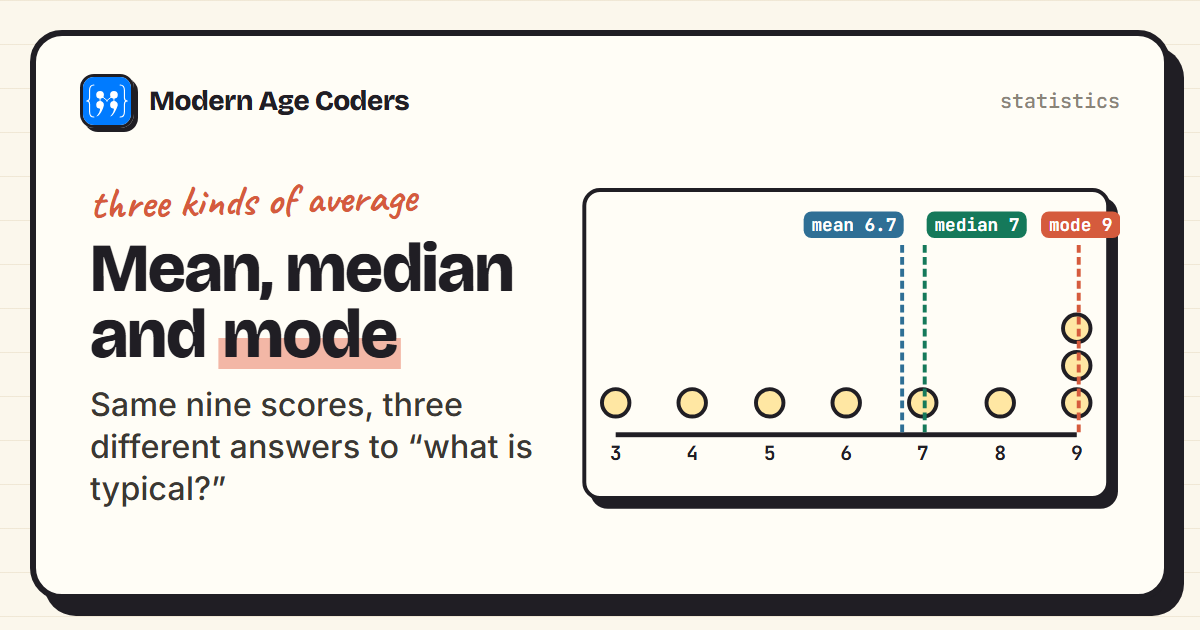
Mean, Median and Mode Explained, With Examples
Mean, median and mode explained with worked examples: how to find each, the median of an even set, m...
Read Article Mathematics
18 min read
Best Online CBSE Maths Tuition for Class 6-12 in India (2026 Guide)
Find the best online CBSE maths tuition for Class 6 to 12 in India. Live 1:1 classes, expert tutors,...
Read ArticleReady to start HKDSE Maths: Compulsory Part, M1 and M2 Exam Prep?
Book a Priority Demo to see a full live class with a mentor reserved for you, today or tomorrow. Or choose a plan and enrol now.
Questions? WhatsApp +91 91233 66161 or email connect@modernagecoders.com