Table of Contents
- Why Do Students Struggle with CBSE Mathematics?
- Benefits of Online CBSE Maths Tuition
- CBSE Maths Syllabus Breakdown: Class 6 to 12
- Topics Students Find Hardest in CBSE Maths
- How Online Maths Tuition Actually Works
- What Makes a Great Online Maths Tutor?
- Tips for Parents Choosing Online Maths Tuition
- The Critical Role of Practice and Problem-Solving
- How Coding Strengthens Maths Skills
- Why Modern Age Coders Is the Ideal Choice for CBSE Maths Tuition
- What Parents and Students Say
- Frequently Asked Questions
- A Step-by-Step Guide to Getting Started
- Conclusion: Every Student Can Excel at Maths
Mathematics is the one subject that can make or break a student's academic career in India. Whether your child is in Class 6 just beginning to encounter algebra, or in Class 12 preparing for board exams and competitive entrances like JEE and NEET, CBSE maths demands consistent practice, conceptual clarity, and the right guidance. Yet every year, lakhs of students across India struggle silently with maths, not because they lack intelligence, but because they lack the right support system.
The good news? Online CBSE maths tuition has transformed how students learn mathematics. No more rushing to tuition centres after a long school day. No more one-size-fits-all classroom teaching where shy students get left behind. Today, a student in a small town in Madhya Pradesh can access the same quality of maths instruction as a student in South Delhi, all from the comfort of home.
In this comprehensive guide, we will cover everything you need to know about choosing the best online maths tuition for CBSE Class 6 to 12, from understanding why students struggle, to what makes a great maths tutor, to how platforms like Modern Age Coders are combining maths with coding to produce truly future-ready learners.
Did You Know?
According to the National Achievement Survey (NAS), over 50% of Indian students in Class 10 score below the proficiency level in mathematics. The problem isn't ability. It's access to quality, personalised teaching.
Why Do Students Struggle with CBSE Mathematics?
Before we talk about solutions, it is critical to understand the root causes. If you are a parent wondering why your child dreads maths despite being bright in other subjects, you are not alone. Here are the most common reasons students struggle with CBSE maths:
1. Weak Foundations from Earlier Classes
Mathematics is a cumulative subject. If a student did not fully grasp fractions in Class 5, they will struggle with ratios in Class 7, which cascades into problems with trigonometry in Class 10 and calculus in Class 12. Unlike subjects such as history or biology where chapters are relatively independent, every maths concept builds on what came before. A single gap in understanding can snowball into years of difficulty.
2. Large Classroom Sizes in Schools
Most CBSE schools have 40 to 60 students per class. A teacher covering the syllabus under time pressure simply cannot stop to re-explain a concept for one confused student. The student nods along, pretends to understand, and the gap widens silently. This is especially damaging in maths where one missed step means the next ten steps make no sense.
3. Fear and Anxiety Around Mathematics
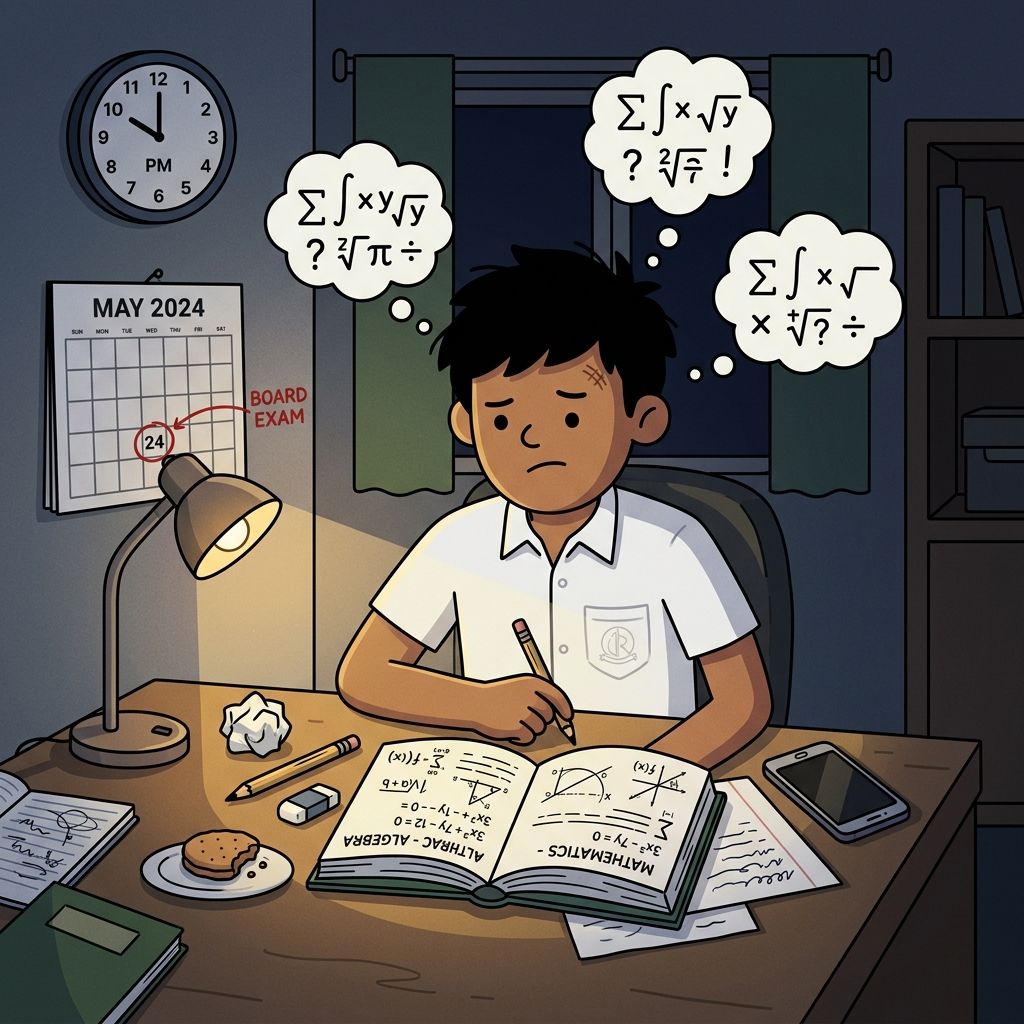
Maths anxiety is a real, well-documented psychological phenomenon. Students who have experienced failure or embarrassment in maths develop a genuine fear response that blocks their ability to think clearly during problem-solving. This creates a vicious cycle: anxiety leads to poor performance, which leads to more anxiety. Breaking this cycle requires a patient, supportive learning environment, something that overcrowded classrooms rarely provide.
4. Rote Learning Instead of Conceptual Understanding
The Indian education system, despite ongoing reforms, still leans heavily towards memorisation. Students memorise formulas and steps for specific problem types without understanding why those formulas work. The moment an exam question is framed slightly differently, they are lost. True mathematical proficiency comes from understanding concepts deeply enough to apply them in unfamiliar situations.
5. Lack of Personalised Attention
Every student learns at a different pace and has different areas of weakness. One student may grasp geometry intuitively but struggle with algebra. Another may find statistics easy but find coordinate geometry confusing. Without personalised instruction that identifies and addresses individual weak spots, students are left to struggle on their own.
Even in geometry, the gaps are usually specific. Mixing up area and perimeter is one of the most common, and it is quick to fix once spotted: see area vs perimeter explained.
Benefits of Online CBSE Maths Tuition
Online maths tuition is not just a pandemic-era stopgap anymore. It has become the preferred mode of learning for millions of Indian families. Here is why:
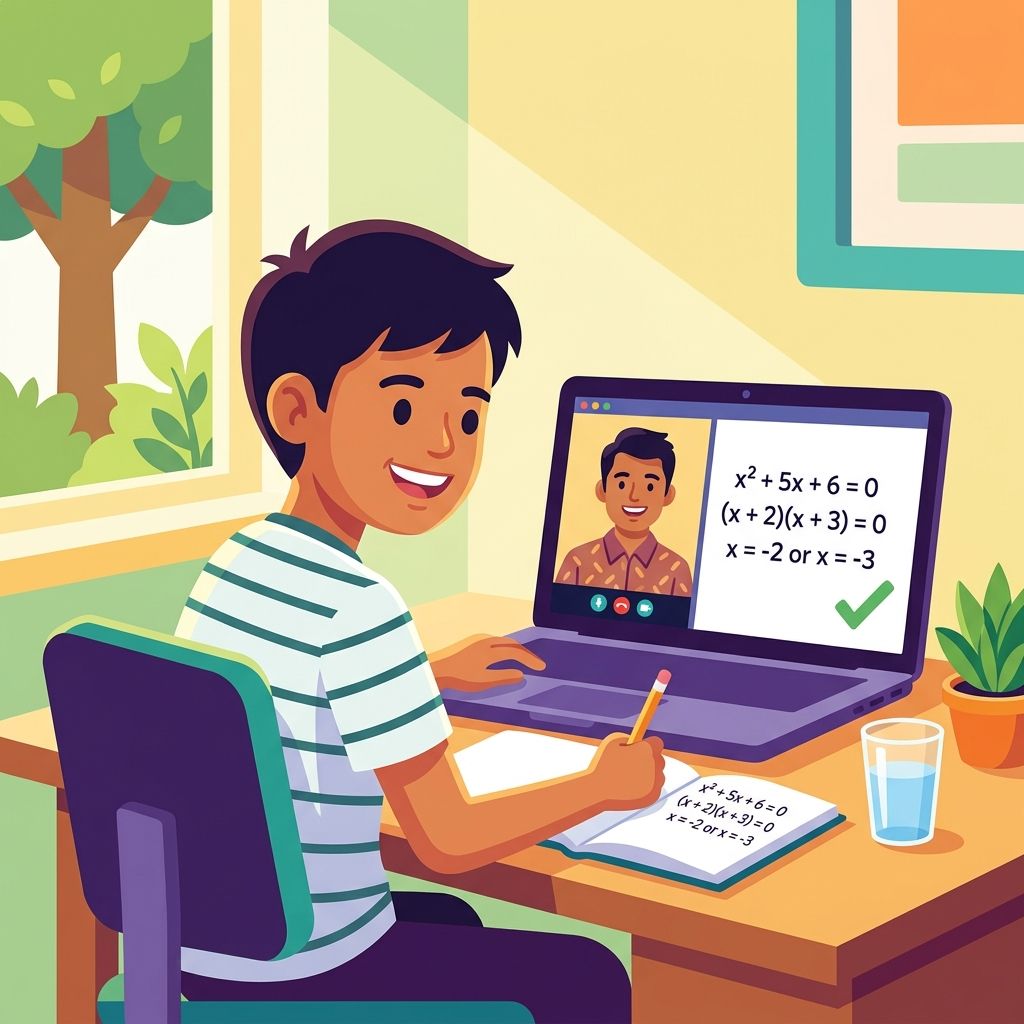
- 1:1 Personalised Attention: Unlike school classrooms or group tuitions, online 1:1 classes mean the tutor's entire focus is on your child. Every doubt gets addressed. Every weak area gets targeted practice. The pace adapts to your child, not the other way around.
- Learn from Anywhere: Whether you live in Mumbai, Patna, or a small town in Kerala, your child gets access to top-quality maths tutors. No commuting, no wasted time, no geographic limitations.
- Flexible Scheduling: Online classes can be scheduled around your child's school timetable, extracurricular activities, and even energy levels. Morning learner? Evening learner? Weekend-only? It all works.
- Recorded Sessions for Revision: Most online platforms allow session recordings. Your child can revisit a tricky concept before exams without needing to schedule another class.
- Interactive Tools: Digital whiteboards, screen sharing, real-time problem solving, and visual simulations make abstract maths concepts tangible and engaging.
- Reduced Anxiety: Learning from the comfort of home, in a private 1:1 setting, dramatically reduces the pressure and embarrassment that many students feel in group settings. Students ask more questions and engage more deeply.
- Parent Visibility: Parents can sit in on sessions, review recordings, and track progress, something that is nearly impossible with traditional tuition centres.
- Cost-Effective: Without the overhead of physical infrastructure, online tuition often provides better value. Plus, you save on transportation costs and time.
Pro Tip for Parents
When choosing online maths tuition, always ask for a free trial or demo class. A good platform will let you experience the teaching quality before committing. At Modern Age Coders, we offer a completely free demo class, book yours here.
CBSE Maths Syllabus Breakdown: Class 6 to 12
Understanding what your child is expected to learn at each stage helps you identify where they might need extra support. Here is a class-wise breakdown of the CBSE maths syllabus and the topics that students typically find most challenging:
Class 6 and 7: Building the Foundation
These are the years where students transition from basic arithmetic to more abstract mathematical thinking. The CBSE syllabus introduces:
- Integers and Number Systems: Moving beyond whole numbers to negative numbers and the number line
- Fractions and Decimals: Operations with fractions, conversion between fractions and decimals
- Introduction to Algebra: Using letters to represent numbers. This is where many students first encounter difficulty
- Basic Geometry: Lines, angles, triangles, symmetry, and basic constructions
- Ratio and Proportion: Foundational concept that appears repeatedly in higher classes
- Data Handling: Mean, median, mode, and basic graph interpretation
Integers are where many students first lose confidence, usually over the sign rules. Negative numbers explained shows why -5 is less than -2, why subtracting a negative adds, and why a negative times a negative is positive, using a pattern rather than a rule.
Critical Stage Alert
Class 6-7 is where most maths gaps originate. If your child is confused about integers, fractions, or basic algebra at this stage, it will compound dramatically by Class 9. Early intervention with a good tutor can prevent years of struggle.
Class 8 and 9: The Complexity Jump
Class 8 and 9 represent a significant jump in complexity. Many students who were comfortable with maths suddenly find themselves struggling. Key topics include:
- Algebraic Expressions and Identities: Factorisation, expanding expressions, and the famous algebraic identities
- Linear Equations in Two Variables: Graphical representation and solution methods
- Quadrilaterals and Circles: Properties, theorems, and proofs
- Statistics and Probability: More formal introduction to probability concepts
- Coordinate Geometry: Plotting points, distance formula, section formula
- Polynomials: Factor theorem, remainder theorem, a major pain point for many students
- Triangles and Congruence: Proof-based geometry that requires logical reasoning
- Surface Areas and Volumes: 3D shapes, composite figures, and real-world applications
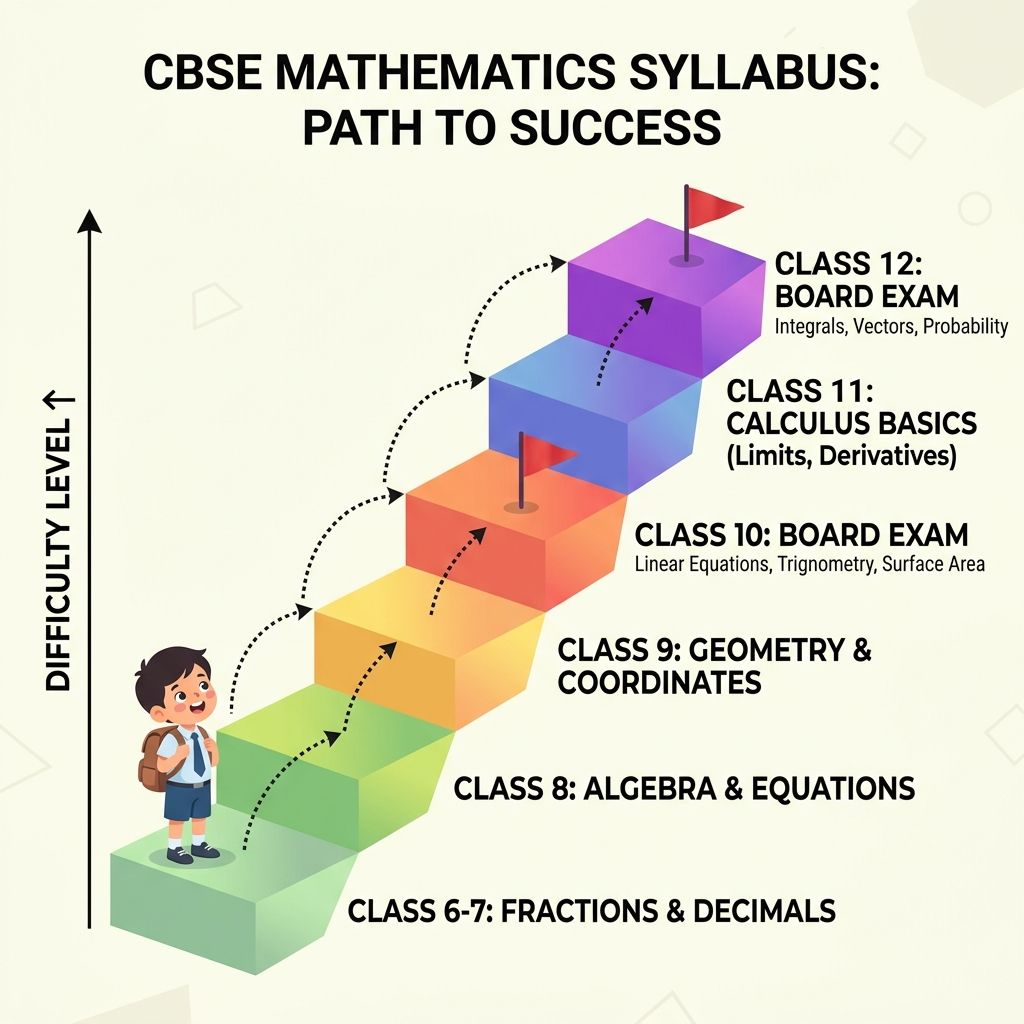
Class 10: The Board Exam Year
Class 10 is when the pressure peaks for the first time. The CBSE Class 10 board exam in mathematics is often the most stressful exam a student has faced in their life. The syllabus covers:
- Real Numbers: Euclid's division lemma, Fundamental Theorem of Arithmetic, irrational numbers
- Polynomials: Zeroes of polynomials, relationship between zeroes and coefficients
- Pair of Linear Equations: Graphical and algebraic methods, substitution, elimination, cross-multiplication
- Quadratic Equations: Factorisation, completing the square, quadratic formula, nature of roots
- Arithmetic Progressions: nth term, sum of n terms, real-world AP problems
- Triangles: Similarity theorems, BPT, Pythagoras theorem and its converse
- Coordinate Geometry: Distance, section, and area formulas
- Trigonometry: Ratios, identities, heights and distances, consistently the hardest unit for most students
- Circles: Tangent properties, number of tangents from a point
- Statistics: Mean, median, mode for grouped data using all three methods
- Probability: Classical probability, complementary events
Class 10 Maths Weightage
In the CBSE Class 10 maths exam, Algebra carries approximately 20 marks, Geometry 15 marks, Trigonometry 12 marks, and Statistics & Probability 11 marks. Strategic preparation means allocating practice time according to these weightages.
Class 11 and 12: The Final Frontier
The jump from Class 10 to Class 11 maths is brutal. There is no other word for it. Students who scored 90+ in Class 10 routinely find themselves struggling to pass in Class 11. The CBSE senior secondary maths syllabus includes:
- Sets and Functions: Types of functions, domain, range, composite and inverse functions
- Trigonometric Functions: General solutions, inverse trigonometric functions, a massive expansion from Class 10 trigonometry
- Complex Numbers and Quadratic Equations: The Argand plane, modulus, conjugate
- Permutations and Combinations: Counting principles that require a completely new way of thinking
- Binomial Theorem: Expansion, general term, applications
- Sequences and Series: AP, GP, HP, special sums
- Limits, Derivatives, and Continuity: The gateway to calculus, a completely new mathematical paradigm
- Integrals: Indefinite and definite integration, properties, methods, consistently ranked as the hardest Class 12 topic
- Differential Equations: Formation, order, degree, solution methods
- Vectors and 3D Geometry: Spatial thinking that many students find incredibly challenging
- Linear Programming: Graphical method, optimisation problems
- Probability: Conditional probability, Bayes' theorem, probability distributions
For students aiming at JEE Main and Advanced, the CBSE Class 11-12 syllabus is just the starting point. Competitive preparation requires mastering these concepts at a much deeper level and solving significantly harder problems. This is where having a skilled, experienced maths tutor becomes absolutely essential.
Topics Students Find Hardest in CBSE Maths
Based on student performance data, board exam analysis, and feedback from thousands of maths tutoring sessions, here are the topics that CBSE students consistently find most difficult:
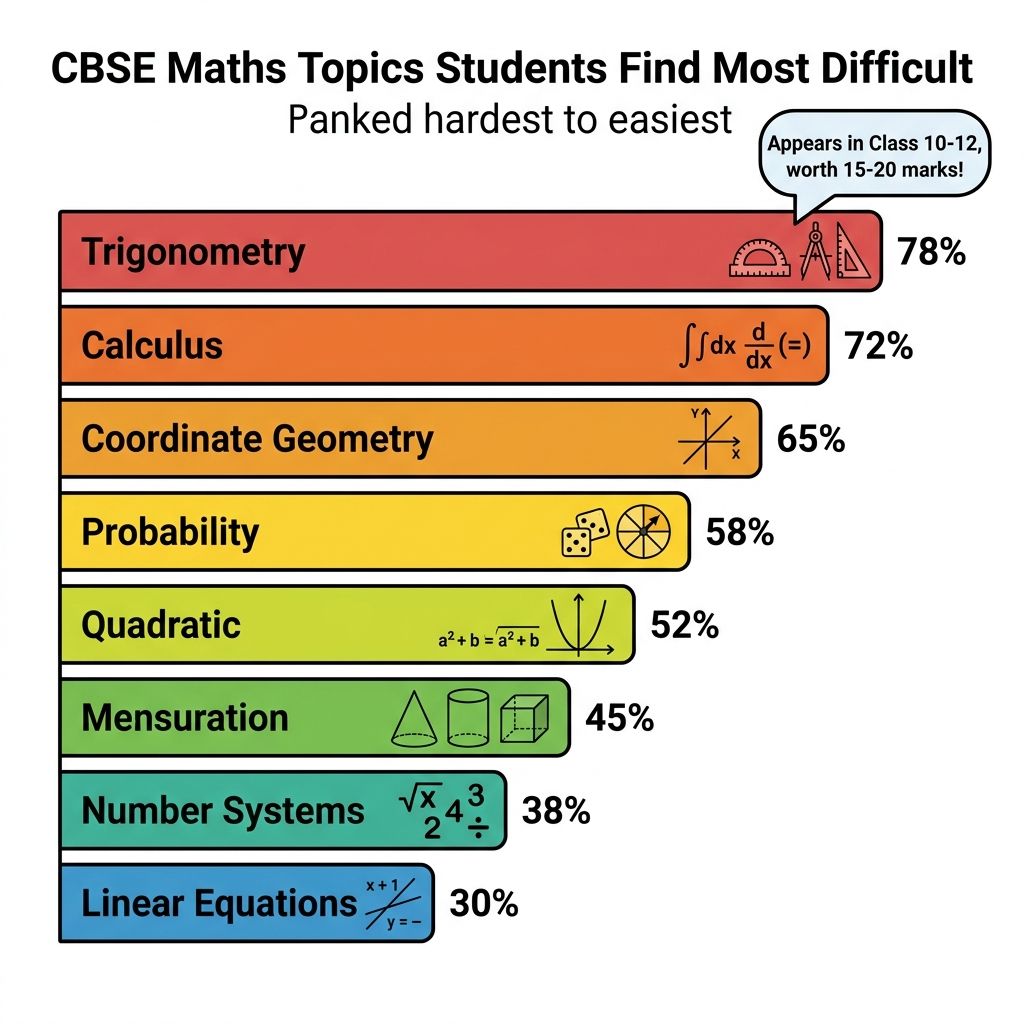
- Trigonometry (Class 10-12): Trigonometric identities, heights and distances, general solutions, and inverse trigonometric functions. Students struggle because the subject requires memorising ratios, understanding the unit circle, and applying identities in non-obvious ways.
- Integration (Class 12): By far the hardest topic in the CBSE Class 12 syllabus. There is no single algorithm for integration, each problem requires recognising which technique to apply, and this pattern recognition only comes with extensive practice.
- Coordinate Geometry (Class 10-11): Combining algebra with geometry confuses students who are strong in one but weak in the other. The section formula and locus problems are common stumbling blocks.
- Probability (Class 10-12): The progression from basic probability in Class 10 to conditional probability and Bayes' theorem in Class 12 is a massive conceptual leap. Students struggle with setting up the correct sample space and identifying the right approach.
- Polynomials and Quadratic Equations (Class 9-10): The abstract nature of working with unknown variables and the multiple solution methods confuse students who are used to straightforward arithmetic.
- 3D Geometry and Vectors (Class 12): Visualising three-dimensional space on paper is inherently difficult. Problems involving lines and planes in 3D require both spatial intuition and algebraic manipulation.
- Proof-Based Geometry (Class 9-10): Writing mathematical proofs is a skill that is almost never taught well in schools. Students can understand a theorem but cannot construct a valid proof.
- Permutations and Combinations (Class 11): The subtle differences between permutations and combinations, and knowing when to apply each, trips up even strong students.
How Online Maths Tuition Actually Works
If you have never experienced online tuition before, you might be wondering how a maths class can work effectively through a screen. Here is a step-by-step walkthrough of how a typical online CBSE maths tuition session works at a platform like Modern Age Coders:

Step 1: Free Assessment and Demo Class
Every good online tuition platform begins with an assessment. This is not a formal exam. It is a friendly, low-pressure conversation where the tutor understands your child's current level, identifies gaps, and observes their problem-solving approach. At Modern Age Coders, we offer a completely free demo class that doubles as an assessment.
Step 2: Personalised Learning Plan
Based on the assessment, the tutor creates a customised learning plan tailored to your child's specific needs. If your child is in Class 10 but has gaps in Class 8 algebra, the plan will include targeted revision of those foundational concepts alongside the current syllabus. This personalisation is simply not possible in a school or group tuition setting.
Step 3: Live 1:1 Classes
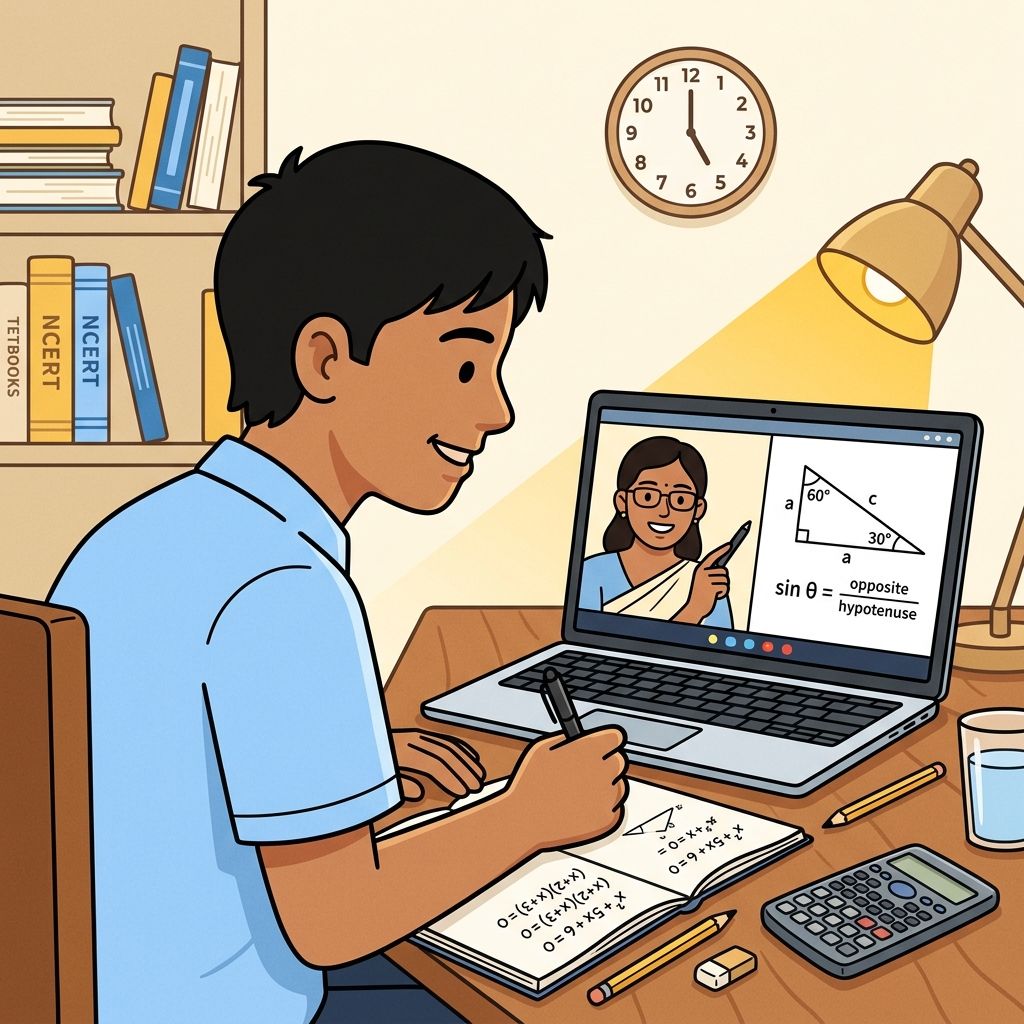
Classes happen via video call with a shared digital whiteboard. The tutor explains concepts visually, works through examples step by step, and then asks the student to solve problems while watching. The student can write on the whiteboard too, so the tutor can see their working and catch errors in real time. This instant feedback loop is what makes 1:1 online tuition so effective.
Step 4: Practice and Homework
After each session, the student receives carefully curated practice problems, not random textbook exercises, but problems specifically chosen to reinforce what was taught and challenge the student at the right level. The tutor reviews the homework at the start of the next session and addresses any difficulties.
Step 5: Regular Progress Tracking
Parents receive regular updates on their child's progress, including areas of improvement, remaining weak spots, and recommendations. Many platforms also conduct periodic assessments to measure growth objectively.
What Makes a Great Online Maths Tutor?
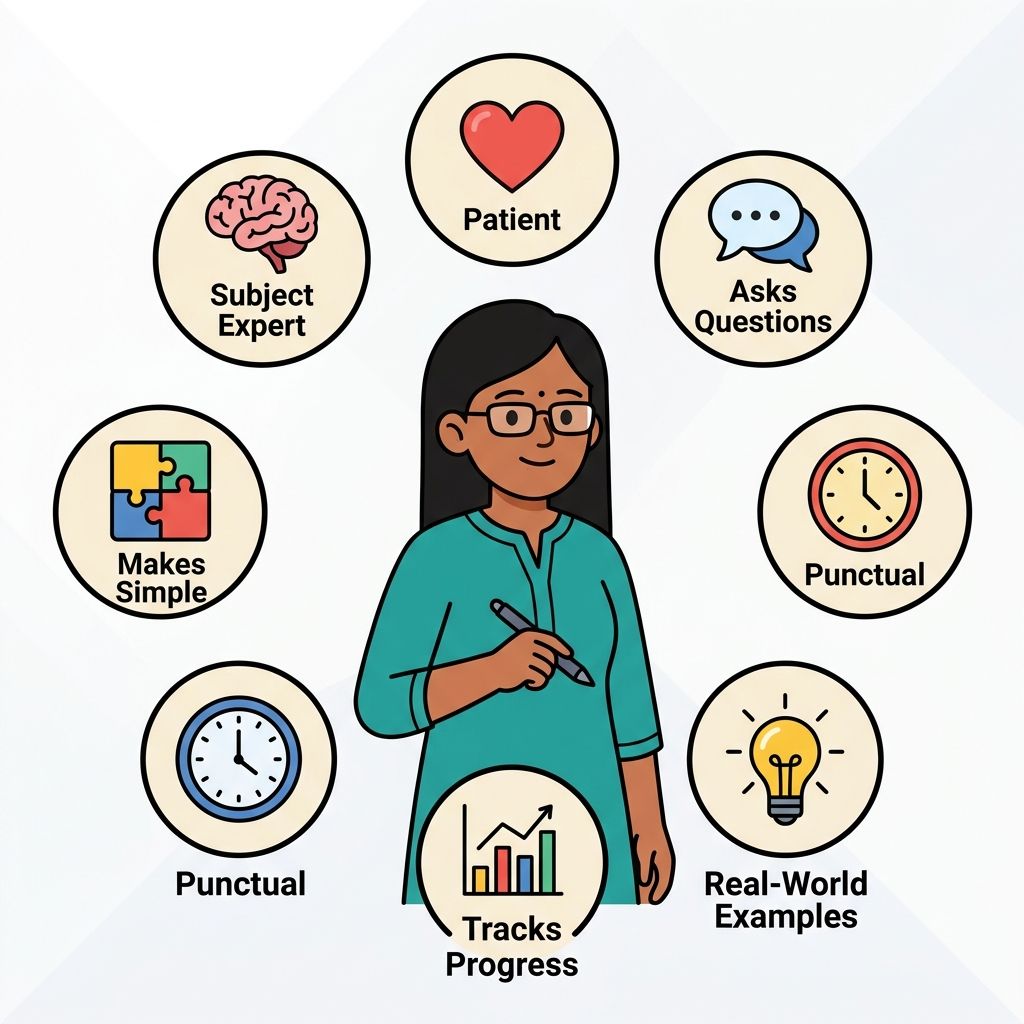
Not all maths tutors are created equal. A tutor who is brilliant at maths themselves may be terrible at teaching it. Here are the qualities that separate a great maths tutor from an average one:
- Deep Conceptual Understanding: A great tutor does not just know how to solve problems. They understand why each method works and can explain the underlying logic in multiple ways until it clicks for the student.
- Patience and Empathy: Maths anxiety is real. A great tutor creates a safe, judgment-free space where it is okay to make mistakes, ask questions, and take time to understand. They never make a student feel stupid for not getting something.
- Adaptability: Every student learns differently. Some are visual learners, some learn by doing, some need real-world analogies. A great tutor reads the student and adjusts their teaching approach accordingly.
- Strong Communication Skills: Being able to break down complex abstract concepts into simple, relatable explanations is a rare skill. The best tutors use analogies, stories, and visual aids to make maths intuitive.
- Knowledge of the CBSE Curriculum: Understanding the specific CBSE syllabus, exam pattern, marking scheme, and common question types is essential. A tutor who knows the curriculum inside out can help students prepare strategically.
- Experience with Board Exam Preparation: Board exam preparation is a specific skill. It involves time management, question paper analysis, understanding marking schemes, and knowing which topics carry the most weight.
- Ability to Build Confidence: The best maths tutors do not just teach maths. They transform how a student feels about maths. When a student starts believing they can do it, performance improves dramatically.
Tips for Parents Choosing Online Maths Tuition
With hundreds of online maths tuition options available in India, choosing the right one can feel overwhelming. Here is a practical checklist to help you make the right decision:
1. Insist on a Free Demo or Trial Class
Never commit to a tuition program without experiencing it first. A free demo class lets you assess the tutor's teaching style, the platform's technology, and most importantly, how your child responds to the experience. If a platform does not offer a free trial, that is a red flag.
2. Choose 1:1 Over Group Classes
For maths specifically, 1:1 classes are significantly more effective than group sessions. Maths requires active problem-solving, and a tutor needs to see the student's working, identify errors in real time, and adjust explanations to the individual. In a group of even 5 students, this level of attention is impossible.
3. Check CBSE Curriculum Alignment
Make sure the tuition is specifically aligned with the CBSE syllabus, NCERT textbooks, and the latest exam pattern. Generic maths tutoring that does not follow the CBSE framework will not help your child score well in school exams and boards.
4. Look for Regular Assessments and Feedback
A good tuition platform should provide regular progress reports, periodic tests, and clear feedback on your child's development. You should always know where your child stands and what is being done to address weak areas.
5. Verify Tutor Qualifications and Experience
Ask about the tutor's educational background, years of teaching experience, and specifically their experience with CBSE students. Ideally, the tutor should have experience preparing students for board exams and competitive entrances.
6. Consider the Coding + Maths Combination
This is where platforms like Modern Age Coders offer a unique advantage. Students who learn coding alongside maths develop stronger logical reasoning, computational thinking, and problem-solving skills. The two subjects reinforce each other in powerful ways. More on this below.
7. Check Pricing and Flexibility
Compare pricing across platforms, but do not just go for the cheapest option. Consider the tutor quality, class frequency, session duration, and whether the platform offers flexibility to reschedule or pause. Good value is not the same as the lowest price.
The Critical Role of Practice and Problem-Solving
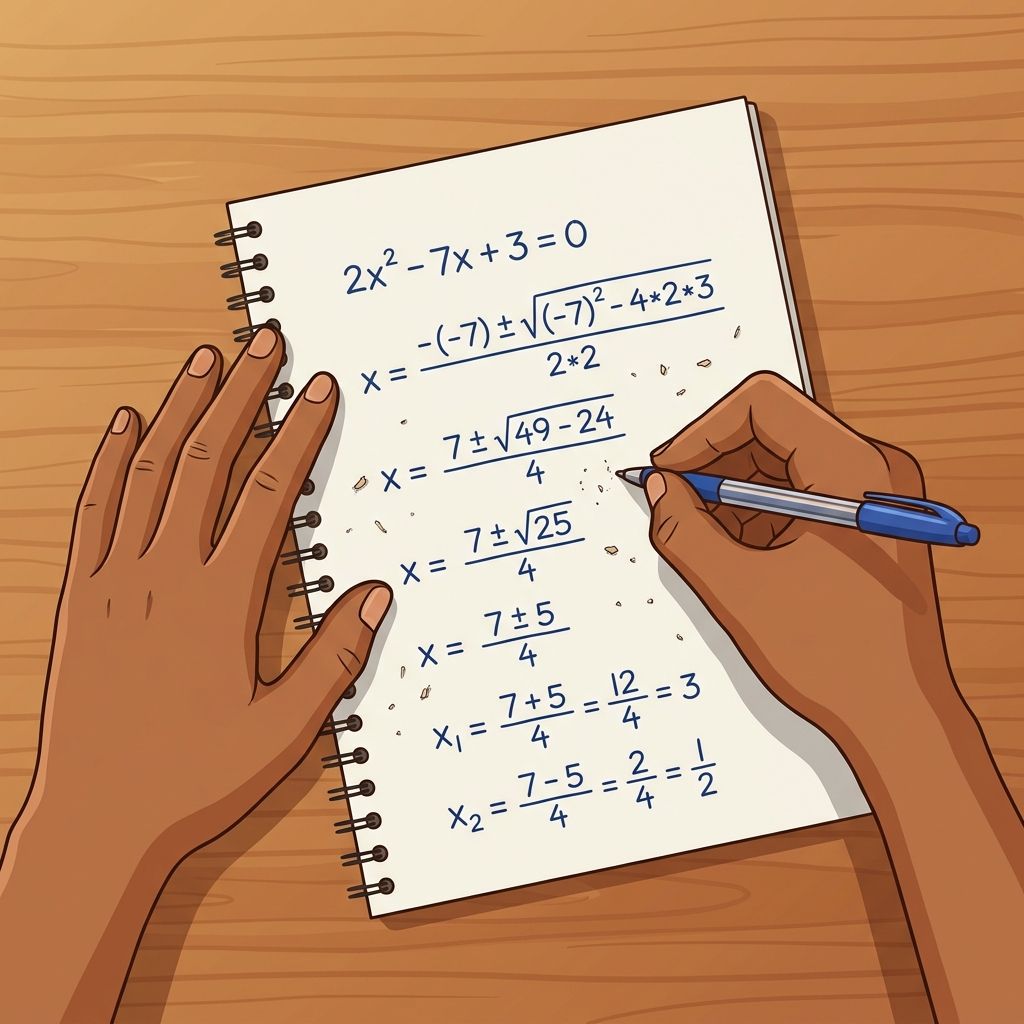
Here is an uncomfortable truth that many students and parents do not want to hear: you cannot learn maths by watching someone else do it. Watching a tutor solve ten problems is not the same as solving ten problems yourself. Mathematics is a skill that requires active practice, much like learning a musical instrument or a sport.
Research consistently shows that the number one predictor of maths success is not intelligence, not expensive coaching, not even the quality of the teacher. It is the amount of deliberate, focused practice the student puts in.
What Does Effective Maths Practice Look Like?
- Daily Practice: Even 30 minutes of focused maths practice every day is more effective than 3 hours once a week. Consistency builds neural pathways and makes mathematical thinking automatic.
- Varied Problem Types: Do not just repeat the same type of problem. Expose yourself to different question formats, MCQs, short answer, long answer, assertion-reasoning, case-based questions, just like the CBSE board exam.
- Increasing Difficulty: Start with NCERT textbook problems, then move to NCERT exemplar, then to previous year board questions, and finally to competitive-level problems. Progressive difficulty builds confidence and competence.
- Error Analysis: When you get a problem wrong, do not just look at the solution and move on. Understand exactly where and why you went wrong. Keep an error log and revisit your common mistakes regularly.
- Timed Practice: As board exams approach, practice solving problems under timed conditions. The CBSE Class 10 maths paper gives you roughly 2 minutes per mark, practicing under time pressure prevents exam-day panic.
- Teach What You Learn: If you can explain a concept to someone else, you truly understand it. Students who teach their siblings or friends find their own understanding deepens significantly.
The 3:1 Practice Rule
For every hour of maths tuition, students should aim for at least 3 hours of independent practice. The tuition provides understanding and technique; practice builds mastery. This is why the best online maths tuition programs include structured homework and practice sets.
How Coding Strengthens Maths Skills
This is where things get really interesting, and where Modern Age Coders offers something that traditional maths tuition simply cannot match. The connection between coding and mathematics is deep, fundamental, and scientifically proven.
When a student learns to code, they are not just learning a tech skill. They are actively exercising the same mental muscles that power mathematical thinking. Here is how:
Logical Reasoning and Sequential Thinking
Every program is a sequence of logical steps. Writing code requires breaking a problem into smaller parts, thinking through each step, and ensuring they connect logically. This is exactly what mathematical proof-writing demands. Students who code regularly develop a natural ability to think in structured, logical sequences, which directly translates to better performance in geometry proofs, algebraic derivations, and word problems.
Working with Variables and Abstraction
In coding, variables are everywhere. A student who writes x = 5, y = x + 3, and print(y) is doing algebra without even realising it. The concept of using letters to represent values, which so many students find abstract and confusing in maths class, becomes intuitive and natural through coding. Students who code handle algebraic expressions with much greater comfort.
Pattern Recognition
Coding teaches students to recognise and exploit patterns, to see that a repetitive task can be automated with a loop, or that similar problems share a common structure. This pattern recognition ability is the single most important mathematical skill. Whether it is recognising that a problem can be solved with a quadratic formula or identifying a geometric series, pattern recognition is what separates strong maths students from average ones.
Computational Thinking
Computational thinking, the ability to formulate problems in a way that a computer (or a methodical process) can solve, is increasingly recognised as a foundational 21st-century skill. It includes decomposition (breaking problems into parts), abstraction (identifying the important information), and algorithmic thinking (creating step-by-step solutions). All of these directly improve mathematical problem-solving.
# Example: Using Python to visualise a quadratic equation
# This is the kind of exercise that blends coding and maths beautifully

import matplotlib.pyplot as plt
import numpy as np

# Define the quadratic function: y = x^2 - 4x + 3
x = np.linspace(-1, 5, 100)
y = x**2 - 4*x + 3

# Find the roots (where y = 0)
roots = np.roots([1, -4, 3])
print(f"Roots of x^2 - 4x + 3 = 0 are: x = {roots[0]} and x = {roots[1]}")

# Plot the graph
plt.plot(x, y, color='purple', linewidth=2)
plt.axhline(y=0, color='gray', linestyle='--')
plt.scatter(roots, [0, 0], color='cyan', s=100, zorder=5)
plt.title('Graph of y = x² - 4x + 3')
plt.xlabel('x')
plt.ylabel('y')
plt.grid(True)
plt.show()
When a student writes code like this, they are not just learning Python. They are developing an intuitive, visual understanding of what a quadratic equation actually means. They can change the coefficients and instantly see how the graph changes. They can verify their algebraic solutions visually. This multi-modal learning, combining algebraic manipulation with visual representation and computational implementation, creates understanding that is far deeper and more durable than textbook-only learning.
Real-World Application of Maths Concepts
One of the biggest complaints students have about maths is the question: "When will I ever use this in real life?" Coding answers that question definitively. Students who code see maths in action every day:
- Game development uses coordinate geometry, trigonometry, and physics equations
- Data science uses statistics, probability, and linear algebra
- Web development uses proportions, percentages, and geometry for layouts
- Machine learning uses calculus, matrices, and probability distributions
- App development uses algorithms that are fundamentally mathematical
When students see their maths knowledge being used to build something real and exciting, their motivation to learn maths increases dramatically. This is why the coding + maths combination is so powerful.
Why Modern Age Coders Is the Ideal Choice for CBSE Maths Tuition
At Modern Age Coders, we have built our maths tuition program specifically to address every challenge discussed in this article. Here is what makes us different:
Live 1:1 Classes with Expert Tutors
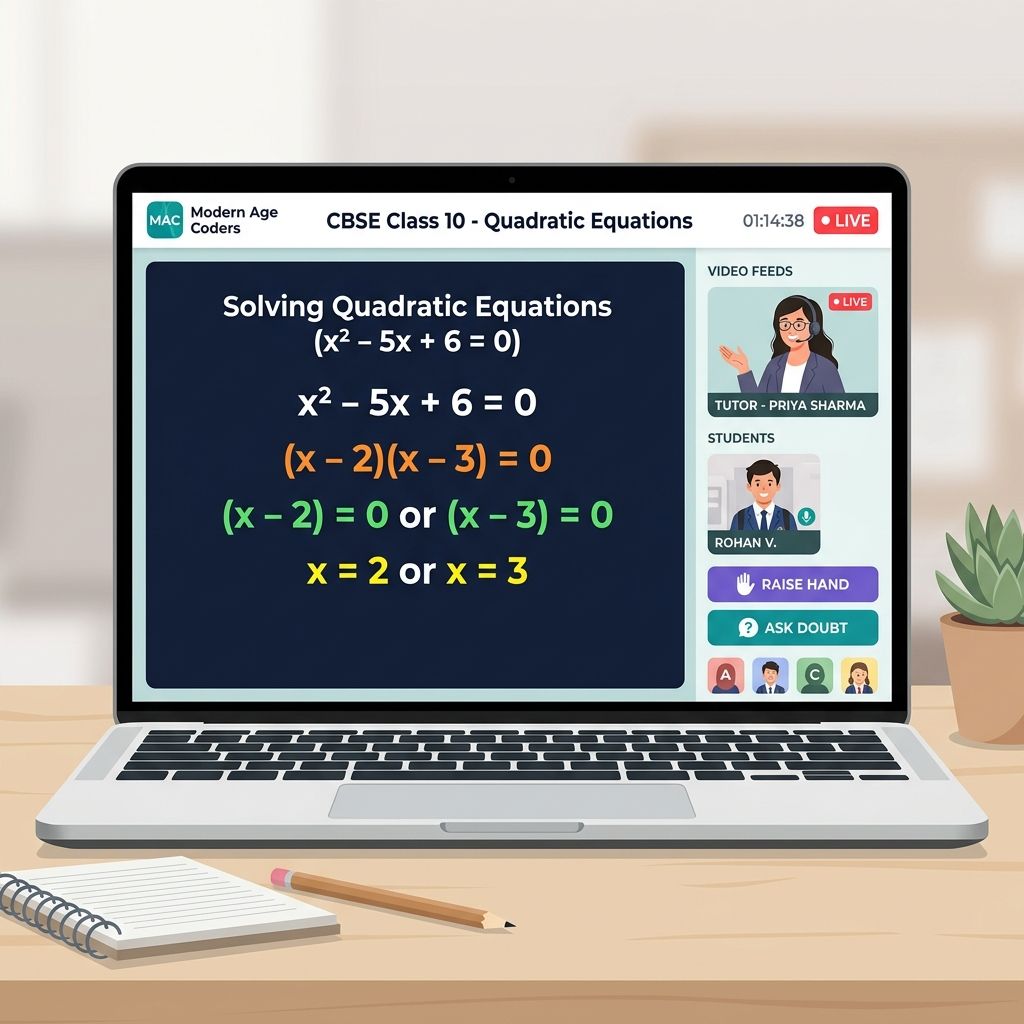
Every class at Modern Age Coders is a live, 1:1 session, not a recorded video, not a group class. Your child gets the undivided attention of an experienced maths tutor who adapts to their pace, addresses their specific doubts, and builds their confidence one concept at a time. Our tutors are not just mathematically skilled. They are trained to teach with patience, clarity, and enthusiasm.
CBSE and ICSE Aligned Curriculum
Our maths curriculum is meticulously aligned with CBSE and ICSE syllabi. We follow NCERT textbooks as the foundation, supplement with exemplar problems, and include previous year board exam questions in our practice sets. Whether your child needs to ace the Class 10 boards or prepare for Class 12 with an eye on JEE, we have got them covered.
The Unique Coding + Maths Advantage
This is our secret weapon. Modern Age Coders is one of the few platforms in India that offers integrated coding and maths education. Students who enrol in both programs develop a synergistic skill set where coding reinforces mathematical thinking and maths strengthens coding logic. The result is students who do not just perform well in exams. They genuinely understand and enjoy mathematics.
Comprehensive Class Coverage: 6 to 12
We cover the entire range from Class 6 to Class 12, with specialised programs for each stage:
- Foundation (Class 6-8): Building rock-solid fundamentals in arithmetic, algebra, and geometry. Filling gaps, building confidence, and developing genuine mathematical curiosity.
- Pre-Board (Class 9-10): Intensive CBSE board preparation with concept mastery, extensive practice, mock tests, and exam strategy coaching.
- Senior Secondary (Class 11-12): Advanced mathematics covering calculus, vectors, probability, and more. Preparation for both board exams and competitive entrances like JEE.
Affordable and Flexible
We believe quality maths education should be accessible to every Indian family. Our pricing plans are designed to be affordable, with flexible scheduling that works around your child's school and extracurricular commitments. We also offer combo packages for students who want both maths and coding instruction.
What Parents and Students Say
Do not just take our word for it. Here is what families who have experienced our maths tuition program have to say:
Parent Testimonial
"My daughter was scoring 55% in Class 9 maths and had completely lost confidence. After 6 months with Modern Age Coders, she scored 89% in her board exams. The 1:1 attention and the patient teaching made all the difference. The coding classes were a bonus, she now wants to pursue Computer Science!", Priya M., Parent from Bangalore
Student Testimonial
"I used to hate maths. Literally hate it. My tutor at Modern Age Coders made me see it differently. He connected everything to coding and real-world problems, and suddenly maths made sense. I went from failing to scoring 92 in my Class 12 boards.": Arjun K., Class 12 Student from Hyderabad
Frequently Asked Questions
What is the right age to start online maths tuition?
The earlier, the better. If your child is showing signs of struggle in Class 6 or 7, do not wait until Class 9 or 10 when the pressure intensifies. Early intervention prevents gaps from compounding. That said, it is never too late. We have helped Class 12 students turn around their maths performance in just a few months of focused tutoring.
How many classes per week are recommended?
For most students, 2 to 3 classes per week is ideal, supplemented by daily self-practice. For students preparing for board exams or competitive entrances, 4 to 5 classes per week may be more appropriate during the critical months. Your tutor will recommend the right frequency based on your child's needs.
Can online tuition help with competitive exam preparation (JEE, NEET)?
Absolutely. Our senior secondary program is designed with competitive exam preparation in mind. While the CBSE syllabus forms the foundation, our tutors go deeper into concepts, introduce advanced problem types, and build the speed and accuracy that competitive exams demand.
What if my child is already scoring well but wants to improve further?
Our tuition is not just for struggling students. Many of our highest performers are students who already score well but want to reach the 95+ or 99+ level. We offer advanced problem-solving, olympiad preparation, and competitive exam coaching for ambitious students.
Is online tuition as effective as in-person tuition?
Multiple studies and our own experience confirm that 1:1 online tuition is at least as effective as in-person tuition, and in many cases more so. The absence of commuting fatigue, the availability of digital tools, session recordings for revision, and the comfort of learning from home all contribute to better outcomes. The key is the quality of the tutor and the personalisation of the instruction. Both of which are easier to achieve in an online setting.
A Step-by-Step Guide to Getting Started
Ready to transform your child's maths journey? Here is how to get started with Modern Age Coders:
- Book a Free Demo Class: Visit our demo booking page and schedule a free, no-obligation trial session. Pick a time that works for you and your child.
- Attend the Assessment Session: In the demo class, our tutor will interact with your child, understand their level, and identify specific areas that need attention.
- Receive a Personalised Plan: After the assessment, we will share a customised learning plan outlining the topics to cover, the recommended class frequency, and the expected timeline for improvement.
- Begin Regular Classes: Start your regular 1:1 classes and watch your child's confidence and competence grow week by week.
- Track Progress: Receive regular progress updates and adjust the plan as your child improves and new needs emerge.
Special Offer for New Students
Modern Age Coders is currently offering a free assessment and demo class for all new students. We also have special combo pricing for families who enrol in both maths and coding programs. Book your free demo today and take the first step towards maths mastery.
Conclusion: Every Student Can Excel at Maths
Let us end with the most important message of this entire article: there is no such thing as a student who "can't do maths." Every student can develop strong mathematical skills with the right support, the right approach, and enough practice. The problem is almost never the student's ability. It is the quality and personalisation of the instruction they receive.
Online CBSE maths tuition has made it possible for every Indian student, regardless of where they live, what school they attend, or how far behind they feel, to access world-class, personalised mathematics education. The combination of expert 1:1 tutoring, CBSE-aligned curriculum, and the unique coding + maths synergy that Modern Age Coders offers creates a learning experience that goes far beyond exam preparation. It builds genuine mathematical confidence and competence that will serve your child throughout their academic career and beyond.
Do not let your child struggle in silence. Do not let maths anxiety hold them back from their potential. And do not wait for a bad report card to take action. The sooner you invest in quality maths tuition, the bigger the impact.
Book a free demo class with Modern Age Coders today and discover how we can transform your child's relationship with mathematics. Because every child deserves to not just survive maths, but to truly enjoy and excel at it.