Deep Learning Engineering: Train, Scale and Ship Models with PyTorch
24 live 1-on-1 classes. Make training fast, make it fit, make it scale across GPUs, fine-tune open models with LoRA and QLoRA, then serve them with a measured latency and cost report, all on your own models and your own GPU budget.
Published November 2026
Questions? WhatsApp +91 91233 66161 or email connect@modernagecoders.com
Recordings are free with a Google sign-in. These recordings show how we teach, not the exact syllabus of this course.
Fees and enrolment
How to join Deep Learning Engineering: Train, Scale and Ship Models
Choose how you want to pay, pick a plan and press Enrol. We then fix your class timing with you.
Rated 4.9 across 547 Google reviews. Monthly billing, cancel any time.
How enrolment works
Pick a plan
This course is taught 1-on-1 only: private live classes with your own mentor, about one hour each. Billing is monthly.
Press Enrol and pay
Fill in the student's name, email and phone, then pay securely: UPI, cards or net banking in India, or a debit or credit card from any other country.
Fix your class timing
After paying, WhatsApp or call +91 91233 66161 with the student's name and your preferred time. We confirm the batch or 1-on-1 slot and send the class link.
Start learning
Join your first live class at the time you chose. Your mentor takes it from there.
Want to see a class first? Book a Priority Demo: a live class of about 45 to 60 minutes with a mentor reserved for you. If you enrol, the demo fee is adjusted against your first month's fee. Share your demo Order ID with us on WhatsApp and we take it off.
Billing is monthly and you can cancel any time.
International Students (Outside India)
Billed monthly in US dollars, the same price in every country. Contact us with any questions.
Questions before you enrol? Talk to our team.
Ask about class timings, the right level for your child, what they need to know already, or payment. Parents and adult learners can reach us on WhatsApp, by email or by phone.
Our promise
The world's best learning experience, open to everyone.
- World-class instructorsEvery class is taught by an instructor who specialises in that exact field.
- No compromise on qualityEvery lesson, project and piece of feedback is held to the highest standard.
- Education for everyoneLearners aged 6 to 67, from first-time beginners to working professionals, in 25+ countries.
If you want the highest quality, Modern Age Coders is the right choice.
Book a Priority DemoHow long this course takes
This course runs 24 live 1-on-1 classes, 1 hour each at One live hour per class plus 3-5 hours of build and experiment time between classes. The range allows for background and pace: a complete beginner uses the full span, and a student with prior knowledge finishes sooner. The syllabus below is planned to the shorter end, with margin kept for revision.
For personalised duration planning, call +91 91233 66161 and we'll map a schedule to your goals.
At a glance
- Who it is for
- Advanced · working engineers, graduate students, researchers and strong college students who already train models in PyTorch.
- Prerequisites
- Comfortable, independent Python, and you have trained at least one model in PyTorch (or another framework and are willing to switch). You should be able to read a training loop and a stack trace without help. Git and the Linux command line are used every class
- Format
- Live, interactive classes with a real instructor, never pre-recorded videos. Live classes run about one hour.
- Language
- English or Hindi, depending on the batch.
- Duration
- 24 live 1-on-1 classes, 1 hour each
- Weekly commitment
- One live hour per class plus 3-5 hours of build and experiment time between classes
- Class size
- Taught 1-on-1 only: every class is a private session with your own mentor.
- Certificate
- Certificate from Modern Age Coders, awarded on passing the final assessment
- Watch first
- Free recordings of real classes for ages 13 and up, free with a Google sign-in. These recordings show how we teach, not the exact syllabus of this course.
- Live demo
- Optional. Enrol directly on this page, or book a Priority Demo: a full live class of about 45 to 60 minutes with a mentor reserved for you.
- Questions
- WhatsApp +91 91233 66161 or email connect@modernagecoders.com.
How we teach
Deep understanding. Real projects. Expert guidance.
Learn coding, AI and maths through careful explanations, practical demonstrations, and hands-on problem-solving. Our instructors guide you from the foundations to advanced ideas, helping you understand what happens, why it happens, and how to build it yourself.
You will explore concepts step by step, write and improve code, investigate mistakes, ask questions, and apply your knowledge to meaningful projects. Lessons are designed around active participation, thoughtful feedback, and growing independence.
Expert-led live teaching, with practical participation built into every lesson.
- Students explain their thinking.
- Instructors demonstrate, then guide practice.
- Learners code, solve, or build during lessons.
- Questions and misconceptions get attention.
- Assignments receive useful feedback.
- Progress is checked before advancing.
Program Overview
Most people who can train a model in a notebook cannot tell you why it runs at 30 percent GPU utilisation, why it runs out of memory at batch size 16, what changes when it moves from one GPU to eight, or what a million generated tokens will cost once it is in production. That gap is the job of a deep learning engineer, and it is what this course teaches. Phase 1 opens up PyTorch itself: tensors, strides and storage, the autograd graph, the CUDA execution model and caching allocator, data pipelines that keep the GPU fed, mixed precision in bf16 and fp16, profiling with the PyTorch profiler and Nsight Systems, and torch.compile with its graph breaks and recompilations. Phase 2 scales training: memory budgets worked out per parameter, gradient accumulation and activation checkpointing, DistributedDataParallel with torchrun and NCCL, fully sharded data parallel (FSDP2 and the ZeRO ideas behind it), sharded checkpoints, an honest map of tensor and pipeline parallelism, experiment tracking, reproducibility, and debugging runs that diverge or silently go wrong. Phase 3 is fine-tuning and evaluation on open models from the Hugging Face ecosystem: LoRA and QLoRA through PEFT, TRL's trainers, fine-tuning data hygiene, preference tuning with DPO, and evaluation that would survive a sceptical reviewer. Phase 4 ships the model: the physics of inference (prefill, decode, KV cache), weight quantization with GPTQ, AWQ and torchao, serving with vLLM, the ONNX and TensorRT route, load testing, MLOps, and the arithmetic that turns a GPU-hour price into a cost per million tokens. You finish by fine-tuning and serving a model of your choice, then defending a written report of its quality, latency and cost. Every class is 1-on-1, so the material bends to your codebase, your hardware, your research question or your product.
What Makes This Program Different
- 1-on-1 only, by design: performance work depends on your model, your data loader, your GPUs and your budget. A dedicated mentor reads your traces and your training code every class, which a group class cannot do.
- Measured, not asserted: every optimisation in the course is introduced with a profiler trace or a benchmark before and after, so you learn to prove a speed-up rather than believe a blog post.
- The full path from training loop to production endpoint: PyTorch internals, distributed training, parameter-efficient fine-tuning, evaluation, quantization and serving in one continuous build, rather than five disconnected tutorials.
- Grounded in the primary sources: the ZeRO, FSDP, mixed precision, activation checkpointing, LoRA, QLoRA, FlashAttention, PagedAttention, GPTQ and AWQ papers are read alongside the code that implements them.
- Cost literacy built in: GPU memory per parameter, model FLOPs utilisation, throughput per GPU-hour and cost per million tokens are computed from your own runs, so you can defend a hardware choice to a manager or a grant committee.
- Taught on the current open-source stack (PyTorch, torch.compile, FSDP2, torchao, Hugging Face Transformers, PEFT, TRL, vLLM), re-checked against release notes because these libraries ship new releases often.
Your Learning Journey
Career Progression
Detailed Course Curriculum
Explore the complete week-by-week breakdown of what you'll learn in this comprehensive program.
Topics Covered
- Tensors as views over storage: shape, stride, offset and contiguity, and why transpose is free but a later .contiguous() call is not
- Dtype and device as first-class decisions: float32, bfloat16, float16, int8, and what each costs in memory and bandwidth
- The dispatcher in one picture: how a call like torch.matmul is routed to a CPU, CUDA or autograd kernel
- The autograd graph: grad_fn, saved tensors, leaf tensors, and why the activations saved for backward dominate training memory
- torch.no_grad, torch.inference_mode and detach compared, and the bugs each one prevents or causes
- Writing a custom torch.autograd.Function and checking it with torch.autograd.gradcheck
- Baseline first: a clean, minimal training loop for your chosen model that every later class will measure itself against
Projects You Build
- Build the course baseline: a small transformer or CNN (or your own research model) trained end to end in plain PyTorch, with a logged throughput number in samples or tokens per second
Practice & Assignments
Predict the shape, stride and contiguity of ten tensor expressions on paper, then check every prediction in code.
Assessment
Explain, from the autograd graph, which tensors your baseline keeps alive between the forward and backward pass and roughly how much memory they take.
Topics Covered
- The CUDA execution model for PyTorch users: kernels, asynchronous launches, the CPU running ahead of the GPU, and why naive timing with time.time() lies
- Synchronisation points hiding in ordinary code: .item(), .cpu(), printing a tensor, and data-dependent Python control flow
- Timing correctly with torch.cuda.Event and torch.cuda.synchronize, and benchmarking with torch.utils.benchmark
- The caching allocator: reserved versus allocated memory, fragmentation, and reading torch.cuda.memory_summary
- Memory snapshots: recording allocation history and reading the timeline to find what really caused an out-of-memory error
- Compute-bound versus memory-bound operations and the roofline intuition: why elementwise ops are slow per FLOP and matmuls are not
- Tensor cores and shape alignment: why dimensions that are multiples of 8 or 16 matter for throughput
Projects You Build
- Instrument your baseline with correct GPU timing and a memory snapshot, then write a one-page diagnosis of where its memory goes at peak
Practice & Assignments
Find and remove every hidden host-device synchronisation in a deliberately slow training loop supplied by your mentor.
Assessment
Given a memory snapshot from an out-of-memory crash, identify the allocation that tipped it over and propose two fixes.
Topics Covered
- Dataset, IterableDataset, Sampler and DataLoader, and the contract between them
- num_workers, prefetch_factor, persistent_workers and pin_memory, tuned with measurements rather than folklore
- Moving work off the critical path: pre-tokenising text, pre-resizing images, and caching decoded data to disk
- Large datasets that do not fit in RAM: memory-mapped arrays, sharded files, streaming with Hugging Face Datasets, and the WebDataset tar-shard pattern
- GPU-side augmentation and collation, and when moving preprocessing to the GPU is worth it
- Sequence packing for language models: concatenating documents to remove padding waste, and the attention-mask question it raises
- Diagnosing an input-bound loop: GPU utilisation gaps, a data-loader-only benchmark, and the starvation signature in a trace
Projects You Build
- Benchmark your data loader in isolation, remove the bottleneck you find, and report the end-to-end throughput change on the baseline
Practice & Assignments
Convert a folder-of-files dataset into sharded, pre-processed files and compare loading speed against the original.
Assessment
From a utilisation trace and a data-loader benchmark, decide whether a run is input-bound or compute-bound and defend the call.
Topics Covered
- Floating-point formats compared: float32, TF32, bfloat16 and float16, with their exponent and mantissa trade-offs
- torch.autocast: which ops run in lower precision, which stay in float32, and why
- Loss scaling with GradScaler for float16 and why bfloat16 usually does not need it, following Micikevicius et al., Mixed Precision Training (2017)
- Master weights, optimiser state precision and where precision loss actually hurts
- Numerical failure modes: overflow, underflow, NaN propagation, and catching them with anomaly detection and gradient-norm logging
- FP8 training in context: what float8 formats are, which recent GPUs support them, and how torchao's float8 training composes with torch.compile and FSDP2
- Measuring the effect honestly: speed, memory and final validation metric, all three, never just speed
Projects You Build
- Run your baseline in float32, bf16 autocast and fp16 with GradScaler, and publish a table of throughput, peak memory and final validation loss for each
Practice & Assignments
Reproduce an fp16 overflow on purpose, then fix it twice: once with loss scaling and once by switching to bf16.
Assessment
Explain why a specific mixed-precision run diverged, using its gradient-norm and loss-scale logs as evidence.
Topics Covered
- torch.profiler: schedules, activities, record_shapes, profile_memory and with_stack, and keeping profiling overhead out of the numbers
- Reading a trace in the Perfetto UI or TensorBoard: CPU launch gaps, kernel timelines, and which operator owns the time
- nvidia-smi and DCGM metrics: what reported GPU utilisation does and does not mean
- NVIDIA Nsight Systems for the whole-program view: CUDA API calls, NCCL kernels and CPU threads on one timeline
- Model FLOPs utilisation (MFU): computing it for your model from parameter count, tokens per second and the GPU's peak throughput
- The usual suspects in order: input pipeline, small kernels and launch overhead, unnecessary synchronisation, poor shapes, optimiser step cost
- Fused and memory-efficient attention: torch.nn.functional.scaled_dot_product_attention and the FlashAttention idea from Dao et al., FlashAttention: Fast and Memory-Efficient Exact Attention with IO-Awareness (2022)
Projects You Build
- Profile your baseline, compute its MFU, fix the top two hotspots, and write a before-and-after profiling note with both traces attached
Practice & Assignments
Swap a hand-written attention implementation for scaled_dot_product_attention and measure the speed and memory change.
Assessment
Read an unfamiliar trace supplied by your mentor and rank the three changes most likely to raise throughput, with reasons.
Topics Covered
- What torch.compile does: TorchDynamo capturing Python bytecode into graphs, AOTAutograd for the backward pass, and TorchInductor generating Triton and C++ kernels
- Graph breaks: what causes them, finding them with TORCH_LOGS and torch._dynamo.explain, and rewriting code to remove the ones that matter
- Recompilation and dynamic shapes: guards, the cost of varying sequence lengths, and padding or bucketing strategies
- Compile modes and their trade-offs, including CUDA graphs and the warm-up cost you pay before the speed-up appears
- Compiling a training step versus compiling a model, and what to compile first in a real codebase
- Correctness checks after compilation: comparing outputs and losses within a tolerance before trusting a speed-up
- Phase 1 gate: the baseline, every optimisation since Class 1, and a single table that attributes the total speed-up to each change
Projects You Build
- Compile your optimised loop, remove its main graph breaks, and ship the Phase 1 performance report: baseline versus final throughput, memory and validation loss, with the contribution of each change
Practice & Assignments
Compile three small models with different control flow and log where and why each one breaks its graph.
Assessment
Phase 1 gate: given an unfamiliar slow training script, profile it, find the bottleneck and make a measured improvement in a single live session.
Topics Covered
- Accounting for training memory per parameter: weights, gradients, optimiser state (Adam keeps two extra values per parameter), activations and temporary buffers
- The mixed-precision Adam arithmetic from the ZeRO paper and why a model that fits for inference can be many times too large to train
- Gradient accumulation: effective batch size, what changes for normalisation layers, and scaling the loss correctly
- Activation checkpointing as in Chen et al., Training Deep Nets with Sublinear Memory Cost (2016): trading recomputation for memory with torch.utils.checkpoint
- Selective checkpointing: choosing which layers to recompute so the speed cost stays small
- Memory-lean optimiser options: fused and foreach implementations, 8-bit optimisers from bitsandbytes, and when they are safe
- CPU offloading as a last resort, and how to recognise when you actually need more GPUs instead
Projects You Build
- Write the memory budget for a model one size larger than your GPU can train naively, then make it fit using accumulation, checkpointing and optimiser choices, and measure the throughput cost
Practice & Assignments
Estimate peak training memory for three model sizes on paper, then compare your estimates against measured peaks.
Assessment
Given a model size, sequence length, batch size and GPU, decide whether it fits and which levers you would pull, with the arithmetic shown.
Topics Covered
- The collective operations every distributed engineer must know: all-reduce, all-gather, reduce-scatter and broadcast
- Launching with torchrun: ranks, local ranks, world size, rendezvous, and the environment variables PyTorch sets
- DistributedDataParallel: gradient bucketing, overlapping communication with backward, and find_unused_parameters
- Process groups and backends: NCCL for GPUs, Gloo for CPUs, and running a two-process DDP job on a CPU-only laptop for learning
- DistributedSampler, set_epoch, and the evaluation and logging bugs that appear only when there is more than one rank
- Gradient accumulation under DDP with no_sync, and why it saves communication
- Scaling efficiency: measuring throughput at 1, 2 and more GPUs and explaining the gap from linear
Projects You Build
- Convert your training script to DDP, run it on at least two GPUs (cloud or university cluster, or Gloo on CPU if GPUs are unavailable), and report the scaling efficiency
Practice & Assignments
Introduce and then fix three classic DDP bugs: every rank logging, unseeded samplers and evaluation on one shard only.
Assessment
Explain from a trace where DDP overlaps gradient communication with computation and what would destroy that overlap.
Topics Covered
- The ZeRO idea from Rajbhandari et al., ZeRO: Memory Optimizations Toward Training Trillion Parameter Models (2019): sharding optimiser state, then gradients, then parameters
- PyTorch FSDP and the lessons in Zhao et al., PyTorch FSDP: Experiences on Scaling Fully Sharded Data Parallel (2023)
- FSDP2 with fully_shard: per-parameter sharding over DTensor, wrapping policy by layer, and mixed-precision policies
- Communication cost of sharding: the extra all-gather and reduce-scatter traffic, prefetching, and when sharding is slower than plain DDP
- Composing FSDP2 with activation checkpointing and torch.compile, and checking the current documentation for the supported order
- DeepSpeed ZeRO stages and Hugging Face Accelerate as alternatives, and how to choose between them for an existing codebase
- Distributed checkpointing with torch.distributed.checkpoint: saving sharded state and resuming on a different number of GPUs
Projects You Build
- Train a model that does not fit under DDP using FSDP2, save a sharded checkpoint, and resume it on a different GPU count with matching loss
Practice & Assignments
Compare peak memory and throughput for DDP, FSDP2 with sharded parameters, and FSDP2 with checkpointing on the same model.
Assessment
Given a model size and a cluster, choose DDP, FSDP2 or a ZeRO stage and justify it with memory and communication estimates.
Topics Covered
- Why data parallelism alone stops scaling: per-GPU memory floors and communication costs at very large model sizes
- Tensor parallelism: splitting matmuls across GPUs, the Megatron-LM column and row pattern, and why it wants fast intra-node links
- Pipeline parallelism: stages, micro-batches, the pipeline bubble, and the schedules used to shrink it
- Context and sequence parallelism for long sequences, explained at the level an engineer needs to read a training config
- Expert parallelism for mixture-of-experts models, and the all-to-all communication it introduces
- Reading the reference stacks: PyTorch's TorchTitan and NVIDIA Megatron-LM, what they combine and how their configs express it
- Hardware topology: NVLink versus PCIe versus inter-node networking, and how it decides which parallelism goes where
Projects You Build
- Write a parallelism plan for a named open model size on a stated cluster: which dimensions you shard on, why, and the expected memory per GPU
Practice & Assignments
Run a small tensor-parallel example with PyTorch's DTensor APIs on two devices and trace the communication it adds.
Assessment
Critique a published training configuration: identify its parallelism layout and explain one change you would make for different hardware.
Topics Covered
- Tracking that answers questions later: metrics, system metrics, configs, code version and data version logged with every run in Weights & Biases or MLflow
- Configuration management with dataclasses, YAML or Hydra, and command-line overrides that never edit code
- Seeds and determinism: torch.manual_seed, torch.use_deterministic_algorithms, cuDNN settings, and the run-to-run variance you should expect anyway
- Data and artefact versioning: hashing datasets, pinning tokenizers, and storing checkpoints with metadata
- Environment pinning: lock files, containers, CUDA and driver versions, and why the same code can train differently on two machines
- Sweeps without waste: small-scale hyperparameter search, learning-rate range tests, and when a sweep is not worth its GPU-hours
- Reporting variance: multiple seeds, mean and spread, and why one lucky run is not a result
Projects You Build
- Make your project fully reproducible: one command recreates any logged run from its config, code commit and data hash, demonstrated by re-running a past experiment
Practice & Assignments
Run the same config with three seeds and report the spread; then find which setting makes two runs bit-identical and what it costs in speed.
Assessment
Given a teammate's run that cannot be reproduced, list in order the five things you would check and why.
Topics Covered
- The silent failures: a model that trains but learns the wrong thing, label leakage, shuffled-label sanity checks, and overfitting a single batch first
- Loss spikes and divergence: learning-rate warm-up and schedules, gradient clipping, and reading gradient and update norms per layer
- NaNs and infs: localising the first bad value with hooks and anomaly mode
- Distributed-only failures: hangs from mismatched collectives, NCCL timeouts, debugging with TORCH_DISTRIBUTED_DEBUG, and rank-specific logging
- Fault tolerance: periodic checkpoints, resuming data order exactly, and handling pre-empted spot or cloud instances
- Checklists that save GPU-hours: the pre-launch review every long run should pass
- Phase 2 gate: your scaled, tracked, reproducible run, defended with its memory budget and scaling numbers
Projects You Build
- Ship the Phase 2 report: a multi-GPU or sharded training run with tracked experiments, a resumable checkpoint test, and a written pre-launch checklist for your own codebase
Practice & Assignments
Debug three broken training runs prepared by your mentor, each failing in a different way, and write the root cause for each.
Assessment
Phase 2 gate: diagnose a diverging or hanging run live from its logs, metrics and traces, and propose a verified fix.
Topics Covered
- When fine-tuning is the right answer and when prompting, retrieval or a smaller specialised model is better
- Choosing a base model: size against your GPU budget, licence terms, context length, and the published model card
- Loading models with Hugging Face Transformers: dtype and device placement, safetensors, and memory at load time
- Tokenizers and chat templates: special tokens, apply_chat_template, and the formatting bugs that quietly ruin a fine-tune
- Base versus instruction-tuned checkpoints and what each one expects as training data
- Compute-optimal intuition from Hoffmann et al., Training Compute-Optimal Large Language Models (2022), and why it matters less for fine-tuning than for pre-training
- Defining the task and the success metric before any training starts
Projects You Build
- Write the fine-tuning brief for your capstone: task, base model with licence check, data source, success metric, GPU budget, and a zero-shot baseline score
Practice & Assignments
Tokenize the same conversation with two model families' chat templates and document every difference.
Assessment
Defend your base-model choice against two alternatives on licence, size, quality and cost.
Topics Covered
- Full fine-tuning versus parameter-efficient methods: memory, quality and the number of artefacts you have to store and serve
- LoRA from Hu et al., LoRA: Low-Rank Adaptation of Large Language Models (2021): the low-rank update, rank, alpha and scaling
- Hugging Face PEFT: LoraConfig, target_modules, get_peft_model, and checking the trainable parameter count
- Which layers to adapt: attention projections only versus all linear layers, and how to test the difference rather than guess
- Learning rates, epochs and overfitting signs specific to adapters
- Saving, loading and merging adapters into the base weights, and serving several adapters on one base model
- Training with TRL's SFTTrainer or a plain PyTorch loop, and knowing exactly what the trainer does for you
Projects You Build
- Fine-tune your capstone base model with LoRA, compare at least two rank and target-module settings, and log quality against the zero-shot baseline
Practice & Assignments
Implement a minimal LoRA linear layer by hand in PyTorch and confirm it matches PEFT's output on the same weights.
Assessment
Explain from your runs why one LoRA configuration beat another, using the validation curves as evidence.
Topics Covered
- QLoRA from Dettmers et al., QLoRA: Efficient Finetuning of Quantized LLMs (2023): 4-bit NF4 storage, double quantization and paged optimisers
- bitsandbytes and BitsAndBytesConfig in Transformers: loading a base model in 4-bit and training adapters on top
- 8-bit inference foundations from Dettmers et al., LLM.int8(): 8-bit Matrix Multiplication for Transformers at Scale (2022), and why outlier features matter
- Gradient checkpointing and sequence-length choices that decide whether a QLoRA run fits a single consumer or cloud GPU
- Quality cost of 4-bit base weights: measuring it rather than assuming it
- Multi-GPU QLoRA and the FSDP combinations that work, checked against current library documentation
- Running on free and low-cost GPUs: Colab, Kaggle and rented instances, and planning a run around session limits
Projects You Build
- Run QLoRA on a larger base model than LoRA allowed on the same GPU, and report memory, throughput and quality against your Class 14 adapter
Practice & Assignments
Measure peak memory for the same model loaded in bf16, 8-bit and 4-bit, and explain the differences from first principles.
Assessment
Decide, for three stated GPU budgets, whether to use full fine-tuning, LoRA or QLoRA, and justify each decision.
Topics Covered
- Data beats hyperparameters: why a few thousand clean, consistent examples often beat a much larger noisy set
- Cleaning and filtering: deduplication (exact and near-duplicate), length filters, language checks and removing broken examples
- Train, validation and test splits that do not leak, including leakage through near-duplicates and shared sources
- Benchmark contamination: checking whether your evaluation data appears in your training data
- Synthetic data generated by larger models: when it helps, how it fails, and the licence and terms questions it raises
- Formatting for the trainer: prompt and completion pairs, conversational formats, and masking the loss on prompt tokens
- Personal and sensitive data: what must be removed before it reaches a training run
Projects You Build
- Build a versioned, deduplicated, contamination-checked dataset for your capstone with a data card describing its source, size, filters and known gaps
Practice & Assignments
Retrain one adapter on a deliberately noisier version of your data and measure the quality drop.
Assessment
Audit a supplied fine-tuning dataset and report its three most serious problems with evidence.
Topics Covered
- Evaluation designed before training: task metrics, held-out sets and the baseline every number is compared against
- EleutherAI's lm-evaluation-harness for standard benchmarks, and why benchmark scores rarely answer your actual product question
- Task-specific evaluation: exact match, F1, pass rates on executable outputs, and structured-output validity
- LLM-as-judge evaluation: rubric design, position and length bias, agreement with human labels, and when not to trust it
- Regression testing: did the fine-tune break general abilities you still need
- Confidence intervals and significance for small evaluation sets, and reporting results with their uncertainty
- Error analysis: reading failures by category, which usually teaches more than the headline metric
Projects You Build
- Build an evaluation suite for your capstone with a task metric, a regression set and an error-analysis table, and score the baseline, LoRA and QLoRA models with confidence intervals
Practice & Assignments
Measure agreement between an LLM judge and your own labels on 50 examples and adjust the rubric until it improves.
Assessment
Present your evaluation results to your mentor acting as a sceptical reviewer, and answer the follow-up questions on leakage and variance.
Topics Covered
- What supervised fine-tuning cannot teach and why preference data exists
- DPO from Rafailov et al., Direct Preference Optimization: Your Language Model is Secretly a Reward Model (2023): the objective, the reference model and the beta parameter
- Preference data: chosen and rejected pairs, where they come from, and the quality problems that undermine them
- Running DPO with TRL on top of a LoRA adapter, within a single-GPU budget
- RLHF with a reward model and PPO in outline, for reading the papers and knowing when the extra machinery is justified
- Measuring the effect of preference tuning with your Class 17 suite rather than by impression
- Phase 3 gate: your best fine-tuned model, its data card and its evaluation report
Projects You Build
- Ship the Phase 3 report: the chosen fine-tuned model (with or without DPO), its data card, evaluation suite results and a decision memo on which variant goes to serving
Practice & Assignments
Build a small preference dataset from your own model's outputs and train one DPO run on it.
Assessment
Phase 3 gate: defend your chosen model against the alternatives using only your evaluation evidence.
Topics Covered
- Prefill versus decode: why the first token is compute-bound and every later token is memory-bandwidth-bound
- The KV cache: its size per token, per layer and per request, and why it, not the weights, often limits concurrency
- Latency metrics that matter: time to first token, time per output token, end-to-end latency, and their percentiles
- Throughput versus latency: batch size, concurrency and the curve every serving decision sits on
- Static batching versus continuous batching, and why continuous batching changed LLM serving
- Attention variants that shrink the KV cache, such as multi-query and grouped-query attention, read from model configs
- Speculative decoding from Leviathan et al., Fast Inference from Transformers via Speculative Decoding (2022): draft models and acceptance rates
Projects You Build
- Write a plain PyTorch generation loop with a KV cache for your model, measure time to first token and time per output token, and compute the KV cache memory per request
Practice & Assignments
Predict how latency will change when you double the prompt length and when you double the output length, then measure both.
Assessment
For a given model and GPU, estimate maximum concurrent requests from weight and KV cache memory, with the working shown.
Topics Covered
- Quantization basics: scales, zero points, per-tensor versus per-channel versus group-wise, and weight-only versus weight-and-activation
- Post-training quantization for LLMs: GPTQ from Frantar et al., GPTQ: Accurate Post-Training Quantization for Generative Pre-trained Transformers (2022)
- AWQ from Lin et al., AWQ: Activation-aware Weight Quantization for LLM Compression and Acceleration (2023), and how it differs from GPTQ
- torchao for PyTorch-native int8, int4 and float8 quantization, and how it composes with torch.compile
- Quantization for non-LLM models: dynamic and static int8 for vision and classic networks
- Measuring the trade: quality on your Class 17 suite, memory, latency and throughput, never one of them alone
- Where quantization does not pay: small batch sizes on some kernels, unsupported hardware, and quality cliffs on hard tasks
Projects You Build
- Quantize your capstone model with two methods, then publish a table of quality, memory, latency and throughput against the bf16 version
Practice & Assignments
Quantize a single linear layer by hand to int8 with per-channel scales and measure the reconstruction error.
Assessment
Choose a quantization method for a stated latency target and quality floor, and defend it with your table.
Topics Covered
- PagedAttention from Kwon et al., Efficient Memory Management for Large Language Model Serving with PagedAttention (2023): KV cache paging and why it raises throughput
- Running vLLM: offline batch inference, the OpenAI-compatible server, and the configuration options that matter most (GPU memory utilisation, maximum model length, tensor parallel size)
- Prefix caching, chunked prefill and speculative decoding in vLLM, each enabled and measured rather than assumed
- Serving LoRA adapters: multiple adapters on one base model, and the trade-off against merged weights
- Structured outputs and guided decoding for JSON and schema-bound responses
- SGLang and NVIDIA TensorRT-LLM as alternatives, and how to compare engines fairly on your own model and traffic
- Health checks, timeouts, request limits and graceful failure under overload
Projects You Build
- Serve your fine-tuned (and optionally quantized) model with vLLM behind an OpenAI-compatible endpoint, with LoRA serving or merged weights chosen by measurement
Practice & Assignments
Turn prefix caching on and off for a workload with a shared system prompt and measure the change in time to first token.
Assessment
Explain, from server metrics, why throughput stopped rising as you increased concurrency.
Topics Covered
- Why export at all: serving without Python, edge and mobile targets, and vendor-optimised runtimes
- torch.export and the exported program: what it captures, dynamic shapes, and the limits on Python control flow
- ONNX export and ONNX Runtime: execution providers, graph optimisations and checking numerical parity
- TensorRT concepts: building an engine, precision modes, layer fusion and why engines are tied to the GPU and version they were built for
- Choosing a path by model type: vision and classic networks versus LLMs, where dedicated LLM engines usually win
- Benchmarking fairly: warm-up, fixed inputs, batch sizes and percentiles across PyTorch, compiled PyTorch and exported runtimes
- Packaging the result: model artefacts, versioning and the runtime dependencies that must ship with them
Projects You Build
- Export a vision or encoder model from your work to ONNX, run it in ONNX Runtime, verify numerical parity, and benchmark it against eager and compiled PyTorch
Practice & Assignments
Break an export on purpose with data-dependent control flow, then rewrite the model so it exports cleanly.
Assessment
Recommend eager, compiled, ONNX Runtime or TensorRT for a stated deployment target, with your benchmark as evidence.
Topics Covered
- From GPU-hour to cost per million tokens: throughput at your latency target, utilisation assumptions and the formula written out
- Training cost estimates: FLOPs per token, MFU from Phase 1, and GPU-hours for a planned run
- Load testing an endpoint: realistic prompt and output length distributions, ramping concurrency, and reading p50, p95 and p99 latency
- Capacity planning: how many GPUs a stated traffic level needs, and where autoscaling and cold starts hurt
- Containerising a model server, pinning CUDA and library versions, and keeping images reproducible
- MLOps essentials: a model registry, CI checks that run your evaluation suite before a model is promoted, and rollbacks
- Monitoring in production: latency, errors, GPU memory, and quality drift on sampled live traffic
Projects You Build
- Load test your capstone endpoint, produce its latency percentile curve against concurrency, and write the cost per million tokens and the GPU count needed for a stated traffic level
Practice & Assignments
Rerun the cost calculation for a different GPU type and a quantized model, and state which change saves more.
Assessment
Defend your cost figure to your mentor acting as a finance reviewer: every assumption named, every number traced to a measurement.
Topics Covered
- Capstone brief recap: the task, the base model, the data, the fine-tuning method and the serving stack you chose
- The training story: memory budget, throughput, scaling and the optimisations that made the run feasible
- The quality story: evaluation suite results, error analysis, and the comparison against the zero-shot baseline
- The serving story: quantization decision, engine choice, latency percentiles and throughput under load
- The cost story: GPU-hours to train and cost per million tokens to serve, with assumptions stated
- Limitations and risks: what the model gets wrong, what the measurements do not cover, and what you would do with twice the budget
- Next steps: open-sourcing the repository and model card, and where to go deeper in research or production engineering
Projects You Build
- Capstone: a fine-tuned open model served behind an endpoint, with a reproducible training repository, data card, evaluation suite, and a written report of quality, latency and cost from real measurements
Practice & Assignments
Rehearse a ten-minute technical presentation of the capstone and tighten it after mentor feedback.
Assessment
Final assessment: a live capstone defence with questions across all four phases, plus a written assessment that decides the certificate.
Projects You'll Build
Build a professional portfolio with 24 engineering deliverables, one per class, finishing with a fine-tuned open model served behind an endpoint with a measured quality, latency and cost report real-world projects.
Weekly Learning Structure
Certification & Recognition
Technologies & Skills You'll Master
Comprehensive coverage of the entire modern web development stack.
Support & Resources
Career Outcomes & Opportunities
Transform your career with industry-ready skills and job placement support.
Prerequisites
Who Is This Course For?
Career Paths After Completion
Course Guarantees
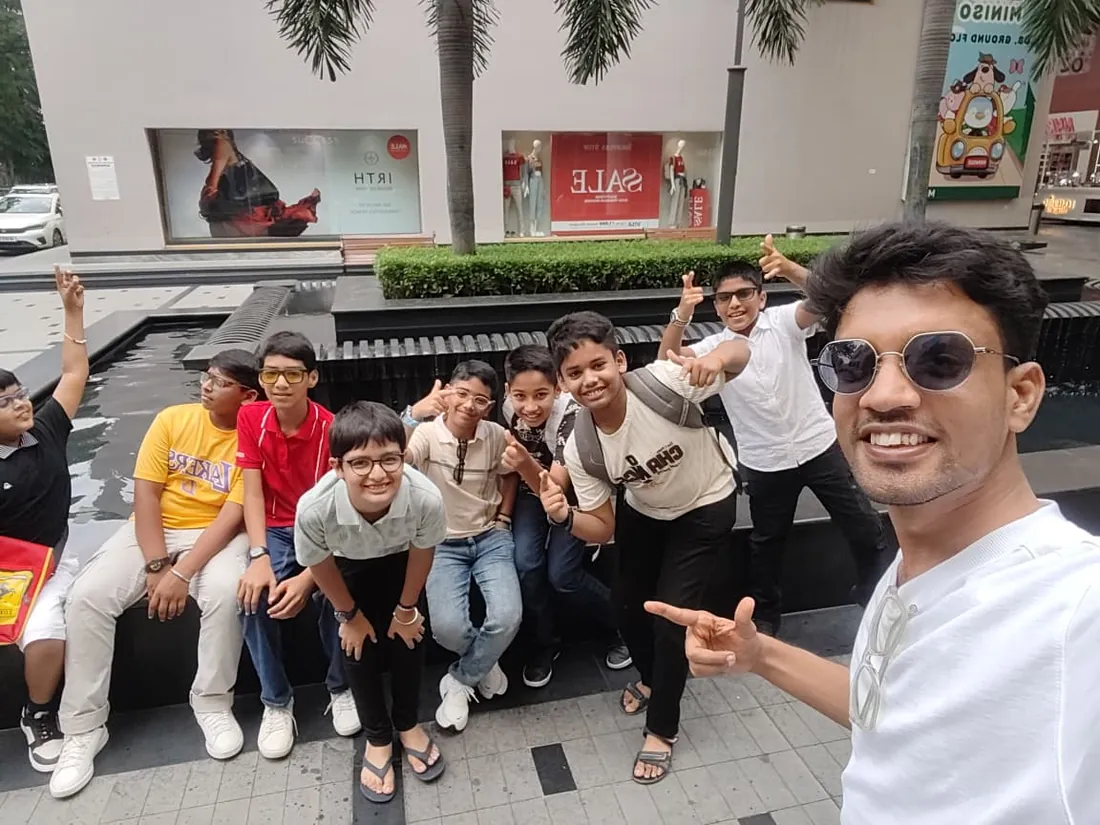
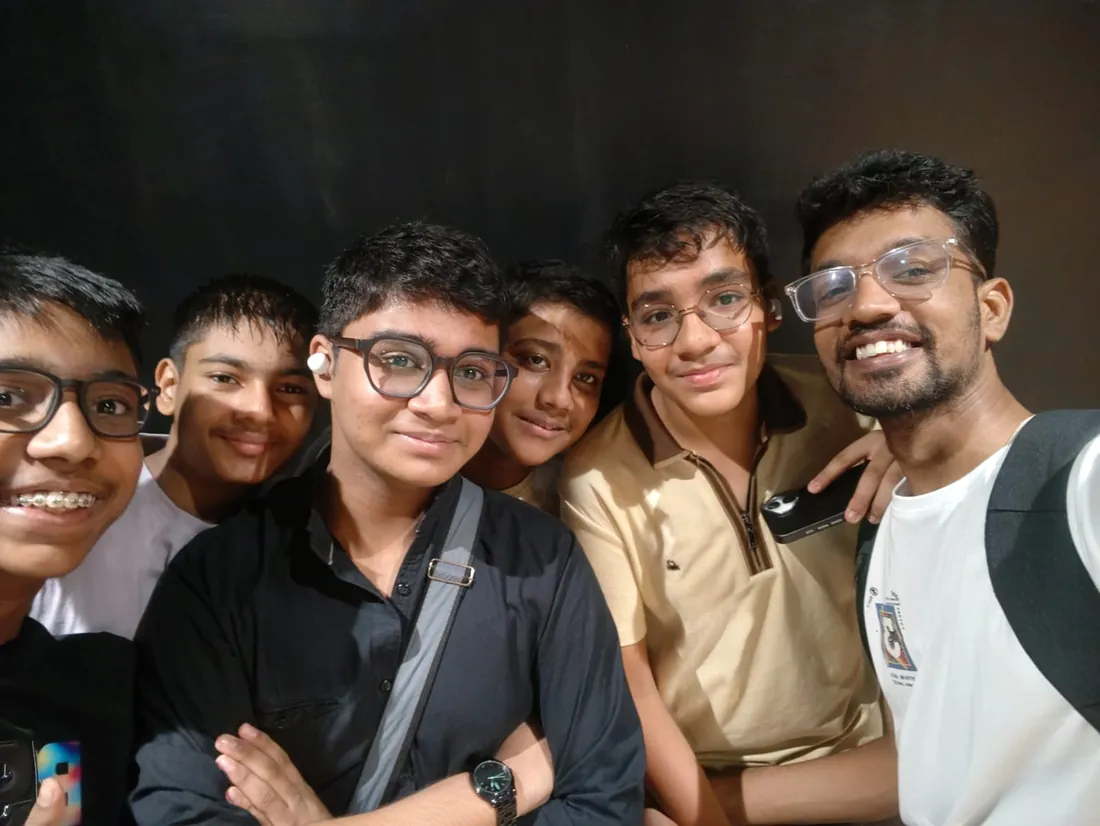
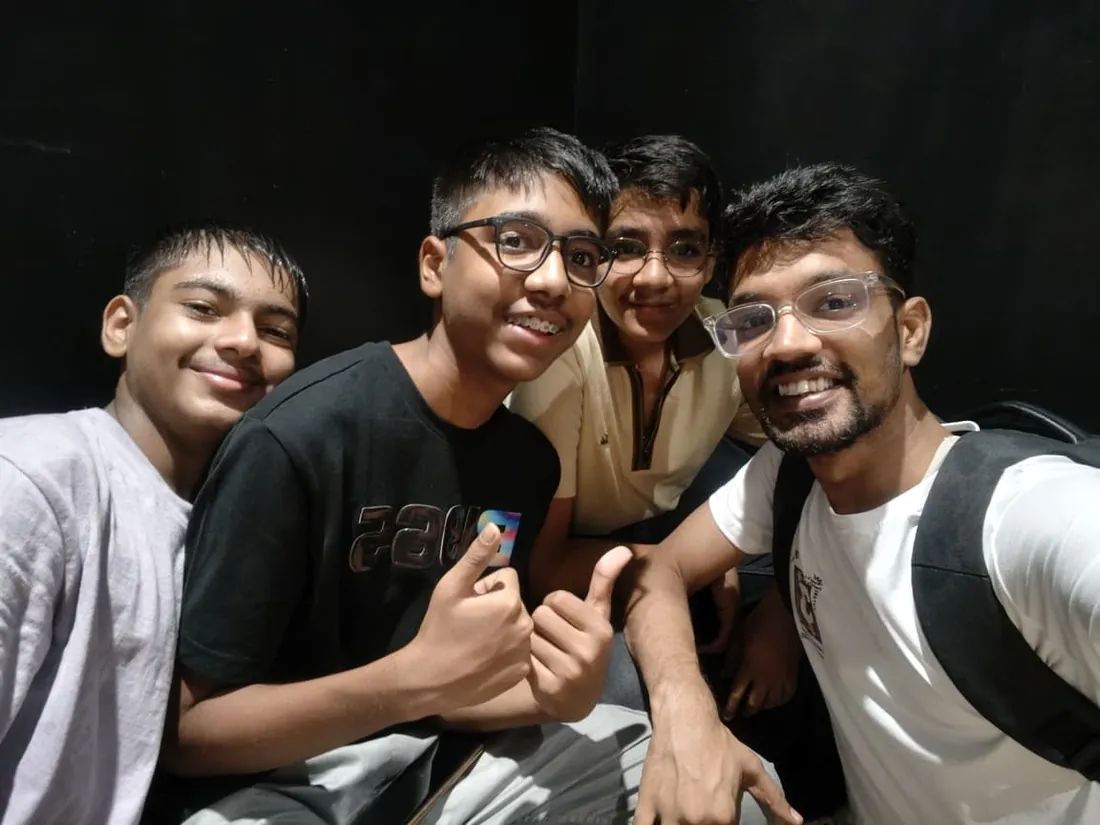
Real students. Real moments. Real joy.
These are our actual student meetups. No stock photos, no filters. Swipe through and meet the community you'll be joining.
























What families say
Straight from the parents and students who learn with us. Rated 4.9 across 547 Google reviews.
“Mivaan enjoys the class. He understands the concepts and completes his tasks with excitement. He started taking interest in coding… truly amazing class.”
“I absolutely love it here! I made new friends and learned important valuable coding skills while having the fun of my life. It's not just coding here, it's outings, bonding and most importantly preparing you for your future. Definitely five stars.”
“What stands out most is how excited my son is before every class. He looks forward to learning, problem-solving, and sharing what he's built. I've noticed a big boost in his confidence!”
“Modern Age Coders has been a game-changer for me! I struggled to grasp IT concepts and coding before joining, but their classes transformed everything. I'm now the topper in my class and can confidently write complex programs with ease.”
“Modern Age Coder have wonderful teachers who teach in a clear, easy and practical way. The teacher boosts students' confidence, keeps them updated with technology, and inspires them to learn without hesitation.”
“The one step solution for my son. Modern Age Coders make learning coding so simple that kids love it.”
“Coding classes here make learning very interesting and conceptual. The teachers teach us in a very easy-to-understand and efficient manner.”
“One of the most wonderful education centres out there. Education is not limited to school syllabus but focuses on skill development. Learning here has been a wonderful journey and still continuing.”
“I highly recommend this computer coding class! The teachers are incredibly knowledgeable and passionate about coding. They make every session engaging and insightful.”
“My child Dhairya is really enjoying the Modern Age Coder IT classes. This is his first online class, and he eagerly looks forward to it.”
“Very good classes. Don't worry about coding. They teach the best, especially Shivam sir.”
“Very good classes. Makes learning very easy and interactive.”
Hear it from our students
Real parents and students in their own words, on our public YouTube channel.
Straight answers about Deep Learning Engineering: Train, Scale and Ship Models
- Who should take this course?
- Advanced · working engineers, graduate students, researchers and strong college students who already train models in PyTorch. It suits software engineers moving into ml engineering, and ml engineers who can train a model but now need to make it faster, scale it across gpus and put it into production; master's and phd students and researchers whose experiments are limited by gpu memory, training time or compute budget, and who want to fine-tune and serve open models properly; strong final-year and senior undergraduate students aiming for ml engineer, research engineer or mlops roles, who want a portfolio project with real measurements rather than another notebook.
- What will they learn and build?
- Most people who can train a model in a notebook cannot tell you why it runs at 30 percent GPU utilisation, why it runs out of memory at batch size 16, what changes when it moves from one GPU to eight, or what a million generated tokens will cost once it is in production. That gap is the job of a deep learning engineer, and it is what this course teaches.
- How deeply are topics covered?
- The course runs 24 live 1-on-1 classes, 1 hour each at One live hour per class plus 3-5 hours of build and experiment time between classes, across 4 phases listed week by week in the syllabus below. A structured 24-class curriculum taught step by step, with a measured, real deliverable in every single class.
- Who teaches it?
- Modern Age Coders mentors, who teach the live classes themselves. You can watch them at work in the free class recordings before you decide.
- How do practice, feedback and assessment work?
- Classwork every session, a task after every class, phase-gate reviews that mix in earlier topics, and a final capstone defended live, plus a written assessment that decides the certificate: real knowledge and real work, with a free retest after revision if needed. Doubt support between classes over WhatsApp, so an out-of-memory error or a hanging distributed run never waits until the next class. A certificate you earn by passing the final assessment, with a free retest after revision if needed.
- What does it cost?
- One plan, taught 1-on-1 only, billed per month of private classes. The price is shown in your currency in the plans section. Monthly billing, cancel any time.
- When can classes take place?
- Live classes are scheduled around your week: as a 1-on-1 student you choose your own slots with your mentor, and international students are scheduled in their own timezone. Ask on WhatsApp for the current availability.
- Can I watch the teaching before deciding?
- Yes. Full recordings of real 13 and up classes are free to watch, free with a Google sign-in. These recordings show how we teach, not the exact syllabus of this course. Some classes are in English and some in Hindi; everyone follows at their own pace. Watch a class end to end, like you are in it. Sessions are interactive and each moment builds on the last.
- Can I enroll without a live demo?
- Yes. Choose a plan on this page and enrol directly; a demo is not required. If you would like to see a full class with a mentor first, book a Priority Demo.
- How do I reach you with a question?
- WhatsApp +91 91233 66161, email connect@modernagecoders.com, or call +91 91233 66161. Tell us the student's age and what they have learned so far, and we will point you to the right plan and batch.
Common Questions About Deep Learning Engineering: Train, Scale and Ship Models
Get answers to the most common questions about this comprehensive program
Still have questions? We're here to help!
Contact UsWhy Choose Deep Learning Engineering: Train, Scale and Ship Models?
Related Courses You May Like
Continue your learning journey with these recommended programs
 Advanced AI & Research
Agentic AI Engineering: Build AI Agents from Scratch
Build AI agents in Python from scratch: tool calling, MCP, RAG, memory, evals, guardrails and deploy...
Explore Course Advanced AI & Research
AI Research Engineering: Reproduce, Experiment, Publish
Reproduce an ML paper, run honest experiments with seeds, ablations and CIs, and write it up like a ...
Explore CourseRelated Articles & Guides
Deepen your knowledge with these hand-picked articles
 Artificial Intelligence
22 min read
What is AI? Complete Beginner's Guide: How to Start, Which Languages, and How Deep to Go
Complete AI guide: Learn what AI is, languages, career paths, ethics, and 5 projects. Your roadmap f...
Read Article Artificial Intelligence
12 min read
Is Coding Still Worth Learning With AI? The 2026 Evidence
Is coding still worth learning in 2026 with AI? What the job data and developer surveys show, who sh...
Read ArticleReady to start Deep Learning Engineering: Train, Scale and Ship Models?
Book a Priority Demo to see a full live class with a mentor reserved for you, today or tomorrow. Or choose a plan and enrol now.
Questions? WhatsApp +91 91233 66161 or email connect@modernagecoders.com