Deep Learning from First Principles: Every Layer, Every Gradient, Implemented
24 live 1-on-1 classes. Derive it, implement it, break it, fix it: from a hand-written autograd engine to a small GPT you pre-train yourself, with a dedicated mentor and the maths kept honest throughout.
Published November 2026
Questions? WhatsApp +91 91233 66161 or email connect@modernagecoders.com
Recordings are free with a Google sign-in. These recordings show how we teach, not the exact syllabus of this course.
Fees and enrolment
How to join Deep Learning from First Principles
Choose how you want to pay, pick a plan and press Enrol. We then fix your class timing with you.
Rated 4.9 across 547 Google reviews. Monthly billing, cancel any time.
How enrolment works
Pick a plan
This course is taught 1-on-1 only: private live classes with your own mentor, about one hour each. Billing is monthly.
Press Enrol and pay
Fill in the student's name, email and phone, then pay securely: UPI, cards or net banking in India, or a debit or credit card from any other country.
Fix your class timing
After paying, WhatsApp or call +91 91233 66161 with the student's name and your preferred time. We confirm the batch or 1-on-1 slot and send the class link.
Start learning
Join your first live class at the time you chose. Your mentor takes it from there.
Want to see a class first? Book a Priority Demo: a live class of about 45 to 60 minutes with a mentor reserved for you. If you enrol, the demo fee is adjusted against your first month's fee. Share your demo Order ID with us on WhatsApp and we take it off.
Billing is monthly and you can cancel any time.
International Students (Outside India)
Billed monthly in US dollars, the same price in every country. Contact us with any questions.
Questions before you enrol? Talk to our team.
Ask about class timings, the right level for your child, what they need to know already, or payment. Parents and adult learners can reach us on WhatsApp, by email or by phone.
Our promise
The world's best learning experience, open to everyone.
- World-class instructorsEvery class is taught by an instructor who specialises in that exact field.
- No compromise on qualityEvery lesson, project and piece of feedback is held to the highest standard.
- Education for everyoneLearners aged 6 to 67, from first-time beginners to working professionals, in 25+ countries.
If you want the highest quality, Modern Age Coders is the right choice.
Book a Priority DemoHow long this course takes
This course runs 24 live 1-on-1 classes, 1 hour each at 1 live hour per class plus 3 to 5 hours of implementation, derivation and reading between classes. The range allows for background and pace: a complete beginner uses the full span, and a student with prior knowledge finishes sooner. The syllabus below is planned to the shorter end, with margin kept for revision.
For personalised duration planning, call +91 91233 66161 and we'll map a schedule to your goals.
At a glance
- Who it is for
- Advanced: college students, working engineers, graduate students and researchers comfortable in Python.
- Prerequisites
- Confident Python: functions, classes, lists and dictionaries, and reading other people's code. NumPy familiarity helps but is taught where needed. No prior PyTorch is required
- Format
- Live, interactive classes with a real instructor, never pre-recorded videos. Live classes run about one hour.
- Language
- English or Hindi, depending on the batch.
- Duration
- 24 live 1-on-1 classes, 1 hour each
- Weekly commitment
- 1 live hour per class plus 3 to 5 hours of implementation, derivation and reading between classes
- Class size
- Taught 1-on-1 only: every class is a private session with your own mentor.
- Certificate
- Certificate from Modern Age Coders, awarded on passing the final assessment
- Watch first
- Free recordings of real classes for ages 13 and up, free with a Google sign-in. These recordings show how we teach, not the exact syllabus of this course.
- Live demo
- Optional. Enrol directly on this page, or book a Priority Demo: a full live class of about 45 to 60 minutes with a mentor reserved for you.
- Questions
- WhatsApp +91 91233 66161 or email connect@modernagecoders.com.
How we teach
Deep understanding. Real projects. Expert guidance.
Learn coding, AI and maths through careful explanations, practical demonstrations, and hands-on problem-solving. Our instructors guide you from the foundations to advanced ideas, helping you understand what happens, why it happens, and how to build it yourself.
You will explore concepts step by step, write and improve code, investigate mistakes, ask questions, and apply your knowledge to meaningful projects. Lessons are designed around active participation, thoughtful feedback, and growing independence.
Expert-led live teaching, with practical participation built into every lesson.
- Students explain their thinking.
- Instructors demonstrate, then guide practice.
- Learners code, solve, or build during lessons.
- Questions and misconceptions get attention.
- Assignments receive useful feedback.
- Progress is checked before advancing.
Program Overview
Most people who use deep learning have never written a backward pass. They can call model.fit or wire up a Hugging Face pipeline, but when a loss goes to NaN, a transformer refuses to learn, or a paper's equation does not match its code, they have nothing underneath to reason with. This course builds that floor. In 24 private one-hour classes you implement the field from the bottom up. You start with tensors and the linear algebra of a single layer, refresh exactly the calculus and probability you need, and write a scalar autograd engine by hand in the spirit of Andrej Karpathy's micrograd. You derive backpropagation in matrix form, check it numerically, then move to PyTorch knowing what loss.backward() is doing. The second phase is optimisation and generalisation: SGD, momentum, Adam and AdamW, learning-rate schedules, Glorot and He initialisation, batch and layer normalisation, residual connections, weight decay, dropout, double descent, and the practical discipline of debugging a training run that silently fails. The third phase builds the architectures: convolutions written as loops before they become library calls, RNNs and LSTMs trained with backpropagation through time, attention derived from the alignment problem it was invented to solve, and a decoder-only transformer written from an empty file, including a byte-pair tokenizer, which you then pre-train on a small corpus and sample from. The final phase looks at the science around the models: scaling laws you reproduce in miniature, variational autoencoders and denoising diffusion built from the DDPM paper, and the basics of interpretability, from probes and the logit lens to superposition and sparse autoencoders. It ends with a capstone on a question you choose, written up and defended live. Because every class is 1-on-1, the pace and depth follow you: a graduate student can push into the derivations their thesis needs, an engineer can tie each class to the models their team ships, and the GPU budget you actually have shapes every experiment.
What Makes This Program Different
- Everything is implemented, nothing is only described: autograd, backprop, every optimiser, every normalisation layer, convolution, LSTM, attention, the transformer, a tokenizer and a diffusion sampler are written by you before the library version is allowed.
- Maths-honest without being a maths degree: linear algebra, matrix calculus and probability refreshers sit inside the classes that need them, and every derivation is checked against code with numerical gradient checks.
- 1-on-1 only, by design: your research question, your codebase, your GPU budget and your gaps decide where each class goes deeper. There are no group batches for this course.
- Grounded in the real literature: you read the key passages of the papers the ideas come from (Rumelhart, Hinton and Williams on backprop; Kingma and Ba on Adam; He et al. on ResNets; Vaswani et al. on the transformer; Kaplan et al. and Hoffmann et al. on scaling; Ho et al. on diffusion) and reproduce small results from them.
- Debugging as a taught skill: overfit-one-batch, activation and gradient statistics, learning-rate range tests and ablations are practised every phase, so you can tell a bug from a bad hyperparameter.
- Runs on modest hardware: every experiment is sized to a laptop CPU, Apple Silicon or a free cloud notebook GPU, and scaled up only if you have the compute and want to.
Your Learning Journey
Career Progression
Detailed Course Curriculum
Explore the complete week-by-week breakdown of what you'll learn in this comprehensive program.
Topics Covered
- Scalars, vectors, matrices and tensors as data structures: shape, dtype, strides and why a reshape can be free while a transpose followed by view fails
- Broadcasting rules written out by hand, and the silent shape bugs they cause in real training code
- A linear layer as a matrix multiply plus bias: what each dimension means for a batch of inputs
- Dot products, norms and cosine similarity as the geometry behind every embedding and attention score
- Matrix rank, linear maps and why stacking linear layers without a nonlinearity collapses to one linear layer
- Nonlinearities (sigmoid, tanh, ReLU, GELU) and the change they make to what a network can represent
- Einsum notation as a precise language for tensor operations you will use for the rest of the course
Projects You Build
- Implement a two-layer network's forward pass in plain NumPy for a batch of inputs, with every intermediate shape asserted
Practice & Assignments
Rewrite five tensor operations from a real model's forward pass in einsum and confirm the outputs match to floating-point tolerance.
Assessment
Shape drill: predict the output shape of ten broadcasting and matmul expressions on paper, then verify each in code.
Topics Covered
- Derivatives as local linear approximations, and the finite-difference estimate you will use as ground truth all course
- Partial derivatives, gradients and the direction of steepest ascent
- The chain rule on a computation graph: forward values, local derivatives and how gradients flow backwards and accumulate at shared nodes
- Forward-mode versus reverse-mode differentiation, and why reverse mode wins when there are many parameters and one scalar loss
- Jacobians and vector-Jacobian products: the object a backward pass really computes
- Numerical stability: catastrophic cancellation, overflow in exp, and choosing a finite-difference step size
- Drawing the graph for a small expression and computing every gradient by hand before touching code
Projects You Build
- Hand-derive and code the gradients of a small expression graph, then verify every one with central finite differences
Practice & Assignments
Draw the computation graph for logistic regression on one example and compute all gradients by hand.
Assessment
Written check: derive the gradient of a composite function with a shared subexpression and explain why the two paths add.
Topics Covered
- A Value object that stores data, gradient, parents and a backward closure, in the style of Karpathy's micrograd
- Operator overloading for add, multiply, power, exp, tanh and ReLU, each with its local derivative
- Topological sort of the graph and the reverse pass that calls each node's backward exactly once
- Gradient accumulation with +=, and the bug you get if you assign instead
- Zeroing gradients between steps and why frameworks make you do it explicitly
- Building neurons, layers and an MLP on top of your engine and training it on a toy classification set
- Comparing your engine's gradients against PyTorch's on the same graph
Projects You Build
- Ship your own scalar autograd engine with a small MLP library on top, a test suite comparing every gradient to PyTorch, and a trained classifier
Practice & Assignments
Add two new operations of your choice (for example log and sigmoid) to the engine with tests.
Assessment
Your mentor introduces three bugs into a copy of your engine; find and fix them using only gradient checks.
Topics Covered
- Moving from scalars to tensors: matrix calculus for a linear layer, with the shapes that force the answer
- Backprop through ReLU, tanh and softmax, and the Jacobian structure of each
- The softmax plus cross-entropy gradient derived cleanly, and why fusing them is both faster and more stable
- Backprop for a full MLP written manually in NumPy, layer by layer
- Gradient checking at scale: relative error, which tolerance is suspicious, and checking a random subset of parameters
- Reading the 1986 paper by Rumelhart, Hinton and Williams, "Learning representations by back-propagating errors", and mapping its notation to yours
- Memory cost of backprop: which activations must be stored and why training uses far more memory than inference
Projects You Build
- Implement forward and backward for a multi-layer perceptron in pure NumPy, train it on MNIST, and pass a full gradient check
Practice & Assignments
Derive the backward pass for a layer you have not seen (for example a bilinear layer) and verify it numerically.
Assessment
Live derivation: on a shared whiteboard, derive dL/dW for a two-layer network with softmax output, then explain each shape.
Topics Covered
- Random variables, expectations and variance: the minimum needed to reason about stochastic gradients
- Maximum likelihood estimation and how mean squared error and cross-entropy both fall out of it
- Softmax as a distribution over classes, logits, temperature and the log-sum-exp trick
- Entropy, cross-entropy and KL divergence, with worked numbers rather than only definitions
- Bayes' rule and the gap between a model's predicted probability and a calibrated one
- Sampling from categorical and Gaussian distributions, and the reparameterisation idea you will use again for VAEs
- Choosing a loss for the task: regression, classification, multi-label and sequence prediction
Projects You Build
- Build a character-level bigram language model two ways, by counting and by gradient descent on negative log-likelihood, and show they converge to the same distribution
Practice & Assignments
Compute entropy, cross-entropy and KL by hand for three small distributions, then confirm in code.
Assessment
Explain, in writing, why minimising cross-entropy is equivalent to maximising likelihood, with your bigram model as the example.
Topics Covered
- PyTorch autograd mapped onto your engine: requires_grad, the dynamic graph, .backward(), .grad and torch.no_grad()
- nn.Module, parameters, state dicts and the anatomy of a clean model definition
- Datasets, DataLoaders, batching and shuffling, and the train, validation and test split you will respect all course
- The training loop line by line: forward, loss, zero_grad, backward, step, and logging that tells you something
- Device handling on CPU, CUDA and Apple Silicon (MPS) so every exercise runs on the hardware you have
- A character-level MLP language model in the style of Bengio et al., 2003, "A Neural Probabilistic Language Model", with learned embeddings
- Phase 1 review: what your engine did that PyTorch also does, and what PyTorch adds
Projects You Build
- Port your bigram model to an MLP language model with embeddings in PyTorch, train it, and beat the bigram baseline on held-out data
Practice & Assignments
Re-implement one Phase 1 project in PyTorch and confirm the gradients match your hand-written version.
Assessment
Phase 1 gate: a timed written paper on tensor shapes, chain rule and loss derivations, plus a live code review of your autograd engine.
Topics Covered
- Full-batch gradient descent, stochastic gradient descent and minibatches, and what the noise in SGD does
- The learning rate as the most important hyperparameter: too small, too large and divergent, shown on real curves
- Convex versus non-convex objectives, saddle points and why local minima are less of a problem in high dimensions than intuition suggests
- Condition number and ill-conditioning: why a long narrow valley makes plain gradient descent zig-zag
- Learning-rate range tests to find a sensible starting value quickly
- Visualising a loss surface along random and filter-normalised directions, with the caveats of a 2D slice of a huge space
- Batch size, gradient noise and the trade-off between steps and examples
Projects You Build
- Implement SGD from scratch for your MLP, run a learning-rate range test and a batch-size sweep, and plot the results with an interpretation
Practice & Assignments
Optimise a hand-built ill-conditioned quadratic with gradient descent and record how the condition number changes convergence.
Assessment
Given five training curves, diagnose each one (learning rate too high, too low, noisy batch, bug, healthy) and justify it.
Topics Covered
- Momentum and Nesterov momentum derived as a moving average, and the physics intuition with its limits
- RMSProp and adaptive per-parameter learning rates
- Adam from Kingma and Ba, 2014, "Adam: A Method for Stochastic Optimization": first and second moments, bias correction, and each line implemented
- AdamW from Loshchilov and Hutter, "Decoupled Weight Decay Regularization": why L2 regularisation and weight decay differ under Adam
- Learning-rate schedules: step, linear warmup, cosine decay and warmup-stable-decay, and why transformers almost always use warmup
- Gradient clipping by norm and when it is a fix versus a mask over a bug
- Newer optimisers such as Muon, at the level of what they change and how you would test whether they help on your problem
Projects You Build
- Write SGD with momentum, RMSProp, Adam and AdamW as your own optimizer classes, verify them against torch.optim, and compare all four on the same model with fixed seeds
Practice & Assignments
Add a warmup plus cosine schedule to your training loop and run an ablation with and without warmup.
Assessment
Implement Adam from memory in under fifteen minutes, then explain bias correction with a numerical example.
Topics Covered
- Why initialisation matters: the variance of activations and gradients as they pass through many layers
- Vanishing and exploding gradients measured, not just described, with per-layer histograms
- Glorot and Bengio, 2010, "Understanding the difficulty of training deep feedforward neural networks": the fan-in and fan-out argument derived
- He et al., 2015, "Delving Deep into Rectifiers": the ReLU correction and why it is a factor of two
- Dead ReLUs, saturated tanh units and how to detect both from activation statistics
- Initialising the output layer and biases sensibly so the initial loss matches what theory predicts
- Building a diagnostic dashboard of activation, gradient and update-to-weight ratios per layer
Projects You Build
- Train a deep MLP with naive, Glorot and He initialisation, log per-layer activation and gradient statistics, and write up which runs fail and why
Practice & Assignments
Predict the initial loss of a 10-class classifier before training, then check it in code.
Assessment
Given a set of per-layer histograms from a broken run, identify the layer and the cause.
Topics Covered
- Batch normalisation (Ioffe and Szegedy, 2015): forward and backward pass implemented, running statistics and train versus eval behaviour
- The batch-dependence problem and the bugs it causes with small batches and in evaluation mode
- Layer normalisation (Ba, Kiros and Hinton, 2016) and RMSNorm, and why sequence models prefer them
- Residual connections from He et al., 2015, "Deep Residual Learning for Image Recognition", seen as a gradient highway
- Pre-norm versus post-norm placement and its effect on training stability in deep stacks
- How normalisation and residuals change what initialisation has to do
- Writing each layer's backward pass by hand and gradient-checking it
Projects You Build
- Implement BatchNorm and LayerNorm with hand-written backward passes, then train a 20-layer MLP with and without residuals and normalisation and compare
Practice & Assignments
Find and fix a deliberately planted train-versus-eval mode bug in a BatchNorm model.
Assessment
Explain in writing why LayerNorm does not depend on batch size, and derive its backward pass.
Topics Covered
- Train, validation and test error, the bias-variance picture, and where it stops describing modern networks
- Weight decay, dropout (Srivastava et al., 2014) and early stopping implemented and compared
- Data augmentation as encoded prior knowledge, with examples for images and text
- Zhang et al., "Understanding deep learning requires rethinking generalization": networks that memorise random labels, reproduced at small scale
- Double descent (Nakkiran et al., "Deep Double Descent") and what it means for choosing model size
- Data leakage and evaluation hygiene: the mistakes that make a result look better than it is
- Seeds, variance across runs and reporting a mean with a spread instead of a single best number
Projects You Build
- Reproduce the random-labels experiment on a small image dataset, then run a regularisation ablation with at least three seeds per setting and report means and spreads
Practice & Assignments
Add dropout and weight decay to an overfitting model and chart train and validation curves for each.
Assessment
Critique a provided results table for leakage, missing seeds and unfair baselines.
Topics Covered
- Karpathy's "A Recipe for Training Neural Networks" (2019) as a working checklist, and where you would adapt it
- Overfit a single batch first: the fastest test that your model, loss and optimiser are wired correctly
- Silent failures: wrong loss reduction, labels shifted by one, data not shuffled, augmentations applied at evaluation, and gradients never reaching a layer
- NaNs and infinities: finding the first operation that produced one and the usual numerical causes
- Ablations as a debugging tool: remove one thing at a time and measure
- Reading training curves and gradient norms like a doctor reads vital signs
- Phase 2 review: optimisation, initialisation, normalisation and regularisation as one system
Projects You Build
- Debug three broken training scripts supplied by your mentor, each with a different silent failure, and write a one-page incident report for each
Practice & Assignments
Build your own pre-flight checklist script that runs the standard sanity checks on any new model.
Assessment
Phase 2 gate: a live debugging session on an unseen broken run, plus a written paper covering optimisers, initialisation and regularisation.
Topics Covered
- Convolution as a sliding dot product, written as explicit loops, then vectorised with unfold (im2col)
- Padding, stride, dilation, channels and the shape arithmetic for each
- The backward pass of a convolution derived and implemented, and why it is itself a convolution
- Weight sharing, translation equivariance and receptive fields as the inductive biases that make CNNs work
- Pooling and strided convolution for downsampling
- A short history in architectures: LeNet, AlexNet (Krizhevsky, Sutskever and Hinton, 2012) and ResNet, and what each changed
- Visualising learned filters and feature maps
Projects You Build
- Implement Conv2d forward and backward from scratch, verify against PyTorch, then build and train a small ResNet on CIFAR-10 and report test accuracy with seeds
Practice & Assignments
Compute the receptive field of every layer in your ResNet by hand and check it empirically.
Assessment
Derive the output shape and parameter count of a given CNN stack without running code.
Topics Covered
- Sequence modelling and why fixed-size inputs are not enough
- A vanilla RNN cell implemented from scratch, unrolled over time
- Backpropagation through time and truncated BPTT
- Why RNN gradients vanish or explode, shown with the repeated Jacobian product
- The LSTM from Hochreiter and Schmidhuber, 1997: gates, cell state and the additive path that preserves gradients
- GRUs as a simpler gated alternative
- Where RNNs still make sense, and the sequential bottleneck that pushed the field towards attention
Projects You Build
- Implement an RNN and an LSTM cell by hand, train both as character-level language models on the same corpus, and compare loss and samples
Practice & Assignments
Measure gradient norms across time steps for your RNN and LSTM and plot them side by side.
Assessment
Explain in writing, with equations, why the LSTM cell state eases the vanishing gradient problem.
Topics Covered
- The alignment problem in translation and Bahdanau, Cho and Bengio, 2014, "Neural Machine Translation by Jointly Learning to Align and Translate"
- Attention as a differentiable lookup: queries, keys and values
- Scaled dot-product attention and the variance argument behind the square root of d_k
- Causal masking for autoregressive models and padding masks for batches
- Self-attention versus cross-attention
- Multi-head attention as several smaller attention operations in parallel, with the reshapes written out
- The quadratic cost in sequence length and what that means for context windows
Projects You Build
- Implement scaled dot-product and multi-head self-attention from scratch with causal masking, and test it against torch.nn.functional.scaled_dot_product_attention
Practice & Assignments
Visualise the attention weights of your layer on a small toy task (for example copying or sorting) and interpret them.
Assessment
Derive the attention output shape for a given batch, sequence length, head count and model dimension, and explain the mask.
Topics Covered
- Vaswani et al., 2017, "Attention Is All You Need": reading the architecture section with your own code beside it
- The decoder-only block: attention, MLP, residual stream and pre-norm LayerNorm
- Positional information: sinusoidal encodings, learned embeddings and rotary embeddings from "RoFormer" (Su et al., 2021)
- Weight tying between input embeddings and the output head
- Parameter counting and FLOP estimates for a transformer, done by hand
- Initialisation and residual scaling choices used in GPT-style models
- Testing a transformer: shape tests, causal leakage tests and overfitting a single batch
Projects You Build
- Write a GPT-style decoder-only transformer from an empty file, with RoPE, a causal leakage test and a parameter count that matches your hand calculation
Practice & Assignments
Swap learned positional embeddings for RoPE and compare validation loss on the same budget.
Assessment
Live review: walk your mentor through every line of your transformer and answer why each design choice is there.
Topics Covered
- Characters, words and subwords: the trade-offs in vocabulary size and sequence length
- Byte-pair encoding from Sennrich, Haddow and Birch, 2016, implemented from scratch
- Byte-level BPE, special tokens and the encode-decode round trip
- How tokenisation causes odd model behaviour with numbers, spelling and non-English text
- Next-token prediction as the training objective, and the shift between inputs and targets
- Perplexity and bits per byte as evaluation metrics, and why bits per byte compares across tokenizers
- Building a clean small corpus: deduplication, splits and avoiding test leakage
Projects You Build
- Implement and train a byte-level BPE tokenizer on your chosen corpus, and measure compression ratio and round-trip correctness
Practice & Assignments
Tokenise the same paragraph in English and one other language you know, and compare token counts.
Assessment
Explain why perplexity from two different tokenizers cannot be compared directly, and what to use instead.
Topics Covered
- Putting it together: your tokenizer, your transformer and your training loop on a small corpus such as TinyStories (Eldan and Li, 2023) or Tiny Shakespeare
- Sizing the model to your compute: parameters, tokens and the time per step on your hardware
- Training stability for transformers: warmup, gradient clipping, AdamW settings and loss spikes
- Sampling: greedy, temperature, top-k and nucleus sampling from Holtzman et al., "The Curious Case of Neural Text Degeneration"
- The KV cache for fast generation, implemented and timed
- Reading open minimal implementations such as Karpathy's nanoGPT and nanochat and comparing them with yours
- Phase 3 review: CNNs, RNNs and transformers as different answers to the same question about inductive bias
Projects You Build
- Pre-train your own small GPT-style model end to end on your corpus, add a KV cache, and publish a short report with loss curves, samples and a timing table
Practice & Assignments
Run a sampling study: the same prompts at five temperature and top-p settings, with your judgement of each.
Assessment
Phase 3 gate: a live whiteboard derivation of attention plus a code review of your trained language model and its report.
Topics Covered
- Kaplan et al., 2020, "Scaling Laws for Neural Language Models": loss as a power law in parameters, data and compute
- Hoffmann et al., 2022, "Training Compute-Optimal Large Language Models" (Chinchilla) and why it changed the recommended ratio of tokens to parameters
- The compute approximation C ≈ 6ND and using it to plan a training run
- Fitting a power law properly: log-log plots, the irreducible loss term and the danger of extrapolating far
- What scaling laws do and do not predict: smooth loss versus jumps in specific capabilities
- Designing a small sweep that fits your GPU budget
- Hyperparameter transfer across model sizes as a practical concern when you scale
Projects You Build
- Run your own scaling sweep of at least five model sizes on your corpus, fit a power law to final loss versus compute, and state honestly how far you would trust it
Practice & Assignments
Use C ≈ 6ND to plan the largest run your hardware could finish in a fixed number of GPU-hours, and justify the split between N and D.
Assessment
Given a published scaling plot, read off the exponent and explain what it implies for doubling compute.
Topics Covered
- Autoencoders as learned compression and the bottleneck that forces structure
- Latent variable models and why the likelihood is intractable
- The evidence lower bound (ELBO) derived step by step from Kingma and Welling, 2013, "Auto-Encoding Variational Bayes"
- The reparameterisation trick revisited and implemented
- Reconstruction versus KL terms, posterior collapse and the beta weighting trade-off
- Sampling and interpolating in latent space
- Where VAEs sit today: as the latent compressor inside latent diffusion systems
Projects You Build
- Implement a VAE from scratch on an image dataset, derive its ELBO in your write-up, and show reconstructions, samples and a latent interpolation
Practice & Assignments
Vary the KL weight and record what happens to reconstructions and samples.
Assessment
Written derivation of the ELBO from the log-likelihood with every inequality justified.
Topics Covered
- Ho, Jain and Abbeel, 2020, "Denoising Diffusion Probabilistic Models": the forward noising process and its closed form
- The reverse process and why predicting the noise is a convenient parameterisation
- The simplified training objective and the noise schedule
- A small U-Net style denoiser with time-step embeddings
- Ancestral sampling, and faster samplers at the level of what they trade
- The connection to score matching and to flow matching (Lipman et al., "Flow Matching for Generative Modeling") at an intuitive level
- Classifier-free guidance as a sampling-time control knob
Projects You Build
- Implement DDPM training and sampling from scratch on a small image dataset and produce a grid of samples across denoising steps
Practice & Assignments
Change the noise schedule from linear to cosine and compare sample quality at a fixed step budget.
Assessment
Explain, with equations, why the forward process can be sampled at any time step in one shot.
Topics Covered
- What interpretability tries to answer, and the difference between explaining a prediction and understanding a mechanism
- Linear probes on hidden states, and the trap of a probe that learns the task itself
- Attention pattern analysis and why attention weights alone are weak evidence
- The residual stream view and the logit lens: reading intermediate layers through the output head
- Activation patching as a causal test of where information lives
- Superposition, from Anthropic's "Toy Models of Superposition" (Elhage et al., 2022), reproduced on a toy model
- Sparse autoencoders for finding features, as in "Towards Monosemanticity" (Bricken et al., 2023), at a scale you can run
Projects You Build
- Apply probes, the logit lens and activation patching to the language model you trained in Class 18, and write up one mechanism you can support with causal evidence
Practice & Assignments
Reproduce one plot from "Toy Models of Superposition" on a toy model you train yourself.
Assessment
Critique an interpretability claim: what evidence would make it causal rather than correlational?
Topics Covered
- Choosing a capstone question you can answer with the compute you have, agreed with your mentor in advance
- Typical shapes: reproduce a small result from a paper, run a careful ablation on your transformer, extend your diffusion model, or answer an interpretability question
- Writing a one-page plan: hypothesis, baseline, metric, seeds and the result that would change your mind
- Running experiments with a log you can trust: configs, seeds and saved checkpoints
- Mid-build review of first results, and pruning the plan to what the evidence supports
- Figures that carry the argument: what to plot and what to leave out
- Personalisation: graduate students often tie this to their thesis topic, engineers to a model their team ships
Projects You Build
- Build the capstone experiment, with a reproducible codebase, a results table with multiple seeds and the core figures
Practice & Assignments
Rerun your key result from a clean checkout to confirm it reproduces.
Assessment
Mentor review of your plan and first results, with written feedback you must address before Class 24.
Topics Covered
- Writing the capstone report in the structure of a short workshop paper: question, method, results, limitations
- Stating limitations honestly and separating what you showed from what you suspect
- Presenting the work in fifteen minutes to a technical audience
- Handling questions about baselines, seeds, compute and alternative explanations
- A cumulative written assessment covering derivations and implementation from all four phases
- Planning next steps: the engineering, paper-reading and research-engineering courses in this track, or graduate study
- Course retrospective: the three ideas that changed how you think about neural networks
Projects You Build
- Submit the capstone report and code, and defend it live with your mentor in the role of a reviewer
Practice & Assignments
Revise the report once based on the defence feedback.
Assessment
Final assessment: the live capstone defence plus a written paper across all phases, which together decide the certificate, with a free retest after revision if needed.
Projects You'll Build
Build a professional portfolio with 24 implementation deliverables, one per class, finishing with a capstone experiment and a report written like a short workshop paper real-world projects.
Weekly Learning Structure
Certification & Recognition
Technologies & Skills You'll Master
Comprehensive coverage of the entire modern web development stack.
Support & Resources
Career Outcomes & Opportunities
Transform your career with industry-ready skills and job placement support.
Prerequisites
Who Is This Course For?
Career Paths After Completion
Course Guarantees
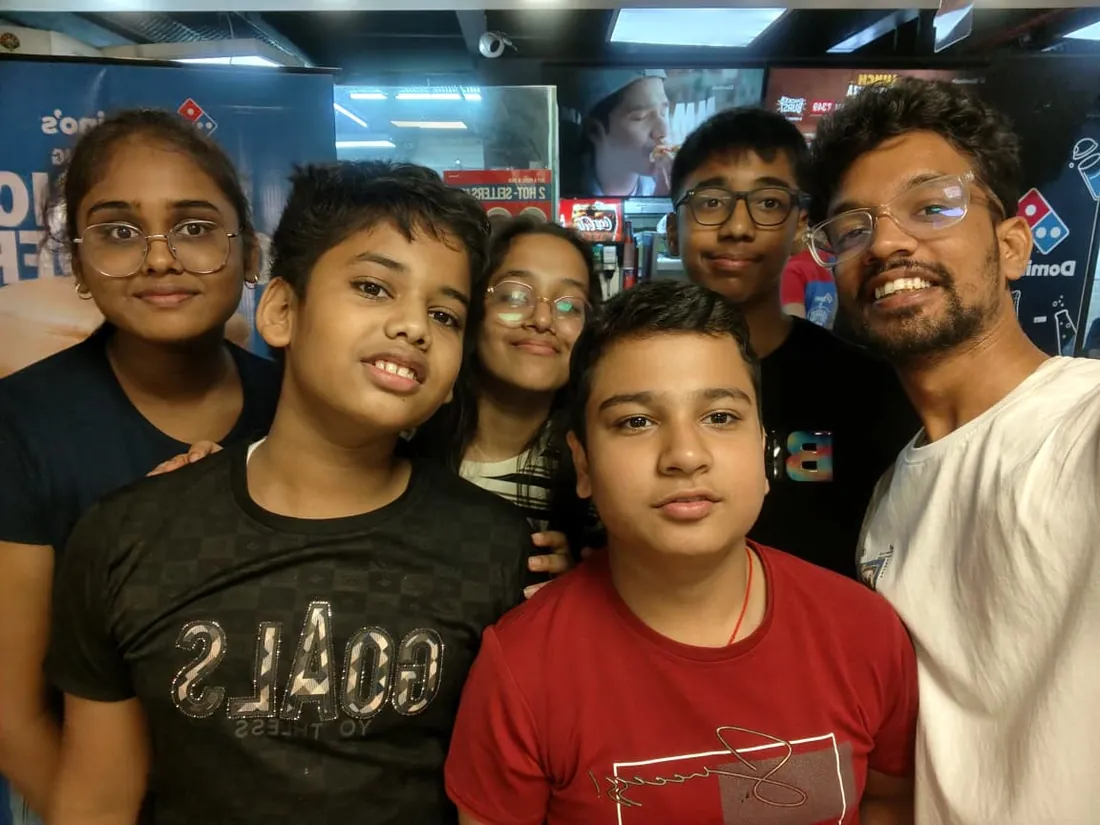
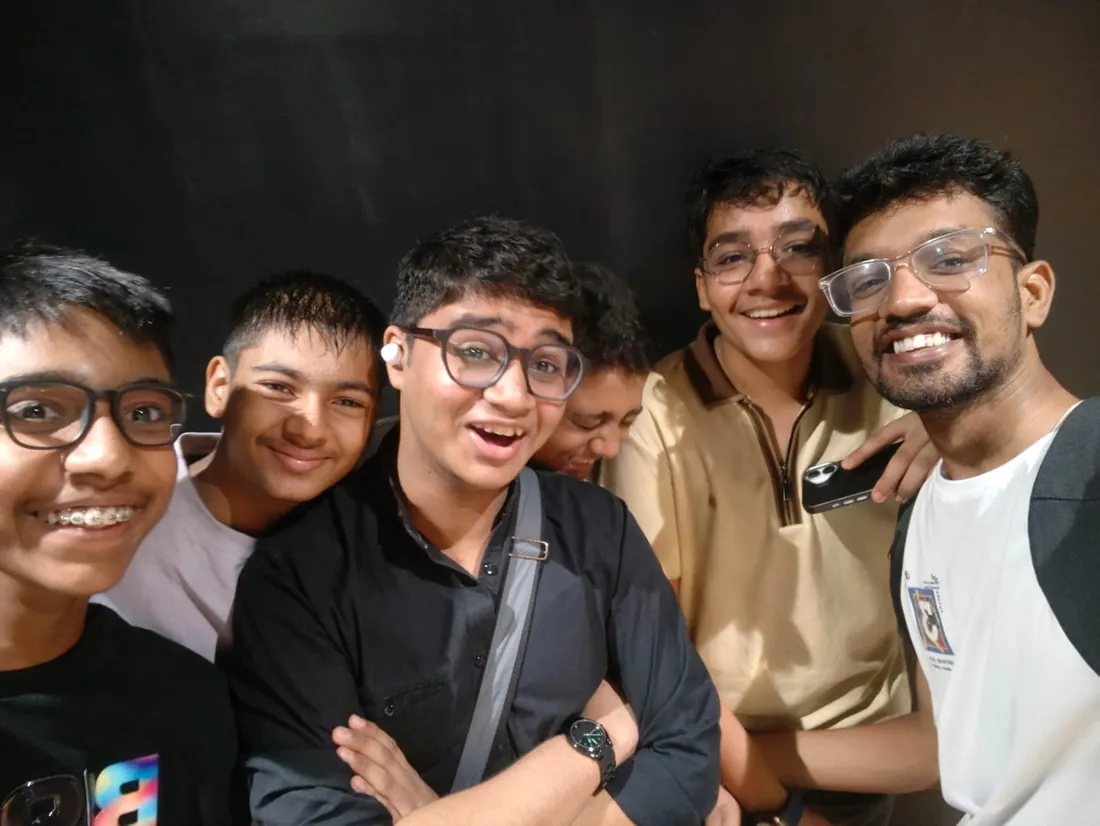
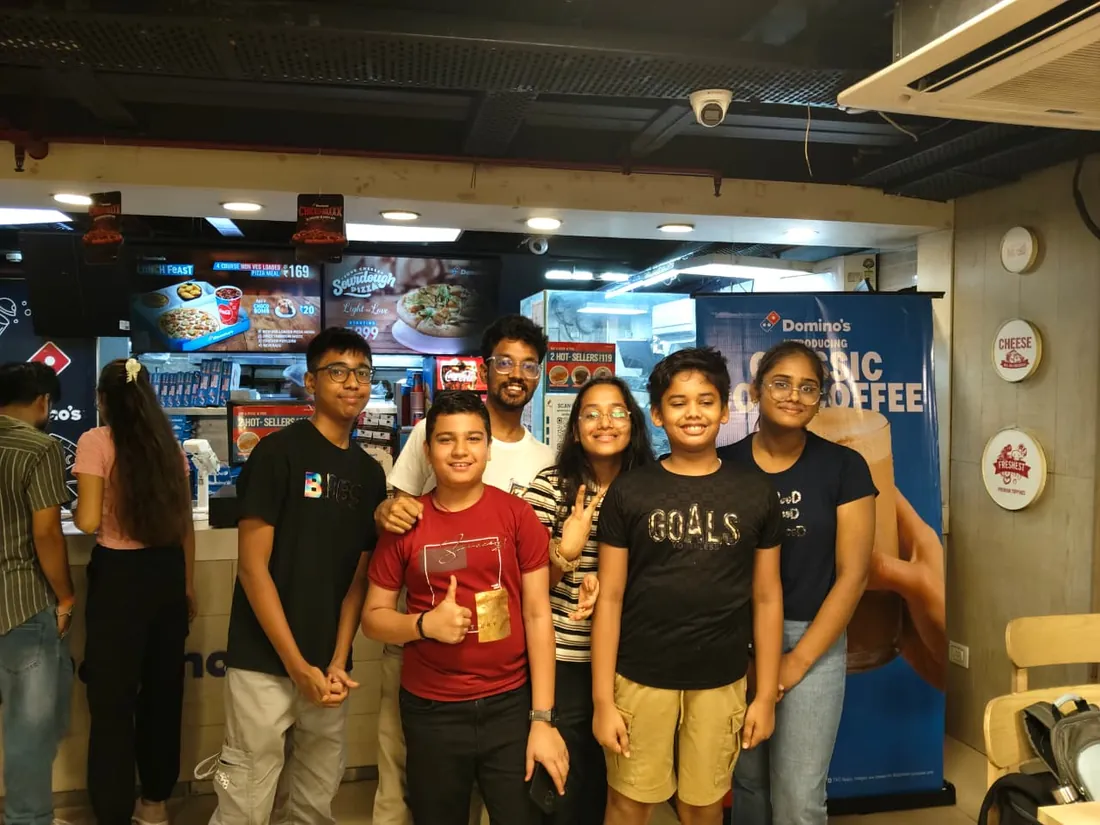
Real students. Real moments. Real joy.
These are our actual student meetups. No stock photos, no filters. Swipe through and meet the community you'll be joining.




































What families say
Straight from the parents and students who learn with us. Rated 4.9 across 547 Google reviews.
“Mivaan enjoys the class. He understands the concepts and completes his tasks with excitement. He started taking interest in coding… truly amazing class.”
“I absolutely love it here! I made new friends and learned important valuable coding skills while having the fun of my life. It's not just coding here, it's outings, bonding and most importantly preparing you for your future. Definitely five stars.”
“What stands out most is how excited my son is before every class. He looks forward to learning, problem-solving, and sharing what he's built. I've noticed a big boost in his confidence!”
“Modern Age Coders has been a game-changer for me! I struggled to grasp IT concepts and coding before joining, but their classes transformed everything. I'm now the topper in my class and can confidently write complex programs with ease.”
“Modern Age Coder have wonderful teachers who teach in a clear, easy and practical way. The teacher boosts students' confidence, keeps them updated with technology, and inspires them to learn without hesitation.”
“The one step solution for my son. Modern Age Coders make learning coding so simple that kids love it.”
“Coding classes here make learning very interesting and conceptual. The teachers teach us in a very easy-to-understand and efficient manner.”
“One of the most wonderful education centres out there. Education is not limited to school syllabus but focuses on skill development. Learning here has been a wonderful journey and still continuing.”
“I highly recommend this computer coding class! The teachers are incredibly knowledgeable and passionate about coding. They make every session engaging and insightful.”
“My child Dhairya is really enjoying the Modern Age Coder IT classes. This is his first online class, and he eagerly looks forward to it.”
“Very good classes. Don't worry about coding. They teach the best, especially Shivam sir.”
“Very good classes. Makes learning very easy and interactive.”
Hear it from our students
Real parents and students in their own words, on our public YouTube channel.
Straight answers about Deep Learning from First Principles
- Who should take this course?
- Advanced: college students, working engineers, graduate students and researchers comfortable in Python. It suits computer science, engineering, maths and physics students who want to understand deep learning properly before they specialise, and who are tired of tutorials that stop at model.fit; software and ml engineers who use models at work and want to understand them well enough to debug training, read papers and make architecture decisions with confidence; master's and phd students and researchers from adjacent fields who need deep learning foundations for their own research, with the derivations their work depends on covered 1-on-1.
- What will they learn and build?
- Most people who use deep learning have never written a backward pass. They can call model.fit or wire up a Hugging Face pipeline, but when a loss goes to NaN, a transformer refuses to learn, or a paper's equation does not match its code, they have nothing underneath to reason with. This course builds that floor. In 24 private one-hour classes you implement the field from the bottom up.
- How deeply are topics covered?
- The course runs 24 live 1-on-1 classes, 1 hour each at 1 live hour per class plus 3 to 5 hours of implementation, derivation and reading between classes, across 4 phases listed week by week in the syllabus below. A structured 24-class curriculum taught step by step, with a real implementation deliverable in every single class.
- Who teaches it?
- Modern Age Coders mentors, who teach the live classes themselves. You can watch them at work in the free class recordings before you decide.
- How do practice, feedback and assessment work?
- Classwork every session, a task after every class, phase-gate reviews that mix in earlier topics, and a capstone defended live, plus a written assessment that decides the certificate: real knowledge and real work, with a free retest after revision if needed. Doubt support between classes over WhatsApp, so a failing gradient check or a NaN loss never waits until the next class. A certificate you earn by passing the final assessment, with a free retest after revision if needed.
- What does it cost?
- One plan, taught 1-on-1 only, billed per month of private classes. The price is shown in your currency in the plans section. Monthly billing, cancel any time.
- When can classes take place?
- Live classes are scheduled around your week: as a 1-on-1 student you choose your own slots with your mentor, and international students are scheduled in their own timezone. Ask on WhatsApp for the current availability.
- Can I watch the teaching before deciding?
- Yes. Full recordings of real 13 and up classes are free to watch, free with a Google sign-in. These recordings show how we teach, not the exact syllabus of this course. Some classes are in English and some in Hindi; everyone follows at their own pace. Watch a class end to end, like you are in it. Sessions are interactive and each moment builds on the last.
- Can I enroll without a live demo?
- Yes. Choose a plan on this page and enrol directly; a demo is not required. If you would like to see a full class with a mentor first, book a Priority Demo.
- How do I reach you with a question?
- WhatsApp +91 91233 66161, email connect@modernagecoders.com, or call +91 91233 66161. Tell us the student's age and what they have learned so far, and we will point you to the right plan and batch.
Common Questions About Deep Learning from First Principles
Get answers to the most common questions about this comprehensive program
Still have questions? We're here to help!
Contact UsWhy Choose Deep Learning from First Principles?
Related Courses You May Like
Continue your learning journey with these recommended programs
 Advanced AI & Research
Agentic AI Engineering: Build AI Agents from Scratch
Build AI agents in Python from scratch: tool calling, MCP, RAG, memory, evals, guardrails and deploy...
Explore Course Advanced AI & Research
AI Research Engineering: Reproduce, Experiment, Publish
Reproduce an ML paper, run honest experiments with seeds, ablations and CIs, and write it up like a ...
Explore CourseRelated Articles & Guides
Deepen your knowledge with these hand-picked articles
 Artificial Intelligence
22 min read
What is AI? Complete Beginner's Guide: How to Start, Which Languages, and How Deep to Go
Complete AI guide: Learn what AI is, languages, career paths, ethics, and 5 projects. Your roadmap f...
Read Article Technology
26 min read
Best Data Science Courses in India for Students and Professionals in 2026
Comprehensive guide to the best data science courses in India for 2026. Compare IITs, IIMs, online p...
Read ArticleReady to start Deep Learning from First Principles?
Book a Priority Demo to see a full live class with a mentor reserved for you, today or tomorrow. Or choose a plan and enrol now.
Questions? WhatsApp +91 91233 66161 or email connect@modernagecoders.com