Table of Contents
- The words you need
- The four moves: divide, multiply, subtract, bring down
- A worked example with a remainder
- The mistake that causes most wrong answers
- Dividing by a two-digit number
- Why long division works
- Short division, long division and chunking
- When should children learn long division?
- How we teach it
- Frequently asked questions
Long division is the written method for dividing big numbers, and it has a reputation for being the point where maths stops making sense. The procedure has a lot of moving parts, and children are often taught the steps without being told why they work. Parents who learned it thirty years ago, sometimes in a different country with a different layout, then find they cannot explain it either.
This guide breaks long division into the four moves that repeat, walks through several examples one step at a time, shows the mistake that causes most wrong answers, and explains why the method works at all. Every worked example here was checked by a short Python program that performs long division exactly the way you do it on paper, and prints each step.
The words you need
- Dividend: the number being divided. In 8472 ÷ 6, it is 8472.
- Divisor: the number you are dividing by. Here, 6.
- Quotient: the answer, written above the dividend in most layouts.
- Remainder: what is left over when the divisor does not go in exactly.
The four moves: divide, multiply, subtract, bring down
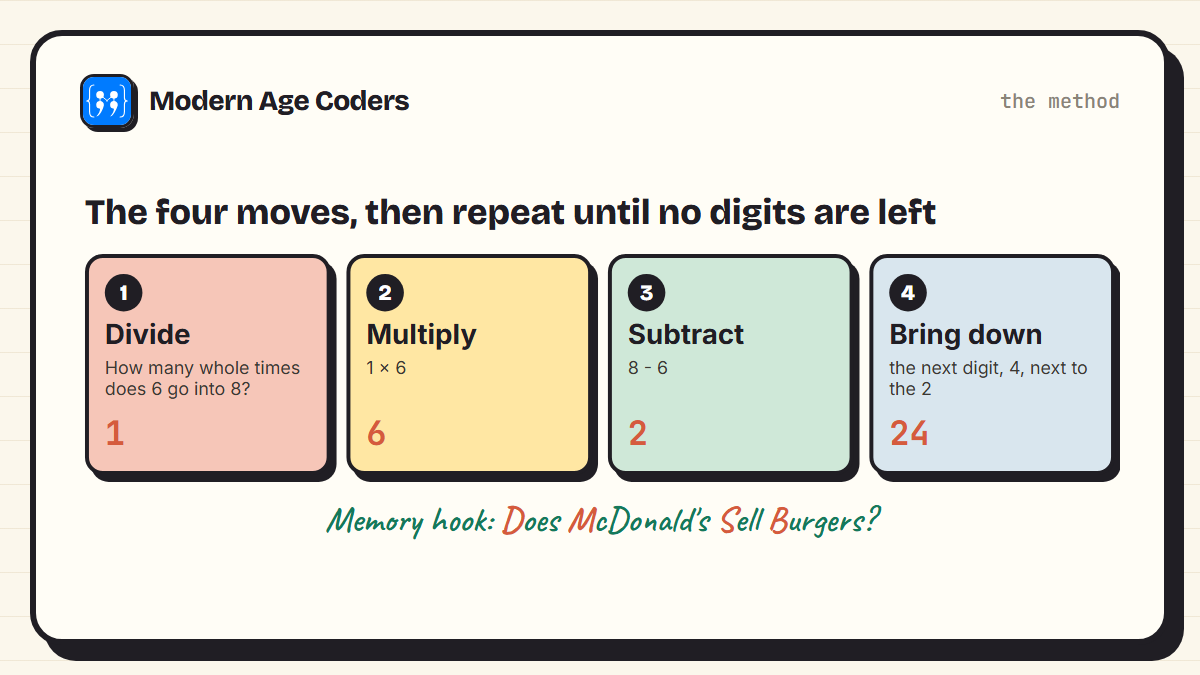
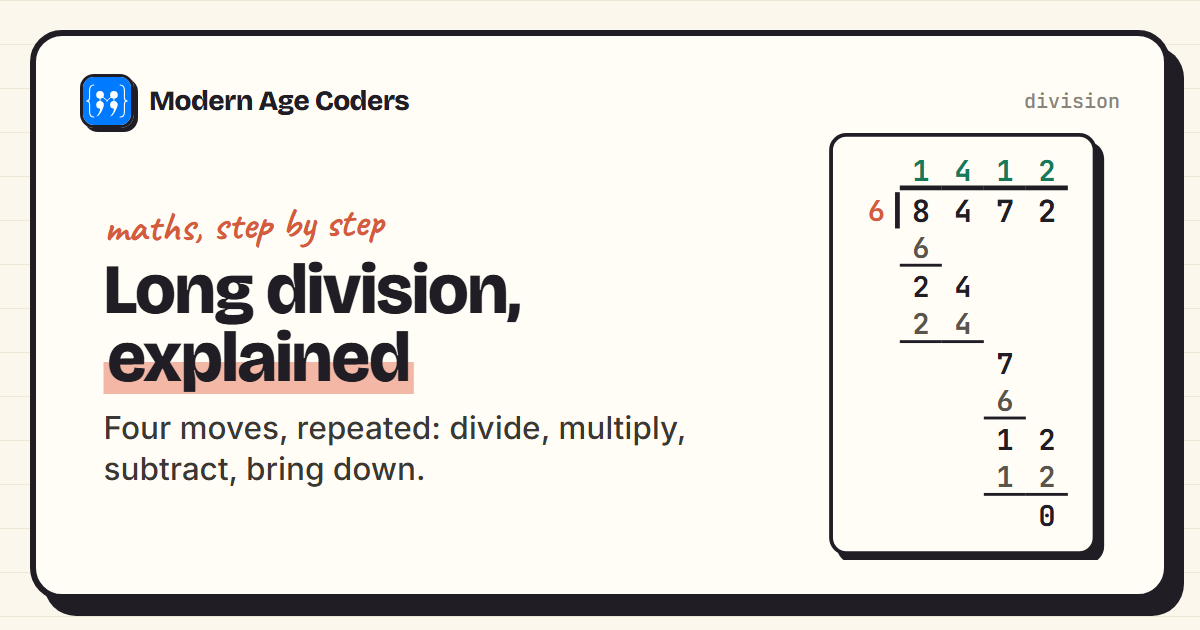
Let us work through 8472 ÷ 6 slowly. Look at the first digit, 8.
- Divide: how many whole times does 6 go into 8? Once. Write 1 above the 8.
- Multiply: 1 x 6 = 6. Write 6 under the 8.
- Subtract: 8 - 6 = 2. This 2 is what is left over so far.
- Bring down: the next digit, 4, comes down next to the 2, making 24.
Now repeat with 24. 6 goes into 24 exactly 4 times; 4 x 6 = 24; 24 - 24 = 0; bring down the 7. Then 6 goes into 7 once, leaving 1; bring down the 2 to make 12; 6 goes into 12 twice with nothing left. The answer is 1412.
Here is the same thing done by a program that follows exactly those four moves for each digit. It also checks its own answer at the end, which is a habit worth copying on paper:
def long_division(dividend, divisor):
    digits = str(dividend)
    quotient, remainder = "", 0
    print(f"{dividend} / {divisor}")
    for position, digit in enumerate(digits):
        current = remainder * 10 + int(digit)          # bring down the next digit
        q = current // divisor                          # divide: how many whole times?
        product = q * divisor                           # multiply back
        remainder = current - product                   # subtract
        quotient += str(q)
        print(f"  bring down {digit}: {current:>3} / {divisor} = {q}, {q} x {divisor} = {product:>3}, remainder {remainder}")
    answer = int(quotient)                              # drop leading zeros
    print(f"answer: {answer} remainder {remainder}")
    print(f"check:  {answer} x {divisor} + {remainder} = {answer * divisor + remainder}")

long_division(8472, 6)
print()
long_division(612, 3)
print()
long_division(9437, 7)8472 / 6
bring down 8: 8 / 6 = 1, 1 x 6 = 6, remainder 2
bring down 4: 24 / 6 = 4, 4 x 6 = 24, remainder 0
bring down 7: 7 / 6 = 1, 1 x 6 = 6, remainder 1
bring down 2: 12 / 6 = 2, 2 x 6 = 12, remainder 0
answer: 1412 remainder 0
check: 1412 x 6 + 0 = 8472
612 / 3
bring down 6: 6 / 3 = 2, 2 x 3 = 6, remainder 0
bring down 1: 1 / 3 = 0, 0 x 3 = 0, remainder 1
bring down 2: 12 / 3 = 4, 4 x 3 = 12, remainder 0
answer: 204 remainder 0
check: 204 x 3 + 0 = 612
9437 / 7
bring down 9: 9 / 7 = 1, 1 x 7 = 7, remainder 2
bring down 4: 24 / 7 = 3, 3 x 7 = 21, remainder 3
bring down 3: 33 / 7 = 4, 4 x 7 = 28, remainder 5
bring down 7: 57 / 7 = 8, 8 x 7 = 56, remainder 1
answer: 1348 remainder 1
check: 1348 x 7 + 1 = 9437A memory hook children like
Divide, Multiply, Subtract, Bring down: "Does McDonald's Sell Burgers?" Some teachers add a fifth step, R for Repeat or Remainder, so it becomes "Does McDonald's Sell Burgers Raw?" Silly sentences are remembered far better than lists.
A worked example with a remainder
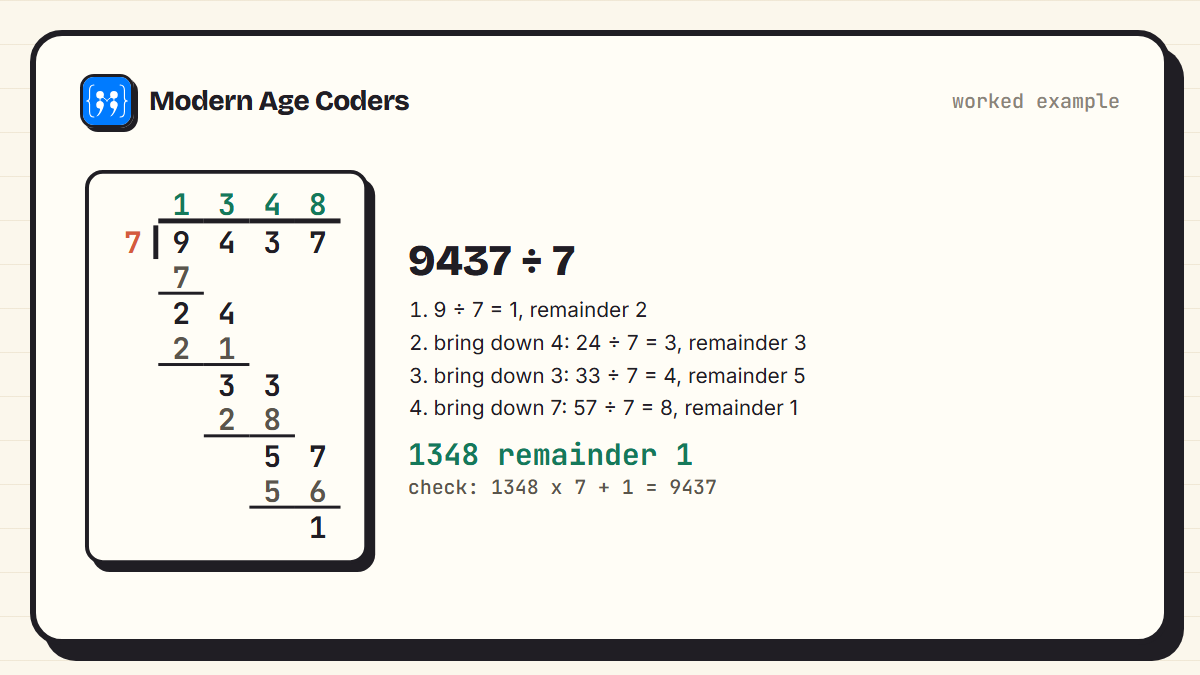
Not every division comes out exactly. In 9437 ÷ 7, after the last digit is brought down and divided, 1 is left over. That is the remainder: the answer is 1348 remainder 1. The check at the end of the program's output is the important part: 1348 x 7 + 1 = 9437. If the check does not give you back the number you started with, there is a mistake somewhere, and you can find it by comparing each step.
Depending on the question, a remainder can be left as it is, written as a fraction (1348 and 1/7), or turned into a decimal by adding a decimal point and zeros to the dividend and continuing to bring down zeros. Real-world questions sometimes need you to round up instead: 9437 people on buses that hold 7 need 1349 buses, not 1348.
The mistake that causes most wrong answers
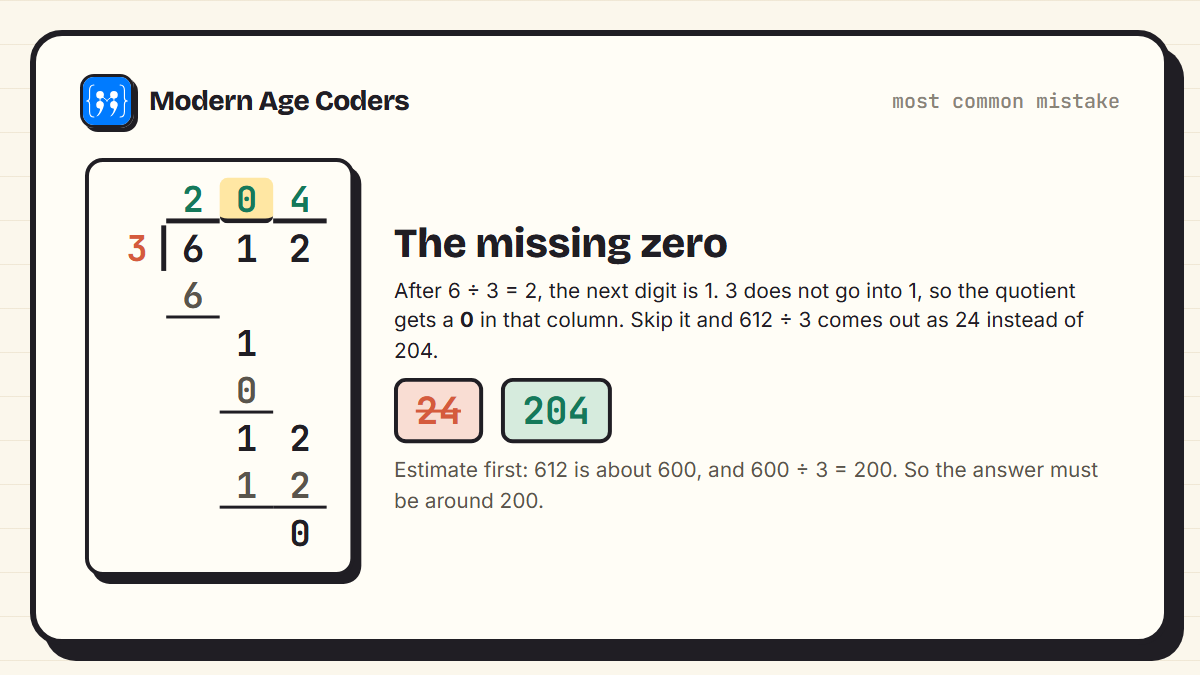
Look at 612 ÷ 3 in the program's output above. 3 goes into 6 twice. Then the next digit is 1, and 3 does not go into 1. At this point a lot of students simply move on, and the answer comes out as 24. The correct answer is 204, because the quotient needs a digit in every column after it starts, and when the divisor does not go in, that digit is 0.
The best protection is an estimate before you start. 612 is about 600, and 600 ÷ 3 is 200, so the answer has to be somewhere around 200. An answer of 24 is obviously wrong the moment you compare it. This takes ten seconds and catches most long division errors, not just this one.
Estimating is a skill worth practising on its own, not just for division. Our guide to estimation in maths shows how accurate rounding to one significant figure really is, measured over 10,000 calculations, and how it catches decimal-point slips.
- Misaligned columns. Write each quotient digit directly above the digit you just brought down. Squared paper helps enormously.
- A guess that is too big. If the multiply step gives a number larger than what you are dividing, your guess was one too high.
- A remainder that is too big. If the remainder is equal to or larger than the divisor, the divisor could have gone in one more time.
- Weak times tables. Every divide step is a times tables fact in reverse. If your child hesitates on 7 x 8, long division will feel impossible. Our guide to learning times tables fast fixes that first.
Dividing by a two-digit number
With a divisor like 27, the four moves are exactly the same. The only hard part is the divide step, because you probably do not know the 27 times table. The trick is to estimate using a rounded divisor, then adjust. To divide by 27, think "about 30"; to divide by 42, think "about 40". Your estimate will sometimes be one too big or too small, and the multiply and subtract steps will tell you.
def long_division_two_digit(dividend, divisor):
    remainder, quotient = 0, ""
    for digit in str(dividend):
        current = remainder * 10 + int(digit)
        q = current // divisor
        remainder = current - q * divisor
        quotient += str(q)
        if quotient.lstrip("0"):
            # estimate by rounding the divisor, the way you would on paper
            guess = current // (round(divisor, -1) or 10)
            print(f"{current:>4} / {divisor}: estimate {guess} from {round(divisor, -1)}, actual {q}, remainder {remainder}")
    print("answer:", int(quotient), "remainder", remainder)

long_division_two_digit(6453, 27) 64 / 27: estimate 2 from 30, actual 2, remainder 10
105 / 27: estimate 3 from 30, actual 3, remainder 24
243 / 27: estimate 8 from 30, actual 9, remainder 0
answer: 239 remainder 0Look at the last line of working. Rounding 27 up to 30 suggested that 243 contains 8 lots, but the real answer is 9, because 27 is smaller than 30. On paper you would find this at the subtract step: 243 - 8 x 27 leaves 27, which is not smaller than the divisor, so the divisor goes in one more time. That is exactly what happens in real long division, and it is normal. Correcting an estimate by one is part of the method, not a sign of getting it wrong.
Why long division works
Long division can feel like a magic trick. It is not. It is a way of dividing a number one place value at a time, from the biggest place downwards.
Take 8472 ÷ 6 again. When we said "6 into 8 goes once", the 8 is really 8 thousands. Six thousands go into 8 thousands once, with 2 thousands left over. Those 2 thousands become 20 hundreds, and together with the 4 hundreds already there, that is the 24 we "brought down". Every "bring down" is really converting what is left over into the next smaller place value. Children who understand this stop making column mistakes, because they can see what each digit means.
Bringing down a digit is just trading leftover thousands for hundreds. Once a child sees that, long division stops being a ritual.
If that trade does not make sense yet, the gap is place value rather than division. Place value explained rebuilds it with base-ten blocks and shows how exchanging works in addition and subtraction too.
Short division, long division and chunking
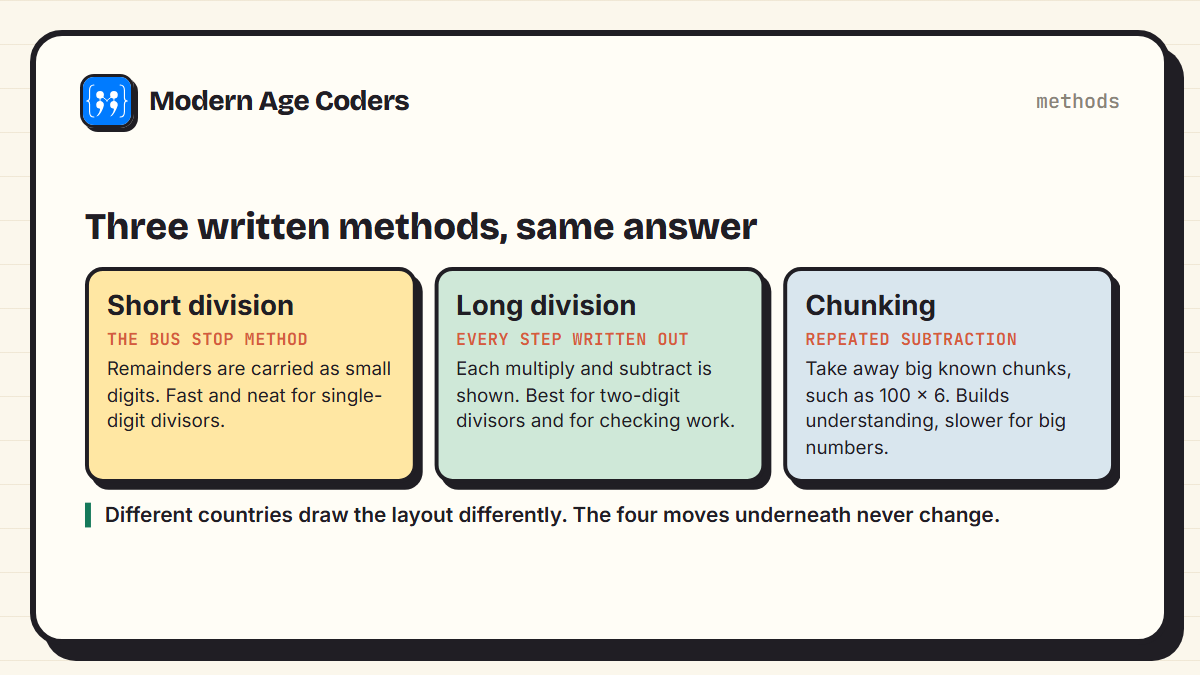
You may see several methods in your child's homework. Short division, often called the bus stop method in the UK, does the same four moves but writes only the carried remainders, as small digits. It is quick for single-digit divisors. Long division writes every multiply and subtract step, which makes it easier with two-digit divisors and easier to check. Chunking subtracts big, easy multiples of the divisor, such as 100 lots or 10 lots, and adds up how many chunks were taken. It is slower but builds real understanding of what division means.
Layouts also differ between countries. Many Indian textbooks write the divisor on the left and the quotient on the right of the dividend, while the UK and US write the quotient above. If you learned one way and your child is learning another, the four moves are identical, so talk about the moves rather than the drawing.
When should children learn long division?
Children usually meet written division with single-digit divisors at around 8 to 10, and long division with two-digit divisors at around 10 to 11. In England, formal long division with two-digit divisors is part of the Year 6 curriculum. Before starting, a child should be secure on times tables, place value and subtraction with exchanging. If any of those is shaky, long division will feel much harder than it is, and the fastest fix is usually to go back a step. Our 4th grade maths tutoring and KS2 maths tuition pages describe how we cover these foundations.
How we teach it
In our live online maths classes, the aim is for a child to understand why a method works before practising it, and to stay with one idea until it genuinely clicks. For long division that means place value first and the procedure second. Our how we teach page describes the approach. Classes are one to one or in small groups of 5 to 10.
Frequently asked questions
Divide, multiply, subtract and bring down. Divide the current number by the divisor, multiply the result by the divisor, subtract to find what is left, and bring down the next digit. Repeat until no digits are left. Whatever is left at the end is the remainder.
Multiply the answer by the divisor and add the remainder. You should get back the number you started with. For example, 1348 remainder 1 for 9437 divided by 7 checks because 1348 x 7 + 1 = 9437.
Once the answer has started, every digit you bring down needs a digit in the quotient. If the divisor does not go into the current number, that digit is 0. Leaving it out is the most common long division mistake, for example writing 24 instead of 204 for 612 divided by 3.
Use the same four steps, but estimate the divide step by rounding the divisor. To divide by 23, think of 20; to divide by 47, think of 50. If your estimate is one too big or small, the multiply and subtract steps will show it, and you adjust by one.
They use the same steps. Short division writes only the carried remainders and suits single-digit divisors. Long division writes out every multiplication and subtraction, which makes larger divisors easier to handle and mistakes easier to find.
Most children learn written division with single-digit divisors around ages 8 to 10, and long division with two-digit divisors around 10 to 11. In England, long division with two-digit divisors is taught in Year 6. Secure times tables and place value should come first.
It depends on the question. You can leave it as a remainder, write it as a fraction over the divisor, or continue dividing after a decimal point to get a decimal. In word problems, think about the context: you might need to round up, as with buses or boxes.