Table of Contents
Negative numbers are where maths first stops matching everyday counting. You cannot hold minus three apples. And then the rules seem to contradict each other: subtracting makes things bigger, two negatives make a positive, and -5 is smaller than -2 even though 5 is bigger than 2. Students who are told "just learn the rules" often get them the wrong way round in exams, and many adults still are not sure why a negative times a negative is positive.
This guide explains negative numbers with the pictures and stories that make them sensible: the number line, temperature, money, and a simple pattern that shows exactly why two negatives make a positive. The calculations were checked by running them in Python, and the output is shown with each one.
What negative numbers are
A negative number is a number less than zero. We write it with a minus sign in front: -3, read as "negative three" or "minus three". You meet them constantly in real life, even if nobody calls them negative numbers:
- Temperature: -4 degrees is four degrees below freezing.
- Money: a bank balance of -150 means you owe 150.
- Height: places below sea level, like the shore of the Dead Sea, have negative elevations.
- Sport and games: a golf score of -2 is two under par, and a goal difference can be negative.
- Floors: in many lifts, B1 or -1 is the level below the ground floor.
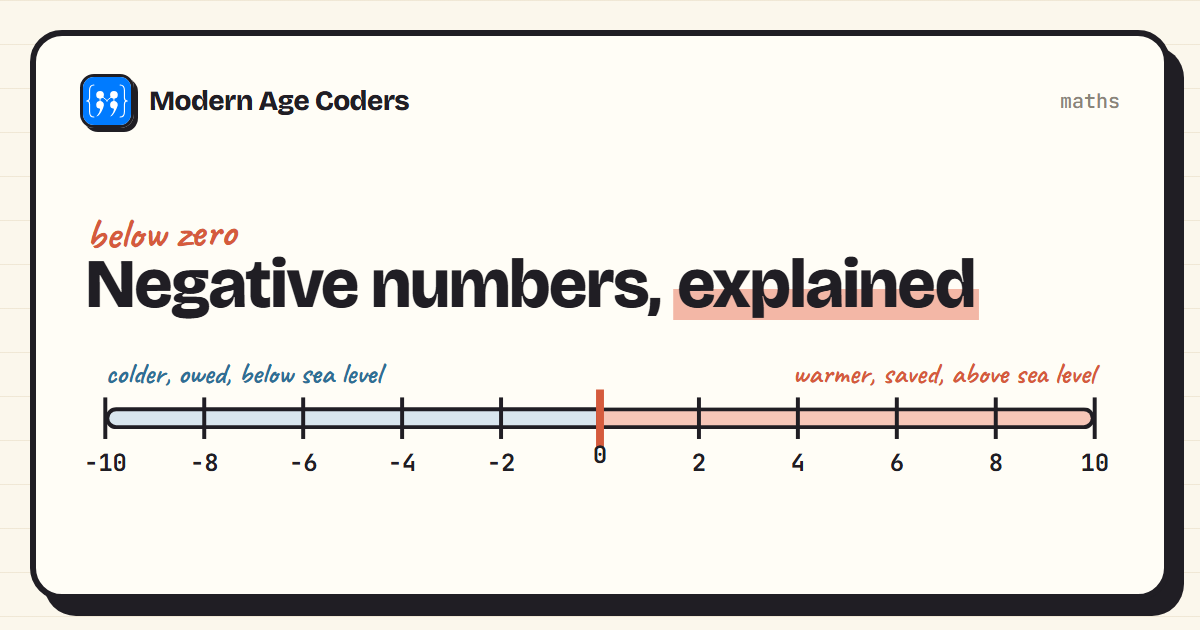
The single most useful picture is the number line. Zero sits in the middle, positive numbers go to the right, and negative numbers go to the left, each one a mirror image of its positive partner.
Comparing negative numbers
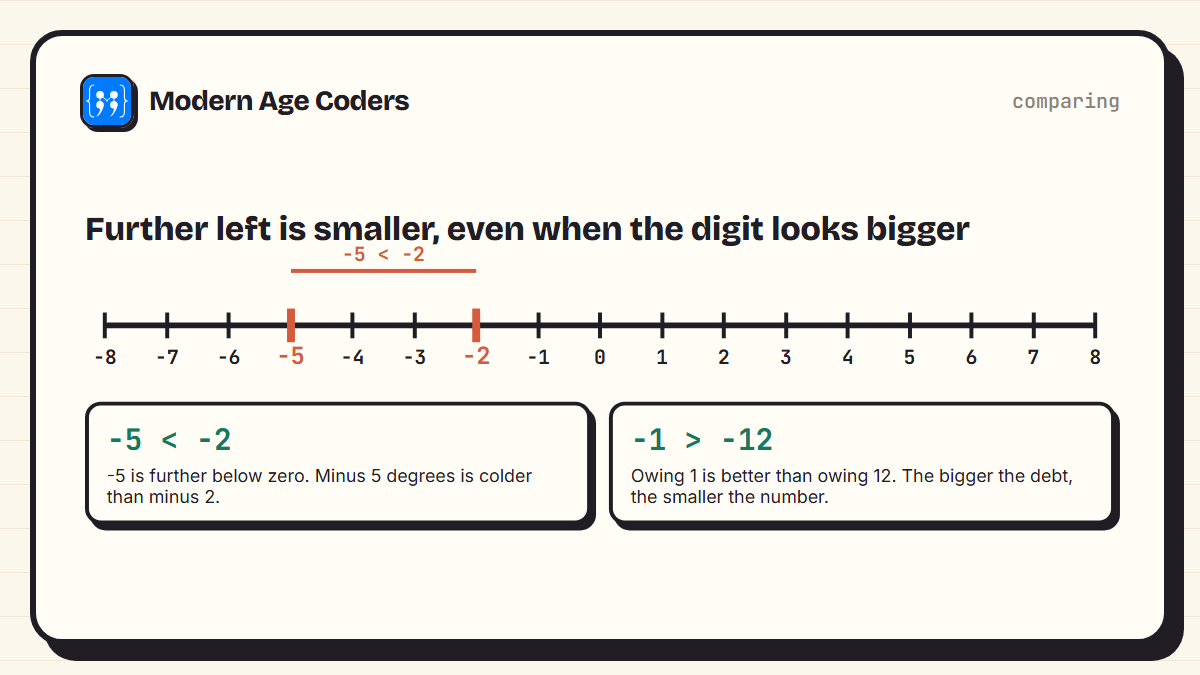
The first confusion is ordering. Because 5 is bigger than 2, many students assume -5 is bigger than -2. It is the other way round. On the number line, -5 is further to the left, so it is smaller. Temperature makes it obvious: -5 degrees is colder than -2. So does money: owing 12 is worse than owing 1, so -12 is smaller than -1.
temps = [-5, 3, -12, 0, -1, 7]
print("coldest to warmest:", sorted(temps))
print("is -5 bigger than -2?", -5 > -2)
print("is -1 bigger than -12?", -1 > -12)

# a practical one: the temperature was -4 and rose by 9 degrees
print("new temperature:", -4 + 9)
# a bank balance of 250 after spending 400
print("balance:", 250 - 400)coldest to warmest: [-12, -5, -1, 0, 3, 7]
is -5 bigger than -2? False
is -1 bigger than -12? True
new temperature: 5
balance: -150Adding and subtracting negative numbers
Think of adding as moving right along the number line and subtracting as moving left. Adding a negative number is like adding a debt, so it moves you left, the same as subtracting. Subtracting a negative number takes away a debt, which leaves you better off, so it moves you right, the same as adding.
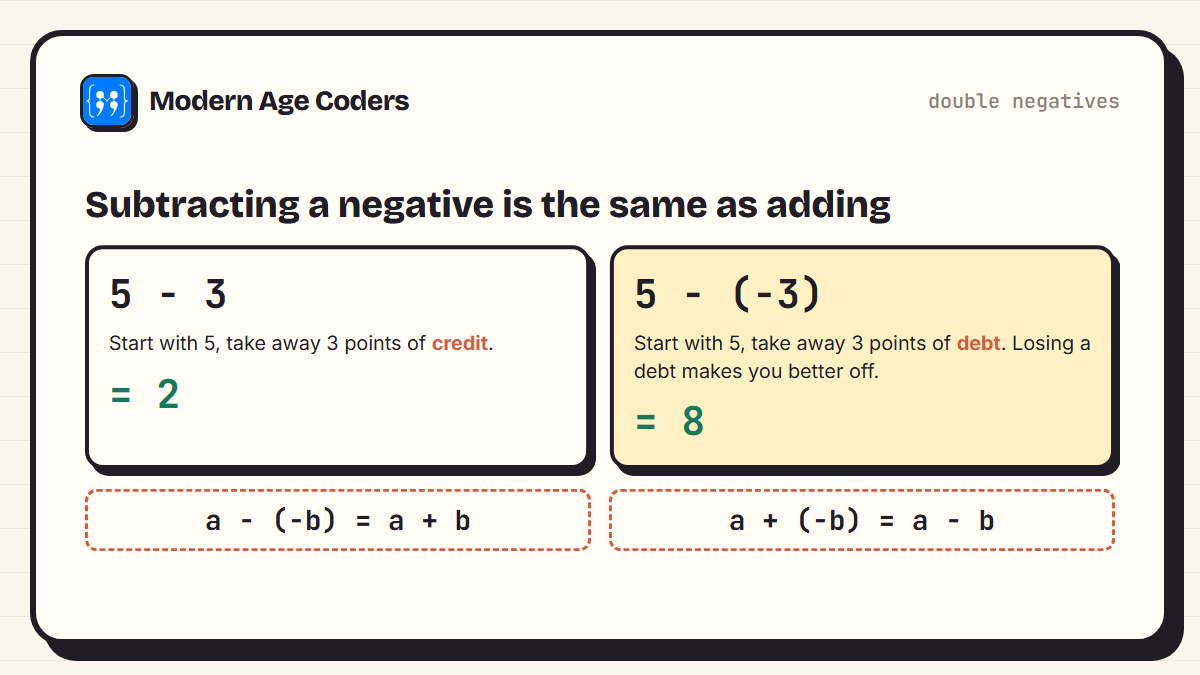
print(" 5 - 3    =", 5 - 3)
print(" 5 - (-3) =", 5 - (-3), "   taking away a debt of 3 leaves you 3 better off")
print("-5 + 3    =", -5 + 3)
print("-5 - 3    =", -5 - 3)
print("-5 - (-3) =", -5 - (-3)) 5 - 3 = 2
5 - (-3) = 8 taking away a debt of 3 leaves you 3 better off
-5 + 3 = -2
-5 - 3 = -8
-5 - (-3) = -2- a + (-b) is the same as a - b. 7 + (-3) = 4.
- a - (-b) is the same as a + b. 7 - (-3) = 10.
- Starting below zero: -5 + 3 means start at -5 and move 3 to the right, reaching -2.
Say it in words
Many mistakes disappear when students read the signs aloud as words: "five minus negative three" rather than "five minus minus three". The first version reminds them that the second sign belongs to the number, not the operation.
Why a negative times a negative is positive
This is the rule everyone remembers and almost nobody can explain. It is not an arbitrary convention. It is the only answer that keeps the patterns of multiplication consistent. Watch what happens when you multiply by -2 and let the first number go down by one each time:
# keep multiplying by -2, and let the first number go down by 1 each time
for n in range(3, -4, -1):
print(f"{n:>3} x -2 = {n * -2:>3}") 3 x -2 = -6
2 x -2 = -4
1 x -2 = -2
0 x -2 = 0
-1 x -2 = 2
-2 x -2 = 4
-3 x -2 = 6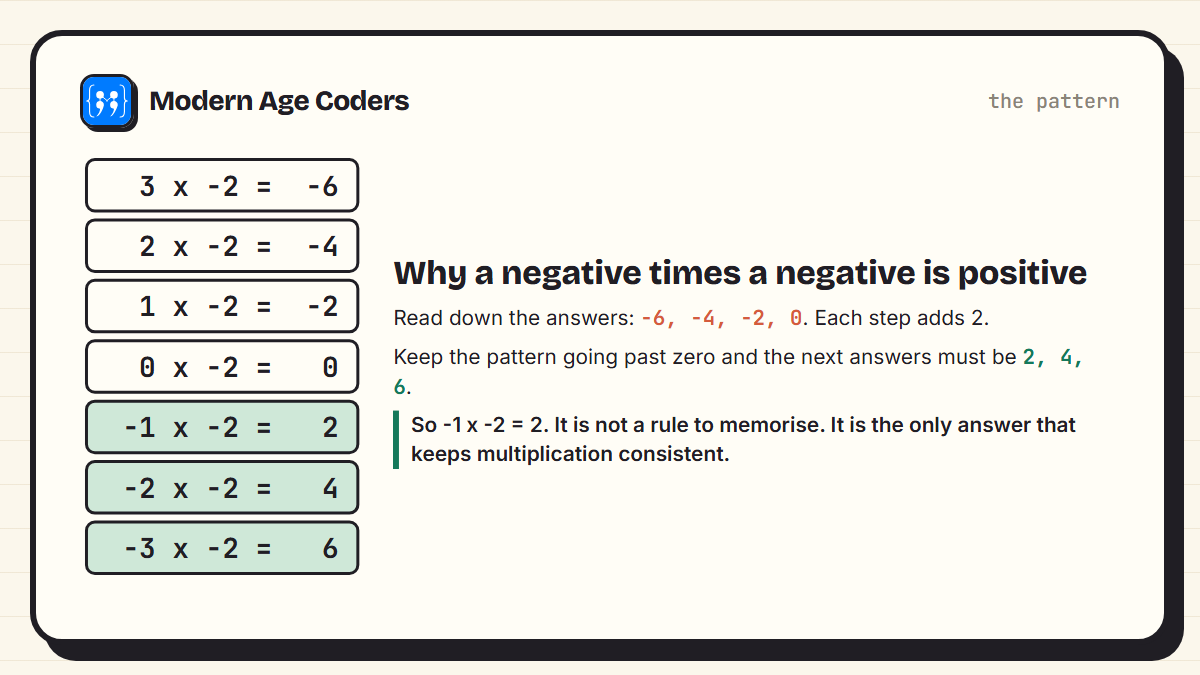
Look at the answers from the top: -6, -4, -2, 0. Each step, the answer goes up by 2. There is no reason for that pattern to suddenly change when the first number drops below zero, so the next answers must be 2, 4, 6. That means -1 x -2 = 2, -2 x -2 = 4 and -3 x -2 = 6. A negative times a negative is positive because anything else would break multiplication.
For comparison, here is the same pattern with a positive number, where the answers fall by 3 each time and simply continue below zero:
# the same idea with 3: watch the answers go down by 3 each step
for n in range(3, -4, -1):
print(f"{n:>3} x 3 = {n * 3:>3}") 3 x 3 = 9
2 x 3 = 6
1 x 3 = 3
0 x 3 = 0
-1 x 3 = -3
-2 x 3 = -6
-3 x 3 = -9A story version, if a child prefers one: if you remove (negative) three debts (negative) of 2 each from someone's account, their balance goes up by 6. Removing debts is a gain.
The sign rules, all in one place
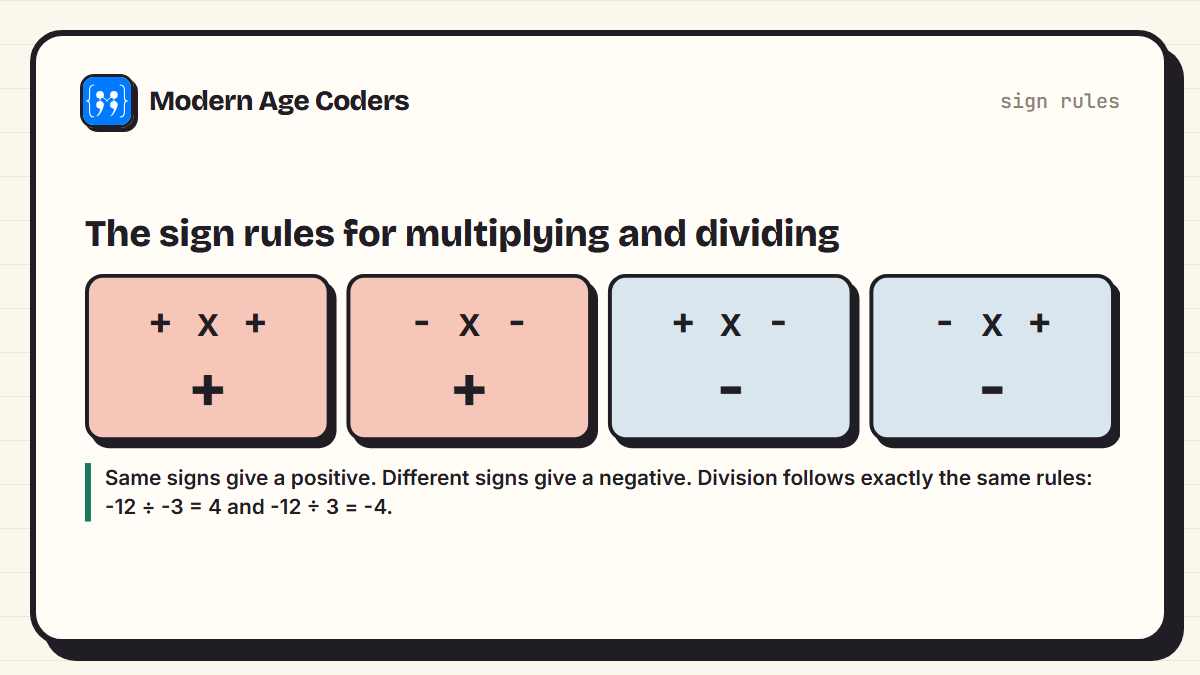
| Operation | Rule | Example |
|---|---|---|
| Adding a negative | Same as subtracting | 8 + (-3) = 5 |
| Subtracting a negative | Same as adding | 8 - (-3) = 11 |
| Multiplying or dividing, same signs | Answer is positive | -4 x -3 = 12, -12 ÷ -4 = 3 |
| Multiplying or dividing, different signs | Answer is negative | -4 x 3 = -12, 12 ÷ -4 = -3 |
A trap: squaring a negative number
Is -3 squared equal to 9 or -9? It depends on the brackets, and this catches students in algebra and on calculators. (-3)² means (-3) x (-3) = 9. But -3² without brackets means "the negative of 3 squared", which is -9, because powers are worked out before the minus sign.
print("-3 ** 2   =", -3 ** 2, "    (the square is done first, then the minus)")
print("(-3) ** 2 =", (-3) ** 2, " (negative times negative)")-3 ** 2 = -9 (the square is done first, then the minus)
(-3) ** 2 = 9 (negative times negative)This is the order of operations at work, and different tools do not always agree: Microsoft Excel, for example, treats =-3^2 as 9. Our guide to the BODMAS rule covers this and other order-of-operations traps.
Why negative numbers confuse students
- They break the counting intuition. For years, numbers meant quantities of things. A negative quantity has no physical form, so it needs a new mental picture, and the number line has to be taught explicitly.
- The minus sign does two jobs. It means "subtract" and it means "negative". In 5 - -3 it does both at once, which is why brackets and reading aloud help.
- Rules are often taught before reasons. "Two negatives make a positive" gets applied to addition too, giving -3 + -4 = 7 instead of -7. Understanding the pattern prevents this.
- Ordering is counter-intuitive. Bigger digits after a minus sign mean smaller numbers.
Most of these are fixed by returning to the number line and a real context, temperature or money, whenever a student is unsure. For broader maths confidence, see how to get better at maths.
If a student can place it on a number line and tell the story with temperatures, the rules follow on their own.
How we teach it
In our live online maths classes, we try to show why a rule is true before asking anyone to remember it, and the sign rules for negative numbers are a clear example. Mistakes with signs are treated as clues about what to revisit, not as failures. The approach is described on our how we teach page. Classes are one to one or in small groups of 5 to 10.
Frequently asked questions
A negative number is a number less than zero, written with a minus sign, such as -3. Negative numbers describe things like temperatures below freezing, money owed and places below sea level.
-5 is smaller than -2. On a number line, -5 is further to the left. Temperature makes it clear: -5 degrees is colder than -2 degrees.
Because it is the only answer that keeps multiplication consistent. In the pattern 2 x -2 = -4, 1 x -2 = -2, 0 x -2 = 0, each answer goes up by 2, so continuing gives -1 x -2 = 2. Any other answer would break the pattern.
Subtracting a negative is the same as adding. For example, 5 - (-3) = 5 + 3 = 8. Think of it as taking away a debt, which leaves you better off.
No. That rule is only for multiplying and dividing. When adding, two negatives make a more negative number: -3 + (-4) = -7.
(-3) squared, with brackets, is 9 because (-3) x (-3) = 9. Without brackets, -3 squared usually means the negative of 3 squared, which is -9, because powers are calculated before the minus sign.
Children often meet negative numbers through temperature at around 8 to 10, order and calculate with them at 10 to 12, and learn multiplying and dividing negatives at around 11 to 13, before algebra.