PRO / USE / 01
AI Tools Mastery
Getting real work out of the tools, with checks.
Open the syllabusIreland · Working professionals · Live online
Irish businesses have moved quickly. The Central Statistics Office found that 20.2% of enterprises used AI in some capacity in 2025, up from just over 15% in 2024 and about 8% in 2023, and that almost six in ten large enterprises now use it. What most of them do not have is somebody who can build an agent, measure whether it works, and say plainly where it should not be used. That gap is what this course fills. It is for professionals who already have a job to protect and improve: analysts, engineers, operations managers, people in finance, marketing and administration who want to put a well-understood agent into a real workflow rather than run another pilot. It covers what an agent is, how to ground it in your own documents, how to test it against cases with known answers, and how to hand it over with a log and an honest account of its limits.
Live teaching since 2020 · 10,000+ students · agents built, tested and handed over
In short
An agent is a program where a language model directs its own steps and tool use towards a goal. Building one for work is mostly unglamorous: deciding what it may touch, grounding it in the right documents, writing test cases with known answers, logging every step and defining where it must stop and ask a person. We teach that live to professionals in Ireland, in small groups or one to one, on the platforms employers actually use. The first class is free; afterwards a group place is USD 100 a month and one-to-one tuition USD 150 a month, and the Copilot Studio course is taught one to one only.
Start here
From the model upwards, inside Microsoft's platform, or directing coding agents. Each card opens its syllabus and format.
WORK / 01
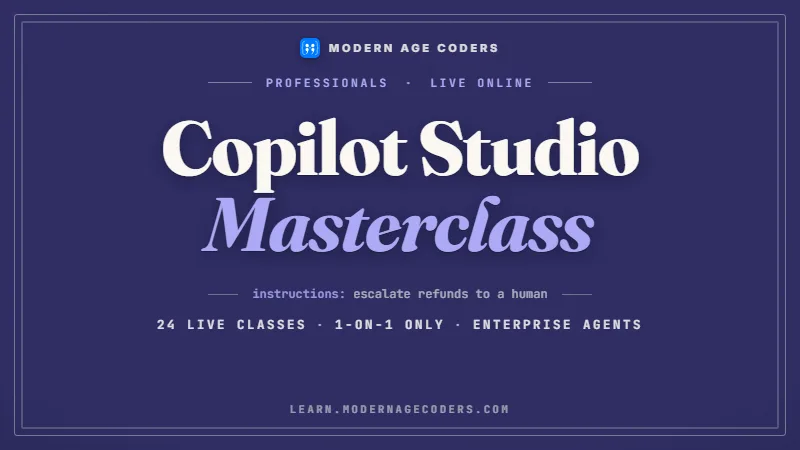
Agents built where much of Irish business already works, grounded in your own documents and connected to real systems. One to one only.
Open the syllabus →
WORK / 02
The engineering underneath any platform: how models are prompted, grounded, given tools and measured.
Open the syllabus →
WORK / 03
For technical staff: directing coding agents through a real codebase and reviewing every change they propose.
Open the syllabus →Adoption, read carefully
The CSO surveys enterprises with ten or more people. Its 2025 figures are the clearest picture available, and they need reading with some care.
| Measure | 2025 |
|---|---|
| All enterprises using AI | 20.2%, against just over 15% in 2024 and about 8% in 2023 |
| Large enterprises | 57.7% |
| Medium enterprises | 28.6% |
| Small enterprises | 17.2% |
| Most common technology: data mining | 10.8% |
| Natural language generation | 9.3% |
| Automating workflows or assisting decision making | 6.2% |
The CSO also publishes a comparison table where Ireland shows 19.6% for 2025 against a European Union average of 20%, with Denmark at 42% and Finland at 37.8%. That is not a contradiction of the 20.2%: the comparison uses a different scope, excluding some sectors.
So the two numbers should never be put in the same sentence. Noticing that is the same skill this course teaches about agent outputs: check what was counted before you compare.
There is no published Irish figure for agents specifically. The closest categories are natural language generation and automating workflows, and calling either of them "agents" would be inventing a statistic, so we do not.
There is also no breakdown by sector: we checked every CSO table that mentions AI. If someone quotes you an Irish AI adoption rate for your industry, ask where it came from.
Business administrative processes lead at 7.8%, then marketing or sales, ICT services and research and development at 5.4% each, accounting at 4.7%, production at 3.3% and logistics at 1.5%.
Systems using technologies such as text mining, machine learning or deep learning "to predict, recommend or make decisions, with varying levels of autonomy", including chatbots and facial recognition.
Among internet users who had used generative AI in 2025, half had used it for professional purposes, so plenty of staff are already using these tools with or without a policy.
Sources, read 16 September 2026: CSO, Information Society Statistics, Enterprises 2025; CSO tables ICA238, BIIESA20 and ICA321.
Public supports
Ireland funds a good deal of AI upskilling and adoption support. If your employer qualifies, start there.
| Support | What it is |
|---|---|
| Enterprise Ireland AI Discovery | A first stage of seven consultant-led days that audits your data, maps current skills and produces a 12 to 18 month AI roadmap, with the great majority of the cost grant funded, for Enterprise Ireland clients |
| The following stages | Support towards building a prototype and then operationalising it, through Enterprise Ireland's digital process innovation funding |
| Skillnet Ireland Upskill SME Training Grant | A grant to recover salary costs for the days staff spend in AI training, across six named categories from getting started to governance and compliance |
| National MSc in Artificial Intelligence | A two-year online part-time masters run with the University of Limerick, which has produced over 400 graduates |
| CeADAR | Designated Ireland's National AI Hub within the European Digital Innovation Hub network |
Two honest notes. Enterprise Ireland's brochure and its live web page state different caps for the same discovery grant, so check the current page rather than a PDF. And the Skillnet grant's own page still says registration details will follow, so confirm it is open before planning around it.
These programmes are not ours and we have no involvement in them. We mention them because a professional should exhaust free options before paying for classes.
What weekly live teaching adds is different in kind: a teacher who sees your actual agent, every week, and asks why it failed that test case.
The national strategy frames the goal well: its ambition is workplaces "where workers are empowered by AI tools, but not replaced". Being the person who can build and check the tool is how that works out in practice.
Sources: Enterprise Ireland, AI for Business and its AI Discovery page; Skillnet Ireland, Upskill SME Training Grant; National AI Strategy refresh, 2024. Read 16 September 2026. Eligibility rules are theirs; check them at source.
What you build
The difference between a demo that impresses a meeting and an agent that survives a quarter is almost entirely in the parts nobody demonstrates.
| Part | Why it exists |
|---|---|
| A narrow job | An agent that does one task well can be tested; one that does everything cannot |
| Grounding | Answers drawn from your documents and systems, not from the model's memory |
| Tools with limits | Explicit permissions: what it may read, write, send or spend |
| A test set | Twenty to fifty real cases with known answers, run after every change |
| A log | Every step recorded, so a wrong answer can be traced rather than argued about |
| A stopping rule | The conditions under which it must hand over to a person |
The best first agent handles something repetitive and low risk: triage, lookups, drafting from a template. Nobody thanks you for automating the one process everyone disputes.
Time taken, error rate, how often a person intervenes. Without a before, an improvement is an opinion.
Somebody other than you has to run it. Documentation, the test set and the log are what make that possible.
We teach on the platforms professionals actually meet, including Microsoft Copilot Studio, taught one to one because every agent is built around a particular organisation's systems and permissions.
Technical staff who want coding agents work through their own repositories, using their own paid accounts, and review every change those agents propose.
What we do not do is tell you an agent belongs in a process it does not. Part of the course is deciding not to build one, which is a perfectly good outcome for a meeting to reach.
The models underneath are covered on learn to train AI, and students in third level have their own page at AI agents for students.
The rungs
Most working professionals reach the fifth rung in four to six months at one lesson a week.
| Rung | What you can do |
|---|---|
| 1. Use with judgement | Work with AI tools and check their output against what you know |
| 2. Ground it | Point a model at your own documents and see where retrieval fails |
| 3. Give it tools | Let it call systems, with permissions written down |
| 4. Prove it | Run a test set of real cases and report the pass rate |
| 5. Hand it over | Document, log and support an agent other people depend on |
Not for the platform route, where agents are built and configured rather than programmed. For the coding agent work, yes, and the free first class will tell you honestly which suits you.
The surrounding subjects are on the coding roadmap.
Lessons are weekly and short enough to survive a busy quarter. Professionals often pause for a launch or a year end and pick the same slot back up.
One-to-one lessons suit anyone building on data they cannot show a group.
The catalogue
By starting point. The free first class decides which one fits your role.
PRO / USE / 01
Getting real work out of the tools, with checks.
Open the syllabusPRO / USE / 02
Answers from your own data, no language needed.
Open the syllabusPRO / USE / 03
The language most agent work eventually needs.
Open the syllabusPRO / BUILD / 01
Agents in Microsoft tooling; taught privately only.
Open the syllabusPRO / BUILD / 02
Retrieval, tools and evaluation from first principles.
Open the syllabusPRO / BUILD / 03
Automation that runs without supervision.
Open the syllabusPRO / ENG / 01
Coding agents directed and reviewed line by line.
Open the syllabusPRO / ENG / 02
The review discipline agent work depends on.
Open the syllabusPRO / ENG / 03
The wider field, for people making decisions about it.
Open the syllabusHow the classes run
Teaching is live, from India, at a weekly hour set in Irish time. India keeps one clock all year while Ireland keeps two, so our teachers are four and a half hours ahead of you in summer and five and a half in winter, which makes Irish mornings and evenings both workable.
Early morning
Before the Irish working day starts.
Evening
The most popular slot with professionals.
Weekend
Longer builds, for people in delivery roles.
You describe a real workflow and leave knowing whether an agent belongs in it.
Professionals at one level, from Ireland and elsewhere, comparing designs.
For confidential systems and for the Copilot Studio course, which is private only.
Coding agent work uses your own paid tool accounts, so everything built stays yours.
No agent is called finished in class without cases whose answers are known.
Documentation and logs are part of the work, not an afterthought at the end.
Student work
Four projects our students published. There are many more across every age group on the student labs page.
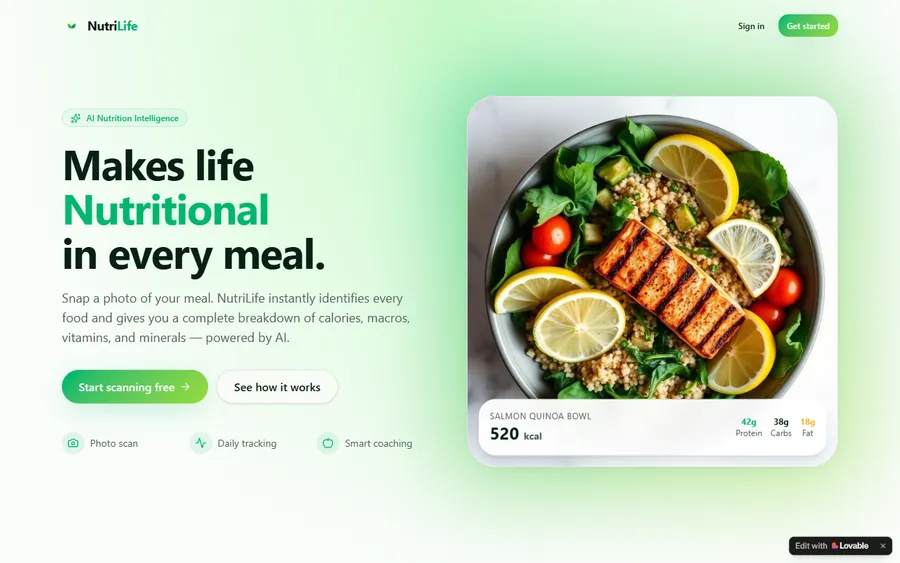
AI and ML
An AI nutrition coach that reads what you eat and works you toward a target.
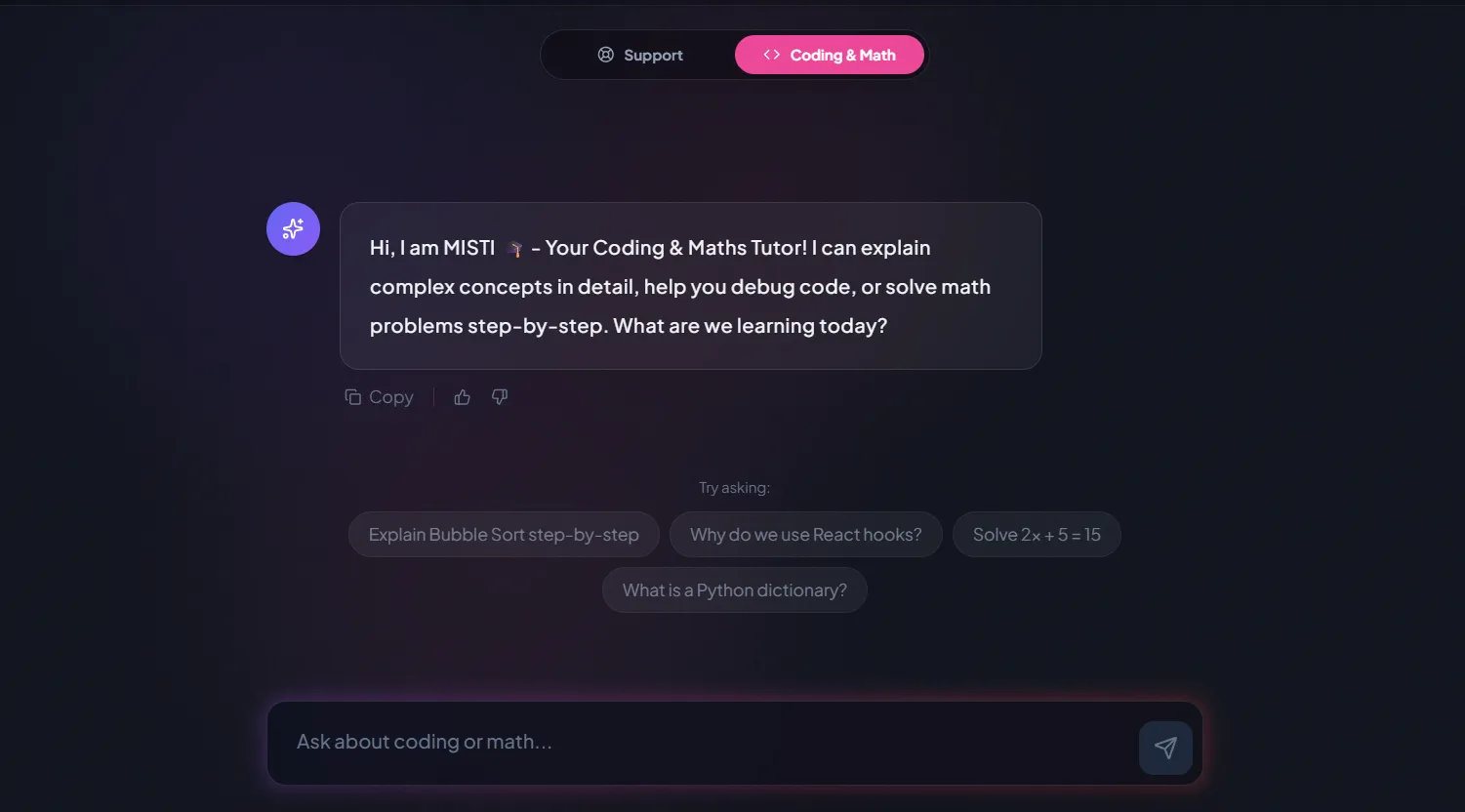
AI and ML
A chatbot that answers mathematics and programming questions, built and deployed by a student.
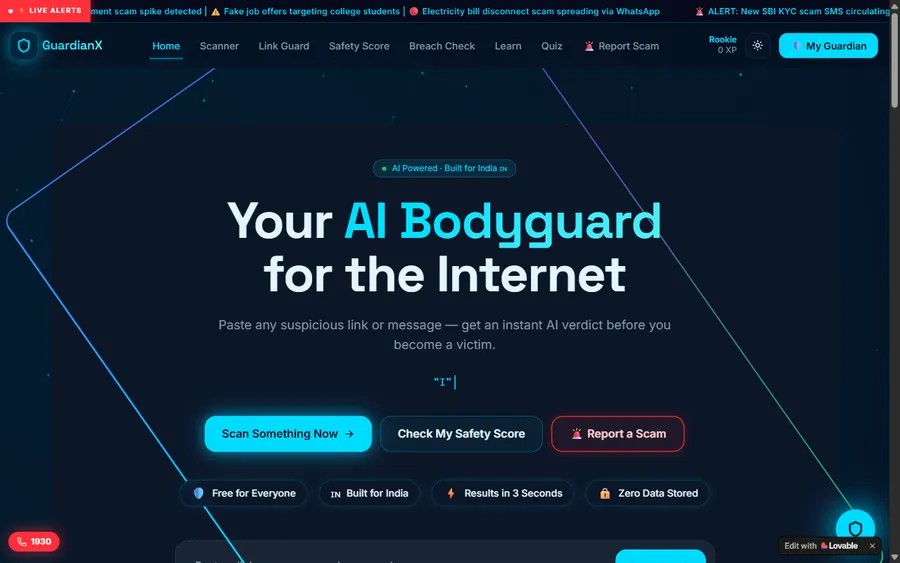
AI and ML
An assistant that helps a young person recognise unsafe situations online.
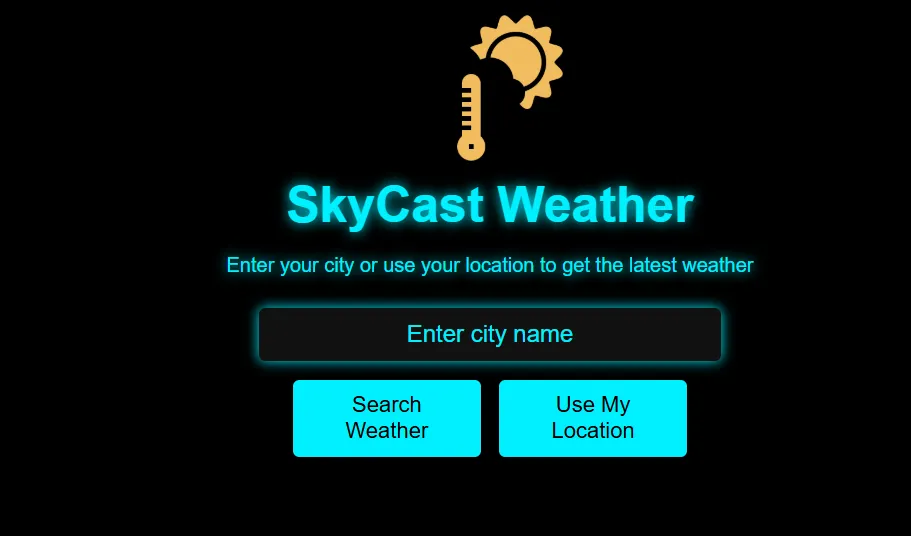
Web app
A weather forecasting site with live conditions for any location.
Fees
A single monthly fee in US dollars, the same in every country outside India, with no enrolment charge and no annual contract. The Copilot Studio course is private tuition only and uses the one-to-one rate.
Free first class
USD 0
no card required
Group batch
USD 100
a month, billed in US dollars
One to one
USD 150
a month, billed in US dollars
What families say
From Google, word for word: reviews left by our students and their families, never paid for.
★★★★★
"The one step solution for my son. Modern Age Coders make learning coding so simple that kids love it. The teachers explain complex concepts clearly with practical exercises and interactive content."
Ria Mukherjee
Parent
★★★★★
"Modern Age Coders has been a game-changer for me. I struggled to grasp IT concepts and coding before joining, but their classes transformed everything. I can now confidently write complex programs with ease."
Samriddha Mondal
Student
★★★★★
"One of the most wonderful education centres out there. Education is not limited to school syllabus but focuses on skill development."
Vansh Agarwal
Student
★★★★★
"My child Dhairya is really enjoying the Modern Age Coders classes. This is his first online class and he eagerly looks forward to it. I can already see his improvement, and the teachers are very cooperative."
Sonam Oswal
Parent of Dhairya
★★★★★
"Modern Age Coders have wonderful teachers who teach in a clear, easy and practical way. The teacher boosts students' confidence and inspires them to learn without hesitation."
Sonu Goyal
Parent
★★★★★
"I highly recommend this computer coding class! The teachers are incredibly knowledgeable and passionate about coding."
Ritu Kedia
Parent
Questions from professionals
The CSO found 20.2% of enterprises used AI in some capacity in 2025, up from just over 15% in 2024, with 57.7% of large enterprises and 17.2% of small ones.
No. The CSO does not publish enterprise AI use by sector, so any industry-specific Irish figure you are shown deserves a question about its source.
Nobody publishes that for Ireland. The closest official categories are natural language generation and automating workflows, and we do not relabel either as agents.
Not for the platform route, where agents are configured rather than coded. The coding agent course does expect programming experience.
Possibly, though not for our classes. Enterprise Ireland supports client companies through its AI Discovery stages and Skillnet Ireland offers an SME training grant. Check their eligibility rules directly.
With a test set of real cases whose answers you know, run after every change, plus a before-and-after measure of time or error rate in the actual process.
No, it is taught one to one only, because each agent is built around a particular organisation's systems and permissions.
The first class is free. After that a group place is USD 100 a month and one-to-one tuition is USD 150 a month, billed in US dollars, with no enrolment fee.
Early mornings, evenings or weekends, at a weekly hour set in the free class. Our teachers are four and a half hours ahead of Irish time in summer and five and a half in winter.
We call you at a suitable Irish hour and arrange the free first class. Nothing is charged unless you continue.
Elsewhere on this site
For teams, students and the technology underneath.
The same subject at third level.
The models beneath the agents.
If you need the programming first.
The data an agent will rely on.
Where agents get deployed.
The national AI page.
Start here
Leave a number and we will ring at a time that suits your working day in Ireland. In the free class you describe a process you actually run, and leave knowing whether an agent fits it and what building one would involve.
If you would rather read first: how we teach, the course list, and what our students have built.
WhatsApp us · +91 91233 66161 · contact@modernagecoders.com
WhatsApp suits busy days and costs nothing from an Irish number. Ours is an Indian number, as the team works from India, and there is no office in Ireland.