Table of Contents
- Understanding the Roles: What Do They Actually Do?
- Salary Comparison: The Numbers in India (2025)
- Job Market: Which Has More Opportunities?
- Skills Required: What Do You Need to Learn?
- Day-to-Day Reality: What's the Work Actually Like?
- Career Growth and Long-Term Prospects
- The Hybrid Path: Can You Do Both?
- Which Should You Choose? A Decision Framework
- How to Get Started on Either Path
- What Hiring Managers Actually Look For
- The Future: Where Are These Fields Heading?
- Frequently Asked Questions
- Conclusion
If you're anywhere near the Indian tech scene, whether you're a fresh graduate, a working professional looking to switch, or a student planning your career, you've probably asked yourself this question: Should I become a Full Stack Developer or an AI Engineer?
Both careers are constantly hyped on LinkedIn. Both promise high salaries. Both have 'experts' claiming their path is the future. And honestly? Both have merit. But they're fundamentally different career tracks with different requirements, different day-to-day work, and yes, different pay scales.
In this article, we're cutting through the noise. No generic advice, no recycled job descriptions. Just an honest look at what each career actually involves, what companies in India are paying, and which path might make more sense for you.
Understanding the Roles: What Do They Actually Do?
Before we talk money, let's get clear on what these roles actually involve. Because despite both being 'tech jobs,' the daily work is completely different.
What Does a Full Stack Developer Do?
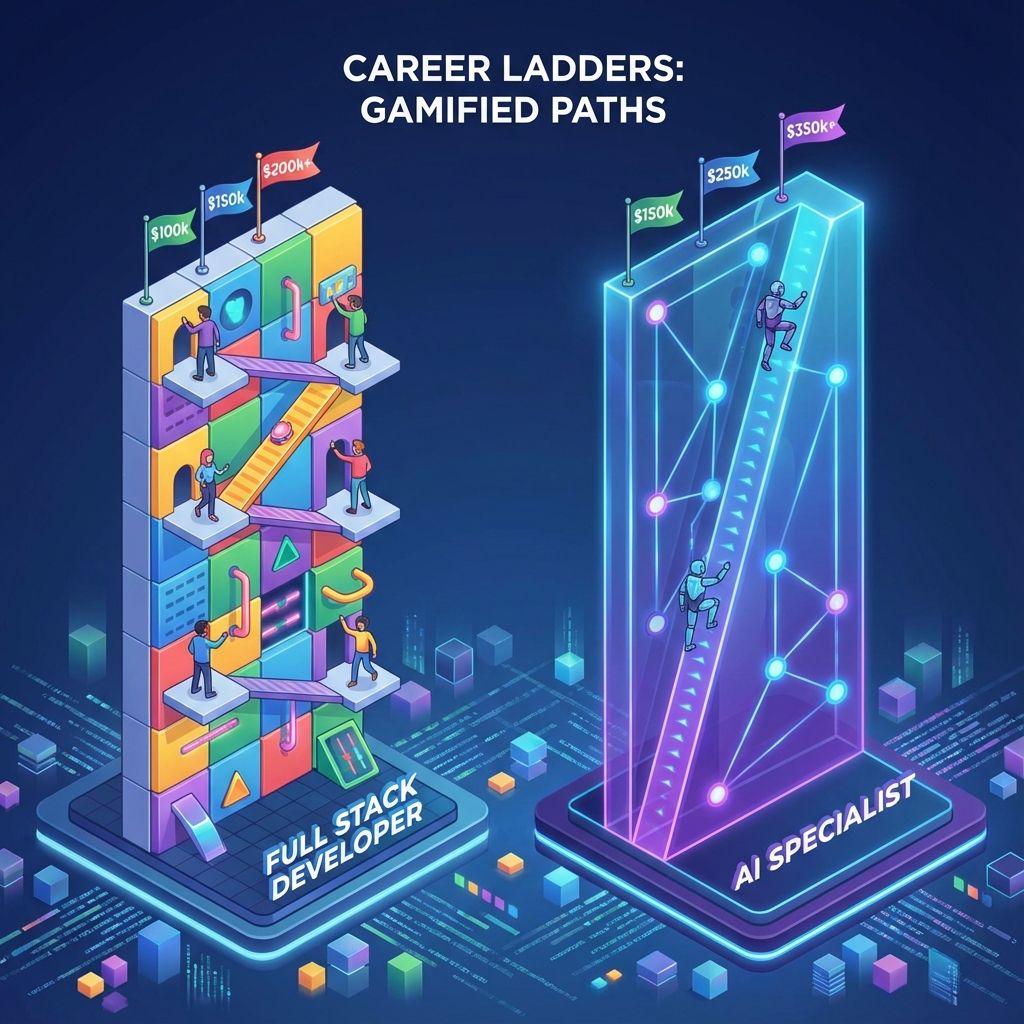
A Full Stack Developer builds complete web applications. Both the parts users see (frontend) and the server-side logic that powers everything behind the scenes (backend). They're the generalists of the web development world.
On any given day, a Full Stack Developer might:
- Design and build user interfaces using React, Angular, or Vue.js
- Write server-side code in Node.js, Python, Java, or PHP
- Design and manage databases (MySQL, PostgreSQL, MongoDB)
- Set up APIs that connect frontend to backend
- Deploy applications to cloud platforms like AWS or Azure
- Debug issues across the entire application stack
- Collaborate with designers, product managers, and other developers
The beauty of Full Stack is versatility. You can work on any part of a product. The challenge is that you need to know a lot, and keep up with rapidly changing frameworks and tools.
What Does an AI Engineer Do?
An AI Engineer (also called Machine Learning Engineer in many companies) builds systems that can learn from data and make predictions or decisions. They're the ones creating the 'intelligence' in artificial intelligence.
A spam filter is the classic first example of such a system. Our guide to how spam filters work builds one from word counts and probability, then tunes the balance between false alarms and missed spam.
Their typical work includes:
- Developing machine learning models for various applications
- Processing and cleaning large datasets
- Training, testing, and optimizing ML algorithms
- Deploying models into production systems (MLOps)
- Working with deep learning frameworks like TensorFlow and PyTorch
- Building recommendation systems, NLP applications, computer vision solutions
- Collaborating with data scientists, software engineers, and product teams
AI Engineering sits at the intersection of software engineering and data science. You need strong programming skills, but also deep understanding of mathematics, statistics, and machine learning algorithms.
Key Difference
Full Stack Developers build applications that users interact with directly. AI Engineers build the intelligence and automation that powers features within those applications.
Salary Comparison: The Numbers in India (2025)
Alright, let's get to what you really came for, the money. Here's a realistic breakdown of what both roles pay in the Indian market, based on data from job portals, industry surveys, and our conversations with hiring managers.
Full Stack Developer Salaries in India
Full Stack salaries vary widely based on experience, company type, and location:
- Freshers (0-1 years): ₹3.5 - 7 LPA
- Junior (1-3 years): ₹6 - 12 LPA
- Mid-Level (3-5 years): ₹12 - 22 LPA
- Senior (5-8 years): ₹20 - 35 LPA
- Lead/Architect (8+ years): ₹35 - 55+ LPA
At product-based companies (think Flipkart, Razorpay, Swiggy, or international MNCs), salaries tend toward the higher end. Service companies (TCS, Infosys, Wipro) typically pay on the lower end, especially for freshers.
AI/ML Engineer Salaries in India
AI Engineers generally command higher salaries, but the entry barrier is also higher:
- Freshers (0-1 years): ₹6 - 12 LPA
- Junior (1-3 years): ₹10 - 18 LPA
- Mid-Level (3-5 years): ₹18 - 32 LPA
- Senior (5-8 years): ₹30 - 50 LPA
- Lead/Principal (8+ years): ₹50 - 80+ LPA
The numbers get even more dramatic at top-tier companies. AI researchers at Google, Microsoft, or OpenAI's India offices can earn ₹1 crore+ packages. But those roles are extremely competitive and usually require advanced degrees.
The Verdict: Who Earns More?
On paper, AI Engineers earn more at almost every level. The median salary for AI/ML roles is roughly 30-50% higher than equivalent Full Stack positions.
But here's the catch: those higher salaries come with higher barriers to entry. AI roles often require:
- Strong mathematical foundation (linear algebra, calculus, probability)
- Often a Master's degree or significant self-study
- Deep specialization that takes years to develop
- Fewer job openings compared to Full Stack roles
A Full Stack Developer can start earning decent money faster, with a lower entry barrier. An AI Engineer takes longer to become job-ready but potentially earns more long-term.
Reality Check
Don't chase AI just for the salary. If you struggle with math or don't enjoy working with data, you'll be miserable, and probably won't reach those high salary brackets anyway.
Job Market: Which Has More Opportunities?
Salary is important, but it doesn't matter if you can't land a job. Let's look at the demand side of the equation.
Full Stack Developer Job Market
Full Stack Development has one of the largest job markets in Indian tech. Here's why:
- Every company with a website or app needs developers
- Startups love Full Stack devs because one person can handle multiple responsibilities
- Remote work opportunities are abundant. You can work for global companies from India
- Freelancing and contract work is highly viable
- The skills are transferable across industries
A quick search on LinkedIn or Naukri shows thousands of Full Stack openings at any given time. Entry-level opportunities are plentiful, though competition is also intense.
AI/ML Engineer Job Market
The AI job market is growing rapidly but is still smaller and more specialized:
- Growing demand as more companies adopt AI solutions
- Concentrated in specific sectors: fintech, e-commerce, healthcare tech, autonomous vehicles
- Many roles require 2+ years of experience, true entry-level AI jobs are rare
- Often requires portfolio of ML projects or research experience
- Major tech hubs (Bangalore, Hyderabad, Pune) have the most opportunities
The challenge with AI roles is the experience paradox. Companies want experienced AI engineers, but it's hard to gain experience without a job. Many people break in through internships, research positions, or transitioning from related roles (like data analyst or backend developer).
Job Market Verdict
Full Stack has more jobs available, especially at the entry level. AI has fewer but higher-paying positions, with tougher competition for those roles.
If you need to start earning quickly, Full Stack is the safer bet. If you can invest time in building specialized skills before entering the job market, AI offers a potentially more lucrative path.
Skills Required: What Do You Need to Learn?
Let's break down the learning curve for each path. This matters because the time and effort to become job-ready is very different.
Full Stack Developer Skills
A competitive Full Stack Developer in 2025 needs:
- Frontend: HTML, CSS, JavaScript, plus at least one framework (React is most popular)
- Backend: Node.js, Python (Django/Flask), or Java (Spring Boot)
- Databases: SQL (PostgreSQL/MySQL) and NoSQL (MongoDB)
- APIs: REST, GraphQL basics
- Version Control: Git and GitHub
- DevOps Basics: Docker, basic CI/CD, cloud deployment (AWS/GCP/Azure)
- Problem Solving: Data structures and algorithms for interviews
Timeline to job-ready: 6-12 months of dedicated learning and building projects. Some motivated learners do it in less; many take longer.
AI/ML Engineer Skills
An AI Engineer needs a different (and arguably deeper) skill set:
- Programming: Python is essential, plus libraries like NumPy, Pandas, Scikit-learn
- Mathematics: Linear algebra, calculus, probability, statistics
- Machine Learning: Supervised/unsupervised learning, model evaluation, feature engineering
- Deep Learning: Neural networks, TensorFlow or PyTorch
- Data Skills: Data preprocessing, visualization, SQL
- MLOps: Model deployment, monitoring, versioning
- Specializations: NLP, computer vision, or reinforcement learning (depending on interest)
Timeline to job-ready: 12-24 months for most people. Those with strong math backgrounds may progress faster. The learning never really stops because the field evolves so rapidly.
Education Expectations
Full Stack roles rarely require degrees beyond B.Tech/BCA. Many AI roles, especially at top companies, prefer candidates with M.Tech, MS, or relevant research experience, though exceptions exist for those with strong portfolios.
Day-to-Day Reality: What's the Work Actually Like?
Salaries and skills are one thing, but you'll be doing this work every day. Here's what each role actually feels like:
A Day in the Life of a Full Stack Developer
Your typical day might involve:
- Morning standup meeting to discuss progress and blockers
- Writing code for a new feature, maybe a user dashboard or payment integration
- Code reviews, reviewing teammates' code and getting yours reviewed
- Debugging an issue reported by users or QA team
- Quick meeting with the product manager about upcoming requirements
- Researching a new library or framework for a future feature
- Deploying code to staging environment and testing
The work is varied and often fast-paced. You see the direct impact of your code, users interact with what you build. There's constant learning because web technologies evolve rapidly.
The stress points: Tight deadlines, context-switching between frontend and backend, keeping up with new frameworks, debugging issues that could be anywhere in the stack.
A Day in the Life of an AI Engineer
AI work tends to be more research-oriented and experimental:
- Analyzing a dataset to understand patterns and quality issues
- Experimenting with different model architectures
- Training models (sometimes waiting hours for results)
- Evaluating model performance and iterating
- Reading research papers to understand new techniques
- Meeting with stakeholders to understand business requirements
- Working on model deployment pipelines
- Documenting experiments and results
AI work is intellectually stimulating but can be frustrating. Models don't always work as expected. You might spend weeks on an approach that turns out to be a dead end. Success requires patience and comfort with uncertainty.
The stress points: Ambiguity (often unclear what will work), long experiment cycles, pressure to deliver 'magic' AI solutions, keeping up with rapid research advances.
Personality Fit
If you like building tangible products and seeing immediate results, Full Stack might suit you better. If you enjoy research, experimentation, and don't mind ambiguity, AI could be your path.
Career Growth and Long-Term Prospects
Where do these paths lead over 10-15 years? Both have strong trajectories, but they look different.
Full Stack Career Path
- Junior Developer → Mid-Level Developer → Senior Developer
- Tech Lead → Engineering Manager (people management track)
- Senior Developer → Principal Engineer → Architect (technical track)
- Entrepreneurship: Many startup founders have Full Stack backgrounds
- Freelancing/Consulting: Viable at any stage with good earnings
Full Stack skills remain relevant and adaptable. Even as specific technologies change, the core concepts transfer. Many CTOs and technical co-founders started as Full Stack developers.
AI Engineer Career Path
- ML Engineer → Senior ML Engineer → Staff ML Engineer
- ML Lead → AI/ML Manager → Director of AI
- Research Scientist path (often requires PhD for top roles)
- AI Architect → Chief AI Officer (emerging C-suite role)
- Starting AI-focused companies or consulting practices
AI careers can reach very high compensation levels, especially at companies where AI is core to the business. However, the field is also more susceptible to hype cycles. What's hot today (like generative AI) may be commoditized in a few years.
Which Has Better Long-Term Security?
Honestly? Both are solid if you keep learning. The bigger risk is becoming stagnant in either field.
Full Stack developers who don't keep up with new frameworks find themselves outdated. AI engineers who don't evolve beyond basic ML might find their skills commoditized by AutoML tools.
The safest approach in either path: Keep learning, build real things, and develop the problem-solving skills that transcend any specific technology.
The Hybrid Path: Can You Do Both?
Here's something not enough people talk about: you don't have to choose forever. Many successful tech professionals have skills in both areas.
The Full Stack + AI Combination
Some of the most valuable engineers in today's market are those who can:
- Build ML models AND deploy them as production applications
- Create end-to-end AI-powered products without depending on large teams
- Bridge the gap between data science teams and engineering teams
- Prototype AI features rapidly in full-fledged applications
This combination is increasingly valuable as companies want to ship AI features fast without hiring separate teams for every piece.
Common Career Transitions
- Full Stack → Add ML skills → ML Engineer or AI Product Developer
- Data Analyst → Learn programming deeply → ML Engineer
- Backend Developer → Specialize in ML infrastructure → MLOps Engineer
- AI/ML → Broaden to full product development → Technical Product Manager
The tech industry rewards adaptability. Your initial choice isn't permanent. It's a starting point.
Which Should You Choose? A Decision Framework
Still not sure? Here's a practical framework to help you decide:
Choose Full Stack Development If:
- You want to start earning sooner (6-12 months learning curve)
- You enjoy building complete products that users interact with
- You prefer variety, working on different parts of an application
- Math isn't your strongest subject or favorite area
- You want maximum job opportunities and flexibility
- Freelancing or entrepreneurship interests you
- You like seeing immediate, tangible results from your work
Choose AI/ML Engineering If:
- You're willing to invest 1-2+ years before becoming fully job-ready
- You genuinely enjoy mathematics and statistics
- Research and experimentation excite you more than building UIs
- You're comfortable with ambiguity and long feedback loops
- You're targeting top-tier salaries and don't mind higher competition
- You find AI/ML concepts genuinely fascinating, not just lucrative
- You have (or are willing to pursue) higher education in relevant fields
The Interest Test
Here's a simple test: What do you do in your free time when exploring tech?
- If you naturally gravitate toward building websites, apps, or tools → Full Stack might be your calling
- If you find yourself reading about how algorithms work, playing with datasets, or watching ML tutorials → AI might be your path
- If you're doing neither... maybe reconsider whether tech is really what you want, or just what seems lucrative
The Honest Truth
Both paths can lead to great careers and high salaries. The one that's 'better' is the one that matches your interests and strengths. Chasing money alone is a recipe for burnout.
How to Get Started on Either Path
Ready to commit to one path? Here's how to begin:
Starting Full Stack Development
- Month 1-2: HTML, CSS, JavaScript fundamentals
- Month 3-4: React or another frontend framework
- Month 5-6: Node.js and Express (or Python with Django/Flask)
- Month 7-8: Databases: SQL and MongoDB
- Month 9-10: Build 2-3 complete projects for your portfolio
- Month 11-12: DSA practice for interviews + apply for jobs
- Ongoing: Learn Git, deployment, and DevOps basics throughout
Starting AI/ML Engineering
- Month 1-3: Python proficiency + NumPy, Pandas
- Month 4-6: Mathematics review, linear algebra, probability, statistics
- Month 7-9: Core ML algorithms, Scikit-learn, model evaluation
- Month 10-12: Deep learning with TensorFlow or PyTorch
- Month 13-15: Specialize in one area (NLP, CV, etc.) and build projects
- Month 16-18: MLOps basics, deployment, and advanced projects
- Ongoing: Read papers, take advanced courses, contribute to open source
These timelines assume consistent part-time effort (2-3 hours daily). Full-time learners can move faster; those with less time will take longer.
What Hiring Managers Actually Look For
We spoke with hiring managers at Indian startups and MNCs about what they really look for. Here's what they said:
For Full Stack Roles
"I don't care which bootcamp you did. Show me what you've built. Can you walk me through the architecture? What decisions did you make and why? Did you deploy it somewhere I can see?": Engineering Manager, Bangalore startup
"Problem-solving matters more than knowing the latest framework. Frameworks change every two years. The ability to learn quickly and debug effectively, that's what we need.", Tech Lead, fintech company
For AI/ML Roles
"We get hundreds of resumes from people who completed Andrew Ng's course. That's baseline. What sets candidates apart is real projects where they handled messy data, made tradeoffs, and solved actual problems.": ML Manager, e-commerce company
"Understanding the math matters. When models don't work, you need to debug them mathematically, not just try random things. If you can't explain why gradient descent works, you'll struggle in real ML work.": AI Research Lead, MNC
Portfolio Over Certificates
In both fields, practical projects matter more than certificates. A GitHub profile with real projects beats a dozen course completions on your resume.
The Future: Where Are These Fields Heading?
Let's look ahead at how these fields might evolve:
Full Stack Development Trends
- AI-assisted coding (GitHub Copilot) making developers more productive
- Rise of low-code/no-code for simple applications
- More emphasis on performance, security, and scalability
- Serverless and edge computing becoming mainstream
- Strong continued demand despite automation fears
Full Stack won't disappear, but the role will evolve. Developers who leverage AI tools effectively will outperform those who don't. The floor might rise (simple tasks automated), but the ceiling remains high for skilled developers.
AI/ML Engineering Trends
- Generative AI and LLMs creating new opportunities and roles
- AutoML tools making basic ML more accessible
- MLOps becoming essential (not just nice-to-have)
- Increased regulation and ethics focus
- Demand for specialized expertise in specific domains
AI is undoubtedly growing, but the field is also maturing. The days of 'anyone who knows TensorFlow' getting hired are fading. Companies now want specialized expertise and the ability to deliver production-ready solutions.
Frequently Asked Questions
Yes, many people do. Strong programming fundamentals from Full Stack translate well. You'll need to add math/ML knowledge, but starting with solid engineering skills is actually advantageous.
Not always, but it helps, especially at top companies and research roles. Strong portfolios and practical experience can compensate for lack of advanced degrees at many product companies.
It depends more on the company than the role. Both can have demanding schedules at startups or high-pressure environments. Generally, neither is significantly better or worse.
AI tools are making developers more productive, not replacing them. The nature of the work is evolving, but skilled developers remain essential. The 'AI replacing developers' narrative is overblown.
Consider MLOps (deploying ML models), building AI-powered applications, or specializing as a Full Stack developer who works on AI products. The combination is increasingly valuable.
Both have excellent remote opportunities. Full Stack might have slightly more options due to sheer volume of jobs, but AI roles, especially at global companies, are often remote-friendly.
Yes, but the market is different. AI freelancing often involves consulting, model development for specific use cases, or data science projects. It's viable but requires more credibility-building than web development freelancing.
Full Stack: 6-12 months of dedicated learning. AI/ML: 12-24 months typically. These can vary significantly based on prior experience and learning intensity.
Conclusion
So, Full Stack vs. AI Engineer, which pays more in India? On average, AI/ML roles pay 30-50% more at comparable experience levels. That's the simple answer.
But the real answer is more nuanced. AI pays more, but demands more, more time to learn, more mathematical depth, more competition for fewer jobs, and more tolerance for ambiguity. Full Stack gets you earning faster, offers more job options, and has a gentler learning curve.
The best choice isn't the one that pays more. It's the one that matches your interests, strengths, and life situation. Someone miserable in a high-paying job they hate will eventually plateau or burn out. Someone energized by their work will keep growing and eventually earn well regardless of which path they chose.
Don't let LinkedIn hype or salary surveys make your decision. Think about what genuinely excites you. Try both through courses or projects if you're unsure. The tech industry rewards passion and continuous learning above all else.
Whichever path you choose, the key is to start. Start learning, start building, start moving. The best time to begin was yesterday. The second best time is today.
Ready to Begin?
Whether you choose Full Stack or AI, the first step is the same: start learning and building. Every expert was once a beginner who decided to take that first step.