AGPR / AGT / 01
AI Coding Agents for Professionals
Specify, review, test.
Open the syllabusAustralia · Working adults · Agents built around privacy
AI agents promise to read the inbox, draft the replies, update the system and file the report. For a working professional in Australia, the first question is not which tool is cleverest. It is what the agent will see, where that information goes, and who checks the result. Our AI agents course for professionals teaches agent building from the ground up, using automation that saves real hours, and it puts Australia's privacy expectations at the centre rather than in a footnote. This page summarises what the privacy regulator has published about AI products, tests a common safeguard on 500 invented customer messages, and sets out how the course is structured.
Live teaching since 2020 · 10,000+ students · agents designed with the data question asked first
In short
An AI agents course for professionals teaches working adults to build agents that use tools to complete tasks, while handling the data they touch responsibly. In Australia, the privacy regulator's guidance says the Privacy Act applies to all uses of AI involving personal information, and recommends not entering personal information into publicly available generative AI tools. Modern Age Coders teaches this live online to Australian professionals, and the first class is free.
Start here
A coding-agents course for technical staff and two platform courses for organisations that already use those platforms. Each card opens the syllabus.

AGPR / 01
Directing coding agents well: specifications, review, tests and safe permissions. Adults only.
Open the syllabus →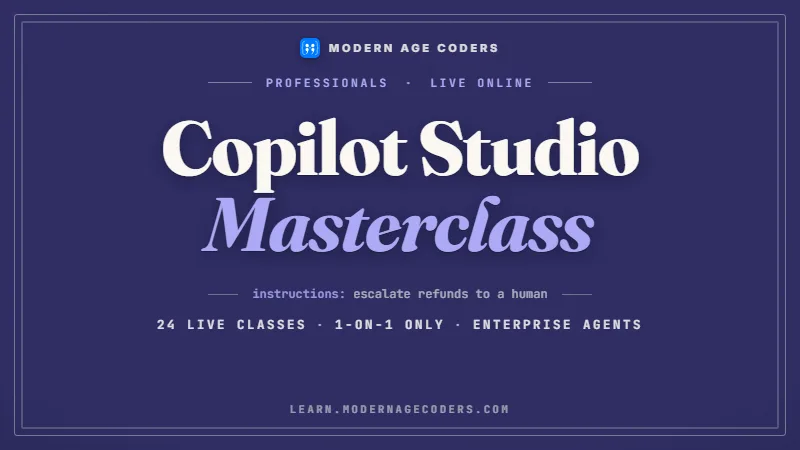
AGPR / 02
Agents inside a Microsoft workplace, taught one to one around your own process.
Open the syllabus →
AGPR / 03
Agents for Google Workspace organisations, taught one to one.
Open the syllabus →Privacy duties
The Office of the Australian Information Commissioner has published guidance on privacy and commercially available AI products. Anyone building agents at work should read it in full; these are the points that shape agent design most.
| The guidance says | What it means for an agent |
|---|---|
| "The Privacy Act applies to all uses of AI involving personal information." | Every prompt and every tool result is in scope if it contains personal information |
| The OAIC recommends that organisations "do not enter personal information, and particularly sensitive information, into publicly available generative AI tools" | Public chat tools are the wrong place for customer text |
| "AI products should not be used simply because they are available." | Start with the task, not the tool; sometimes no AI is the answer |
| Due diligence "should not amount to a ‘set and forget’ approach" | Agents need monitoring and periodic review after launch |
| Only "the minimum amount of personal information sufficient" for the purpose | Send the agent fields, not whole records |
| Inferred or "artificially generated information" about an identifiable person "constitutes personal information" | An agent's wrong guess about a customer is still their personal information |
Under APP 10, the guidance says, organisations "have an obligation to take reasonable steps to ensure the personal information collected, used and disclosed is accurate". An agent that drafts letters about customers inherits that obligation.
That is why every agent in our course has an evaluation set and a human review step before anything reaches a customer.
The guidance also asks businesses to ensure that "public facing AI tools (such as chatbots) are clearly identified as such to external users such as customers."
We treat that as a design requirement: the agent says what it is, and a person can always be reached.
Source: Office of the Australian Information Commissioner, Guidance on privacy and the use of commercially available AI products, read 13 October 2026. This page summarises; it is not legal advice.
A worked example
A common plan is to "strip the personal details" from text before an agent sends it to an AI service. We tested how well that works on 500 invented customer-support messages.
We wrote eight message templates and filled them with invented names, @example.com email addresses, mobile numbers, street addresses in a made-up suburb and order numbers: 500 messages containing 807 name mentions, 240 email addresses, 190 phone numbers and 199 addresses. No real person or customer appears. We then tried four ways of redacting them before they would be sent anywhere.
| Redaction method | Names removed | Emails, phones, addresses | Ordinary words wrongly removed | Messages still containing a name |
|---|---|---|---|---|
| Patterns for emails, phones and addresses | 0 of 807 | all | 0 | 500 |
| Patterns plus a list of 50 common names | 389 of 807 | all | 0 | 342 |
| Patterns plus every name we used, any letter case | 807 of 807 | all | 377 | 0 |
| Send only the order number and issue type | nothing to remove | nothing to remove | 0 | 0 |
Email addresses, Australian mobile numbers and addresses with a state and postcode have a shape, and simple patterns caught every one. Names have no shape, so patterns caught 0 of 807 of them.
A list of 50 common names still left a name in 342 of 500 messages. A complete list matched without regard to case removed 377 ordinary words, led by "will" (137), "hope", "may", "mark" and "bill", because they are also names.
Sending only the fields the task needs, here an order number and an issue category, leaves nothing to redact. It is what the OAIC means by the minimum amount of personal information, and it beat every redactor we built.
Matching our full name list with exact capitals scored 807 of 807 with no wrong removals. That only happened because we invented the names from that list; real customers do not come with one.
A test that the method cannot fail is not a test. We show it so learners recognise the trap in vendor demonstrations, where the sample data has often been chosen to suit the tool being sold.
Design the agent so personal details never need to leave your systems. Where free text must be processed, use an approved, contracted service rather than a public tool, and measure redaction before trusting it.
Count what slips through, on data that looks like yours, before any real data is involved. Then write the count down, because the same test should be run again whenever the agent, the model or the data changes.
Designing agents
Most failed workplace agents fail on the first question, not the last.
| Question | Why it matters | A good answer looks like |
|---|---|---|
| Is an agent needed at all? | A fixed process is better served by a script or a form | A written comparison with the simplest option |
| What data will it see? | Privacy duties attach to every input and output | A field list, with personal fields removed or justified |
| What can it change? | Irreversible actions need a person to approve them | Read-only by default; writes behind confirmation |
| How will we know it works? | Accuracy is an obligation, not a hope | A test set with known answers, rerun on every change |
| Who reviews it later? | Due diligence is not set and forget | A named owner and a review date |
Students and younger learners have a separate AI agents course for students, which concentrates on tool-call checks and assessment rules.
The course
Six stages, each ending in something usable at work, built on data that is either public or invented.
| Stage | What you build | What you learn to check |
|---|---|---|
| 1. Task first | A written workflow and the simplest non-AI version | Whether an agent beats it |
| 2. Tools | Small functions the agent may call, read-only first | Permissions and logging |
| 3. The agent | A loop on a test model, then on an approved service | Every step replayable |
| 4. Data handling | Field-level minimisation and measured redaction | What still leaks |
| 5. Evaluation | A task set with known answers | Accuracy, cost of errors, drift over time |
| 6. Handover | Documentation, owner, review date | That someone else can run it |
Python, APIs and coding agents, with code review and tests as non-negotiable.
Platform agents in tools your organisation already licenses, with the same design questions.
Enough building to judge proposals: what to ask, what to measure and when to say no.
Honest limits
Clear boundaries protect learners and their employers.
We summarise published guidance and teach engineering practice. Questions about your organisation's obligations belong with its privacy officer or lawyers.
We never ask learners to bring real customer or employee data into lessons.
We do not promise promotions, job changes or savings figures. We promise working agents, measured honestly, that you understand well enough to defend.
Organisations must still make their own decisions about deployment.
Progress
Most professionals reach the third level within one or two terms of weekly lessons.
| Level | What you can do |
|---|---|
| 1. Informed user | Explain what an agent sees, does and stores |
| 2. Builder | Build a read-only agent with logged tool calls |
| 3. Responsible builder | Add minimisation, measured redaction, evaluation and approval steps |
| 4. Owner | Document, monitor and review an agent others depend on |
For the technical track, basic Python helps; we teach it if needed. Platform courses need no coding to start.
Every track uses the same design questions.
Small groups from one organisation can be arranged. Lessons use public or invented data only.
Ask in the free class and we will propose a plan.
The catalogue
Adults only. Choose by the platform your work already uses, or by the depth you need.
AGPR / AGT / 01
Specify, review, test.
Open the syllabusAGPR / AGT / 02
One to one only.
Open the syllabusAGPR / AGT / 03
One to one only.
Open the syllabusAGPR / FND / 01
Scripts and applied AI.
Open the syllabusAGPR / FND / 02
LLMs and retrieval.
Open the syllabusAGPR / FND / 03
Everyday AI, used carefully.
Open the syllabusAGPR / WRK / 01
Excel, SQL, Python, BI.
Open the syllabusAGPR / WRK / 02
For teams shipping code.
Open the syllabusAGPR / WRK / 03
Analytics without code.
Open the syllabusHow lessons run
Teaching happens from India in hours that match Australian evenings, weekends and some lunchtimes. We schedule in your state's time and keep lessons aligned through daylight saving.
Evening
After work, weekly.
Weekend
Longer build sessions.
Lunchtime
One to one, by arrangement.
A small read-only agent and an honest view of fit.
Professionals at a similar level.
Around one process or one platform.
No real customer records in lessons.
Every safeguard is tested.
Approval steps before anything changes.
Student work
Projects our students built and published. The student labs list many more.

AI and ML
An AI nutrition coach that reads what you eat and works you toward a target.

AI and ML
A chatbot that answers mathematics and programming questions, built and deployed by a student.

AI and ML
An assistant that helps a young person recognise unsafe situations online.

Web app
A weather forecasting site with live conditions for any location.
Fees
Professionals in Australia pay monthly in US dollars. No upfront charge applies, and you may end the arrangement after any month.
Free first class
USD 0
no card required
Group batch
USD 100
a month, billed in US dollars
One to one
USD 150
a month, billed in US dollars
What families say
What learners and parents wrote on Google, quoted without changes.
★★★★★
"The one step solution for my son. Modern Age Coders make learning coding so simple that kids love it. The teachers explain complex concepts clearly with practical exercises and interactive content."
Ria Mukherjee
Parent
★★★★★
"Modern Age Coders has been a game-changer for me. I struggled to grasp IT concepts and coding before joining, but their classes transformed everything. I can now confidently write complex programs with ease."
Samriddha Mondal
Student
★★★★★
"One of the most wonderful education centres out there. Education is not limited to school syllabus but focuses on skill development."
Vansh Agarwal
Student
★★★★★
"My child Dhairya is really enjoying the Modern Age Coders classes. This is his first online class and he eagerly looks forward to it. I can already see his improvement, and the teachers are very cooperative."
Sonam Oswal
Parent of Dhairya
★★★★★
"Modern Age Coders have wonderful teachers who teach in a clear, easy and practical way. The teacher boosts students' confidence and inspires them to learn without hesitation."
Sonu Goyal
Parent
★★★★★
"I highly recommend this computer coding class! The teachers are incredibly knowledgeable and passionate about coding."
Ritu Kedia
Parent
Professionals ask
It is a course that teaches working adults to design, build, evaluate and maintain AI agents, programs that use AI to choose and run tools, for real workplace tasks, with privacy and human review built in.
The OAIC recommends that organisations do not enter personal information, and particularly sensitive information, into publicly available generative AI tools. Your organisation's own policies also apply.
Not reliably. In our test on 500 invented messages, patterns removed every email, phone number and address but no names. Sending only the fields a task needs worked better.
The OAIC's guidance states that the Privacy Act applies to all uses of AI involving personal information, including information an AI system generates or infers about an identifiable person.
Not for the platform tracks. The technical track uses Python, which we can teach from the start.
We wrote eight message templates and filled them with invented names, example.com email addresses, mobile numbers in Australian formats and addresses in a made-up suburb, then measured what each redaction method removed and what it missed.
No. We summarise published guidance and teach engineering practice. Your organisation's privacy officer or lawyers advise on obligations.
Python-built agents, coding agents, and one-to-one courses for Microsoft Copilot Studio and Google Gemini Enterprise for organisations already using them.
The first class is free with no card. Monthly fees are listed in the fees section, for groups and one-to-one.
Also on this site
Related AI and adult learning pages.
The national index of our pages.
Tool-call checks and assessment rules.
Python, data and the web around work.
Judgement before automation.
Building models, not just agents.
Private lessons around one workflow.
Start here
Leave a number and a time. We build a small read-only agent together in the free lesson and talk honestly about whether the course fits your work.
To learn more first, read about our teaching or look over the courses.
WhatsApp us · +91 91233 66161 · connect@modernagecoders.com
Our people are in India, so you will see a +91 number, and there is no office in Australia. WhatsApp from an Australian phone normally brings the fastest response.
A priority demo is a full class of about 45 to 60 minutes. After the class the mentor sends a written skill report and a personal learning roadmap on WhatsApp. If you enrol, the demo fee is adjusted against your first month's fee. Share your demo Order ID with us on WhatsApp and we take it off.
Book a priority demo