AGENTS / GROUND / 01
Python Masterclass
The language nearly all agent code is written in, to an advanced level.
Open the syllabusIreland · Third level and senior cycle · Live online
When the Central Statistics Office first asked about generative AI, in its 2025 household survey, students came out on top: 66% of students had used a tool such as ChatGPT or Copilot in the previous three months, against 46% of employees and 42% of all internet users. Most of them used it for their studies. Irish colleges have been clear about where the line sits. The National Academic Integrity Network's guidelines say students must be told that submitting the output of generative AI as their own work, without authorisation, is academic misconduct. So there are two very different ways a student can spend time with AI agents. One is asking an agent to do the work, which may break the rules and teaches very little. The other is building an agent: deciding what it may do, giving it tools, measuring how often it is right, and writing down honestly what you built and what the model generated. This page is about the second, taught live online to students in Ireland.
Live classes since 2020 · over 10,000 students taught · agents built, tested and disclosed
In short
An AI agent is a program in which a language model directs its own steps and tool use to reach a goal. The best way for a student to learn about agents is to build one as their own work, test it against questions with known answers, and disclose what the model produced, which is also what Irish academic integrity guidance expects. Modern Age Coders teaches students in Ireland to build agents in Python, live online, in groups of five to ten or one to one. A first class is free. Then a group place costs USD 100 a month and one-to-one tuition USD 150 a month; the Copilot Studio course is taught one to one only.
Start here
From the model upwards, inside a platform many employers use, or directing agents that write code. Every card opens its syllabus and format.
AGENTS / 01
Language models, retrieval from your own documents, and agents whose every tool call is recorded, for students who want to understand the whole stack.
Open the syllabus →
AGENTS / 02
Agents grounded in documents and connected to real systems in Microsoft Copilot Studio. One-to-one lessons only.
Open the syllabus →
AGENTS / 03
Giving coding agents real tasks, reading every change they propose and deciding what to keep, using your own paid accounts.
Open the syllabus →Students and AI
The figures below come from the CSO's 2025 household survey, the first to ask about generative AI. It covers internet users aged 16 and over, and "student" means people whose main status is student, at second or third level.
| Measure | Figure |
|---|---|
| All internet users aged 16 and over who had used generative AI | 42% |
| Students who had used it | 66% |
| Employees who had used it | 46% |
| Of students who used it: for formal education | 62% |
| Of students who used it: for private purposes | 60% |
| Of all users: for educational purposes | 28% |
| Of people who had not used it: said they did not know how | 20% |
The CSO defines generative AI as a form of AI designed to generate human-like content, "which can be text, audio, images, videos, programming code, etc.", and names ChatGPT, Copilot and Gemini among the tools.
So when a student in Ireland reaches for an AI tool, writing code is one of the things it is built to do. The question is whether the student can judge that code.
Look at the base of each row. The 62% describes students who had used generative AI, not all students. Since 66% of students had used it, the share of all student internet users who used it for formal education is nearer 41%, by our arithmetic.
That kind of slip is exactly what an agent makes when it summarises a table carelessly, which is why the first agent project on this page is built around it.
Sources, read 16 September 2026: CSO, Household Digital Consumer Behaviour 2025: Generative AI (5 December 2025); CSO tables ICA320 and ICA322. The 41% is our own calculation from the published figures.
Integrity guidance
The National Academic Integrity Network, facilitated by Quality and Qualifications Ireland, published guidelines for educators on generative AI in 2023. Each college sets its own policy, but these lines show the national thinking.
| Theme | In the guidelines' words |
|---|---|
| Misconduct | "There must be clear information for students that unauthorised submission of the output of GenAI as their own work constitutes academic misconduct and will be treated accordingly." |
| Own work | "It is important that students submit work that they have produced and acknowledge the sources used" |
| Authorised use | "If you identify a particular appropriate role for GenAI in your courses, then ensure that students are aware of what constitutes authorised and unauthorised use." |
| Limits of the tools | They "can give unreliable answers whilst appearing confident and convincing." |
Two ideas run through the guidelines. Credit is for the student's own work, and the difference between authorised and unauthorised use is set by the course, so a student has to know their institution's policy and be able to draw the line.
The guidelines also describe these tools as largely relying on statistical predictions of word combinations, not expertise. That is a good sentence to keep in mind while building an agent on top of one.
Our position is simple. We never produce, edit or check work that will be submitted for assessment. What we teach is building agents as the student's own projects, with a written record of what the model generated.
That record, a note naming the models and versions used and separating the student's own code from generated code, is a habit that protects a student under any policy. More on this is on understanding the code instead of copy-pasting.
Sources: QQI, NAIN publishes GenAI guidelines for educators (8 September 2023) and the guidelines themselves, read 16 September 2026. This is a summary, not advice about any course; your own institution's rules always apply.
A first agent
Anthropic, which makes the Claude models, draws a useful line in its engineering guidance of December 2024. "Workflows are systems where LLMs and tools are orchestrated through predefined code paths." Agents, by contrast, "are systems where LLMs dynamically direct their own processes and tool usage, maintaining control over how they accomplish tasks."
The first project is an agent that answers questions about Irish statistics. It has two tools: one fetches a CSO table, one runs a small calculation. Given a question, it decides which table to fetch, reads it, calculates and answers, writing every step to a log.
Then comes the part most tutorials skip. The student writes twenty questions whose answers they have checked by hand, runs the agent on all twenty, and counts how many it gets right.
The questions are chosen to catch the agent out. Real CSO tables contain traps that a language model walks straight into, and each one becomes a test the agent must pass before the student trusts it.
Students who want to direct agents that write software rather than answer questions go on to agentic coding classes; the wider picture is on the AI agents course page.
Asked what share of students use AI for their studies, a careless agent answers 62%. That figure is a share of students who used AI; the right answer needs the 66% as well.
The CSV download of table ICA319 repeats some rows: the male and female figures for ages 16 to 29 each appear twice. An agent that averages raw rows gets the wrong result without any warning.
The CSO's 72% refers to young men aged 16 to 29 only. The figure for that whole age group is 65%. An agent that reports 72% for all young people fails the test.
Sources: Anthropic, Building effective agents (19 December 2024); CSO table ICA319, read 16 September 2026.
Where it leads
An agent with a test set and a disclosure note is a portfolio piece that shows judgement, not just enthusiasm.
Agents are built on Python, version control and some data structures. The coding for college students page covers them for Irish third-level students.
Students who want to know how the underlying models learn can go further on learning to train AI.
After college the same skills continue on the AI agents course for professionals, which covers agents inside organisations.
The rungs
A student who cannot read code cannot tell what an agent did. The ladder starts with the language and ends with evidence.
| Rung | What the student can do |
|---|---|
| 1. Python without help | Write and debug programs with no assistant switched on |
| 2. Version control | Keep every change in Git, so the history shows who wrote what |
| 3. Models and retrieval | Call a language model and ground it in chosen documents |
| 4. Tools and agents | Let a model choose and call tools, with limits and a log |
| 5. Tests and disclosure | Measure the agent against known answers and write an honest note |
Saying exactly what you built, what a model produced and how you checked it is harder than it sounds. Irish guidance asks students to acknowledge sources, and an agent project is where the habit becomes second nature.
How agents connect to the rest of computing is shown on the coding roadmap.
Most students take one or two lessons a week in term and pause for exams. Many Irish universities run semesters from September to December and January to May, and lessons follow that pattern.
The Copilot Studio course runs one to one only, because each agent is built around particular systems.
The catalogue
In the order most students take them. Every card opens a course page with its syllabus and format.
AGENTS / GROUND / 01
The language nearly all agent code is written in, to an advanced level.
Open the syllabusAGENTS / GROUND / 02
A history of every change, which is half of any honest disclosure.
Open the syllabusAGENTS / GROUND / 03
Enough theory to judge whether an agent's code is any good.
Open the syllabusAGENTS / BUILD / 01
From a single model call to an agent with tools and a test set.
Open the syllabusAGENTS / BUILD / 02
Scripts that call models and services to get real jobs done.
Open the syllabusAGENTS / BUILD / 03
Agents on Microsoft's platform, taught privately only.
Open the syllabusAGENTS / CODE / 01
Handing coding agents real tasks and reviewing each change line by line.
Open the syllabusAGENTS / CODE / 02
Building quickly with AI across the stack while reading all of it.
Open the syllabusHow the classes run
All lessons are live, with teachers who work from India. India has one clock all year and Ireland has two, so the gap is four and a half hours during Irish summer time and five and a half from late October to late March. Students usually pick an evening after lectures or a weekend block, fixed in the free class.
Evening
After lectures and labs, Irish time.
Weekend
Longer sessions for building and testing an agent.
Free afternoons
Where a timetable has gaps, usually one to one.
A tiny agent with one tool, built with the teacher, who then suggests where to start.
Students at one level, comparing how their agents fail on the same test questions.
For a final-year project with an agent in it, and for the Copilot Studio course.
Every agent records each step it takes, so testing and disclosure are built in from day one.
Teachers do not write, edit or check anything that will be submitted for credit.
Agents, test sets and disclosure notes live in the student's own GitHub account.
Student work
Four live projects from our students, of all ages. The student labs page has the rest.
AI and ML
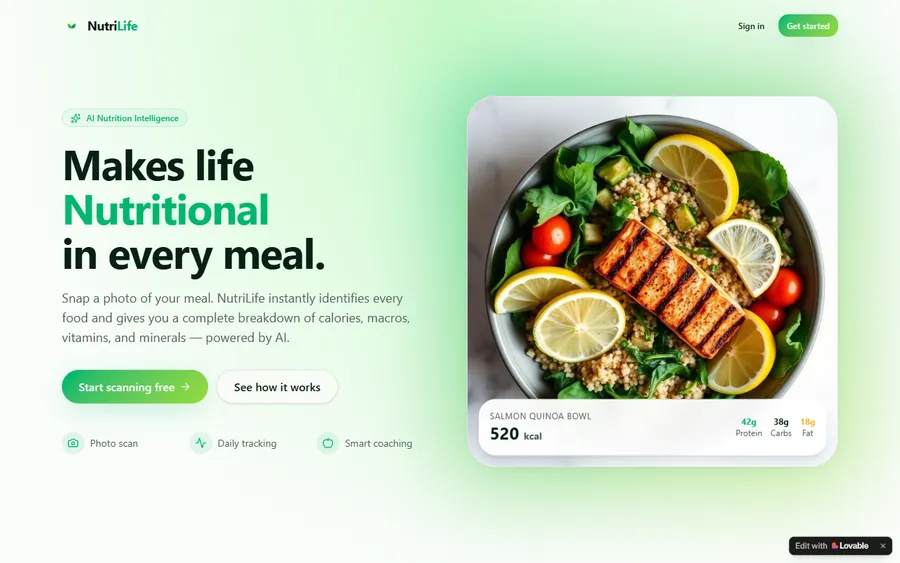
An AI nutrition coach that reads what you eat and works you toward a target.
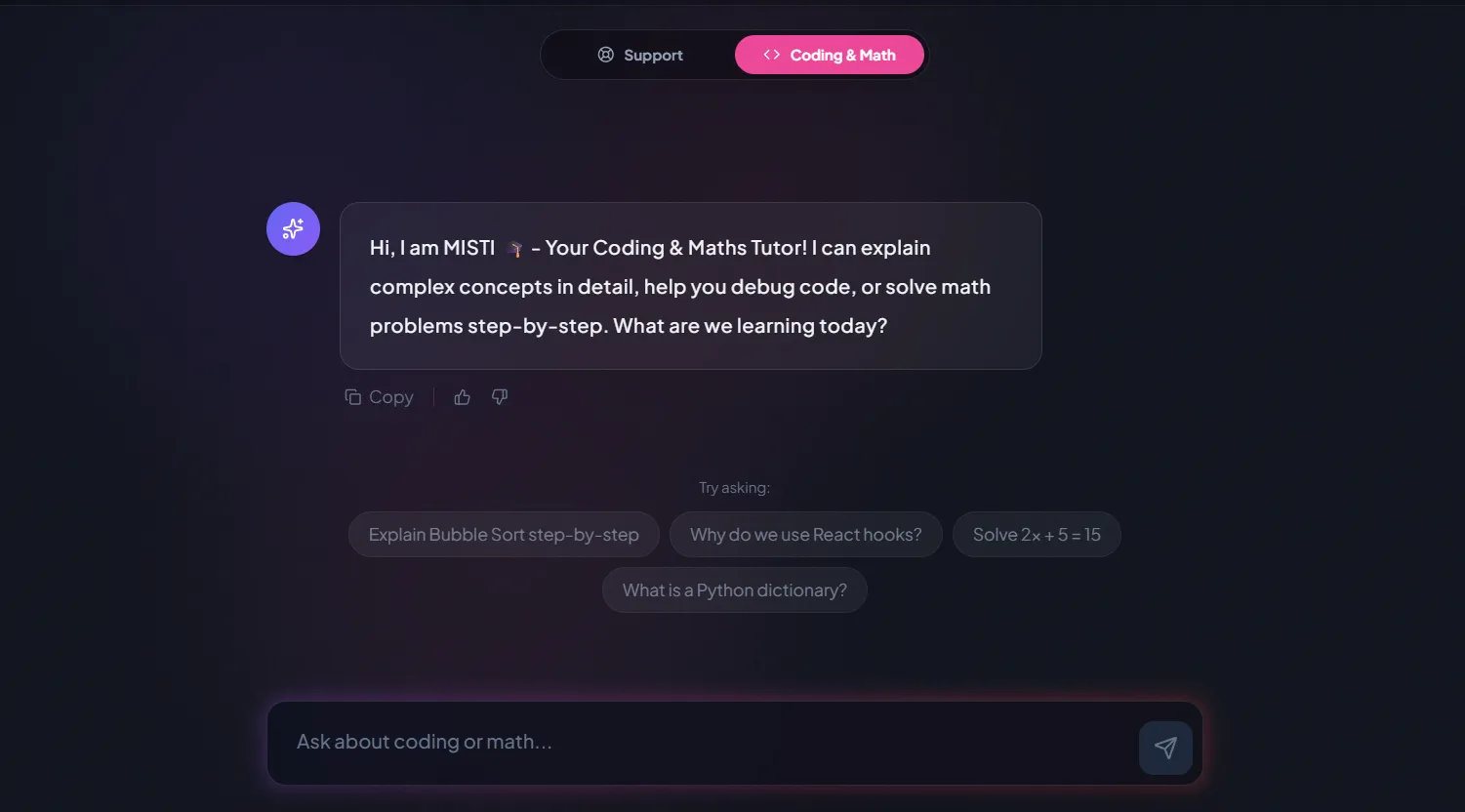
AI and ML
A chatbot that answers mathematics and programming questions, built and deployed by a student.
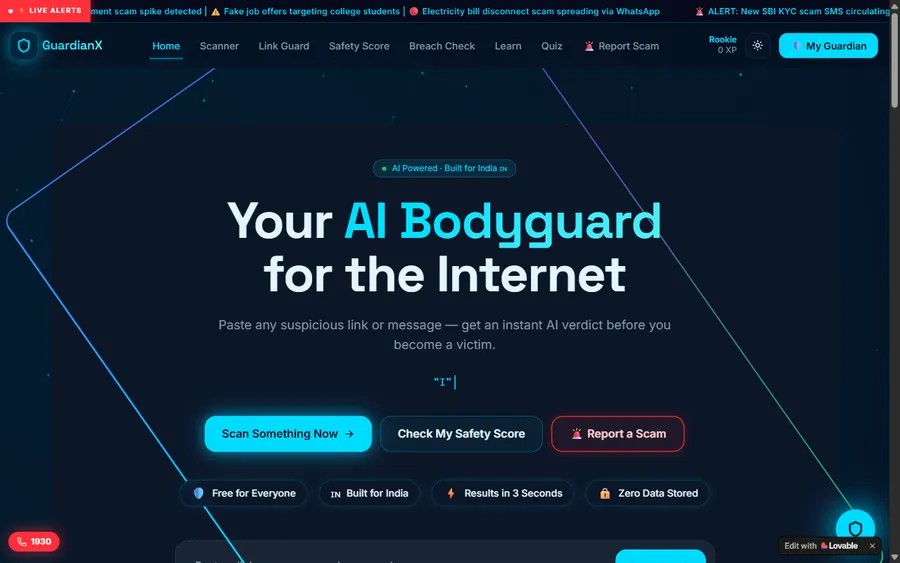
AI and ML
An assistant that helps a young person recognise unsafe situations online.
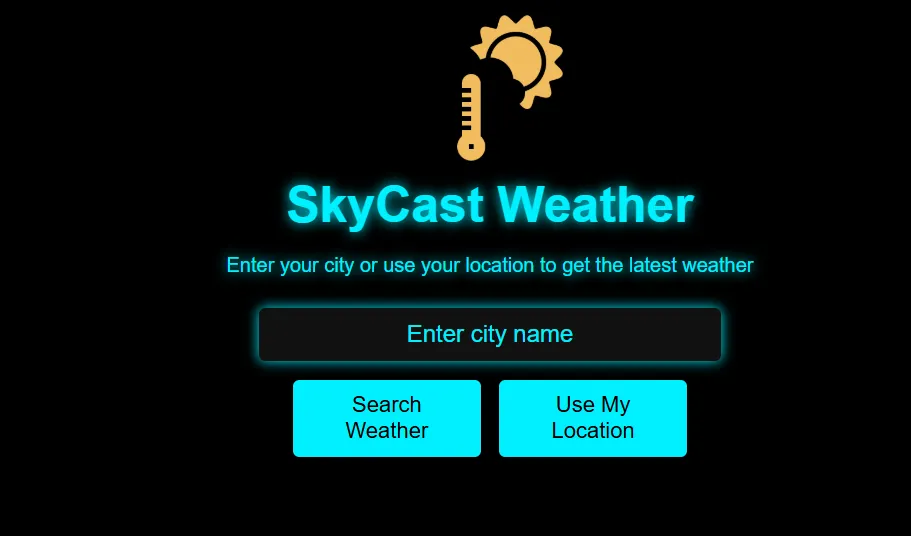
Web app
A weather forecasting site with live conditions for any location.
Fees
Monthly in US dollars, at the rate we charge in every country outside India, with no enrolment fee and nothing to sign for the year. The Copilot Studio course is private only and uses the one-to-one rate; the coding agents course needs your own paid accounts for the tools.
Free first class
USD 0
no card required
Group batch
USD 100
a month, billed in US dollars
One to one
USD 150
a month, billed in US dollars
What families say
Word for word from Google. We have never paid anyone for a review or written one ourselves.
★★★★★
"The one step solution for my son. Modern Age Coders make learning coding so simple that kids love it. The teachers explain complex concepts clearly with practical exercises and interactive content."
Ria Mukherjee
Parent
★★★★★
"Modern Age Coders has been a game-changer for me. I struggled to grasp IT concepts and coding before joining, but their classes transformed everything. I can now confidently write complex programs with ease."
Samriddha Mondal
Student
★★★★★
"One of the most wonderful education centres out there. Education is not limited to school syllabus but focuses on skill development."
Vansh Agarwal
Student
★★★★★
"My child Dhairya is really enjoying the Modern Age Coders classes. This is his first online class and he eagerly looks forward to it. I can already see his improvement, and the teachers are very cooperative."
Sonam Oswal
Parent of Dhairya
★★★★★
"Modern Age Coders have wonderful teachers who teach in a clear, easy and practical way. The teacher boosts students' confidence and inspires them to learn without hesitation."
Sonu Goyal
Parent
★★★★★
"I highly recommend this computer coding class! The teachers are incredibly knowledgeable and passionate about coding."
Ritu Kedia
Parent
Questions from students
That depends on your institution and each module. Irish academic integrity guidance says unauthorised submission of generative AI output as your own work is academic misconduct, so check what your course allows.
No. We never write, edit or check work that will be submitted for assessment. We teach you to build agents as your own projects, outside your coursework.
A chatbot answers. An agent is given a goal and decides its own steps, choosing and calling tools such as search or code execution along the way.
Yes, at least the basics. If you do not yet, the free class will show which foundation course to take first.
The CSO found that 66% of students aged 16 and over had used it in the three months before its 2025 survey, compared with 46% of employees.
No. It is taught one to one only, because each agent is built around particular systems and permissions.
Yes. You use your own paid accounts for the tools, so what you build stays yours.
Your first class is free. A group place is then USD 100 a month and one-to-one lessons USD 150 a month, charged in US dollars, with no enrolment fee and no contract for the year.
Evenings or weekends at a time you choose in the free class. Our teachers are four and a half hours ahead of Irish time in summer and five and a half in winter.
Someone from our team calls you at a sensible Irish hour to set up the free class. You pay nothing unless you choose to continue.
Elsewhere on this site
Foundations, deeper AI and what comes after college.
The foundations under every agent.
How the models learn.
Agents inside organisations.
AI help without losing the learning.
The global page on agents.
The national AI page.
Start here
Leave your number and we will ring at an hour that suits you in Ireland. In the free class you build a very small agent with a teacher, and you leave knowing which rung to start on.
To look around first, there is the AI agents course page, an account of how our lessons work, and the full course list.
WhatsApp us · +91 91233 66161 · contact@modernagecoders.com
WhatsApp works too and is usually the fastest way to reach us; messaging from an Irish number costs nothing. It is an Indian number, as our whole team is in India, and we have no Irish office.