CAN / KID / 01
Scratch for kids
A first coding course for after-school slots.
Open the syllabusCanada · Official time in 2026 · Scheduling online classes
Until this year a Canadian family could assume two clock changes, one in March and one in November, almost everywhere except Saskatchewan and Yukon. That is no longer true. British Columbia made its last change on 8 March 2026 and now stays on UTC-7. Alberta's new Official Time Act fixes the province at six hours behind UTC. Saskatchewan has passed a new Time Act at UTC-6, and Manitoba stops at UTC-5 from 31 October 2026. Ontario, Quebec, the Atlantic provinces and Newfoundland still change. For anyone booking a live online class across provinces, the gap between two cities now depends on the season in a new way. This page quotes each rule from the government's own text and then shows, in tables, what one class time looks like in every zone.
Teaching live online since 2020 · 10,000+ students · every class time confirmed in your own province's clock
In short
From November 2026 BC stays at UTC-7, Alberta and Saskatchewan at UTC-6 and Manitoba at UTC-5 all year; Ontario, Quebec and Atlantic Canada still change, on 1 November 2026 and 14 March 2027. Modern Age Coders schedules live online classes in each family's local time, in a batch or one to one, including its CCC Junior and Senior Preparation course.
Classes across Canada
Each of these follows a Canadian school or contest calendar, so the class time matters as much as the syllabus.
CAN / 01
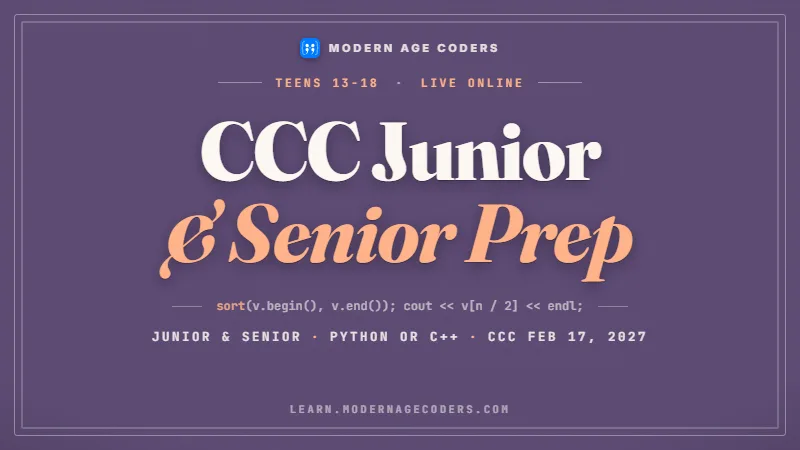
Ages 13 to 18. For the Canadian Computing Competition, which every school writes near the start of its own school day.
Open the syllabus →
CAN / 02
Grades 11 and 12, alongside ICS3U and ICS4U. We do not grant Ontario credits.
Open the syllabus →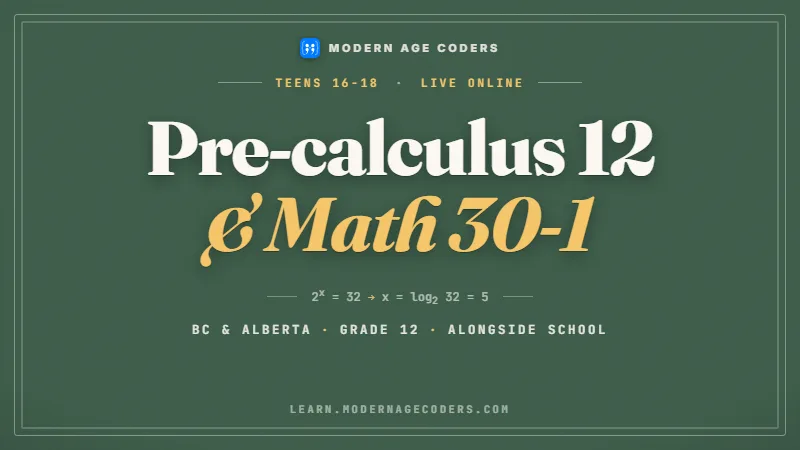
CAN / 03
Ages 16 to 18. For BC and Alberta students, the two provinces that no longer change their clocks.
Open the syllabus →What changed
The offsets below apply from Sunday 1 November 2026, when this autumn's changes are complete. "Changes" means the region still moves its clocks on the second Sunday of March and the first Sunday of November.
| Where | Winter (from 1 Nov 2026) | Summer (from 14 Mar 2027) | What sets it |
|---|---|---|---|
| British Columbia (most of the province) | UTC-7 | UTC-7 | Provincial decision announced 2 March 2026; last change 8 March 2026 |
| Alberta | UTC-6 | UTC-6 | Official Time Act, current as of 18 June 2026 |
| Saskatchewan | UTC-6 | UTC-6 | The province has long kept one time all year; the Time Act, 2026 sets UTC-6 |
| Manitoba | UTC-5 | UTC-5 | Official Time Amendment Act, in force from 31 October 2026 |
| Ontario (most) and Quebec (most) | UTC-5 | UTC-4 | Still changes |
| New Brunswick, Nova Scotia, PEI, most of Labrador | UTC-4 | UTC-3 | Still changes |
| Newfoundland | UTC-3:30 | UTC-2:30 | Still changes |
| Yukon | UTC-7 | UTC-7 | One time all year since November 2020 (tz database) |
| Northwest Territories | UTC-6 | UTC-6 | Territorial regulations recorded by the tz database in August 2026 |
| Nunavut | UTC-5, -6 or -7 by region | UTC-4, -5 or -6 | Still changes, in three zones (tz database) |
The change of note for families is in the middle of the country. Calgary, Edmonton, Regina and Saskatoon now share one clock all year, at UTC-6. Winnipeg shares Toronto's clock in winter, at UTC-5, and falls one hour behind Toronto when Eastern time moves forward on 14 March 2027. Vancouver is always one hour behind Calgary, because both provinces now stay put.
Sources: BC Gov News, 2 March 2026; Alberta Official Time Act; Saskatchewan Bill 58, The Time Act, 2026; Manitoba news release, 17 September 2026 and the Official Time Amendment Act; IANA tz database 2026e. All read 22 October 2026.
In their own words
Each line below is copied from the government document named under it. Where a rule's start depends on a step we could not confirm, we say so.
The province's release of 2 March 2026 says "B.C. will adopt permanent, year-round daylight saving time after clocks shift forward an hour on Sunday, March 8, 2026" and "This will be the final time change in British Columbia."
On the offset it is exact: "Pacific time will be set seven hours behind co-ordinated universal time (UTC-7), matching the current offset used during daylight saving time." So BC families will not move their clocks this autumn, and will not in March 2027 either.
The Official Time Act, in the consolidation "Current as of June 18, 2026", defines official time as the time that "means the time 6 hours behind Coordinated Universal Time".
It adds: "No person shall use or observe within Alberta any time other than official time." Alberta's summer offset was already UTC-6, so the visible change comes on 1 November 2026, when Alberta clocks do not fall back.
Bill 58, The Time Act, 2026, defines central standard time as one that "means UTC-6 hours", says "the time to be observed in Saskatchewan is central standard time", and says Saskatchewan "includes the City of Lloydminster".
The bill also says "This Act comes into force by order of the Lieutenant Governor in Council." We could not confirm that the order has been made. In practice the clock is the same either way: Saskatchewan has not changed its clocks in decades, and Alberta now sits at UTC-6 too.
Manitoba's release of 17 September 2026 says clocks "will not revert to standard time on Nov. 1". The proclamation then sets the date in law: "we name October 31, 2026, as the day on which The Official Time Amendment Act (S.M. 2023, c. 4) comes into force".
That Act defines Manitoba Standard Time as "five hours behind Coordinated Universal Time (UTC)", and adds "The official time may be referred to as "MBT"." The release also notes Manitoba "joins several other provinces and territories that have adopted or are moving toward a permanent time including British Columbia, Yukon, Northwest Territories, Alberta and Saskatchewan."
Sources: the four government documents named above, and the Manitoba proclamation, read 22 October 2026. We quote only the timekeeping lines; the releases' other reasoning is outside this page's purpose.
One class time, every zone
Three example start times, written in Eastern time, converted into every Canadian zone for the coming winter and for summer 2027. These are illustrations only, not our batch times: families choose their own slot, and we confirm it in their local clock.
| Zone | Weekday 4:30 pm ET, winter | Weekday 7:00 pm ET, winter | Saturday 10:00 am ET, winter | Weekday 4:30 pm ET, summer | Weekday 7:00 pm ET, summer | Saturday 10:00 am ET, summer |
|---|---|---|---|---|---|---|
| Newfoundland | 6:00 pm | 8:30 pm | 11:30 am | 6:00 pm | 8:30 pm | 11:30 am |
| Atlantic (NB, NS, PEI) | 5:30 pm | 8:00 pm | 11:00 am | 5:30 pm | 8:00 pm | 11:00 am |
| Eastern (Ontario, Quebec) | 4:30 pm | 7:00 pm | 10:00 am | 4:30 pm | 7:00 pm | 10:00 am |
| Manitoba | 4:30 pm | 7:00 pm | 10:00 am | 3:30 pm | 6:00 pm | 9:00 am |
| Alberta, Saskatchewan, NWT | 3:30 pm | 6:00 pm | 9:00 am | 2:30 pm | 5:00 pm | 8:00 am |
| British Columbia, Yukon | 2:30 pm | 5:00 pm | 8:00 am | 1:30 pm | 4:00 pm | 7:00 am |
| India (for our teachers) | 3:00 am next day | 5:30 am next day | 8:30 pm same day | 2:00 am next day | 4:30 am next day | 7:30 pm same day |
Winter means 1 November 2026 to 14 March 2027; summer means from 14 March 2027 until Eastern clocks fall back on 7 November 2027. India time is UTC+5:30 all year, with no daylight saving, according to the same tz database.
Read across one row of the table and the problem is plain. A 4:30 pm Eastern start lands at 2:30 pm in Vancouver in winter and 1:30 pm in summer, inside the school day. A 7:00 pm Eastern start is 8:30 pm in St. John's, late for a younger child.
That is why we do not publish one national batch time. A family picks a time that works in its own province, and the batch or the one-to-one slot is built around that.
From November 2026, families in BC, Alberta, Saskatchewan, Manitoba, Yukon and the NWT keep the same clock all year. If their class is set in their own local time, nothing moves for them on 14 March 2027.
What moves is everyone else's clock relative to them. A class fixed in Toronto time arrives an hour earlier in Calgary, Regina and Winnipeg when Eastern time springs forward. Fixing each class in the family's own time avoids that surprise.
The gap to Toronto
Many Canadian timetables, including contest and exam schedules, are given in Eastern time. This table shows how the gap to Toronto shifts across the next three seasons. Our arithmetic, from the offsets above.
| Zone | Now, until 1 Nov 2026 | 1 Nov 2026 to 14 Mar 2027 | From 14 Mar 2027 |
|---|---|---|---|
| Newfoundland | +1:30 | +1:30 | +1:30 |
| Atlantic (NB, NS, PEI) | +1 | +1 | +1 |
| Manitoba | -1 | 0 (same clock) | -1 |
| Saskatchewan | -2 | -1 | -2 |
| Alberta | -2 | -1 | -2 |
| Northwest Territories (Yellowknife) | -2 | -1 | -2 |
| British Columbia (most) | -3 | -2 | -3 |
| Yukon | -3 | -2 | -3 |
| India | +9:30 | +10:30 | +9:30 |
Read this way, the 2026 changes are simple to remember. Every zone that stopped changing is one hour closer to Toronto in winter than in summer, because only Toronto moves. Newfoundland and the Atlantic provinces move with Toronto, so their gap never changes. And the gap to India widens by an hour in the Canadian winter for the same reason.
Offsets from the government texts quoted above and the IANA tz database 2026e (Asia/Kolkata for India time). If you are working from a Canadian contest timetable, our CCC Junior guide explains why the computing contest follows each school's own day instead of one national start time.
Exceptions
A province's official time is not always the clock every town keeps. These exceptions come from the IANA tz database's own notes, release 2026e; where the notes say a point is an assumption, so do we.
| Place | What the tz database records | How sure |
|---|---|---|
| East Kootenay and Golden, BC | Stay aligned with Alberta, on UTC-6 all year, after local decisions in August and September 2026 | Recorded from local decisions; one rural area was still to decide |
| Northwestern Ontario, west of 90 degrees west | Shown on Manitoba's clock, so UTC-5 all year from November 2026 | An assumption: the database says it will "assume for the time being that they will" |
| Atikokan, Ontario | UTC-5 all year, no changes | Recorded in the database since at least the 1950s |
| Blanc-Sablon area, Quebec | UTC-4 all year, no changes | Recorded in the database |
| Lloydminster | UTC-6 all year, on either side of the Alberta and Saskatchewan border | Saskatchewan's bill names the city; Alberta is UTC-6 too |
| Northwest Territories | UTC-6 all year from November 2026 | Regulations recorded in August 2026; the regulation PDF returned an error when we tried it |
| Nunavut | Three zones, at UTC-5, UTC-6 and UTC-7 in winter, all still changing | Recorded in the database; the territory's site refused our request |
If your town is on a border or in one of these areas, tell us your town when you book. We set the class in the clock you actually live by, not the one a map suggests.
Our converter
A worked example in Python, written for this page. It uses fixed offsets typed in from the laws above rather than a device's built-in time zone rules, and that choice is the lesson.
# Our converter: one class time in Eastern time, shown in every Canadian zone.
# Fixed UTC offsets from the 2026 laws and tzdb 2026e, written in by hand, because
# a computer whose time zone data predates 2026 would still apply the old rules.
from datetime import datetime, timedelta, timezone

def tz(hours, minutes=0):
    sign = -1 if hours < 0 else 1
    return timezone(timedelta(hours=hours, minutes=sign * minutes))

WINTER = {  # 1 November 2026 to 14 March 2027
    "Eastern (ON, QC)": tz(-5), "Newfoundland": tz(-3, 30), "Atlantic": tz(-4),
    "Manitoba": tz(-5), "AB, SK, NWT": tz(-6), "BC, Yukon": tz(-7), "India": tz(5, 30)}
SUMMER = dict(WINTER, **{  # from 14 March 2027
    "Eastern (ON, QC)": tz(-4), "Newfoundland": tz(-2, 30), "Atlantic": tz(-3)})

def show(label, when, zones):
    start = when.replace(tzinfo=zones["Eastern (ON, QC)"])
    print(label)
    for name, zone in zones.items():
        local = start.astimezone(zone)
        print(f"  {name:18} {local:%a %d %b %H:%M}")

show("Class at 7:00 pm ET, Tuesday 17 November 2026:", datetime(2026, 11, 17, 19, 0), WINTER)
show("Class at 7:00 pm ET, Tuesday 20 April 2027:", datetime(2027, 4, 20, 19, 0), SUMMER)Class at 7:00 pm ET, Tuesday 17 November 2026: Eastern (ON, QC) Tue 17 Nov 19:00 Newfoundland Tue 17 Nov 20:30 Atlantic Tue 17 Nov 20:00 Manitoba Tue 17 Nov 19:00 AB, SK, NWT Tue 17 Nov 18:00 BC, Yukon Tue 17 Nov 17:00 India Wed 18 Nov 05:30 Class at 7:00 pm ET, Tuesday 20 April 2027: Eastern (ON, QC) Tue 20 Apr 19:00 Newfoundland Tue 20 Apr 20:30 Atlantic Tue 20 Apr 20:00 Manitoba Tue 20 Apr 18:00 AB, SK, NWT Tue 20 Apr 17:00 BC, Yukon Tue 20 Apr 16:00 India Wed 21 Apr 04:30
Same Eastern time, two seasons: Manitoba, Alberta, Saskatchewan, the NWT, BC and Yukon all show a time one hour earlier in April than in November, because Eastern time moved and they did not. India shows the next calendar day both times.
Python's standard library can look zones up by name, such as America/Vancouver, but it reads those rules from whatever time zone data the computer has. Data older than the 2026 changes would still move BC, Alberta or Manitoba in November.
Typing the offsets in, with a comment saying where each came from, makes the program say exactly what the law says. The cost is that someone must update it if a rule changes again.
A time written without a zone is not a time; it is half of one. The program refuses to work with a bare "7:00 pm": every datetime gets a zone before it is converted.
Try it: change the Eastern start to 4:30 pm and check the output against our table above. Then add a row for Newfoundland in summer and predict it before you run it.
How we schedule
Five steps we follow with every Canadian family, so the class arrives when everyone expects it.
A parent in Toronto booking for a child in Winnipeg sees the same clock all winter and a one-hour gap from March. We write both local times on the confirmation, so neither has to work it out.
The same applies to a one-to-one slot shared between, say, Vancouver and Halifax: a three-hour gap all winter, widening to four hours from 14 March 2027.
Canadian contests and exams set their own timing rules. The national computing contest, for one, is written at each school near the start of its own school day, not at a single national moment.
For anything with an official start time, we work from the organiser's published time and its zone, then convert, never the other way round.
Choosing a slot
Our own rule of thumb for picking a class time. Each family decides in the end.
| Slot | Who it tends to suit |
|---|---|
| 1. Weekday, straight after school | Younger students in BC and Alberta, where an Eastern evening time falls too early |
| 2. Weekday evening | Teens in Ontario, Quebec and Manitoba, after homework and practice |
| 3. Weekend morning | Atlantic and Newfoundland families, and anyone with busy weeknights |
| 4. One to one, any time | Students fitting class around sport, jobs or a school timetable that changes |
Pick the slot for the hardest week of the term, not the easiest. A class that survives exam week survives everything.
If you live in a province that stopped changing clocks, your class time will not move in March 2027 as long as it is set in your own local time.
Put the class in your calendar with its zone, and let the calendar do the arithmetic.
If a class time ever looks an hour off, check your device's time zone setting before anything else.
The catalogue
Each is taught live online by one regular teacher, in a batch or one to one, at a time set in the family's own zone.
CAN / KID / 01
A first coding course for after-school slots.
Open the syllabusCAN / KID / 02
Typed code and small AI projects.
Open the syllabusCAN / KID / 03
Grades 1 to 5, on weekend mornings or weekdays.
Open the syllabusCAN / TEEN / 01
From first program to real projects.
Open the syllabusCAN / TEEN / 02
MHF4U and MCV4U alongside school.
Open the syllabusCAN / TEEN / 03
Python to working models.
Open the syllabusCAN / ADT / 01
Zero to advanced, evenings in your zone.
Open the syllabusCAN / ADT / 02
For university students and job seekers.
Open the syllabusCAN / ADT / 03
Building with language models, for adults.
Open the syllabusHow lessons run
Weekdays or weekends, flexible: choose your batch, or for a very personalised plan choose 1-on-1 at your convenience, weekend mornings or weekdays.
Weekdays
After school or in the evening, in your local time.
Weekends
Mornings that work from St. John's to Victoria.
1-on-1
Any slot our teachers can cover, set in your zone.
The calendar does the converting.
Around the Eastern clock changes.
The same teacher at the same local time.
Students think before they type.
Homework explained, never done for them.
Fifteen to twenty, or one to one.
Student work
Students in many time zones, one standard of work. A few projects are below; the student labs page lists more.

AI and ML
An AI nutrition coach that reads what you eat and works you toward a target.

AI and ML
A chatbot that answers mathematics and programming questions, built and deployed by a student.

AI and ML
An assistant that helps a young person recognise unsafe situations online.

Web app
A weather forecasting site with live conditions for any location.
Fees
The fee is the same whichever zone you are in: a monthly fee for eight live classes a month, no contract, and the price shown in your own currency. Changing the class time later costs nothing.
Free first class
Free
no card required
Group batch
$100 USD
a month, eight live classes
One to one
$150 USD
a month, eight live classes
What families say
Google reviews from parents, in their own words.
★★★★★
"The one step solution for my son. Modern Age Coders make learning coding so simple that kids love it. The teachers explain complex concepts clearly with practical exercises and interactive content."
Ria Mukherjee
Parent
★★★★★
"Modern Age Coders has been a game-changer for me. I struggled to grasp IT concepts and coding before joining, but their classes transformed everything. I can now confidently write complex programs with ease."
Samriddha Mondal
Student
★★★★★
"One of the most wonderful education centres out there. Education is not limited to school syllabus but focuses on skill development."
Vansh Agarwal
Student
★★★★★
"My child Dhairya is really enjoying the Modern Age Coders classes. This is his first online class and he eagerly looks forward to it. I can already see his improvement, and the teachers are very cooperative."
Sonam Oswal
Parent of Dhairya
★★★★★
"Modern Age Coders have wonderful teachers who teach in a clear, easy and practical way. The teacher boosts students' confidence and inspires them to learn without hesitation."
Sonu Goyal
Parent
★★★★★
"I highly recommend this computer coding class! The teachers are incredibly knowledgeable and passionate about coding."
Ritu Kedia
Parent
Questions from Canadian families
No. BC made its last change on Sunday, March 8, 2026 and now stays on Pacific time at UTC-7 all year. Clocks in most of BC will not fall back on 1 November 2026 and will not spring forward in March 2027.
Yes, in effect. The proclamation names 31 October 2026 as the day Manitoba's Official Time Amendment Act comes into force, and the Act sets Manitoba Standard Time at five hours behind UTC all year. The province has announced that clocks will not revert to standard time on 1 November 2026.
Alberta's Official Time Act sets official time at six hours behind UTC, all year. That is the same offset Alberta used in summer, so the difference shows from 1 November 2026, when Alberta clocks no longer fall back.
Yes, from November 2026 both are at UTC-6 all year. Saskatchewan's Time Act, 2026 sets UTC-6 and includes Lloydminster. We could not confirm the date that Act comes into force, but Saskatchewan already kept one time all year.
Eastern clocks fall back on Sunday 1 November 2026 and spring forward on Sunday 14 March 2027, under the Canadian rule of the first Sunday in November and the second Sunday in March. The Atlantic provinces and Newfoundland change on the same dates.
In winter, yes: from 1 November 2026 to 14 March 2027 both are at UTC-5. From 14 March 2027 Toronto moves to UTC-4 and Winnipeg stays at UTC-5, so Winnipeg is one hour behind.
India time is UTC+5:30 all year. In the Canadian winter it is 10 hours 30 minutes ahead of Toronto and 12 hours 30 minutes ahead of Vancouver. From 14 March 2027 it is 9 hours 30 minutes ahead of Toronto, while the gap to Vancouver stays 12 hours 30 minutes.
Weekdays or weekends, flexible: choose your batch, or for a very personalised plan choose 1-on-1 at your convenience, weekend mornings or weekdays. Every class is confirmed in your own local time.
Not if it is set in your own local time and you live in BC, Alberta, Saskatchewan, Manitoba, Yukon or the NWT. Families in Ontario, Quebec and Atlantic Canada move with their own clocks. We re-confirm every class around 1 November 2026 and 14 March 2027.
A device that has not updated its time zone data may still apply the old rules for BC, Alberta or Manitoba. Updating the operating system usually fixes it. Our invitations carry the time zone, so a corrected device shows the right local time.
Elsewhere on this site
Classes and guides for students in every Canadian zone.
All our pages for Canadian families.
Classes set in BC's permanent Pacific time.
Classes in Alberta's UTC-6 time.
Classes in Eastern time, which still changes.
Coding and AI classes for Toronto families.
Math help in any province's clock.
A contest that starts with each school's day.
Private classes at a time you choose.
For when a program, like a clock, is an hour off.
Start here
Tell us your town and the times that suit you, in your own clock. We find a teacher for that slot, confirm it in writing with your zone named, and the first class starts on time wherever you are.
Before booking you can read what happens in a class, or open the courses page for every syllabus we teach.
WhatsApp us · +91 91233 66161 · connect@modernagecoders.com
Our teachers are in India, where the clock never changes, and teach over live video. That is why we take care over the Canadian side of every booking.
A priority demo is a full class of about 45 to 60 minutes. After the class the mentor sends a written skill report and a personal learning roadmap on WhatsApp. If you enrol, the demo fee is adjusted against your first month's fee. Share your demo Order ID with us on WhatsApp and we take it off.
Book a priority demo