CH / KIDS / 01
Python and AI for Kids
Typed code from lesson one, not coloured blocks. Python, turtle drawings, short games, then a machine that works out a rule from examples.
Open the syllabusSwitzerland · Live online · Ages 6 to 67
In September 2025 three Swiss institutions put a national language model online with its weights free to download. That is the argument of this page. Any family in Zurich, Geneva, Basel or Lugano can sit a child in front of a chatbot. We sit them in front of a published dataset, a training loop, and an error they have to defend.
Teaching since 2020 · 10,000+ students across 25+ countries · no recordings sold as classes
In short
Modern Age Coders teaches live online AI and machine learning in Switzerland, ages 6 to 67, in groups of fifteen to twenty or one to one. The subject is model building: Python, then the statistics and linear algebra underneath, then training and evaluating models on real published data. Teaching is in English and the timetable follows your cantonal calendar. A group place is USD 100 a month, and the first class is free.
The catalogue
Putting a ten year old in Zug and a working analyst in Basel through one course at two speeds produces two disappointed learners. These are separate programmes.
CH / KIDS / 01
Typed code from lesson one, not coloured blocks. Python, turtle drawings, short games, then a machine that works out a rule from examples.
Open the syllabusCH / KIDS / 02
Where an answer comes from, why a wrong one sounds as certain as a right one, and how to test a claim.
Open the syllabusCH / KIDS / 03
The child asks an AI tool for something, then reads what came back and repairs what will not run. Judging is the real work.
Open the syllabusCH / TEEN / 01
The main route here. Python, the mathematics the subject demands, classical algorithms, neural networks, vision and language models, each stage closing on a trained model.
Open the syllabusCH / TEEN / 02
Loading, cleaning, joining and plotting, where most hours in a real project go. Teens learn to catch the column whose units are wrong.
Open the syllabusCH / TEEN / 03
Two years from a blank file to files, APIs, testing and structure, for a teenager arriving with no code behind them.
Open the syllabusCH / TEEN / 04
Web and Python projects shipped with AI assistance, paired with the review skill that makes the assistance safe to accept.
Open the syllabusCH / PRO / 01
Supervised and unsupervised learning, deep networks, training discipline, validation that survives a hostile reader, and the deployment step short courses omit.
Open the syllabusCH / PRO / 02
How a language model is trained, fine tuned and grounded against a private document set, and how an agent is constrained so that it fails loudly.
Open the syllabusCH / PRO / 03
For professionals in Zurich, Zug, Basel or Geneva who want the applied half first: machine learning aimed at the reports on the desk.
Open the syllabusCH / PRO / 04
Statistics, SQL, feature construction, modelling and the write up, ending in a portfolio built for a hiring manager, not a marker.
Open the syllabusCH / PRO / 05
The interview gate at every serious engineering employer, and the reason a pipeline that behaves on 1,239 rows behaves on a million.
Open the syllabusCH / ALL / 06
Beyond AI we teach mathematics to university level, plus web, app and game development, all on Swiss time.
Open all coursesWhat you actually build
Every market we teach in gets a first project from that country's own measurements. Switzerland gets its glaciers. The dataset is Swiss Glacier Mass Balance, release 2025, from GLAMOS, DOI 10.18750/massbalance.2025.r2025, licensed CC BY 4.0. It holds 1,239 glacier years across 43 named glaciers, from 1885 to 2025, and one of the cleanest traps in any public dataset.
| Glacier | Bw | Bs | Ba | ELA, m | AAR, % | Area, km2 |
|---|---|---|---|---|---|---|
| Glacier de Tsanfleuron | 1664 | -4336 | -2672 | 3084 | 0 | 2.145 |
| Glacier de la Plaine Morte | 1398 | -3967 | -2569 | 3051 | 0 | 6.529 |
| Silvrettagletscher | 711 | -2983 | -2272 | 3142 | 0 | 2.244 |
| Griesgletscher | 1462 | -3639 | -2177 | 3429 | 0 | 3.643 |
| Claridenfirn | 1170 | -2973 | -1803 | 3105 | 1 | 4.144 |
| Grosser Aletschgletscher | 1083 | -2697 | -1614 | 3175 | 48 | 75.813 |
| Glacier de Corbassière | 1014 | -2259 | -1245 | 3415 | 23 | 14.070 |
| Findelgletscher | 1216 | -1988 | -772 | 3345 | 49 | 12.269 |
| Alphubelgletscher N | 843 | -1246 | -403 | 3832 | 19 | 0.068 |
Bw is the winter balance, Bs the summer balance, Ba the annual balance. ELA is the equilibrium line altitude, AAR the accumulation area ratio. Mean Ba across the 27 glaciers observed in 2024/25 is -1,568.
The question is one a glaciologist genuinely asks. You are on the ice in April, the winter snowpack is measured, the melt season has not started: how bad will it be? The target is Ba, and the features a student may use are Bw, area, the lowest and highest points, the elevation range, the region letter and the year.
Everything else has to go, and working out why is the lesson. Bs is not a predictor, it is the other half of the answer, known only once the melt season is over. The equilibrium line altitude is the height at which the year's balance is zero and the accumulation area ratio is the share of glacier above it, so both are diagnosed from the quantity being predicted.
pandasscikit-learn target leakagegrouped splits gradient boostingmean absolute error
Open massbalance_fixdate_2025_r2025.csv, skip the nine licence lines, and read as UTF-8 or Giétro, Corbassière and Basòdino arrive as mojibake. Confirm 1,239 rows and 43 glaciers.
Compute Bw plus Bs minus Ba on every row and count the non-zero cases. There are none: the identity holds exactly in all 1,239 rows. A student who threw every numeric column at scikit-learn has by now reported an R squared of 1.000. The model learned addition.
Keep Bw, area, minimum and maximum elevation, elevation range, year, and a one-hot region from the glacier identifier: A for the northern and eastern Alps, B for Valais and the Bernese region, C for Ticino, E for the Engadin.
Train on years up to 2010, giving 822 rows, and test on 2011 to 2025, giving 417. Ba averages -290 in training and -1,230 in testing, which is a different climate rather than noise. Group by glacier, since Grosser Aletschgletscher contributes 111 rows.
Predict the training mean as a floor, then a linear regression on Bw, then a gradient boosted tree. Report test R squared and mean absolute error in millimetres of water equivalent.
The same model scores 0.135 in sample and 0.082 under a random 80/20 split. Only the time split shows -1.10, worse than predicting a constant, because the constant it learned belongs to a decade that no longer exists.
Retrain on 2000 to 2015 and test on 2016 to 2025. The standard deviation of Bw is 444 against 909 for Ba and the correlation is 0.289, so winter snow explains roughly 8 per cent of the variance. Cite GLAMOS with its DOI.
The distinction
We teach both, in that order. From one CSV file a beginner's pipeline can report 1.000, or 0.082, or -1.10. Exactly one of those is honest, and knowing which is not a prompting skill.
Switzerland is a good place to make that argument, because the country sits on the building side of it. A public supercomputer in Lugano trained a national model and the weights went out under an open licence.
Why now, in Switzerland
On 2 September 2025 ETH Zurich, EPFL and the Swiss National Supercomputing Centre released Apertus, a fully open multilingual language model in 8 billion and 70 billion parameter sizes, covering more than 1,000 languages, with Swisscom as strategic partner. Apertus 1.5 followed on 24 July 2026, adding multimodal understanding of images and audio and stronger tool use, plus Apertus Mini, a suite of 16 compact models, under the Apache 2.0 licence.
Behind it sits the Swiss AI Initiative, started in December 2023 under the Swiss National AI Institute, a partnership of the ETH AI Center and the EPFL AI Center. It was seeded with a CHF 20 million grant from the ETH Domain plus more than 10 million GPU hours on Alps, the CSCS machine in Lugano carrying over 10,000 GH200 GPUs, and involves more than 800 researchers and 70 AI professors.
For a student that produces something almost no other market offers. The weights of the national model can be downloaded, inspected, run locally and fine tuned.
The regulatory picture is the opposite of the story most European pages tell. At its meeting of 12 February 2025 the Federal Council decided that Switzerland will ratify the Council of Europe Framework Convention on Artificial Intelligence and amend Swiss law accordingly, but that the changes should be as sector-specific as possible rather than one omnibus AI law. A bill goes to public consultation by the end of 2026, and the Competence Network for Artificial Intelligence transferred to the Federal Chancellery on 1 February 2026.
The employers are concentrated. Google's Zurich site is its largest engineering and research hub outside the United States, with teams in natural language processing, machine learning and computer vision, placed here roughly twenty years ago largely because of ETH Zurich. IBM Research Europe sits at Rüschlikon under Alessandro Curioni, and on 31 March 2026 IBM and ETH Zurich announced a ten year collaboration on AI and quantum computing.
The demand figure is the one to read as a parent. ICT-Berufsbildung Schweiz, in a forecast presented on 18 September 2025 at SwissSkills in Bern, counted 266,000 people in ICT roles in 2024 and projected additional demand of 128,600 by 2033 against roughly 44,400 from education and 29,800 through immigration, leaving a shortfall of 54,400.
54,400
ICT specialists Switzerland is projected to be short of by 2033
266,000
People working in ICT roles in Switzerland in 2024
2 Sept 2025
Apertus released by ETH Zurich, EPFL and CSCS, weights open to download
1,239
Glacier years in the GLAMOS release behind the first student project
School and university
Education is run by the 26 cantons, not the Confederation, so there is no national curriculum, no national school calendar and no national exam date. Swiss qualifications also carry no per-subject alphanumeric codes.
The academic route is the gymnasiale Maturität, maturité gymnasiale in French and maturità liceale in Italian, awarded by cantonal schools under the MAR and MAV recognition regime, and it gives unconditional entry to ETH Zurich and EPFL. The Schweizerische Maturitätsprüfung is the non-school route, run by the State Secretariat for Education, Research and Innovation, with two sessions a year in each language region.
Most Swiss technology careers take the vocational route instead: the Berufsmaturität, taken with an apprenticeship, alongside the Fachmaturität. Since 81 per cent of Swiss ICT professionals come from vocational education, an apprentice is as much our audience as a Gymnasium student.
The EDK adopted a framework curriculum for Informatik on 27 October 2017, the partially revised MAR and MAV came into force on 1 August 2018, and Informatik became compulsory inside the mathematics, informatics and natural sciences area at the latest from school year 2022/23, with the Ergänzungsfach Informatik for deeper study. Swiss parents therefore need no persuading that computing is examinable.
Around Zurich, Zug, Geneva, Lausanne, Basel and Lugano sits a large expatriate population buying in English. The IB Diploma Programme is widely offered, at the International School of Lausanne, the International School of Berne, Institut Montana Zugerberg, TASIS Switzerland and Zurich International School. St. George's International School and Institut International de Lancy are Cambridge centres, where computer science at IGCSE is syllabus 0478.
Every Bachelor's programme is taught in German, and a German C1 certificate must be submitted by the 31 March deadline; a missing or insufficient certificate means rejection on formal grounds after that date. For a non-Swiss certificate there are three categories: no entrance examination, the reduced examination in four subjects, or the comprehensive examination in eight, and ETH decides which only after a complete eApply application. The examination runs in the third and fourth weeks of the year in the ETH Zurich main building, next on 18 to 28 January 2027, in German, at CHF 550.00 or CHF 800.00.
Bachelor teaching is in French, level B2 is required and C1 is highly recommended. Holders of the Swiss maturité gymnasiale are accepted with no other condition. IB Diploma holders are admitted directly from 38 points out of 42 excluding bonus points, with mathematics and physics at higher level at 6 out of 7 or better; Swiss residents need 36 out of 42. EU, EFTA and UK certificate holders need mathematics and physics at the highest available level in a scientific stream, with grades in both at 80 per cent of maximum and a general average of 80 per cent, reduced to 70 per cent for Swiss residents. First-year enrolment is capped at 3,000 places from 2025. Applicants from outside the EU and EFTA, India included, either meet that profile or sit the entrance examination, and passing the Cours de mathématiques spéciales is equivalent.
The University of Zurich runs a Master of Science in Informatik specialising in Artificial Intelligence, 120 ECTS as a 90 ECTS major plus a 30 ECTS minor, and Università della Svizzera italiana in Lugano a two year Master in Artificial Intelligence, also 120 ECTS. At ETH the gate is German; at EPFL it is French plus a percentage or an IB total. Neither is opened by being good at code.
How the classes run
Switzerland keeps CET in winter and CEST in summer. India, where our teaching operation sits, is on UTC plus 5 hours 30 minutes all year and never changes its clocks, so the gap is not a constant. India is 3 hours 30 minutes ahead now; from Sunday 25 October 2026 to Sunday 28 March 2027 it is 4 hours 30 minutes ahead.
Tue and Thu 17:00 to 18:30
Swiss time, so 20:30 to 22:00 in India in summer, 21:30 to 23:00 in winter. Fits secondary students.
Wed 18:30 to 20:00
Swiss time, for working adults, so 22:00 to 23:30 in India in summer but 23:00 to 00:30 in winter. The slot the clock change breaks.
Sat 09:30 to 11:30
Swiss time, our default cohort slot, so 13:00 to 15:00 in India in summer, 14:00 to 16:00 in winter. It survives the clock change.
Ninety minutes on live video with a teacher who remembers where the student stopped last week. Screens are shared both ways, so a mistake is caught in the second it is typed rather than found in a marked file three days later. Batches are fifteen to twenty, or one to one, and between sessions there is something to build, break and bring back.
Two Swiss specifics sit on top. The timetable is written against the canton the family lives in, because there is no national calendar to write it against. And every recurring booking is re-cut at the end of October, when the Indian side of the call moves an hour.
Canton Zürich opens the 2026/27 school year on Monday 17 August 2026. Its Mittelschulen take Herbstferien 5 to 17 October 2026, Weihnachtsferien 21 December 2026 to 2 January 2027, Sportferien within 8 to 27 February 2027, Frühlingsferien 26 April to 8 May 2027 and Sommerferien 19 July to 21 August 2027. Canton Genève also opens on 17 August 2026, with autumn 19 to 23 October 2026, Christmas 24 December 2026 to 8 January 2027, February 15 to 19 February 2027, Easter 26 March to 9 April 2027 and summer 5 July to 25 August 2027.
So 17 August 2026 is the closest thing to a national intake date, but the autumn breaks do not overlap, and we avoid opening cohorts into 19 July to 25 August 2027. Maturität examinations are set per canton and often per school, so we ask for your school's own timetable. Admission is not tied to a term: a student can begin in any week.
Student work
Switzerland already understands the value of something you can open and check yourself, because its national model ships with downloadable weights. We ask the same at student scale. Each of the four below is a working application at a public address. More sit in Student Labs.
AI and ML
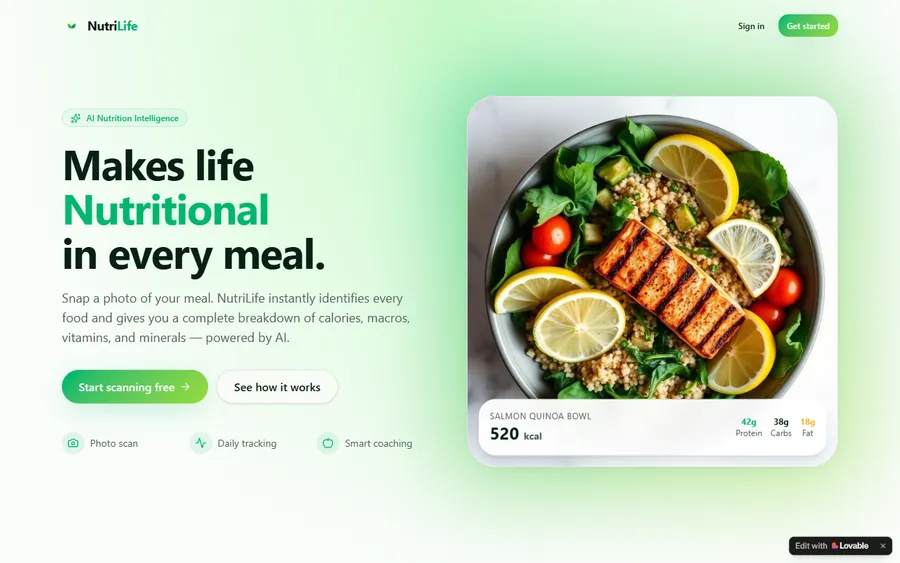
A nutrition assistant that reads what has been eaten and coaches the user towards a target, taken from idea to public link.
AI and ML
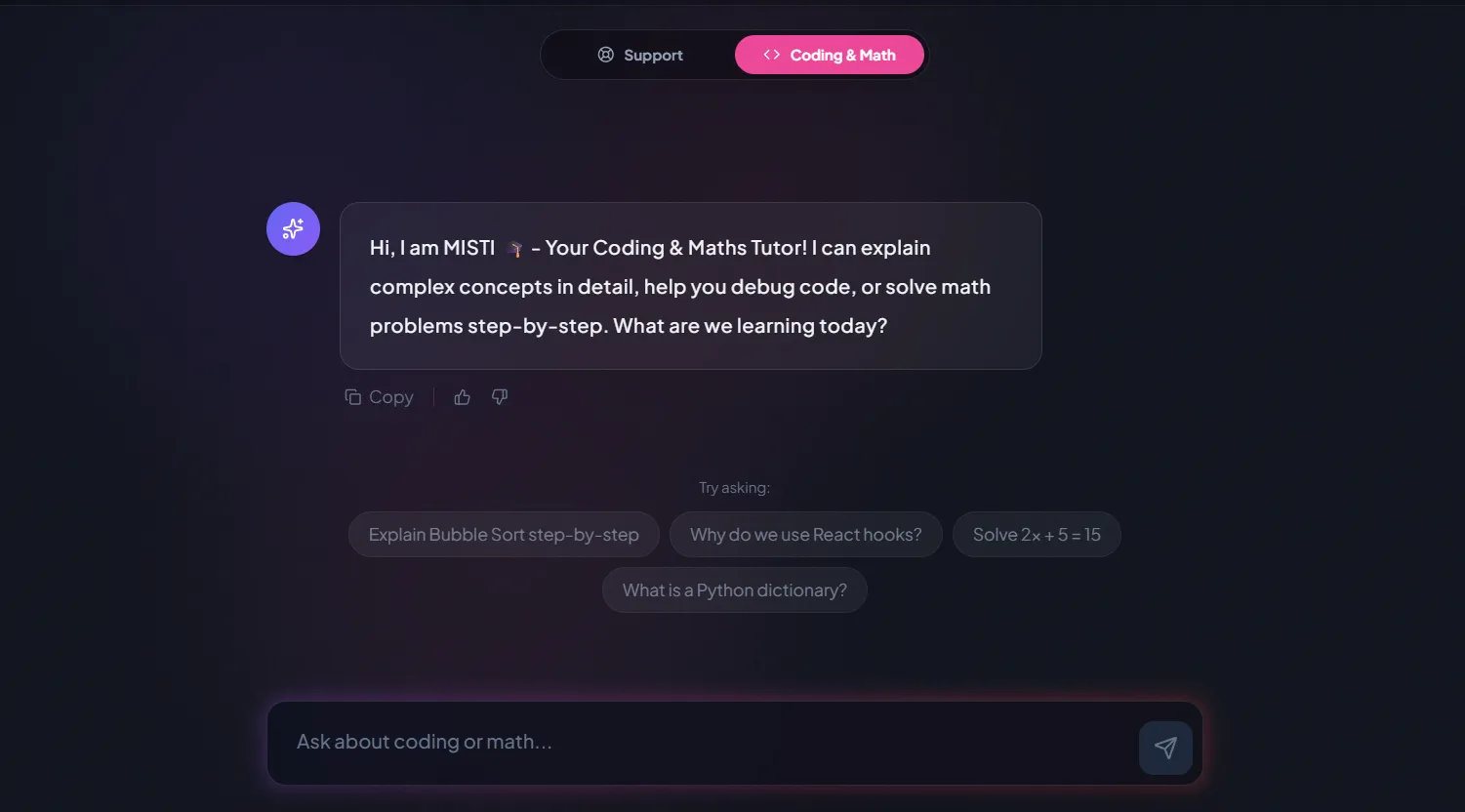
A tutoring chatbot answering maths and programming questions, deployed on its own domain.
AI and ML
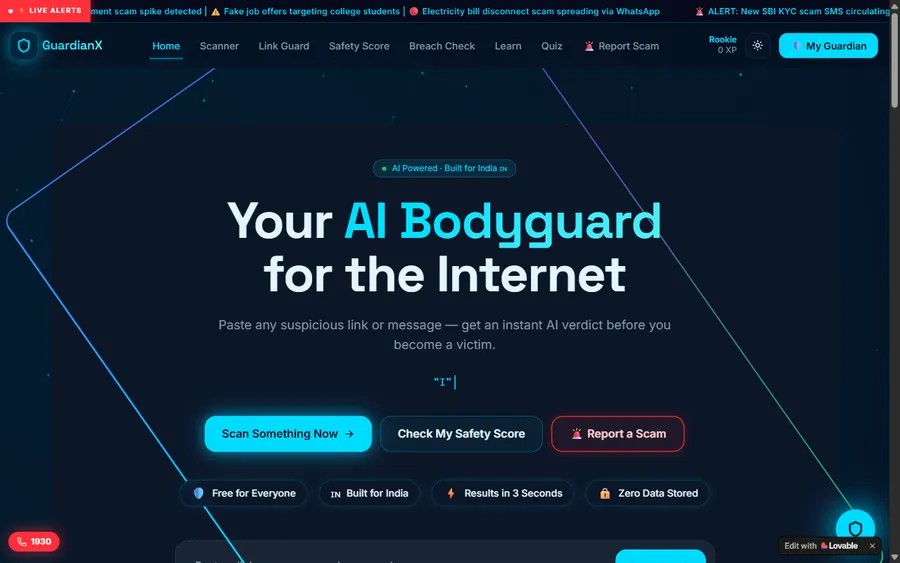
An assistant that helps a young person recognise an unsafe situation online, shipped end to end by a student.
Data and forecasting
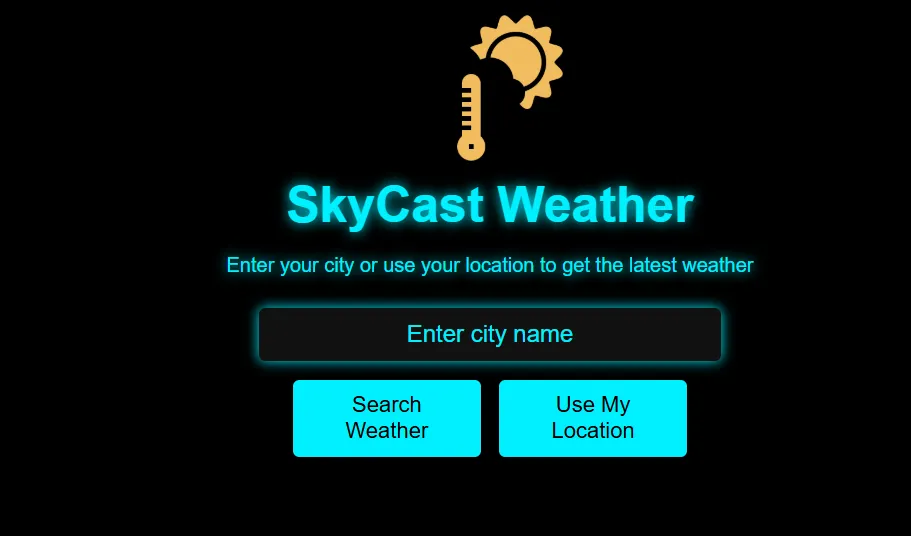
A weather application on live data feeds, the nearest relative of the glacier work above.
Fees
Fees are monthly, with no joining fee and no annual contract. Pricing is flat: USD 100 a month for a group batch and USD 150 a month for one to one, billed in US dollars everywhere outside India.
Free first class
USD 0
No card needed
Group batch
USD 100
a month, billed in US dollars
One to one
USD 150
a month, billed in US dollars
One point deserves saying directly, because it is how this page is most often misread here. One hundred US dollars is small in one of the most expensive tutoring markets in the world, and a small number usually signals a thin course. It does not here. Judge the syllabus, the glacier project and the student work, and let the price be the last thing you look at.
What families say
Left by families who pay us. We do not draft testimonials and we do not commission them.
★★★★★
"The one step solution for my son. Modern Age Coders make learning coding so simple that kids love it. The teachers explain complex concepts clearly with practical exercises and interactive content."
Ria Mukherjee
Parent
★★★★★
"Modern Age Coders has been a game-changer for me. I struggled to grasp IT concepts and coding before joining, but their classes transformed everything. I can now confidently write complex programs with ease."
Samriddha Mondal
Student
★★★★★
"One of the most wonderful education centres out there. Education is not limited to school syllabus but focuses on skill development. Learning here has been a wonderful journey and still continuing."
Vansh Agarwal
Student
★★★★★
"My child Dhairya is really enjoying the Modern Age Coders classes. This is his first online class and he eagerly looks forward to it. I can already see his improvement, and the teachers are very cooperative."
Sonam Oswal
Parent of Dhairya
★★★★★
"Modern Age Coders have wonderful teachers who teach in a clear, easy and practical way. The teacher boosts students' confidence and inspires them to learn without hesitation."
Sonu Goyal
Parent
★★★★★
"I highly recommend this computer coding class! The teachers are incredibly knowledgeable and passionate about coding. They make every session engaging and insightful."
Ritu Kedia
Parent
Questions from Switzerland
We teach in English, and it does not replace the language requirement at a Swiss federal institute. ETH Zurich teaches its Bachelor programmes in German and needs a German C1 certificate by the 31 March application deadline. EPFL teaches in French, requires level B2 and recommends C1. Machine learning itself is documented in English, so that is the vocabulary we hand a student.
Three slots, all Swiss local time: Tuesday and Thursday 17:00 to 18:30, Wednesday 18:30 to 20:00, Saturday 09:30 to 11:30. Our teachers are in India, on UTC plus 5 hours 30 minutes all year with no clock change, so India is 3 hours 30 minutes ahead of Switzerland now and 4 hours 30 minutes ahead from 25 October 2026 to 28 March 2027.
Switzerland has 26 cantonal school systems, each publishing its own holidays, so there is no national school calendar and we do not pretend there is. We build around your canton. Zürich and Genève both open the 2026/27 year on Monday 17 August 2026, but their autumn breaks do not overlap: Zürich Mittelschulen take 5 to 17 October 2026, Genève 19 to 23 October 2026.
It sits beside school Informatik rather than repeating it. The EDK adopted a framework curriculum on 27 October 2017, the revised MAR and MAV came into force on 1 August 2018, and Informatik became compulsory inside the mathematics, informatics and natural sciences area at the latest from school year 2022/23. Training a model adds what a syllabus rarely reaches: a real dataset, a leaking column, and an error somebody else can check.
Not directly, and we will not claim otherwise. For a non-Swiss certificate ETH Zurich decides the admission category only after a complete eApply application, and any entrance examination is written in German, next on 18 to 28 January 2027, at CHF 550.00 reduced or CHF 800.00 comprehensive. EPFL needs French at B2 and admits IB Diploma holders from 38 points out of 42 with mathematics and physics at higher level at 6 out of 7. Neither gate is opened by coding.
Per month, not per class. A group batch of fifteen to twenty students is USD 100 a month, and one to one teaching is USD 150 a month. Pricing is flat and billed in US dollars everywhere outside India. The first class is free.
Because Switzerland is one of the few countries where a student sees the difference first hand. ETH Zurich, EPFL and the Swiss National Supercomputing Centre released Apertus, a fully open multilingual language model, on 2 September 2025, and Apertus 1.5 followed on 24 July 2026 under the Apache 2.0 licence. A learner here can download real national model weights and fine tune them.
The work is here, and most of it is not inside the technology industry. ICT-Berufsbildung Schweiz counted 266,000 people in ICT roles in Switzerland in 2024 and projects a shortfall of 54,400 specialists by 2033. Two thirds work outside the core ICT industry, and 81 per cent came through vocational education rather than a Gymnasium. Named employers include Google Zurich, IBM Research Europe at Rüschlikon, CSCS in Lugano, Swisscom and Klepsydra AI in Volketswil.
Start here
Leave a number and a mentor rings you back at an hour that works in Swiss time rather than one that suits us. The first class is a real class with a real teacher, and it doubles as a placement check so your child begins at their own level.
Prefer to look around first? Read how we teach, browse the full course catalogue, or see what students have built in Student Labs.