Skip to content
Math tutor, Oakville, Ontario

An Oakville math tutor, live online

How can an Oakville student get live math tutoring?

Oakville students from Grade 1 to Grade 12 take live online math with Modern Age Coders, in a class of 15 to 20 working at one level or one to one with a teacher. Older students mostly join Ontario Grade 12 University Math (MHF4U and MCV4U) or Waterloo Math Contests: Gauss to Euclid; younger ones join a maths course matched to their age. The first lesson is free.

Much of the math an Oakville student meets after Grade 8 asks the same question in different clothes: when one quantity changes, what happens to another? Unit rates in Grade 7, linear relations in MTH1W, functions in Grade 11 and correlation in MDM4U are all versions of it. This page lines those courses up so a family can see where their student is on the path, with a link to our detailed page for each. Then it works through a real example from the Town of Oakville’s own open data: the energy used by Town facilities in 2017, where bigger buildings use more electricity, as expected, until eight strange rows make the relationship look weaker than it is.

Facts last verified 22 October 2026. Teaching is online; no Oakville branch is claimed.

Math course picks for Oakville

Four ways into math with us for Oakville students

A starting course for each stage. In the free lesson the teacher checks the fit before you decide anything.
Browse the course atlas for more than one hundred options and use the coding roadmap to check prerequisites.

The four we are known for

Python, AI, vibe coding and agentic coding

These run underneath everything above. Every one is live and online, placed by ability rather than by age, and the first class is free.

Ontario math in Oakville

One question, many courses: how Ontario math studies two changing quantities

Oakville public schools teach the Ontario curriculum. Each row below names a stage, what the curriculum asks for in our summary, and the page where we teach that stage in depth.

Grades 1 to 6Patterns, measurement and early data; EQAO tests Grades 3 and 6 in a window it lists as 4 May to 8 June 2027.
See our Grade 3 and Grade 6 practice pages, and Grade 6 math and coding.
Grades 7 and 8Unit rates and proportional relationships: so many of this for each one of that.
Our Gauss page uses many rate problems at this level.
MTH1WLinear relations and coding that decomposes situations into computational steps; EQAO Grade 9 math from 12 January to 5 February 2027.
MCR3U / MCF3MFunctions: one input, one output, and the graph that shows the rule.
See MCR3U or compare MCF3M and MCR3U.
MDM4UTwo-variable data: scatter plots, correlation and regression, alongside counting and probability.
Our MDM4U page goes further; the energy lesson below is a sample.
MHF4U / MCV4URates of change of non-linear functions, then derivatives; MHF4U comes before or with MCV4U.
See MHF4U and MCV4U.

The MTH1W row deserves a closer look, because it explains why the lesson below uses code. The ministry’s coding expectation C2.2 asks Grade 9 students to create code by decomposing situations into computational steps in order to represent mathematical concepts and relationships. In practice, that means writing the steps of a calculation clearly enough that a computer can follow them, which is also the clearest way for a student to show a teacher that they understand the steps.

MDM4U is usually the last place an Oakville student meets the full picture: two variables, a scatter plot, a correlation coefficient and a line. It is also where the most important caution in statistics is taught, that a summary number is only as trustworthy as the rows behind it.

We support the school course

We teach next to the school course and we do not grant Ontario credits; the credit and the mark are the school’s. We are not connected with the Ontario Ministry of Education, EQAO or any Oakville school board.

Oakville data lesson

Bigger buildings, more electricity: correlation in Oakville’s 2017 facility energy file

The Town of Oakville publishes the energy used by its own facilities. We took the 2017 file and asked an MDM4U question: how strongly does floor area predict electricity use? Every statistic below is our calculation.

The Town describes the file as energy consumption data for town-owned infrastructure to meet the Green Energy Act 2009 (O. Reg. 397/11) annual reporting requirements. Each row is a facility, with its type, floor area in square feet, average hours open per week, electricity in kWh, natural gas in cubic metres and an energy intensity in equivalent kWh per square foot. Our download had 55 rows, of which 54 list both a floor area and an electricity figure.

Our statistics on the Town of Oakville Energy Consumption at Town Facilities (aggregate) 2017 layer, downloaded 22 October 2026
MeasureAll 54 usable rowsWithout the eight 1 sq ft rows (46)
Correlation, floor area against electricityr = 0.721r = 0.894
Least-squares slope16.01 kWh per sq ft17.32 kWh per sq ft
Median energy intensity41.5 ekWh per sq ft32.72 ekWh per sq ft
Largest energy intensity5,190,942.75 ekWh per sq ft98.17 ekWh per sq ft

Eight rows, all of type Other, give a floor area of exactly 1 square foot. No Town building is one square foot, so the 1 is a placeholder, and the file does not say what those rows measure. Left in, those rows sit at the far left of the scatter plot with large electricity values, pulling the correlation down to 0.721 and producing an energy intensity in the millions. Taken out, with the reason stated, the relationship is plainly strong. The program below computes both versions:import json, math def pearson(xs, ys): n = len(xs) mx, my = sum(xs) / n, sum(ys) / n sxy = sum((x - mx) * (y - my) for x, y in zip(xs, ys)) sxx = sum((x - mx) ** 2 for x in xs) syy = sum((y - my) ** 2 for y in ys) return sxy / math.sqrt(sxx * syy), sxy / sxx rows = [f["attributes"] for f in json.load(open("energy-2017.json"))["features"]] usable = [r for r in rows if r["Total_Floor_Area"] and r["Electricity___Quantity"]] for label, keep in (("all usable rows", usable), ("floor area of 100 sq ft or more", [r for r in usable if r["Total_Floor_Area"] >= 100])): area = [r["Total_Floor_Area"] for r in keep] kwh = [r["Electricity___Quantity"] for r in keep] r, slope = pearson(area, kwh) print(label, "| n =", len(keep), "| r =", round(r, 3), "| kWh per sq ft =", round(slope, 2))

Say why a row goes

Removing data to improve r is cheating; removing data because it cannot be a floor area is cleaning. The difference is the stated reason, and a student should write it down before running the numbers again.

Strong is not causal

An r of 0.894 says bigger facilities tend to use more electricity. It does not say why: hours open, ice plants and pools all matter. Six of the rows are an indoor pool or ice rinks, which are energy-hungry for their size.

Hours tell a story too

The average-hours field has a median of 65 hours a week and a maximum of 168, which is every hour of the week. Fourteen rows say 1 hour, probably another placeholder, and a good report flags them.

Licence and attribution

Contains information licensed under the Open Government Licence - Town of Oakville. Data from the Town of Oakville open data portal (licence); every statistic here is ours. The Town of Oakville does not endorse this page or our classes.

A worked problem, ours

Find the hidden number: how the Town turns gas into equivalent kWh

The energy intensity column combines electricity and gas into one unit, but the file never says how. A Grade 9 or 10 student can recover the rule with one equation. The data are the Town’s; the problem and solution are ours.

One row of the 2017 file: a Town community centre, ObjectId 2
FieldValue
Floor area9,000 sq ft
Electricity24,380.63 kWh
Natural gas6,061.24 cubic metres
Energy intensity9.86646 ekWh per sq ft

Step 1, guess the model. For rows with no gas, we found the intensity is exactly electricity divided by floor area. So suppose that for every row, intensity = (electricity + f × gas) ÷ area, where f is an unknown number of equivalent kWh per cubic metre of gas.

Step 2, substitute. 9.86646 = (24,380.63 + 6,061.24f) ÷ 9,000. Multiply both sides by 9,000: 88,798.14 = 24,380.63 + 6,061.24f.

Step 3, solve. 6,061.24f = 88,798.14 − 24,380.63 = 64,417.51, so f = 64,417.51 ÷ 6,061.24 ≈ 10.628.

Step 4, test it on other rows. One row could be a coincidence. Our program applied the same calculation to all 40 rows with a gas figure, and every one gave 10.628 to three decimal places. A constant that survives forty tests is very likely the conversion factor the Town used. We still call it our inference, because the file does not state it.

Try it yourself. Using f = 10.628, compute the energy intensity of a facility with 20,000 sq ft, 300,000 kWh of electricity and 15,000 cubic metres of gas. Then explain in a sentence why intensity, not total energy, is the fairer way to compare a small library with a large arena.

Contests for Oakville students

The Beaver Computing Challenge and the Problem of the Week

Not every Waterloo resource is a heavy contest. Two from CEMC suit Oakville students who are curious rather than competitive, and one starts in a few weeks.

The 2026 Beaver Computing Challenge, as CEMC lists it (read 22 October 2026)
LevelWho may write itPaper
Grade 5/6Students in Grade 6 or below12 multiple-choice questions, total 60, in 45 minutes
Grade 7/8Grade 8 or below15 multiple-choice questions, total 90, in 45 minutes
Grade 9/10Grade 10 or below15 multiple-choice questions, total 90, in 45 minutes

CEMC runs the BCC from Monday 9 November to Friday 20 November 2026, in English only, with a school ordering deadline of Monday 26 October 2026. Despite the name, it needs no programming: CEMC says the problems only require familiarity with concepts covered in the mathematics curriculum across all Canadian provinces. They are logic and pattern puzzles, the same reasoning a student uses to spot the 1 sq ft rows above. Our Beaver Computing Challenge guide has original practice tasks.

Problem of the Week

CEMC e-mails problems to educators for students from Grades 3 to 12. New problems go out every Thursday and solutions follow a week later, so an Oakville student can ask a teacher to share them.

Free and open

CEMC’s resources, including ten years of past contests, need no registration or fee. Our guide to CEMC’s free resources explains what is where.

Contests run through schools

A student cannot enter a CEMC contest alone. Oakville families ask the school, or another local school if theirs is not taking part.

Not connected with CEMC

CEMC’s rule is that “all students must participate through their school”. We are not connected with CEMC or the University of Waterloo. Their problems and solutions are never copied here; the problems we teach with are ours.

Math tutor price in Oakville

Thinking about a math tutor price in Oakville as a monthly budget

The fees section of this page shows what we charge, in your own currency. This section explains how to compare it with other math help in Oakville.

Families often compare an hourly rate from a home tutor with a monthly fee from an online school, which is like comparing energy totals instead of energy intensity: the units do not match. Convert everything to the same unit first, live teaching per month, then compare.

Live online class

Our class puts 15 to 20 students at one level with one teacher, eight live lessons a month, for a monthly fee. It suits a student who is broadly on track and wants regular, structured practice.

One-to-one online

A teacher for one student at times you choose, for a higher monthly fee. Worth it for a specific gap, an ambitious goal or exam weeks.

Home tutor

In-home tutoring is normally billed per visit or per hour, and the visit includes the tutor’s drive. It makes sense when a student settles better with an adult sitting beside them.

After that, look inside the hours. A lesson tied to the student’s actual Ontario course, homework that someone reads, and a teacher who makes the student talk through each step are worth more than a lower rate without them.

Learning ladder

From counting to correlation and calculus

Bands are rough. The real starting point is found in the free lesson, from what the student can do and explain.

Grades 1 to 3

Number sense

Counting, place value and the meaning of each operation, said out loud.

Early Math FoundationsElementary Maths for Grades 1-5
Grades 4 to 8

Rates and patterns

Fractions, unit rates and patterns, explored with small programs.

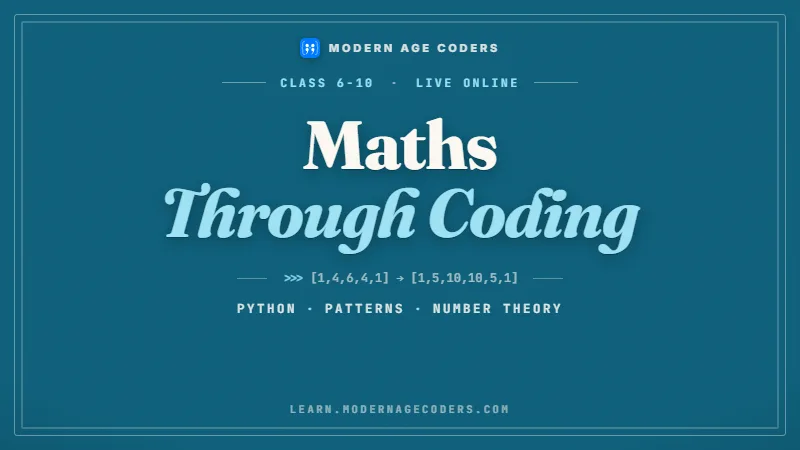
Middle School Mathematics MasteryMaths Through Coding
Grades 9 and 10

Linear relations

MTH1W and Grade 10 algebra and analytic geometry.

High School MathematicsWaterloo Math Contests
Grades 11 and 12

Functions, data, calculus

MCR3U, MDM4U, MHF4U and MCV4U, beside the school course.

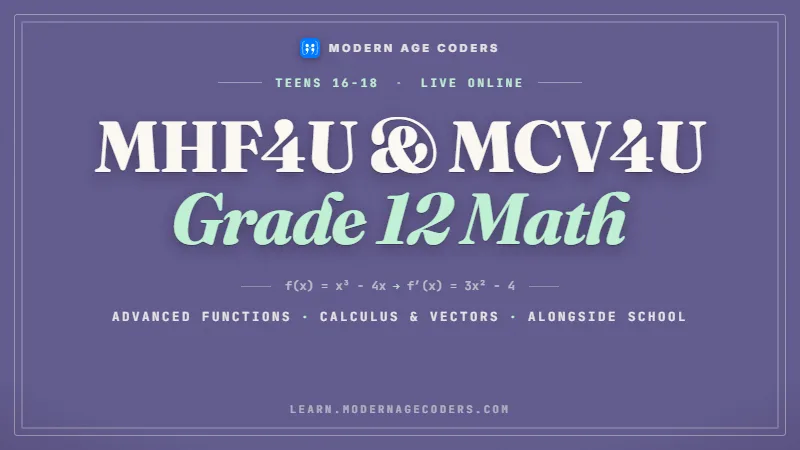
Statistics & ProbabilityOntario Grade 12 University Math
Math and AI

If AI can compute r, what is left for an Oakville student to learn?

Deciding whether r means anything. That part has not been automated.

A spreadsheet or AI assistant will report r = 0.721 for the energy file in an instant. It will not stop to ask why eight buildings are one square foot, or whether an intensity of five million makes physical sense. The student who asks those questions is doing statistics; the one who copies the number is not.

In our lessons the student plots first, predicts the shape, then computes and compares, and always explain the result in words. School work that will be marked is written by the student.

MDM4U is a course in judging evidence. Tools make the arithmetic faster; they do not make the judgement for you. The longer argument is in why the thinking behind the numbers still matters.

Delivery

Live online math lessons across Oakville

Bronte, Glen Abbey or Old Oakville: the lesson comes to the student at home, so nobody drives along Trafalgar Road at rush hour.

When classes run

Weekdays or weekends, flexible: choose your batch, or for a very personalised plan choose 1-on-1 at your convenience, weekend mornings or weekdays.

Eastern time, both changes

An Oakville evening class shifts relative to India when Ontario changes clocks, on 1 November 2026 (to UTC-5) and 14 March 2027 (to UTC-4). We send every time in Eastern time, with a reminder before each switch.

Scatter plots on screen

Students plot and annotate data on a shared board, so the teacher sees which points they trust and which they question.

Following the course code

Lessons track the Ontario course on the student’s timetable, whether MTH1W, MCR3U, MDM4U or MCV4U.

Oakville numbers

Phone numbers beginning 905, 289, 365 or 742 work in the form; enter the ten digits and we supply the country code.

One lesson free

The first lesson is a real lesson at the student’s level and ends with a recommended course. We take no card details.

No Oakville centre

Modern Age Coders has no tutoring centre in Oakville and claims none. Lessons are live and online, taught from India, and a student needs a computer with a microphone and a reliable connection.

Fees

Math tutoring fees for Oakville

Shown in the currency for where you live.

First classFree

A complete live lesson for free, finishing with the course and level we recommend.

Group tuition$140 CAD

The monthly fee for a live class of 15 to 20 students working at one level.

Private tuition$210 CAD

The monthly fee for a teacher and one student, at hours you choose.

The fee is the same across Canada, Oakville included. Nothing is charged before the free lesson, and billing starts only once you have chosen a course and a time.

Reviews

Reviews of Modern Age Coders on Google

Rated 4.9 across 547 Google reviews. These are real reviews, reproduced as written.

★★★★★

"The one step solution for my son. Modern Age Coders make learning coding so simple that kids love it. The teachers explain complex concepts clearly with practical exercises and interactive content."

Ria Mukherjee

Parent

★★★★★

"Modern Age Coders has been a game-changer for me. I struggled to grasp IT concepts and coding before joining, but their classes transformed everything. I can now confidently write complex programs with ease."

Samriddha Mondal

Student

★★★★★

"One of the most wonderful education centres out there. Education is not limited to school syllabus but focuses on skill development."

Vansh Agarwal

Student

★★★★★

"My child Dhairya is really enjoying the Modern Age Coders classes. This is his first online class and he eagerly looks forward to it. I can already see his improvement, and the teachers are very cooperative."

Sonam Oswal

Parent of Dhairya

★★★★★

"Modern Age Coders have wonderful teachers who teach in a clear, easy and practical way. The teacher boosts students' confidence and inspires them to learn without hesitation."

Sonu Goyal

Parent

★★★★★

"I highly recommend this computer coding class! The teachers are incredibly knowledgeable and passionate about coding."

Ritu Kedia

Parent

Free placement class

Book a free math lesson in Oakville

Share your student’s grade, plus the course code in high school. A Grade 1 child might start with a counting game; a Grade 12 MDM4U student might start with the energy file.

+1

FAQ

Oakville math tutoring questions

Short answers to what Oakville families ask us most.

Is there a math tutor in Oakville I can book with you?

Yes, online. We have no Oakville building; students learn live from home with a teacher, in a class of 15 to 20 at one level or one to one.

What is the price of a math tutor in Oakville with you?

Our fees section shows the free first lesson, the monthly class fee and the monthly one-to-one fee, all in your own currency. This answer includes no figures by design.

Should we choose an online class or a home tutor?

It depends on the student. A home tutor usually bills by the hour and travels to you. Our live class gives 15 to 20 students at one level a teacher for a monthly fee, and our one-to-one online lessons give one student a teacher alone.

Do you help with MDM4U data management?

Yes. We teach correlation, regression, probability and counting from real data, as in the energy lesson on this page, alongside the school course.

Can my child earn an Ontario credit with you?

No. Credits are granted by schools, not by us. Our lessons support the school course the student is taking.

Is the Beaver Computing Challenge only for coders?

No. CEMC says it only needs concepts from the math curriculum. It runs from 9 to 20 November 2026 and is entered through a school.

Do you prepare students for the Waterloo math contests?

Yes, from Gauss in Grades 7 and 8 to Euclid in Grade 12, using original problems and CEMC's free past papers.

What times are classes for Oakville students?

Weekdays or weekends, flexible: choose your batch, or for a very personalised plan choose 1-on-1 at your convenience, weekend mornings or weekdays. We state each time in Eastern time.

From what age do you teach math?

From about age 6, with short, friendly lessons on number sense and explaining answers.

My teen is fine with formulas but struggles with word problems. Can you help?

Yes. Word problems are about choosing the model, as in the gas-factor problem above, and we practise setting up equations before solving them.

More for Oakville and Canada

Related math pages for Oakville families

Our national page is online math tutoring in Canada. Related course pages are MDM4U, MHF4U, MCV4U and MTH1W. For the province, read our Ontario page.

Free classPriority demoCall us

Keep exploring Modern Age Coders

More maths tuition

Learn more

From the blog

Start here