UK / PY1 / 01
Python for younger learners
The move from blocks to a keyboard, with short programs whose results can be seen immediately.
Open the syllabusUnited Kingdom · Python · Primary school to adult
Here is something most UK parents never discover. One of the exam boards has published a document that states exactly which parts of Python 3 its practical paper will draw on. It runs to eighteen pages, it names the library modules it will use, and the board commits in writing not to go beyond it. That changes what a Python class for a British learner should look like: there is a known floor, it is public, and the interesting work begins above it rather than inside it. This page sets out what is in that subset, which UK qualifications actually require Python and which merely allow it, and how we teach so that a learner is fluent well past the edges of any published list.
Live teaching since 2020 · 10,000+ students · Python from age 10 to adult
In short
Python became the default language of British school computing without anybody legislating for it. Wales names it in the rules of its new GCSE. Northern Ireland permits it alongside Java and C#. In England the boards choose, and one of them, Pearson Edexcel, adopted Python as what it calls the vehicle for the whole qualification and then published a Programming Language Subset stating which parts of Python 3 its on-screen paper will use, with a written commitment not to exceed it. Knowing that list exists is useful. Building a year of teaching around only that list is not, because the subset is a floor and every interesting problem sits above it. We teach Python live online to learners from about ten upwards, in groups of five to ten at one level or one to one. The first lesson is free; after that it is USD 100 a month in a group or USD 150 one to one.
Start here
The same language at three different starting points. Each card opens a full syllabus.
PY / 01
The first crossing from blocks to a keyboard, usually somewhere between Year 5 and Year 8, taken slowly enough that nothing is guessed at.
Open the syllabus →
PY / 02
The whole language for secondary students, well past whatever subset an exam board has published.
Open the syllabus →
PY / 03
A complete route for an adult who has never programmed and wants to end up somewhere genuinely useful.
Open the syllabus →The examined subset
Pearson Edexcel publishes a Programming Language Subset for its on-screen paper. Everything quoted here comes from version 6 of that booklet and from the specification itself.
The board states its purpose plainly. The subset "specifies which parts of Python 3 are required in order that the assessments can be undertaken with confidence", and "students familiar with everything in this document will be able to access all parts of the Paper 2 assessment". Then it makes a promise that is rarer than it should be: "Pearson will not go beyond the scope of the PLS when setting assessment tasks."
It also refuses to turn the list into a cage. Going further is explicitly allowed, and "any student successfully using more esoteric or complex constructs or approaches not included in this document will still be awarded marks in Paper 2 if the solution is valid".
The paper it governs is unusual in England. Candidates sit it on screen, using "their Integrated Development Environment (IDE) of choice", with coding files supplied, a printed question paper, the subset booklet as an insert, and six compulsory questions. They answer "onscreen using Python 3", and they "must not have access to the internet".
So the assessment is a person and an IDE and nothing else, which is a fair description of what programming actually is.
| Area | What is listed |
|---|---|
| The basics | Comments, identifiers, primitive data types and conversion, constants, and combining declaration with initialisation |
| Data | Structured data types and dimensions |
| Operators | Arithmetic and the rest, set out explicitly |
| Library modules | Random, math, time, and turtle graphics |
| Turtle in detail | Window and canvas, creation and movement, positioning and direction, filling shapes, pen control, circles and colours |
undefined
Sources, read 20 September 2026: Pearson Edexcel GCSE (9-1) Computer Science (1CP2), the specification and the 1CP2/02 Programming Language Subset booklet, version 6.
Who mandates Python
Four school systems, four different answers, and a language that won without a decision ever being taken nationally.
| Nation | What the rules say | What that means for a learner |
|---|---|---|
| Wales | The new Made-for-Wales GCSE names Python in its own rules for the programming examination | No choice, and no ambiguity. See coding and AI classes in Wales |
| Northern Ireland | CCEA permits one of three languages in the practical unit | The school picks. See coding and AI classes in Northern Ireland |
| England | The boards decide; Pearson Edexcel adopted Python "as the vehicle" for its whole qualification | Ask which board, then which language. See coding and AI classes in England |
| Scotland | Qualifications are written around concepts rather than a named language | In practice most schools teach Python. See coding and AI classes in Scotland |
Pearson's reasoning is worth quoting because it is refreshingly unromantic: "Python is popular and commonly used in education." Not fastest, not most rigorous, not most employable. Popular, and already in the building.
The board is equally clear that the language is not the subject. "Mastering programming involves much more than simply learning the syntax and semantics of a programming language", it says, before listing problem solving, treating mistakes as material to learn from, and working with others.
There is one more requirement in that specification that most families never hear about, and it exists because practical programming is easy to quietly drop. Centres must complete a Practical Programming Statement confirming they have taken reasonable steps to ensure each candidate "has had the opportunity to demonstrate their programming skills in terms of design, write, test and refine programs in Python during their course of study".
It has to be signed by a member of the senior leadership team, and failing to send one in on time counts as "potential malpractice and/or maladministration". A board does not build a mechanism like that unless it has reason to.
undefined
Past the edges
A published subset is a floor to clear, not a syllabus to sit inside.
| In the exam subsets | What we also teach | Why it matters |
|---|---|---|
| Lists and simple structures | Dictionaries used properly, nesting, and choosing the structure before writing the loop | Most real problems are lookups, and a student who only knows lists solves them badly |
| Reading and writing text files | Structured formats, error handling and what happens when the file is missing | Programs that only work on a perfect day are not programs |
| Functions and parameters | Modules, imports and writing code that another person can reuse | This is the difference between a script and something worth keeping |
| Turtle graphics | Real libraries for data and charts, and the judgement to say what a chart does not show | Visible output is a good teaching device and a poor final destination |
| Test your solution | Writing tests before the code, and deliberately breaking your own work | The habit that separates a student who checks from one who hopes |
None of this is at the expense of the exam. A learner who can use a dictionary sensibly will use a list correctly, and a learner who writes tests will not lose marks for an untested edge case. Teaching upwards covers the paper on the way past.
The method is the same at every level. A student says what the code will do before running it, runs it, and compares. Being wrong out loud in a small group, week after week, is what produces someone who checks by reflex rather than by instruction.
For younger learners the entry point is different but the destination is not. A ten-year-old moving from blocks to typed Python needs patience and short programs with visible results, which is exactly what the Python course for younger learners is built around.
For adults, the useful first target is usually automating something tedious from their own work rather than a toy exercise. The adults page covers how that works alongside a job.
undefined
Progression
The step a learner starts on is decided by what they can already write unaided, not by their age or school year.
| Step | What is being learnt | What the learner can show |
|---|---|---|
| 1. First programs | Input, output, variables and the idea that order matters | A short program written from an empty file, and an error message read rather than feared |
| 2. Decisions and repetition | Conditions, loops, and when each is the right tool | A program that behaves differently on different input, and a prediction made before running it |
| 3. Structure | Functions, lists, dictionaries and files | Something long enough to need planning, split into parts that each do one job |
| 4. Real libraries | Working with data, charts and external code | A published dataset loaded, questioned and charted, with the limits of the chart stated |
| 5. Judgement | Testing, refactoring and reviewing code including code from an AI tool | A review of somebody else's program with reasons, and their own work deliberately broken and fixed |
Most UK qualifications assess somewhere between steps two and three, which is why a learner working at step four finds the paper straightforward rather than stressful.
The full topic order past school is on the coding roadmap.
A student who arrives already writing functions starts at step three. Placement follows the work, and the free lesson is where it is decided.
Moving up happens when the evidence in a learner's code says so, not on a fixed schedule.
The catalogue
Grouped by where a learner is when they begin. Every syllabus sits behind its card.
UK / PY1 / 01
The move from blocks to a keyboard, with short programs whose results can be seen immediately.
Open the syllabusUK / PY1 / 02
The whole language for secondary students, taught by predicting before running.
Open the syllabusUK / PY1 / 03
A complete beginner route written for people with jobs and limited evenings.
Open the syllabusUK / PY2 / 01
Published datasets cleaned, charted and argued with, base lines included.
Open the syllabusUK / PY2 / 02
A working site with data behind it, deployed where other people can use it.
Open the syllabusUK / PY2 / 03
The repetitive parts of a real week turned into something that runs on its own.
Open the syllabusUK / PY3 / 01
Theory and programming taught to whichever board a school has actually chosen.
Open the syllabusUK / PY3 / 02
The problems more typing will not solve, worked on paper before any code appears.
Open the syllabusUK / PY3 / 03
For learners who want an independent credential in the language alongside school or work.
Open the syllabusHow lessons work
Teachers work from India, where the clocks do not move, so the UK is five and a half hours behind in winter and four and a half in summer. Families pick a slot and keep it.
After school
The usual choice for school-age learners.
Evening
For sixth formers and for adults once the day is over.
Weekend morning
The right slot for a long build that should not be interrupted.
Nothing is executed until the learner has said what they expect. It is the fastest way to find out what they actually believe.
Every week, with reasons. A recorded course cannot tell a learner why their working program is badly built.
Teachers work to the qualification a school has chosen, whether that is an English board, WJEC, CCEA or SQA.
Permitted once a learner can predict the answer, and logged: what the tool offered, what was kept, and why.
Five to ten learners at the same stage, reading each other's code and disagreeing about it.
Projects go to the learner's own repository, which is what a school, university or employer can actually open.
Student work
Four examples built in lessons. More are on the student labs page.
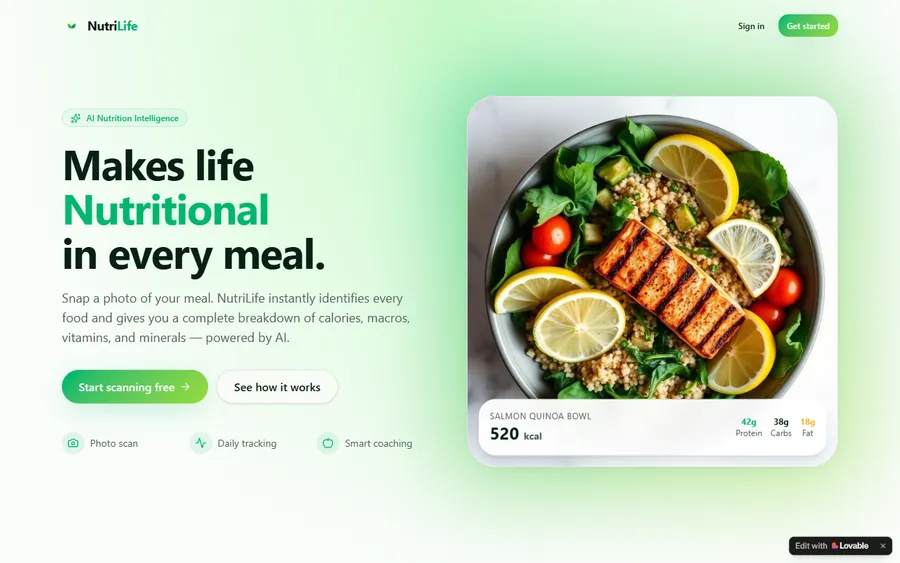
AI and ML
An AI nutrition coach that reads what you eat and works you toward a target.
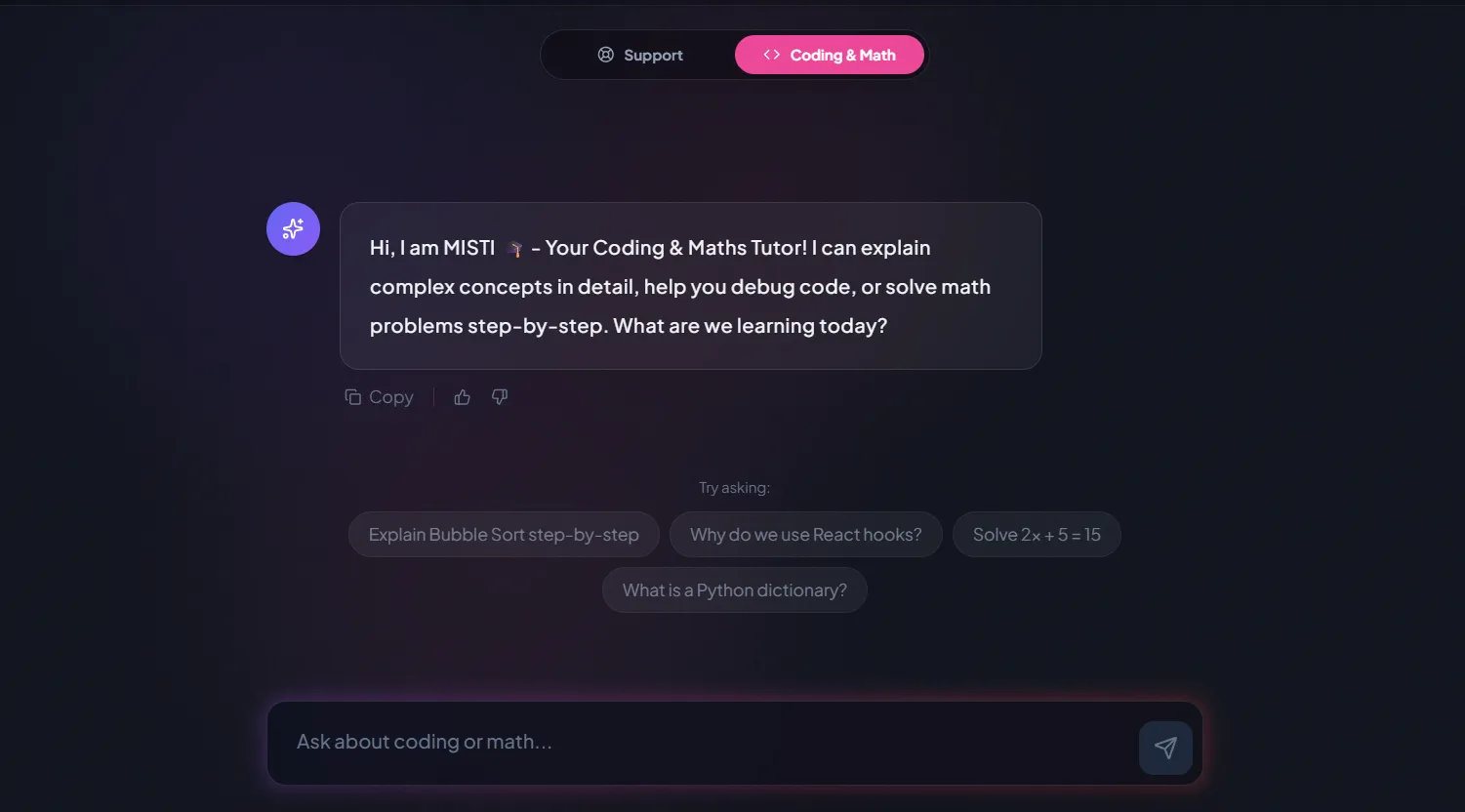
AI and ML
A chatbot that answers mathematics and programming questions, built and deployed by a student.
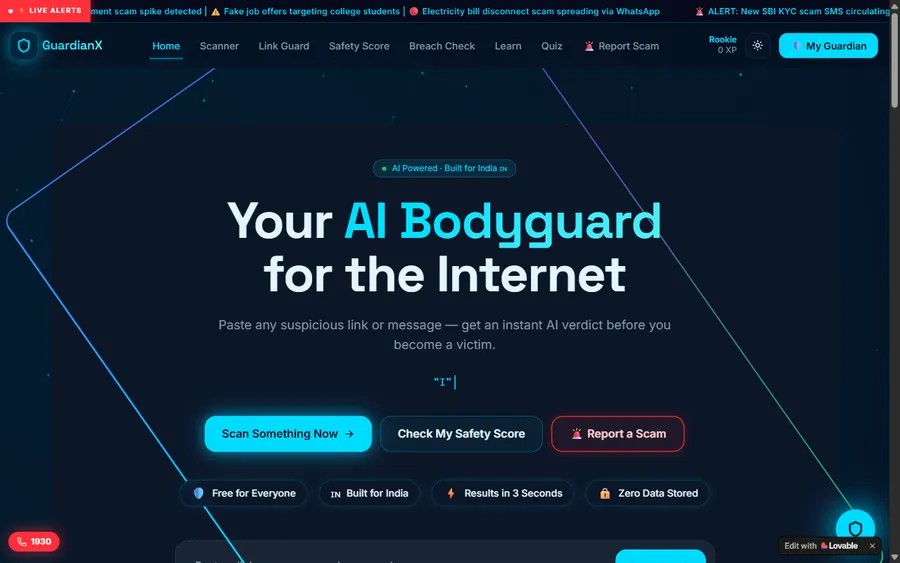
AI and ML
An assistant that helps a young person recognise unsafe situations online.
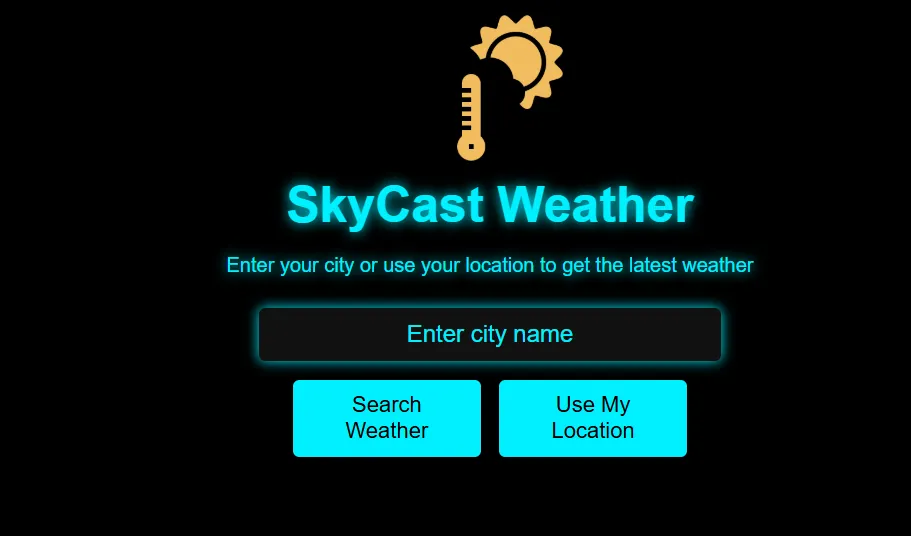
Web app
A weather forecasting site with live conditions for any location.
Fees
One monthly charge, quoted in US dollars for every family outside India. The free lesson comes first and nothing is taken until a course and a slot are agreed.
Free first class
USD 0
no card required
Group batch
USD 100
a month, billed in US dollars
One to one
USD 150
a month, billed in US dollars
What families say
Lifted from Google word for word. No review here was paid for or requested.
★★★★★
"The one step solution for my son. Modern Age Coders make learning coding so simple that kids love it. The teachers explain complex concepts clearly with practical exercises and interactive content."
Ria Mukherjee
Parent
★★★★★
"Modern Age Coders has been a game-changer for me. I struggled to grasp IT concepts and coding before joining, but their classes transformed everything. I can now confidently write complex programs with ease."
Samriddha Mondal
Student
★★★★★
"One of the most wonderful education centres out there. Education is not limited to school syllabus but focuses on skill development."
Vansh Agarwal
Student
★★★★★
"My child Dhairya is really enjoying the Modern Age Coders classes. This is his first online class and he eagerly looks forward to it. I can already see his improvement, and the teachers are very cooperative."
Sonam Oswal
Parent of Dhairya
★★★★★
"Modern Age Coders have wonderful teachers who teach in a clear, easy and practical way. The teacher boosts students' confidence and inspires them to learn without hesitation."
Sonu Goyal
Parent
★★★★★
"I highly recommend this computer coding class! The teachers are incredibly knowledgeable and passionate about coding."
Ritu Kedia
Parent
Questions about Python in the UK
It depends on the board and the nation. Pearson Edexcel adopted Python as the vehicle for its qualification and examines Paper 2 on screen in Python 3. Wales names Python in the rules of its new GCSE. CCEA in Northern Ireland permits one of three languages. Scottish qualifications are written around concepts rather than a named language.
A booklet from Pearson Edexcel stating which parts of Python 3 its Paper 2 will use. Version 6 runs to eighteen pages, and the board commits not to go beyond it when setting assessment tasks.
Yes. Pearson states that a student using more complex constructs not in the document will still be awarded marks if the solution is valid.
Six compulsory questions answered on screen in the student's own IDE, with coding files supplied, a printed question paper, the subset booklet as an insert, and no access to the internet.
A declaration a centre must complete, signed by a member of its senior leadership team, confirming each candidate had the opportunity to design, write, test and refine programs in Python during the course. Not returning one on time counts as potential malpractice or maladministration.
No. The subset is a floor. Dictionaries, error handling, real libraries and testing all sit above it, and a learner who has them finds the paper straightforward rather than tight.
Around ten for most children, after a year or two of block-based coding. Some are ready earlier; the free lesson is where that is judged rather than guessed.
No. We teach Python. The constructs transfer between the three languages but the syntax practice does not, so we will say plainly in the free lesson if we are the wrong fit.
It is the usual language for both and it is enough to do well, though at that level the subject is algorithms and data structures rather than syntax, and we teach those on paper first.
The opening lesson is free. A group place afterwards runs at USD 100 each month, and a teacher to yourself at USD 150, charged month by month with nothing taken in advance.
Elsewhere on this site
Each takes one part of this further.
The national page, and the index of every UK page we publish.
The one UK nation that names Python in its own rules.
Where Python is one of three permitted languages and the school chooses.
What Ofcom found about British teenagers and AI this year.
Where the funded routes stop, and what is left.
What order topics come in, well past school.
Start here
Leave a number and we will come back at a UK time that suits. The lesson is real teaching on a real problem, and it ends with a straight view of the right starting step.
Happier reading than talking? Each course page carries its own syllabus, how we teach explains the method and its limits, and the sequence of topics runs down the coding roadmap.
WhatsApp us · +91 91233 66161 · contact@modernagecoders.com
Most people reach us fastest on WhatsApp, which costs a UK mobile nothing. The number is registered in India and we would rather say that up front than have you spot it later.