
Table of Contents
- Why Data Science Is Booming in India in 2026
- Data Science Salary Landscape in India: Freshers to Senior Leaders
- Essential Skills Every Data Scientist Needs in 2026
- The Role of Mathematics in Data Science
- Top Data Science Courses in India: A Comprehensive Comparison
- Python for Data Science: The Foundation You Cannot Skip
- Data Science Career Paths: Which Role Is Right for You?
- How to Build a Data Science Portfolio That Gets You Hired
- How to Choose the Right Data Science Course: A Decision Framework
- Industry Demand: Where Data Scientists Are Most Needed in India
- Common Mistakes to Avoid When Learning Data Science
- A Realistic Data Science Learning Roadmap for 2026
- Frequently Asked Questions About Data Science Courses in India
- Why Modern Age Coders for Your Data Science Journey
- Final Thoughts: Your Data Science Journey Starts Today
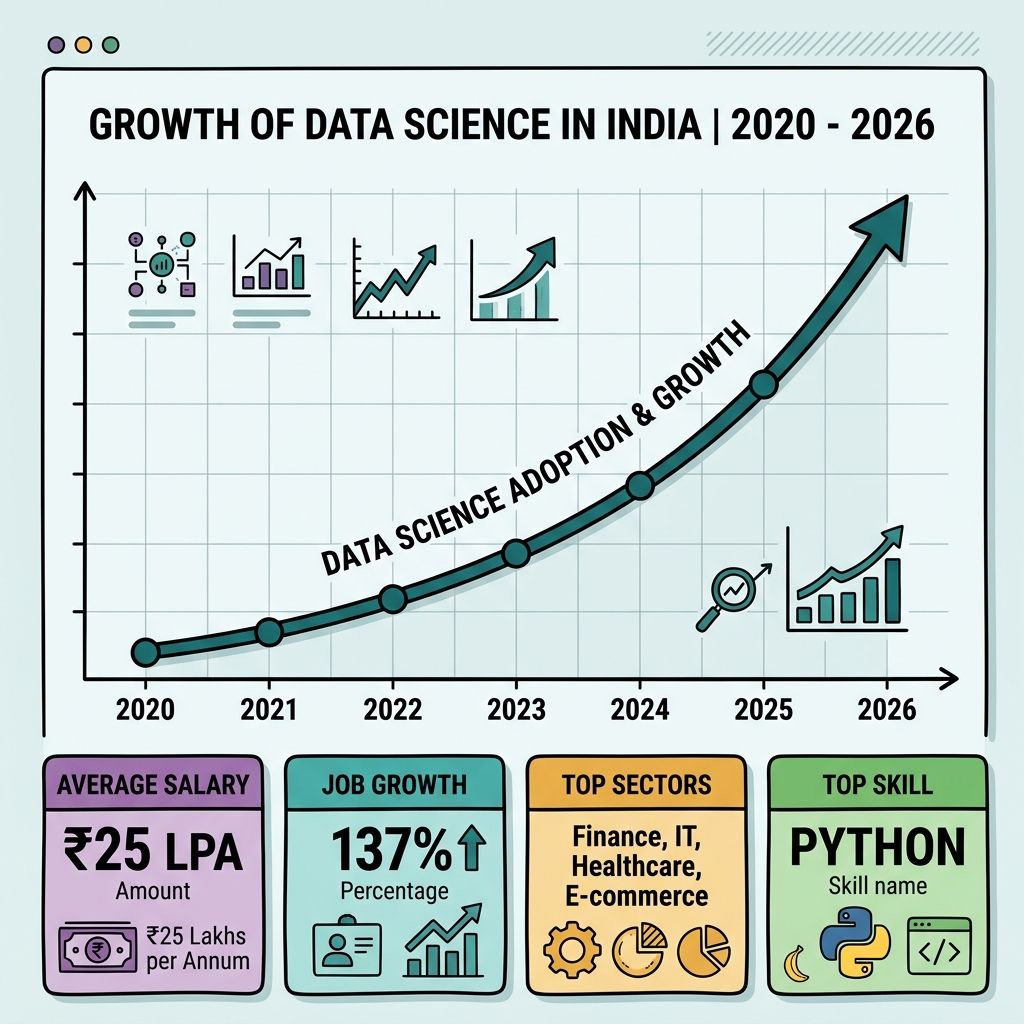
Data science has firmly established itself as one of the most sought-after career paths in India. With the explosion of digital data, the rise of artificial intelligence, and the rapid digital transformation across every sector of the Indian economy, the demand for skilled data scientists has reached unprecedented levels in 2026. According to NASSCOM, India needs over 300,000 data science professionals by 2028, and the current supply covers barely 50% of that demand.
But here's the challenge: with hundreds of data science courses flooding the Indian market, from IIT executive programs to weekend bootcamps to self-paced YouTube playlists, how do you decide which one is actually worth your time and money? The wrong choice could cost you lakhs and months of effort with little to show for it. The right choice could launch a career that pays ₹8-40 LPA within the first few years.
This comprehensive guide cuts through the noise. We'll examine every major category of data science education available in India, compare them head-to-head on factors that actually matter (placement support, project experience, cost, flexibility), and give you a clear roadmap based on your current situation, whether you're a final-year B.Tech student, a working IT professional looking to upskill, or someone making a complete career pivot from a non-tech background.
2026 India Data Science Snapshot
India is the second-largest market for data science talent globally. The average data scientist salary in India is ₹12.5 LPA (2026), up 22% from 2024. Bangalore, Hyderabad, and Pune lead in data science job openings. Over 70% of Indian IT companies now have dedicated data science teams. Entry-level data analyst roles start at ₹4.5-8 LPA, while senior data scientists command ₹25-50+ LPA at top companies.
Why Data Science Is Booming in India in 2026
The data science boom in India isn't hype. It's a structural shift driven by multiple converging forces. Understanding why this field is exploding helps you evaluate whether it's the right career move for you and what specific skills employers are actually paying for.
The Digital India Effect
India's digital economy has crossed the $500 billion mark in 2026. With over 900 million internet users, the country generates massive volumes of data every second, from UPI transactions (over 15 billion monthly) to e-commerce purchases, telehealth consultations, and EdTech interactions. Every one of these data points needs to be collected, cleaned, analyzed, and turned into business decisions. That's where data scientists come in.
AI and GenAI Are Accelerating Demand
The generative AI revolution hasn't replaced data scientists. It has made them more valuable. Companies across India are racing to build AI-powered products, and they need data scientists who understand how to prepare training data, fine-tune models, evaluate outputs, and deploy ML pipelines in production. The rise of tools like LangChain, vector databases, and RAG architectures has created entirely new roles that didn't exist two years ago, and data science skills are the foundation for all of them.
Government and Enterprise Investment
The Indian government's push for data-driven governance, from Aadhaar analytics to smart city initiatives, has created significant public-sector demand. Meanwhile, every major enterprise, from Reliance to Tata to Infosys, has expanded their analytics and AI teams dramatically. Startups in fintech (Razorpay, PhonePe), healthtech (Practo, PharmEasy), and e-commerce (Flipkart, Meesho) are hiring data scientists at aggressive pace and premium salaries.
- Fintech: Fraud detection, credit scoring, algorithmic trading, risk modeling: India's fintech sector alone needs 50,000+ data professionals by 2027
- Healthcare: Drug discovery, diagnostic imaging, patient outcome prediction, hospital operations optimization
- E-commerce: Recommendation engines, demand forecasting, pricing optimization, supply chain analytics
- Telecom: Network optimization, churn prediction, customer lifetime value modeling across 1.2 billion mobile connections
- Banking & Insurance: Anti-money laundering, claims prediction, personalized financial products
- Manufacturing: Predictive maintenance, quality control, production optimization using IoT data
Data Science Salary Landscape in India: Freshers to Senior Leaders
Let's talk numbers, because salary is often the primary motivator for choosing data science, and understanding the pay landscape helps you set realistic expectations and negotiate effectively. The data below reflects 2026 figures from Glassdoor India, AmbitionBox, and LinkedIn Salary Insights.
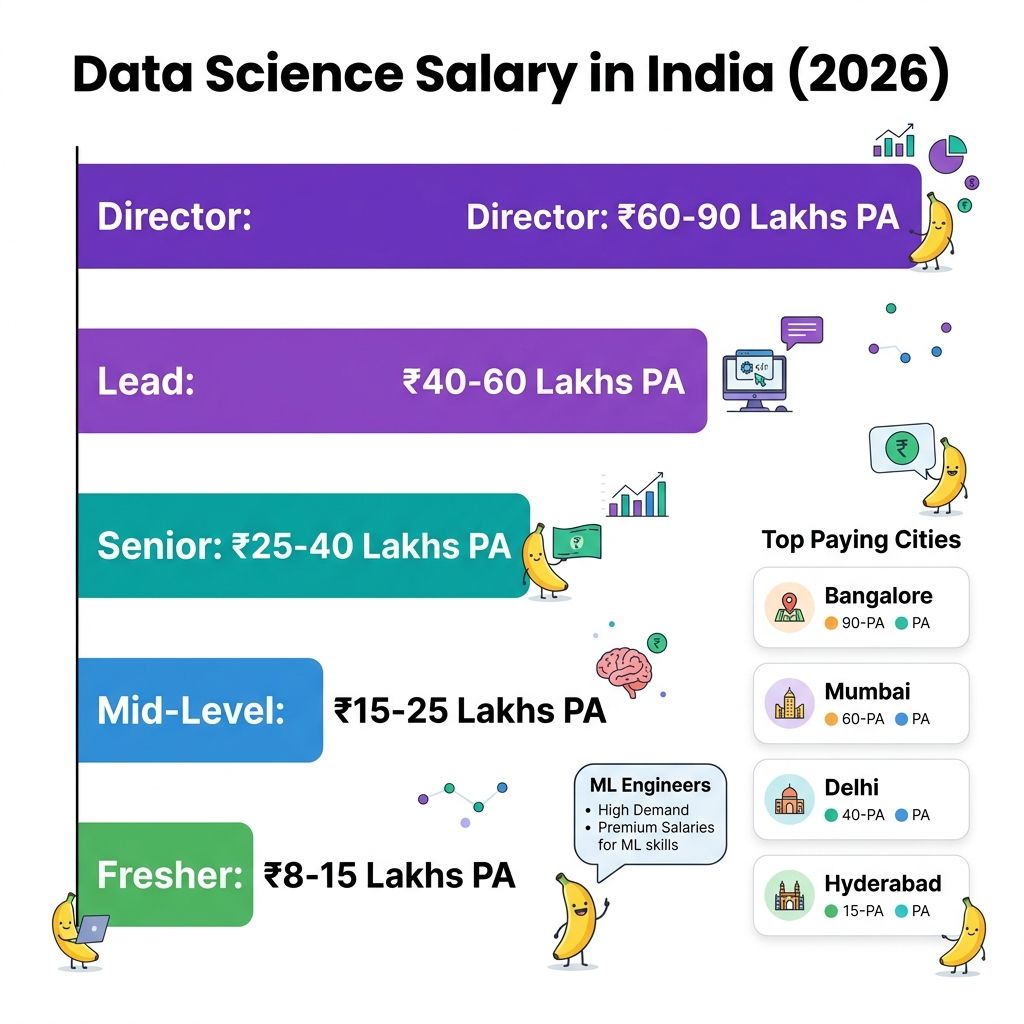
Salary by Experience Level
- Fresher / Data Analyst (0-1 year): ₹4.5-8 LPA: Entry roles at TCS, Wipro, Infosys, startups. Requires Python, SQL, Excel, basic statistics, and visualization (Power BI or Tableau)
- Junior Data Scientist (1-3 years): ₹8-15 LPA: Mid-tier companies and product startups. Requires ML fundamentals, feature engineering, model deployment basics
- Mid-Level Data Scientist (3-5 years): ₹15-25 LPA: Product companies, consulting firms, high-growth startups. Requires deep ML knowledge, NLP or computer vision specialization, cloud platforms
- Senior Data Scientist (5-8 years): ₹25-40 LPA: FAANG, top product companies, fintech. Requires end-to-end ML systems, team leadership, business impact measurement
- Principal / Lead Data Scientist (8+ years): ₹40-70+ LPA: Google, Microsoft, Amazon, Flipkart, PhonePe. Requires research contributions, architecture decisions, cross-functional leadership
- Data Science Manager / Director: ₹50-1 Cr+: Strategic leadership roles. Requires team building, stakeholder management, data strategy
Salary by City
Location significantly impacts data science salaries in India. Bangalore leads with 30-40% higher salaries than the national average, followed by Mumbai (20-30% premium), Hyderabad (15-25% premium), Pune (10-20% premium), and Delhi NCR (15-25% premium). Remote roles have somewhat equalized this, but in-office roles at top companies still command a significant location-based premium.
Salary Negotiation Tip
Data science roles have some of the highest salary negotiation leverage in Indian tech. Companies report a 30-45% acceptance rate on first offers, meaning most candidates successfully negotiate upward. Having a strong portfolio with deployed projects and Kaggle rankings gives you measurable proof of skills that justifies higher compensation. Never accept the first offer without negotiating.
Essential Skills Every Data Scientist Needs in 2026
Before comparing courses, you need to understand what skills employers are actually testing for in interviews and what you'll use daily on the job. A good data science course should cover most or all of these areas. If a course skips any of these foundational skills, that's a red flag.
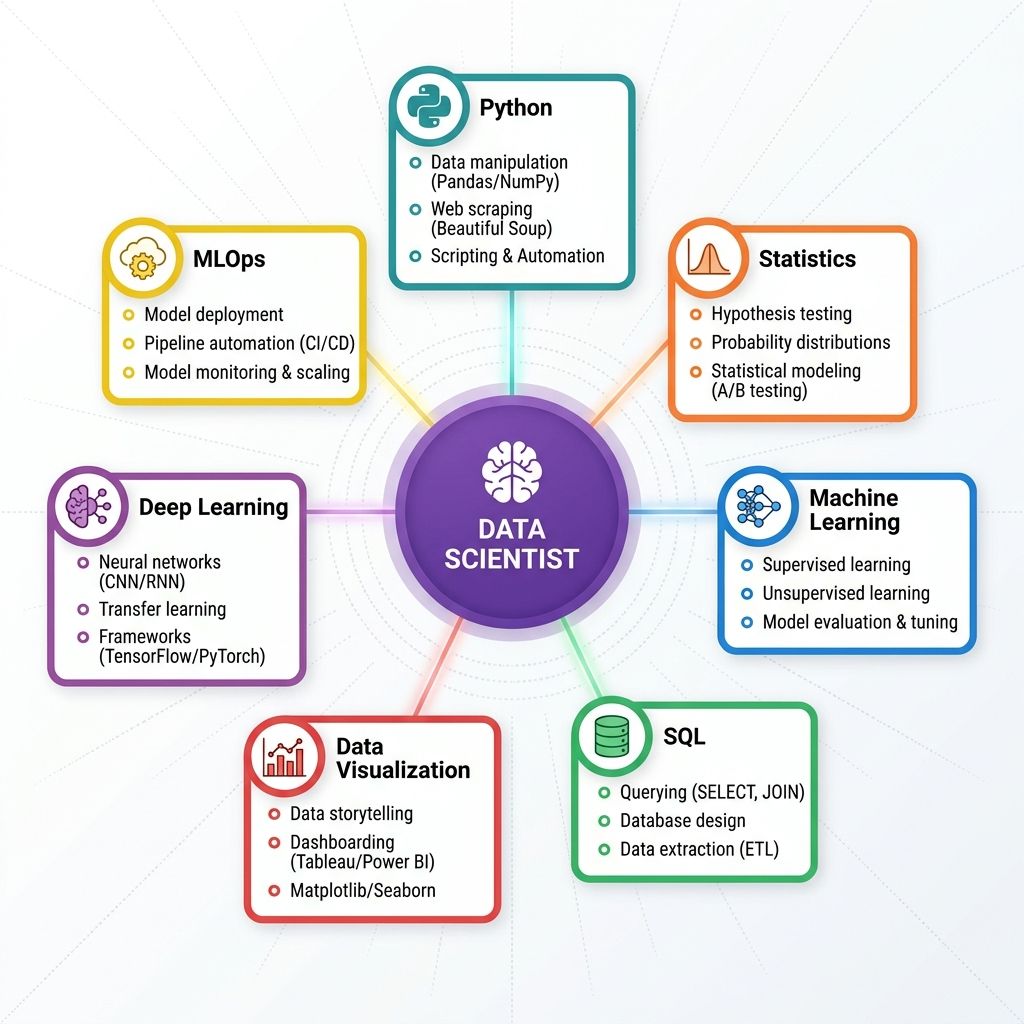
1. Python Programming
Python is non-negotiable for data science. Over 90% of data science job postings in India list Python as a required skill. You need proficiency in core Python (data structures, OOP, file handling, error handling) plus the data science ecosystem: NumPy for numerical computing, Pandas for data manipulation, Matplotlib and Seaborn for visualization, Scikit-learn for machine learning, and Jupyter Notebooks for interactive development.
If you're starting from scratch, Modern Age Coders' Python Masterclass is specifically designed to take you from zero to production-level Python proficiency with hands-on projects, exactly the kind of foundation you need before diving into data science libraries.
2. Statistics and Probability
Statistics is the backbone of data science. Without it, you're just running code without understanding what the results mean. You need solid grounding in: descriptive statistics (mean, median, mode, standard deviation, percentiles), probability distributions (normal, binomial, Poisson), hypothesis testing (t-tests, chi-square, ANOVA, p-values), confidence intervals, Bayesian thinking, and A/B testing methodology. Most hiring managers report that weak statistics knowledge is the #1 reason data science candidates fail technical interviews.
3. Machine Learning
Machine learning is where data science gets powerful. You need to understand both the theory and practical implementation of: supervised learning (linear/logistic regression, decision trees, random forests, gradient boosting, SVMs), unsupervised learning (k-means clustering, hierarchical clustering, PCA, DBSCAN), model evaluation (cross-validation, confusion matrices, ROC-AUC, precision-recall), feature engineering (encoding, scaling, selection, creation), and hyperparameter tuning (grid search, random search, Bayesian optimization).
4. SQL and Database Skills
Data scientists spend 60-80% of their time working with data, and SQL is how you access it. Every company interview includes SQL rounds. You need proficiency in: complex joins (inner, outer, cross, self), window functions (ROW_NUMBER, RANK, LAG, LEAD, running totals), subqueries and CTEs, aggregation and grouping, query optimization, and familiarity with both relational databases (PostgreSQL, MySQL) and data warehouses (BigQuery, Redshift, Snowflake).
5. Data Visualization
The ability to communicate findings visually is what separates good data scientists from great ones. Technical stakeholders want detailed charts; business leaders want clear dashboards with actionable insights. You need skills in: Matplotlib and Seaborn (Python-native plotting), Plotly (interactive visualizations), Tableau or Power BI (business intelligence dashboards), and the principles of effective data storytelling, choosing the right chart type, avoiding misleading visualizations, and structuring a data narrative.
6. Deep Learning and NLP (For Advanced Roles)
For mid-level and senior roles, deep learning knowledge is increasingly expected. This includes: neural network fundamentals (architecture, backpropagation, activation functions), CNNs for computer vision, RNNs/LSTMs for sequence data, Transformers and attention mechanisms, NLP with Hugging Face (text classification, sentiment analysis, named entity recognition), and frameworks like TensorFlow and PyTorch. The GenAI wave has made NLP skills particularly valuable in 2026.
7. MLOps and Deployment
A model that lives only in a Jupyter notebook has zero business value. Modern data science roles require you to deploy and monitor models in production. Key skills include: Docker for containerization, Flask/FastAPI for model serving, MLflow for experiment tracking, basic cloud services (AWS SageMaker, GCP Vertex AI, Azure ML), CI/CD for ML pipelines, and model monitoring and drift detection.
The Skills Gap That Gets People Rejected
The most common reason data science candidates fail interviews in India isn't a lack of ML knowledge. It's weak fundamentals. Poor Python coding skills, inability to write efficient SQL, shaky statistics understanding, and zero experience with real-world messy data. Focus on building strong foundations before chasing advanced topics like GenAI or reinforcement learning.
The Role of Mathematics in Data Science
Mathematics is the language that data science speaks. While you don't need to be a mathematician to succeed in data science, a solid understanding of key mathematical concepts will dramatically improve your ability to understand algorithms, debug models, and innovate. Here's what matters most:
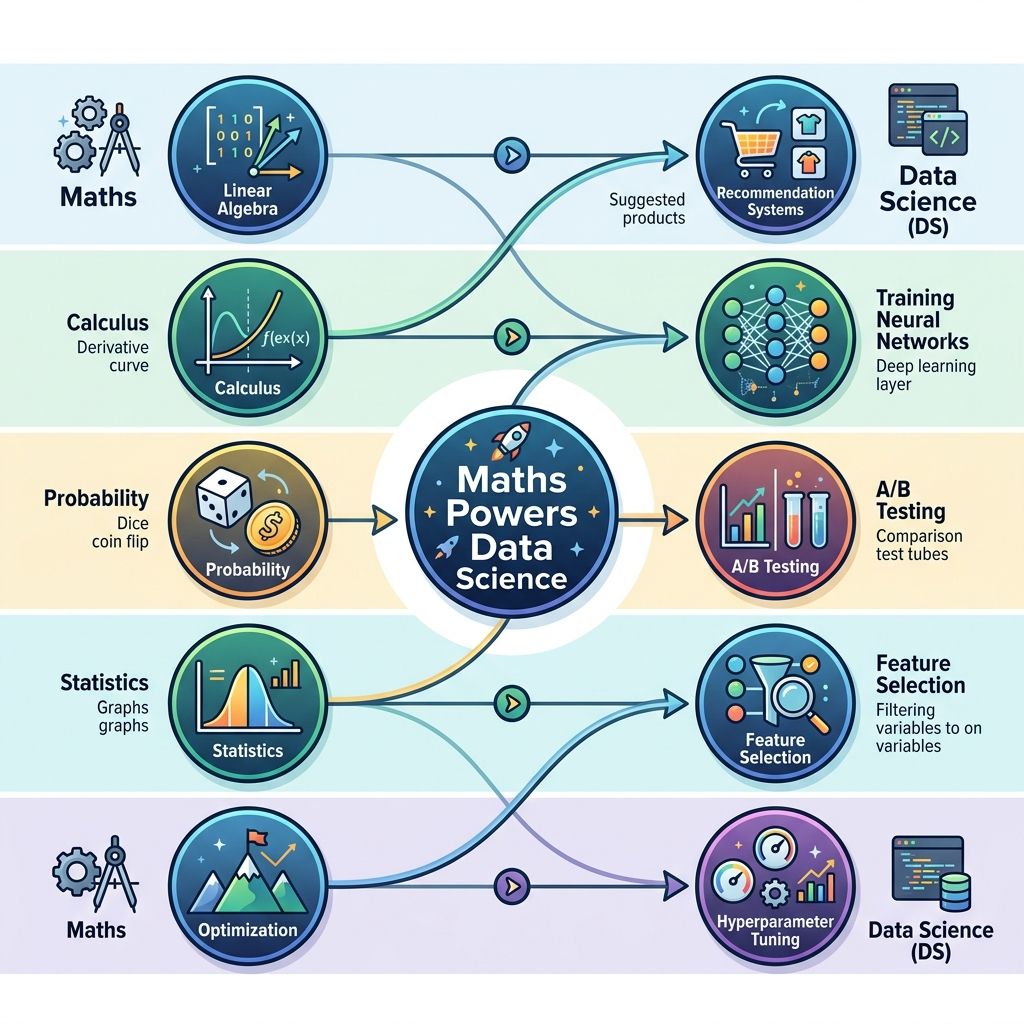
- Linear Algebra: Vectors, matrices, eigenvalues, matrix decomposition, the foundation of every ML algorithm from linear regression to neural networks. When you understand that a dataset is a matrix and model weights are vectors, everything clicks
- Calculus: Derivatives, partial derivatives, gradients, chain rule. This is how models learn. Gradient descent, backpropagation, and optimization all require calculus. You don't need to prove theorems, but you need to understand the intuition
- Probability and Statistics: Bayes' theorem, probability distributions, maximum likelihood estimation, hypothesis testing, the basis for all statistical inference and probabilistic models
- Optimization: Convex optimization, gradient descent variants (SGD, Adam, RMSprop), constrained optimization, understanding how models find the best parameters
- Discrete Mathematics: Graph theory, combinatorics, set theory, important for recommendation systems, network analysis, and algorithm design
The good news is that you don't need to learn all of this before starting data science. The best approach is to learn math concepts as you encounter them in practical applications. When you implement linear regression, study the linear algebra behind it. When you train a neural network, understand the calculus of backpropagation. This applied approach makes the math concrete and memorable.
Top Data Science Courses in India: A Comprehensive Comparison
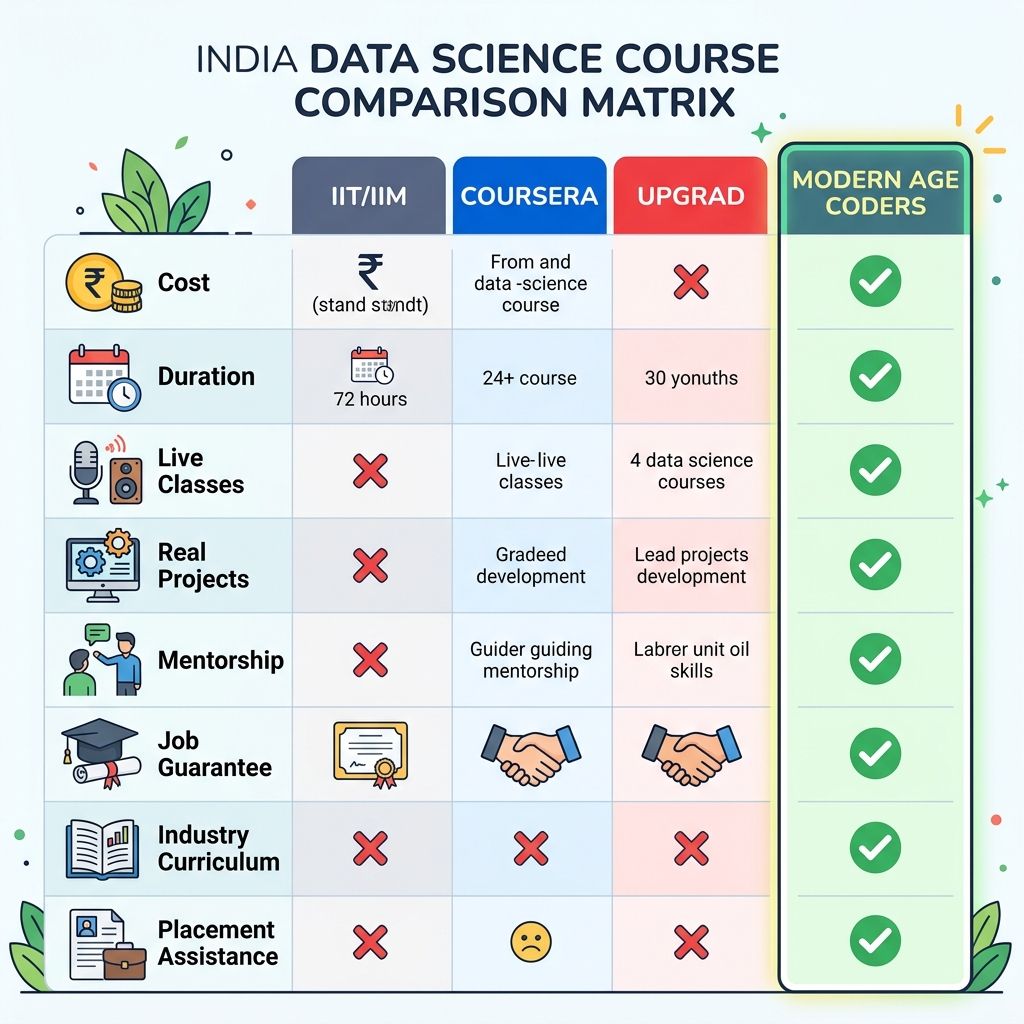
Now for the main event, a detailed comparison of the best data science courses available in India in 2026. We've organized them by category and evaluated each on curriculum depth, practical projects, placement support, flexibility, and value for money.
Category 1: IIT and IIM Executive Programs
India's premier institutions offer executive-level data science programs that carry strong brand recognition. These are best suited for working professionals with 3+ years of experience who want a prestigious credential.
- IIT Madras: BS in Data Science and Applications: One of the most respected programs in India. Fully online, takes 3-4 years, costs approximately ₹3-4 lakhs total. Rigorous curriculum covering Python, statistics, ML, and databases. The IIT Madras brand carries significant weight with employers. Best for students who want a full degree and can commit to a multi-year program.
- IIT Hyderabad: AI & ML Certificate (via TalentSprint): 9-month executive program costing ₹3.5-4 lakhs. Covers deep learning, NLP, computer vision, and deployment. Includes campus immersion. Good for working professionals, but the short duration limits depth on fundamentals.
- IIM Bangalore: Data Science & AI Executive Program (via upGrad): 12-month program at ₹3-3.5 lakhs. Strong on business analytics and management perspective. Ideal if you want to move into analytics leadership rather than hands-on data science. Limited on coding depth.
- IIT Delhi: Certificate in Data Science & ML (via Intellipaat): 12-month program at ₹3-4 lakhs. Good curriculum covering Python, ML, deep learning, and big data technologies. IIT Delhi brand is strong in North India.
- ISI Kolkata: PG Diploma in Data Science: Highly rigorous on-campus program with extremely competitive admission. Arguably the strongest statistical foundation of any Indian program. Very limited seats.
The IIT/IIM Premium: Is It Worth It?
IIT and IIM programs offer undeniable brand value that helps in resume screening. However, at ₹3-5 lakhs, they're expensive and often teach at a pace that doesn't allow deep practical learning. Most of these programs are actually delivered by third-party platforms (upGrad, Great Learning, Intellipaat) using IIT/IIM-approved curriculum. The actual teaching quality varies significantly by batch and instructor. For pure skill development and job readiness, live project-based programs often deliver better ROI.
Category 2: Online Platform Courses (Coursera, edX, Udacity)
International online platforms offer high-quality content from global universities and tech companies. They're affordable and flexible but come with trade-offs.
- Coursera: IBM Data Science Professional Certificate: 10-course series covering Python, SQL, data visualization, ML, and capstone projects. Costs ₹3,000-4,000/month (Coursera Plus). Self-paced, takes 6-10 months. Strong content but entirely pre-recorded with no live instruction or mentorship.
- Coursera: Google Data Analytics Professional Certificate: 8 courses focused on analytics fundamentals with R and SQL. More entry-level than the IBM certificate. Good starting point for complete beginners. Costs ₹3,000-4,000/month.
- Coursera: Andrew Ng's Machine Learning Specialization (Stanford): The gold standard for ML theory. Three courses covering supervised learning, unsupervised learning, and recommender systems. Excellent pedagogy but limited on practical deployment skills.
- edX: MicroMasters in Statistics and Data Science (MIT): Extremely rigorous academic program covering probability, statistics, ML, and deep learning. Takes 1.5 years, costs approximately ₹80,000-1 lakh. Best for those who want academic depth.
- Udacity: Data Scientist Nanodegree: Project-focused program with mentor reviews. Covers data engineering, ML, and recommendation systems. Costs approximately ₹60,000-80,000. Good projects but limited live support.
The biggest limitation of platform-based courses is the isolation factor. You're watching videos alone, solving assignments alone, and have no one to turn to when you're stuck at 11 PM on a tricky concept. Completion rates for self-paced data science courses hover around 5-15%, and the lack of live instruction means your doubts can remain unresolved for days or weeks.
Category 3: Indian EdTech Platforms (upGrad, Scaler, Analytics Vidhya)
Indian EdTech companies have built large-scale programs specifically designed for the Indian job market. They typically combine pre-recorded content with some live sessions and placement support.
- upGrad: PG Diploma in Data Science (with IIIT Bangalore): 12-18 month program at ₹3-4 lakhs. Covers Python, ML, deep learning, NLP, big data. Includes industry projects and placement support. Strong brand but very expensive for what's essentially recorded content with periodic live sessions.
- Scaler: Data Science & ML Program: 9-11 month program at ₹3-4 lakhs. Strong on DSA fundamentals and ML. Live classes with experienced instructors. Good peer community and placement support. However, large batch sizes (100+ students per batch) limit individual attention.
- Analytics Vidhya: Blackbelt ML Program: 6-12 month program at ₹60,000-80,000. Focused on ML competitions and practical skills. Good community of data science enthusiasts. Less structured than formal programs.
- Great Learning: PG Program in Data Science (with IIT Madras): 12-month program at ₹3-3.5 lakhs. IIT Madras branding with Great Learning's platform. Mixed reviews on teaching quality and placement outcomes.
Watch Out for Misleading Placement Claims
Many EdTech platforms advertise '93% placement rate' or '₹15 LPA average salary.' Dig deeper. Ask: What's the denominator? (All enrolled students or only those who completed + opted for placement?) What's the median salary, not average? (A few high outliers can skew averages dramatically.) What percentage of placements are in data science roles vs. generic IT roles? Always ask for verifiable data and talk to alumni before enrolling in any expensive program.
Category 4: Live, Project-Based Programs (Modern Age Coders and Similar)
This is the category that often gets overlooked but delivers the highest learning ROI, live, instructor-led programs with small batch sizes, real project experience, and personalized mentorship. This is where Modern Age Coders' approach stands out significantly.
Modern Age Coders' Data Science Masterclass is designed specifically for college students and early professionals who want to build genuine, job-ready data science skills through hands-on practice rather than passive video watching. Here's what makes this approach different:
- 100% Live Classes: Every session is taught live by experienced instructors. You can ask questions in real-time, get immediate clarification on complex topics, and participate in live coding exercises. No pre-recorded videos disguised as 'live sessions'
- Small Batch Sizes: Unlike platforms with 200+ students per batch, smaller cohorts mean your instructor actually knows your name, understands your strengths and weaknesses, and can provide personalized feedback on your projects
- Project-Based Curriculum: You don't just learn theory. You build real data science projects from scratch. EDA on real datasets, ML model development, dashboard creation, and end-to-end deployment. These projects become your portfolio
- Strong Python Foundation: The curriculum ensures your Python programming skills are rock-solid before moving to data science libraries. Many students fail in data science not because ML is hard, but because their Python is weak
- Mathematics Integrated Naturally: Statistics and linear algebra concepts are taught alongside their practical applications, not as separate abstract modules
- Affordable Pricing: At a fraction of the cost of IIT executive programs or EdTech platforms charging ₹3-4 lakhs, you get more live instruction hours and more personal attention
- Doubt Resolution: Dedicated doubt-clearing sessions ensure no concept is left half-understood. This alone can save you weeks of frustrated Googling
For those who need to strengthen their Python programming before diving into data science, the Python Masterclass provides a comprehensive foundation covering everything from basic syntax to advanced concepts like decorators, generators, file handling, and object-oriented programming, all the prerequisites you need.
Python for Data Science: The Foundation You Cannot Skip
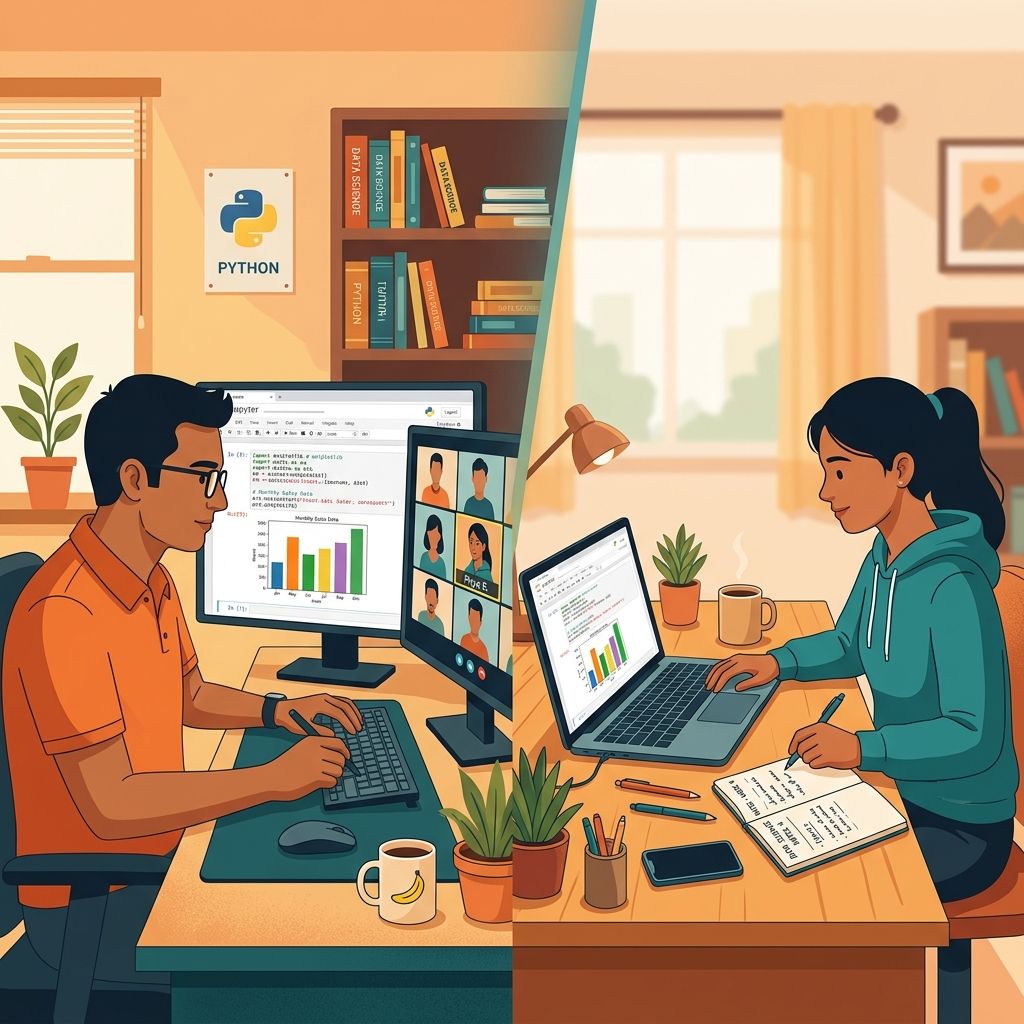
Python deserves its own section because it is the single most important technical skill for a data science career. It's not just 'one of the tools'. It's the primary language of the entire data science ecosystem. If your Python is weak, everything else will be 10x harder.
Why Python Dominates Data Science
- Library ecosystem: NumPy, Pandas, Scikit-learn, TensorFlow, PyTorch, Matplotlib, Seaborn, Plotly, Statsmodels, NLTK, SpaCy, Hugging Face, the entire ML/AI stack is Python-native
- Readability: Python's clean syntax makes it easier to focus on data science concepts rather than fighting with the language itself
- Community: The largest data science community in the world uses Python. Every Stack Overflow answer, every Kaggle kernel, every tutorial. They're in Python
- Industry standard: Over 90% of data science teams in India use Python as their primary language
- Versatility: From data cleaning scripts to production ML APIs to web dashboards: Python does it all
The Python Skills Hierarchy for Data Science
Here is a practical roadmap for building Python skills specifically for data science, organized from foundational to advanced:
- Core Python (Weeks 1-4): Variables, data types, control flow, functions, list comprehensions, dictionaries, file I/O, error handling, OOP basics
- NumPy (Week 5): Arrays, broadcasting, vectorized operations, linear algebra operations, random number generation
- Pandas (Weeks 6-8): DataFrames, Series, indexing, filtering, groupby, merge/join, pivot tables, handling missing data, time series basics
- Visualization (Weeks 9-10): Matplotlib fundamentals, Seaborn statistical plots, Plotly interactive charts, choosing the right chart type
- Scikit-learn (Weeks 11-14): Preprocessing, model selection, training, evaluation, pipelines, cross-validation, hyperparameter tuning
- Advanced (Weeks 15+): TensorFlow/PyTorch basics, Flask/FastAPI for model serving, working with APIs, web scraping for data collection
# Example: End-to-end data science workflow in Python
import pandas as pd
import numpy as np
from sklearn.model_selection import train_test_split
from sklearn.ensemble import RandomForestClassifier
from sklearn.metrics import classification_report

# 1. Load and explore data
df = pd.read_csv('customer_churn.csv')
print(f"Dataset shape: {df.shape}")
print(f"Churn rate: {df['churn'].mean():.2%}")

# 2. Feature engineering
df['tenure_group'] = pd.cut(df['tenure'], bins=[0, 12, 24, 48, 72],
                            labels=['New', 'Growing', 'Mature', 'Loyal'])
df['monthly_per_tenure'] = df['monthly_charges'] / (df['tenure'] + 1)

# 3. Prepare features
features = ['tenure', 'monthly_charges', 'total_charges',
            'monthly_per_tenure', 'num_services']
X = df[features]
y = df['churn']

# 4. Train-test split
X_train, X_test, y_train, y_test = train_test_split(
    X, y, test_size=0.2, random_state=42, stratify=y
)

# 5. Train model
model = RandomForestClassifier(n_estimators=100, random_state=42)
model.fit(X_train, y_train)

# 6. Evaluate
y_pred = model.predict(X_test)
print(classification_report(y_test, y_pred))
This kind of end-to-end workflow, from loading raw data to deploying a trained model, is exactly what employers expect you to demonstrate in interviews. Modern Age Coders' Python Masterclass builds this proficiency systematically through progressively complex real-world projects.
Data Science Career Paths: Which Role Is Right for You?
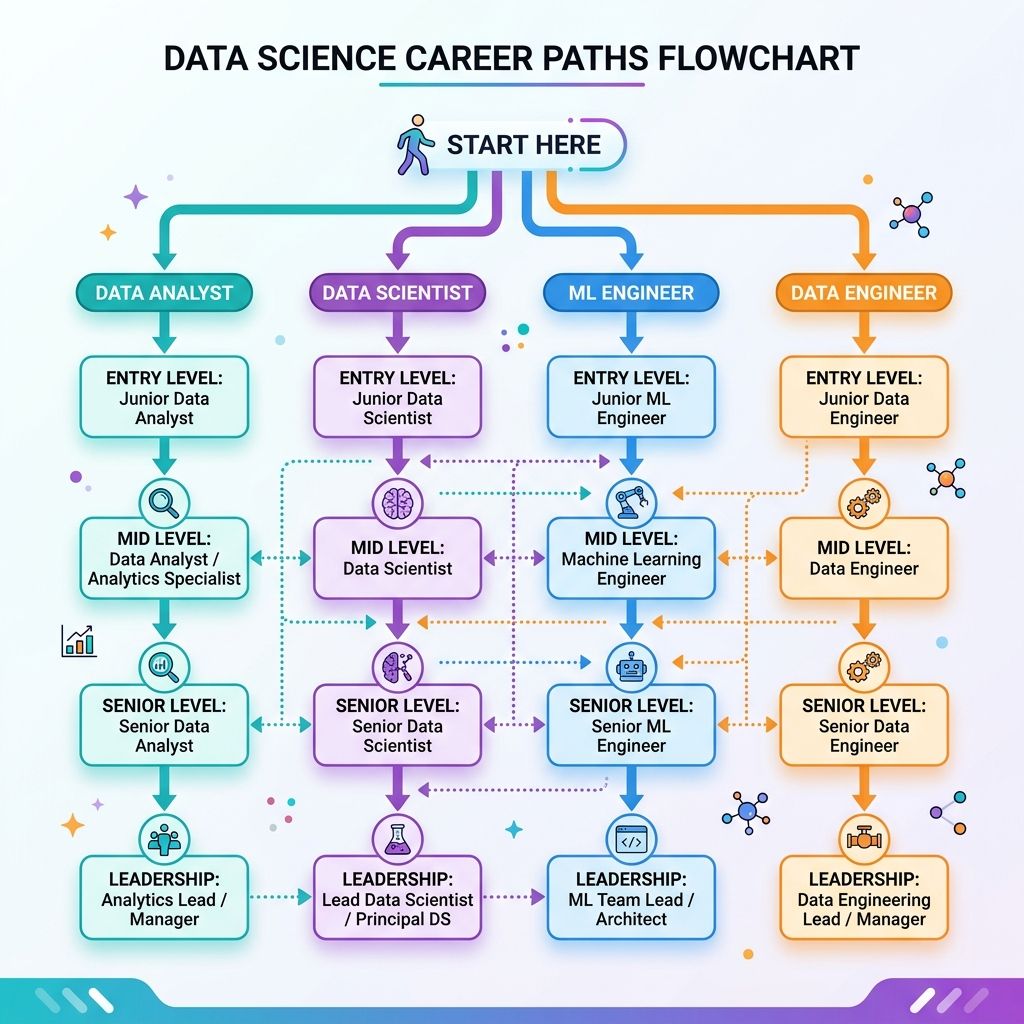
'Data science' is an umbrella term that covers multiple distinct career paths. Understanding these paths helps you choose the right course and focus your learning on the skills that matter most for your target role.
1. Data Analyst
What you do: Extract insights from data to drive business decisions. Create dashboards, reports, and visualizations. Perform A/B test analysis and KPI tracking. Skills needed: SQL (advanced), Python/R (intermediate), Tableau/Power BI, Excel, statistics, business domain knowledge. Salary range: ₹4.5-12 LPA. Best for: People who enjoy storytelling with data and prefer business-facing roles over heavy engineering. This is the most common entry point into the data science field.
2. Data Scientist
What you do: Build predictive models, design experiments, develop algorithms, and work on complex analytical problems. Skills needed: Python (advanced), statistics (strong), ML algorithms, feature engineering, model evaluation, communication skills. Salary range: ₹8-40 LPA. Best for: People who love both coding and mathematics and want to solve complex business problems using data.
3. Machine Learning Engineer
What you do: Take ML models from prototype to production. Build scalable ML systems, design data pipelines, optimize model performance, and implement MLOps practices. Skills needed: Python (advanced), software engineering (strong), ML frameworks (TensorFlow/PyTorch), Docker, Kubernetes, cloud platforms, CI/CD. Salary range: ₹12-45 LPA. Best for: People with strong software engineering backgrounds who want to work at the intersection of engineering and data science. This role commands some of the highest salaries in Indian tech.
If the ML engineering path interests you, Modern Age Coders' AI/ML Masterclass covers the complete pipeline from algorithm theory to model deployment, giving you the full-stack ML engineering skills that companies pay a premium for.
4. Data Engineer
What you do: Design and build the data infrastructure that data scientists rely on. Create ETL pipelines, manage data warehouses, ensure data quality and availability. Skills needed: SQL (expert), Python, Apache Spark, Airflow, cloud services (AWS/GCP/Azure), data modeling, dbt. Salary range: ₹8-35 LPA. Best for: People who enjoy building systems and infrastructure more than building models. Data engineering roles are growing faster than data scientist roles in India.
5. AI/GenAI Engineer
What you do: Build applications powered by large language models and generative AI. Implement RAG systems, fine-tune models, build AI agents, and integrate LLMs into products. Skills needed: Python (advanced), LLM APIs (OpenAI, Anthropic, Google), LangChain/LlamaIndex, vector databases (Pinecone, Weaviate), prompt engineering, evaluation frameworks. Salary range: ₹15-50+ LPA. Best for: The newest and hottest path in 2026. Demand vastly outstrips supply. Best for people who want to build AI-powered products. Having a strong data science foundation makes you significantly more effective in this role.
6. AI Researcher
What you do: Push the boundaries of what's possible with AI. Publish papers, develop novel algorithms, work on fundamental problems in ML/DL/NLP/CV. Skills needed: Mathematics (advanced, linear algebra, optimization, probability theory), Python, PyTorch, research methodology, academic writing. Salary range: ₹20-60+ LPA (research labs at Google, Microsoft, Meta pay ₹50-1 Cr+ for top researchers). Best for: People with strong mathematical aptitude who want to work on cutting-edge problems. Typically requires a Master's or PhD.
How to Build a Data Science Portfolio That Gets You Hired
In India's competitive data science job market, your portfolio matters more than your certificate. Hiring managers at companies like Flipkart, Amazon, and PhonePe consistently say they prefer candidates who can demonstrate practical skills through a strong portfolio over those who simply list certifications. Here's exactly how to build one that stands out.

The 5-Project Portfolio Strategy
You don't need 20 mediocre projects. You need 5 excellent ones that demonstrate breadth and depth. Here's the ideal portfolio composition:
- Exploratory Data Analysis (EDA) Project: Take a real-world dataset (Indian census data, IPL statistics, Zomato restaurant data, or stock market data) and perform thorough exploratory analysis. Show your ability to clean messy data, identify patterns, create compelling visualizations, and draw meaningful conclusions. This demonstrates your Pandas, visualization, and analytical thinking skills.
- Supervised Learning Project: Build a classification or regression model for a practical problem. Predict house prices in Indian cities, classify customer churn, detect fraudulent UPI transactions, or predict crop yields. Include proper train-test splits, cross-validation, feature engineering, model comparison, and clear documentation of your thought process.
- NLP Project: Work with text data, sentiment analysis of product reviews, news article categorization, building a chatbot, or named entity recognition on Indian language text. NLP projects demonstrate you can work with unstructured data, which is increasingly important.
- Dashboard / Data Application: Build an interactive dashboard or web application using Streamlit, Dash, or Flask. Deploy it on Heroku, Streamlit Cloud, or Railway. Show a live, working application that someone can actually use. This demonstrates end-to-end skills from data processing to user interface.
- End-to-End ML Pipeline: Build a complete machine learning pipeline with data ingestion, preprocessing, model training, evaluation, and deployment. Use MLflow for experiment tracking and Docker for containerization. This is the project that separates you from 90% of candidates who can only work in notebooks.
Portfolio Platforms and Presentation
- GitHub: Every project should have a well-organized GitHub repository with a clear README, requirements.txt, proper code structure, and documentation. Write commit messages that show your development process
- Kaggle: Participate in competitions and publish kernels/notebooks. Even if you don't win medals, published kernels with good EDA and clear explanations get noticed. Aim for at least a Notebooks Expert badge
- LinkedIn: Write posts about your projects, share insights from your analyses, and engage with the data science community. Many hiring managers discover candidates through LinkedIn content
- Personal Blog: Writing about your projects forces you to understand them deeply. Explain your approach, what worked, what didn't, and what you learned. This demonstrates communication skills
- Deployed Applications: Having a live, working application (even a simple one) is worth more than 10 Jupyter notebooks. Use Streamlit Cloud (free) or Hugging Face Spaces to deploy
The India-Specific Portfolio Advantage
Use Indian datasets and solve Indian problems in your portfolio. Analyzing UPI transaction patterns, predicting Indian stock market trends, working with Indian language NLP, or building solutions for Indian agricultural data shows domain relevance that international datasets don't. Indian hiring managers appreciate candidates who understand local data challenges, messy Aadhaar data, multilingual text, Indian address parsing, and similar real-world complexities.
How to Choose the Right Data Science Course: A Decision Framework
With so many options, making the right choice requires a structured approach. Use this framework based on your current situation:
If You're a College Student (B.Tech / BCA / BSc)
You have more time than money, and you need skills that directly lead to your first job. Best approach: Start with a strong Python foundation, then take a structured, project-based data science course with live instruction and mentorship. Avoid spending ₹3-4 lakhs on IIT executive programs at this stage. That money is better invested later when you have work experience and the credential carries more weight. Focus on building a portfolio of 4-5 strong projects.
Modern Age Coders' Data Science Masterclass is specifically designed for college students, affordable, live classes, project-based, with strong Python fundamentals built in. Combined with the Python Masterclass, you'll have a complete skill stack that employers value.
If You're a Working IT Professional (1-5 Years Experience)
You have some programming experience but limited time. You need a structured program that works around your job. Best approach: Choose a program with weekend or evening live classes, strong placement support, and industry-relevant projects. Your existing tech background is an advantage. You don't need to start from scratch. Focus on statistical foundations, ML algorithms, and a specialization area (NLP, computer vision, or GenAI) that aligns with your career goals.
If You're a Career Switcher (Non-Tech Background)
You need comprehensive coverage from fundamentals to advanced topics with extra support. Best approach: Start with a Python programming course to build your coding foundation. Then move to a data science program that doesn't assume prior programming experience. Avoid programs that rush through Python basics in 2 weeks. You need at least 6-8 weeks of dedicated Python learning before data science makes sense. Your domain expertise (finance, healthcare, marketing) is actually a secret weapon, data scientists who understand business context are rare and valued.
If You're a Senior Professional (5+ Years Experience)
You want a credential that matches your seniority and you can afford premium programs. Best approach: This is where IIT/IIM executive programs make the most sense. The brand recognition complements your work experience, and the business-focused curriculum aligns with leadership-track roles. Consider programs from IIT Madras, IIM Bangalore, or IIM Calcutta.
Industry Demand: Where Data Scientists Are Most Needed in India
Understanding which industries are hiring the most data scientists helps you target your learning, specialize in the right domain, and position yourself for the highest-paying roles.
Fintech and Banking
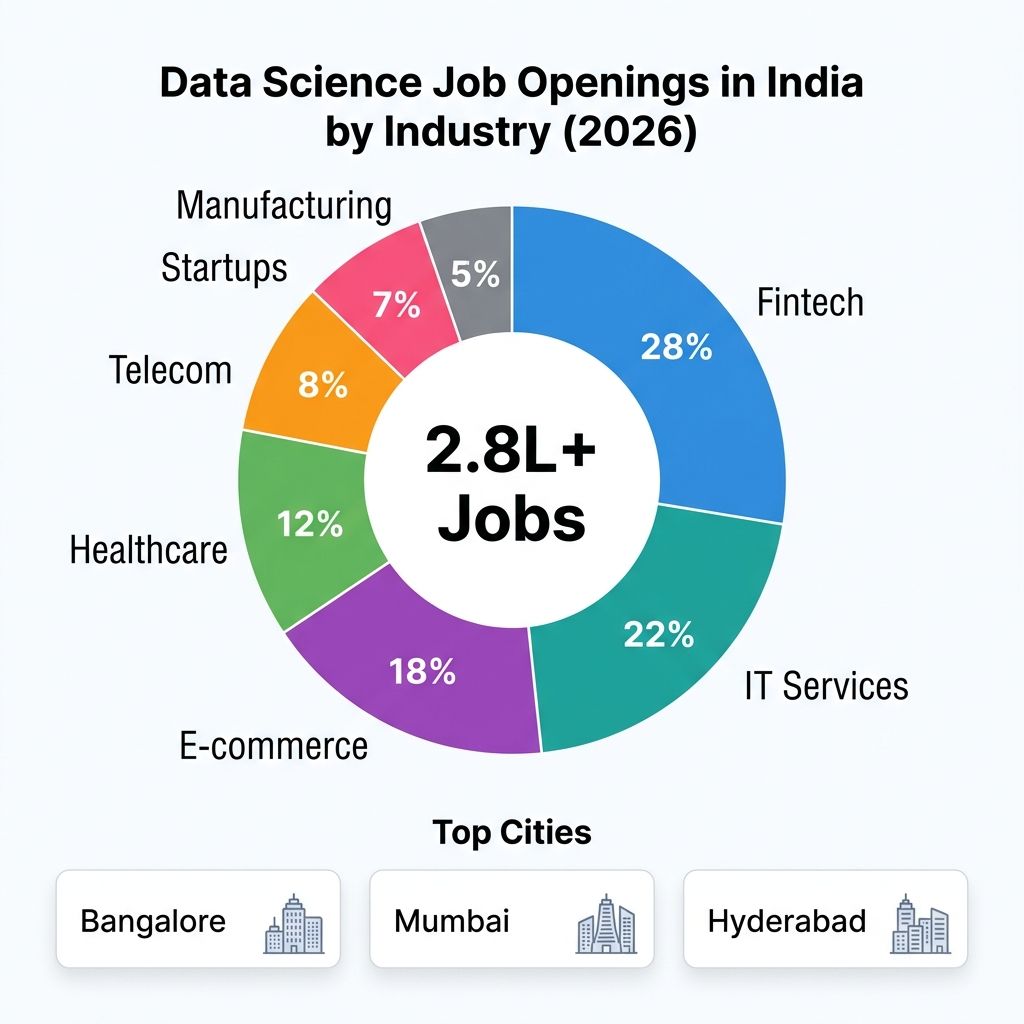
India's fintech sector is the world's third largest, and it's the single biggest employer of data scientists in the country. Companies like Razorpay, PhonePe, Paytm, CRED, Groww, Zerodha, and every major bank (HDFC, ICICI, Kotak) are hiring data scientists aggressively. Key problem areas include: fraud detection in real-time UPI transactions, credit risk scoring for lending platforms, algorithmic trading and portfolio optimization, customer segmentation and personalization, anti-money laundering compliance, and insurance claim prediction. Fintech data science roles typically pay 20-30% above market average due to the direct revenue impact.
Healthcare and Pharma
The Indian healthcare data science market is projected to reach $5 billion by 2028. Post-pandemic investment in digital health has been massive. Key applications include: medical image analysis (X-rays, MRIs, CT scans), drug discovery and clinical trial optimization, patient outcome prediction, hospital operations optimization, genomics and personalized medicine, and health insurance analytics. Companies hiring: Practo, PharmEasy, 1mg, Apollo 24/7, SRL Diagnostics, and the research arms of Sun Pharma, Dr. Reddy's, and Cipla.
E-Commerce and Retail
With Flipkart, Amazon India, Meesho, Myntra, and Nykaa all scaling rapidly, e-commerce is a major employer of data scientists. Key areas include: recommendation engines ("customers who bought this also bought..."), demand forecasting and inventory optimization, dynamic pricing, search ranking optimization, supply chain analytics, and customer lifetime value prediction. These roles offer the unique advantage of seeing your models impact millions of users directly.
IT Services and Consulting
TCS, Infosys, Wipro, HCL, Tech Mahindra, and consulting firms (Deloitte, McKinsey, BCG) have expanded their data science practices significantly. While base salaries may be lower than product companies, these roles offer exposure to diverse industries and problems, strong training programs, and clear career progression paths. These companies are also the largest volume hirers of data science freshers in India.
Startups and Product Companies
India's startup ecosystem employs data scientists across every domain, logistics (Delhivery, Dunzo), edtech (Unacademy, Physics Wallah), gaming (Dream11, MPL), social commerce (Meesho, ShareChat), and more. Startup roles typically offer: lower base salary but equity upside, faster career growth, broader responsibilities (you're often the entire data team), and the opportunity to build data infrastructure from scratch. If you want maximum learning velocity, startup data science roles are unmatched.
Common Mistakes to Avoid When Learning Data Science
After training thousands of students and professionals, we've observed consistent patterns in mistakes that derail data science learning journeys. Avoid these pitfalls to stay on track:
- Skipping Python fundamentals: The #1 mistake. Students rush to import TensorFlow before they can write a proper function. Spend 6-8 weeks mastering core Python before touching any data science library. Your future self will thank you.
- Ignoring statistics: Knowing how to call model.fit() is not data science. If you don't understand why you're choosing a particular test or what a p-value means, you're building models on a foundation of sand. Statistical knowledge is what employers test most rigorously in interviews.
- Tutorial hell: Watching 300 hours of YouTube tutorials without building anything is comfortable but useless. After learning a concept, immediately apply it to a real dataset. Struggle with real problems. That's where learning happens.
- Only using clean datasets: Kaggle competition data is pre-cleaned and well-structured. Real-world data is messy, incomplete, inconsistent, and poorly documented. Practice with raw data from government portals, web scraping, or APIs to build realistic skills.
- Neglecting SQL: Many aspiring data scientists focus exclusively on Python and ML while ignoring SQL. In practice, you'll write more SQL than Python on most data science jobs. SQL rounds are elimination rounds in interviews.
- Certificate collecting: Having 15 Coursera certificates doesn't impress hiring managers. What impresses them is 3-4 strong projects where you solved real problems, made design decisions, handled edge cases, and deployed working solutions.
- Not communicating findings: Technical skills get you interviews; communication skills get you offers. Practice explaining your analyses to non-technical audiences. Write clear documentation. Create compelling visualizations. Tell stories with data.
- Learning in isolation: Data science is collaborative. Join communities (Kaggle, LinkedIn groups, local meetups, Discord servers), participate in discussions, get code reviews, and find study partners. The people who learn in isolation burn out faster.
A Realistic Data Science Learning Roadmap for 2026
Here is a month-by-month roadmap for going from zero to job-ready data scientist. This assumes you're dedicating 2-3 hours per day (more on weekends). If you're learning full-time, you can compress this timeline significantly.
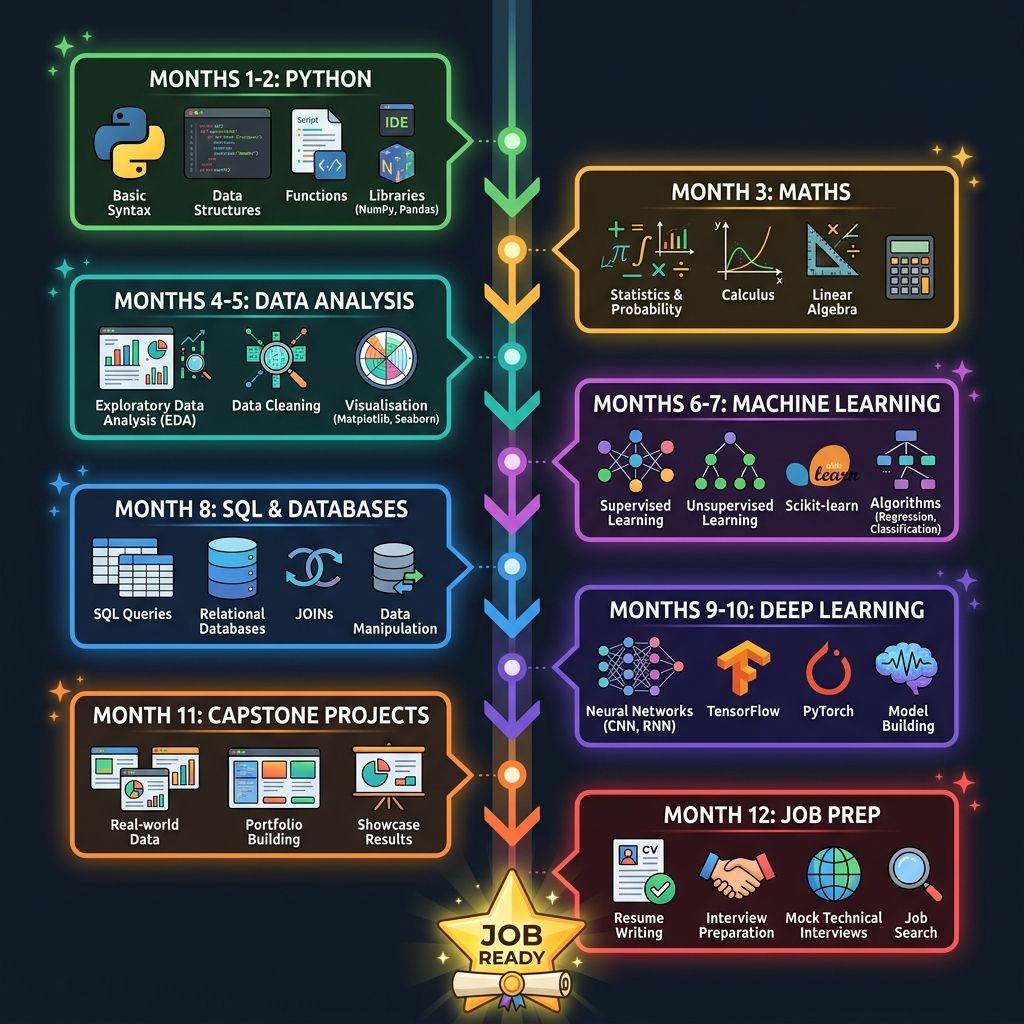
Months 1-2: Python Programming Foundation
Focus exclusively on Python. Cover variables, data types, strings, lists, tuples, dictionaries, sets, control flow, functions, file handling, error handling, modules, OOP basics, list comprehensions, and lambda functions. Build at least 3 mini-projects (calculator, contact book, file organizer). Use the Python Masterclass for structured, live instruction.
Months 3-4: Data Analysis with Python
Learn NumPy (arrays, operations, broadcasting), Pandas (DataFrames, data manipulation, groupby, merge, pivot tables), and visualization (Matplotlib, Seaborn). Complete 2 full EDA projects on real Indian datasets. Start learning SQL in parallel, basic queries, joins, aggregations, subqueries.
Months 5-6: Statistics and Probability
Study descriptive statistics, probability distributions, hypothesis testing, confidence intervals, correlation and regression analysis, Bayesian fundamentals, and A/B testing. Apply every concept using Python (Scipy, Statsmodels). Complete a statistical analysis project.
Months 7-9: Machine Learning
Cover supervised learning (regression, classification, ensemble methods), unsupervised learning (clustering, dimensionality reduction), model evaluation, feature engineering, and hyperparameter tuning. Use Scikit-learn extensively. Build 2-3 ML projects with proper train-test methodology. Start participating in Kaggle competitions.
Months 10-11: Advanced Topics and Specialization
Choose a specialization based on your career goal: NLP (text classification, sentiment analysis, transformers), computer vision (image classification, object detection), time series analysis, or recommendation systems. Learn deep learning basics with TensorFlow or PyTorch. Build a significant specialization project.
Month 12: Deployment, Portfolio, and Job Preparation
Learn Docker basics, Flask/FastAPI for API creation, Streamlit for dashboards, and basic cloud deployment. Polish your portfolio with clear READMEs and documentation. Deploy at least 2 projects as live applications. Prepare for interviews: DSA in Python, SQL problem sets, ML theory, case studies, and system design basics.
Frequently Asked Questions About Data Science Courses in India
Can I learn data science without a technical background?
Absolutely yes. Many successful data scientists in India come from non-engineering backgrounds, commerce, economics, life sciences, and even arts. The key is to build a strong programming foundation first (spend extra time on Python) and leverage your domain expertise. A data scientist with a finance background who understands lending, risk, and markets is extremely valuable to fintech companies. Your non-tech perspective is an asset, not a liability.
How long does it take to become a data scientist?
With consistent daily effort (2-3 hours), you can become job-ready for entry-level data analyst or junior data scientist roles in 8-12 months. If you already have programming experience, you can compress this to 5-7 months. Full-time intensive learning can get you ready in 4-6 months. However, mastery is an ongoing journey, even experienced data scientists are constantly learning new techniques and tools.
Is data science oversaturated in India?
The entry-level data analyst market is competitive, but it's not oversaturated for skilled candidates. The problem is that many certificate holders lack practical skills. They can't write clean Python code, struggle with SQL, and have no real projects. If you build genuine skills with a strong portfolio, you'll stand out from 80% of applicants. The mid-level and senior data science market in India has more demand than supply, and that gap is widening.
Do I need a Master's degree for data science?
For most industry roles in India, no. A Bachelor's degree plus demonstrable skills (strong portfolio, relevant projects, good interview performance) is sufficient for 90% of data science jobs. A Master's degree helps for research-oriented roles, positions at top MNCs that use degree as a screening filter, and career progression to principal/staff level. If you're early in your career, invest in skills first. You can always pursue a Master's later when you have clearer career goals and potentially employer sponsorship.
Which is better: self-paced online courses or live instructor-led courses?
Data strongly favors live instruction. Self-paced courses have completion rates of 5-15%, while live instructor-led programs see 60-80% completion rates. The reasons are clear: accountability, real-time doubt resolution, personalized feedback, and peer motivation. Self-paced works well for experienced learners who need to fill specific skill gaps, but for building a comprehensive data science foundation, live instruction is significantly more effective. This is why Modern Age Coders' approach centers on 100% live classes, the learning outcomes are measurably better.
Why Modern Age Coders for Your Data Science Journey
At Modern Age Coders, we've designed our data science and Python programs based on a simple observation: the students who succeed in data science are the ones who learn by building, who have mentors they can turn to when stuck, and who develop strong fundamentals before chasing advanced topics. Our programs are built around these principles.
- Live, Interactive Classes: No pre-recorded videos. Every class is taught live with real-time Q&A, live coding, and collaborative problem-solving
- Project-First Curriculum: You'll build real data science projects from week one, working with actual datasets, solving actual problems, building an actual portfolio
- Strong Python + Mathematics Foundation: We don't rush through fundamentals. Our programs ensure your Python and statistics skills are rock-solid before moving to ML algorithms
- Expert Instructors: Our teachers are experienced data professionals who have worked on real-world data science problems, not just academic concepts
- Affordable and Accessible: Premium-quality data science education at a fraction of the cost of IIT programs or expensive EdTech platforms. We believe cost should never be a barrier to quality education
- Doubt Resolution: Dedicated doubt-clearing sessions and mentor support ensure you never stay stuck for long
- Career-Aligned Learning: Our curriculum is continuously updated to match what Indian companies are actually hiring for right now
Our three most relevant programs for aspiring data scientists:
- Data Science Complete Masterclass: Comprehensive data science program covering Python, statistics, ML, visualization, and deployment with live projects
- Python Programming Masterclass: Build the essential Python foundation for data science, from zero to advanced concepts
- AI/ML Masterclass: Deep dive into artificial intelligence and machine learning with hands-on model building and deployment
Final Thoughts: Your Data Science Journey Starts Today
The data science landscape in India in 2026 presents an extraordinary opportunity. The demand is real, the salaries are compelling, and the career growth potential is massive. But opportunity without action is just a nice idea. The students and professionals who will land those ₹10-40 LPA data science roles are the ones who start learning today, commit to building real skills (not just collecting certificates), and develop a portfolio that proves their abilities.
The best course for you depends on your situation, but no matter which path you choose, prioritize these three things: strong Python programming skills, solid statistical foundations, and a portfolio of real projects. These three elements will serve you regardless of which specific tools or techniques become trendy.
If you're ready to start your data science journey with structured, live, project-based learning, book a free demo class with Modern Age Coders today. Our team will assess your current level, understand your career goals, and recommend the right learning path for you. No pressure, no sales pitch, just an honest conversation about how to get from where you are to where you want to be.
Start Your Data Science Journey Today
Don't wait for the 'perfect time', the best time to start learning data science is right now. Every week you delay is a week your peers are getting ahead. Book a free demo class with Modern Age Coders and take the first step toward a data science career that could transform your future. Our live, project-based approach has helped hundreds of students and professionals launch successful data science careers.