RAP / ML / 01
Python and AI for Kids
The first step, for younger learners.
Open the syllabusUK · Teens and adults · Python and models
A real AI project is mostly two questions that demos skip: where did the data come from, and how do you know it works? In the UK the first has a legal edge. The Intellectual Property Office explains that the copyright exception for text and data mining lets researchers copy material they can lawfully read for computational analysis, but "This exception only permits the making of copies for the purpose of text and data mining for non-commercial research." A school or personal research project may sit inside that; an app you plan to sell does not. Public sector data under the Open Government Licence is different again: you may "exploit the Information commercially and non-commercially", provided you credit the source. The second question has an unusual UK answer too. The UK AI Security Institute co-develops Inspect, "An open-source framework for large language model evaluations", which anyone can install. Our lessons show UK teenagers and adults how to build AI projects that answer both questions: lawful data in, a trained or grounded model in the middle, and a measured result out.
Live teaching since 2020 · 10,000+ students · AI projects with lawful data and measured results
In short
In the UK, copyright law includes an exception allowing copies of lawfully accessed material to be made for text and data mining, but only for non-commercial research, and contract terms that forbid such copying are unenforceable, according to the Intellectual Property Office. Public sector information under the Open Government Licence v3.0 may be used commercially and non-commercially with attribution, though the licence excludes personal data, logos and third party rights. Evaluation matters as much as data: the UK AI Security Institute co-develops Inspect, an open-source framework for large language model evaluations with over 200 pre-built evaluations. Modern Age Coders teaches UK teenagers and adults to build real AI projects live and online: choosing lawful data, training and fine-tuning models in Python, grounding assistants in licensed documents, and evaluating results. This is general information, not legal advice. Your first class costs nothing; after that, group places are USD 100 a month and one-to-one teaching USD 150 a month.
Start here
Machine learning for teenagers, generative AI engineering for adults, and a project sprint. Each card opens the full syllabus.
RAP / 01
Python to real models, for ages 13 to 18, with school maths enough to start.
Open the syllabus →
RAP / 02
Retrieval, fine-tuning and evaluation for adults, built in Python.
Open the syllabus →
RAP / 03
Scoping, building and presenting an AI project against a clock.
Open the syllabus →Data you may use
From the Intellectual Property Office's guidance on exceptions to copyright on gov.uk. Training data is where most student AI projects quietly go wrong.
The IPO describes text and data mining as "the use of automated analytical techniques to analyse text and data for patterns, trends and other useful information", and notes that it usually requires copying the work being analysed. The exception lets researchers make those copies when they already have lawful access to the work, that is, the right to read it. Two limits matter for anyone building AI: "This exception only permits the making of copies for the purpose of text and data mining for non-commercial research", and researchers still have to pay for access where access costs money.
| Data source | The question to ask | Usual answer for a learner |
|---|---|---|
| Public sector data under the Open Government Licence | Have I credited the source as the licence asks? | Usable, including commercially, with attribution |
| Texts or images you can lawfully read | Is my project non-commercial research? | Possibly within the exception; not for a product |
| Datasets published with their own licence | What does that licence allow? | Read it; many allow research, some forbid commercial use |
| Data you create yourself | Does it include anyone else's personal data? | Usually the cleanest choice |
| Social media posts and profiles | Is this personal data about real people? | Avoid for learning projects |
The IPO adds that "Contract terms that stop researchers making copies to carry out text and data mining will be unenforceable." Publishers may still use reasonable measures to protect their networks.
That protects research. It does not turn a research project into permission to build a commercial product on the same material.
The Data (Use and Access) Act 2025 included "provisions requiring the government to prepare a progress update and a report on copyright works and artificial intelligence systems", which came into force in August 2025.
Anyone planning to commercialise a model trained on other people's work should take proper legal advice. This page, and the course, give general information only.
Sources, read 21 September 2026: Intellectual Property Office, Exceptions to copyright; Data Use and Access Act 2025: plans for commencement. Not legal advice.
Open data
Much UK public sector information is published under the Open Government Licence v3.0, maintained by The National Archives. It is the most generous licence a learner is likely to meet.
| As the licence states | |
|---|---|
| The spirit | "You are encouraged to use and re-use the Information that is available under this licence freely and flexibly, with only a few conditions." |
| The grant | A worldwide, royalty-free, perpetual, non-exclusive licence |
| Commercial use | You may "exploit the Information commercially and non-commercially", including in your own product or application |
| The main condition | Acknowledge the source; the default statement is "Contains public sector information licensed under the Open Government Licence v3.0." |
| Not covered | Personal data, logos and crests, third party rights, other intellectual property such as trade marks |
| No endorsement | You may not suggest official status or that the provider endorses your use |
Because commercial use is allowed, a model or app trained on OGL data can keep going after the course, as long as every use keeps the attribution.
Students learn to put the attribution statement in the project README and the app itself from the first commit.
Not everything on a government website is OGL. Each dataset states its own licence, and some include third party material the government cannot license.
And the licence never covers personal data, which brings in data protection law instead.
Source, read 21 September 2026: The National Archives, Open Government Licence v3.0.
Proving it works
A demo shows a model working once. An evaluation shows how often it works, on cases chosen before the results were known.
The UK AI Security Institute, with Meridian Labs, develops Inspect, described in its documentation as "An open-source framework for large language model evaluations". It is built from "datasets, agents, tools, and scorers", ships "A collection of over 200 pre-built evaluations ready to run on any model", and can run untrusted model code in a sandbox. It is used for serious frontier model testing, and it is free for a student to install and learn.
| Part | What it is | In a student project |
|---|---|---|
| Dataset | The test cases, with the answers you expect | Thirty to a hundred real examples, written before looking at results |
| Solver or agent | How the model is asked, with any tools | The prompt, retrieval step or fine-tuned model being tested |
| Scorer | How each answer is marked | Exact match, a rubric, or a second model with its own checks |
| Report | The score, and where it fails | A pass rate, the failures listed, and what changed between runs |
For models trained from scratch, the same idea appears as a held-out test set: data the model never saw in training, used only once to measure it.
Students learn why accuracy alone can mislead, and when precision, recall or a confusion matrix tell the real story.
A project that reports 60% on a fair test is better work than one that reports 99% on the data it was trained on. The course rewards the first.
How models learn and are assured is also covered on learn to train AI, not just prompt it.
Source, read 21 September 2026: Inspect documentation, UK AI Security Institute and Meridian Labs. We are not connected with either organisation.
Project ideas
Each one names its data source and its evaluation before any code is written.
| Project | Data | How it is evaluated |
|---|---|---|
| A guidance assistant | Public guidance pages published under the Open Government Licence, credited | Fifty questions with known answers from the pages, scored for accuracy and citation |
| A handwritten digit or leaf classifier | A public benchmark dataset, or photos the student takes | A held-out test set and a confusion matrix |
| A local air quality forecaster | Public environmental monitoring data under an open licence | Error on months the model never saw |
| A study-notes quiz generator | The student's own notes | A rubric marking whether each question is answerable from the notes |
| A text classifier for research | Texts the student can lawfully read, for a non-commercial project | Precision and recall on a labelled sample |
Each project starts with a one-page plan: the data, its licence, the test set and what counts as success.
Code and results live in the student's own repository, with attribution statements where licences require them.
Every project ends with a short write-up of what the model gets wrong, not only what it gets right.
Younger learners start gently: our AI classes for kids build the ideas behind this. Students who want an audience can take a finished project to a student hackathon or the UK Olympiad in Artificial Intelligence. We never work on coursework, NEA or anything submitted for assessment.
Stages
Where you begin depends on your Python and maths, not your age.
| Stage | What should be true |
|---|---|
| 1. Data first | You can find a dataset, read its licence and describe what is in it |
| 2. A first model | You train a simple model in Python and understand every line |
| 3. Grounded or fine-tuned | You build a retrieval assistant or fine-tune a model on lawful data |
| 4. Measured | You evaluate on a fair test set, report the failures and improve the score honestly |
A brilliant model on data you may not use is not a finished project.
The wider sequence of subjects is on the coding roadmap.
The evaluation is what turns a demo into evidence.
It is also what employers and competition judges look for first.
The catalogue
From first models to generative AI engineering, and the data skills underneath.
RAP / ML / 01
The first step, for younger learners.
Open the syllabusRAP / ML / 02
Python to real models, ages 13 to 18.
Open the syllabusRAP / ML / 03
Models, evaluation and deployment.
Open the syllabusRAP / GEN / 01
Retrieval, fine-tuning and evaluation.
Open the syllabusRAP / GEN / 02
The wider field, from search to neural networks.
Open the syllabusRAP / GEN / 03
Python, web and AI projects, reviewed line by line.
Open the syllabusRAP / DAT / 01
Cleaning and exploring the data first.
Open the syllabusRAP / DAT / 02
Python, SQL and machine learning.
Open the syllabusRAP / DAT / 03
Building and presenting under time pressure.
Open the syllabusHow lessons run
Classes come from India, which never changes its clocks. Against the UK that means a four and a half hour gap in summer and five and a half in winter, so weekday evenings and weekends in UK time are easy to schedule.
After school or work
A weekday evening session.
Saturday
A longer block for training runs.
Sunday
For evaluation and write-ups.
We check your Python and maths and agree a first project with you.
Between five and ten learners, grouped by ability.
For a competition deadline or a particular idea.
No dataset is used until its licence has been read and recorded.
A test set is written before the model is judged.
Code, data notes and results stay in your own repository.
Student work
Four projects completed by our students. The rest, across every age group, are in student labs.
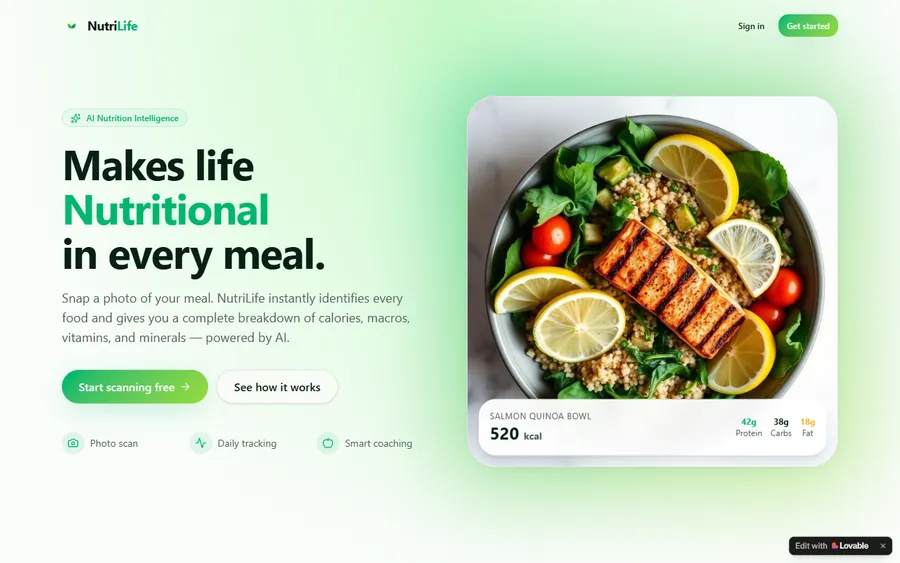
AI and ML
An AI nutrition coach that reads what you eat and works you toward a target.
AI and ML
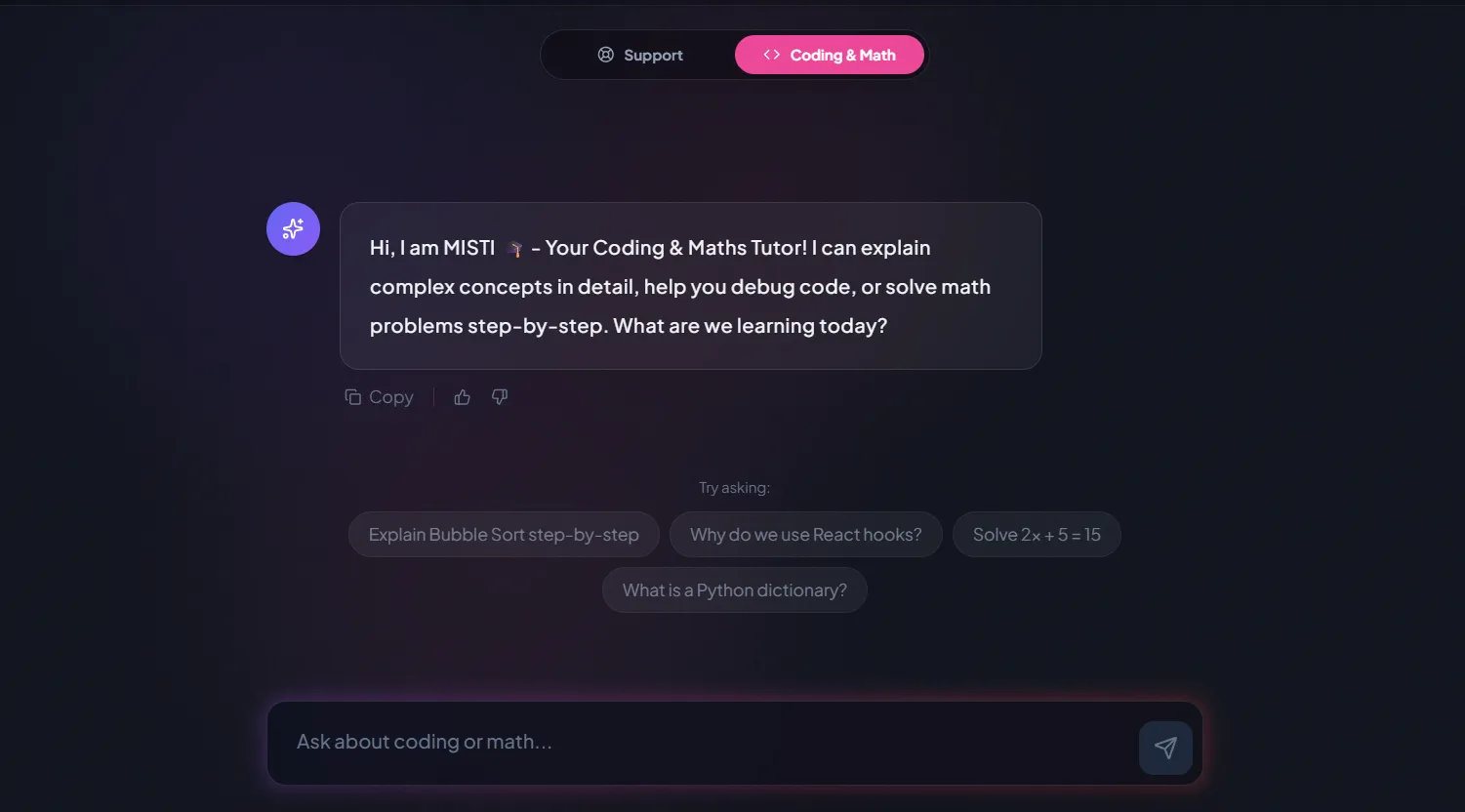
A chatbot that answers mathematics and programming questions, built and deployed by a student.
AI and ML
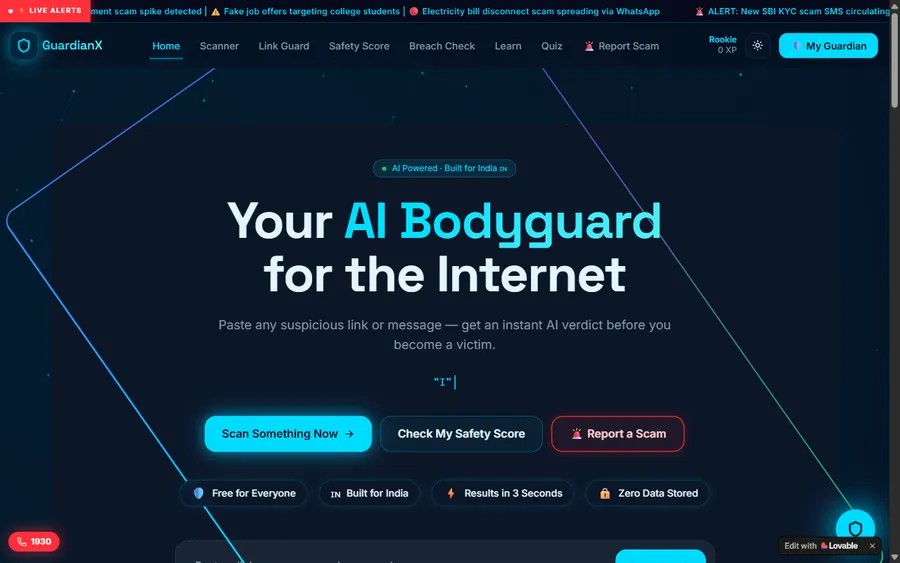
An assistant that helps a young person recognise unsafe situations online.
Web app
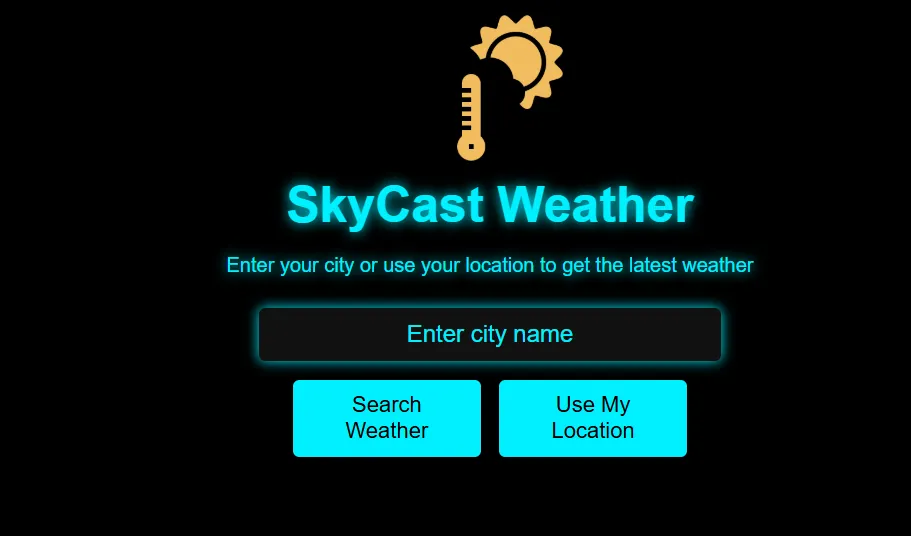
A weather forecasting site with live conditions for any location.
Fees
Billed monthly in US dollars, at the same rate for every country outside India, with no joining charge and no commitment past the current month. Most tools used are free; any paid AI service is your own choice and your own account.
Free first class
USD 0
no card required
Group batch
USD 100
a month, billed in US dollars
One to one
USD 150
a month, billed in US dollars
What families say
Reviews on Google from our students and their families, shown as written.
★★★★★
"The one step solution for my son. Modern Age Coders make learning coding so simple that kids love it. The teachers explain complex concepts clearly with practical exercises and interactive content."
Ria Mukherjee
Parent
★★★★★
"Modern Age Coders has been a game-changer for me. I struggled to grasp IT concepts and coding before joining, but their classes transformed everything. I can now confidently write complex programs with ease."
Samriddha Mondal
Student
★★★★★
"One of the most wonderful education centres out there. Education is not limited to school syllabus but focuses on skill development."
Vansh Agarwal
Student
★★★★★
"My child Dhairya is really enjoying the Modern Age Coders classes. This is his first online class and he eagerly looks forward to it. I can already see his improvement, and the teachers are very cooperative."
Sonam Oswal
Parent of Dhairya
★★★★★
"Modern Age Coders have wonderful teachers who teach in a clear, easy and practical way. The teacher boosts students' confidence and inspires them to learn without hesitation."
Sonu Goyal
Parent
★★★★★
"I highly recommend this computer coding class! The teachers are incredibly knowledgeable and passionate about coding."
Ritu Kedia
Parent
Questions about AI projects
Not safely. The UK text and data mining exception covers copies made for non-commercial research from material you can lawfully access. Commercial projects need data licensed for that use. This is general information, not legal advice.
A licence from The National Archives for public sector information, allowing commercial and non-commercial reuse with attribution. It excludes personal data, logos and third party rights.
The IPO says contract terms that stop researchers making copies to carry out text and data mining will be unenforceable, though publishers may use reasonable measures to protect their networks.
An open-source framework for large language model evaluations, developed by the UK AI Security Institute and Meridian Labs, with over 200 pre-built evaluations. We use tools like it to teach evaluation; we are not connected with either organisation.
School maths is enough to start the teen course. The maths grows with the projects, and it is taught as needed.
Python throughout, with standard machine learning and data libraries.
Younger learners start with Python and AI for Kids, which builds the ideas step by step before full projects.
No. We never work on coursework, NEA or anything submitted for assessment. Projects are separate and the student's own.
Nothing for the first class. Then a group place is USD 100 a month and one-to-one teaching USD 150 a month, and nothing is charged for joining.
Usually a weekday evening, or a longer weekend block for training runs, set in UK time at the first class. India is four and a half hours ahead of British Summer Time and five and a half ahead in winter.
Elsewhere on this site
Training, data and competitions around AI.
How models are measured and assured.
The data skills underneath every model.
A competition for AI projects.
Where younger learners start.
Agents as portfolio evidence.
All our UK pages.
Start here
Leave a number and we will call at a UK time that suits you. Bring an idea; the class checks your level and turns it into a plan with a data source and a test.
Reading first? Every course page lists its syllabus, how we teach sets out the approach, and student labs gathers finished projects.
WhatsApp us · +91 91233 66161 · contact@modernagecoders.com
WhatsApp from a UK number is usually the fastest way to reach us. We are based in India, so our number starts +91; there is no UK office.