AIB / BASE / 01
Algebra foundations
The ground every route stands on.
Open the syllabusGermany · Abitur, IB, A levels · Maths
Families who move to Germany with teenagers often face a choice of route: the German Abitur at a local school, the IB Diploma at an international school, or A levels at a British one. Maths is where the routes differ most, in how it is examined, whether a calculator is allowed and whether it can close doors later. This guide compares the three from their official documents, then explains the German rules that decide what an IB Diploma is worth at a German university.
Live online since 2020 · 10,000+ students worldwide · IB, Abitur and A level maths tutoring in English
In short
The German Abitur tests maths in one long exam with a part without a calculator; IB Maths (AA or AI) adds a compulsory exploration and allows technology in every paper; A level Maths is three two-hour papers with a calculator throughout. Under KMK rules, an IB Diploma with SL maths limits German university choices. Modern Age Coders tutors all three live online in English, in a group or one to one.
One course per route
Whichever route your teenager takes, the mentor teaches to that exam, not to a general syllabus.
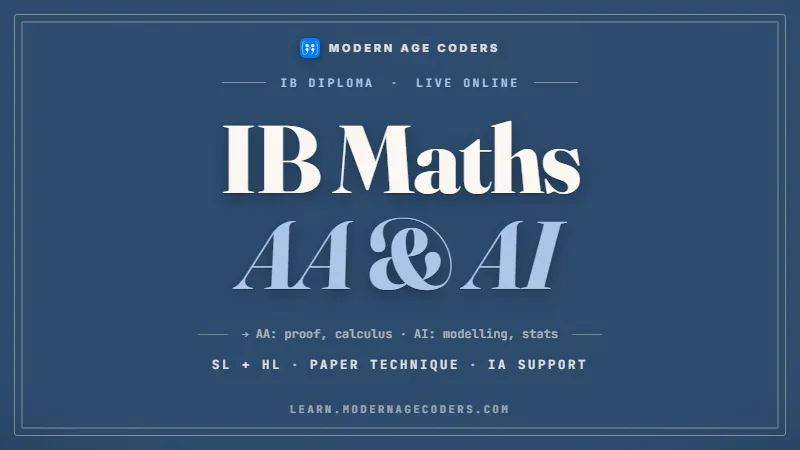
AIB / 01
SL and HL for both IB maths subjects, with coaching on choosing a topic for the exploration.
Open the syllabus →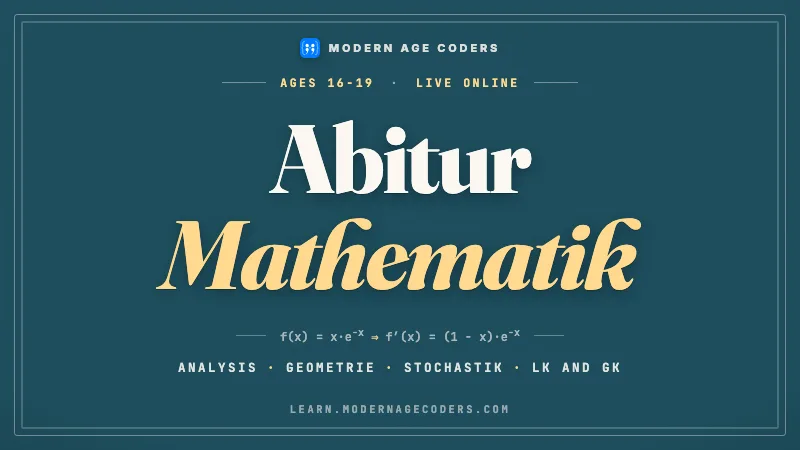
AIB / 02
Grundkurs and Leistungskurs, with practice for the part without aids and full timed papers.
Open the syllabus →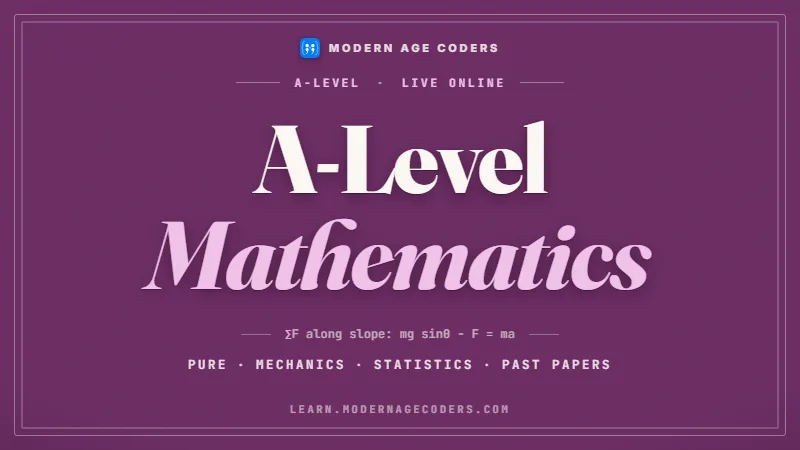
AIB / 03
Pure, mechanics and statistics for pupils at British schools in Germany.
Open the syllabus →Side by side
One column per route, each filled only from that route's own document. For the IB we quote the subject brief for Mathematics: applications and interpretation (AI), because it is the one we could read in full; the IB's other maths subject, analysis and approaches (AA), shares its assessment objectives.
| German Abitur (IQB pool) | IB Maths AI | A level Maths (AQA 7357) | |
|---|---|---|---|
| Levels | Grundkurs (basic) or Leistungskurs (raised) | SL or HL | One level |
| Written exam | One sitting: 255 minutes basic, 300 raised, including choice time | SL: two papers of 1.5 hours; HL: two of 2 hours and one of 1 hour | Three papers of 2 hours each |
| Calculator | None in Part A; Part B with the aids the Land allows | All external assessments use technology | Required in all assessments |
| Coursework | None in the pool exam | Exploration, 20 % at SL and HL | None; all exams at the end |
| Marks | 80 basic, 100 raised | SL papers 40 % each; HL 30, 30 and 20 % | 300 in total, 100 per paper |
| Final scale | 0 to 15 Notenpunkte | IB grades 1 to 7 | A* to E, or U |
| Teaching time | Set by each Land | Recommended 150 hours SL, 240 HL | Not stated in the specification we read |
Sources: IQB, Gemeinsame Abituraufgabenpools der Länder, Mathematik, Beschreibung der Struktur (Stand 19 June 2024); International Baccalaureate, DP Subject Brief, Mathematics: applications and interpretation, first assessments 2021 (copy hosted by the University of Tartu); AQA, A-level Mathematics 7357 specification, Version 1.3, 31 January 2018; IB grade names from the KMK agreement below. Read 2 and 3 November 2026. We did not fetch ibo.org itself.
Dividing the written time by the marks gives a rough sense of pace. A Leistungskurs pupil in the pool exam has 300 minutes for 100 marks, 3 minutes a mark; a Grundkurs pupil 255 for 80, about 3.2. An A level candidate has 360 minutes for 300 marks, 1.2 minutes a mark.
These are our calculations, and the Abitur figures include choice time. They say nothing about difficulty, only about rhythm: A level papers reward speed on many short steps, the Abitur rewards stamina on long connected tasks.
The biggest practical difference is technology. The Abitur pool exam keeps a whole part without any aids; the IB AI brief says every external assessment involves technology; AQA requires a calculator in every paper.
A pupil switching from IB or A levels into a German Oberstufe usually needs the most help with fast, exact work by hand. One moving the other way needs to learn the calculator as a tool, not a crutch.
The Abitur side is explained in full on our page Abitur maths in English, with the marks by area and the 2027 dates in Nordrhein-Westfalen, where the maths papers are on Wednesday 5 May 2027.
Is maths compulsory?
The three routes treat maths very differently, and that matters for a pupil who finds it hard.
The KMK says the Abitur covers four or five exam subjects, and two of them must come from German, a foreign language and maths. In practice almost every pupil keeps maths to the end, and it counts in the overall grade.
For an IB Diploma to count as a university entrance qualification in Germany, the KMK requires maths among the six subjects: either Analysis and Approaches or Applications and Interpretation.
A levels are chosen subject by subject. AQA's specification sets no previous learning requirements for A level Maths, and a pupil who does not choose it simply does not sit it.
The IB in Germany
Yes, under conditions. The KMK has an agreement on recognising the IB Diploma, first adopted on 10 March 1986 and last amended on 15 June 2023. AGIS, the association of international schools in Germany, sums it up: the IB Diploma, with the prescribed subject combinations, is equivalent to the German Abitur. The conditions are where families need to look carefully.
| Condition | What the agreement says |
|---|---|
| Years of school | At least twelve ascending school years of full-time schooling |
| Subjects | Two languages, a natural science, maths (AA or AI), a social science, and a sixth subject from a list |
| Higher Level | From the 2025 exams, one of the three HL subjects must be a language, maths or a natural science |
| Continuity | All subjects taken for the full two years |
| Grades | Each of the six subjects at IB grade 4 or better; one 3 can be offset by a 5 at the same level and at least 24 points in total |
| Maths at SL | Since the 2021 exams: only subject-restricted access, outside maths, science and technology, unless the school is on the KMK's list |
| German | German holders from a school abroad without German in its IB programme must show enough German before study |
Source: KMK, Vereinbarung über die Anerkennung des "International Baccalaureate Diploma / Diplôme du Baccalauréat International", Beschluss vom 10.03.1986 i. d. F. vom 15.06.2023, Anlage 1 Stand 26.03.2026, read 3 November 2026. AGIS homepage, read 2 November 2026. This is a summary, not advice: the university or the Land's certificate office makes the decision.
Footnote 3 of the agreement is the line most families miss. A pupil who sat Mathematics AA SL or AI SL from the 2021 exams on gets, as a rule, only a subject-restricted entry: university courses outside the mathematics, natural science and technology area.
The exception is a list of schools whose graduates meet the maths requirement with SL. Anlage 1 of the agreement, dated 26 March 2026, numbers 59 schools in Germany. If your teenager is at an IB school in Germany and may want to study engineering, computer science or a science, ask the school whether it is on that list, or plan for HL maths.
At sixteen, choosing SL maths can look like the safe option. Under these rules it can quietly close the door to a German engineering or science degree. HL maths keeps it open everywhere.
We are not connected to the KMK, the IB or any school, and we do not give admissions advice. We do help pupils who choose HL to cope with it, which is often what makes the choice possible.
A formula you can run
The KMK agreement gives one formula for the German average grade (Durchschnittsnote) of an IB Diploma: N = 1 + 3 × (Pmax − P) / (Pmax − Pmin), with Pmax = 42 and Pmin = 24, and every total from 42 to 45 points counted as 1.0. We coded it in five lines and tested it the way we teach every formula: at its ends first.
P_MAX, P_MIN = 42, 24      # from the KMK agreement on the IB Diploma

def german_note(points, clamp=True):
    if clamp and points >= P_MAX:          # 42 to 45 points all count as 1.0
        return 1.0
    return 1 + 3 * (P_MAX - points) / (P_MAX - P_MIN)

for p in [24, 27, 30, 33, 36, 39, 42, 45]:
    print(p, "points ->", round(german_note(p), 2))

print("45 points without the 1.0 rule:", round(german_note(45, clamp=False), 2))
Run with Python 3 on 3 November 2026, it prints 24 points -> 4.0, 27 points -> 3.5, 30 points -> 3.0, 33 points -> 2.5, 36 points -> 2.0, 39 points -> 1.5, 42 points -> 1.0, 45 points -> 1.0 and 45 points without the 1.0 rule: 0.5.
The formula is a straight line: every three IB points move the German grade by half a step. 24 points sit at 4.0, the lowest pass grade of the Abitur, and 42 at 1.0, the top.
The agreement says the grade is worked out in the Land where the certificate is assessed, under a further KMK agreement from 1991 that sets the remaining details. We print two decimals; ask the assessing office how the final grade is rounded.
An IB Diploma can reach 45 points. Put 45 into the bare formula and it returns 0.5, a grade that does not exist in Germany. That is why the KMK adds the rule that 42 to 45 points all count as 1.0, and why our function needs its if line.
Testing a formula only in the middle, at 33 or 36, would never reveal that. The ends are where formulas break.
if line, run 43 and 44 points, and write one sentence on why the answers are impossible.Which suits
There is no single right answer, and we do not advise on school choice. But the documents above point to some honest patterns.
On the Abitur, a Leistungskurs with its 300-minute exam is the natural home. In the IB, HL maths keeps every German degree open under the KMK rules. A levels allow maths to be combined with physics or further subjects of the pupil's choice.
Whatever the route, olympiad problems and real programming stretch a strong pupil more than extra exam drill.
The Abitur keeps maths in for almost everyone, so steady support through Qualifikationsphase matters. The IB keeps it in too, and SL maths has the university consequence described above. A levels let a pupil drop maths entirely.
In each case, the earlier the gaps in algebra are closed, the more choices stay open.
All classes are live and in English. For Abitur pupils, the mentor names each German term beside the English.
Mentors adjust to how fast your teenager works and how they speak.
The same person every week, teaching to the exam your teenager actually sits.
Planning ahead
Our own outline for the last two school years on each route. Adjusted for every pupil.
| Stage | Abitur | IB Maths | A level Maths |
|---|---|---|---|
| First term | Functions and derivatives | Algebra and functions; choose SL or HL with care | Pure foundations: algebra, proof |
| First year | Analysis, start geometry | Calculus, statistics; exploration topic | Pure, then mechanics or statistics |
| Second year, autumn | Stochastik, mixed practice | Write the exploration | Full syllabus, first past-style papers |
| Final months | Part A without aids, full mocks | Timed papers with technology | Three timed papers, 2 hours each |
If your teenager is at an IB school, check before Year 1 of the Diploma whether SL maths would limit later study in Germany.
For the Abitur, ask the school which Leistungskurse it runs; not every school offers every combination.
Practise in the conditions of your exam: without a calculator for Abitur Part A, with your calculator for IB and A levels.
Test every formula you learn at its smallest and largest values.
More maths
Taught live in English, each with a regular mentor and the choice of a class or private lessons.
AIB / BASE / 01
The ground every route stands on.
Open the syllabusAIB / BASE / 02
Before A levels or the IB.
Open the syllabusAIB / BASE / 03
Algebra to calculus, step by step.
Open the syllabusAIB / MORE / 01
For the strongest A level pupils.
Open the syllabusAIB / MORE / 02
The area all three routes test.
Open the syllabusAIB / MORE / 03
A first look at degree-level calculus and linear algebra.
Open the syllabusAIB / STRETCH / 01
German competitions, our own problems.
Open the syllabusAIB / STRETCH / 02
International competition maths.
Open the syllabusAIB / STRETCH / 03
For UK university maths tests.
Open the syllabusHow classes run
Weekdays or weekends, flexible: choose your batch, or for a very personalised plan choose 1-on-1 at your convenience, weekend mornings or weekdays. Groups are formed by route and level, so an IB HL pupil never sits in an Abitur Grundkurs group.
Afternoon
For example 14:45 German time, 19:15 in India in winter.
Early evening
For example 17:15 German time, 20:45 in India after 28 March 2027.
1-on-1
Sunday from 09:00, or a slot of your choosing.
Abitur, IB and A level pupils taught in separate groups.
Calculator or none, as your exam demands.
For Abitur pupils, every word from the paper.
For IB pupils: topic choice and method, never writing it.
Marked against the right scale for the route.
Fifteen to twenty in a batch, or private lessons.
Student work
Many of our maths students also code. A few of their projects are shown below; the student labs page collects more.

AI and ML
An AI nutrition coach that reads what you eat and works you toward a target.

AI and ML
A chatbot that answers mathematics and programming questions, built and deployed by a student.

AI and ML
An assistant that helps a young person recognise unsafe situations online.

Web app
A weather forecasting site with live conditions for any location.
Fees
Billing is monthly, for eight live classes. We display the euro amount using the European Central Bank reference rate, but the payment is processed in US dollars, so your bank handles the conversion and the final figure may vary slightly.
Free first class
Free
no card required
Group batch
€90
a month, eight live classes, charged in US dollars
One to one
€134
a month, eight live classes, charged in US dollars
What families say
Google reviews by parents and students, quoted exactly.
★★★★★
"The one step solution for my son. Modern Age Coders make learning coding so simple that kids love it. The teachers explain complex concepts clearly with practical exercises and interactive content."
Ria Mukherjee
Parent
★★★★★
"Modern Age Coders has been a game-changer for me. I struggled to grasp IT concepts and coding before joining, but their classes transformed everything. I can now confidently write complex programs with ease."
Samriddha Mondal
Student
★★★★★
"One of the most wonderful education centres out there. Education is not limited to school syllabus but focuses on skill development."
Vansh Agarwal
Student
★★★★★
"My child Dhairya is really enjoying the Modern Age Coders classes. This is his first online class and he eagerly looks forward to it. I can already see his improvement, and the teachers are very cooperative."
Sonam Oswal
Parent of Dhairya
★★★★★
"Modern Age Coders have wonderful teachers who teach in a clear, easy and practical way. The teacher boosts students' confidence and inspires them to learn without hesitation."
Sonu Goyal
Parent
★★★★★
"I highly recommend this computer coding class! The teachers are incredibly knowledgeable and passionate about coding."
Ritu Kedia
Parent
Families ask
Under conditions. The KMK agreement of 10 March 1986, as amended on 15 June 2023, recognises the IB Diploma as a university entrance qualification if it includes the required subjects, including maths, after at least twelve school years, with every subject at IB grade 4 or better (one 3 can be offset).
It can. The KMK agreement says that from the 2021 exams, a Diploma with Mathematics AA SL or AI SL gives only subject-restricted access, to courses outside maths, science and technology, unless the school is on the KMK's list; Anlage 1 of 26 March 2026 numbers 59 schools in Germany.
With the KMK formula N = 1 + 3 (42 minus P) / (42 minus 24), where P is the IB total; 42 to 45 points count as 1.0. So 24 points give 4.0, 33 give 2.5 and 39 give 1.5. The Land that assesses the certificate calculates the final grade.
Not in Part A of the shared pool exam, which is done without any aids. Part B allows the aids your Land permits. In the IB AI brief every external assessment involves technology, and AQA A level Maths requires a calculator in all papers.
In the Abitur pool exam, 255 minutes at basic level and 300 at raised level, including choice time. IB Maths AI has two papers of 1.5 hours at SL, and at HL two of 2 hours plus one of 1 hour. AQA A level Maths has three papers of 2 hours each.
Our sources for this page do not cover A level recognition, so we do not state a rule. Ask the admissions office of the university your teenager is considering, early.
No, we teach only in English, live, with mentors in India who adapt to your teenager's pace and accent. Abitur pupils also learn the German term for every idea, because their paper is in German.
Weekdays or weekends, flexible: choose your batch, or for a very personalised plan choose 1-on-1 at your convenience, weekend mornings or weekdays. German afternoons are early evening for our mentors in India.
No. We teach maths. We are not connected to the KMK, the IB, AQA, the IQB or any school, and the decisions on recognition rest with universities and the Land's offices.
Monthly. The page shows euro at the European Central Bank reference rate; the card is charged in US dollars, which your bank converts. The first class is free and needs no card.
Elsewhere on this site
More for teenagers in Germany.
The pool exam in detail, with practice tasks.
Our page on the applications course at SL.
The three papers in detail.
How we coach the internal assessment.
All our Germany pages.
Inside a live class.
Start here
Tell us the route and the level. In the first class the mentor sets a short task in the style of that exam, sees where marks would be lost, and suggests a plan.
If you want to read first: the IB maths syllabus, the Abitur maths syllabus and how we teach.
WhatsApp us · +91 91233 66161 · connect@modernagecoders.com
Live online lessons in English, given by mentors in India. WhatsApp reaches us fastest.
A priority demo is a full class of about 45 to 60 minutes. After the class the mentor sends a written skill report and a personal learning roadmap on WhatsApp. If you enrol, the demo fee is adjusted against your first month's fee. Share your demo Order ID with us on WhatsApp and we take it off.
Book a priority demo