Table of Contents
- Why Our Exam Is Intentionally Tough
- The Numbers Don't Lie: Our Passing Rates
- Why We Refuse to Make It Easy
- What We Actually Test (And How We Design Questions)
- You Failed? Good. Let's Make You Stronger.
- The Real Reason Behind Our Strictness
- What Makes Our Certificate Different From Everyone Else?
- How We Teach: It's Not Just About the Exam
- Stories From Students Who Made It
- A Breakdown of What Each Track Demands
- The Certificate Distribution: When Hard Work Meets Celebration
- A Message to Students (and Parents)
- The Bottom Line
Let's talk about something that most coding schools will never say out loud.
Most certificates in this industry are worthless. You pay the fee, you sit through the videos, you click "complete" -- and boom, you get a shiny PDF with your name on it. Nobody checks if you actually learned anything. Nobody cares if you can write a single line of code on your own. The certificate exists to make you feel good. That's it.
We're not going to pretend that's okay. Because it's not.
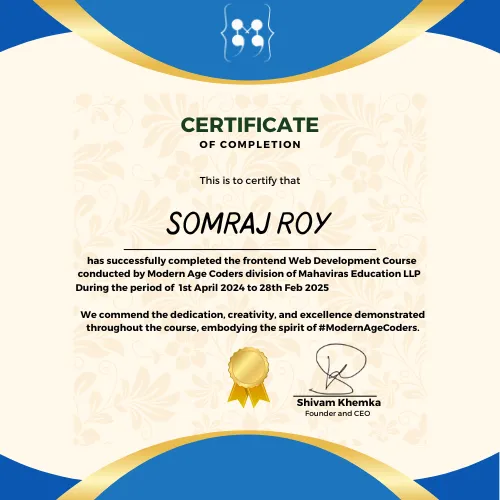
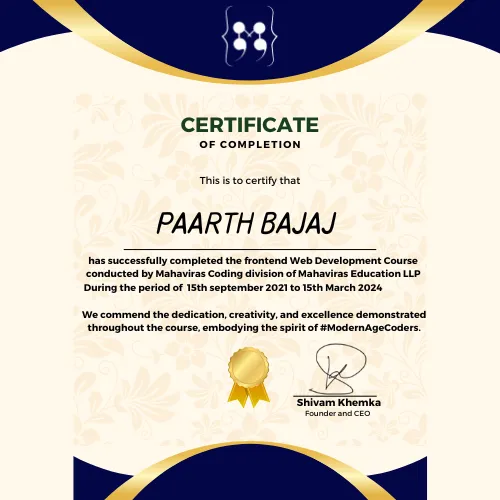
At Modern Age Coders, our certificate means something. It means you sat down, you struggled, you failed, you got back up, you practised until your fingers hurt -- and then you passed. Not because someone handed it to you. Because you earned it.
Why Our Exam Is Intentionally Tough
Here's the honest truth: we designed our certification exam to be hard. Not "hard" in the way that trick questions are hard. Not "hard" in the way that confusing instructions are hard. Hard in the way that actually knowing your stuff is hard.
Every single question in our exam is crafted with one goal: to find out if you truly understand the concept, or if you just memorised the syntax. There's a massive difference between someone who can type for i in range(10) and someone who understands why a loop works, when to use it, and what happens when things go wrong.
We test for the second kind. Always.
Fair Warning
If you're looking for a quick certificate to add to your LinkedIn, this is not the place. Our exam will challenge you. That's the whole point.
Our questions are designed to test:
- Conceptual understanding -- Can you explain what's happening under the hood, not just what you see on screen?
- Logical thinking -- Can you break down a problem you've never seen before and figure out a path forward?
- Application skills -- Can you take what you've learned and use it in a real scenario, not just a textbook exercise?
- Debugging ability -- Can you read broken code and figure out what went wrong, without someone holding your hand?
- Code writing from scratch -- No multiple choice safety nets. You write the code. On paper or on screen. From nothing.
This is what separates a certificate that gets you hired from a certificate that gets you ignored.
The Numbers Don't Lie: Our Passing Rates
We're going to show you something that most coding schools would never share publicly -- our actual passing rates. Most schools boast "100% completion rates" because completion means nothing. You showed up? Congratulations, here's your certificate.
That's not us. Look at these numbers:
| Course / Track | First-Attempt Passing Rate | Difficulty Level |
|---|---|---|
| HTML, CSS Basics & AI-Assisted Coding | 60% | Accessible -- High chance with consistent effort |
| Python Fundamentals & Beginner Programming | 35% | Moderate -- Requires solid logical thinking |
| Java Fundamentals | 30% | Moderate -- Object-oriented concepts trip many up |
| Python Advanced Concepts, AI & ML | 21% | Challenging -- Deep understanding required |
| JavaScript & Frontend Development | 20% | Challenging -- DOM, async, and real projects tested |
| Data Science with Python | 18% | Hard -- Statistics + code + real data analysis |
| Java Advanced Concepts & App Development | 9% | Very Hard -- Architecture, design patterns, real builds |
| Full Backend, React & DSA | 8% | Very Hard -- Only the truly dedicated clear this |
Read that again. 8% passing rate for Full Backend + React + DSA. That's not a typo. That's how seriously we take this.
Now, before you panic -- these are first-attempt passing rates. Most of our students don't pass on the first try for the advanced tracks. And that's completely fine. In fact, that's the whole point. The exam is supposed to show you where your gaps are. It's supposed to push you. It's supposed to make you realise that coding isn't about rushing through tutorials -- it's about deep, patient, honest learning.
What These Numbers Really Mean
A 20% passing rate doesn't mean 80% of students fail forever. It means 80% of students need more time, more practice, and more depth before they're truly ready. And we're here for every single one of them.
Why We Refuse to Make It Easy
We've had parents call us and ask, "Can you make the exam a little easier?" We've had students send emails saying, "I've been studying for two months, can't you just give me the certificate?" We've had people tell us we're being too strict, too demanding, too intense.
And every single time, our answer is the same: No.
Not because we're cruel. Not because we enjoy watching students struggle. But because we've seen what happens when you hand someone a certificate they didn't earn.
They walk into a job interview. They can't answer basic questions. They get rejected. They feel like they failed -- when really, their education failed them. The school that gave them a meaningless certificate set them up for embarrassment.
We refuse to be that school.
The certificate you earn through struggle will always be worth more than the certificate you receive through attendance.
, Modern Age Coders
What We Actually Test (And How We Design Questions)
Let's pull back the curtain. Our exam questions aren't pulled from some question bank or copied from the internet. Every single question is written by our senior instructors, reviewed by the team, and tested before it goes into an exam.
Here's how we think about question design:
Level 1: Do You Understand the Basics?
These questions check if you actually understand foundational concepts. Not "what is a variable" -- but "what happens to memory when you declare a variable inside a loop versus outside it?" Not "write a function" -- but "why would you use a function here instead of writing the code directly?"
Level 2: Can You Think Through Problems?
Here's where most students hit a wall. We give you a problem you've never seen in class. No hints. No template. Just a clear description of what needs to happen, and you have to figure out how to build it. This is what real coding looks like. Your future boss isn't going to give you a tutorial -- they're going to give you a problem and expect a solution.
Level 3: Can You Debug and Fix?
We hand you broken code. It almost works, but not quite. Something's off. Maybe it's a logical error. Maybe it's an edge case that crashes everything. Maybe the code runs fine but produces the wrong output. Your job is to find the bug, explain why it's happening, and fix it. If you can do this consistently, you're a real coder.
Level 4: Can You Build From Scratch?
The final test. No starter code. No reference. Just you, a blank editor, and a project brief. Build it. Make it work. Make it clean. This is the part that separates the students who genuinely learned from the students who just watched someone else code on YouTube.

You Failed? Good. Let's Make You Stronger.
Here's where we're different from every other school you've seen.
Most schools, if you fail their exam (assuming they even have a real one), they say "better luck next time" and move on to the next batch. You're on your own. Figure it out yourself.
At Modern Age Coders, when you fail, we sit down with you. Not to judge you. Not to lecture you. To understand where things went wrong.
- Was it a conceptual gap? We go back to that topic and teach it differently -- maybe with a new analogy, a different project, a hands-on exercise
- Was it a logical thinking issue? We give you targeted problem-solving drills until that muscle gets stronger
- Was it exam anxiety? We practise together. We do mock exams. We build your confidence until the real exam feels normal
- Was it a time management problem? We work on speed and efficiency without sacrificing understanding
We don't give up on you. Ever. We teach you again. We drill it again. We explain it from a different angle. We assign you a different project. We sit with you until the lightbulb goes on.
And when it does -- when you finally pass that exam you failed three times before -- that certificate isn't just a piece of paper anymore. It's proof of resilience. It's proof that you don't quit. And trust us, employers notice that.
Our Promise
If you fail, we don't abandon you. We re-teach, we re-train, we re-prepare you. You keep going until you're genuinely ready. No extra fees for re-examination. No shame. Just growth.

The Real Reason Behind Our Strictness
Let's zoom out for a second. Why do we put ourselves through this? Why do we spend extra hours re-teaching students who fail? Why do we design exams that most students don't pass on the first try? Why don't we just... make it easy?
Because we love this craft. We genuinely, deeply love coding. And we've seen what it can do when someone truly learns it.
We've seen a 14-year-old build a working e-commerce site from scratch. We've seen a 45-year-old career changer land their first tech job. We've seen a college student go from "I can't do this" to building full-stack applications that actually get users. We've seen kids as young as 8 understand logical thinking patterns that some adults struggle with.
None of that happens with shortcuts. None of that happens with easy exams and participation certificates. That kind of transformation only happens when someone is pushed, supported, pushed again, and given the space to grow at their own pace.
That's what we do. We push. We support. We push again. And we never, ever stop believing that our students can get there.
What Makes Our Certificate Different From Everyone Else?
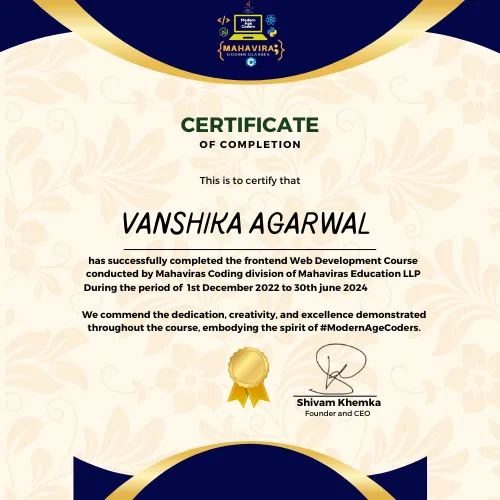
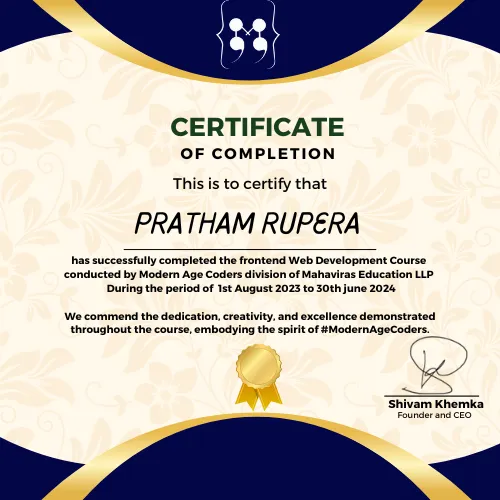
Walk into any tech meetup and tell someone you have a certificate from a random online course. You'll probably get a polite nod and a change of subject. Now tell them you have a certificate from a programme with a 8% passing rate for advanced tracks. That gets a different reaction.
Here's what sets our certificate apart:
- Verifiable credentials -- Every certificate has a unique ID. Anyone can verify it. Employers check. We've seen it happen.
- Skill-specific, not generic -- Your certificate says exactly what you know. "Python Fundamentals" doesn't mean you watched Python videos. It means you can write Python code, debug it, and build projects with it.
- Respected by employers -- We work with companies that specifically look for Modern Age Coders alumni because they know what our certificate represents.
- Portfolio-backed -- Your certificate isn't standalone. It comes with a portfolio of real projects you built during the course. The certificate opens the door; the portfolio seals the deal.
- LinkedIn-ready -- Share it publicly. Let the world know. When someone clicks on it, they see the real deal.
How We Teach: It's Not Just About the Exam
The exam is the final checkpoint, but the magic happens in how we teach. Let us walk you through what a typical learning journey looks like at Modern Age Coders.
We Teach You How to Think, Not What to Type
This is the biggest difference. Most coding courses teach you syntax. "Here's how you write an if-statement. Here's how you create a list. Here's how you make a function." Great -- you can type code. But can you think in code?
At Modern Age Coders, we spend a huge amount of time on logical reasoning and computational thinking. Before you write a single line of code, you learn to break problems into smaller pieces. You learn to spot patterns. You learn to think about edge cases. You learn to plan before you build.
That's the skill that lasts. Languages change. Frameworks come and go. But the ability to think logically and solve problems? That's forever.
Real Projects From Day One
We don't do "Hello World" for three weeks. By the end of your first week, you're building something real. Something you can show your friends. Something that actually works. That's not an accident -- it's by design. When students build real things, they stay motivated. They see the point. They push harder because they can see the results of their effort.
One-on-One Feedback That Actually Helps
Every student gets personalised feedback on their code. Not "good job!" or "needs improvement." Real, detailed feedback. "Your loop works, but here's why it's inefficient at scale." "This function does too many things -- here's how to split it." "Your logic is correct but your naming makes it hard to read."
This is how professional developers grow. Code review is how the real world works, and we bring that into the classroom.

Stories From Students Who Made It
Let us share a few stories. Real stories. No names changed (shared with permission), no details embellished.
I failed the JavaScript exam twice. The first time, I thought I knew enough. I didn't. The second time, I was closer but still had gaps in async programming. My instructor didn't just tell me to study harder -- she sat with me for three extra sessions and we went through every single concept I was struggling with. The third time, I passed. That certificate is the proudest thing on my wall.
, A Student, Age 17
Coming from a non-tech background, I was terrified. Python seemed impossible at first. But the way they teach -- breaking everything into small, manageable pieces -- it just clicked over time. When I finally passed the certification, I actually cried. Not because it was easy, but because I never thought I could do something like this.
, A Student, Age 34, Career Changer
My son failed his first exam and was really upset. But his teacher called us and explained exactly what he needed to work on. They gave him extra exercises, extra projects, extra support. When he passed the second time, the confidence boost was incredible. He's now building his own games in Python and talks about becoming a software engineer.
, A Parent
A Breakdown of What Each Track Demands
Let's give you a clearer picture of what each certification track actually involves and why the passing rates are what they are.
HTML, CSS & AI-Assisted Coding (60% Pass Rate)
This is our most accessible track, but don't mistake "accessible" for "easy." You need to demonstrate that you can build responsive web pages from scratch, understand CSS layouts like Flexbox and Grid, and use AI tools meaningfully -- not just copy-paste from ChatGPT. The 60% pass rate reflects the fact that these are fundamentally visual skills. You can see when your layout is broken, and that feedback loop helps you learn faster.
Python Fundamentals (35% Pass Rate)
This is where it gets real. Python looks simple on the surface -- clean syntax, readable code. But our exam tests whether you actually understand data structures, control flow, functions, file handling, and error management at a deep level. Writing code that works is the minimum. We test whether you understand why it works.
Java Fundamentals (30% Pass Rate)
Java introduces object-oriented programming, and that's a paradigm shift for most students. Classes, objects, inheritance, polymorphism, encapsulation -- these aren't just vocabulary words on our exam. You have to design class hierarchies, explain your design choices, and build working applications using OOP principles properly.
JavaScript & Frontend (20% Pass Rate)
JavaScript is deceptively complex. Our exam covers DOM manipulation, event handling, asynchronous programming (callbacks, promises, async/await), API integration, and building interactive web applications. Many students can follow along with tutorials but freeze when given a blank page and a project brief. That's exactly what our exam does.
Python Advanced, AI & ML (21% Pass Rate)
Advanced Python isn't just "more Python." It's algorithms, data processing, machine learning fundamentals, and understanding how AI models work under the hood. You need to demonstrate that you can train a model, evaluate its performance, and explain your decisions. No hand-waving. No buzzwords. Real understanding.
Data Science with Python (18% Pass Rate)
Data science combines coding, statistics, and domain knowledge. You need to clean real datasets, perform meaningful analysis, create visualisations that actually communicate insights, and build predictive models. The exam uses real-world messy data -- not the clean, curated datasets you see in tutorials.
Java Advanced & App Development (9% Pass Rate)
Architecture. Design patterns. Database integration. API development. Real application building. This track is for students who want to build production-quality software, and our exam reflects that. Nine percent pass on the first attempt. Those who do are genuinely ready for industry work.
Full Backend, React & DSA (8% Pass Rate)
The most demanding track we offer. Full-stack development with React, backend APIs, database design, authentication, deployment, and data structures and algorithms. Eight percent pass rate. Every single person who clears this exam can walk into a tech company and contribute from day one. That's not marketing -- it's fact.
The Certificate Distribution: When Hard Work Meets Celebration
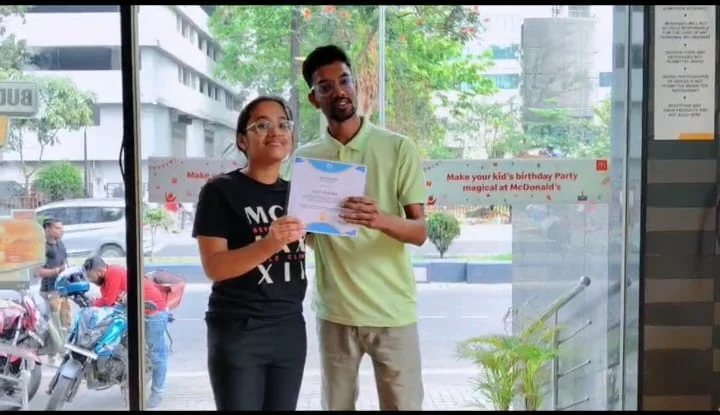
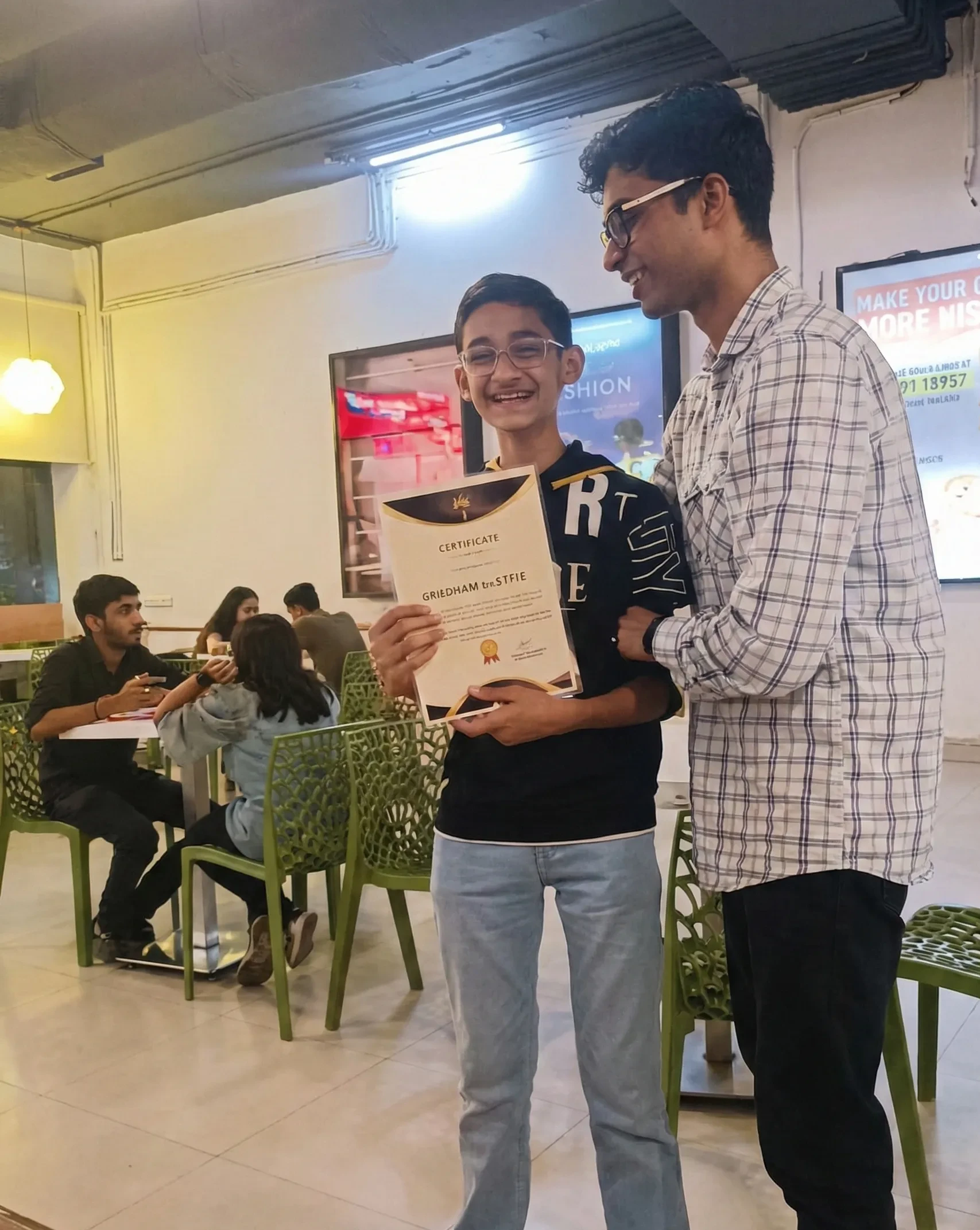
When a student finally earns their certificate, we don't just email it to them. We celebrate. Properly.
Our certificate distribution events are some of the most emotional days in our calendar. Parents who watched their children struggle for months see them walk up and receive that certificate with shining eyes. Students who failed two, three, even four times hold that certificate like it's the most valuable thing they own. Because for many of them, it is.



These moments remind us why we do what we do. Every tough question, every extra tutoring session, every late-night doubt session with a worried parent -- it all leads here. To a room full of people who earned something real.
A Message to Students (and Parents)
To Students:
If you're reading this and feeling intimidated -- good. That means you understand what's at stake. But here's what we want you to know: you can do this. Not because it's easy. Because you're capable of doing hard things.
Every single person who earned our certificate felt exactly what you're feeling right now. They were scared. They doubted themselves. They wondered if they were smart enough. And then they showed up, put in the work, and proved to themselves that they were.
We're not asking you to be perfect. We're asking you to be persistent. Show up. Try. Fail. Learn. Try again. That's all it takes.
To Parents:
We know it's hard to watch your child struggle. Every instinct tells you to make it easier for them. But we promise you this -- the struggle is where the growth happens. When your child finally passes that exam, they won't just have a certificate. They'll have confidence. They'll have proof that they can overcome challenges. They'll carry that with them for the rest of their lives.
And if they fail? We're right there with them. We don't send them home with a "try harder" message. We sit down, we figure out what went wrong, and we teach them until they're ready. That's our commitment to you and to your child.
The Bottom Line
In a world where certificates are handed out like candy, we chose to be different. Our certificate is hard to get. Our exam is designed to challenge you. Our passing rates are low.
And that's exactly why our certificate matters.
Because when you hold a Modern Age Coders certificate, it doesn't just say "completed a course." It says "I can code. I can think. I can solve problems. I can build things. And I earned this through real effort."
That's the kind of certificate that opens doors. That's the kind of certificate that gets you noticed. That's the kind of certificate that stays valuable long after the course is over.
Earned. Not given.
Ready to Earn Yours?
Start your coding journey with Modern Age Coders. It won't be easy, but it will be worth it. Book a free demo class and see what real coding education looks like.