AIAI / WORK / 01
Vibe Coding for Adults
Describe a small work tool, then read every line it needs.
Open the syllabusHong Kong · AI online · Every age
Search for an AI course in Hong Kong and three very different things come back: free self-paced lessons, subsidised courses that the Continuing Education Fund can partly repay, and live classes with a tutor. Each suits a different person. This page sets out what each one is, what the CEF really asks of you, and where a live one-to-one course is worth paying for. Ours are taught live in English by a mentor who works with you alone.
Teaching live since 2020 · 10,000+ students worldwide · in Hong Kong every class is one to one, online, in English
The short answer
Modern Age Coders offers an online AI course for Hong Kong learners of any age: live classes, taught one to one in English, at the Hong Kong hours you choose. You learn what AI is, how to use and fact-check generative AI tools, and, if you want to build, Python and real models. We are not registered with the Continuing Education Fund, so fees cannot be claimed from it; if a subsidy matters most, check the fund's course search first. If you want a tutor who follows your own goals and pace, the first class is free.
Start here
Three starting points cover most adults and older students. Taken from Hong Kong, each runs as private live lessons with a mentor who adapts it to you.
AIAI / 01
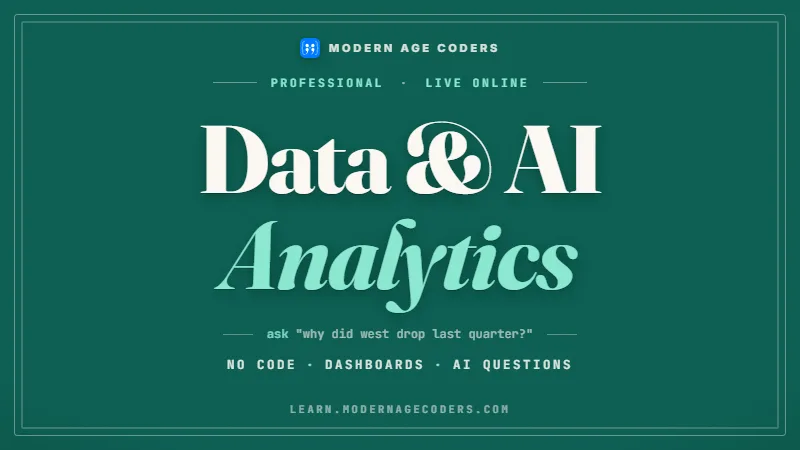
For office staff, teachers, parents and retirees. Spreadsheets, dashboards, prompting and checking claims, using AI tools offered in Hong Kong or provided by your employer, with every exercise built around work you already do.
Open the syllabus →
AIAI / 02
Python, machine learning, deep learning and generative AI from the ground up, for career changers, graduates and the technically curious.
Open the syllabus →
AIAI / 03
For a secondary student in the family. Python and real models, with AI tools used only where their makers' terms allow the student's age.
Open the syllabus →Three kinds of course
Broadly three, and the right one depends on whether you most need a low price, a subsidy, or someone who will teach you personally. Almost everyone in Hong Kong can take any of them from home.
| Free self-paced course | Subsidised registered course | Live one-to-one tutor (ours) | |
|---|---|---|---|
| What you pay | Nothing | A fee, part of which the CEF may later repay | A monthly fee; no subsidy |
| Who teaches | Recorded text, video and quizzes | The provider's lecturers, often to a class | One mentor, for you alone |
| Pace | Your own, entirely | The provider's timetable | Set by you, lesson by lesson |
| When | Any time | Fixed sessions | Hours you book |
| Help when stuck | Forums, if any | During or after class | Immediately, in the lesson |
| Completion rules | None | Attendance and assessment thresholds for the subsidy | None beyond your own goals |
| Suits | Curious, self-driven learners | Adults for whom a subsidy and a provider's certificate matter | People with a specific goal or who learn better with a person |
Our own comparison. The subsidy column summarises the Continuing Education Fund’s overview page (Working Family and Student Financial Assistance Agency, read 23 November 2026); individual registered courses set their own formats. We name no other provider and quote no other provider’s fees.
The Census and Statistics Department's survey for 2025 found that 96.9% of households had internet access at home, and that 96.4% of people aged 10 and over had used the internet in the previous year (Thematic Household Survey Report No. 86, published 25 June 2026).
The same survey shows older residents online too: internet use among people aged 65 and over rose from 84.0% in 2024 to 87.1% in 2025. A live online course is no longer only for the young.
A recorded lecture is online. So is a live lesson where someone watches you try, notices the moment you get lost and explains it a different way. Both have their place, but they are not the same product, and a search result will not tell you which you are buying.
Ask any provider two questions: is a person teaching me live, and how many other learners are in the room? With us the answers are always yes, and none.
The Continuing Education Fund
Only for a course registered with the fund, and only if you meet its conditions. We are not registered, so our fees cannot be claimed back. Here is what the fund itself says, so that you can judge any course fairly.
| Rule | What the fund's page says (our summary) |
|---|---|
| Who it is for | Adults aged 18 or above when the course starts, who meet the residential requirements |
| Total subsidy | Up to 25,000 Hong Kong dollars per person, across as many claims as you like |
| Means test | None: reimbursement is non-means-tested |
| When to claim | Within one year of successfully completing the course |
| Attendance | At least 70% of the contact hours, or more if the course demands it |
| Assessment | An overall mark of at least 50%, or more if the course demands it |
| Your share of the fee | 20% of the course fee while using the first 10,000 dollars of subsidy, 40% for the remaining 15,000 |
| Before enrolling | Check that the course is registered and still valid in the fund's Course Search Engine |
| Applies to | Courses that began on or after 1 August 2022 |
Source: Working Family and Student Financial Assistance Agency, Continuing Education Fund overview page, read 23 November 2026. The second column is our plain-English summary; the agency’s page and guidance notes are the authority, and the rules can change. This is general information, not advice on your own eligibility.
The subsidy is generous and not means-tested, so for many adults it is the obvious first look. But it repays you after you finish, it asks you to attend and pass, and it covers only courses on the fund's register.
Your share is never zero. Even inside the first tier you pay a fifth of the fee yourself, and the share rises after that. The fund's own advice is to consider your situation and check a course's registration before you enrol.
Some people take a subsidised course and then want help applying it: a project at work, a stuck piece of code, a topic the class rushed. A few one-to-one lessons alongside or after a registered course is a common pattern.
Others simply need hours and a pace that a timetabled class cannot offer. Paying a monthly fee for a private mentor is a different choice from a subsidised class, not a cheaper or dearer version of the same thing.
Whatever you choose, keep the Digital Policy Office’s advice in mind for any AI course: its 2025 guideline asks users to be “fully aware of the potential for falsity in content generated by AI” and to “proactively verify the authenticity of the content.” A good course teaches that habit in its first week.
Free options
Yes, and for some people a free course is all they need. The honest question is what you want at the end: general understanding, or a skill you can use with someone checking your work.
Elements of AI is "a series of free online courses created by MinnaLearn and the University of Helsinki", and its homepage invites you to "Join over 2 million other people learning about the basics of AI." Its courses "can be completed at your own pace".
Its first part needs no programming. For its second part, Building AI, the site says "Some basic Python programming skills are recommended".
If you want to understand what AI is and follow the news with confidence, a free self-paced course may be all you need. Start there; you lose nothing.
If you have tried a free course and stalled, or you need a specific result (a working tool for your job, a model for a project, a child who actually finishes), a live tutor solves the part that self-paced courses cannot: someone noticing exactly where you are stuck.
Source: Elements of AI homepage, read 23 November 2026. We have no connection with Elements of AI, MinnaLearn or the University of Helsinki and mention the course only as a free option.
Our own AI course for beginners page describes how a first month with a mentor differs from a self-paced start, and AI classes for adults shows the adult route in more detail.
A real lesson
By retrieving a passage first and answering from it, or declining when nothing fits. This lesson builds the retrieval half with no AI model at all, using our own notes on the CEF rules above, so that adults see why assistants sometimes cite the wrong thing.
# Answer only from your notes, or say you cannot: a tiny retrieval program with no AI model at all.
# The notes are our own short summaries of the CEF overview page (WFSFAA, read 23 November 2026).
import math, re
from collections import Counter

NOTES = [
    "The fund subsidises adults aged 18 or above who take continuing education and training.",
    "Each applicant can be reimbursed up to 25,000 Hong Kong dollars in total; it is not means-tested.",
    "Claims must be made within one year of successfully completing a registered course.",
    "You must attend at least 70 percent of the contact hours of the course.",
    "You must reach an overall assessment mark of at least 50 percent.",
    "Check that a course is registered and still valid in the Course Search Engine before you enrol.",
]
STOP = set("a an the of to and or in is it be can i my me you your for on at do does how what if".split())

def words(text, stem=False):
    found = [w for w in re.findall(r"[a-z0-9]+", text.lower()) if w not in STOP]
    return Counter(w[:5] if stem else w for w in found)      # crude stem: keep the first five letters

def cosine(a, b):
    dot = sum(a[w] * b[w] for w in a)
    norm = math.sqrt(sum(v * v for v in a.values())) * math.sqrt(sum(v * v for v in b.values()))
    return dot / norm if norm else 0.0

def answer(question, stem, threshold=0.25):
    q = words(question, stem)
    score, note = max((cosine(q, words(n, stem)), n) for n in NOTES)
    if score < threshold:
        return f"[{score:.2f}] Not in my notes. Ask the fund's office or read its own pages."
    return f"[{score:.2f}] {note}"

QUESTIONS = [
    "What attendance is required for the course?",
    "How much can I be reimbursed in total?",
    "How old do I need to be?",
    "Is there an age limit for adults?",
    "Can I claim for a course I take online from an overseas school?",
]
for stem in (False, True):
    print("Whole words" if not stem else "First five letters")
    for question in QUESTIONS:
        print("  Q:", question)
        print("  A:", answer(question, stem))
The six notes are our own summaries of the fund's overview page, written for this exercise; read the fund's page itself for the rules. The program uses only Python's standard library. Run it and the output below is what you see.
Whole words
  Q: What attendance is required for the course?
  A: [0.32] Check that a course is registered and still valid in the Course Search Engine before you enrol.
  Q: How much can I be reimbursed in total?
  A: [0.32] Each applicant can be reimbursed up to 25,000 Hong Kong dollars in total; it is not means-tested.
  Q: How old do I need to be?
  A: [0.00] Not in my notes. Ask the fund's office or read its own pages.
  Q: Is there an age limit for adults?
  A: [0.15] Not in my notes. Ask the fund's office or read its own pages.
  Q: Can I claim for a course I take online from an overseas school?
  A: [0.21] Not in my notes. Ask the fund's office or read its own pages.
First five letters
  Q: What attendance is required for the course?
  A: [0.41] You must attend at least 70 percent of the contact hours of the course.
  Q: How much can I be reimbursed in total?
  A: [0.32] Each applicant can be reimbursed up to 25,000 Hong Kong dollars in total; it is not means-tested.
  Q: How old do I need to be?
  A: [0.00] Not in my notes. Ask the fund's office or read its own pages.
  Q: Is there an age limit for adults?
  A: [0.15] Not in my notes. Ask the fund's office or read its own pages.
  Q: Can I claim for a course I take online from an overseas school?
  A: [0.24] Not in my notes. Ask the fund's office or read its own pages.
With whole words, the attendance question retrieves the wrong note (the one about checking registration), because "attendance" never appears in the notes and "course" does. Matching on five letters fixes it. "How old do I need to be?" scores zero both times: the note says "aged 18", and no counting trick links "old" to "aged".
The first run is the important one. The program was confident, scoring 0.32, and wrong, because a common word pulled it to the wrong passage. Real assistants that cite sources can fail in the same way, which is why the Digital Policy Office tells users to verify.
The refusals are a feature. Asked about an overseas online course, the notes say nothing, so the program says so. An assistant that will not say "I don't know" is more dangerous than one that does.
The "old" and "aged" problem is exactly what modern systems solve with embeddings, which place words of similar meaning close together. Later lessons swap the word counts for embeddings and watch that question start working.
Learners who code keep going into full retrieval-augmented generation. Those who do not still leave knowing what to ask of any AI tool at work: where did this answer come from, and would it tell me if it did not know?
By age
AI is worth learning at every age, but the right course changes a great deal between a nine year old and a retiree, and the tools change too because their makers set minimum ages.
| Learner | Route | Notes |
|---|---|---|
| Children, about 7 to 12 | AI course for kids in Hong Kong | How machines learn, with no chatbot accounts |
| Teenagers, 13 to 17 | AI and Machine Learning for Teens | Tools offered in Hong Kong, with a parent's permission; not ChatGPT or Claude |
| Adults who do not code | Data and AI Analytics for Non-Programmers | Prompting, checking, spreadsheets, dashboards |
| Adults who want to build | AI and ML Masterclass | Python to machine learning and generative AI |
| Repetitive office roles | Python Automation and Applied AI | Scripts that clear repeat file and report chores |
| Over 60s | Any adult route, at a gentle pace | Larger text on screen, slower speech, more repetition |
Routes are our own. Tool ages come from each vendor’s terms as recorded in our AI tools age guide (15 July 2026): Claude requires users to be at least 18; ChatGPT requires 13 and a parent’s or guardian’s permission under 18. Neither OpenAI nor Anthropic lists Hong Kong among the places it offers these tools, so our Hong Kong lessons use AI tools offered here or provided by your school or employer.
If you arrived here looking for your child, the kids page linked in the table is the better starting point. Children learn AI by training small models themselves, which needs no chatbot at all.
For secondary students, the teen course goes much further than the AI module most Hong Kong junior secondary schools teach, and stays within the tool makers' age rules.
Adults usually arrive with a purpose: a work task, a career change, a grandchild's questions. The mentor builds the first month around it. Many begin with tools and later move to building.
For a broader view of what we teach adults online, see online AI and machine learning classes and our generative AI course page.
English, one to one
English is the working language of AI tools and their documentation, and a single mentor can fit your schedule, your level and your questions in a way no class can.
Menus, error messages, model names and the help pages of almost every AI tool are written in English first. Learning the ideas in the same words saves a translation step every time you open a tool.
Our mentors speak clearly and steadily, write every new term in the chat and repeat without fuss. All teaching is in English; we do not teach in Cantonese or Mandarin.
From Hong Kong every course is taught one to one. You choose the topics, the pace and the hours; if a week is busy, the lesson moves.
It also means privacy. Questions you might not ask in a class of strangers, about your job, your English or your confidence with computers, are easy to ask one person.
| Hong Kong time | India time | Who often books it |
|---|---|---|
| 2:00 pm, weekday | 11:30 am | Retirees and parents with school-day hours |
| 7:30 pm, weekday | 5:00 pm | Adults after work |
| 9:00 pm, weekday | 6:30 pm | Late learners, once the house is quiet |
| 10:30 am, Saturday | 8:00 am | Weekend learners |
Time basis: Hong Kong UTC+8, India UTC+5:30, no daylight saving in either (IANA time zone database; Hong Kong Observatory), so India is always 150 minutes behind. The rows are our arithmetic and show sample hours, not a timetable.
Progress
Our own stages for adult AI learners, used to plan lessons and in the monthly note you receive. They are not a government or university level.
| Stage | You can | Evidence |
|---|---|---|
| 1. Explain | Say in plain words what AI, a model and training data are | A two-minute explanation to the mentor |
| 2. Use | Get a useful result from an AI tool for a real task | A before-and-after piece of your own work |
| 3. Check | Verify an AI answer against a source and catch an error | A short written check |
| 4. Retrieve | Explain how a source-based assistant picks its passage | A run of the lesson above, adapted |
| 5. Build | Make a small tool or model that solves one problem | A working project, shown live |
| 6. Judge | Decide when AI should not be used for a task | A one-page note on a task you chose |
A tool that cites a source can still cite the wrong one.
Stage 6 matters as much as stage 5.
A written note each month lists what was covered and what the learner can now do unaided.
Our certificate of completion is our own record; it carries no subsidy or official standing.
More courses
Live and in English throughout; from Hong Kong each one is one to one.
AIAI / WORK / 01
Describe a small work tool, then read every line it needs.
Open the syllabusAIAI / WORK / 02
The first step from using tools to scripting them.
Open the syllabusAIAI / WORK / 03
Posters, slides and social graphics with AI features.
Open the syllabusAIAI / BUILD / 01
Language models, retrieval and agents in depth.
Open the syllabusAIAI / BUILD / 02
The language behind nearly every AI tool.
Open the syllabusAIAI / BUILD / 03
Agents with tools, limits and evaluation.
Open the syllabusAIAI / YOUNG / 01
How machines learn, ages 8 to 14.
Open the syllabusAIAI / YOUNG / 02
Real code and small models, ages 9 to 12.
Open the syllabusAIAI / YOUNG / 03
Using AI tools well, within their age rules.
Open the syllabusHow classes run
Any day, any time, flexible: one to one at the hour that suits your family, weekdays or weekends. You need a laptop with a camera and a steady connection; the mentor teaches from India, two and a half hours behind Hong Kong all year.
Daytime
Two in the afternoon here is half past eleven in India.
Evenings
A 7:30 pm Hong Kong lesson begins at 5 pm on the mentor's side.
Weekends
Saturday or Sunday mornings and afternoons alike.
The first lesson asks what you want AI for.
You work, the mentor watches and guides.
Every AI answer gets one claim verified.
A short written recap of what was covered.
Repeat a topic or skip one; it is your course.
A familiar face each week.
Student work
Built during our longer programmes; the student labs hold the full collection.

AI and ML
An AI nutrition coach that reads what you eat and works you toward a target.

AI and ML
A chatbot that answers mathematics and programming questions, built and deployed by a student.

AI and ML
An assistant that helps a young person recognise unsafe situations online.

Web app
A weather forecasting site with live conditions for any location.
Fees
You are billed monthly for the coming month and nothing more: no package, no upfront block of lessons. The fee card is in Hong Kong dollars, and a payment-gateway charge, where it applies, is itemised before you pay. There is no CEF reimbursement, because our courses are not on the fund's register.
Free first class
Free
no card required
One to one
$1,200 HKD
a month, eight live classes
What families say
Google reviews from learners and parents, exactly as posted.
★★★★★
"The one step solution for my son. Modern Age Coders make learning coding so simple that kids love it. The teachers explain complex concepts clearly with practical exercises and interactive content."
Ria Mukherjee
Parent
★★★★★
"Modern Age Coders has been a game-changer for me. I struggled to grasp IT concepts and coding before joining, but their classes transformed everything. I can now confidently write complex programs with ease."
Samriddha Mondal
Student
★★★★★
"One of the most wonderful education centres out there. Education is not limited to school syllabus but focuses on skill development."
Vansh Agarwal
Student
★★★★★
"My child Dhairya is really enjoying the Modern Age Coders classes. This is his first online class and he eagerly looks forward to it. I can already see his improvement, and the teachers are very cooperative."
Sonam Oswal
Parent of Dhairya
★★★★★
"Modern Age Coders have wonderful teachers who teach in a clear, easy and practical way. The teacher boosts students' confidence and inspires them to learn without hesitation."
Sonu Goyal
Parent
★★★★★
"I highly recommend this computer coding class! The teachers are incredibly knowledgeable and passionate about coding."
Ritu Kedia
Parent
Questions from Hong Kong
No. Our courses are not on the Continuing Education Fund's register, so the fund cannot repay our fees. If a subsidy is essential for you, use the fund's Course Search Engine to find a registered course; we are happy to explain the difference in a free class.
Yes. Free self-paced courses such as Elements of AI are a sensible first step. Our first class is also free, so you can compare a self-paced start with a live mentor before paying anything.
Yes. Every lesson is live over video with a mentor based in India, and all teaching is in English. Mentors speak clearly and write new terms in the chat. We do not teach in Cantonese or Mandarin.
One to one. In Hong Kong we only teach learners individually, so the course follows your goals and your pace.
Any day, any time, flexible: one to one at the hour that suits your family, weekdays or weekends. Because India is a fixed 150 minutes behind Hong Kong, a 7:30 pm lesson for you is 5 pm for the mentor.
No. We are an independent online school, not a university, and our certificate of completion is our own. If a university's name on a certificate is what you need, a university programme is the right choice; if you want personal teaching around your own goals, we are.
Yes. Many adults start with no technical background. The mentor goes slowly, repeats freely and begins with the tools you already use, such as your phone or email.
Children take a different course designed for their age, with no chatbot accounts. Teenagers can take our teen AI course, which uses tools offered in Hong Kong, with a parent's permission. ChatGPT and Claude are not used, because OpenAI and Anthropic do not list Hong Kong among the places they offer them.
Monthly, in Hong Kong dollars, with no lump sum or prepayment. Any payment-gateway charge is shown before you confirm. The first class costs nothing.
A laptop or desktop with a camera and microphone, a reliable internet connection and a quiet place. Most tools we use are free and run in a browser.
Related
More on choosing and starting an AI course.
Everything we teach Hong Kong learners.
Deeper technical study for teens and adults.
Where to begin with no background.
The first steps into building models.
Each tool's minimum age, from its maker.
Inside a live one-to-one lesson.
Part of the guide: Every Hong Kong page
More guides: Coding and AI classes in Hong Kong · 中文:英文授課編程課程 · Start here: Online coding for kids · Coding subjects and courses: App development · By age and school level: Adults · HKDSE ICT and maths: DSE ICT elective guide · IB, IGCSE, A-level and SAT: A level Computer Science tutor · Olympiads and competitions: AMC 10 preparation · Guides for families: After-school coding · School holidays: AI summer course · Districts and areas: Causeway Bay
Start here
In the free class you tell the mentor what you want AI for, try one tool or one small piece of code together, and leave with a plan for your first month. If a subsidised course or a free one suits you better, the mentor will say so.
Prefer to look around first? How we teach explains the lesson format, and our courses page has every syllabus.
WhatsApp us · +91 91233 66161 · connect@modernagecoders.com
Live, online and one to one, in English, with mentors based in India. Message us on WhatsApp for the quickest answer.
A priority demo is a full class of about 45 to 60 minutes. After the class the mentor sends a written skill report and a personal learning roadmap on WhatsApp. If you enrol, the demo fee is adjusted against your first month's fee. Share your demo Order ID with us on WhatsApp and we take it off.
Book a priority demo