BEAI / KIDS / 01
Scratch Coding for Kids
The logic every AI course builds on.
Open the syllabusHong Kong · AI courses compared by criteria · Ages 8 to adult
Search for the best AI course in Hong Kong, or ask 「AI 課程 邊間好?」 on a forum, and you will get a list of names. A list cannot tell you which course suits your child, your teenager or you. What helps more is knowing what a good AI course should do, and how to check it in a single trial lesson. This page sets out the criteria we think matter, the Hong Kong sources behind them, and our own evidence. Our classes are live, online, one to one and in English.
Teaching since 2020 · 10,000+ students worldwide · rated 4.9 across 547 Google reviews · in Hong Kong, every class is one to one
The short answer
The best AI course in Hong Kong is the one that teaches how AI works and fails, not just which buttons to press: it should make the learner test AI output, respect tool age rules, cover ethics and privacy, build real projects, give real teacher attention, and let you pay month by month. Modern Age Coders builds its AI courses around those tests for learners from about 8 to adult, teaching each one live over video, one to one and in English, at whatever Hong Kong hour you pick. Children start with AI literacy; teens and adults go on to machine learning and generative AI. The first class is free.
Courses first
One course for each stage of life. Every Hong Kong learner gets a private mentor, who sets the depth for that learner alone.
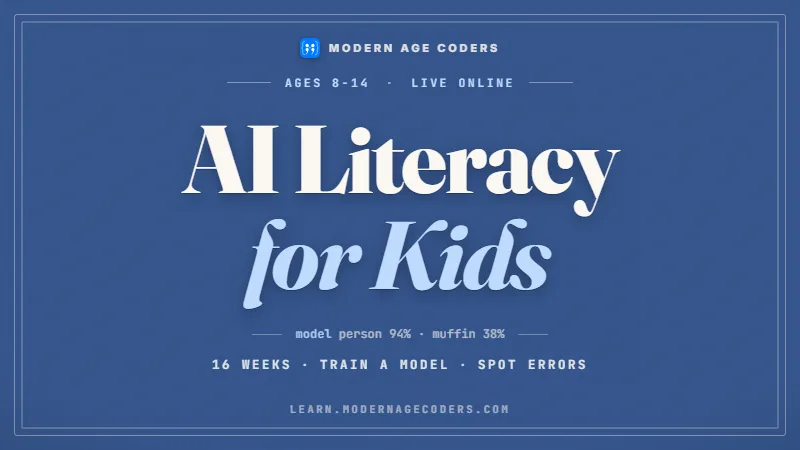
BEAI / 01
Children train small models, watch them fail and learn to question AI answers. No chatbot account and no prior coding needed.
Open the syllabus →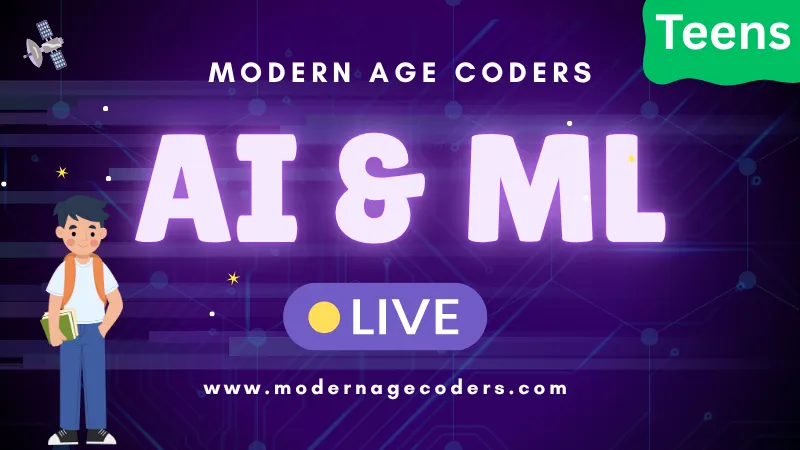
BEAI / 02
Python, real datasets and real models, with honest evaluation: what a model gets right, what it misses, and why.
Open the syllabus →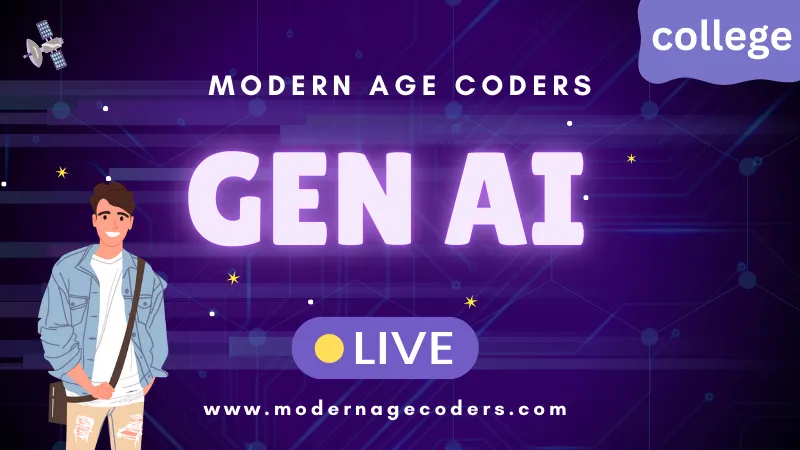
BEAI / 03
Large language models, retrieval and AI agents, built and tested in code. For university students and working adults.
Open the syllabus →Before any list
"Best" is a claim, and in Hong Kong a claim in an advertisement is meant to be backed up. So instead of praising ourselves and stopping there, we say what we think the word should mean, and show our evidence.
The Customs and Excise Department's guidelines on the Trade Descriptions Ordinance note that "Some advertisements may include such puffery claims as" "the best", and warn that such claims "should be used with caution when they are used with quantifiable standards or reference". Where a claim can be measured, "Traders should be prepared to give sufficient evidence".
We think parents deserve that standard even where the law does not require it. A course that calls itself the best should be able to say: best at what, measured how, and with what proof.
An AI course that is right for a nine year old is wrong for a university student, and the reverse. "Best" only makes sense once you know the learner: their age, their goal, whether they code yet, and how they learn.
So this page does two things. It sets out eight criteria any good AI course should meet, whoever teaches it. Then it shows which of our courses fits which learner. You can apply the criteria to any provider you are considering; we never rank or name others.
If you are choosing for a younger child specifically, our AI course for kids in Hong Kong goes deeper into what children should learn about AI and when.
Our definition, with evidence
Eight criteria, each tied to a Hong Kong or exam-board source where one exists. The last column is our evidence against each; judge it for yourself in the free class.
| Criterion | Why it matters (source) | Our evidence |
|---|---|---|
| 1. Teaches how AI works | The EDB's junior secondary AI module "covers topics on AI basics", ethics, vision, speech and language and more (EDBCM 109/2023); Cambridge has "expanded content on AI, machine learning and ethical considerations" in IGCSE CS | Learners train and test their own models before using anyone else's |
| 2. Teaches checking, not trusting | The HKEAA reminds students that "AI tools are not without their shortcomings" (2027 ICT SBA handbook) | Every AI activity ends with a test or a check of the output |
| 3. Keeps people in charge | EDB pilot primary AI strand: 「認識人是主角︰人工智能是人類的工具和助手」, people are the main actors and AI their tool and assistant (2026) | Learners decide when AI is used and explain every result in their own words |
| 4. Covers ethics and privacy | The 2026 Blueprint aims at "strengthening their AI literacy (including cyber security awareness and privacy protection" | Bias, privacy and honest use are taught as topics, not footnotes |
| 5. Respects tool age rules | ChatGPT requires users to be 13 or over, with a parent's permission under 18; Claude requires 18 (vendor terms, audited 15 July 2026); neither maker lists Hong Kong among its supported places | Under-13s learn without chatbots; teens use tools offered in Hong Kong, with a parent's agreement |
| 6. Builds real thinking | The Blueprint names "critical thinking, creativity and problem-solving skills" as the aim | Projects the learner designs, not copies; original practice problems |
| 7. Gives real teacher attention | Our view: AI misconceptions are individual and need a teacher who can hear them | Hong Kong classes are one to one only, with the same mentor each week |
| 8. Lets you pay safely | The Consumer Council advises that "tuition fees should best be paid on a monthly basis instead of a lump-sum advance payment" (2023 year-ender) | Monthly billing only, with any gateway charge shown before payment |
Sources: EDB circular memorandum 109/2023; Cambridge International, IGCSE Computer Science 0478 page; HKEAA, HKDSE 2027 ICT School-based Assessment Teachers' Handbook; EDB, pilot primary AI strand (Chinese edition, our English rendering); EDB, Blueprint for Digital Education Development, executive summary (2026); vendor terms as recorded in our AI tools age guide; Consumer Council, 2023 year-ender (6 February 2024). All read on 23 November 2026. Criterion 7 is our own view, labelled as such.
One more thing to ask any provider for, ourselves included. Hong Kong's rules for tutorial schools exempted from full registration say that "Before enrolling for a course, a pupil shall be given a leaflet containing the course particulars, fees, information on the principal and teachers of the exempted school, and refund policies and procedures" (Cap. 279F, condition 4).
We are an online provider based in India and we do not claim any status under those rules. But the standard is a sensible one for any course: you should know what is taught, what it costs, who teaches and how refunds work before you pay.
Our numbers come from one place and are the same on every page: teaching since 2020, more than 10,000 students worldwide, and a rating of 4.9 across 547 Google reviews. These are worldwide figures; we do not publish a Hong Kong student count.
Reviews are shown further down exactly as written. The free first class is the strongest evidence of all, because you can watch how your child is taught.
Test before you choose
Most providers offer a trial. Use it as an inspection, not a sales call. These six checks take no technical knowledge.
Our approach to the second and third checks is set out in detail on we teach you how to think.
A lesson about "best"
The same question, "which one wins?", applies to AI models themselves, and the answer depends entirely on the measure. In this lesson, for teens of about 13 and over, two spam filters are compared on an invented inbox. The one with the higher accuracy is useless.
# Which spam filter is better? Accuracy can mislead. Our own lesson.
# All twenty messages are invented by us; 1 means spam, 0 means fine.
inbox = [
    ("See you at the station exit at 4", 0),
    ("Homework: finish the loop exercise", 0),
    ("Click the link for tomorrow's class notes", 0),
    ("Mum says dinner is at 7", 0),
    ("Your library book is due on Friday", 0),
    ("Free period moved to Thursday", 0),
    ("Did you claim your seat for the school trip?", 0),
    ("Swimming is cancelled today", 0),
    ("Can you send the photo of the worksheet?", 0),
    ("Grandma is visiting on Sunday", 0),
    ("Bring a calculator tomorrow", 0),
    ("Great goal at football!", 0),
    ("The robot project is due next week", 0),
    ("Piano moved to 5:30", 0),
    ("Happy birthday!", 0),
    ("Who is in our group for science?", 0),
    ("Remember your water bottle", 0),
    ("Test results are on the portal", 0),
    ("You won a prize! Click here now", 1),
    ("Free phone for you, click to claim", 1),
]
WORDS = ("prize", "click", "free", "claim")

def lazy(text):
    return 0                      # never flags anything

def keyword(text):
    return int(any(w in text.lower() for w in WORDS))

def report(name, model):
    tp = fp = tn = fn = 0
    for text, truth in inbox:
        guess = model(text)
        if guess and truth: tp += 1
        elif guess: fp += 1
        elif truth: fn += 1
        else: tn += 1
    print(name)
    print("  accuracy  ", str(round(100 * (tp + tn) / len(inbox))) + "%")
    print("  spam caught", tp, "of", tp + fn, " | fine messages wrongly flagged", fp)

report("Lazy filter (always says fine)", lazy)
report("Keyword filter", keyword)
The twenty messages, the word list and both filters are ours, invented for this lesson. Python 3 prints exactly the six lines below.
Lazy filter (always says fine)
  accuracy   90%
  spam caught 0 of 2  | fine messages wrongly flagged 0
Keyword filter
  accuracy   85%
  spam caught 2 of 2  | fine messages wrongly flagged 3
The lazy filter is right 18 times out of 20, simply because most messages are fine, so it scores 90% while catching no spam at all. The keyword filter scores only 85%, because it wrongly flags three school messages, yet it is the only one that does its job.
When one outcome is rare, accuracy rewards doing nothing. Machine-learning practitioners call this the accuracy paradox, and it is why serious work reports what was caught, what was missed and what was wrongly flagged.
The next step is the learner's: improve the keyword filter so it stops flagging "Free period moved to Thursday" without missing the real spam. There is no single right answer, which is the point.
Choosing an AI course is the same problem. Measure the wrong thing, such as the number of tools covered or the size of a certificate, and the weakest course can look the strongest. Measure what you actually want, such as whether your child can test an AI's answer, and the ranking changes.
A course that teaches this lesson is also teaching the habit that matters most with AI: asking how a result was measured before believing it.
By age and goal
Our recommendation by learner, with the reason. Because Hong Kong lessons are private, depth and pace shift inside whichever course you pick.
| Learner | Course | Why this one |
|---|---|---|
| Child, about 8 to 14, no coding yet | AI Literacy for Kids | How AI learns and fails, through models the child trains |
| Child, about 9 to 12, ready to type | Python and AI for Kids | Real code first, then AI built small |
| Teen, 13 and over, wants depth | AI and Machine Learning for Teens | Python models, evaluation and a capstone project |
| Teen, 13 and over, wants to use tools well | AI Tools Course for Teens | Prompting and fact-checking within age terms |
| Teen, curious about data without code | Visual Machine Learning for Teens | Models built with drag-and-drop, then explained |
| Adult, wants to build with generative AI | Generative AI Course | Language models, retrieval and agents, in code |
| Adult, wants AI for everyday work | Python Automation and Applied AI Course | Scripts that take repeat chores off your desk |
Age bands are our own course rules, set with each tool vendor's minimum age in mind. Teens who want more detail can compare options on our AI courses for teens page, and older learners in Hong Kong can see AI and machine learning classes in Hong Kong.
Hong Kong's publicly funded secondary schools are advised to give "10 to 14 hours of AI learning at the junior secondary level" (EDBCM 109/2023). So a local-school teenager meets AI basics and ethics in class.
A course outside school is worth it when it goes further: building and evaluating models, or projects the school timetable has no room for. Ask any course what it adds beyond those hours.
A free one-off workshop can be a good taster, and if your child enjoys one, that is useful information. An ongoing course is a different product: weeks of building, failing and improving with the same teacher.
Some adult courses in Hong Kong qualify for government subsidy. Ours do not, and we say so plainly. If a subsidy matters to you, check the official list before you choose, then apply the same eight criteria.
Progress
Our own stages for AI learners, reported to parents (or to adult learners themselves) each month. They are not an official qualification.
| Stage | The learner can | Evidence |
|---|---|---|
| 1. Explain | Say in plain English how an AI system learns from data | A short spoken or written explanation |
| 2. Build | Train a small model on data they prepared | A working model and its dataset |
| 3. Measure | Choose a fair measure and report caught, missed and false alarms | A results table they can defend |
| 4. Break | Find inputs where the model or an AI tool fails | A list of failures with reasons |
| 5. Improve | Change data or method and show the measure improve | A before-and-after comparison |
| 6. Decide | Say when AI should not be used for a task | A reasoned recommendation |
Before asking which model is better, ask: better at what?
A number without its measure is not evidence.
Stage 3 is where most AI courses stop short, and where real understanding starts.
You will see each stage in the monthly note, with the work attached.
More AI and coding courses
All live and taught in English; one to one for every Hong Kong learner.
BEAI / KIDS / 01
The logic every AI course builds on.
Open the syllabusBEAI / KIDS / 02
Typed code, then small AI projects.
Open the syllabusBEAI / KIDS / 03
Describe a game, then test what comes back.
Open the syllabusBEAI / TEEN / 01
Tools used well, inside their age terms.
Open the syllabusBEAI / TEEN / 02
Python, data and first models.
Open the syllabusBEAI / TEEN / 03
AI-assisted projects, every line reviewed.
Open the syllabusBEAI / ADULT / 01
Deep learning and generative AI in Python.
Open the syllabusBEAI / ADULT / 02
Full stack apps with AI help, every line checked.
Open the syllabusBEAI / ADULT / 03
Scripts and AI that save real hours.
Open the syllabusTiming
Any day, any time, flexible: one to one at the hour that suits your family, weekdays or weekends. Our mentors work from India, whose clocks trail Hong Kong by two and a half hours, so a Hong Kong afternoon or evening lands inside their working day.
After school
Hong Kong 4:30 pm; India 2 pm.
After work
An 8:30 pm class for adults is 6 pm in India.
Weekends
Saturday 9 am in Hong Kong is 6:30 am for the mentor.
No AI result is accepted until it has been checked.
Tool choice follows each vendor's minimum age.
The same person each week, who knows the learner.
AI vocabulary learned in the language it is written in.
Each course ends with something the learner built.
Progress against the stages above, with the work.
Student work
Work by learners on our longer courses; the student labs page shows more.

AI and ML
An AI nutrition coach that reads what you eat and works you toward a target.

AI and ML
A chatbot that answers mathematics and programming questions, built and deployed by a student.

AI and ML
An assistant that helps a young person recognise unsafe situations online.

Web app
A weather forecasting site with live conditions for any location.
Fees
Each month is paid on its own, at the Hong Kong dollar figure on the card, so you are never holding credit for lessons months away; no lump sum is taken. A payment-gateway charge, where one applies, appears before you confirm.
Free first class
Free
no card required
One to one
$1,200 HKD
a month, eight live classes
What families say
Reviews on Google from parents and learners, shown unedited.
★★★★★
"The one step solution for my son. Modern Age Coders make learning coding so simple that kids love it. The teachers explain complex concepts clearly with practical exercises and interactive content."
Ria Mukherjee
Parent
★★★★★
"Modern Age Coders has been a game-changer for me. I struggled to grasp IT concepts and coding before joining, but their classes transformed everything. I can now confidently write complex programs with ease."
Samriddha Mondal
Student
★★★★★
"One of the most wonderful education centres out there. Education is not limited to school syllabus but focuses on skill development."
Vansh Agarwal
Student
★★★★★
"My child Dhairya is really enjoying the Modern Age Coders classes. This is his first online class and he eagerly looks forward to it. I can already see his improvement, and the teachers are very cooperative."
Sonam Oswal
Parent of Dhairya
★★★★★
"Modern Age Coders have wonderful teachers who teach in a clear, easy and practical way. The teacher boosts students' confidence and inspires them to learn without hesitation."
Sonu Goyal
Parent
★★★★★
"I highly recommend this computer coding class! The teachers are incredibly knowledgeable and passionate about coding."
Ritu Kedia
Parent
Choosing an AI course in Hong Kong
The one that fits the learner and meets the eight criteria on this page: it teaches how AI works, makes learners test its output, respects tool age rules, covers ethics and privacy, builds real projects, gives real teacher attention, and lets you pay monthly. We do not rank other providers; use the criteria and a trial lesson to judge any course, including ours.
Yes. Every class is live and in English, taught by mentors based in India who adjust their pace to each learner. We do not teach in Cantonese or Mandarin.
Yes. In Hong Kong all our AI classes are one to one, with the same mentor each week.
Any day, any time, flexible: one to one at the hour that suits your family, weekdays or weekends. A 5 pm class in Hong Kong is 2:30 pm in India, all year round.
From about 8 with AI Literacy for Kids, which needs no coding and no chatbot. Children of 9 to 12 who want to type code can take Python and AI for Kids. Teen courses start at 13.
No. OpenAI does not list Hong Kong among the places it offers ChatGPT, and Anthropic does not list it for Claude; their terms also set 13 (with a parent's permission under 18) and 18. We teach with AI tools offered in Hong Kong or provided by your child's school, and the habits we teach, like testing an answer before trusting it, carry over to any tool.
No. Our courses are not registered for any Hong Kong government subsidy, and we are not approved by the EDB or any university. If a subsidy matters to you, check the official list of eligible courses.
Yes: a generative AI course on language models, retrieval and agents, an AI and machine learning masterclass, and a practical AI tools course, each taught one to one.
Monthly, in Hong Kong dollars, with no lump sum or prepayment, and any payment-gateway charge is shown before you pay. The first class is free.
We have taught since 2020, more than 10,000 students worldwide, and hold a 4.9 rating across 547 Google reviews. These are worldwide figures. The strongest evidence for your family is the free first class.
Related
Other pages that help the decision.
What children should learn about AI.
For teens and adults.
Every course offered here.
Minimum ages, quoted from each maker.
A wider comparison for teenagers.
Our teaching approach.
Part of the guide: Every Hong Kong page
More guides: Coding and AI classes in Hong Kong · 中文:英文授課編程課程 · Start here: Online coding for kids · Coding subjects and courses: App development · By age and school level: Adults · HKDSE ICT and maths: DSE ICT elective guide · IB, IGCSE, A-level and SAT: A level Computer Science tutor · Olympiads and competitions: AMC 10 preparation · Guides for families: After-school coding · School holidays: AI summer course · Districts and areas: Causeway Bay
Start here
Use the free class as your inspection. The mentor teaches a real short lesson, your child or you build and test something, and you can hold the class against the eight criteria above before deciding anything.
Prefer to compare syllabuses first? Every course is listed with its full outline in our course list.
WhatsApp us · +91 91233 66161 · connect@modernagecoders.com
Live, online and one to one, in English, with mentors based in India. WhatsApp gets the fastest answer.
A priority demo is a full class of about 45 to 60 minutes. After the class the mentor sends a written skill report and a personal learning roadmap on WhatsApp. If you enrol, the demo fee is adjusted against your first month's fee. Share your demo Order ID with us on WhatsApp and we take it off.
Book a priority demo