BAA / BASE / 01
Problem Solving for Teens
Plans and edge cases before any agent runs.
Open the syllabusHong Kong · AI agents · Teens 13 to 17
An agent is a program that is given a goal, chooses a next step, uses a tool, looks at what came back and decides again, until the job is done or it is told to stop. Plenty of teenagers in Hong Kong have chatted with an AI. Far fewer have built one that acts, and fewer still have built one that knows what it must not do. This course is for the second group to become the third, live and one to one, in English.
Teaching since 2020 · 10,000+ students worldwide · Hong Kong teens learn online, one to one, in English
The short answer
A build AI agents course for teens teaches a 13 to 17 year old to make a program that pursues a goal by choosing tools, checking results and stopping safely. Modern Age Coders teaches it to Hong Kong teenagers live online, one to one, in English, at flexible Hong Kong times. Teens build in Microsoft Copilot Studio on a work or school account, with a parent accepting Microsoft's terms, and write small agent loops in Python by hand. Every agent gets a short list of allowed tools, a step limit, a human approval point and a test set before anyone else uses it. Tools limited to adults are never used.
Start here
Three courses, in the order most teens take them. Each is taught one to one for Hong Kong families, and none of them asks a teenager to use a tool its maker keeps for adults.
BAA / 01
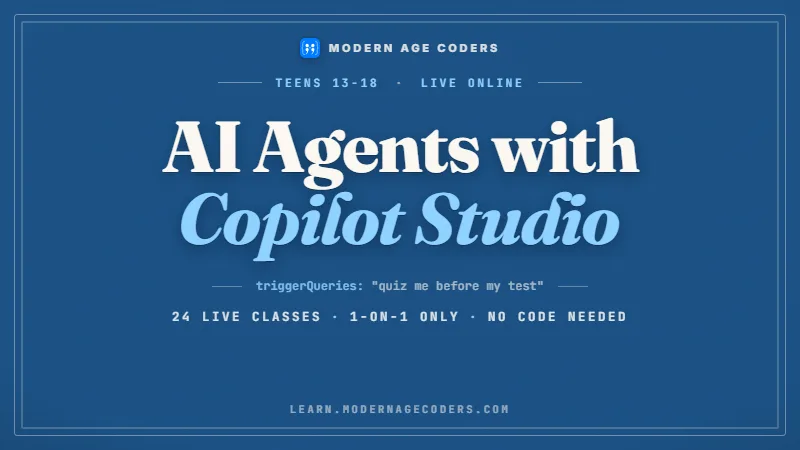
Twenty-four live classes from a first agent described in plain English to a published capstone. Knowledge sources, topics, tools, triggers and testing, on Microsoft's low-code studio.
Open the syllabus →
BAA / 02
The language our hand-written agent loops use. Functions, dictionaries and loops are what an agent is made of once the drag-and-drop canvas is taken away.
Open the syllabus →
BAA / 03
Prompting, checking and citing with tools that accept teenage users, so the instructions a teen later writes for an agent are precise and tested.
Open the syllabus →What gets built
Not a robot and not a new chatbot model. A teen builds the wrapper around a model: the goal, the instructions, the sources it may read, the tools it may press, and the rules for when it stops. That wrapper is where almost all the design work lives.
Microsoft's own documentation for Copilot Studio, updated 27 October 2026, describes an agent as an assistant that "follows the instructions you give it, draws on the knowledge sources you connect, and uses tools to take action". Those three nouns, instructions, knowledge and tools, are a fair map of the first half of our course. The second half is about the fourth thing the sentence leaves to the builder: limits.
| Part | Question it answers | Example from a teen project |
|---|---|---|
| Instructions | What is this agent for, and how should it behave? | "You help S2 students revise science vocabulary. Ask one question at a time. Never give the answer before the student tries." |
| Knowledge | What may it read before answering? | The student's own revision notes, uploaded as a file, and nothing from the open web |
| Tools | What may it do besides talk? | Look up the club timetable; add up revision minutes; nothing that sends, buys or deletes |
| Limits | When must it stop, refuse or ask a person? | Stop after five steps; refuse any tool not on the list; ask a parent before sharing anything |
First column after Microsoft Learn, "What is Copilot Studio?", page dated 27 October 2026. The questions and the examples are ours.
A chatbot answers. An agent acts on the answer: it looks something up, works something out, writes something down, and then decides what to do next with the result. The loop is the difference.
Hong Kong's Digital Policy Office puts it in one line in its generative AI guideline: "Generative AI has the ability to make judgments and decisions." It adds that an agent can "perceive the environment, make decisions, take actions, and interact with other systems at the same time". Each of those verbs is something a builder has to permit on purpose.
Writing instructions for an agent is a lot like writing instructions for a younger sibling who takes everything literally. Teens who have explained a game to a nine-year-old already know the skill: be exact, cover the odd cases, say what not to do.
It also rewards the kind of thinking schools value. A good agent needs a clear goal, a sensible plan, evidence at each step, and an honest record of what it did. For more on that habit of mind, read how to think like a programmer.
Ages and accounts
This is the question parents should ask first, and many agent courses skip it. Each company sets its own minimum age. Some allow 13 with a parent's permission; some say 18 and nothing lower. We only build with the first kind.
| Tool | What the maker says | In this course |
|---|---|---|
| Microsoft Copilot Studio | Uses a Microsoft work or school account rather than a personal email (our course page); for students under 18 a parent or guardian accepts Microsoft's terms | Main platform, set up with the family in the first class |
| Microsoft Copilot (consumer app) | "You must be at least 13 years old to use Copilot", higher in some countries | Offered in Hong Kong; allowed for research from 13, with a parent's agreement |
| ChatGPT | "You must be at least 13 years old or the minimum age required in your country"; under 18, "you must have your parent or legal guardian's permission" | Not used: OpenAI does not list Hong Kong among its supported places |
| Python, run on the student's own computer | Free software with no account and no age rule | Used for every hand-written agent loop |
| Claude, Claude Code | "at least 18 years old", or higher where local law says so | Never used: adults only, and Anthropic does not list Hong Kong |
Sources: Microsoft Support, "Microsoft Copilot for Young People"; OpenAI Terms of Use; Anthropic consumer terms as quoted in our AI tools age guide (audit of 15 July 2026); our Copilot Studio for teens course page; OpenAI's and Anthropic's supported country lists, which do not include Hong Kong; Microsoft Support, which says Copilot is unavailable in "China (excluding Hong Kong SAR)". All read 23 November 2026. A minimum age set by a company is not a judgement that the tool suits a particular child.
Microsoft's page for younger users is unusually plain. It says "Copilot can be helpful, but it's not a person", and that "AI is a tool, not a friend or a substitute for receiving advice from a trusted adult". We read that page with every teen in the first week, because an agent builder should know how their own users are told to treat AI.
It also says "Copilot doesn't train AI models on young people's data". That is a promise about Microsoft's consumer app, not about whatever a teenager builds. Once a teen makes an agent that other people talk to, protecting their users' information becomes the builder's job.
Some popular coding agents are written for adults, and their terms say so. A course for 15-year-olds that quietly uses them is asking a family to break a contract in the first lesson. We would rather teach the same ideas with tools that welcome teenagers.
Nothing important is lost. The ideas that make an agent safe, a tool list, a step limit, a human sign-off and a test set, are the same in every product. The Python loop further down this page shows them with no AI product at all.
Beside Hong Kong school
Secondary students in Hong Kong now meet AI in class. What school gives is a broad introduction; building and testing an agent of your own is the part left for students who want to go further.
Since 2023, Hong Kong junior secondary pupils have had an AI module in school: an Education Bureau circular of that year (EDBCM 109/2023) puts it at 10 to 14 hours, inside the ICT strand of Technology Education, and its list of topics runs from AI basics and ethics through vision, speech, VR and robotics to the future of work. Agents, as such, are not on that list.
The bureau's curriculum overview dates the module to the 2023/24 school year. A 2026 circular (EDBC 11/2026) widens the goal to "AI for all schools" and "AI for all students", so a teen who builds agents at home is going further down a road school has already opened.
Ten to fourteen hours across a year is a good survey of a large field. It is not enough time for each student to design, test and publish an agent, and it is not meant to be; the list of topics is about understanding AI and its effects on society.
An agents course picks up one strand of that survey, AI that takes action, and goes deep. A teen who has heard about AI ethics at school gets to make ethical choices in code: which tool to leave out, when to ask a person, what to log.
We have no link with the Education Bureau, and nothing here suggests the EDB approves our courses. Younger brothers and sisters can start on our AI course for kids in Hong Kong, which teaches how AI learns before anything acts on its own.
Keeping an agent on a leash
The OWASP Gen AI Security Project lists "Excessive Agency" among its top risks for 2025. Its three root causes make a perfect syllabus for a young builder, because each has a habit that fixes it.
| Root cause, in OWASP's words | What it looks like in a teen project | The habit that prevents it |
|---|---|---|
| "excessive functionality" | A homework helper that can also send messages, because the connector came with that button | List the tools the goal needs; switch off everything else |
| "excessive permissions" | A club agent that can edit the whole shared drive when it only needs to read one file | Read-only access unless writing is the point; one folder, not the drive |
| "excessive autonomy" | An agent that sends a reminder to every member without anyone checking the wording | A person approves anything that leaves the agent: messages, posts, deletions |
Source: OWASP Gen AI Security Project, "LLM06:2025 Excessive Agency", read 23 November 2026. OWASP's advice includes "Limit the functions that are implemented in LLM extensions to the minimum necessary" and "Utilise human-in-the-loop control to require a human to approve high-impact actions before they are taken". The teen examples are ours. OWASP does not endorse any course.
Teens do not have to invent the sign-off step. Microsoft's documentation says agent flows in Copilot Studio "can run prompts, call agents, and include human review steps". We use that last part in every project that touches another person.
The rule in class is simple: an agent may draft freely and act on its own builder's data, but anything that reaches someone else waits for a human click. OWASP's warning is about an application that "fails to independently verify and approve high-impact actions"; ours never skip it.
Teen projects are often for other teens: a revision agent for a class, an FAQ agent for a club. Hong Kong's Digital Policy Office guideline asks service providers to take extra care with "services used by special groups such as minors", and to protect users by "avoiding excessive collection, misuse, or disclosure of user data".
So our agents ask for no names, phone numbers or school details, store nothing they do not need, and tell users what they are. The same guideline points to the PCPD's "Artificial Intelligence: Model Personal Data Protection Framework" of June 2024 for anyone building with personal data. This is not legal advice; it is good manners in code.
A worked example
Before a teen trusts a platform to run the loop, they write one by hand. Here the "model" is replaced by a few plain rules, so nothing is hidden: the teen can see the planner choose a tool, the program check the tool against a list, and the loop stop when the budget runs out.
ALLOWED.# A tiny agent loop with no language model inside. Our own teaching code.
WEEK = {"Mon": "Maths revision", "Wed": "Python club", "Fri": "Badminton"}
DAYS = ["Mon", "Tue", "Wed", "Thu", "Fri", "Sat", "Sun"]
def calculator(expr):
if not set(expr) <= set("0123456789+-*/() "):
return "error: only numbers and + - * / ( )"
return str(eval(expr, {"__builtins__": {}}))
def timetable(day):
return WEEK.get(day, "nothing")
ALLOWED = {"calculator": calculator, "timetable": timetable}
def planner(goal, seen):
# Rules stand in for the model: look at the goal and at what came back so far
if goal == "minutes":
return ("finish", seen[-1]) if seen else ("calculator", "3 * 2 * 45")
if goal == "python and tell Ken":
if not seen:
return ("timetable", "Wed")
if len(seen) == 1:
return ("send_message", "Ken: Python club is on Wed")
return ("finish", "draft ready for a human to send")
if goal == "chess":
if seen and seen[-1] == "Chess club":
return ("finish", DAYS[len(seen) - 1])
return ("timetable", DAYS[len(seen)])
def run(goal, budget):
seen = []
print("GOAL:", goal, "| budget", budget)
for step in range(1, budget + 1):
action, arg = planner(goal, seen)
if action == "finish":
print(" done:", arg)
return
if action not in ALLOWED:
print(" step", step, "REFUSED", action, "(not on the allowlist)")
seen.append("refused")
continue
result = ALLOWED[action](arg)
print(" step", step, action + "(" + arg + ") ->", result)
seen.append(result)
print(" stopped: step budget of", budget, "used up")
run("minutes", 3)
run("python and tell Ken", 4)
run("chess", 4)Our own teaching code; the week of clubs, the goals and the planner rules are invented for the lesson. The calculator uses eval only on strings made of digits, spaces and arithmetic signs, and with no built-in functions available; even so, we discuss in class why real agents should use a proper parser instead.
GOAL: minutes | budget 3
  step 1 calculator(3 * 2 * 45) -> 270
  done: 270
GOAL: python and tell Ken | budget 4
  step 1 timetable(Wed) -> Python club
  step 2 REFUSED send_message (not on the allowlist)
  done: draft ready for a human to send
GOAL: chess | budget 4
  step 1 timetable(Mon) -> Maths revision
  step 2 timetable(Tue) -> nothing
  step 3 timetable(Wed) -> Python club
  step 4 timetable(Thu) -> nothing
  stopped: step budget of 4 used up
Exact output from python3 -I on Python 3.14.8. Three goals, three endings: done, done after a refusal, and stopped by the budget.
Minutes. Three weeks of two 45-minute sessions: the planner picks the calculator, gets 270 and finishes. The boring case matters, because it proves the loop can end on its own.
Python and tell Ken. The planner finds the club day, then reaches for send_message. It was never given that tool, so the loop refuses, and the agent ends with a draft for a person to send. That is excessive functionality, caught by one line of code.
Chess. The invented week has no chess club, but the planner does not know that. It checks Monday, Tuesday, Wednesday and Thursday, and then the budget of four steps is spent. The agent stops and reports it, rather than burning time or money.
Students first see this as a failure. It is the opposite: the agent did what it was told when its goal was impossible. A loop with no limit would have checked every day, and in a real product, every call might cost something or touch someone.
__import__("os"). Predict the result, run it, and explain which line protected the program.send_message with a step that prints the draft and waits for the user to type yes. Which OWASP habit is that?Step by step
Our own twelve steps, in the order we teach them. Most teenagers move through them over about six months of weekly classes, but the pace is set by the student, not the calendar.
Our own teaching sequence. Step 2 quotes Microsoft Learn, "What is Copilot Studio?" (27 October 2026). Features available in a school's Microsoft account can differ from the full product; the mentor checks what the student's account allows in the first class.
Teens who would rather go deeper into how the models underneath work can pair this with our AI and machine learning classes in Hong Kong. For a plain-English tour of the idea itself, see AI agents explained.
For parents
Five questions to ask any agents course, ours included. A good course will answer each without hesitating.
Building agents is a project skill, not a homework shortcut. If a teen wants an agent that helps them revise, we build it to quiz them, not to write their answers. Our page on learning to think, not copy AI sets out the line Hong Kong's exam authority draws.
We never build an agent to complete a school assessment, and we never write any part of an SBA or internal assessment for a student.
We do not promise a competition prize, a school place, a portfolio result or a job. We promise a teen who can design an agent, explain every part of it, and say honestly where its limits are.
The certificate at the end is our own certificate of completion. It is not issued or approved by the EDB, any school or any technology company.
Format
Because agents are built out of words as much as code, and because a mentor needs to see every instruction a teen writes.
Agent instructions, tool descriptions and test notes are written in precise English, the same register as technical documentation.
The mentor reads each instruction as it is typed and asks what a tricky user would do with it.
No travel across the harbour after school; the class starts when the laptop opens.
More on how families here use English-taught classes is on coding classes taught in English in Hong Kong. Teens who want the Python side first can begin with our Python course in Hong Kong.
Progress
Levels we wrote ourselves and use in the monthly note home. Each names a thing your teen can now build or check; none is a grade, and none matches a school or exam level.
| Level | The teen can | Shown by |
|---|---|---|
| 1. Describer | Write instructions that keep a simple agent on topic | A classmate fails to push it off course |
| 2. Grounder | Connect a source and get answers that cite it | Every answer in a test points to a page |
| 3. Loop writer | Write a Python loop with an allowlist and a budget | The three runs on this page, then their own |
| 4. Tool chooser | Give an agent only the tools its goal needs | A written list with a reason for each tool |
| 5. Tester | Build a test set that includes attempts to break it | Twenty cases, results recorded |
| 6. Publisher | Release an agent to a small group with a human sign-off | A parent review and a note to users |
The agent is only as good as the limits you wrote for it.
A refusal you planned is a feature; one you did not plan is a bug.
Level 3 is where most teens realise what the platform was doing for them.
Level 6 always includes you: nothing is published without your review.
More courses
All live and in English, taught one to one for families in Hong Kong, and all within the age terms of the tools they use.
BAA / BASE / 01
Plans and edge cases before any agent runs.
Open the syllabusBAA / BASE / 02
The language of the pages agents live on.
Open the syllabusBAA / BASE / 03
Every change to an agent, saved and explained.
Open the syllabusBAA / AI / 01
What the model inside an agent is doing.
Open the syllabusBAA / AI / 02
Cleaning the data an agent will read.
Open the syllabusBAA / AI / 03
Models built visually, then questioned.
Open the syllabusBAA / SHIP / 01
AI-assisted projects, every line reviewed.
Open the syllabusBAA / SHIP / 02
APIs: the tools an agent calls.
Open the syllabusBAA / SHIP / 03
Thinking like an attacker, defending like a builder.
Open the syllabusTimes and format
Any day, any time, flexible: one to one at the hour that suits your family, weekdays or weekends. Our mentors work from India, which sits two and a half hours behind Hong Kong throughout the year.
Straight after school
A 4:40 pm start in Hong Kong is 2:10 pm for the mentor.
After dinner
Hong Kong 8:45 pm is 6:15 pm in India.
Saturday morning
Hong Kong 10 am is 7:30 am in India.
The teen drives; the mentor watches the screen and asks questions.
Tools, budget and human step are agreed before the agent runs.
Agents are tested away from real users until they pass.
Instructions, tests and explanations in clear technical English.
Accounts, terms and publishing all go through a parent.
The level reached, the agent built and what it may not do.
Student work
Projects from students on our longer courses, each presented by the student who made it. The student labs page has more.

AI and ML
An AI nutrition coach that reads what you eat and works you toward a target.

AI and ML
A chatbot that answers mathematics and programming questions, built and deployed by a student.

AI and ML
An assistant that helps a young person recognise unsafe situations online.

Web app
A weather forecasting site with live conditions for any location.
Fees
The fee is charged monthly and shown in Hong Kong dollars, and you pay one month at a time with no lump sum and nothing paid in advance. Should the card processor add a fee, it appears on the checkout screen first, so the total you agree to is the total you pay.
Free first class
Free
no card required
One to one
$1,200 HKD
a month, eight live classes
What families say
Unedited Google reviews from families and learners.
★★★★★
"The one step solution for my son. Modern Age Coders make learning coding so simple that kids love it. The teachers explain complex concepts clearly with practical exercises and interactive content."
Ria Mukherjee
Parent
★★★★★
"Modern Age Coders has been a game-changer for me. I struggled to grasp IT concepts and coding before joining, but their classes transformed everything. I can now confidently write complex programs with ease."
Samriddha Mondal
Student
★★★★★
"One of the most wonderful education centres out there. Education is not limited to school syllabus but focuses on skill development."
Vansh Agarwal
Student
★★★★★
"My child Dhairya is really enjoying the Modern Age Coders classes. This is his first online class and he eagerly looks forward to it. I can already see his improvement, and the teachers are very cooperative."
Sonam Oswal
Parent of Dhairya
★★★★★
"Modern Age Coders have wonderful teachers who teach in a clear, easy and practical way. The teacher boosts students' confidence and inspires them to learn without hesitation."
Sonu Goyal
Parent
★★★★★
"I highly recommend this computer coding class! The teachers are incredibly knowledgeable and passionate about coding."
Ritu Kedia
Parent
Hong Kong families ask
Teenagers of 13 to 17, and 18-year-olds still at school. Younger children start with how AI learns, in our AI course for kids, and come to agents later.
No. The Copilot Studio course starts without code. Python is added for the hand-written loops, and we teach it from the beginning if needed.
A Microsoft work or school account rather than a personal email. Many students have one from school. If not, we arrange a practice environment, and for students under 18 a parent or guardian accepts Microsoft's terms.
No. OpenAI and Anthropic do not list Hong Kong among the places they offer ChatGPT and Claude, and Claude also requires users to be 18. Your teen builds with Microsoft tools, which Microsoft offers in Hong Kong, on a work or school account, plus Python written by hand. The habits of limiting, testing and approving an agent carry over to any tool they meet later.
Not on their own. Our agents get only the tools their goal needs, and anything that reaches another person, posts, buys or deletes waits for a human to approve it.
Yes. Yes, only English, taught live by mentors who work from India. An agent runs on written instructions, so a teen who learns to brief one precisely in English is practising the language every lesson. Cantonese and Mandarin teaching are not offered.
Always, for families in Hong Kong. A mentor reads every instruction and tool choice the teen makes, which is how the safety habits on this page get checked.
Any day, any time, flexible: one to one at the hour that suits your family, weekdays or weekends. India runs two and a half hours behind Hong Kong in every month, so a Hong Kong class at 7:45 pm starts at 5:15 pm where the mentor sits.
We do not build agents for that, and we never write any part of an SBA or school assessment for a student. Revision agents we build quiz the student rather than answer for them.
No. We are independent. We quote Education Bureau and Microsoft documents because they describe the school curriculum and the platform; neither body approves our courses. The certificate is our own.
Monthly, shown in Hong Kong dollars, one month at a time with no prepayment. Any payment-gateway charge appears before you pay. The first class is free.
Related
Further reading on our site.
The idea of an agent, without the hype.
What each maker says about age, quoted.
Honest AI use in Hong Kong schoolwork.
The models underneath an agent.
The language of the hand-written loop.
Every course for families here.
Part of the guide: Every Hong Kong page
More guides: Coding and AI classes in Hong Kong · 中文:英文授課編程課程 · Start here: Online coding for kids · Coding subjects and courses: App development · By age and school level: Adults · HKDSE ICT and maths: DSE ICT elective guide · IB, IGCSE, A-level and SAT: A level Computer Science tutor · Olympiads and competitions: AMC 10 preparation · Guides for families: After-school coding · School holidays: AI summer course · Districts and areas: Causeway Bay
Start here
In the free class your teen describes a small agent, gives it two tools and a step limit, and watches it refuse a third. You see how they reason about limits, and the mentor suggests a starting level.
Prefer to read first? Each syllabus is in the course list, and how we teach walks through a class.
WhatsApp us · +91 91233 66161 · connect@modernagecoders.com
Live, online, one to one and in English, with mentors in India. WhatsApp reaches us fastest.
A priority demo is a full class of about 45 to 60 minutes. After the class the mentor sends a written skill report and a personal learning roadmap on WhatsApp. If you enrol, the demo fee is adjusted against your first month's fee. Share your demo Order ID with us on WhatsApp and we take it off.
Book a priority demo