MCT / KIDS / 01
Python and AI for Kids
Typed Python from the first week, not coloured blocks. Turtle graphics, small games, then the idea that a machine can work out a rule from examples instead of being handed the rule.
Open the syllabusMuscat · Live online · Ages 6 to 67
In April 2026 a Royal Decree set aside roughly 104,000 square metres in Al Seeb for semiconductors, robotics and integrated AI systems. Yet almost every AI course a Muscat family can buy still teaches how to talk to a chatbot. We teach the layer underneath: how a model is fed, trained, measured and corrected, in Python, on data the student can check. Live classes, one teacher, Sunday to Thursday.
Teaching since 2020 · 10,000+ students across 25+ countries · no recordings sold as classes
In short
Modern Age Coders runs live online AI and machine learning classes for students in Muscat, ages 6 to 67, in batches of fifteen to twenty or one to one. Students work in Python, take on the statistics and linear algebra machine learning actually runs on, and finish able to train a model and state how accurate it is. Classes run Sunday to Thursday on Gulf Standard Time, with a Friday or Saturday morning option. Fees are USD 100 a month for a group batch, billed in US dollars, and the first class is free.
The catalogue
A nine year old and a Middle East College undergraduate do not belong in one syllabus with the pace adjusted. Each band is a separate curriculum with its own projects. Each card opens a complete schedule, term by term.
MCT / KIDS / 01
Typed Python from the first week, not coloured blocks. Turtle graphics, small games, then the idea that a machine can work out a rule from examples instead of being handed the rule.
Open the syllabusMCT / KIDS / 02
Where an answer comes from, why a model invents things, and why sounding certain is not the same as being right. The habit we want at this age is to check the machine before believing it.
Open the syllabusMCT / KIDS / 03
Children instruct an AI tool to build something, then open the result and repair what is broken. Giving the instruction takes a minute. Judging the output is the term's work.
Open the syllabusMCT / TEEN / 01
The spine of this page, and the answer to the NU entry problem. Python, the mathematics machine learning actually uses, neural networks, computer vision and language models, with a trained model at each stage.
Open the syllabusMCT / TEEN / 02
The airport project below, in miniature. Load a table, prove it sums to the published total, find the row that would have wrecked the result, and only then predict anything.
Open the syllabusMCT / TEEN / 03
Two years from the first line to advanced Python, including the object oriented work a Cambridge or CBSE syllabus assumes. The entry point for a teenager arriving with no code.
Open the syllabusMCT / TEEN / 04
Shipping real web and Python projects with an AI assistant, while learning to review what the assistant wrote. Teens finish able to ship, and able to defend every line.
Open the syllabusMCT / PRO / 01
The full engineering route for an NU, GUtech or Middle East College student who wants more than the timetable gives. Deep networks, training discipline, evaluation that survives a viva, and deployment.
Open the syllabusMCT / PRO / 02
How large language models are trained, fine tuned and grounded against documents you own, and how an agent is constrained so it fails loudly. Relevant to the national language model work under way in Oman.
Open the syllabusMCT / PRO / 03
For a professional in Al Khuwair or Ruwi who wants the applied half first: machine learning and language processing pointed at the reports and pipelines already on the desk.
Open the syllabusMCT / PRO / 04
The job shaped route into telecom observability, banking fraud work and energy analytics, which is where Muscat hires. Statistics, SQL, feature engineering, modelling, and explaining a result to a manager.
Open the syllabusMCT / PRO / 05
The interview gate for every serious engineering role, and the reason a model that runs on fourteen rows still runs on fourteen million. Problem solving, not memorised patterns.
Open the syllabusMCT / ALL / 06
Past AI we teach mathematics from early number sense to university level, web and app development, game development and exam preparation, all live and all on Muscat timings.
Open all coursesWhat you actually build
Every market we teach in gets a first project built on its own data. In Muscat that project is the airport. Muscat International sits in the Wilayat of Al Seeb, the same wilayat the Royal Decree chose for the AI zone, and in 2025 it handled 13,157,559 of Oman's 14,939,209 air passengers, 88.1 per cent of the national total. Every student on this page has stood in that terminal.
| Airport | Segment | Flights 2024 | Passengers 2024 | Flights 2025 | Passengers 2025 |
|---|---|---|---|---|---|
| Muscat International | International | 86,797 | 11,681,790 | 82,913 | 11,838,223 |
| Muscat International | Domestic | 9,009 r | 1,178,163 | 9,606 | 1,319,336 |
| Salalah | International | 5,008 | 678,402 | 4,886 | 678,591 |
| Salalah | Domestic | 5,450 | 869,954 | 6,227 | 1,023,529 |
| Sohar | International | 495 | 44,897 | 110 | 390 |
| Sohar | Domestic | 165 r | 23,331 r | 150 | 18,247 |
| Duqm | Domestic | 622 | 61,137 | 618 | 60,893 |
| All airports | Total | 107,546 | 14,537,674 | 104,510 | 14,939,209 |
International flights at Muscat fell 4.5 per cent, from 86,797 to 82,913, while international passengers rose 1.3 per cent, from 11,681,790 to 11,838,223. Passengers per flight therefore moved from 134.59 to 142.78. The headline says growth. The ratio says consolidation: fewer aircraft, fuller aircraft. A student who reads only the passenger column reports the wrong story, and reports it confidently.
The same derived column ranks the whole 2025 frame: Salalah domestic 164.37, Muscat international 142.78, Salalah international 138.88, Muscat domestic 137.34, Sohar domestic 121.65, Duqm domestic 98.53, Sohar international 3.55. That last figure is 390 passengers on 110 flights, which is not a commercial schedule, and any regression fitted with the row left in is dragged by something that does not describe scheduled air travel at all.
pandasscikit-learn matplotlibOneHotEncoder LeaveOneOutmean absolute error
| Month | Passengers | Flights |
|---|---|---|
| January 2026 | 1,189,938 | 7,594 |
| February 2026 | 939,921 | not printed |
| March 2026 | 728,588 | 5,515 |
The same article prints a first quarter total of 2,857,817 against 2,929,495 a year earlier, a fall of 2.4 per cent. The three monthly figures as printed add to 2,858,447, which is 630 more. We do not tell students where the gap comes from, because we do not know. We tell them what the page prints and make them write the difference down instead of quietly choosing the number they prefer.
Three rows cannot carry a regression, and the class is told so plainly. What three rows can carry is the first habit of anyone who works with data for a living: add the parts, compare them with the whole, report the difference.
Sum the seven 2025 rows and confirm 14,939,209 passengers and 104,510 flights against the published totals. Then recover the three 2024 cells that are printed nowhere: Sohar domestic passengers of 18,247 are described as a fall of 21.8 per cent, giving 23,331, which is exactly the residual against 14,537,674. Nothing is modelled until the recovery closes to the digit.
A scatter of flights against passengers, coloured by airport, with segment as the marker shape. Six points suggest a line. Sohar international lands nowhere near it. The outlier is seen before a model quietly averages it away.
Passengers per flight is one line of pandas and it changes the story. The student then decides, in writing, whether Sohar international belongs in the training set, and defends the decision either way. Both answers are acceptable. Not deciding is not.
Rows are held back before anything is fitted. Fourteen rows makes this uncomfortable, and the discomfort is the lesson: one random split of eighty and twenty would be meaningless at this size, so leave one out cross validation is the honest choice.
A linear regression of passengers on flights, with airport and segment one hot encoded. The flights coefficient is stated in extra passengers per extra flight. Then the hard question: can the model reproduce what happened at Muscat, where flights fell and passengers rose?
Mean absolute error in passengers is a number a parent who flies out of Muscat can judge. Report it in passengers and as a percentage of its own row, then refit without the Sohar international row to see how much of the error was one bad row.
Fourteen annual rows. One airport carrying 88.1 per cent of the traffic. A 2026 shock the model never saw. A 630 passenger discrepancy in the source. All of it goes in the write up, published at a link with arithmetic anyone in Muscat can re-run, which is worth more in an application than a certificate.
One question is left deliberately open. In May 2026 Indian nationals were the largest passenger group at Oman's airports, 175,022 movements made of 76,515 arrivals and 98,507 departures. Does that departure surplus line up with schools closing on 31 May, with Eid travel, or with none of them? Published reporting attributes the 2026 decline to regional tension in aviation and says nothing about schools. The student has to argue it from the data and then state what the data cannot settle, which is the hardest sentence in the course to write.
The distinction
We teach both, in that order, and we tell parents which of the two holds its value.
The distinction is sharper in Muscat than in most cities, because the governorate is building AI capacity rather than only buying it. What follows is a decree zoning land, seven data centres, a research centre, an open data platform and a national language model. Not one of them is staffed by a generation trained only to prompt.
Why now, in Muscat
Royal Decree No. 50/2026, issued on 30 April 2026 by His Majesty Sultan Haitham bin Tarik, establishes an Artificial Intelligence Special Zone in the Governorate of Muscat, in the Wilayat of Al Seeb, on approximately 104,000 square metres. The Board of Directors of the Public Authority for Special Economic Zones and Free Zones appoints the party that will manage, operate and develop it, in coordination with the Ministry of Transport, Communications and Information Technology. Reported target industries are semiconductors, robotics, integrated AI systems and software development, with special economic zone incentives, exemptions and a lighter regulatory setup. It sits inside the Eleventh Five Year Development Plan for 2026 to 2030 and Oman Vision 2040. The National reported combined chip sector investment of RO 14.63 million, USD 38 million, involving GSME, Lumotive and Movandi.
Above it sits the national frame. On 22 September 2024 His Excellency Said bin Hamoud al Maawali, Minister of Transport, Communications and Information Technology, announced the National Programme for Artificial Intelligence and Advanced Digital Technologies, running to the end of 2026: a National Open Data Platform, a National Centre for AI Research and Development, an AI Studio, an Omani national language model, a Centre for the Fourth Industrial Revolution with the Ministry of Economy and the World Economic Forum, and quantum computing work. The stated targets are to raise the digital economy from 2 per cent of GDP in 2021 to 10 per cent by 2040, and to enter the top 50 of the Oxford Insights Government AI Readiness Index.
The skills pipeline underneath it is measured rather than promised. At the five year Makeen forum on 27 April 2026 the ministry reported more than 11,000 trainees since September 2022, 139 programmes across more than 30 technology fields, a 50 per cent employment rate in the technology bootcamp track, 2,790 Omanis supported into jobs, IT sector Omanisation raised to 45.5 per cent, and 150 or more Omani semiconductor engineers behind five start-ups. The next phase targets 10,000 jobseekers over five years, with new programmes in AI agents and quantum computing.
The work is already here, and it is infrastructure rather than prompting. Otech, the technology arm of Omantel launched on 11 February 2026 and reported as the first company in the Middle East accredited by Amazon Web Services for sovereign cloud, runs seven Tier 3 certified data centres with a combined 12 megawatts across Muscat and Duqm, serving about 1,200 customers. Its GPU workloads answer the question a teenager should be asking, which is what would I actually do here: healthcare imaging, computer vision and seismic analysis. Knowledge Oasis Muscat at Al Rusayl is a one million square metre free zone whose tenants include Ericsson, Oracle, Microsoft and Huawei, with Middle East College on the same campus. Byanat, founded in Muscat in April 2022 by Ahmed Alghadani and Dr Ahmed Albadi, builds AI observability for telecom operators and data centres. Bank Muscat and Bank Dhofar are reported to analyse suspicious transactions with algorithms in real time.
Read that as a parent in Bousher and one pattern stands out: every item is a building project. A child who is twelve today is twenty two in 2036, four years short of the Vision 2040 horizon, applying for exactly these roles. That is why we will not sell a prompt engineering course as an AI education.
104,000 sq m
Land zoned for AI in Al Seeb under Royal Decree 50/2026
12 MW
Seven Tier 3 data centres across Muscat and Duqm
45.5%
IT sector Omanisation after five years of Makeen
88.1%
Share of Oman's 2025 air passengers through Muscat International
School and university
The Board of Directors, Indian Schools in the Sultanate of Oman governs 22 schools with 47,465 students, 2,086 teachers and 760 administrative staff, according to figures published on the Board's own site. Eight are inside Muscat Governorate: Indian School Muscat, Darsait, Al Wadi Al Kabir, Al Ghubra, Al Seeb, Al Maabela, Bousher and Al Amerat. ALLEN Overseas counts seven inside Muscat city and notes that Al Wadi Al Kabir and Al Ghubra each run both a CBSE stream and a Cambridge stream. Wikipedia gives Indian School Muscat, established 1975 and CBSE affiliated, more than 9,200 students and 499 academic staff, and Al Wadi Al Kabir more than 5,800.
Whichever your child attends, CBSE Computer Science and Informatics Practices sit inside our teens track, and the machine learning ladder runs alongside the board year rather than against it. Board marks and a real portfolio are produced by the same work when the work is set up properly.
British School Muscat is a non profit British international school for ages 3 to 18, holds a Royal Charter and teaches the English National Curriculum, which is the IGCSE and A Level route. The American International School Muscat runs the United States curriculum with Advanced Placement courses and SAT preparation. American British Academy is an International Baccalaureate World Continuum school with 940 students from more than 65 countries, offering the Primary Years, Middle Years and Diploma programmes. Beaconhouse International Private School offers IGCSE, A Levels and the Ministry of Education General Education Diploma, and the international schools database lists 26 schools for Muscat families. We teach against Cambridge IGCSE Computer Science 0478, Advanced Placement Computer Science A and Principles, and IB Diploma Computer Science.
The National University of Science and Technology, on its campus at Azaiba in Bousher, runs a BSc in Artificial Intelligence over four years full time or six in flexible mode, at 120 credit hours. Entry is on the General Education Diploma or an equivalent with a minimum grade of C in Mathematics, plus the university's own placement test. The ladder inside the degree is published and explicit: Introductory Machine Learning in Year 2, Data Mining and Big Data in Year 3, Deep Learning in Year 4. The graduate roles listed are AI Engineer or Developer, Data Scientist, AI Researcher, AI Product Manager, NLP Engineer, AI Application Developer and Software Developer, and the named collaborations are with the University of Southern California, West Virginia University and Glasgow Caledonian University.
Two consequences follow, and they are the practical heart of this page. The entry gate is a mathematics grade, so mathematics is not something to be survived on the way to a computing degree. And the first genuine machine learning course does not arrive until Year 2, so a teenager who has never trained a model walks in cold and spends a semester catching up on work they could have done at fifteen.
The German University of Technology in Oman occupies its Halban campus in Muscat Governorate, held since September 2012 and described as Oman's first green campus, and lists direct admission to its bachelor programmes on the International Baccalaureate Certificate or Diploma, A Levels, the Indian High School Certificate, or Advanced Placement. Middle East College at Knowledge Oasis Muscat teaches engineering, business, technology and logistics management in partnership with Coventry University and Breda University of Applied Sciences, with Waljat Colleges of Applied Sciences on the same campus. Sultan Qaboos University at Al Khoud is Oman's only public university and admits most students on their high school final examination performance. Every one of those routes rewards a mathematics grade and evidence that the applicant has built something.
How the classes run
Muscat runs on Gulf Standard Time, UTC+4, with no daylight saving at any point in the year, exactly one hour and thirty minutes behind India. The clock is the easy half. The week is the half that catches people out: the Omani working and school week runs Sunday to Thursday and the weekend is Friday and Saturday, so a Muscat student's free evenings are Sunday through Thursday and their free mornings are Friday and Saturday.
16:00 to 17:30
Muscat time, Sunday to Thursday, 17:30 to 19:00 in India. Children aged 6 to 12, straight after the school day.
18:00 to 19:30
Muscat time, Sunday to Thursday, 19:30 to 21:00 in India. The main teenage block, homework done.
20:00 to 21:30
Muscat time, Sunday to Thursday, 21:30 to 23:00 in India. University students and working professionals.
10:00 to 11:30
Muscat time, Friday or Saturday, 11:30 to 13:00 in India. Your weekend, a working day for the teacher.
Ninety minutes on live video with one teacher who already knows where your child stopped last week. Screens are shared both ways, so the teacher watches the code being written and interrupts at the moment the mistake happens rather than marking it three days later. Batches are fifteen to twenty students, or one to one.
The week in between carries a build, not a worksheet. Make it, break it, bring it back. Questions during the week go to the same teacher. Timings shift around Ramadan and the Eid holidays rather than running through them.
Muscat's Indian schools run an April to March year rather than August to June. Indian School Darsait's Calendar of Events for 2026 to 2027 opens on 6 April 2026, begins summer vacation on 31 May, and reopens on 12 July for Classes IX to XII and 20 July for the younger classes under a Board circular issued 31 December 2025. Renaissance Day falls on 23 July, half yearly examinations begin 20 and 21 September, the second term opens 6 October, National Day holidays fall on 25 and 26 November, winter break runs 20 to 31 December, school reopens 3 January 2027, annual examinations run through February, and the next academic year begins 4 April 2027. Several examination windows are printed as tentative in the calendar itself.
Two moments in that year are the natural ones to start something new: early April and the middle of July. Two are best avoided: the June travel exodus and the annual examinations. Outside those, admission is rolling.
Student work
Not one of these is a mockup. Each is a working application at a real address, built by a student and left online for anyone to open. More in Student Labs.

AI and ML
Logs what you eat, reads it back against a target and coaches you toward it. Built end to end.
AI and ML
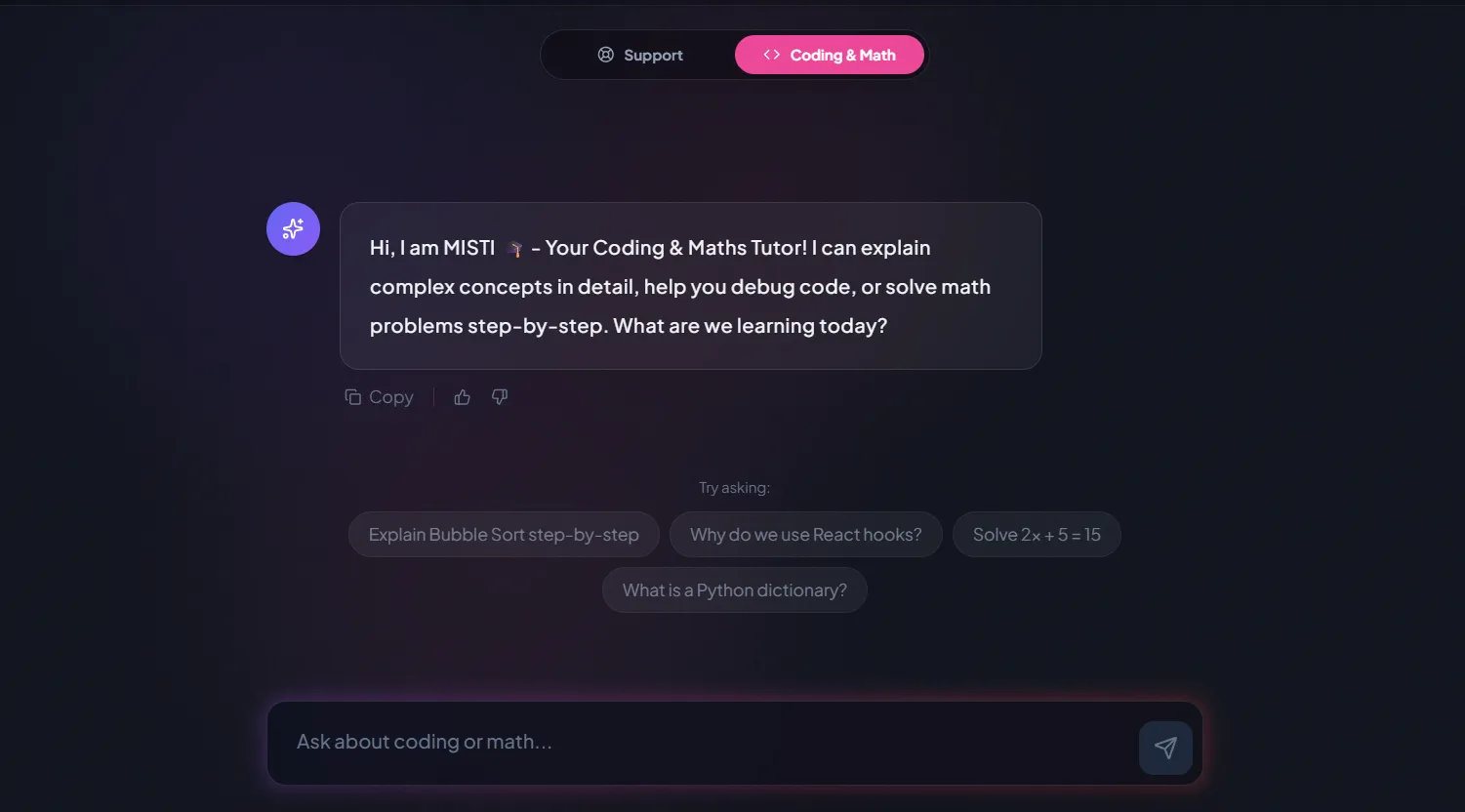
A tutoring chatbot that works through maths and programming questions, deployed on its own domain.

AI and ML
Helps a young person recognise an unsafe situation online and decide what to do next.
Data and forecasting
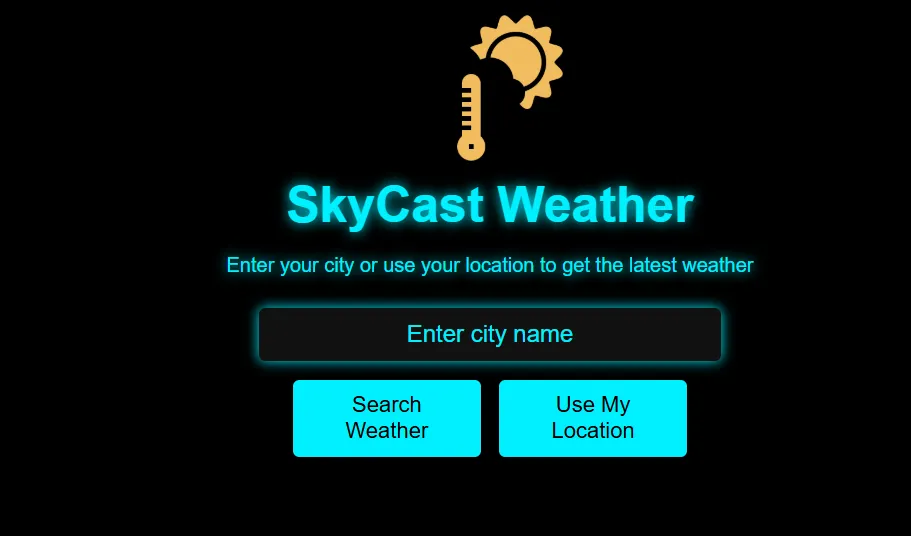
Pulls live forecast data and presents it clearly, which is the discipline the airport project teaches.
Fees
Fees are flat and billed in US dollars: USD 100 a month for a group batch and USD 150 a month for one to one, the same figures everywhere outside India. A month covers eight live one-hour classes, and the first class is free.
Free first class
USD 0
no card needed
Group batch
USD 100
a month, billed in US dollars
One to one
USD 150
a month, billed in US dollars
What families say
These are real reviews left by real families. We do not write testimonials and we do not commission them.
★★★★★
"The one step solution for my son. Modern Age Coders make learning coding so simple that kids love it. The teachers explain complex concepts clearly with practical exercises and interactive content."
Ria Mukherjee
Parent
★★★★★
"Modern Age Coders has been a game-changer for me. I struggled to grasp IT concepts and coding before joining, but their classes transformed everything. I can now confidently write complex programs with ease."
Samriddha Mondal
Student
★★★★★
"One of the most wonderful education centres out there. Education is not limited to school syllabus but focuses on skill development."
Vansh Agarwal
Student
★★★★★
"My child Dhairya is really enjoying the Modern Age Coders classes. This is his first online class and he eagerly looks forward to it. I can already see his improvement, and the teachers are very cooperative."
Sonam Oswal
Parent of Dhairya
★★★★★
"Modern Age Coders have wonderful teachers who teach in a clear, easy and practical way. The teacher boosts students' confidence and inspires them to learn without hesitation."
Sonu Goyal
Parent
★★★★★
"Coding classes here make learning very interesting and conceptual. The teachers teach us in a very easy-to-understand and efficient way."
Arush Poddar
Student
Questions from Muscat
Batches run Sunday to Thursday, the Omani working and school week, so classes land on evenings your child is already at home. Indian School Darsait's calendar for 2026 to 2027 confirms that shape, with assemblies and tests on Sundays and Mondays. There is also a weekend morning slot at 10:00 to 11:30 Muscat time, which is a normal working day in India.
19:30. Muscat keeps Gulf Standard Time, UTC+4, with no daylight saving at any point in the year, and India keeps UTC+5:30, so Muscat is always exactly one hour and thirty minutes behind. Read the other way, our 18:00 to 19:30 Muscat teen block is 19:30 to 21:00 for the teacher. Neither country moves its clocks, so the slot you agree in July is the same slot in January.
Join in any week. Admission is rolling and the free first class doubles as a placement check, so a student starts at the level they are actually at rather than where a batch has reached. Two moments in the Muscat year are easier than the rest: the opening fortnight in early April, and the July reopening. The two we would avoid are the June travel exodus and the annual examinations in February.
A group batch of fifteen to twenty students is USD 100 a month and one to one teaching is USD 150 a month, billed in US dollars. The fee is the same flat figure everywhere outside India, so there is no rial conversion to watch. The first class is free and does not need a card.
The National University of Science and Technology admits on the General Education Diploma or an equivalent with a minimum grade of C in Mathematics, plus its own placement test. Inside the degree, Introductory Machine Learning sits in Year 2, Data Mining and Big Data in Year 3 and Deep Learning in Year 4. So the entry gate is a mathematics grade, and a student who has never trained a model reaches Year 2 cold. Our teens track closes both gaps, teaching the statistics and linear algebra inside the machine learning.
The work already here is infrastructure and applied modelling rather than prompting. Otech, the technology arm of Omantel launched in February 2026, runs seven Tier 3 certified data centres with a combined 12 megawatts across Muscat and Duqm and names its GPU workloads as healthcare imaging, computer vision and seismic analysis. Bank Muscat and Bank Dhofar are reported to run algorithms over suspicious transactions in real time. Royal Decree 50/2026 then adds roughly 104,000 square metres in Al Seeb scoped for semiconductors, robotics, integrated AI systems and software development.
No, because we teach against both. Our teachers work with CBSE Computer Science and Informatics Practices, Cambridge IGCSE Computer Science 0478, Advanced Placement Computer Science A and Principles, and IB Diploma Computer Science, so board content is supported rather than repeated. ALLEN Overseas notes that Indian School Al Ghubra and Indian School Al Wadi Al Kabir each run a CBSE stream and a Cambridge stream, so cousins sitting different boards fit the same batch.
Yes to both. Summer vacation for Muscat's Indian schools began on 31 May 2026, and under the Board circular the break ran to 11 July for Classes IX to XII and to 19 July for Balvatika to Class VIII. Send us the travel dates and we pause the batch rather than bill through it. Because a teacher here is a fixed person rather than a rota, the same teacher picks up where your child stopped.
Start here
Leave a number and a mentor calls you back, usually within a few hours, at an hour that works in Muscat. The first class is a real class with a real teacher, and it doubles as a placement check so your child starts at the right level rather than the average one.
Prefer to look around first? Read how we teach, browse the full catalogue, see the wider Oman page, or open Student Labs.