TAX / CORE / 01
Middle school math
All five strands.
Open the syllabusNew York · Grade 8 · The TACHS, November 2026
The TACHS, the Test for Admission into Catholic High Schools, is taken by eighth graders applying to Catholic high schools in the Archdiocese of New York, the Diocese of Brooklyn/Queens and the Diocese of Rockville Centre. It is an online test taken at home, and for 2026 it adds a basic calculator inside the platform. This page sets out what the official TACHS site says about the math, read on 31 October 2026, including its candid view of tutoring, and then teaches the five math strands with worked examples and practice items of our own.
Live teaching since 2020 · 10,000+ students · school math made strong, not test tricks
In short
The TACHS (Test for Admission into Catholic High Schools) is given by Riverside Insights for three New York dioceses to eighth graders applying for ninth grade. It tests reading, written expression, mathematics and reasoning, online at home, in about 2 hours 10 minutes. Modern Age Coders teaches the underlying math live online, in a batch or 1-on-1.
Learn with a teacher
School math done thoroughly, which is what the TACHS organizers themselves say counts.
TAX / 01
Grades 6 to 8. All five TACHS math strands in depth.
Open the syllabus →
TAX / 02
Patterns, expressions and equations, the algebraic strand.
Open the syllabus →
TAX / 03
Number sense and estimation that keep a calculator honest.
Open the syllabus →The test
The TACHS tests academic achievement in reading, written expression and mathematics, plus general reasoning. Its results go to three high schools the student chooses, together with school records.
| Area | What the organizers say it covers |
|---|---|
| Reading | Factual, interpretative and evaluative comprehension of informational and literary texts |
| Written Expression | Standard English: organization, sentence structure, clarity, and finding the line with an error |
| Mathematics | Number sense and operations, algebraic patterns and connections, data analysis, probability and statistics, geometry, and measurement |
| Ability | Learned reasoning with somewhat novel questions using spatial and figural content |
The 2026 Parent Guide says "There are 6 timed subtests". After each of the first three a student may take a 5-minute break; after the fourth and fifth there is only a one-minute pause.
Testing time is about 2 hours 10 minutes for most students, or about 3 hours 15 minutes with approved extended time, which is the only accommodation offered. Each question has four answer choices.
The organizers do not publish how many math questions there are or how long the math subtest lasts, and they say they cannot give tutors or families more detail than the site and official materials.
So any prep course claiming to mirror the exact TACHS format is guessing. The site warns that outside practice tests may not match "the number of questions, exam format, and allotted testing time".
Sources: the official TACHS site (exam FAQs) with its 2026 Student Handbook and 2026 Parent Guide, read 31 October 2026. Modern Age Coders is not connected with Riverside Insights, TACHS or any diocese or school.
A straight answer
The organizers say plainly that they do not encourage or endorse coaching for the TACHS. Their view is that students who do well in school math can expect to do well on the test, and we build our classes around that.
On its practice-test FAQ the official site states that Riverside Insights, together with the Archdiocese of New York, the Diocese of Brooklyn/Queens and the Diocese of Rockville Centre, "does not encourage or endorse coaching or tutoring programs for the TACHS Examination." It adds that "Official TACHS practice tests are not published or provided" and that outside practice tests "are not fully representative of the actual TACHS Examination".
We think families deserve to read that before paying anyone, including us. So we do not sell TACHS question drills or claim inside knowledge of the test. What we teach is the middle school math the organizers list, the estimation habits that make the new calculator safe to use, and the pacing that keeps a student moving across a timed subtest. Those skills serve a student in ninth grade math too, whatever the result.
| We do | We do not |
|---|---|
| Teach the five math strands the organizers name | Sell copies or imitations of TACHS items |
| Use the free sample questions in the Student Handbook as a format check only | Reproduce the handbook’s sample questions |
| Build estimation and calculator judgment for 2026 | Claim to know the number or timing of math questions |
| Report progress against school grade-level math | Predict a percentile, an acceptance or a scholarship |
Source: TACHS site FAQ, “Where can I find a practice test?” and “What is the content of the exam?”, read 31 October 2026.
Math strands
The Mathematics subtest draws on five strands: number sense and operations; algebraic patterns and connections; data analysis, probability and statistics; geometry; and measurement. All five sit inside a normal grade 6 to 8 course.
| Strand | Typical grade 8 skills (our reading) | One habit we drill |
|---|---|---|
| Number sense and operations | Fractions, decimals, percents, integers, rounding, order of operations | Estimate before computing |
| Algebraic patterns and connections | Number and shape patterns, expressions, one-step and two-step equations | Write the rule as a formula in n |
| Data analysis, probability and statistics | Mean, median, range, reading tables and graphs, simple probability | Sort the data first |
| Geometry | Perimeter, area, angles, properties of shapes | Label every known length |
| Measurement | Units of length, time, weight and capacity, and converting between them | Write units on every line |
Worked example 1, a pattern turned into a rule (ours). A row of tile squares uses 4 tiles for one square, 7 for two joined squares and 10 for three. How many tiles for 20 joined squares? Each new square adds 3 tiles, so the count is 3n + 1, where n is the number of squares. Check: n = 1 gives 4. For n = 20 the answer is 3 x 20 + 1 = 61 tiles. A student who extends the list 4, 7, 10, 13 by hand gets there too, but the rule takes ten seconds and cannot drift.
“Algebraic patterns and connections” can get less direct attention in grade 8 classes than equations do. Some students can solve 2n + 9 = 31 but freeze when asked for the 12th term of a pattern.
We teach one move for both: find what changes each step, write it as a number times n, then fix the starting value.
Converting 2.75 hours to minutes or 3 feet 8 inches to inches is easy only when the unit facts are automatic: 60 minutes, 12 inches, 3 feet, 16 ounces, 4 quarts.
We test those facts in the first minutes of class until a student never has to pause on them.
New in 2026
Yes, from 2026, but only the basic 4-function calculator built into the testing platform. A student found using their own calculator is disqualified.
The official FAQ says: "New in 2026: A basic 4-function calculator will be provided within the testing platform for use on applicable questions." It opens from the calculator icon in the Proctorio toolbar. The site points families to a free basic calculator practice page so students can get used to it before test day.
| Situation | Our advice | Why |
|---|---|---|
| Multiplying decimals such as 19.8 x 3.1 | Estimate first (20 x 3 = 60), then use the calculator | The estimate catches a mistyped decimal point |
| A mixed expression such as 3 + 4 x 5 | Do the multiplication first, then add | Many basic calculators work left to right and would show 35 |
| Fractions such as 3/5 against 5/8 | Convert by division, or cross-multiply by hand | A 4-function calculator has no fraction key |
| Easy facts such as 25 percent of 48 | Mental math: a quarter of 48 is 12 | Opening the calculator takes longer than the answer |
| Choosing between four answers | Estimate and eliminate before computing | Two choices are often far from the estimate |
Worked example 2, order of operations (ours). Evaluate 3 + 4 x 5. The correct value is 23: multiply 4 x 5 = 20, then add 3. On a calculator that applies each key as it is pressed, typing 3 + 4 x 5 in that order gives 7 x 5 = 35. The fix is to enter 4 x 5 first and add 3 afterwards. Try this on the practice calculator before test day to see how it behaves.
Worked example 3, estimation as a check (ours). A rectangle is 19.8 cm by 3.1 cm. What is its area? Estimate first: about 20 x 3 = 60 square centimeters. The exact product is 61.38. If the calculator shows 6.138 or 613.8, a decimal point slipped, and the estimate exposes it at once. Among four answer choices, only one is likely to sit near 60.
Sources: TACHS site FAQ “Are students allowed to use calculators?” and the 2026 Parent Guide, page on the in-exam calculator, read 31 October 2026. Our advice table and examples are our own.
Dates
The 2026 TACHS is on Friday, November 6, 2026 for the Archdiocese of New York and Saturday, November 7, 2026 for Brooklyn/Queens and Rockville Centre. Registration closed on October 28, 2026.
| Date | What happens |
|---|---|
| August 24, 2026 | Registration opened online and by phone |
| October 2, 2026 | Deadline for extended time requests to the student’s diocese |
| October 28, 2026 | Registration closed |
| November 4, 2026 | Test session code, date and time emailed after 1:00 PM |
| Friday, November 6, 2026 | TACHS for the Archdiocese of New York |
| Saturday, November 7, 2026 | TACHS for the Diocese of Brooklyn/Queens and the Diocese of Rockville Centre |
| November 11 and 18, 2026 | Make-up session details posted for students who missed the test or had approved technical problems |
| December 7, 2026 | Scores provided to the three high school choices, on or before this date |
| December 11, 2026 | Paper Applicant Records for public school students due at the high schools |
| January 22, 2027 | Home Report available to families online from 3:00 PM |
The Student Handbook is firm: "A student may take the TACHS examination only once." It also says results are final, with no reviewing, rescoring or retesting.
That makes grade 7 the real preparation year. A student who strengthens all five math strands then sits the test once, in the fall of grade 8.
The site says high schools use a combination of TACHS results, the Applicant Record from the student’s school and state testing results. Families see local and national percentile ranks in the Home Report.
Scholarship and financial aid decisions are made by each high school. Questions about admission go to the high schools directly, not to the testing company.
Sources: the TACHS site registration and exam FAQs and the 2026 Student Handbook calendar, read 31 October 2026. Confirm every date on the official site; it is the organizers’ to change.
Practice set
Our own items, across the five strands, with four-choice thinking in mind. They are not TACHS items. Use the calculator only where our table above says it helps.
| Item | Answer | Idea |
|---|---|---|
| 1 | 5/8 | 0.625 against 0.6, or cross-multiply: 25 against 24 |
| 2 | 4,800 | The tens digit 6 rounds the hundreds up |
| 3 | 49 | 5 + 11 x 4: the 12th term is eleven steps past the first |
| 4 | 11 | 2n = 22 |
| 5 | 3/8 | Favorable sections over total sections |
| 6 | 12 | Largest 21 minus smallest 9 |
| 7 | 23 units | 2 x (7.5 + 4) |
| 8 | 30 square cm | Half of base times height |
| 9 | 165 minutes | 2 hours is 120, three quarters of an hour is 45 |
| 10 | 44 inches | 3 x 12 + 8 |
| 11 | 12 | A quarter of 48 |
| 12 | 25 | y = 3x + 1, the same rule as the tile pattern |
A common wrong answer to item 3 is 53, from multiplying 12 x 4 and add 5. The 12th term is only eleven steps past the first, so it is 5 + 11 x 4 = 49.
Writing the rule as 4n + 1 and checking n = 1 gives 5 avoids the slip every time.
The free Student Handbook on the TACHS site ends with sample questions and an answer key. Use them once, untimed, to see the screen-style layout and the four choices.
Then come back to strand work. The organizers say there is no official practice test, so the samples show format, not difficulty.
A year plan
Our plan for a student in grade 7 now, with one live class a week. Dates for the 2027 test are not yet published; the 2026 pattern was registration in late summer and the test in early November.
| Months | Strand focus | Habit |
|---|---|---|
| November 2026 to January 2027 | Number sense and operations | Estimate before computing |
| February to March 2027 | Algebraic patterns and connections | Rules in n, checked at n = 1 |
| April to May 2027 | Data analysis, probability and statistics | Sort data before any average |
| June to July 2027 | Geometry and measurement | Units on every line |
| August to September 2027 | Mixed review; basic calculator practice | Calculator only where it helps |
| October 2027 | Timed mixed sets of our own; handbook samples once | Keep moving, mark and return within a subtest |
Strong fractions and percents now make grade 8 easy.
The plan above: one strand at a time.
Mixed review and the calculator habit in the fall.
Readiness
The organizers link TACHS success to school coursework. These are the signs we look for in that coursework.
| Step | What it looks like |
|---|---|
| 1. Accurate | Grade 7 and 8 problems right on homework and quizzes |
| 2. Estimating | Knows roughly what an answer should be before working it out |
| 3. Judicious | Uses the calculator for messy arithmetic only |
| 4. Steady | Marks a hard item and moves on, then returns before the subtest ends |
Look at your child’s school math grades and state test results first; the site says high schools consider them alongside the TACHS.
If the school math is solid, a few weeks on estimation and the calculator may be all that is needed. If it is shaky, fix the school math.
Practice the basic calculator before test day, so it is a tool and not a surprise.
On the day, you can skip and mark items inside a subtest. Once you finish a subtest you cannot go back, so use the marks.
The catalogue
Live online classes with one regular teacher, as a group or one to one.
TAX / CORE / 01
All five strands.
Open the syllabusTAX / CORE / 02
Patterns into equations.
Open the syllabusTAX / CORE / 03
Data and chance.
Open the syllabusTAX / NUM / 01
Mental arithmetic.
Open the syllabusTAX / NUM / 02
Reasoning and logic.
Open the syllabusTAX / NUM / 03
For extra challenge.
Open the syllabusTAX / HS / 01
Algebra 1 onward.
Open the syllabusTAX / HS / 02
Python for math.
Open the syllabusTAX / HS / 03
Coding from zero.
Open the syllabusHow lessons run
Weekdays or weekends, flexible: choose your batch, or for a very personalised plan choose 1-on-1 at your convenience, weekend mornings or weekdays.
Weekdays
Late afternoon or evening, Eastern Time.
Weekends
Saturday and Sunday mornings work for many families.
1-on-1
Focused on one student’s weakest strand.
Five strands, tracked separately.
Every answer sized before it is computed.
A basic calculator used with judgment.
Measurement conversions made automatic.
Live online, no travel.
Fifteen to twenty students, or one.
Student work
Our learners also put math to work in code. Browse the student labs.
AI and ML
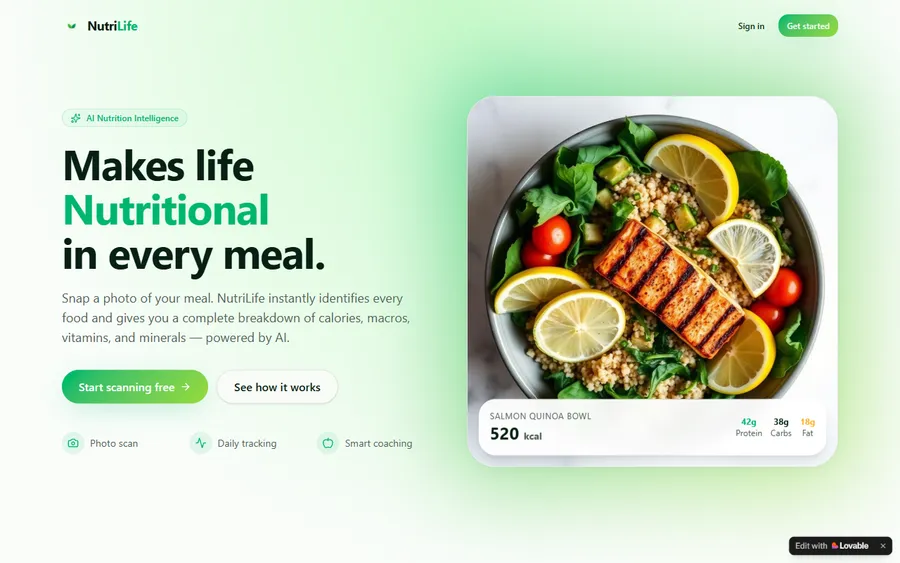
An AI nutrition coach that reads what you eat and works you toward a target.
AI and ML
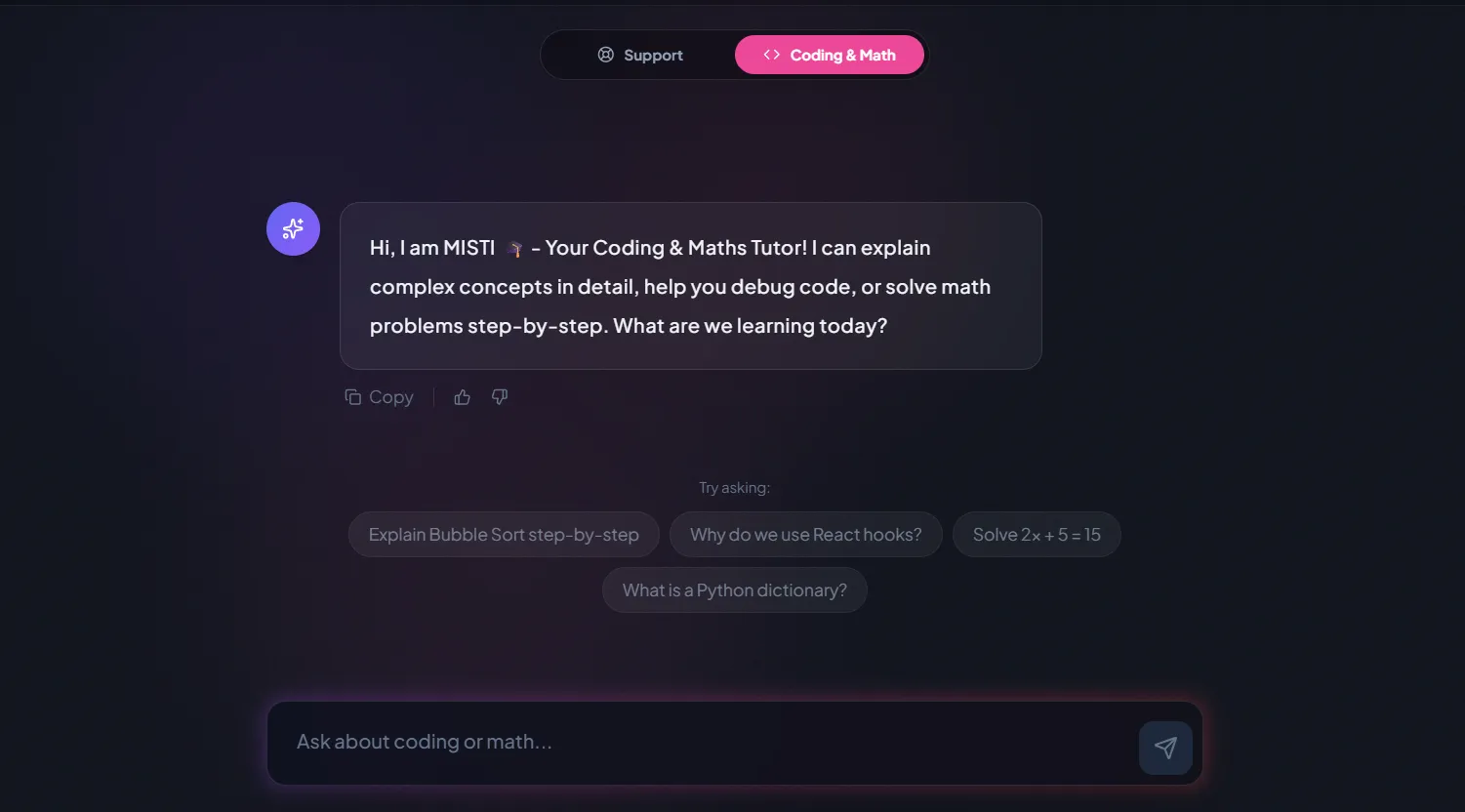
A chatbot that answers mathematics and programming questions, built and deployed by a student.

AI and ML
An assistant that helps a young person recognise unsafe situations online.
Web app
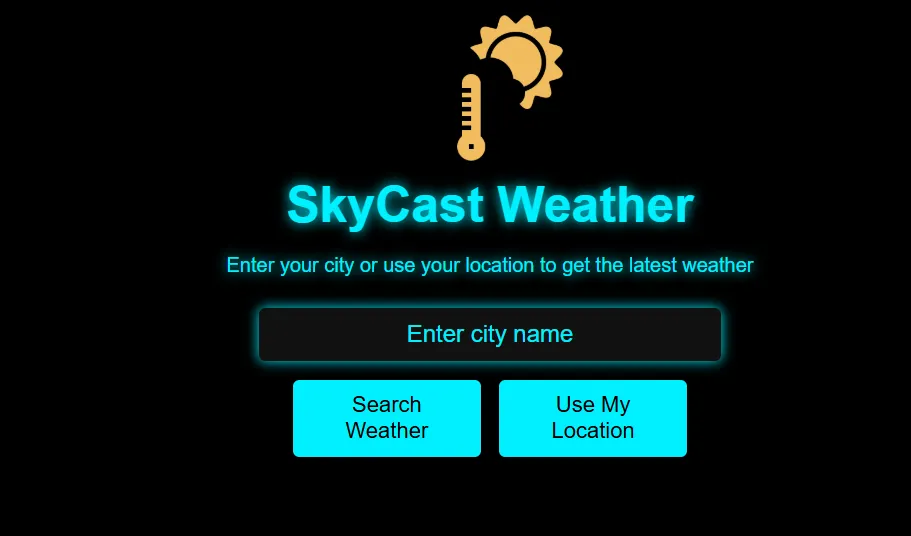
A weather forecasting site with live conditions for any location.
Fees
The TACHS registration fee is paid to the TACHS program, not to us; our fee is for classes only. We bill monthly, so a family can study through grade 7 and stop whenever they choose.
Free first class
USD 0
no card required
Group batch
USD 100
a month, billed in US dollars
One to one
USD 150
a month, billed in US dollars
What families say
What parents wrote on Google, word for word.
★★★★★
"The one step solution for my son. Modern Age Coders make learning coding so simple that kids love it. The teachers explain complex concepts clearly with practical exercises and interactive content."
Ria Mukherjee
Parent
★★★★★
"Modern Age Coders has been a game-changer for me. I struggled to grasp IT concepts and coding before joining, but their classes transformed everything. I can now confidently write complex programs with ease."
Samriddha Mondal
Student
★★★★★
"One of the most wonderful education centres out there. Education is not limited to school syllabus but focuses on skill development."
Vansh Agarwal
Student
★★★★★
"My child Dhairya is really enjoying the Modern Age Coders classes. This is his first online class and he eagerly looks forward to it. I can already see his improvement, and the teachers are very cooperative."
Sonam Oswal
Parent of Dhairya
★★★★★
"Modern Age Coders have wonderful teachers who teach in a clear, easy and practical way. The teacher boosts students' confidence and inspires them to learn without hesitation."
Sonu Goyal
Parent
★★★★★
"I highly recommend this computer coding class! The teachers are incredibly knowledgeable and passionate about coding."
Ritu Kedia
Parent
Questions from parents
The official site lists number sense and operations, algebraic patterns and connections, data analysis, probability and statistics, geometry, and measurement. These are standard middle school topics.
Yes. New in 2026, a basic 4-function calculator is provided inside the testing platform for applicable questions. Personal calculators are not allowed, and a student using one is disqualified.
The Archdiocese of New York tests on Friday, November 6, 2026, and the Diocese of Brooklyn/Queens and the Diocese of Rockville Centre on Saturday, November 7, 2026. Sessions begin at 8:30 AM or 10:00 AM.
About 2 hours 10 minutes for most students, including directions, across 6 timed subtests. With approved extended time it is about 3 hours 15 minutes.
Yes. The 2026 TACHS is an online, remote, at-home test with Proctorio proctoring and a webcam, a format the site says has been used since 2020.
No. The site says official practice tests are not published or provided, though the Student Handbook includes sample questions and an answer key.
No. The site says Riverside Insights and the three dioceses do not encourage or endorse coaching or tutoring programs, and that students who do well in school coursework can expect to do well. We teach school math, not TACHS drills.
No. The Student Handbook says a student may take the TACHS only once, and results are final with no rescoring or retesting.
Scores go to the three high school choices on or before December 7, 2026. Families can view the Home Report online from 3:00 PM on January 22, 2027.
Weekdays or weekends, flexible: choose your batch, or for a very personalised plan choose 1-on-1 at your convenience, weekend mornings or weekdays.
No. Modern Age Coders is independent and has no tie to Riverside Insights, the TACHS program, any diocese or any high school.
Elsewhere on this site
Other entrance tests and help by grade.
For independent schools.
The preparation year.
Support through the test year.
Patterns and equations, one to one.
For students who like to build.
Part of the guide: US gifted and selective school tests
More guides: US state math tests by state · US math placement and college readiness tests · Homeschool and school math curricula guide · US math and coding competitions guide
Start here
Tell us your child’s grade and how school math is going. The teacher runs a short check across the five strands and tells you honestly whether extra classes are worth it.
To see a lesson’s shape first, read how we teach, or look through the course catalogue.
WhatsApp us · +91 91233 66161 · connect@modernagecoders.com
We teach live over video from India, at New York after-school and weekend times. Families usually find WhatsApp the fastest way to reach us.
A priority demo is a full class of about 45 to 60 minutes. After the class the mentor sends a written skill report and a personal learning roadmap on WhatsApp. If you enrol, the demo fee is adjusted against your first month's fee. Share your demo Order ID with us on WhatsApp and we take it off.
Book a priority demo