TET / E / 01
Elementary math
Grades 1 to 5.
Open the syllabusUnited States · Teaching Textbooks Math 3 to Pre-Calculus · A person beside the app
Teaching Textbooks was built so a homeschool parent does not have to teach math: the app gives the lecture, reads problems aloud, offers hints, grades every answer and plays a worked solution for each one. For many families it does exactly that. The trouble usually starts quietly, around Pre-Algebra or Algebra 1, when a child can follow every solution and still cannot start the next problem. This page explains how the program works, from its own site, and what a live teacher adds that a recorded solution cannot.
Teaching math and coding live since 2020 · 10,000+ students · grades K to 12
In short
Teaching Textbooks is a self-paced homeschool math curriculum delivered as one app per course, from Math 3 to Pre-Calculus, that teaches each lesson, grades every problem and gives a step-by-step solution for each. Teaching Textbooks math help from a live tutor suits a student who follows the solutions but cannot yet explain or start problems alone. Modern Age Coders teaches live online, in a batch or 1-on-1, through its Algebra Foundations course; the first class is free.
Live courses beside the app
The student keeps working in their Teaching Textbooks course. These classes add a teacher who asks why.
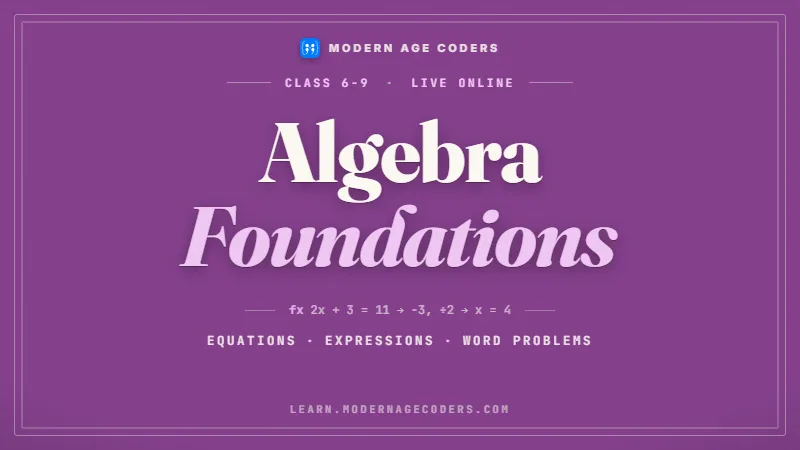
TET / 01
Pre-Algebra and Algebra 1, the point where most TT families look for a person.
Open the syllabus →
TET / 02
For Math 6, Math 7 and Pre-Algebra: fractions, ratios, integers.
Open the syllabus →
TET / 03
Geometry, Algebra 2 and Pre-Calculus with live explanation.
Open the syllabus →How it works
Each Teaching Textbooks course is an app that does the teaching and the grading. Its site lists a set of safety nets meant to keep a child moving without a parent stepping in.
| Feature | In Teaching Textbooks’ words |
|---|---|
| What it is | "a complete math curriculum offered as a series of apps (one for each grade level)" |
| Teaching | "Every lesson begins with an interactive lecture." |
| Hints | "just-in-time hints" when a student gets stuck |
| Read aloud | "Each problem and hint is read aloud to the student" |
| Solutions | "100% of problems have a full, step-by-step solution." |
| Grading | Every problem graded as soon as the answer is entered, recorded in a printable gradebook |
| Human help | "a free tutor helpline for any customer that needs extra help" |
| Parents | "Parents also receive a daily email showing their students’ progress." |
Teaching Textbooks says access to each course "is for 12 months, plus a 3-month pause feature" for breaks, and that the apps work on computers, tablets and phones, offline "for up to 6 lessons at once".
Students get a scratchpad area to work out steps on screen, which is saved so a parent can look at it later, and each app includes a full, searchable eBook that a parent can print.
The publisher offers its own free tutor helpline: customers can call to set up an appointment with a math tutor about a problem the solutions did not clear up. If your child is stuck on one problem, that is the natural first step.
This page is for a different situation: a child who needs regular teaching, week after week, because the stuck moments have become the pattern.
Sources: Teaching Textbooks and its Algebra 1 course page, checked 31 October 2026. Teaching Textbooks is a trademark of Teaching Textbooks, LLC. Modern Age Coders is not affiliated with or endorsed by Teaching Textbooks.
Courses
The site lists ten courses, from Math 3 to Pre-Calculus. Placement tests decide where a child starts, and Teaching Textbooks gives specific advice on reading them.
| Course | Stage | Where a live teacher often helps |
|---|---|---|
| Math 3 to Math 5 | Elementary | Times tables, long division, first fractions |
| Math 6 and Math 7 | Middle grades | Fraction and decimal operations, percents, ratios |
| Pre-Algebra | Bridge to algebra | Integers, variables, one-step and two-step equations |
| Algebra 1 | High school | Linear equations, slope, systems, factoring |
| Geometry | High school | Proof and reasoning about shapes |
| Algebra 2 and Pre-Calculus | High school | Functions, exponents, logarithms, trigonometry |
Teaching Textbooks publishes a placement test for each course. If you are unsure, it says to "have them take two tests starting with the higher level" and to give the lower test only if very few questions are right on the higher one.
It adds that its pass marks are rough, and that "if a student is just under the recommended score they’re almost assuredly ready for that grade level." It also reminds parents to take out the answer key page, which is the last printed page.
The free trial covers "the first 15 lessons of any grade level", with no expiration date and no payment details, and work done in the trial carries over if you buy the course.
For a child moving into Algebra 1, the first fifteen lessons are a useful test of whether the app alone will be enough. Each course page also links to its table of contents and index.
Source: Teaching Textbooks placement tests page, checked 31 October 2026.
Warning signs
A high average in the gradebook can hide a child who is leaning on hints and solutions. These are signals our teachers look for; they come from our own lessons and are offered as general guidance, never as figures.
| What you notice | What it often means | What to try |
|---|---|---|
| Scores are fine, but lessons take much longer than before | Hints are doing the thinking | Do three problems a day with hints switched off, if your parent controls allow it |
| Your child watches the solution, then moves on | Following is not the same as being able to start | After a missed problem, redo it from a blank page |
| The scratchpad is empty for multi-step problems | Steps are being done in the head, or guessed | Ask for every line written |
| Your child cannot say why a step works | The method is memorised, not understood | Ask "why are we allowed to do that?" once a lesson |
| Pre-Algebra or Algebra 1 brings tears | Fractions and negatives were never quite secure | Repair those first, then go forward |
None of these are faults in the program. A recorded solution is excellent at showing how. It cannot notice which part of the reasoning your child skipped, or ask a follow-up question. That is the gap a person fills.
The why
Our worked examples at Algebra 1 level, written by us. Each step carries a reason, which is what we ask students to say out loud in class.
| Step | Working | Why it is allowed |
|---|---|---|
| 1 | Slope = (13 - 5) / (6 - 2) = 8 / 4 = 2 | Slope is change in y over change in x between any two points on a line |
| 2 | 5 = 2 x 2 + b | Any point on the line satisfies y = mx + b |
| 3 | b = 5 - 4 = 1 | Subtracting 4 from both sides keeps the equation balanced |
| 4 | y = 2x + 1 | Slope and intercept fix the line |
| 5 | Check (6, 13): 2 x 6 + 1 = 13 | The second point must also fit, or something went wrong |
def line_through(p, q):
    (x1, y1), (x2, y2) = p, q
    slope = (y2 - y1) / (x2 - x1)
    intercept = y1 - slope * x1
    return slope, intercept

m, b = line_through((2, 5), (6, 13))
print(f"slope = {m}, intercept = {b}")
print("(10, 21) on the line:", 21 == m * 10 + b)
Output: slope = 2.0, intercept = 1.0, then (10, 21) on the line: True. Each line of the function is one of the reasons in the table above, written as code. We use small programs like this with older students to make the reasoning visible.
Solve x/3 + x/4 = 7. Our worked answer: the denominators 3 and 4 share the multiple 12, so multiply every term by 12. That gives 4x + 3x = 84, so 7x = 84 and x = 12.
The why: multiplying both sides by the same non-zero number keeps the equation true. The usual slip is multiplying only the left side.
Solve y = 2x + 1 and x + y = 10 together. Our worked answer: replace y in the second equation with 2x + 1, so x + 2x + 1 = 10, 3x = 9, x = 3 and y = 7.
The why: both equations describe the same point, so y means the same thing in each. Check: 3 + 7 = 10 and 2 x 3 + 1 = 7.
| Problem | Say why before you start |
|---|---|
| Line through (1, 4) and (5, 16) | Slope from two points (slope 3, y = 3x + 1) |
| x/2 + x/5 = 14 | Multiply every term by 10 (x = 20) |
| y = 3x - 2 and x + y = 14 | Substitute for y (x = 4, y = 10) |
| Is (3, 7) on y = 2x + 1? | Substitute and compare (yes) |
| 2 to the 3rd times 2 to the 2nd | Count the factors of 2 (2 to the 5th, 32) |
App and teacher
The app keeps the daily lessons and grading. The teacher takes the week’s hardest problems and turns them into a conversation.
A student who rarely needs hints, can explain the steps and keeps a steady average. Many children are in this group.
A student at Pre-Algebra or Algebra 1 who benefits from hearing classmates reason through the same kinds of problems.
A student with specific gaps, such as fractions or negatives, who needs them repaired at their own pace.
Where your child is
Our description of how students grow from following to reasoning.
| Stage | What it looks like |
|---|---|
| 1. Following | Gets problems right after hints or watching solutions |
| 2. Copying | Repeats the method from the lecture on similar problems |
| 3. Explaining | Can say why each step is allowed |
| 4. Starting | Begins an unfamiliar problem without a prompt |
The gradebook cannot tell stage 1 from stage 4. Asking your child to explain one problem a day can.
Stage 3 is where algebra starts to feel easier, not harder.
After you watch a solution, close it and do the problem again on paper.
If you can explain it to someone else, you know it.
The catalogue
Live teaching to sit beside any Teaching Textbooks course.
TET / E / 01
Grades 1 to 5.
Open the syllabusTET / E / 02
Fast, reasoned facts.
Open the syllabusTET / E / 03
For younger siblings.
Open the syllabusTET / M / 01
Fractions to equations.
Open the syllabusTET / M / 02
Algebra ideas in Python.
Open the syllabusTET / M / 03
Stretch problems.
Open the syllabusTET / H / 01
Algebra 1 with reasons.
Open the syllabusTET / H / 02
Geometry to Pre-Calculus.
Open the syllabusTET / H / 03
For college-bound homeschoolers.
Open the syllabusHow lessons run
Weekdays or weekends, flexible: choose your batch, or for a very personalised plan choose 1-on-1 at your convenience, weekend mornings or weekdays.
Weekdays
During the homeschool day or after it.
Weekends
A weekly session on flagged problems.
1-on-1
Paced to your TT lesson.
We teach beside it.
The week’s hard ones, explained.
New problems written by us.
Every step gets a why.
Daytime slots across US zones.
A batch of fifteen to twenty, or solo.
Student work
Some homeschool students add coding to their week. A few projects are on student labs.

AI and ML
An AI nutrition coach that reads what you eat and works you toward a target.

AI and ML
A chatbot that answers mathematics and programming questions, built and deployed by a student.

AI and ML
An assistant that helps a young person recognise unsafe situations online.

Web app
A weather forecasting site with live conditions for any location.
Fees
Lessons beside Teaching Textbooks are billed each month in US dollars and you can stop at any month end: many families add a teacher for the move into algebra and step back when the app is enough again.
Free first class
USD 0
no card required
Group batch
USD 100
a month, billed in US dollars
One to one
USD 150
a month, billed in US dollars
What families say
Reviews parents left on Google, word for word.
★★★★★
"The one step solution for my son. Modern Age Coders make learning coding so simple that kids love it. The teachers explain complex concepts clearly with practical exercises and interactive content."
Ria Mukherjee
Parent
★★★★★
"Modern Age Coders has been a game-changer for me. I struggled to grasp IT concepts and coding before joining, but their classes transformed everything. I can now confidently write complex programs with ease."
Samriddha Mondal
Student
★★★★★
"One of the most wonderful education centres out there. Education is not limited to school syllabus but focuses on skill development."
Vansh Agarwal
Student
★★★★★
"My child Dhairya is really enjoying the Modern Age Coders classes. This is his first online class and he eagerly looks forward to it. I can already see his improvement, and the teachers are very cooperative."
Sonam Oswal
Parent of Dhairya
★★★★★
"Modern Age Coders have wonderful teachers who teach in a clear, easy and practical way. The teacher boosts students' confidence and inspires them to learn without hesitation."
Sonu Goyal
Parent
★★★★★
"I highly recommend this computer coding class! The teachers are incredibly knowledgeable and passionate about coding."
Ritu Kedia
Parent
Questions from families
Yes. Our teachers work live online with students who keep doing their daily Teaching Textbooks lessons. We explain the reasoning behind the problems your child found hardest, in a batch of 15 to 20 or one to one.
Each course is an app that begins every lesson with an interactive lecture, gives hints, grades every problem and offers a step-by-step solution for each one. Problems and hints are read aloud to the student.
Yes. Its site describes a free tutor helpline: customers can call to set up an appointment with a math tutor. That is a good first step for a single problem; regular live classes suit a child who needs ongoing teaching.
The site lists Math 3, Math 4, Math 5, Math 6, Math 7, Pre-Algebra, Algebra 1, Geometry, Algebra 2 and Pre-Calculus, with optional printed textbooks.
Use its placement tests. Teaching Textbooks suggests trying the higher level first and says a student just under the recommended score is almost certainly ready for that level.
In our experience it is usually not the new algebra but older gaps in fractions and negative numbers, or a habit of following solutions without being able to start a problem alone. Both can be repaired.
Not always. A child can score well while relying on hints and solutions. Ask them to explain one problem a day, or redo a missed problem on paper, to see what they can do unaided.
No. The app stays your curriculum. We add live teaching on the problems your child flags, with fresh practice written by our teachers.
Weekdays or weekends, flexible: choose your batch, or for a very personalised plan choose 1-on-1 at your convenience, weekend mornings or weekdays.
No. We are an independent online school. Teaching Textbooks is a trademark of its owner, and we describe its program only from its own published pages.
Elsewhere on this site
More math help for homeschool families in the US.
Planning math across the homeschool years.
Live help for Algebra 1 and beyond.
After Algebra 1 in Teaching Textbooks.
For the last course in the TT series.
Fractions, decimals and ratios.
Adding a CS course to the transcript.
Part of the guide: Homeschool and school math curricula guide
More guides: US state math tests by state · US gifted and selective school tests · US math placement and college readiness tests · US math and coding competitions guide
Start here
Tell us which Teaching Textbooks course and lesson your child is on, and bring two or three problems they could only do with the solution. We start with those.
Find out how we teach live, or see all our courses.
WhatsApp us · +91 91233 66161 · connect@modernagecoders.com
We are an online school with teachers in India, teaching US homeschoolers live during the day as well as in the evening. Send us a WhatsApp message to begin.
A priority demo is a full class of about 45 to 60 minutes. After the class the mentor sends a written skill report and a personal learning roadmap on WhatsApp. If you enrol, the demo fee is adjusted against your first month's fee. Share your demo Order ID with us on WhatsApp and we take it off.
Book a priority demo