VCFM / NA / 01
Algebra foundations
Formulas and relationships, one clear step at a time.
Open the syllabusVictoria · VCE Foundation Mathematics · Live online
Foundation Mathematics is the VCE maths study built around everyday, workplace and community problems. Most of the study score comes from three investigations rather than the exam, so students who can plan, calculate, explain and present a piece of practical maths do well here, whatever their past results in maths.
Study design read at source · Practical problems, plain reasoning · After-school lessons in Victorian time
In short
VCE Foundation Mathematics Units 3 and 4 apply mathematics to real contexts across four areas of study: algebra, number and structure; data analysis, probability and statistics; discrete mathematics; and space and measurement. Three mathematical investigations make up 60 per cent of the study score (40 in Unit 3, 20 in Unit 4), and a 2-hour examination with a scientific calculator makes up 40 per cent.
Where to begin
Confident number work first, then data and measurement in real contexts.
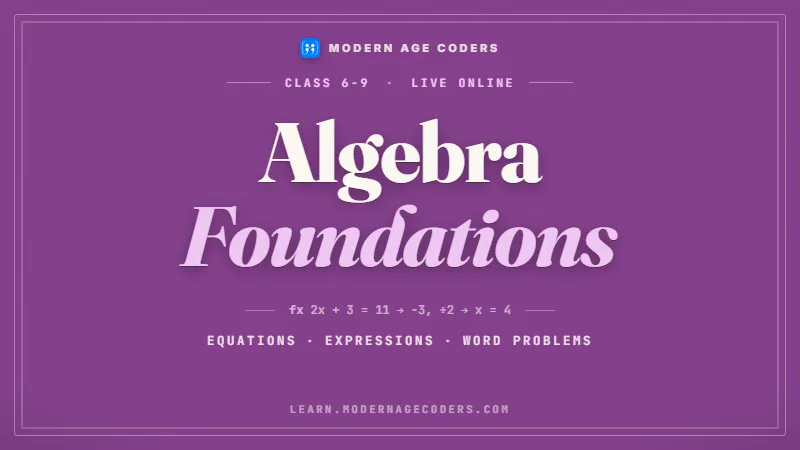
VCFM / 01
Formulas, rates and relationships rebuilt step by step, for students whose confidence took a knock earlier.
Open the syllabus →
VCFM / 02
Percentages, ratios, measurement and data, the everyday maths Foundation builds on.
Open the syllabus →
VCFM / 03
Collecting, presenting and questioning data from community and media contexts.
Open the syllabus →Inside the study design
Taken from the VCE Mathematics Study Design on 7 October 2026. All four areas are completed across Units 3 and 4, with content equivalent to two areas in each unit, developed through contexts from students' other studies.
| Area of study | What it covers, in the study design's terms |
|---|---|
| Algebra, number and structure | Estimation, different forms of numbers and calculations, and algorithmic and computational thinking |
| Data analysis, probability and statistics | Collecting, presenting and analysing gathered and provided data from community, work, recreation and media contexts |
| Discrete mathematics | Numbers, relationships and formulae applied to analysing and critiquing practical situations |
| Space and measurement | The metric system and related measurement in domestic, societal, industrial and commercial contexts |
The study design is clear about the purpose: providing students with the knowledge and skills to solve problems in real contexts "for a range of workplace, personal, further learning, community and global settings". It suits students heading into trades, apprenticeships, TAFE, or work, and students who need maths that makes sense rather than maths that impresses.
The estimation key knowledge is a good example of its practical spirit. It lists interval estimates, rounding, significant figures, leading-digit approximations, floor and ceiling values and percentage error, all of which decide real answers about how many, how much and how sure.
Technology is part of the study, not an extra. Outcome 3 asks students to apply computational thinking and use the numerical, graphical, symbolic and statistical functions of technology in practical situations. Spreadsheets are the natural tool, and a little coding helps students see what a formula is doing.
The study design even suggests investigation contexts, including pandemic data, climate change modelling, financial life stage planning and the operations of a community organisation. Schools choose, but the range shows how wide "practical" is meant to be.
Read on 7 October 2026: the VCAA Foundation Mathematics page and the Mathematics study design it links.
How the study score is built
Foundation's weights, task lengths and exam rules come straight from the study design, and its exam date from the VCAA timetable we checked on 7 October 2026.
| What | Share | Detail |
|---|---|---|
| Unit 3 coursework | 40 per cent | Mathematical Investigations 1 and 2 |
| Unit 4 coursework | 20 per cent | Mathematical Investigation 3 |
| Every investigation | Within those shares | Four to six hours across one or two weeks, drawing on at least two areas of study; each area features in one investigation or more |
| Final examination | 40 per cent | Two hours of multiple-choice and written questions, with a scientific calculator and one bound reference text |
Each investigation has three parts in the study design: identifying the context and the questions worth asking, investigating and analysing with mathematics and technology, and summarising and interpreting what was found. Marks follow all three, so a page of correct calculations with no explanation earns much less than it could.
Because the investigations carry so much weight, steady work through the year matters more in Foundation than in any other VCE maths study. A student who learns to explain their reasoning plainly in Term 1 benefits in every investigation after.
The 2026 examination is on Tuesday 17 November, in the session the VCAA timetable prints as 3:00 pm to 5.15pm (that page writes the end time with a full stop and no space). It is the last VCE maths exam of the year, which gives Foundation students extra revision weeks.
The exam assumes a scientific calculator, not a CAS, and allows one bound reference text that may be annotated. Building the reference as the year goes, with a worked example for each kind of problem, is one of the most useful habits a Foundation student can form.
Assessment from the Foundation sections of the study design; the session from the 2026 VCE examination timetable, accessed 7 October 2026.
A worked lesson
The study design lists floor and ceiling values and interval estimates beside ordinary rounding. They matter because the context, not the calculator, decides which way an answer should go. Every number below is from an invented school excursion.
130 students travel on 45-seat buses. 130 divided by 45 is 2.89, but 2.89 buses cannot leave the car park. The ceiling is 3 buses, with 5 seats spare.
The hall has 130 chairs set in full rows of 8. 130 divided by 8 is 16.25, and a quarter of a row is not a row. The floor is 16 full rows, with 2 chairs left over.
A room measures 12.4 m by 7.8 m to the nearest 0.1 m. Each length could be 0.05 m either way, so the true area lies between 95.71 and 97.73 square metres.
| Question | Calculation | Rule | Answer | Check |
|---|---|---|---|---|
| How many buses? | 130 / 45 = 2.89 | Ceiling | 3 buses | 3 x 45 = 135 seats, 5 spare |
| How many packs of 12 name tags? | 130 / 12 = 10.83 | Ceiling | 11 packs | 11 x 12 = 132 tags, 2 spare |
| How many full rows of 8 chairs? | 130 / 8 = 16.25 | Floor | 16 rows | 16 x 8 = 128, 2 chairs left |
| What is the room's area? | 12.4 x 7.8 = 96.72 | Interval | 95.7125 to 97.7325 square metres | About 1 per cent either side |
Ordinary rounding would give "3 buses" by luck and "11 packs" by luck, but it would also round 16.25 rows to 16 and 2.4 buses to 2, leaving 22 students on the footpath. The question to ask every time is what the leftover part means in the real situation, and then choose the floor, the ceiling or a range.
The interval answer is the most honest. Stating 96.72 square metres suggests precision the measurements do not have; the percentage error of the stated area is about 1.05 per cent above and 1.04 per cent below. That is exactly the kind of reasoning an investigation rewards when it asks how reliable a result is.
Spreadsheets and code both have ceiling and floor functions, and they are worth meeting early. Python's math.ceil(130 / 45) gives 3. One trap is worth knowing: Python's round() sends 2.5 to 2 and 3.5 to 4 (it rounds halves to the even number), which is why careful students choose the function deliberately.
In the exam, written-response questions often hinge on this choice. A correct calculation followed by the wrong kind of rounding loses the final mark, so we practise stating the rule in words: "rounded up because a part bus is still a bus".
Estimation key knowledge from the VCE Mathematics Study Design, Foundation Mathematics Units 3 and 4. All scenarios and values are our own, checked in Python on 7 October 2026.
The investigations
Investigations are 60 per cent of Foundation Mathematics, and the VCAA accepts them only as the student's own work. The points below come from the study design.
| Aspect | Requirement |
|---|---|
| Authorship | Teachers sign off that work not acknowledged was produced by the student |
| Timing | Mostly in class, inside a limited window |
| Length | Four to six hours over one or two weeks per investigation, covering two or more areas of study |
| Structure | Set the context and questions, investigate and analyse, then summarise and interpret |
We teach the mathematics, the use of spreadsheets and the habit of explaining findings, using practical problems we invent, like the excursion above. We never plan, calculate, write, check or edit any part of a student's investigation. A student who has practised the whole cycle on our problems can complete the school's investigations with confidence and full ownership.
Study design sections on authentication and Foundation coursework, read 7 October 2026.
Building confidence
Many Foundation students arrive having lost confidence in maths. The rungs rebuild it in order.
| Stage | Rung | The sign it is secure |
|---|---|---|
| Starting out | 1. Number sense | Estimates before calculating and spots an answer that cannot be right |
| Unit 3 early | 2. Rates and measurement | Converts units and works with rates without mixing them up |
| Unit 3 investigations | 3. Explaining | Writes what each result means for the real situation |
| Unit 4 and the exam | 4. Judging reliability | States how accurate an answer is and why |
Foundation is designed for real contexts, which often suits students who struggled with abstract maths. Starting from a situation they care about makes the numbers mean something.
Small, regular wins matter more than long sessions. One practical problem done well each lesson rebuilds confidence quickly.
The habits here carry straight into apprenticeships, TAFE and work, where estimation and checking are daily tasks.
Students who discover they enjoy data can look at our VCE General Maths page for the next step in statistics.
The catalogue
Grouped by the areas of study they support. Each card opens a full syllabus.
VCFM / NA / 01
Formulas and relationships, one clear step at a time.
Open the syllabusVCFM / NA / 02
Mental methods that make estimation quick and reliable.
Open the syllabusVCFM / NA / 03
Percentages, ratios and measurement, revisited properly.
Open the syllabusVCFM / DM / 01
Collecting and questioning real data.
Open the syllabusVCFM / DM / 02
Senior-years practical maths across every area.
Open the syllabusVCFM / DM / 03
Spreadsheet-style analysis without heavy code.
Open the syllabusVCFM / TE / 01
Simple programs that make formulas and rounding visible.
Open the syllabusVCFM / TE / 02
For students who want to automate their calculations.
Open the syllabusVCFM / TE / 03
Quick number facts, rebuilt for students who never quite had them.
Open the syllabusHow lessons run
Your tutor is in India. Victorian time runs 4.5 hours ahead of India in winter and 5.5 hours ahead in summer, when daylight saving applies from 4 October 2026 to 4 April 2027 (IANA time zone data), so a 4 pm lesson in Victoria begins at 10.30 am for the tutor.
Weekday after school
Steady weekly progress through both units.
Weekend morning
Longer practice on investigation skills.
School holidays
Exam revision before mid-November.
Every topic starts from a real situation, then the maths.
A sentence about what the number means, every time.
Technology used to check and explore, as Outcome 3 asks.
Fifteen to twenty students at one level, encouraged to ask anything.
For students who want a quieter pace.
We do not predict study scores or ATARs; progress is earned by the student.
Student work
Made in their own time, not for school assessment; there are plenty more in the student labs.

AI and ML
An AI nutrition coach that reads what you eat and works you toward a target.

AI and ML
A chatbot that answers mathematics and programming questions, built and deployed by a student.

AI and ML
An assistant that helps a young person recognise unsafe situations online.

Web app
A weather forecasting site with live conditions for any location.
Fees
Foundation lessons are charged monthly in US dollars, at the same rate for any family outside India, with nothing to pay to begin and no lock-in.
Free first class
USD 0
no card required
Group batch
USD 100
a month, billed in US dollars
One to one
USD 150
a month, billed in US dollars
What families say
Just as families and students posted them on Google.
★★★★★
"The one step solution for my son. Modern Age Coders make learning coding so simple that kids love it. The teachers explain complex concepts clearly with practical exercises and interactive content."
Ria Mukherjee
Parent
★★★★★
"Modern Age Coders has been a game-changer for me. I struggled to grasp IT concepts and coding before joining, but their classes transformed everything. I can now confidently write complex programs with ease."
Samriddha Mondal
Student
★★★★★
"One of the most wonderful education centres out there. Education is not limited to school syllabus but focuses on skill development."
Vansh Agarwal
Student
★★★★★
"My child Dhairya is really enjoying the Modern Age Coders classes. This is his first online class and he eagerly looks forward to it. I can already see his improvement, and the teachers are very cooperative."
Sonam Oswal
Parent of Dhairya
★★★★★
"Modern Age Coders have wonderful teachers who teach in a clear, easy and practical way. The teacher boosts students' confidence and inspires them to learn without hesitation."
Sonu Goyal
Parent
★★★★★
"I highly recommend this computer coding class! The teachers are incredibly knowledgeable and passionate about coding."
Ritu Kedia
Parent
Questions about Foundation
It is the VCE mathematics study focused on practical problems in workplace, personal, further learning, community and global settings. Units 3 and 4 cover four areas of study and are assessed mainly through three mathematical investigations.
School-assessed Coursework contributes 60 per cent (40 per cent from Investigations 1 and 2 in Unit 3, 20 per cent from Investigation 3 in Unit 4), and the end-of-year examination contributes 40 per cent.
The VCAA timetable lists Foundation Mathematics on Tuesday 17 November 2026, in the 3:00 pm session ending at 5:15 pm. The examination itself is 2 hours.
The study design says student access to a scientific calculator is assumed in the examination, and one bound reference text, which may be annotated, may be brought in.
The floor of a number is the largest whole number not above it; the ceiling is the smallest whole number not below it. The floor of 16.25 is 16 and the ceiling of 2.89 is 3. Real problems decide which one makes sense.
The study design sets each mathematical investigation at 4 to 6 hours over 1 to 2 weeks, addressing content from two or more areas of study.
It suits students who want practical, everyday maths for work, TAFE or apprenticeships. Course and pathway choices are a conversation with your school and family; we can help with the maths once you have chosen.
We teach the maths and the investigation process with our own problems, and never plan, calculate, write, check or edit any part of a student's investigation.
Often, yes. A patient tutor, a small group or one-to-one setting, and problems from real life tend to rebuild confidence. The free lesson is a low-risk way to find out.
Late afternoon in Victoria suits most students and sits within our tutors' working day. The weekly time is agreed after the free lesson.
Related pages
The other VCE maths studies and our wider maths help.
The next step for students who enjoy data and models.
Functions and calculus, for comparison.
Maths support for every age, from primary up.
Coding and AI for Victorian students who prefer hands-on learning.
What lessons cost per term, in plain numbers.
Our main page for coding across Australia.
Start here
Tell us which area of study feels hardest, or simply that maths has never clicked. The free lesson starts from a practical problem and goes at your pace.
Prefer to look around first? The course atlas lists every syllabus, how we teach walks through a lesson, and our Australian maths tutoring page covers other year levels.
WhatsApp us · +91 91233 66161 · connect@modernagecoders.com
WhatsApp reaches us fastest. +91 is India's dialling code, where our tutors are; we do not have a Victorian office.
A priority demo is a full class of about 45 to 60 minutes. After the class the mentor sends a written skill report and a personal learning roadmap on WhatsApp. If you enrol, the demo fee is adjusted against your first month's fee. Share your demo Order ID with us on WhatsApp and we take it off.
Book a priority demo