MUS / A / 01
Early math foundations
Concrete play for Primer-age children.
Open the syllabusUnited States · Math-U-See Primer to Calculus · Live help with the hard levels
Math-U-See, published by Demme Learning, teaches each idea three ways at once: a child builds it with color-coded blocks, writes the steps, and says out loud why they work. In a homeschool that rhythm is usually led by a parent. It runs smoothly for years, then a level arrives where the parent is unsure of the math, or the child can build a problem but cannot yet do it on paper. That is where a live Math-U-See tutor helps, inside the method the family already uses.
Teaching math and coding live since 2020 · 10,000+ students · grades K to 12
The short answer
Math-U-See is a mastery-based math curriculum from Demme Learning with 13 levels named by Greek letters and subjects, from Primer through Calculus, taught with integer blocks, a lesson video and a Build, Write, Say routine. A Math-U-See tutor works live with the student on the current lesson, especially from Delta to Algebra 1. Modern Age Coders runs these lessons live online in its Algebra Foundations course, as a group batch or 1-on-1, and the first class costs nothing.
Courses that sit beside the levels
Your child keeps the Math-U-See book, blocks and video. These classes add a teacher who asks them to explain.
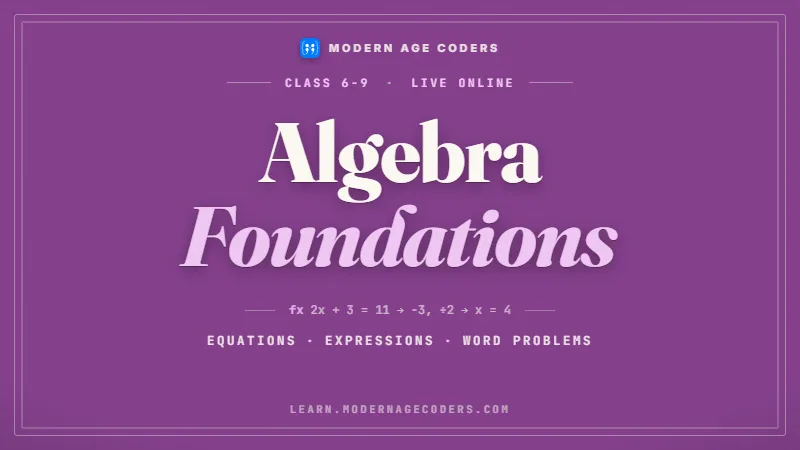
MUS / 01
For Pre-Algebra and Algebra 1: negatives, solving for the unknown, graphing and factoring.
Open the syllabus →
MUS / 02
For Epsilon and Zeta: fractions, decimals, percents and ratio.
Open the syllabus →
MUS / 03
For Gamma and Delta: multiplication facts, long division and place value.
Open the syllabus →The levels
Math-U-See names its levels with Greek letters and subjects rather than grades. Demme Learning says the curriculum "consists of 13 levels, building from an introduction to mathematics through calculus."
| Level | Subject, in Demme Learning's words | What we often see at this level |
|---|---|---|
| Primer | An Introduction to Mathematics | Counting, place value with blocks, first addition |
| Alpha | Single-Digit Addition & Subtraction | Facts that must become automatic before Beta |
| Beta | Multiple-Digit Addition & Subtraction | Regrouping, which blocks make visible |
| Gamma | Single & Multiple-Digit Multiplication | Times tables as rectangles |
| Delta | Single & Multiple-Digit Division | Long division and remainders |
| Epsilon | Fractions | Equivalent fractions and common denominators |
| Zeta | Decimals & Percents | Place value to the right of the point |
| Pre-Algebra | Negative Numbers, Order of Operations, and Solving for the Unknown | The first level where symbols lead |
| Algebra 1 | Graphing, Simultaneous Equations, Exponents, Polynomials, and Unit Multipliers | Two editions; see below |
| Geometry | Points, Lines, Planes, Angles, Circles, Triangles, Quadrilaterals, Pythagorean Theorem, Conic Sections, and Proofs | Proof is a new kind of writing |
| Algebra 2 | Factoring Polynomials, Quadratic Formula, and Graphing Conic Sections | Heavy factoring practice pays off |
| PreCalculus | with Trigonometry, Identities, Polar Equations, Logarithms, Sequences, Limits, and Other Topics to Prepare for Calculus | Functions as a single language |
| Calculus | Derivatives, Integrals, Calculus Applications, and Differential Equations | Built on secure algebra |
Demme Learning explains the naming directly: "Using Greek letters for levels instead of age or grade ensures that students can build strength where needed and progress without pressure or self-consciousness."
For a family that means a ten-year-old in Delta and a nine-year-old in Epsilon are both simply on their next level. We follow the same idea in class: we ask which lesson your child is on, not which grade.
The Algebra 1 page lists a Legacy Edition and Algebra 1: Principles of Secondary Mathematics. Demme Learning says the Legacy Edition gives "basic coverage of Algebra 1 topics", while the Principles edition "covers nationally expected topics for Algebra 1".
Tell us which edition your child uses when you book. The topics overlap, but the order and depth differ, and we plan the class around the book on your table.
Sources: Math-U-See Curriculum, the Algebra 1: Legacy Edition page and the placement page, checked 31 October 2026. Math-U-See is a trademark of Demme Learning. Modern Age Coders is not affiliated with or endorsed by Demme Learning.
The lesson
Every lesson follows what Demme Learning calls its Four-Step Approach. The second step holds the method the curriculum is known for: Build, Write, Say.
| Step | What Math-U-See says | In practice at home |
|---|---|---|
| 1. Preparation | Look over the Instruction Manual, watch the lesson videos and get familiar with the Student Workbook pages | A few minutes for the parent before the child starts |
| 2. Presenting | Work examples together using the Build, Write, Say method | The heart of the lesson, done side by side |
| 3. Practice | Lesson Practice pages until mastery is achieved | The child works alone, with help when needed |
| 4. Progression | Systematic Review pages, then the Tests booklet (except for Primer) | Move on only when mastery is shown |
In Demme Learning's words, "Build: Use the manipulatives to demonstrate and model the problems." The integer blocks are color-coded by value, so a 7 and a 3 look different before they are counted.
Again from the curriculum page: "Write: Write down step-by-step solutions while working through the problems." The written record is what carries forward once the blocks are put away.
The third part asks the child to talk through why the concept works as they build and write. It is the step most likely to be skipped on a busy day, and the one a tutor can protect.
Math-U-See defines it carefully: "Mastery means that the student not only understands a new concept but can also apply the concept independently to solve a problem." It adds that the student can teach back the concept using the Build, Write, Say method.
That teach-back test is a gift to any tutor. It gives a clear, shared signal for when a lesson is done, which the parent, the child and the teacher can all check.
For Algebra 1: Legacy Edition, the site lists a Student Workbook with Lesson Practice, Systematic Review, and Application and Enrichment worksheets, a separate Test booklet, an Instruction Manual with detailed instructions and solutions, and lesson videos.
The site says a student who shows mastery quickly may not need every Systematic Review page, and that a student who has not yet mastered a concept may need more practice, reteaching and review, with extra resources on its Digital Toolbox.
| Kit | Where Math-U-See uses it |
|---|---|
| Integer Block Kit (described as a 133-piece set) | From Primer all the way through Algebra 1 |
| Fraction Overlay Kit | Fractions in Epsilon |
| Algebra/Decimal Insert Kit | With the integer blocks, for decimals and algebra in Zeta, Pre-Algebra and Algebra 1 |
Source: Math-U-See Integrated Manipulatives, checked 31 October 2026. We describe the kits only so you know what your child should have on the desk during a live lesson.
Readiness
Demme Learning publishes a short readiness list on each level page and offers an interactive placement tool with yes or no questions and example problems. Three of those lists are a useful map of where children tend to need help.
| Before starting | Math-U-See says the student may be ready if they can |
|---|---|
| Delta | Add or subtract multiple-digit numbers with regrouping; "Recall single-digit multiplication facts from memory"; "Demonstrate a multiplication problem by building or drawing a rectangle" |
| Pre-Algebra | Work fluently with multiple-digit whole numbers; "Proficiently add, subtract, multiply, and divide fractions", mixed numbers and decimals; convert between fraction, decimal and percent; choose the operation for a word problem |
| Algebra 1: Legacy | Do all four operations with whole numbers, fractions, mixed numbers and decimals; convert between forms; solve one-step equations; plot points; operate with integers; write an expression for a word problem |
Stall points
Every curriculum has places where the work changes character. These are the Math-U-See transitions our teachers see most often in live lessons; they are general teaching guidance, not statistics.
| Transition | What changes | What tends to help |
|---|---|---|
| Gamma to Delta | Division asks the child to run multiplication backwards | Rebuild the rectangle and ask what side is missing |
| Delta to Epsilon | Fractions mean a part of one, not a count | Name the whole first, every time |
| Zeta to Pre-Algebra | Negative numbers break the idea that adding makes bigger | Zero pairs, built and then drawn |
| Pre-Algebra to Algebra 1 | The blocks step back and symbols carry the meaning | Keep saying the why even after the blocks go away |
| Inside any level | Systematic Review pages feel like repetition | Treat review as the check that mastery has lasted |
A child who can model a problem with blocks but freezes at the written version has the concept but not the notation. That is not a reason to return to an earlier level.
In class we put the build and the written step side by side, line by line, until the child can do the writing without the blocks and still describe what the blocks would show.
The opposite also happens. The answers are right, but the child cannot explain them, which usually means the steps were copied from the video or the manual's examples.
Math-U-See's own mastery test asks the child to teach the idea back. We use that test in every class, gently, and it quickly shows whether a page of right answers is really understood.
Worked examples
Original examples written by our teachers on topics from the Math-U-See sequence, from Delta to Algebra 1. None of them is taken from a Math-U-See book.
| Part | What the student does | What the student says |
|---|---|---|
| Build | Lay out one x-by-x square, five x-by-1 strips and six unit squares, then arrange all of them into one rectangle | "I need the pieces to make a rectangle with no gaps." |
| Build | The only rectangle that works has sides x + 2 and x + 3 | "Two strips go down one side and three along the other, and the six units fill the corner." |
| Write | x squared + 5x + 6 = (x + 2)(x + 3) | "The sides of the rectangle are the factors." |
| Check | (x + 2)(x + 3) = x squared + 3x + 2x + 6 = x squared + 5x + 6 | "Multiplying the sides gives back the area I started with." |
| Say | Two numbers multiply to 6 and add to 5 | "The corner must be 6 units and the strips must total 5, so I need 2 and 3." |
def rectangle_sides(b, c):
    """Find whole numbers p, q with p * q == c and p + q == b."""
    for p in range(1, c + 1):
        if c % p == 0:
            q = c // p
            if p + q == b:
                return p, q
    return None

print(rectangle_sides(5, 6))    # x^2 + 5x + 6
print(rectangle_sides(7, 12))   # x^2 + 7x + 12
print(rectangle_sides(4, 6))    # x^2 + 4x + 6
Output: (2, 3), then (3, 4), then None. The last trinomial has no whole-number rectangle, which is exactly what happens when a child tries to build it with blocks and always has pieces left over. We use small programs like this with older students who also learn to code.
Our problem: 744 divided by 6. Build 744 as 7 hundreds, 4 tens and 4 units. Share the hundreds into 6 equal groups: each group gets 1 hundred, and 1 hundred is left over.
Trade the leftover hundred for 10 tens, so there are 14 tens. Each group gets 2 tens, with 2 tens left. Trade those for 20 units, making 24 units, and each group gets 4. Write it: 744 / 6 = 124. Say it: "Every trade keeps the value the same; only the block size changes." Check: 6 x 124 = 744.
Our problem: -7 + 4. Build seven negative units and four positive units. Each positive and negative unit together make zero, so remove four pairs. Three negative units remain.
Write it: -7 + 4 = -3. Say it: "Pairs that make zero do not change the total, so I can take them away." The same picture explains why 4 - 7 is also -3.
Our problem: three quarters of 28. Build 28 and split it into 4 equal groups of 7. Three of those groups make 21.
Write it: 28 / 4 = 7, then 7 x 3 = 21. Say it: "The bottom number tells me how many equal groups; the top number tells me how many groups I keep."
Our problem: how many hours is 90 minutes? Multiply by a fraction equal to one: 90 minutes x (1 hour / 60 minutes) = 90/60 hours = 1.5 hours.
Say it: "One hour over sixty minutes is worth exactly 1, so multiplying by it changes the units but not the amount, and the minutes cancel."
| Problem | Build or draw first, then write |
|---|---|
| x squared + 7x + 12 | Rectangle with sides x + 3 and x + 4 [(x + 3)(x + 4)] |
| 852 / 4 | Trade hundreds for tens as you share [213] |
| -5 + 9 | Remove zero pairs [4] |
| Two fifths of 35 | Five groups of 7, keep two [14] |
| 150 seconds in minutes | Multiply by 1 minute over 60 seconds [2.5 minutes] |
| 0.3 x 0.4 | Shade 3 tenths across and 4 tenths down on a hundredths square [0.12] |
With a tutor
Math-U-See itself says the curriculum can be used for tutoring and that tutors should become familiar with its core principles. Our classes keep its lesson order and its Build, Write, Say rhythm; the teacher adds questions and fresh problems.
A child in the early levels whose parent enjoys the Build, Write, Say routine and has time for it each day.
A Pre-Algebra or Algebra 1 student who benefits from hearing others explain their steps, in a group of fifteen to twenty.
A student with a gap two levels back, or a parent who wants the teacher to lead the Presenting step at the harder levels.
Co-ops that use Math-U-See face the same balance. The curriculum page reminds instructors that the program "is designed to be student-paced", so a group class works best as a place for reasoning out loud, with each child still moving through their own level at home.
Blocks to symbols
Our description of the stages we see as children move through the levels.
| Stage | What it looks like |
|---|---|
| 1. Building | Can model the problem with blocks, with help |
| 2. Matching | Writes each step next to the matching build |
| 3. Picturing | Draws the blocks or imagines them instead of using them |
| 4. Explaining | Writes the steps alone and teaches the reason back |
Stage 3 is the turning point. A child who can describe what the blocks would show, without touching them, is ready for the symbol-heavy levels.
If the blocks have quietly disappeared before stage 3, bring them back for a week. That is not a step backwards.
When you are stuck, build it. When you are not stuck, say why.
If you can teach your parent the lesson, you have finished it.
The catalogue
Choose by the level on your child's book, not by grade.
MUS / A / 01
Concrete play for Primer-age children.
Open the syllabusMUS / A / 02
Facts, regrouping, multiplication, division.
Open the syllabusMUS / A / 03
Number sense to make facts stick.
Open the syllabusMUS / A / 04
Patterns and spatial thinking, ages 6 to 9.
Open the syllabusMUS / B / 01
Fractions, decimals, percents, ratio.
Open the syllabusMUS / B / 02
Patterns checked in Python.
Open the syllabusMUS / C / 01
Pre-Algebra and Algebra 1, explained.
Open the syllabusMUS / C / 02
Geometry, Algebra 2 and PreCalculus.
Open the syllabusMUS / C / 03
When a homeschooler plans for college.
Open the syllabusHow classes run
Weekdays or weekends, flexible: choose your batch, or for a very personalised plan choose 1-on-1 at your convenience, weekend mornings or weekdays.
Weekdays
In the homeschool day, when math usually happens.
Weekends
A weekly class on the lesson that stuck.
1-on-1
Matched to your level and lesson number.
We follow the Math-U-See lesson order.
The build is part of the class.
Each line ties to a move.
Your child explains one idea.
Written by our teachers.
Fifteen to twenty, or just your child.
Student work
Some Math-U-See families add coding once algebra clicks. A selection is on student labs.

AI and ML
An AI nutrition coach that reads what you eat and works you toward a target.

AI and ML
A chatbot that answers mathematics and programming questions, built and deployed by a student.

AI and ML
An assistant that helps a young person recognise unsafe situations online.

Web app
A weather forecasting site with live conditions for any location.
Fees
Classes beside Math-U-See are billed month by month in US dollars. Families often bring a teacher in for one hard level, such as Pre-Algebra, then step back once the child can teach the lessons back unaided.
Free first class
USD 0
no card required
Group batch
USD 100
a month, billed in US dollars
One to one
USD 150
a month, billed in US dollars
What families say
What parents wrote about us on Google, unedited.
★★★★★
"The one step solution for my son. Modern Age Coders make learning coding so simple that kids love it. The teachers explain complex concepts clearly with practical exercises and interactive content."
Ria Mukherjee
Parent
★★★★★
"Modern Age Coders has been a game-changer for me. I struggled to grasp IT concepts and coding before joining, but their classes transformed everything. I can now confidently write complex programs with ease."
Samriddha Mondal
Student
★★★★★
"One of the most wonderful education centres out there. Education is not limited to school syllabus but focuses on skill development."
Vansh Agarwal
Student
★★★★★
"My child Dhairya is really enjoying the Modern Age Coders classes. This is his first online class and he eagerly looks forward to it. I can already see his improvement, and the teachers are very cooperative."
Sonam Oswal
Parent of Dhairya
★★★★★
"Modern Age Coders have wonderful teachers who teach in a clear, easy and practical way. The teacher boosts students' confidence and inspires them to learn without hesitation."
Sonu Goyal
Parent
★★★★★
"I highly recommend this computer coding class! The teachers are incredibly knowledgeable and passionate about coding."
Ritu Kedia
Parent
Questions from families
Yes. Our teachers work live online with students who keep using their Math-U-See books, videos and blocks. Classes follow the lesson your child is on, in a batch of 15 to 20 or one to one.
Demme Learning lists 13 levels: Primer, Alpha, Beta, Gamma, Delta, Epsilon, Zeta, Pre-Algebra, Algebra 1, Geometry, Algebra 2, PreCalculus and Calculus. The letters stand for subjects rather than grades.
It is how Math-U-See presents each concept. The student builds the problem with manipulatives, writes the step-by-step solution, and says why it works. Math-U-See uses the same three parts as its mastery check, asking the child to teach the idea back.
Math-U-See runs through Algebra 2, PreCalculus and Calculus, and Demme Learning says its Principles of Secondary Mathematics edition of Algebra 1 covers nationally expected topics. Whether a particular student is ready for college math depends on what they have mastered, which a placement check or an honest teach-back shows better than a level name.
Demme Learning points families to the Systematic Review pages, the Application and Enrichment worksheets and its Digital Toolbox. Our teachers also write fresh problems on the same topic so the book's own pages stay available for your child.
In our experience it is usually the move from building with blocks to working in symbols, together with negative numbers. Keep the blocks for zero pairs, and ask your child to say why each step is allowed even when the blocks are put away.
Demme Learning offers the Legacy Edition, which it describes as basic coverage of Algebra 1 topics, and Algebra 1: Principles of Secondary Mathematics, which it says covers nationally expected topics. Its own comparison page and placement team are the right place to decide; we teach whichever your child has.
They help a great deal up to Algebra 1, the last level where Math-U-See says the integer blocks are used. Your child keeps them on the desk and builds on camera; older students can draw the blocks instead.
Weekdays or weekends, flexible: choose your batch, or for a very personalised plan choose 1-on-1 at your convenience, weekend mornings or weekdays.
No. We are an independent online school. Math-U-See is a trademark of Demme Learning, and we describe the curriculum only from its own published pages.
Elsewhere on this site
More help for families who homeschool math in the US.
A wider look at choosing and pacing a homeschool program.
For students in the Pre-Algebra and Algebra 1 levels.
The level after Algebra 1, with proofs.
Multiplication and division, around Gamma and Delta.
If your family is comparing a cumulative program.
Another self-paced homeschool program, explained.
Part of the guide: Homeschool and school math curricula guide
More guides: US state math tests by state · US gifted and selective school tests · US math placement and college readiness tests · US math and coding competitions guide
Start here
Tell us the Math-U-See level and lesson number, and which edition if your child is in Algebra 1 or Algebra 2. Have the blocks nearby. We begin with the problem that stopped them.
Read how our live classes work, or browse every course.
WhatsApp us · +91 91233 66161 · connect@modernagecoders.com
Our teaching team works from India, which lets us offer US homeschoolers live slots during the school day as well as after it. WhatsApp is the fastest way to reach us.
A priority demo is a full class of about 45 to 60 minutes. After the class the mentor sends a written skill report and a personal learning roadmap on WhatsApp. If you enrol, the demo fee is adjusted against your first month's fee. Share your demo Order ID with us on WhatsApp and we take it off.
Book a priority demo