Algebra asks "what's the answer?" Geometry asks "how do you know?"
A student can be perfectly good at algebra and still hit a wall in geometry, and it surprises everyone. The reason is that geometry changes the question. It's the first course that asks you to prove something must be true, to lay out a logical argument others can follow, instead of just computing a number.
Faced with a proof and no clear formula to apply, students who relied on procedures don't know where to begin, and decide they're "bad at proofs."
The second hurdle is visual. Geometry buries the information you need inside a figure, and a student who can't read the diagram can't start the problem, however good their algebra is.
We treat both directly. We teach proof as a plain chain of "if this, then that" steps anyone can build, and we train figure-reading live on a shared whiteboard, so the diagram starts handing over its secrets.
Proof as logic, figures as information.
Demystify the two things that make geometry feel hard, and the rest follows.
Reframe proof as a chain of reasons
A proof is just statements, each justified by the one before, no different from explaining your reasoning out loud. We make that structure obvious.
Master the toolkit of facts
Congruence criteria, angle relationships, circle theorems. Your child learns these as tools to reach for, knowing exactly when each one applies.
Train reading the figure
We practise extracting given information, marking diagrams, and adding the auxiliary line that cracks a problem open, live, together.
Connect to algebra and the real plane
Coordinate geometry and trigonometry tie geometry back to the algebra your child already knows, so it all becomes one subject.
A two-column proof: really just a chain of "if-then" steps.
What scares students: the blank two-column proof. They stare at "prove the base angles of an isosceles triangle are equal" with no idea where to start, because nobody showed them that a proof is just careful reasoning written down.
How we do it. We read a proof the way you'd explain anything: each line is a claim, and next to it the reason it's true. Building one is choosing the next honest step:
1. draw the bisector from A to midpoint M of BC (construction)
2. AB = AC (given)
3. BM = CM (M is the midpoint)
4. AM = AM (same segment)
5. △ABM ≅ △ACM (SSS, from 2–4)
6. ∠B = ∠C (matching parts of congruent triangles)
Every line is just "this is true, and here's why." Once a student sees that a proof is a chain of small justified steps, not a magic ritual, the panic disappears, and they can build their own. This is the exact same skill as explaining why a piece of code is correct, which is no coincidence in how we teach it.
A geometry proof and a correct program are built the same way.
If-then logic
A proof is a chain of conditionals, exactly the if-then logic at the heart of every program. Master one and the other feels familiar.
Using what's given
A proof works only from stated facts; good code works only from its inputs. Both teach you to reason from what you actually have.
One sound step at a time
Build a proof line by line, each justified, and you're debugging in advance, the same discipline that keeps a program correct.
We're Modern Age Coders. The logical reasoning at the core of geometry is the same reasoning that makes a strong programmer, which is why we treat proof not as a chore but as the most transferable thinking a student will learn in high school math.
The full high school geometry course.
Aligned with US high school geometry and Common Core, taught for reasoning.
Foundations & proof
Points, lines, planes, definitions and postulates, and how to write clear two-column and paragraph proofs.
Angles & lines
Parallel lines and transversals, angle relationships, and the reasoning that links them.
Congruence & similarity
Triangle congruence (SSS, SAS, ASA, AAS), similarity, and the proportional reasoning that flows from it.
Circles
Arcs, chords, inscribed and central angles, tangents, and the circle theorems students often find slippery.
Coordinate geometry & transformations
Distance, midpoint, slope, equations of lines and circles, and translations, rotations and reflections.
Area, volume & right-triangle trig
Areas and volumes of solids, the Pythagorean theorem, and the sine, cosine and tangent ratios.
The right fit: and an honest word on what to expect.
This fits the student who was fine until proofs appeared, the one who can't "see" the figures, and the strong student who wants geometry to be a genuine strength before pre-calc. We diagnose which it is and teach accordingly.
What's realistic. The proof fear usually fades within a few weeks once a student sees the structure. A real grade change tracks steady work over the term. We'll give you an honest read and won't promise an instant fix.
What we won't do
- Skip proofs because they're "hard."
- Have your child memorize proofs without understanding them.
- Ignore the visualization struggle underneath.
- Promise a grade jump on a timeline we can't honestly back.
Built for a subject that lives on the whiteboard.
1:1, live
One student, one mentor, real-time video with a shared whiteboard for drawing and marking figures together.
8 classes a month
Two each week, around 60 minutes, worked from your child's homework and tests.
Your time zone
All six US zones, after school, evenings or weekends.
You stay informed
A note after each class and a progress summary every few weeks.
One simple price. No contract.
1:1 Private Mentorship
$150 / month
- 8 live one-to-one classes a month (2 per week, 1 hour each)
- 4 live one-to-one classes a month (1 per week, 1 hour each)
- The same dedicated mentor throughout
- Worked from your child's class & homework
- Notes after every class · cancel any time
Small-Group Cohort
$100 / month
- 8 live small-group classes a month (2 per week, 1 hour each)
- A few students at the same level
- Same teaching approach, lower price
- A solid first step · cancel any time
Want the full high-school path geometry sits inside? Explore the High School Mathematics Masterclass →
Mentors who make proofs feel like common sense.
A good geometry teacher can take the dread out of a proof by showing it's just reasoning written carefully. Our mentors do that, and they're patient with the visualization struggle, drawing, re-drawing and marking figures until your child can do it themselves.
The same mentor stays through the course, so they know whether the next gap is logical or visual and aim each session at it.
"My son struggled with math for years. Integrating it into coding projects has transformed his understanding and confidence. Highly recommended!"
Shewta Singh, mother of Ishan · verified Google review
How we differ from the alternatives.
| What matters | Modern Age Coders | Homework-help apps | A typical tutor |
|---|---|---|---|
| Teaches proof reasoning | Yes, as a core skill | No | Varies |
| Trains figure-reading live | Yes, on a whiteboard | No | Sometimes |
| Same teacher each time | Yes | N/A | Often |
| Works from your child's class | Yes | No | Sometimes |
| Monthly price | $150 (1:1) / $100 (group) | $10–20 | $200–600+ |
An app can give the answer to a geometry problem, but it can't teach your child to construct a proof, which is the entire skill the course is built to develop.
Everything you might be wondering.
My child is fine at algebra but lost in geometry. Why?
Geometry asks you to build a logical argument, not just compute. A student strong at procedures can struggle to justify why something must be true, a learnable skill we coach directly.
Are proofs really necessary, or can we skip them?
Proofs are the point of geometry, where students first learn rigorous reasoning that pays off everywhere later. We make them approachable rather than skipping them.
Which geometry topics do you cover?
Definitions and postulates, angles, congruence and similarity, triangle theorems, circles, coordinate geometry, transformations, area and volume, and right-triangle trig.
How much does it cost?
The fees for private 1-on-1 and small-group classes are shown in your own currency in the pricing section of this page. Billing is monthly, there is no contract and you can cancel any time.
Can we try a class before enrolling?
Yes. Book a Priority Demo: a full live class of about 45 to 60 minutes, today or tomorrow, with a mentor reserved for your child. After the class the mentor sends a written skill report and a personal learning roadmap on WhatsApp. If you enrol, the demo fee is adjusted against your first month's fee.
Will my child keep the same tutor?
Yes, one mentor through the course who works from your child's class and homework.
My child struggles to 'see' the figures. Can you help?
Yes, spatial visualization is trainable. We draw, mark and manipulate figures live on a shared whiteboard.
Does this help with SAT and ACT geometry?
Are sessions live?
Yes, live, one-to-one, with a shared whiteboard, which matters more in geometry than almost any subject.
How soon will we see progress?
The proof fear usually drops within a few weeks; grade improvement tracks steady work over the term.
What ages is geometry tutoring for?
Typically grades 9–11, plus advanced younger students. We meet the level, not the grade.
What time zones do you cover?
All six US time zones; two weekly slots around school.
Book a free geometry trial lesson.
Tell us whether it's proofs, the figures or both that are tripping your child up. We'll show you how we'd untangle it on the whiteboard. No card needed.
More math tutoring from Modern Age Coders.
Real student projects
What our students actually build
Every one is a real, live project shipped by a Modern Age Coders student. Explore more in Student Labs.
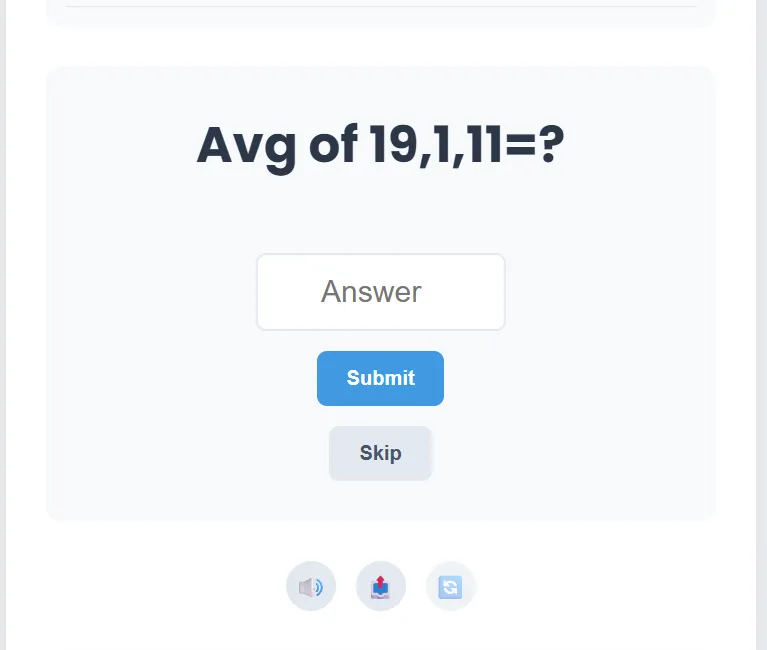 GameBabu: 90 Second Maths ChallengeAn exciting 90-second maths challenge with random problems under time pressure, and a dynamic leaderboard powered by Firebase/MongoDB with real-time score updates.by Modern Age CodersOpen the live project ↗
 AI & MLNutriLife: AI Nutrition CoachSnap a photo of any meal and NutriLife instantly names every food, then breaks down the calories, macros, vitamins and minerals, powered by AI. Bhavya vibe-coded it from a single idea: shaped the app in prompts, then wired up the AI food-recognition, daily tracking and smart coaching by hand.by BhavyaOpen the live project ↗
 AI & MLGuardianX: AI Bodyguard for the InternetPaste any suspicious link or message and GuardianX returns an instant AI verdict before you become a victim, plus a link scanner, safety score, breach check and live scam alerts built for India. Vibe-coded from idea to working product through prompts, then refined until it genuinely understands how phishing and scams work.by VivaanOpen the live project ↗