LTAU / CHD / 01
What AI is and is not
Activities that show how machines learn.
Open the syllabusAustralia · Years 5 to 12 and adults · AI with judgement
An AI chatbot will write a paragraph, a program or a maths solution in seconds, and most of the time the result looks convincing. The skill that matters now is not getting an answer; it is knowing whether the answer is right, and knowing what you would have done without it. Australian schools are already teaching students to write prompts. This page sets out what the curriculum actually asks for, what the AI companies themselves say about age, and a piece of mathematics that answers a question every student should ask: if I cannot check every answer, how many do I need to check before I trust the rest?
Live teaching since 2020 · 10,000+ students · every answer explained, never just pasted
In short
Learning to think with AI means understanding how a tool produces its answer, checking that answer, and being able to solve the problem without it. The Australian Curriculum already includes writing prompts and refining output "to improve its correctness". Because no one can check every answer, students also need to know how many to spot-check: if 4 of 40 AI answers are wrong, checking 17 at random gives at least a 90% chance of catching one.
Where to start
Matched to age and to the AI tools each age may use. The free first lesson confirms the right one.
LTAU / 01
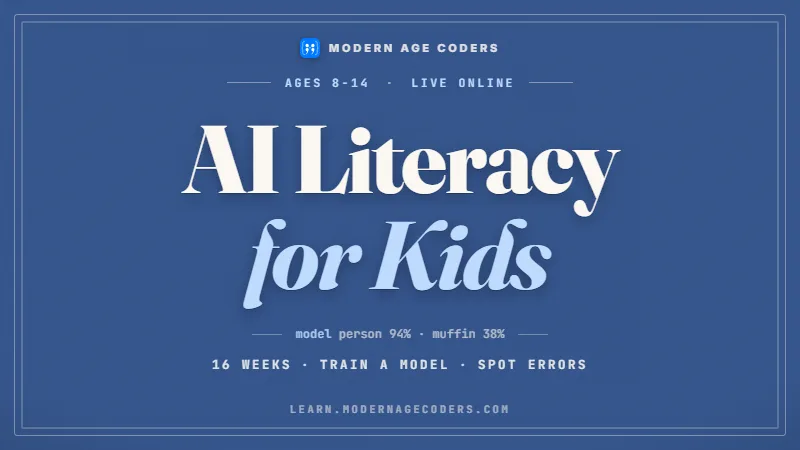
Ages 8 to 14. What AI learns from, where it goes wrong, and how to check it, without needing an adult-only chatbot.
Open the syllabus →
LTAU / 02
Ages 13 and up. Prompting, checking and citing, using tools whose terms allow teenagers.
Open the syllabus →
LTAU / 03
Teens ready for Python. Train small models and see exactly where their answers come from.
Open the syllabus →The curriculum
Prompting is not a fringe skill in Australia. The Australian Curriculum v9 names it in Digital Technologies for Years 7 and 8, alongside the expectation that students improve the correctness of what a model produces.
| Where | Code | The curriculum's words |
|---|---|---|
| Years 7 and 8, elaboration | AC9TDI8P11 | "using effective prompts with generative AI models to create output that is better suited to the problem being solved" |
| Years 7 and 8, elaboration | AC9TDI8P11 | "using a progressive series of prompts with generative models to refine output to improve its correctness" |
| Years 9 and 10, elaboration | AC9TDI10P11 | "locating relevant content by using Boolean operators or artificial intelligence search features of search engines" |
| Years 7 and 8, band description | None | "Students check their solutions meet the specifications by testing and debugging their algorithms" |
Look closely at the second line. The curriculum does not stop at writing a prompt; it expects students to refine the output "to improve its correctness". That assumes the student can tell when the output is wrong.
Telling right from wrong is a thinking skill, and it depends on understanding the subject well enough to notice a mistake.
The band description for Years 7 and 8 asks students to check their own solutions "by testing and debugging". Checking an AI's answer is the same discipline applied to someone else's work.
A student who tests their own code habitually is already halfway to checking an AI properly.
Source, read 7 October 2026: ACARA, Australian Curriculum v9, Digital Technologies content, Years 7 to 10 (Word file). Elaborations are examples of how a content description may be taught, not compulsory content.
Age rules
Thinking well about AI starts with using the right tool for your age. The companies and the education system each set their own lines, and they are not all the same.
| Who says it | What they say |
|---|---|
| Anthropic, consumer terms for Claude | "You must be at least 18 years old or the minimum age required to consent to use the Services in your location, whichever is higher." |
| Digital Technologies Hub, AI implementation module for teachers | Strategies "for integrating GenAI with students (age 13+)" |
| Our courses | Children under 13 learn how AI works through activities that need no adult-only accounts |
AI tools set their own minimum ages, and Claude's is 18. We follow each tool's current terms, which shapes how we teach younger students.
Children aged 8 to 12 learn how a model learns from examples, train small classifiers in child-safe tools, and practise checking outputs, without signing up to any adult service.
The Digital Technologies Hub offers teachers nine modules on AI "designed to build understanding of AI concepts such as Generative AI, machine learning and bias, responsible AI, programming and ethics", with no log-in required.
If your school uses them, our lessons will feel familiar; if it does not, they are a useful read for parents too.
Sources, read 7 October 2026: Anthropic consumer terms and Digital Technologies Hub, Explore AI in education. Terms change; always check the current terms of any tool before a child signs up.
Spot-checking
Suppose an AI has produced 40 answers for you: worked solutions, translations, or lines of code. Checking all 40 defeats the purpose of using it. Checking two feels too few. Factories face the same question with batches of parts, and the answer has a name: acceptance sampling.
| Wrong answers in the batch | Check 3 | Check 5 | Check 10 | Check 20 |
|---|---|---|---|---|
| 1 of 40 | 7.5% | 12.5% | 25.0% | 50.0% |
| 2 of 40 | 14.6% | 23.7% | 44.2% | 75.6% |
| 4 of 40 | 27.7% | 42.7% | 70.0% | 94.7% |
| 8 of 40 | 49.8% | 69.4% | 92.4% | 99.8% |
If 4 of the 40 answers are wrong and you check 5, you have only a 42.7% chance of spotting even one mistake. More often than not, a quick glance passes a batch that contains four errors.
To reach a 90% chance of catching at least one mistake in that batch, you need to check 17 answers. With 8 wrong, 10 checks are enough; with 2 wrong, you need 27.
The chance of missing every wrong answer is the number of ways to choose your checks from the correct answers, divided by the number of ways to choose them from all 40. One minus that is the chance of catching at least one.
In Python it is a single line using math.comb: 1 - comb(40 - k, n) / comb(40, n). Students in Years 9 and 10 can derive it; younger students can simulate it by drawing cards.
The thinking lesson
A few spot-checks catch a tool that is often wrong, but they rarely catch one that is occasionally wrong. The rarer the mistakes, the more you have to understand the subject yourself, because sampling alone will not save you.
Thinking habits
These are the habits we build in every course that touches AI, at every age.
Before asking an AI, write down what you expect the answer to look like. A prediction turns a surprising answer into a question rather than an acceptance.
For any answer you keep, be able to explain why it is right in your own words. If you cannot, you have borrowed it, not learned it.
When you cannot check everything, check a random sample, not the first few. Errors are not polite enough to sit at the top of a list.
Every so often, solve a problem without the tool. It keeps the skill alive and gives you a benchmark for the tool's answers.
Learn what kinds of question a tool handles badly, such as exact arithmetic, recent events or sources it cannot see.
Whatever you submit or ship is yours. Schools and employers judge the work, not the tool that helped.
For assessed school work, each state's rules decide what AI use is allowed, and the work must be the student's own. We teach the understanding and the checking; we never write a student's assessed work. For a deeper look at reading and owning code, see our page on understanding the code rather than copying it.
Stages
A progression we see in students who learn to work with AI well.
| Stage | What the student can do |
|---|---|
| 1. Use | Get a useful answer from a tool appropriate for their age |
| 2. Doubt | Notice when an answer looks wrong, and say why |
| 3. Check | Test answers systematically, including by random sampling |
| 4. Build | Write programs, and train small models, that do the checking |
The first two stages come through activities and games, without adult-only accounts.
Children learn that a computer can be confidently wrong, which is the most useful lesson of all.
Stages three and four involve real code: test harnesses, sampling programs and small models whose every decision can be inspected.
By then the AI is a tool the student directs, not an oracle they obey.
The catalogue
Grouped by age. The free first lesson places each student.
LTAU / CHD / 01
Activities that show how machines learn.
Open the syllabusLTAU / CHD / 02
Small, checkable AI programs.
Open the syllabusLTAU / CHD / 03
Logic that makes checking possible.
Open the syllabusLTAU / TEN / 01
AI tools used with judgement.
Open the syllabusLTAU / TEN / 02
From data to a working model.
Open the syllabusLTAU / TEN / 03
Python for real datasets.
Open the syllabusLTAU / ADL / 01
Productive, checked, accountable.
Open the syllabusLTAU / ADL / 02
Retrieval, agents and evaluation.
Open the syllabusLTAU / ADL / 03
Scripts with applied AI.
Open the syllabusHow lessons run
Whether or not an AI tool is involved, the student does the thinking, out loud, with a teacher listening.
After school
Weekday afternoons in your state.
Evenings
For senior students and adults.
Weekends
Saturday and Sunday options.
Students say what they expect before any code or tool runs.
An answer counts only once the student can explain it.
We follow each tool's terms on minimum age.
Fifteen to twenty students, or one to one.
Teachers question and guide; they do not do the work.
Students write tests and samplers, not just opinions.
Student work
Work our students built and can explain line by line. Many more are collected on the student labs page.

AI and ML
An AI nutrition coach that reads what you eat and works you toward a target.

AI and ML
A chatbot that answers mathematics and programming questions, built and deployed by a student.

AI and ML
An assistant that helps a young person recognise unsafe situations online.

Web app
A weather forecasting site with live conditions for any location.
Fees
Outside India we charge a single monthly fee in US dollars, identical across countries. Joining costs nothing extra and no term contract applies, so you may stop at the close of any month.
Free first class
USD 0
no card required
Group batch
USD 100
a month, billed in US dollars
One to one
USD 150
a month, billed in US dollars
What families say
Parents and students in their own words, as they posted them on Google.
★★★★★
"The one step solution for my son. Modern Age Coders make learning coding so simple that kids love it. The teachers explain complex concepts clearly with practical exercises and interactive content."
Ria Mukherjee
Parent
★★★★★
"Modern Age Coders has been a game-changer for me. I struggled to grasp IT concepts and coding before joining, but their classes transformed everything. I can now confidently write complex programs with ease."
Samriddha Mondal
Student
★★★★★
"One of the most wonderful education centres out there. Education is not limited to school syllabus but focuses on skill development."
Vansh Agarwal
Student
★★★★★
"My child Dhairya is really enjoying the Modern Age Coders classes. This is his first online class and he eagerly looks forward to it. I can already see his improvement, and the teachers are very cooperative."
Sonam Oswal
Parent of Dhairya
★★★★★
"Modern Age Coders have wonderful teachers who teach in a clear, easy and practical way. The teacher boosts students' confidence and inspires them to learn without hesitation."
Sonu Goyal
Parent
★★★★★
"I highly recommend this computer coding class! The teachers are incredibly knowledgeable and passionate about coding."
Ritu Kedia
Parent
Questions from parents and students
It means understanding how an AI tool reaches its answer, checking that answer properly, and keeping the ability to solve the problem without the tool, so the student directs the AI rather than depending on it.
Acceptance sampling is a way of deciding whether to trust a batch of items by checking a random sample of them. Applied to AI, it tells you how many answers to check: with 4 wrong in 40, checking 17 at random gives at least a 90% chance of catching one.
Yes. The Australian Curriculum v9 includes elaborations in Digital Technologies for Years 7 and 8 about using effective prompts with generative AI and refining output to improve its correctness.
It depends on the tool. Anthropic's consumer terms for Claude require users to be at least 18. Other tools set their own minimum ages, so always check the current terms before a child signs up.
Yes. Children aged 8 to 12 learn how AI works through activities and child-safe tools that need no adult-only accounts.
We teach understanding and checking. We never write a student's assessed work, and each state's rules decide what AI use is allowed in assessments.
Because "usually" hides the problem. If a tool is wrong only occasionally, a few spot-checks rarely catch it, so the student must understand the subject well enough to notice errors.
No. Younger students start with activities and Scratch; programming in Python comes later, when they write programs that test AI answers.
Yes. Every lesson is live over video with a teacher, in small groups or one to one, at times set for your state.
The first lesson is free. After that, fees are monthly with no joining fee and no term commitment, as shown in the fees section on this page.
Elsewhere on this site
More on reading code, AI for children and building AI rather than prompting it.
Our main page for Australian families.
Owning what you submit.
Building models rather than prompting them.
AI for primary-age children.
AI for secondary students.
For NSW senior students.
Start here
Give us a number and a convenient time. The student tackles a short problem with a teacher, AI included where age allows, and you see how the thinking is kept with the student.
Prefer to read first? Here is how a lesson runs, and here are all our courses.
WhatsApp us · +91 91233 66161 · connect@modernagecoders.com
WhatsApp is the quickest way to reach us from Australia. Our team is in India and replies from a +91 number; we have no Australian premises.
A priority demo is a full class of about 45 to 60 minutes. After the class the mentor sends a written skill report and a personal learning roadmap on WhatsApp. If you enrol, the demo fee is adjusted against your first month's fee. Share your demo Order ID with us on WhatsApp and we take it off.
Book a priority demo