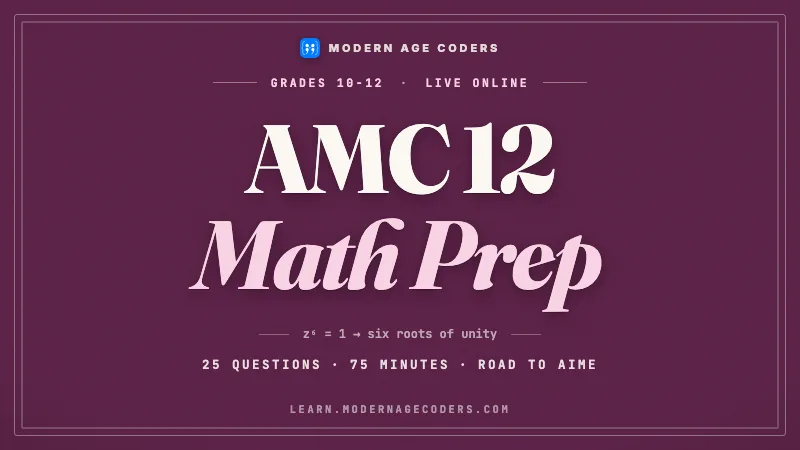
AMC 12 Math Competition Prep: Advanced Algebra to the AIME
The whole high school curriculum at contest depth, a worked example every fortnight, the scoring maths that decides when to guess, and a bridge to the 2027 AIME.
Syllabus updated November 2026
Questions? WhatsApp +91 91233 66161 or email connect@modernagecoders.com
Recordings are free with a Google sign-in. These recordings show how we teach, not the exact syllabus of this course.
Fees and enrolment
How to join AMC 12 Math Competition Prep: Advanced Algebra to the AIME
Choose how you want to pay, pick a plan and press Enrol. We then fix your class timing with you.
Rated 4.9 across 547 Google reviews.
How would you like to pay?
Pay once for 6 months and save 20%. Same live classes, same mentor, a lower price for every session.
Group Classes
6 months · 48 sessions
One payment for all 6 months
- Paying monthly
₹1,499 × 6 months = ₹8,994- You save
- ₹1,795 (20%)
- Per session
- ₹150
₹187
2 sessions a week · 15 to 20 students
Stop early? Every session you have not taken is refunded at ₹150. Refund policy
Enrol for 6 monthsMini Batch
6 months · 48 sessions
One payment for all 6 months
- Paying monthly
₹2,999 × 6 months = ₹17,994- You save
- ₹3,595 (20%)
- Per session
- ₹300
₹375
2 sessions a week · Up to 6 students
Stop early? Every session you have not taken is refunded at ₹300. Refund policy
Enrol for 6 monthsHow your 6-month price works
- Sessions
- 24 one-to-one sessions over 6 months, fully flexible timing
- Price per session
- ₹1,000 instead of
₹1,250 - Your 6-month fee
- ₹1,000 × 24 sessions = ₹24,000
- Paying monthly instead
₹4,999 × 6 months = ₹29,994- You save
- ₹5,994 (20%)
Everything in the monthly 1-on-1 plan is included: your own mentor, flexible timing, personal dashboard, class recordings, progress reports and parent-teacher meetings.
Stop early? Every session you have not taken is refunded at ₹1,000. Refund policy
Pay once for 6 months and save 25%. Same live classes, same mentor, a lower price for every session.
Group Classes
6 months · 48 sessions
One payment for all 6 months
- Paying monthly
$100 × 6 months = $600- You save
- $151 (25%)
- Per session
- $9.35
$12.50
2 sessions a week · 15 to 20 students
Stop early? Every session you have not taken is refunded at $9.35. Refund policy
Enrol for 6 monthsHow your 6-month price works
- Sessions
- 48 one-to-one sessions over 6 months, 2 sessions a week
- Price per session
- $14 instead of
$18.75 - Your 6-month fee
- $14 × 48 sessions = $672
- Paying monthly instead
$150 × 6 months = $900- You save
- $228 (25%)
Everything in the monthly 1-on-1 plan is included: your own mentor, flexible timing, personal dashboard, class recordings, progress reports and parent-teacher meetings.
Stop early? Every session you have not taken is refunded at $14. Refund policy
Pay once for 6 months and save 25%. Same live classes, same mentor, a lower price for every session.
Group Classes
6 months · 48 sessions
One payment for all 6 months
- Paying monthly
$140 × 6 months = $840- You save
- $211 (25%)
- Per session
- $13.10
$17.50
2 sessions a week · 15 to 20 students
Stop early? Every session you have not taken is refunded at $13.10. Refund policy
Enrol for 6 monthsHow your 6-month price works
- Sessions
- 48 one-to-one sessions over 6 months, 2 sessions a week
- Price per session
- $19.60 instead of
$26.25 - Your 6-month fee
- $941
- Paying monthly instead
$210 × 6 months = $1,260- You save
- $319 (25%)
Everything in the monthly 1-on-1 plan is included: your own mentor, flexible timing, personal dashboard, class recordings, progress reports and parent-teacher meetings.
Stop early? Every session you have not taken is refunded at $19.60. Refund policy
How enrolment works
Pick a plan
Group (15 to 20 students), Mini Batch (up to 6, India only) or 1-on-1 with your own mentor. Pay monthly, or for 6 months at once and save.
Press Enrol and pay
Fill in the student's name, email and phone, then pay securely: UPI, cards or net banking in India, or a debit or credit card from any other country.
Fix your class timing
After paying, WhatsApp or call +91 91233 66161 with the student's name and your preferred time. We confirm the batch or 1-on-1 slot and send the class link.
Start learning
Join your first live class at the time you chose. Your mentor takes it from there.
Want to see a class first? Book a Priority Demo: a live class of about 45 to 60 minutes with a mentor reserved for you. If you enrol, the demo fee is adjusted against your first month's fee. Share your demo Order ID with us on WhatsApp and we take it off.
Pay monthly and cancel any time, or pay for 6 months at once and save. Stop a 6-month plan early and every session left is refunded.
International Students (Outside India)
Billed monthly in US dollars, the same price in every country. Contact us with any questions.
Questions before you enrol? Talk to our team.
Ask about class timings, the right level for your child, what they need to know already, or payment. Parents and adult learners can reach us on WhatsApp, by email or by phone.
Our promise
The world's best learning experience, open to everyone.
- World-class instructorsEvery class is taught by an instructor who specialises in that exact field.
- No compromise on qualityEvery lesson, project and piece of feedback is held to the highest standard.
- Education for everyoneLearners aged 6 to 67, from first-time beginners to working professionals, in 25+ countries.
If you want the highest quality, Modern Age Coders is the right choice.
Book a Priority DemoHow long this course takes
This course runs 8 months (32 weeks) per cycle, joinable any month; most students start in the spring or summer before the November contest dates at 2 live classes/week + weekly original problem sets, an error log and a monthly 75-minute timed set. The range allows for background and pace: a complete beginner uses the full span, and a student with prior knowledge finishes sooner. The syllabus below is planned to the shorter end, with margin kept for revision.
For personalised duration planning, call +91 91233 66161 and we'll map a schedule to your goals.
At a glance
- Who it is for
- High school students in grades 9 to 12 (roughly ages 15 to 18) who are secure in algebra and geometry and want contest-level depth in the whole high school curriculum. Age: Grades 9 to 12, roughly ages 15 to 18. A strong younger student may join after the demo class if the teacher agrees the level fits.
- Prerequisites
- Secure in algebra 1, geometry and most of algebra 2; trigonometry is taught in the course, but some exposure helps
- Format
- Live, interactive classes with a real teacher, never pre-recorded videos. Live classes run about one hour.
- Language
- English or Hindi, depending on the batch.
- Duration
- 8 months (32 weeks) per cycle, joinable any month; most students start in the spring or summer before the November contest dates
- Weekly commitment
- 2 live classes/week + weekly original problem sets, an error log and a monthly 75-minute timed set
- Class size
- Group batches of 15 to 20 students, mini batches of up to 6, or 1-on-1.
- Certificate
- Certificate from Modern Age Coders, awarded on passing the final assessment (this is not an MAA document or score)
- Watch first
- Free recordings of real classes for ages 13 and up, free with a Google sign-in. These recordings show how we teach, not the exact syllabus of this course.
- Live demo
- Optional. Enrol directly on this page, or book a Priority Demo: a full live class of about 45 to 60 minutes with a mentor reserved for you.
- Questions
- WhatsApp +91 91233 66161 or email connect@modernagecoders.com.
How we teach
Deep understanding. Real projects. Expert guidance.
Learn coding, AI and maths through careful explanations, practical demonstrations, and hands-on problem-solving. Our instructors guide you from the foundations to advanced ideas, helping you understand what happens, why it happens, and how to build it yourself.
You will explore concepts step by step, write and improve code, investigate mistakes, ask questions, and apply your knowledge to meaningful projects. Lessons are designed around active participation, thoughtful feedback, and growing independence.
Expert-led live teaching, with practical participation built into every lesson.
- Students explain their thinking.
- Instructors demonstrate, then guide practice.
- Learners code, solve, or build during lessons.
- Questions and misconceptions get attention.
- Assignments receive useful feedback.
- Progress is checked before advancing.
Program Overview
The AMC 12 is a mathematics contest for high school students run by the Mathematical Association of America (MAA). It is the senior contest in the American Mathematics Competitions series, which also includes the AMC 8 and the AMC 10. Any student in grade 12 or below who is under 19.5 on competition day can sit it. It is held twice a year, as the AMC 12A and then the AMC 12B (in 2026 the dates were 5 November and 13 November). A student may sit one A contest and one B contest, but cannot take the AMC 10 and the AMC 12 on the same date. Registration is done through a school or an approved competition manager, not through us.
The paper has 25 multiple-choice questions, each with five answer choices, and lasts 75 minutes. Calculators are not allowed. Questions start gentle and become much harder towards the end, so a strong student often spends more time on the last ten questions than on the first fifteen.
The scoring shapes strategy. A correct answer earns 6 points, a blank earns 1.5 points and a wrong answer earns 0, so the maximum is 150. That means guessing is not free. A random guess among five choices is worth 6/5 = 1.2 points on average, less than the 1.5 a blank earns, so a blind guess loses points over time. If you can rule out one choice, a guess among four is worth exactly 1.5, break-even. If you can rule out two, a guess among three is worth 2 points, more than a blank. We teach students to make that decision quickly and honestly on every question they cannot finish.
The AMC 12 covers the whole high school curriculum, including trigonometry, advanced algebra and advanced geometry, but never calculus. That is the big difference from the AMC 10, which stops at elementary algebra, basic geometry, elementary number theory and elementary probability. The AMC 12 is also the door to the next contest. From the 2027 AIME, the MAA announced on 26 August 2026 that qualification is a fixed score: 85 or more on the AMC 12 (or 100 or more on the AMC 10), plus other eligibility rules. The AIME is 15 questions, every answer an integer from 000 to 999, taken on computer at Pearson testing centers in the United States and Canada on 5 or 6 February 2027, in two parts: 8 questions in 90 minutes, then 7 questions in 90 minutes, with no return to Part 1. USAJMO and USAMO selection is now based primarily on the AIME score, and AMC scores are no longer a factor. Students outside the US and Canada should check with their competition manager what applies to them.
This course takes eight months. Months 1 and 2 explain how the AMC 12 works, set a diagnostic and build advanced algebra: polynomials and Vieta's formulas, the remainder and factor theorems, functions, exponentials and logarithms, sequences and series. Months 3 and 4 cover trigonometry, complex numbers and advanced number theory. Months 5 and 6 cover counting, probability and advanced geometry, including circles, coordinates, vectors and solids. Months 7 and 8 are contest craft: 75-minute pacing, full-length timed sets of our own original problems, an error log, and an AIME bridge practised under the new two-part split. Every fortnight is built around a fully worked original example so students see exactly how an idea is used under time pressure.
All problems in our materials are written by us. Past AMC papers are published by the MAA, and students may use them on their own, but we never copy or reconstruct contest items. We are independent of the MAA and we promise learning, never scores, AIME qualification or awards.
What Makes This Program Different
- AMC 12 only: the whole high school curriculum at contest depth, with trigonometry, complex numbers and advanced geometry that the AMC 10 leaves out
- A fully worked original example in every fortnight, with the transferable idea written in one sentence
- The 6, 1.5 and 0 scoring taught as real maths, so students know when a guess is worth more than a blank
- Monthly 75-minute timed sets of original problems and an error log reviewed with the teacher
- An AIME bridge built on the 2027 format: integer answers from 000 to 999, two parts of 8 and 7 questions, 90 minutes each, no return to Part 1
- Honest by design: independent of the MAA, no copied contest problems, no promised scores or qualifications
Your Learning Journey
Career Progression
Detailed Course Curriculum
Explore the complete week-by-week breakdown of what you'll learn in this comprehensive program.
The AMC 12 gives 6 points for a right answer, 1.5 for a blank and 0 for a wrong one, so a blind guess is worth only 1.2 points on average and loses to leaving the question empty. Once two choices are ruled out, a guess among three is worth 2 points and beats the blank. The common trap is guessing everything out of habit from tests with no penalty, or leaving everything blank out of fear. This fortnight also sets a diagnostic so each student knows where to start.
Topics Covered
- The format: 25 multiple-choice questions, five choices each, 75 minutes, no calculators
- Eligibility: grade 12 or below and under 19.5 on competition day
- The A and B dates, and why a student cannot sit the AMC 10 and AMC 12 on the same date
- AMC 10 versus AMC 12: the trigonometry, advanced algebra and advanced geometry only the AMC 12 tests
- Expected value of a guess: 6/5 with nothing ruled out, 6/4 with one ruled out, 6/3 with two ruled out
- Elimination tactics: checking parity, sign, size and units against the choices
- A diagnostic of our own across algebra, number theory, counting and geometry
- Starting an error log: the question, the mistake, the fix, the idea to remember
Worked Example
Problem. A student finishes the AMC 12 sure of 15 answers, all of them correct. On 4 other questions she has ruled out exactly two choices each, and on the remaining 6 she has ruled out nothing. If she chooses for each group whether to guess or leave blank so as to make her expected score as large as possible, what is that expected score? (A) 101 (B) 104 (C) 105.5 (D) 107 (E) 110
- The 15 correct answers give 15 x 6 = 90 points.
- On the 4 questions with three choices left, a guess is worth 6/3 = 2 points on average, more than 1.5 for a blank, so she guesses: 4 x 2 = 8.
- On the 6 questions with five choices left, a guess is worth 6/5 = 1.2, less than 1.5, so she leaves them blank: 6 x 1.5 = 9.
- Expected total: 90 + 8 + 9 = 107.
Answer. (D) 107
The idea to keep. Guess only when you have ruled out at least two choices; otherwise the 1.5-point blank is worth more.
Projects You Build
- A personal starting profile from the diagnostic: three strengths, three gaps and a first target list
Practice & Assignments
Ten original mixed problems in 25 minutes, with a blank-or-guess decision written beside each one left unfinished
Vieta's formulas link the roots of a polynomial to its coefficients, so you can find sums and products of roots without ever solving the equation. That matters because AMC 12 polynomials are often impossible to factor by hand, yet the question only asks about a symmetric expression of the roots. The trap is mixing up signs: for x^3 + ax^2 + bx + c the sum of roots is minus a, not a.
Topics Covered
- Vieta's formulas for quadratics, cubics and quartics, with the sign pattern
- Symmetric sums: sum of squares and sum of reciprocals of roots from the coefficients
- The remainder theorem: P(a) is the remainder when P(x) is divided by x minus a
- The factor theorem and finding integer roots with the rational root test
- Polynomial division and the remainder on division by a quadratic
- Building a polynomial from given roots, and transforming roots (roots doubled, roots shifted)
- Counting real roots with sign changes and simple graph sketches
- Coefficient sums: P(1) and P(-1) as quick checks
Worked Example
Problem. Let r, s and t be the roots of x^3 - 6x^2 + 5x - 2 = 0. What is r^2 + s^2 + t^2? (A) 16 (B) 21 (C) 26 (D) 31 (E) 36
- By Vieta, r + s + t = 6 and rs + st + tr = 5.
- Use the identity r^2 + s^2 + t^2 = (r + s + t)^2 - 2(rs + st + tr).
- Substitute: 6^2 - 2 x 5 = 36 - 10 = 26.
Answer. (C) 26
The idea to keep. When a question asks about a symmetric expression of roots, rewrite it in terms of sums and products and never solve the polynomial.
Projects You Build
- A one-page polynomial formula sheet in the student's own words, with a tiny original example under each formula
Practice & Assignments
Twelve original polynomial problems in 30 minutes, each checked by substituting P(1) or a root back in
Assessment
Month 1 check: a 40-minute timed set of original problems on scoring decisions and polynomials
A logarithm answers the question: what power do I raise the base to? On the AMC 12 the key skill is changing every logarithm in a problem to one common base so they can be added like ordinary numbers. The usual trap is treating log_4 x as if it were log_2 x, forgetting that log_4 x is only half of log_2 x.
Topics Covered
- Function notation, composition, inverses and domain restrictions
- Functional equations solved by substituting clever values such as x and 1 - x
- Laws of exponents and solving exponential equations by matching bases
- Logarithm rules: product, quotient, power and change of base
- Equations mixing logarithms of different bases
- Checking that every solution is inside the domain of the logarithm
- Comparing sizes of numbers like 2^100 and 3^63 using logarithms
- Graphs of exponential and logarithmic functions and their transformations
Worked Example
Problem. If log_2 x + log_4 x + log_16 x = 7, what is x? (A) 2 (B) 4 (C) 8 (D) 16 (E) 32
- Change to base 2: log_4 x = (log_2 x)/2 and log_16 x = (log_2 x)/4.
- The equation becomes log_2 x times (1 + 1/2 + 1/4) = 7, that is (7/4) log_2 x = 7.
- So log_2 x = 4 and x = 2^4 = 16.
- Check: 4 + 2 + 1 = 7.
Answer. (D) 16
The idea to keep. Put every logarithm in one base first; then the problem is ordinary algebra.
Projects You Build
- An original set of six functional-equation and logarithm problems, each with a full solution written for a classmate
Practice & Assignments
Ten original problems in 25 minutes, with every answer checked against the domain
A telescoping sum is one where each term cancels part of the next, so a long sum collapses to its first and last pieces. The AMC 12 loves sums that look hopeless until one term is rewritten, often by rationalising a denominator or splitting a fraction. The trap is starting to add terms one by one and running out of time.
Topics Covered
- Arithmetic sequences: nth term and sum formulas, and the average-times-count shortcut
- Geometric sequences and infinite geometric series with ratio between minus 1 and 1
- Telescoping by partial fractions such as 1/(k(k+1)) = 1/k - 1/(k+1)
- Telescoping by rationalising denominators with square roots
- Recursive sequences: computing early terms and spotting a cycle
- Sums of squares and cubes and when to use them
- Sigma notation read and rewritten correctly
Worked Example
Problem. What is the value of the sum 1/(sqrt(1) + sqrt(2)) + 1/(sqrt(2) + sqrt(3)) + ... + 1/(sqrt(24) + sqrt(25))? (A) 3 (B) 4 (C) 5 (D) 2 sqrt(6) (E) 24
- Rationalise one term: 1/(sqrt(k) + sqrt(k+1)) = (sqrt(k+1) - sqrt(k)) / ((k+1) - k) = sqrt(k+1) - sqrt(k).
- The sum becomes (sqrt(2) - sqrt(1)) + (sqrt(3) - sqrt(2)) + ... + (sqrt(25) - sqrt(24)).
- Everything in the middle cancels, leaving sqrt(25) - sqrt(1) = 5 - 1 = 4.
Answer. (B) 4
The idea to keep. If a long sum appears, rewrite one general term as a difference and look for cancellation before adding anything.
Projects You Build
- A series toolkit page: arithmetic, geometric and three telescoping patterns, each with an original example
Practice & Assignments
Eight original series problems in 20 minutes, writing the general term before any arithmetic
Assessment
Phase 1 assessment: a 75-minute timed set of 25 original problems on scoring, polynomials, functions, logarithms and series, scored 6, 1.5 and 0
The law of cosines is the Pythagorean theorem for any triangle: it gives an angle from three sides, or a side from two sides and the angle between them. Once an angle is known, the area is half of two sides times the sine of the angle between them. The trap is using the wrong angle: the angle in the formula must sit opposite the side you single out.
Topics Covered
- Unit circle values for multiples of 30 and 45 degrees, known by heart
- Pythagorean, double-angle and sum and difference identities
- The law of sines, including the circumradius form a/sin A = 2R
- The law of cosines for finding angles and sides
- Triangle area as (1/2)ab sin C
- Trigonometry inside geometry: heights, chords and inscribed angles
- Solving trigonometric equations on a stated interval
- Radians and degrees, and converting without slips
Worked Example
Problem. A triangle has sides 5, 7 and 8. What is its area? (A) 10 (B) 10 sqrt(2) (C) 10 sqrt(3) (D) 20 (E) 20 sqrt(3)
- Let C be the angle opposite the side 7. By the law of cosines, 49 = 25 + 64 - 2(5)(8) cos C.
- So 80 cos C = 40 and cos C = 1/2, which gives C = 60 degrees.
- Area = (1/2)(5)(8) sin 60 degrees = 20 x (sqrt(3)/2) = 10 sqrt(3).
- Check with Heron's formula: s = 10 and sqrt(10 x 5 x 3 x 2) = sqrt(300) = 10 sqrt(3).
Answer. (C) 10 sqrt(3)
The idea to keep. Use the law of cosines to find a nice angle, then the sine area formula finishes the job.
Projects You Build
- A trigonometry reference card written from memory: unit circle values, the key identities and both laws
Practice & Assignments
Ten original trigonometry problems in 25 minutes, each with a labelled sketch
A complex number can be written by its distance from zero and its angle, and in that form multiplying means multiply the distances and add the angles. That turns a huge power like (1 + i)^20 into a quick calculation. The trap is expanding the power by hand, which takes far too long and invites mistakes.
Topics Covered
- Rectangular form, conjugates and modulus
- Polar form r(cos t + i sin t) and converting between forms
- De Moivre's theorem for powers
- The nth roots of unity as vertices of a regular polygon
- Sums and products of roots of unity, and why they are often 0 or 1
- Complex numbers as rotations in the plane
- Solving z^n = w for all n solutions
- Using complex numbers to evaluate trigonometric sums
Worked Example
Problem. What is (1 + i)^20? (A) -1024 (B) 1024 (C) -1024i (D) 1024i (E) 512
- Write 1 + i in polar form: modulus sqrt(2), angle 45 degrees.
- By De Moivre, (1 + i)^20 has modulus (sqrt(2))^20 = 2^10 = 1024 and angle 20 x 45 = 900 degrees.
- 900 degrees is 2 full turns plus 180 degrees, so the number points along the negative real axis.
- The result is -1024. Quick check: (1 + i)^2 = 2i, so (1 + i)^20 = (2i)^10 = 1024 x i^10 = -1024.
Answer. (A) -1024
The idea to keep. For powers of complex numbers, switch to modulus and angle; powers become multiplication and addition.
Projects You Build
- A diagram sheet of the 6th, 8th and 12th roots of unity with three original questions about each
Practice & Assignments
Eight original complex-number problems in 20 minutes, with the polar form written first
Assessment
Month 3 check: a 45-minute timed set of original trigonometry and complex-number problems
Modular arithmetic means keeping only the remainder, like reading a clock. To find the last two digits of a huge power you only need the remainder when dividing by 100, and powers always fall into a repeating cycle. The trap is trying to compute the power itself instead of finding how long the cycle is.
Topics Covered
- Congruences and the rules for adding, subtracting and multiplying them
- Last digits and last two digits of large powers
- The order of a number: the smallest power that gives remainder 1
- Fermat's little theorem and Euler's theorem as shortcuts for the cycle length
- Divisibility tests proved with modular arithmetic
- Solving linear congruences and finding inverses
- Squares modulo 3, 4, 8 and 9 to rule out impossible equations
Worked Example
Problem. What is the remainder when 7^2026 is divided by 100? (A) 1 (B) 7 (C) 43 (D) 49 (E) 57
- Compute small powers mod 100: 7^1 = 7, 7^2 = 49, 7^3 = 343, which is 43 mod 100, and 7^4 = 2401, which is 1 mod 100.
- So the order of 7 mod 100 is 4: the remainders repeat every 4 powers.
- 2026 = 4 x 506 + 2, so 7^2026 has the same remainder as 7^2.
- The remainder is 49.
Answer. (D) 49
The idea to keep. For a huge power, find the cycle length first, then reduce the exponent by that length.
Projects You Build
- An order table of our own: the order of 2, 3, 7 and 9 modulo 10, 100 and 13, with the pattern explained
Practice & Assignments
Ten original modular-arithmetic problems in 25 minutes, no calculator
The Chinese remainder idea says that if you know a number's remainders when divided by numbers that share no factors, the number is fixed up to their product. In practice you solve one condition, list the numbers that satisfy it, and test them against the next condition. The trap is listing all numbers up to the product one by one when stepping through a single condition is far faster.
Topics Covered
- Systems of congruences solved by stepping through one condition at a time
- Why the moduli must share no common factor for a unique answer
- Prime factorisation and the formulas for the number and sum of divisors
- GCD, LCM and the Euclidean algorithm
- Number bases: converting, and arithmetic in base b
- Digit problems written as polynomials in the base
- Diophantine equations solved with factoring and parity
Worked Example
Problem. What is the smallest positive integer that leaves remainder 2 when divided by 5, remainder 3 when divided by 7, and remainder 4 when divided by 9? (A) 67 (B) 112 (C) 157 (D) 202 (E) 247
- Remainder 4 on division by 9 means the number is one of 4, 13, 22, 31, 40, 49, 58, 67, 76, 85, 94, 103, 112, 121, 130, 139, 148, 157, and so on.
- Remainder 3 on division by 7 picks out 31, then every 63 after it: 31, 94, 157, 220, and so on.
- Check remainder 2 on division by 5: 31 gives 1, 94 gives 4, 157 gives 2.
- The answer is 157, and the next one would be 157 + 315 = 472.
Answer. (C) 157
The idea to keep. Satisfy one congruence, then step in jumps of its modulus to meet the next; the answers repeat every product of the moduli.
Projects You Build
- Write five original number-theory problems with full solutions for a newer student
Practice & Assignments
Ten original number-theory problems in 25 minutes, each answer checked against every condition
Assessment
Phase 2 assessment: a 75-minute timed set of 25 original problems on trigonometry, complex numbers and number theory, scored 6, 1.5 and 0
Recursion means counting the big case by building it from smaller cases you have already counted. For example, a string with no two 1s next to each other either ends in 0 or ends in 01, which links each length to the two before it. The trap is trying to list every case directly, which is slow and almost always misses some.
Topics Covered
- Permutations, combinations and the multiplication principle
- Stars and bars for distributing identical objects
- Pascal's identity and the hockey stick identity
- Complementary counting and inclusion-exclusion
- Setting up a recursion from the last step
- Fibonacci-type recursions in tilings, stairs and strings
- Bijections: counting one set by matching it with an easier one
- Counting with symmetry and avoiding double counting
Worked Example
Problem. How many strings of ten digits, each digit 0 or 1, contain no two 1s next to each other? (A) 55 (B) 89 (C) 110 (D) 144 (E) 233
- Let a(n) be the number of good strings of length n. A good string either ends in 0, after any good string of length n - 1, or ends in 01, after any good string of length n - 2.
- So a(n) = a(n - 1) + a(n - 2), with a(1) = 2 and a(2) = 3.
- Continue: 5, 8, 13, 21, 34, 55, 89, 144.
- a(10) = 144.
Answer. (D) 144
The idea to keep. Split by how the object ends; that usually gives a recursion you can run in under a minute.
Projects You Build
- A recursion notebook page: three original counting problems, each solved once by recursion and once by another method
Practice & Assignments
Ten original counting problems in 25 minutes, with the method named before solving
Conditional probability asks for a chance when you already know something has happened, so the known event becomes the whole new set of possibilities. Expected value is the long-run average, and linearity of expectation lets you add expected values even when events depend on each other. The trap is dividing by all 36 dice outcomes when the question has already told you which smaller set you are in.
Topics Covered
- Probability as favourable over equally likely outcomes, and when outcomes are not equally likely
- Conditional probability: restrict to the known event, then count
- Independence, and checking it rather than assuming it
- Expected value as a weighted average
- Linearity of expectation with indicator variables
- Geometric probability using lengths and areas
- States and simple recursions for games and random walks
Worked Example
Problem. Two fair six-sided dice are rolled and the sum is 8. What is the probability that at least one die shows a 6? (A) 1/6 (B) 11/36 (C) 1/3 (D) 2/5 (E) 1/2
- List the outcomes with sum 8: (2,6), (3,5), (4,4), (5,3), (6,2). There are 5, all equally likely.
- The ones with a 6 are (2,6) and (6,2): 2 outcomes.
- The probability is 2/5.
Answer. (D) 2/5
The idea to keep. Given information shrinks the sample space; count only inside the event you are told has happened.
Projects You Build
- An expected-value experiment: simulate an original game by hand 30 times, then compare with the exact expected value
Practice & Assignments
Ten original probability problems in 25 minutes, each with the sample space written first
Assessment
Month 5 check: a 45-minute timed set of original counting and probability problems
Power of a point says that for any line through a point and a circle, the product of the two distances from the point to the circle is always the same number. For a tangent, both distances are the tangent length, so the product is the tangent length squared. The trap is multiplying the inside piece of a secant instead of the whole distance from the point.
Topics Covered
- Inscribed angles, central angles and cyclic quadrilaterals
- Power of a point for two chords, two secants and a tangent with a secant
- Tangent lengths from an external point being equal
- Incircle and circumcircle radii, including area = rs and R = abc/(4K)
- Ptolemy's theorem for cyclic quadrilaterals
- Similar triangles hidden inside circle diagrams
- Choosing between synthetic, trigonometric and coordinate approaches
Worked Example
Problem. From a point P outside a circle, a tangent touches the circle at T with PT = 12. A line through P meets the circle at A and then at B, with PA = 8. What is AB? (A) 9 (B) 10 (C) 12 (D) 15 (E) 18
- Power of a point: PA x PB = PT^2.
- So 8 x PB = 144, which gives PB = 18.
- AB = PB - PA = 18 - 8 = 10.
Answer. (B) 10
The idea to keep. Every distance in power of a point is measured from the point itself, so find the whole secant first, then subtract.
Projects You Build
- A circle theorems poster with one original diagram and problem for each theorem
Practice & Assignments
Eight original circle problems in 25 minutes, each with an accurate diagram drawn first
Many hard geometry questions become routine once you place the figure on coordinate axes, because lengths, planes and distances turn into short formulas. A cube is ideal for this, since its corners have simple coordinates. The trap is placing the axes awkwardly, which makes every later step messy.
Topics Covered
- Placing a figure on axes to keep the algebra small
- Distance, midpoint and section formulas in two and three dimensions
- Vectors, dot products and the angle between two lines
- Equation of a plane and distance from a point to a plane
- Volumes and surface areas of prisms, pyramids, cylinders, cones and spheres
- Cross sections and nets of solids
- Areas of polygons using trigonometry and the shoelace formula
Worked Example
Problem. A cube has edge length 6. One vertex is V, and the three vertices joined to V by an edge determine a plane. What is the distance from V to that plane? (A) sqrt(3) (B) 2 sqrt(2) (C) 3 (D) 2 sqrt(3) (E) 3 sqrt(2)
- Put V at (0, 0, 0); its three neighbours are (6, 0, 0), (0, 6, 0) and (0, 0, 6).
- Those three points lie on the plane x + y + z = 6.
- The distance from (0, 0, 0) to that plane is |0 + 0 + 0 - 6| / sqrt(1 + 1 + 1) = 6/sqrt(3).
- Simplify: 6/sqrt(3) = 2 sqrt(3).
Answer. (D) 2 sqrt(3)
The idea to keep. Choose coordinates that make the given points simple; a plane through intercepts a, a, a is x + y + z = a.
Projects You Build
- A geometry method map: one original problem solved three ways (synthetic, trigonometric, coordinates), with a note on which was quickest
Practice & Assignments
Eight original coordinate and solid-geometry problems in 25 minutes
Assessment
Phase 3 assessment: a 75-minute timed set of 25 original problems on counting, probability and geometry, scored 6, 1.5 and 0
Pacing means deciding in advance how long each part of the paper deserves, so the hard questions at the end get real time. Estimation is a big part of this: often you only need to know which answer is largest, not its exact value. The trap is spending ten minutes on one early question and arriving at the last ten with no time left.
Topics Covered
- A 75-minute plan: a first pass on the early questions, then the middle, then the hardest
- Recognising in under a minute whether a problem is for now, later or blank
- Estimation with logarithms and bounds to compare answer choices
- Testing simple cases and plugging in choices when that is faster
- Reading the choices first to see what form the answer takes
- Checking with parity, size and special values before committing
- The blank-or-guess rule applied in real time
Worked Example
Problem. Which of these numbers is the largest? (A) 10^30 (B) 5^43 (C) 3^63 (D) 2^100 (E) 7^36
- Compare the base 10 logarithms: log 2 is about 0.301, log 3 about 0.477, log 5 about 0.699, log 7 about 0.845.
- Estimates: 10^30 gives 30, 5^43 gives about 30.06, 3^63 about 30.06, 2^100 about 30.10, and 7^36 about 30.42.
- The others are all very close to 30, but 7^36 is clearly larger.
- The gap is safe: 30.42 against 30.10 means 7^36 is about twice 2^100, far bigger than any rounding error in the estimates.
Answer. (E) 7^36
The idea to keep. When choices are huge powers, compare their logarithms; a rough estimate is enough to separate them.
Projects You Build
- A personal pacing plan with three checkpoints, tested on two full timed sets and revised
Practice & Assignments
Two full 75-minute timed sets of 25 original problems, each followed by a written pacing review
An error log turns each mistake into a rule you will remember: what went wrong, why, and what to check next time. Many AMC 12 points are lost not to hard maths but to traps, such as an equation that looks solvable but has no solutions. The trap is reviewing only the questions you got wrong, not the ones you got right by luck.
Topics Covered
- Full-length 75-minute sets of original problems under contest conditions
- Sorting errors into types: concept, careless, misread, time
- Spotting impossibility early with parity and remainders
- Reviewing correct answers that were guesses or took too long
- Targeted mini-lessons on each student's two weakest topics
- A short personal checklist used before every answer is marked
Worked Example
Problem. How many ordered pairs of integers (x, y) satisfy x^2 - y^2 = 2026? (A) 0 (B) 2 (C) 4 (D) 8 (E) 16
- Factor: x^2 - y^2 = (x - y)(x + y).
- x - y and x + y differ by 2y, an even number, so they are both even or both odd.
- If both are odd, the product is odd. If both are even, the product is a multiple of 4.
- 2026 is even but 2026 = 4 x 506 + 2, so it is not a multiple of 4. No pair works.
Answer. (A) 0
The idea to keep. Before searching for solutions, check remainders mod 2 or mod 4; the answer may be none.
Projects You Build
- An error log summary: the ten most useful rules the student wrote this course, ranked
Practice & Assignments
One full 75-minute timed set each week, plus a 20-minute review of every error log entry
Assessment
Month 7 assessment: a full 75-minute timed set reviewed one to one with the teacher, including blank-or-guess decisions
From 2027, the AIME is open to students who score 85 or more on the AMC 12, plus other eligibility rules. It has 15 questions with no answer choices, and every answer is an integer from 000 to 999, so you cannot check against choices or guess usefully. The trap is stopping at an answer that is close but not finished, for example forgetting to take the remainder the question asks for.
Topics Covered
- The 2027 AIME: fixed AMC 12 qualifying score of 85, plus other eligibility rules
- 15 questions, answers from 000 to 999, computer based at Pearson testing centers in the US and Canada
- Two parts: 8 questions in 90 minutes, then 7 questions in 90 minutes, with no return to Part 1
- No rulers or compasses, graph-paper booklets supplied, minimum age 13
- USAJMO and USAMO selection now based primarily on the AIME score
- Why integer answers change checking: no choices to test
- Divisor sums, remainders and answers reduced mod 1000
Worked Example
Problem. AIME style, answer an integer from 000 to 999: let S be the sum of all positive divisors of 360. Find the remainder when S is divided by 1000.
- Factor: 360 = 2^3 x 3^2 x 5.
- The divisor sum multiplies across prime powers: (1 + 2 + 4 + 8)(1 + 3 + 9)(1 + 5) = 15 x 13 x 6.
- 15 x 13 = 195, and 195 x 6 = 1170.
- 1170 divided by 1000 leaves remainder 170.
Answer. 170
The idea to keep. On integer-answer problems, finish the last step the question asks for, such as the remainder, before you write the answer.
Projects You Build
- An AIME starter set: ten original integer-answer problems written and solved by the student
Practice & Assignments
Original AIME-style problems in sets of 4 in 45 minutes, answers written as three digits
Because the 2027 AIME has two separate 90-minute parts and no return to Part 1, students must finish and check Part 1 before moving on. Practising under that split teaches you to budget time for 8 questions, then 7. The trap is leaving a Part 1 question half done, expecting to come back to it.
Topics Covered
- Timed practice: 8 original questions in 90 minutes, then 7 in 90 minutes
- Deciding when to stop work on a question and when to check
- Long multi-step problems linking complex numbers, counting and number theory
- Writing clean solutions so checking is fast
- Reviewing the AMC 12 contest plan for the A and B dates
- Planning next steps after the course, whatever the result
Worked Example
Problem. AIME style, answer an integer from 000 to 999: for how many integers n with 1 <= n <= 999 is (1 + i)^n a real number?
- (1 + i) has angle 45 degrees, so (1 + i)^n has angle 45n degrees.
- It is real exactly when 45n is a multiple of 180, that is when n is a multiple of 4.
- The multiples of 4 from 1 to 999 are 4, 8, ..., 996.
- There are 996/4 = 249 of them.
Answer. 249
The idea to keep. Turn a condition about complex powers into a condition about angles, then count with divisibility.
Projects You Build
- Write a full solution to your favourite problem of the course for a newer student
Practice & Assignments
Two full practice runs of the 8 then 7 split using original problems, each with a written review
Assessment
Final assessment: a 75-minute AMC 12-style timed set of original problems plus an 8-question, 90-minute AIME-style part, then a short conversation about the student's method choices
Projects You'll Build
Build a professional portfolio with Sixteen worked examples studied in depth, hundreds of solved original problems, a complete error log, formula sheets for every topic and a history of monthly 75-minute timed sets real-world projects.
Weekly Learning Structure
Certification & Recognition
Technologies & Skills You'll Master
Comprehensive coverage of the entire modern web development stack.
Support & Resources
Career Outcomes & Opportunities
Transform your career with industry-ready skills and job placement support.
Prerequisites
Who Is This Course For?
Career Paths After Completion
Course Guarantees
Real students. Real moments. Real joy.
These are our actual student meetups. No stock photos, no filters. Swipe through and meet the community you'll be joining.







































What families say
Straight from the parents and students who learn with us. Rated 4.9 across 547 Google reviews.
“Mivaan enjoys the class. He understands the concepts and completes his tasks with excitement. He started taking interest in coding… truly amazing class.”
“I absolutely love it here! I made new friends and learned important valuable coding skills while having the fun of my life. It's not just coding here, it's outings, bonding and most importantly preparing you for your future. Definitely five stars.”
“What stands out most is how excited my son is before every class. He looks forward to learning, problem-solving, and sharing what he's built. I've noticed a big boost in his confidence!”
“Modern Age Coders has been a game-changer for me! I struggled to grasp IT concepts and coding before joining, but their classes transformed everything. I'm now the topper in my class and can confidently write complex programs with ease.”
“Modern Age Coder have wonderful teachers who teach in a clear, easy and practical way. The teacher boosts students' confidence, keeps them updated with technology, and inspires them to learn without hesitation.”
“The one step solution for my son. Modern Age Coders make learning coding so simple that kids love it.”
“Coding classes here make learning very interesting and conceptual. The teachers teach us in a very easy-to-understand and efficient manner.”
“One of the most wonderful education centres out there. Education is not limited to school syllabus but focuses on skill development. Learning here has been a wonderful journey and still continuing.”
“I highly recommend this computer coding class! The teachers are incredibly knowledgeable and passionate about coding. They make every session engaging and insightful.”
“My child Dhairya is really enjoying the Modern Age Coder IT classes. This is his first online class, and he eagerly looks forward to it.”
“Very good classes. Don't worry about coding. They teach the best, especially Shivam sir.”
“Very good classes. Makes learning very easy and interactive.”
Hear it from our students
Real parents and students in their own words, on our public YouTube channel.
Straight answers about AMC 12 Math Competition Prep: Advanced Algebra to the AIME
- Who should take this course?
- High school students in grades 9 to 12 (roughly ages 15 to 18) who are secure in algebra and geometry and want contest-level depth in the whole high school curriculum. Age: Grades 9 to 12, roughly ages 15 to 18. A strong younger student may join after the demo class if the teacher agrees the level fits. It suits strong grade 9 and 10 students ready for trigonometry and complex numbers who want the amc 12 rather than the amc 10; grade 11 and 12 students preparing for the amc 12a or 12b; students aiming for the amc 12 score that qualifies for the 2027 aime and wanting a first taste of aime problems.
- What will they learn and build?
- The AMC 12 is a mathematics contest for high school students run by the Mathematical Association of America (MAA). It is the senior contest in the American Mathematics Competitions series, which also includes the AMC 8 and the AMC 10. Any student in grade 12 or below who is under 19.5 on competition day can sit it.
- How deeply are topics covered?
- The course runs 8 months (32 weeks) per cycle, joinable any month; most students start in the spring or summer before the November contest dates at 2 live classes/week + weekly original problem sets, an error log and a monthly 75-minute timed set, across 4 phases listed week by week in the syllabus below.
- Who teaches it?
- Modern Age Coders mentors, who teach the live classes themselves. You can watch them at work in the free class recordings before you decide.
- How do practice, feedback and assessment work?
- Classwork in every session and homework after every class.
- What does it cost?
- Three monthly plans: a group batch, a mini batch and 1-on-1. Prices are shown in your currency in the plans section. Monthly billing, cancel any time.
- When can classes take place?
- Live classes are scheduled around your week. Group batches meet at a fixed weekly slot; 1-on-1 students choose their own. International students are scheduled in their own timezone. Ask on WhatsApp for the current slots.
- Can I watch the teaching before deciding?
- Yes. Full recordings of real 13 and up classes are free to watch, free with a Google sign-in. These recordings show how we teach, not the exact syllabus of this course. Some classes are in English and some in Hindi; everyone follows at their own pace. Watch a class end to end, like you are in it. Sessions are interactive and each moment builds on the last.
- Can I enroll without a live demo?
- Yes. Choose a plan on this page and enrol directly; a demo is not required. If you would like to see a full class with a mentor first, book a Priority Demo.
- How do I reach you with a question?
- WhatsApp +91 91233 66161, email connect@modernagecoders.com, or call +91 91233 66161. Tell us the student's age and what they have learned so far, and we will point you to the right plan and batch.
Common Questions About AMC 12 Math Competition Prep: Advanced Algebra to the AIME
Get answers to the most common questions about this comprehensive program
Still have questions? We're here to help!
Contact UsRelated Courses You May Like
Continue your learning journey with these recommended programs
 Competition Mathematics & Olympiad Training
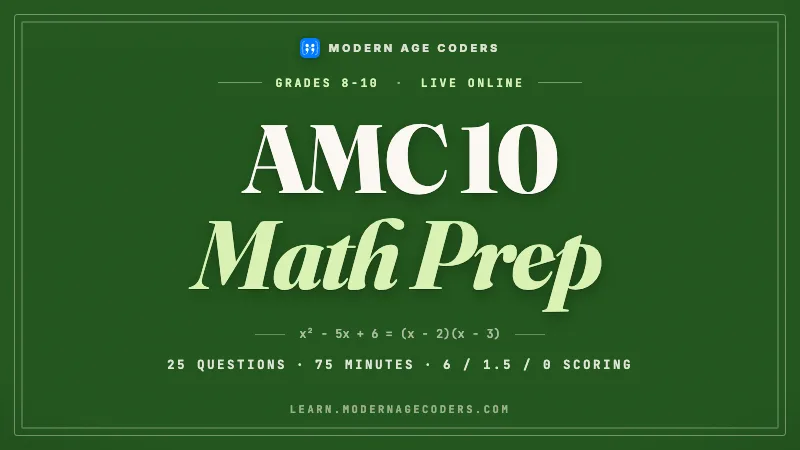
AMC 10 Math Competition Prep: Algebra to AIME
Live online AMC 10 prep for grades 8 to 10: algebra, number theory, counting, probability and geomet...
Explore Course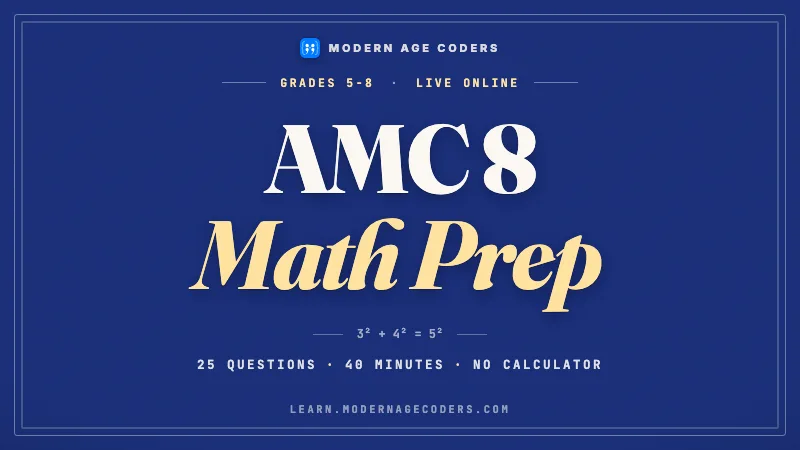 Competition Mathematics & Olympiad Training
AMC 8 Math Competition Prep: Grades 5 to 8
Live online AMC 8 prep for ages 10 to 14: 25 questions in 40 minutes, number theory, counting, algeb...
Explore CourseRelated Articles & Guides
Deepen your knowledge with these hand-picked articles
 Education
14 min read
How Learning Coding Improves Mathematical Thinking in Children
Discover the research-backed connection between coding and math skills. Learn how programming develo...
Read Article Career
28 min read
Data Science, AI, and Math: Skills Every Tech Professional Must Learn
Master data science, AI, and math skills for 2025. Complete guide with skill assessments, learning p...
Read ArticleReady to start AMC 12 Math Competition Prep: Advanced Algebra to the AIME?
Book a Priority Demo to see a full live class with a mentor reserved for you, today or tomorrow. Or choose a plan and enrol now.
Questions? WhatsApp +91 91233 66161 or email connect@modernagecoders.com