CCJ / BASE / 01
Python for kids
Typed code for younger students in Grades 5 to 7.
Open the syllabusCanada · Canadian Computing Competition · Junior level
The Junior level of the Canadian Computing Competition is where most Canadian students meet contest programming for the first time: one online sitting at school, five problems, three hours, and an automatic grader that only accepts output in exactly the form the problem asks for. This guide is built from the 2027 contest page published by the Centre for Education in Mathematics and Computing (CEMC) at the University of Waterloo and from the rules of its CCC Online Grader. It covers what the paper looks like, how entry through a school works, how Junior compares with Senior, the skills Junior problems lean on, three practice problems we wrote with full Python solutions, and a sixteen-week plan that ends on contest day.
Teaching live online since 2020 · 10,000+ students · practice problems written by our teachers, never copied from CEMC
In short
CCC Junior is the beginner-to-intermediate level of the Canadian Computing Competition, run by CEMC at the University of Waterloo: five programming problems, three hours, scored out of 75, written online at school. It suits students who can write loops and conditions, in any grade. Modern Age Coders prepares students live online, in a batch or one to one, in its CCC Junior and Senior Preparation course.
Prepare with a teacher
The first is built around the CCC itself. The other two are where a student goes to strengthen the programming underneath it.
CCJ / 01
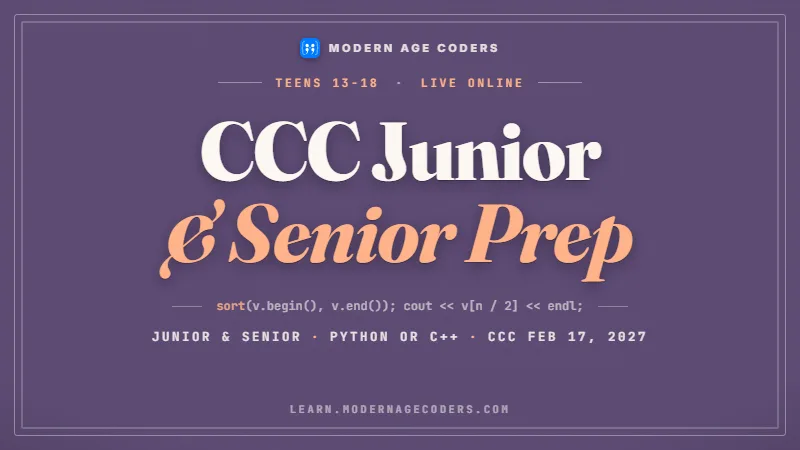
Ages 13 to 18. Junior and Senior tracks in Python or C++, two live classes a week and timed practice contests, up to the 17 February 2027 contest.
Open the syllabus →
CCJ / 02
Ages 13 to 18. Algorithms and contest habits for students heading from Junior towards Senior.
Open the syllabus →
CCJ / 03
Ages 13 to 18. Fluent Python first, for a student who is not yet comfortable with loops, lists and strings.
Open the syllabus →The 2027 contest
Each line below comes from CEMC's own page for the Canadian Computing Competition, read on 22 October 2026. CEMC sets these details each year, so check its page again before the contest.
| Point | What CEMC publishes for 2027 |
|---|---|
| Contest date | CEMC lists "North and South America: Wednesday, February 17, 2027" and "Outside North and South America: Thursday, February 18, 2027". |
| Ordering deadline | CEMC gives schools until Thursday, February 11, 2027 to order the 2027 CCC. |
| Levels | Junior: "any participant with beginner to intermediate programming skills." Senior: "any participant with intermediate to advanced programming skills." |
| Choosing a level | CEMC lets each writer pick a level "regardless of their grade". |
| Where and how | "Written in school, participants write online, individually." |
| Format | "5 questions." "Time allowed for completion is 3 hours." "Score out of 75." "Each question is worth 15." |
| Partial marks | CEMC says problems may be split into subtasks, with a partial score for each, including an easier, restricted version of a problem. |
| Programming languages | "CCC participants may use C, C++, Python 2, Python 3, or Java." |
| Contest language | CEMC: "This contest is available in English and French." |
| Fee | CEMC sets a ten-dollar fee per participant, plus a processing fee per school order; the school places the order. |
| Practice | The CCC Online Grader, "where participants can create a free practice account and access previous contests". |
CEMC's supervisor instructions say "An individualized 3-hour timer will begin for each participant as soon as they enter biographical information" after logging in to the grader. The clock is personal, so a student who starts a few minutes late still gets the full three hours.
The grader rules add a detail many families miss: a student may open both the Junior and the Senior contest, but has "a maximum of 3 hours in total" across the two. CEMC then counts the higher result: "We will take the maximum score between the Junior and Senior contest as the student's overall score."
There is no single national start time. CEMC asks supervisors to run the contest "as close to the beginning of the school day as possible in their respective time zones" on the official date, so a student in Halifax and a student in Vancouver write on the same Wednesday 17 February 2027 but at different moments.
Results reach the school's supervisor through CEMC's Contest Supervisor Portal within a few weeks of the contest, according to the CCC page.
Source: CEMC, Canadian Computing Competition, and the CEMC contests overview, read 22 October 2026. Modern Age Coders is not connected with CEMC or the University of Waterloo; we teach students who write the contest through their schools.
The grader rules
Every CCC answer is a program, and a machine marks it. The rules document linked from CEMC's page is short, and nearly every Junior mark lost to a "silly mistake" breaks one of the lines below.
| Rule | What the CCC rules say | What it means for a Junior writer |
|---|---|---|
| Input and output | "All input is from standard input and all output is to standard output." | Read with input(); never open a file. |
| Exact output | "Output must match the output format specified in the problem exactly. Prompts or additional output must not be produced." | input("Enter a number: ") costs the whole test case. |
| Limits | "3 second time limit and a 512 MB memory limit" unless a problem says otherwise | Slow code fails on big inputs even when it is correct. |
| Submissions | "up to 50 submissions per problem", "at most once per minute" | Test on your own machine first; the grader is not a debugger. |
| Scoring | The "maximum score over all submissions" counts for each problem | A later, worse submission never lowers a score. |
| Help allowed | Official language documentation only; "generative AI such as CoPilot or ChatGPT" is forbidden, and "AI-based tools within an IDE cannot be used." | Practise with plain documentation open, not an AI assistant. |
| After the contest | "Do not discuss the problems or solutions from a contest online within 48 hours after the contest." | Wait two days before posting about it. |
CEMC's sample-programs document lists the Python 3 compiler as "Pypy3 7.3.9 (running Python 3.8.13)". Code written with newer syntax, such as a match statement, will not run there.
We write every practice solution on this page in Python 3.8 syntax for that reason, and we ask students to avoid features they have only seen in the newest tutorials.
CEMC warns that "it may not always be possible to achieve a perfect score with a particular language choice (for example, Python or Java)", while there is always at least one language in which a perfect score is possible.
For a first Junior paper we teach in Python, because the student's attention belongs on the problem. Students who aim for Senior and the Canadian Computing Olympiad move to C++, which the CCO requires.
Sources: CCC rules and sample programs and language details, both linked from CEMC's CCC page and read 22 October 2026. Outside the contest, ChatGPT needs a parent's permission for anyone under 18.
Entry
Families often look for a sign-up form. There is none for students. CEMC is direct about it on its How contests work page: "It is not possible for students to individually register for a contest", and "all students must participate through their school."
CEMC's pages that we read give one route for a student whose own school does not take part: another local school that agrees to host them. They do not describe a separate route for homeschooled students, so we do not invent one. A homeschooling family's practical step is the same: contact a nearby school's math or computer science department and ask whether the student can write there.
An online class cannot host the sitting. We teach the preparation; the contest itself is always written in person at a school, under that school's supervision.
CEMC says "Any full-time student may participate" in the CCC. For writers at a school inside Canada, CEMC counts a participant as official if they were born on or after July 1, 2007, and live in Canada.
Official status matters mainly for invitations onward from Senior. Unofficial participants, CEMC notes, are still eligible for certificates.
Sources: CEMC, How contests work and the CCC page, read 22 October 2026.
Junior or Senior
Both papers share the same format and the same afternoon. They differ in what the five problems demand, and in where a strong result can lead.
| Junior | Senior | |
|---|---|---|
| CEMC's audience line | Beginner to intermediate programming skills | Intermediate to advanced programming skills |
| Questions 1 and 2 | Straightforward: "basic loops and conditions" | Basic algorithms: "sorting, searching" |
| Questions 3 and 4 | More challenging: "some combination of loops, conditions and counting" | More advanced algorithms: "careful counting, more advanced mathematical reasoning" |
| Question 5 | "recursion, two-dimensional arrays, efficient/insightful algorithms" | "IOI level question" |
| Format | 5 questions, 3 hours, out of 75 | 5 questions, 3 hours, out of 75 |
| 2026 average (mean) | 42.65 out of 75 | 15.56 out of 75 |
| 2026 Certificate of Distinction cutoff | 58 | 26 |
| 2026 number of contestants | 3421 | 2439 |
| Honour roll | Not listed by CEMC for Junior | Some top official participants named |
| Leads onward | CEMC names no onward invitation from Junior | About 20 top official Senior participants from schools in Canada invited to the CCO |
| Our guidance | A student who still checks how to write a loop, or has never written a contest program | A student who solves the last Junior problems from past papers comfortably within the time |
Our own reading of CEMC's 2026 Junior figures, labelled as ours: the Certificate of Distinction cutoff of 58 is three full questions at 15 points each plus 13 more points (58 = 45 + 13), so in 2026 a Junior writer needed roughly four questions' worth of marks to reach it. The Junior mean of 42.65 is about 57 percent of 75 (42.65 / 75). CEMC awards the certificate to "the top 25%" of all competitors, so the cutoff moves from year to year with the paper.
The first two Junior problems reward plain, careful programming. A student who reads the statement slowly and prints exactly what is asked can collect 30 points before any clever idea is needed.
Junior is also where students learn the rhythm of a contest: the personal timer, the grader's verdicts, the decision to stop polishing one problem and move to the next.
We look at evidence from timed practice, not at the grade on a report card. When a student finishes Junior questions 4 and 5 from several past years inside the time, the Senior paper is the more useful afternoon.
CEMC allows a student to open both levels, and the higher score counts, but the three hours are shared, so time spent on one paper is time lost on the other. We settle the level in late January or early February 2027, after two timed papers, so the student walks in planning to spend the afternoon on one.
What Junior tests
CEMC describes its Junior questions in a single line each. In our teaching, those lines break down into six habits a student can practise. The descriptions below are ours, not CEMC's.
| Skill | What it looks like in a Junior problem | How we practise it |
|---|---|---|
| Input parsing | A count on the first line, then values one per line or several on one line | Students write the reading code first and print what they read before solving anything |
| Loops and conditions | Deciding what happens to each item: count it, skip it, compare it | Short drills where the only change is a word such as "at least" versus "more than" |
| Simulation | Following a process step by step: a queue, a game, a timetable | Tracing the sample by hand on paper, one row per step, before any code |
| String handling | Checking characters one at a time, building an answer string, slicing | Problems where spaces, capitals and punctuation matter, so careless shortcuts fail |
| Simple data structures | Lists, dictionaries for counting, a two-dimensional grid by question 5 | One structure a week, used in three different problems |
| Careful reading | Edge cases hidden in the wording: ties, the first item, an empty run | Students write two test inputs of their own for every problem, one of them tiny |
Almost every Junior problem is solvable by a student who knows loops, lists and strings. What separates the scores is how exactly the statement is followed: whether "taller" means strictly taller, whether output goes on one line or two.
That is why our three practice problems below each hide one small trap in the wording, and why each solution names the mistake it is built to catch.
Because CEMC can award partial scores for an easier, restricted version of a problem, a student who cannot see the full solution to question 5 should still solve the small case.
A simple program that is correct for small inputs and too slow for large ones can still earn the subtask points. We practise writing that version first, then improving it.
Three practice problems
We wrote these three problems for our students; they are our practice problems, not CEMC problems, and they are not copied or adapted from any past contest. They follow the Junior ladder in difficulty: the first is question 1 or 2 level, the second question 3 level, the third a string problem of the kind that appears in the middle of a Junior paper. Each solution is written in Python 3.8 syntax, to suit the grader, and was run on its sample input.
Practice problem 1: Line-up Leaders. Students stand in a line. Count how many students are strictly taller than every student in front of them; the first student always counts. Input: the first line holds N (1 to 100), the number of students. Each of the next N lines holds one height in centimetres, a whole number from 1 to 250. Output: one line with the count.
Sample input:
5
140
152
152
149
160

Sample output:
3
# Our practice problem 1: Line-up Leaders (not a CEMC problem)
n = int(input())
count = 0
tallest = 0          # every height is at least 1, so 0 is safe
for _ in range(n):
    h = int(input())
    if h > tallest:  # strictly taller; a tie does not count
        count += 1
        tallest = h
print(count)
The mistake it catches: writing >= instead of >. The second student of height 152 ties, so does not count, and the answer is 3, not 4. The second trap is a prompt: input("How many students? ") prints extra text, and the grader marks the case wrong.
Practice problem 2: Plough Days. A town ploughs its roads on any day with at least 5 cm of new snow. Given the snowfall for N days, print how many plough days there were, then the length of the longest run of plough days in a row. Input: the first line holds N (1 to 1000). The second line holds N whole numbers from 0 to 100, separated by single spaces. Output: two lines, the number of plough days and then the longest run.
Sample input 1:
8
0 6 7 2 5 5 9 1

Sample output 1:
5
3

Sample input 2:
4
1 5 6 7

Sample output 2:
3
3
# Our practice problem 2: Plough Days (not a CEMC problem)
n = int(input())
snow = list(map(int, input().split()))

plough_days = 0
run = 0
longest = 0
for cm in snow:
    if cm >= 5:
        plough_days += 1
        run += 1
        if run > longest:   # update inside the loop, so a run
            longest = run   # that reaches the last day still counts
    else:
        run = 0
print(plough_days)
print(longest)
The mistake it catches: many first attempts update the longest run only when a run breaks. On the second sample the run of 5, 6 and 7 reaches the last day and never breaks, so that version prints 0 instead of 3. Updating inside the loop, as above, fixes it. The input trap: all the numbers sit on one line, so a program that reads each day with int(input()) receives the whole line "0 6 7 2 5 5 9 1" at once, raises a ValueError, and the grader reports a run-time error.
Practice problem 3: Postal Pattern. Our simplified postal pattern has exactly seven characters: a capital letter, a digit, a capital letter, one space, a digit, a capital letter and a digit. For each line, print VALID if it matches the pattern and INVALID if it does not. (This is our made-up checking rule for practice, not a full postal-code validator.) Input: the first line holds N (1 to 50). Each of the next N lines holds one string of up to 20 characters. Output: N lines, each VALID or INVALID.
Sample input:
5
A1B 2C3
a1b 2c3
A1B2C3
Z9Y 8X7
A1B 2C3D

Sample output:
VALID
INVALID
INVALID
VALID
INVALID
# Our practice problem 3: Postal Pattern (not a CEMC problem)
LETTER = "ABCDEFGHIJKLMNOPQRSTUVWXYZ"
DIGIT = "0123456789"
PATTERN = [LETTER, DIGIT, LETTER, " ", DIGIT, LETTER, DIGIT]

def is_valid(code):
    if len(code) != len(PATTERN):
        return False
    for ch, allowed in zip(code, PATTERN):
        if ch not in allowed:
            return False
    return True

n = int(input())
for _ in range(n):
    line = input()            # keep the space in the middle
    print("VALID" if is_valid(line) else "INVALID")
The mistake it catches: reading the line with input().split() cuts "A1B 2C3" into two pieces and loses the space the pattern needs. The second trap is isalpha(), which accepts lower-case letters, so "a1b 2c3" would wrongly pass. Comparing each character with an explicit list of allowed characters follows the statement exactly.
Solve each one before reading our solution, then type your program into a fresh file and run it on the sample input. If it disagrees with the sample output, find out why before you look.
Then write two inputs of your own: a tiny one (N equal to 1) and an awkward one, such as all ties in problem 1 or no snow at all in problem 2. Predict the output by hand first.
None needs an algorithm a Grade 8 student has not met. Each needs the statement read twice: a strict comparison, a run that ends at the edge, a space that must survive.
That is the lesson family behind this page: treat the input and output description as a contract, and test the contract before the clever part.
Sixteen weeks
Our plan for a student writing Junior on Wednesday 17 February 2027, the date CEMC lists for the Americas. It assumes two live one-hour classes a week, as in our CCC course, a short problem set between them, and lighter weeks over the winter break. Our full course season began in September 2026; this plan is for a student who begins in late October 2026.
Weeks 1 to 8 matter most. A first paper with questions 1 to 3 solved cleanly is a strong start.
The full sixteen weeks, with question 4 as the target and question 5 subtasks as the stretch.
Faster through weeks 1 to 6, then the question 5 work and an honest look at Senior.
Beyond Junior
Junior is a contest in its own right, but CEMC's pages show it as the first rung of a longer ladder. CEMC describes every step above it in terms of the Senior paper.
| Step | What CEMC says |
|---|---|
| CCC Senior | The Senior question 5 is described as an "IOI level question". |
| Canadian Computing Olympiad | "Approximately 20 of the top official CCC Senior participants from schools in Canada are invited to the CCO at the University of Waterloo each spring." |
| What the CCO is | A "week-long learning experience featuring workshops, a contest and other extracurricular activities". |
| CCO language | "CCO participants must use C++." |
| International Olympiad in Informatics | The CCO "is also used to select Canada's teams for the International Olympiad in Informatics (IOI)". |
| How Canada enters the IOI | "Canada's entry into the annual IOI competition is determined by performance on the" Canadian Computing Competition. |
| Who decides | Selection of CCO participants and IOI team members "is at the discretion of the CEMC". |
Senior questions 1 and 2 begin where Junior question 5 ends: sorting, searching and choosing an efficient method. The season after a first Junior paper is mostly about speed of thought on those ideas, and about the mathematical reasoning CEMC names for Senior questions 3 and 4.
A move from Python to C++ belongs in that year too, for a student who wants the CCO in view, because the CCO accepts only C++.
About 20 invitations a year, across the whole country, is a very small number. For nearly every student the honest goal is a strong CCC paper, and the skills behind it.
We cannot influence any invitation. CEMC decides on results, at its discretion, and we say so to every family that asks.
Sources: CEMC, CCC and CCO and Canada at the IOI, read 22 October 2026. For the full Senior route, see our CCC preparation page.
The practice bank
The richest store of CCC Junior problems belongs to CEMC, and it is free. CEMC says of its resources: "There is no registration or fee required to access these materials." We never reproduce those problems on our pages; we send students to the originals.
| Resource | What CEMC says it is | How we use it |
|---|---|---|
| Past contests, solutions and results | "Below you will find resources from the last 10 years." The CCC can be filtered by year, from 2016 to 2026. | One past Junior paper every two to three weeks, untimed at first, timed from January 2027 |
| CCC Online Grader | "the system used to run the Canadian Computing Competition", which "also provides access to practice problems and previous contests" | Every past problem is submitted to the grader, so students meet its verdicts long before the contest |
| Computer Science Circles | CEMC's Python programming tutorials | Revision for a student whose loops or lists are still shaky |
| CEMC Courseware | Math and computer science lessons for Grades 4 to 12; "No registration is required" | Background math for Senior-bound students |
| Books CEMC names | Competitive Programming by Halim and Halim, and Competitive Programmers Handbook by Antti Laaksonen | Reading for students moving from Junior towards Senior |
A note on honesty with past papers: a solution read before the problem is attempted teaches far less than one struggled towards. We ask students to spend at least twenty minutes on a past problem before opening CEMC's solution, and to explain the official solution back in their own words afterwards. The CEMC resources page lists everything else CEMC offers.
Across Canada
Our live classes are arranged in Eastern time and converted for each family, because students join from every province. There is no fixed batch time on this page; you choose the slot that suits you.
| Where | Winter (from 1 November 2026) | Summer (from 14 March 2027) |
|---|---|---|
| British Columbia (most), Yukon | UTC-7 | UTC-7, all year (in BC since 8 March 2026) |
| Alberta, Saskatchewan | UTC-6 | UTC-6, all year |
| Manitoba | UTC-5 | UTC-5, all year from 1 November 2026 |
| Ontario and Quebec (ET) | UTC-5 | UTC-4 |
| Nova Scotia, New Brunswick, Prince Edward Island (AT) | UTC-4 | UTC-3 |
| Newfoundland (NT) | UTC-3:30 | UTC-2:30 |
Eastern clocks go back on Sunday 1 November 2026 and forward on Sunday 14 March 2027, so a class time agreed in Toronto in October 2026 shifts for a family in Calgary or Vancouver when the clocks change. We confirm the time with each family at both changes. The contest itself follows the school day: CEMC asks each school to start it near the beginning of its own day on Wednesday 17 February 2027.
Where a student starts
Our stages, to place a student honestly in the first class.
| Stage | What it looks like |
|---|---|
| 1. Typing code | Can follow a tutorial and change a program, but not yet write one from a blank file |
| 2. Writing code | Writes short programs with loops, conditions and lists without help |
| 3. Reading problems | Turns a written problem into input, processing and output, and tests the sample |
| 4. Contest ready | Solves Junior questions 1 to 3 from past papers inside the time, and knows why a submission failed |
A student at stage 1 in October 2026 can still write a respectable Junior paper on Wednesday 17 February 2027 with steady weekly work. Stage 2 by December 2026 is the milestone to watch.
The step from stage 2 to stage 3 is where a teacher helps most, because the problem is no longer the code but the reading.
Print what you read before you solve anything. Half of all early bugs are input bugs.
Keep a list of every wrong answer and its cause. By February 2027 it is the most useful page you own.
The catalogue
Each is taught live online by one regular teacher, in a batch or one to one, for students anywhere in Canada.
CCJ / BASE / 01
Typed code for younger students in Grades 5 to 7.
Open the syllabusCCJ / BASE / 02
One of the five CCC languages, from scratch.
Open the syllabusCCJ / BASE / 03
Logic and data structures, step by step.
Open the syllabusCCJ / STEP / 01
The language the CCO requires.
Open the syllabusCCJ / STEP / 02
The reasoning Senior questions 3 and 4 ask for.
Open the syllabusCCJ / STEP / 03
For students also writing math contests.
Open the syllabusCCJ / ADV / 01
Contest technique beyond high school.
Open the syllabusCCJ / ADV / 02
The systematic treatment, for ages 18 and up.
Open the syllabusCCJ / ADV / 03
For schools that offer AP, in Java.
Open the syllabusHow lessons run
Weekdays or weekends, flexible: choose your batch, or for a very personalised plan choose 1-on-1 at your convenience, weekend mornings or weekdays.
Weekdays
After-school batches, with the time converted to your province.
Weekends
Weekend mornings leave the school week free for homework.
1-on-1
Timed around the student, and paced to the 2027 contest date.
Original practice sets, with CEMC's archive for past papers.
Exact input and output, checked like the real thing.
Three-hour sittings from January 2027, reviewed afterwards.
Python for Junior; C++ when Senior comes into view.
Students from British Columbia to Newfoundland.
A batch of fifteen to twenty, or a teacher to yourself.
Student work
Contest practice sits alongside real projects. A selection from our learners is below, and the student labs page holds more.

AI and ML
An AI nutrition coach that reads what you eat and works you toward a target.

AI and ML
A chatbot that answers mathematics and programming questions, built and deployed by a student.

AI and ML
An assistant that helps a young person recognise unsafe situations online.

Web app
A weather forecasting site with live conditions for any location.
Fees
The contest fee is the school's business with CEMC. Our fee covers the teaching only, paid one month at a time with no contract for the season, so a student can stop after February 2027 without anything owed.
Free first class
Free
no card required
Group batch
$100 USD
a month, eight live classes
One to one
$150 USD
a month, eight live classes
What families say
Parents' Google reviews, printed exactly as they wrote them.
★★★★★
"The one step solution for my son. Modern Age Coders make learning coding so simple that kids love it. The teachers explain complex concepts clearly with practical exercises and interactive content."
Ria Mukherjee
Parent
★★★★★
"Modern Age Coders has been a game-changer for me. I struggled to grasp IT concepts and coding before joining, but their classes transformed everything. I can now confidently write complex programs with ease."
Samriddha Mondal
Student
★★★★★
"One of the most wonderful education centres out there. Education is not limited to school syllabus but focuses on skill development."
Vansh Agarwal
Student
★★★★★
"My child Dhairya is really enjoying the Modern Age Coders classes. This is his first online class and he eagerly looks forward to it. I can already see his improvement, and the teachers are very cooperative."
Sonam Oswal
Parent of Dhairya
★★★★★
"Modern Age Coders have wonderful teachers who teach in a clear, easy and practical way. The teacher boosts students' confidence and inspires them to learn without hesitation."
Sonu Goyal
Parent
★★★★★
"I highly recommend this computer coding class! The teachers are incredibly knowledgeable and passionate about coding."
Ritu Kedia
Parent
Questions from Canadian families
It is the Junior level of the Canadian Computing Competition, run by CEMC at the University of Waterloo. CEMC describes Junior as being for any participant with beginner to intermediate programming skills, whatever their grade. Students solve five programming problems online, at school.
CEMC lists the 2027 CCC for Wednesday, February 17, 2027 in North and South America, and Thursday, February 18, 2027 elsewhere. The ordering deadline for schools is Thursday, February 11, 2027.
Three hours. CEMC says an individual 3-hour timer starts when the student enters their details in the CCC Online Grader. A student who opens both Junior and Senior has a maximum of 3 hours in total across the two.
Five questions, each worth 15, for a score out of 75. CEMC says problems may have subtasks with partial scores, and the grader keeps the highest score across a student's submissions for each problem.
CEMC lets each student choose a level regardless of grade. Our rule of thumb: if past Junior questions 4 and 5 are solved comfortably inside the time, Senior is the more useful paper. CEMC invites about 20 of the top official CCC Senior participants from schools in Canada to the Canadian Computing Olympiad, at its discretion.
No. CEMC says it is not possible for students to individually register, and all students must participate through their school. If their own school is not taking part, CEMC suggests looking for another local school that will let them join.
CEMC's pages that we read describe one route for a student whose school does not take part: another local school that agrees to host them. The contest must be written in person at the ordering school, under supervision, so ask a nearby school early.
CEMC allows C, C++, Python 2, Python 3 and Java, and the contest is available in English and French. The CCO, the next step after Senior, requires C++.
Only for editing, compiling, submitting and reading official language documentation. The CCC rules forbid generative AI and AI tools inside an editor. Outside the contest, ChatGPT needs a parent's permission for anyone under 18.
CEMC publishes past contests, solutions and results free on its website, covering the last ten years, and the CCC Online Grader lets students open a free practice account. We do not copy those problems; we link to them and write our own practice sets.
Weekdays or weekends, flexible: choose your batch, or for a very personalised plan choose 1-on-1 at your convenience, weekend mornings or weekdays. We arrange times in Eastern time and convert them for your province.
CEMC states that taking part in the CCC is not required for admission to the Faculty of Mathematics at the University of Waterloo. Its value is the problem solving a student builds while preparing, which no contest result can promise.
Elsewhere on this site
More for Canadian students who like to solve problems with code.
Every page we have for families across Canada.
Our main CCC page, with the Senior route in detail.
The math contests CEMC runs for Grades 7 to 12.
Math help that sits under a Senior paper.
What the top of the informatics ladder asks.
Another online contest many CCC writers try.
Finding the bug a wrong-answer verdict hides.
Turning a problem statement into steps.
The error first-time contest writers meet most.
Start here
The first class starts with one short Junior-style problem we wrote, solved together on screen. By the end, the teacher can tell you which stage the student is at and what the weeks to February 2027 should hold.
Prefer to read more before booking? How we teach shows what happens in a live class, and the course list carries every syllabus in full.
WhatsApp us · +91 91233 66161 · connect@modernagecoders.com
Our teachers are based in India and teach every class over live video, so there is no Canadian centre to visit. WhatsApp is the quickest way to reach us from any province.
A priority demo is a full class of about 45 to 60 minutes. After the class the mentor sends a written skill report and a personal learning roadmap on WhatsApp. If you enrol, the demo fee is adjusted against your first month's fee. Share your demo Order ID with us on WhatsApp and we take it off.
Book a priority demo