Table of Contents
- At a Glance: Scratch vs Python Comparison
- Understanding Scratch: Visual Programming for Beginners
- Understanding Python: Text-Based Programming for All Ages
- Detailed Head-to-Head Comparison
- When to Choose Scratch
- When to Choose Python
- The Ideal Learning Path: Detailed Timeline
- Making the Transition: Scratch to Python
- Common Mistakes Parents Make
- Frequently Asked Questions
- Conclusion: It's Not Either/Or
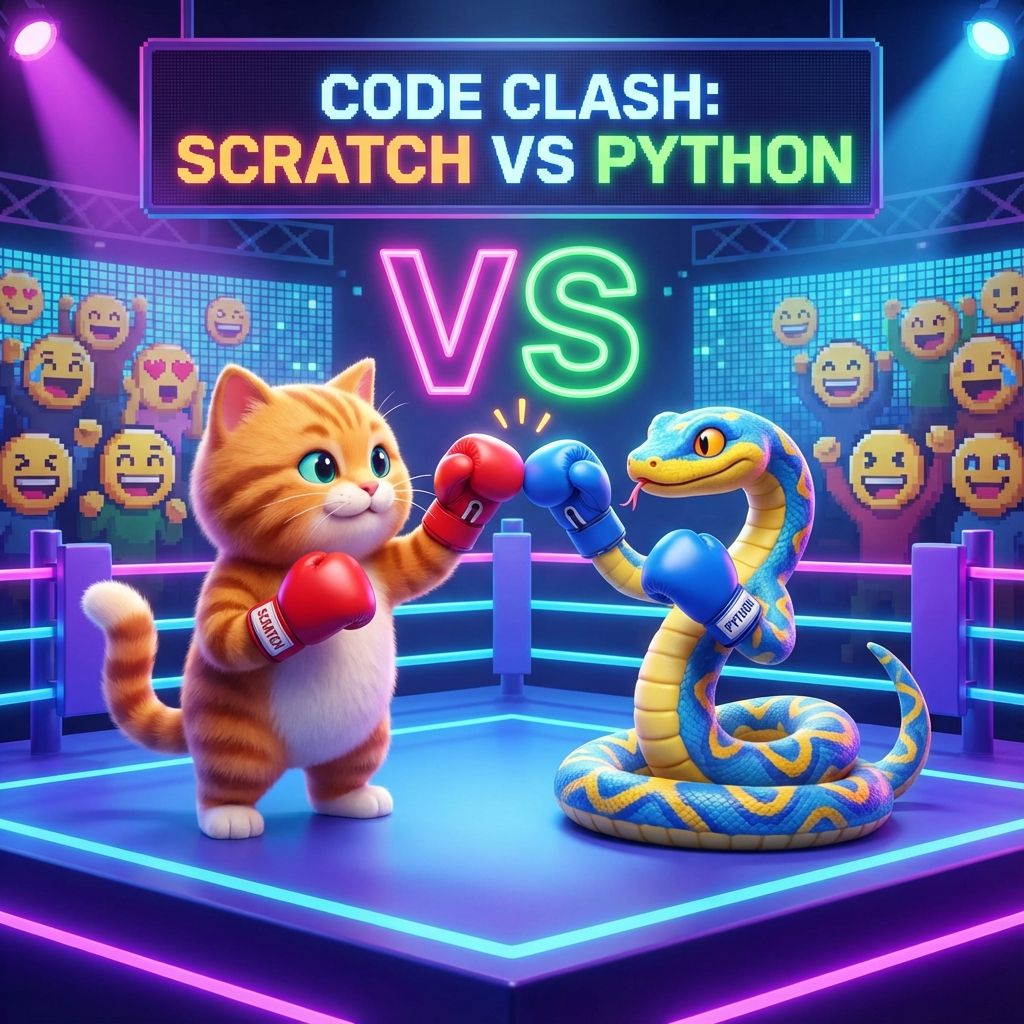
Scratch vs Python: Scratch is a free, block-based language from the Scratch Foundation, made for ages 8 to 13+, where children build programs by snapping blocks together and never type. Python is a text-based language used by professional programmers, where every line is typed. Most children do best starting with Scratch at about 8 to 10 and moving to Python from about 11; a child of 11 or older who types comfortably can start with Python directly.
Is Scratch Python? No. They are separate languages, but the ideas are the same: a Scratch repeat block is a Python for loop, and set score to 0 is score = 0. Below we compare them honestly, show the same programs side by side with their Python output, and set out when to move from one to the other.
Quick Decision Guide
Ages 8-10 or new to coding? → Start with Scratch
Ages 11+ with typing skills? → Python is appropriate
Not sure? → Start with Scratch. It never hurts, and the transition to Python is smoother
Spoiler alert: for many kids, the answer isn't 'either/or'. It's 'both, in the right order.' Let's dive in.
At a Glance: Scratch vs Python Comparison
Before we dive deep, here's a comprehensive comparison table:
| Factor | Scratch | Python | Winner |
|---|---|---|---|
| Best Age Range | 8 to 13+ (Scratch Foundation) | 11+ years | Depends on age |
| Learning Curve | Very gentle | Moderate | Scratch |
| Typing Required | No | Yes | Scratch for non-typers |
| Syntax Errors | Impossible | Common | Scratch |
| Visual Feedback | Immediate | Requires setup | Scratch |
| Real-World Use | Educational only | Professional | Python |
| Career Relevance | Low | Very High | Python |
| Depth/Ceiling | Limited | Unlimited | Python |
| Fun Factor | Very High | High (with effort) | Scratch initially |
| Cost | Free | Free | Tie |
| Community | The Scratch Foundation says 200 million kids create on Scratch | Large and professional | Both excellent |
Understanding Scratch: Visual Programming for Beginners
Scratch is a visual programming language for children. It was developed at the MIT Media Lab in 2007 by a team led by Professor Mitchel Resnick, and since 2019 it has been run by the Scratch Foundation, an independent nonprofit. Instead of typing code, kids drag colourful blocks that snap together like puzzle pieces; each block is one instruction, such as move, turn, repeat or if-then.
What Makes Scratch Special
- No typing required: Kids who can't type fluently can still code complex programs
- No syntax errors: Blocks only fit together in valid ways, impossible to make typos
- Immediate visual feedback: See characters move and animations play instantly
- Creative focus: Build games, stories, and animations from day one
- Huge community: the Scratch Foundation says 200 million kids create on Scratch, and projects can be shared and remixed in a moderated online community
- Completely free: runs in a web browser, with an offline app for Windows, macOS, ChromeOS and Android
What Scratch Code Looks Like
Here's how a simple game loop looks in Scratch, visual blocks that snap together:
Scratch Block Example
🟡 when [green flag] clicked
🔵 forever
🔵 if
🟠 say [Game Over!] for (2) seconds
🔴 stop [all]
🔵 end
🔵 end
The same idea in Python: a loop that keeps running until the game ends, then stops.
lives = 3

while True:                 # Scratch: forever
    print("lives left:", lives)
    lives -= 1
    if lives == 0:          # Scratch: if <(lives) = (0)> then ... stop [all]
        print("Game Over!")
breaklives left: 3
lives left: 2
lives left: 1
Game Over!What Kids Can Build with Scratch
- Games: Platformers, mazes, shooters, racing games, RPGs
- Animations: Cartoons, music videos, interactive stories
- Simulations: Physics demos, ecosystem models, math visualizations
- Art: Generative art, drawing tools, visual effects
- Music: Beat makers, instrument simulators, sound experiments
- Educational tools: Quizzes, flashcards, interactive presentations
Understanding Python: Text-Based Programming for All Ages
Python is a professional, text-based programming language used for websites, data science, AI and automation. Don't let that intimidate you: it is also one of the most readable languages to start typing in, which is why so many schools teach it to teenagers.
What Makes Python Special
- Readable syntax: Code looks almost like English, easy to read and understand
- Real-world relevance: Used in actual jobs across every industry
- Incredibly versatile: Web development, data science, AI, games, automation, robotics
- Massive ecosystem: Libraries for almost anything you want to build
- Career pathway: Skills transfer directly to professional development
- Free and open-source: No cost, runs on any computer
What Python Code Looks Like
Here's a simple Python program, notice how readable it is:
# A simple number guessing game in Python
import random

secret_number = random.randint(1, 100)
guesses = 0

print('I am thinking of a number between 1 and 100!')

while True:
    guess = int(input('Your guess: '))
    guesses += 1

    if guess < secret_number:
        print('Too low! Try again.')
    elif guess > secret_number:
        print('Too high! Try again.')
    else:
        print(f'Correct! You got it in {guesses} guesses!')
        break
What Kids Can Build with Python
- Games: Text adventures, graphical games with Pygame, puzzle games
- Utilities: Calculators, converters, password generators, to-do apps
- Data projects: Analyze sports stats, visualize data, create charts
- Automation: File organizers, web scrapers, repetitive task automators
- Web apps: Simple websites and web applications with Flask/Django
- AI/ML: Basic machine learning projects, chatbots, image recognition
Detailed Head-to-Head Comparison
Let's compare Scratch and Python across every factor that matters for young learners:
1. Age Appropriateness
| Age | Scratch | Python | Recommendation |
|---|---|---|---|
| 5-7 | ScratchJr ✓ | Too young | ScratchJr only |
| 8-10 | Perfect fit ✓ | Possible but challenging | Scratch strongly recommended |
| 11-12 | Still valuable ✓ | Good starting point ✓ | Either works; Scratch→Python ideal |
| 13-14 | May feel limiting | Excellent fit ✓ | Python (or transition from Scratch) |
| 15+ | Too basic | Perfect fit ✓ | Python directly |
2. Learning Curve Comparison
Scratch: Kids can create their first project in 5-10 minutes. No frustrating syntax errors. Concepts are visual and intuitive. The learning curve is almost flat, immediate success builds confidence.
Python: First working program takes 15-30 minutes with guidance. Syntax errors are common and can be frustrating. Requires understanding of text-based logic. The learning curve is steeper but manageable with good instruction.
The Frustration Factor
In Python, a single typo can break your entire program. 'pritn' instead of 'print' causes an error. Missing a colon stops everything. For young kids, this frustration can kill motivation. Scratch eliminates this entirely.
3. Same Concept, Different Syntax
Here's how the same programming concept looks in both languages:
Example: A Simple Loop
Scratch Version
🔵 repeat (3)
🟠 say [Hello!]
🔵 wait (1) seconds
🔵 end
import time

for i in range(3):          # Scratch: repeat (3)
    print("Hello!")         # Scratch: say [Hello!]
time.sleep(1) # Scratch: wait (1) secondsHello!
Hello!
Hello!Same concept, same logic, just different ways of expressing it. Kids who learn the Scratch version first understand what the Python version does immediately.
Example: Conditional Logic (If-Then)
Scratch Version
🔵 if <(score) > (100)> then
🟠 say [You win!]
🔵 else
🟠 say [Keep trying!]
🔵 end
score = 120

if score > 100:             # Scratch: if <(score) > (100)> then
    print("You win!")
else:
print("Keep trying!")You win!Example: Variables
Scratch Version
🟠 set [score] to (0)
🟠 change [score] by (10)
score = 0                   # Scratch: set [score] to (0)
score = score + 10          # Scratch: change [score] by (10)
score += 10                 # the short way to write the same thing
print("score:", score)score: 204. Real-World Relevance
Scratch: Not used professionally. However, the concepts (loops, conditionals, variables, functions) are universal and transfer to any language. Think of it as learning to ride a bike with training wheels. You're still learning to balance.
Python: Used by millions of professionals worldwide. Skills directly applicable to careers in software development, data science, AI, automation, and more. Learning Python is learning a marketable skill.
| Industry | Python Usage | Scratch Usage |
|---|---|---|
| Web Development | Django, Flask, FastAPI | Not used |
| Data Science | pandas, numpy, matplotlib | Not used |
| AI/Machine Learning | TensorFlow, PyTorch, scikit-learn | Not used |
| Automation | Scripts, bots, testing | Not used |
| Game Development | Pygame, Ren'Py | Educational only |
| Education | Teaching tool | Primary teaching tool |
5. Depth and Growth Potential
Scratch: Has a ceiling. After 1-2 years of regular use, most kids have explored its full potential. Advanced Scratch projects exist, but the platform is designed for learning, not professional development.
Python: Virtually unlimited depth. From 'Hello World' to building AI systems, Python scales with the learner. Professional developers use Python their entire careers and still learn new things.
The Growth Path
Scratch: Beginner → Intermediate → Advanced Scratch → Need to switch languages
Python: Beginner → Intermediate → Advanced → Expert → Professional → Still growing
When to Choose Scratch
Scratch is the right choice when:
- Your child is under 11 years old
- They're completely new to programming concepts
- They can't type fluently yet (under 20 WPM)
- They get frustrated easily and need quick wins to stay motivated
- They're more interested in games and animations than 'serious' coding
- You want them to build confidence before tackling text-based coding
- They learn better visually than through reading/writing
- They have limited patience for debugging text errors
Scratch Success Indicators
Your child is thriving in Scratch when they: create projects independently, explain their code logic, debug their own errors, and start asking 'can I make it do more?'
When to Choose Python
Python is the right choice when:
- Your child is 11 or older
- They can type reasonably well (30+ WPM)
- They've already learned Scratch or similar visual tools
- They're interested in 'real' programming used by professionals
- They want to build more complex, powerful projects
- They're thinking about tech careers or college applications
- They're patient enough to handle syntax errors and debugging
- They want to explore AI, data science, or web development
The Ideal Learning Path: Detailed Timeline
For most children, the best approach isn't choosing one or the other. It's learning both in sequence. Here's a detailed timeline:
Phase 1: Foundation (Ages 5-7): 6-12 months
- Tool: ScratchJr (tablet app)
- Time: 15-20 minutes, 2-3 times per week
- Goals: Understand sequencing, cause-effect, basic programming concepts
- Projects: Simple animations, character stories, basic games
- Signs of readiness to advance: Creates projects independently, understands sequence order matters
Phase 2: Core Skills (Ages 8-10): 12-18 months
- Tool: Scratch (browser-based)
- Time: 30-45 minutes, 3-4 times per week
- Goals: Master loops, conditionals, variables, events, basic functions
- Projects: Multi-level games, interactive stories, animations with logic
- Signs of readiness to advance: Uses variables confidently, creates custom blocks, projects have complex logic
Phase 3: Transition (Ages 11-12): 3-6 months
- Tool: Python with visual libraries (Turtle, Pygame Zero)
- Time: 45-60 minutes, 4-5 times per week
- Goals: Learn text syntax while leveraging existing concept knowledge
- Projects: Recreate Scratch projects in Python, simple text games, Turtle graphics
- Signs of readiness to advance: Comfortable with syntax, debugs errors independently, wants more power
Phase 4: Proficiency (Ages 13-14): Ongoing
- Tool: Python with professional libraries
- Time: 1-2 hours, regular practice
- Goals: Build substantial projects, explore specializations
- Projects: Web apps, data analysis, games with Pygame, automation scripts
- Next steps: Specialize based on interests (web dev, data science, game dev, etc.)
Timeline Flexibility
These timelines are guidelines, not rules. Some kids move faster, some slower. Watch for readiness signs rather than strictly following ages. A motivated 9-year-old might be ready for Python; a 12-year-old new to coding should start with Scratch.
Making the Transition: Scratch to Python
The transition from Scratch to Python is a critical moment. Done well, it's smooth and exciting. Done poorly, it can be frustrating and discouraging. Here's how to do it right:
Step 1: Acknowledge What They Already Know
Show them how Scratch concepts translate directly to Python. This builds confidence and shows continuity.
| Scratch Concept | Python Equivalent | What to Say |
|---|---|---|
| repeat (10) | for i in range(10): | 'Remember loops? Same thing, just typed!' |
| if <> then | if condition: | 'If-then works exactly the same way' |
| set [score] to (0) | score = 0 | 'Variables! You already know these' |
| say [Hello] | print('Hello') | 'Instead of say, we use print' |
| forever | while True: | 'Forever loop, just written differently' |
Step 2: Start with Visual Python
Use Python's Turtle graphics library first. It provides visual output similar to Scratch, bridging the gap:
# Python Turtle - Visual like Scratch!
import turtle

t = turtle.Turtle()
t.color('blue')

# Draw a square - just like Scratch!
for i in range(4):
    t.forward(100)
    t.right(90)

# This feels familiar to Scratch users!
Step 3: Recreate Familiar Projects
Have them rebuild simple Scratch projects in Python. Familiar goals make new syntax less overwhelming:
- Week 1-2: Number guessing game (they probably made this in Scratch)
- Week 3-4: Simple quiz game with scoring
- Week 5-6: Mad Libs story generator
- Week 7-8: Basic calculator with menu
- Week 9+: Turtle graphics projects (drawing, animations)
Step 4: Normalize Frustration
Syntax errors WILL happen. Prepare your child that this is normal and part of learning. Share that every Python programmer has typed 'pritn' instead of 'print' a thousand times. Debugging is a skill, not a failure.
Common Transition Frustrations
• Forgetting colons after if/for/while
• Indentation errors (Python is picky!)
• Typos in variable names
• Missing parentheses in print()
• Using = instead of == for comparison
These are ALL normal. Every programmer makes these mistakes!
Step 5: Consider Structured Learning
The transition is where many self-taught kids get stuck. A structured course designed for this transition can make a huge difference. Our Python course is specifically designed for students coming from visual programming backgrounds.
Common Mistakes Parents Make
Mistake #1: Skipping Scratch Because It's 'Not Real Coding'
Some parents push their young children straight to Python because they want them learning 'real' programming. This often backfires spectacularly. Kids get frustrated, lose confidence, and may develop negative associations with coding that last years.
Scratch IS real coding. It teaches real programming concepts. The visual interface is a feature, not a limitation: its designers built it so children can concentrate on ideas instead of typos.
Mistake #2: Staying in Scratch Too Long
The opposite problem: keeping kids in Scratch when they're ready to move on. If your 13-year-old has mastered Scratch, is getting bored, and is asking for more challenge, it's time for Python. Don't let comfort become stagnation.
Signs it's time to transition: They've completed 20+ projects, use advanced features like clones and custom blocks, express boredom, ask about 'real' programming.
Mistake #3: Choosing Based on What's 'Hot' in Tech
Python is popular in AI and data science, so some parents push it regardless of their child's readiness. But a frustrated 8-year-old learning Python won't become an AI engineer, they'll become someone who hates coding.
Mistake #4: Comparing to Other Kids
'But my friend's 9-year-old is learning Python!' Every child is different. Some 9-year-olds are ready for Python. Most aren't. Focus on YOUR child's readiness, not what others are doing.
Frequently Asked Questions
No. Scratch is its own block-based language from the Scratch Foundation, and Python is a separate text-based language. You cannot write Python inside Scratch, but the ideas, loops, conditions, variables and events, are the same, so moving from one to the other is mostly learning to type what you already know.
Scratch uses drag-and-drop blocks, so there is no typing and no syntax errors, and it is built for children aged 8 to 13+. Python is typed text, used by professionals, with far more depth but more room for mistakes. Scratch is for learning; Python is for learning and for real work.
For most children under about 11, Scratch; for 11 and up who type comfortably, Python. The best path for most is Scratch first, then Python, because the concepts learned in blocks carry straight over.
Yes, if they are 11 or older, type reasonably well and have patience for debugging. Children who start with Scratch arrive at Python already understanding loops, conditions and variables, so they only have to learn the new way of writing them.
Scratch has surprising depth. Advanced Scratch projects involve complex logic, custom blocks (functions), cloning, lists, and sophisticated algorithms. Make sure they've truly mastered these features before moving on. Many 'smart' kids haven't explored Scratch's full potential.
No. Scratch builds the concepts, so in Python children are learning a new way to express ideas they already know, not new ideas and new syntax at once.
It depends on their personality. If they're patient, motivated, and comfortable with text, Python is fine. If they're anxious about coding, easily frustrated, or unsure about their interest, a few weeks of Scratch can build confidence before transitioning. There's no shame in starting with Scratch at any age.
Typically 6-12 months of regular practice (3-4 times per week) is enough to build a solid foundation. Signs they're ready: completed 15-20+ projects, understand variables/loops/conditionals deeply, use custom blocks, and are asking for more challenge.
Yes. EduBlocks, a free tool by Anaconda, uses drag-and-drop blocks in which each block is a line of Python, so children see exactly how blocks turn into text code.
Some children find Scratch too childish or prefer text from the start. If they are motivated and 11 or older, try Python directly. As a middle ground, Blockly Games switches between blocks and JavaScript in its last levels, and CodeAI (formerly Code.org) has free text-based courses.
We don't recommend it for beginners. Focus on one until they're comfortable, then transition. Learning both simultaneously can cause confusion about syntax and concepts. Sequential learning (Scratch first, then Python) is more effective.
For most 10-year-olds, yes: Python's syntax errors and abstract nature can be frustrating. However, exceptionally motivated 10-year-olds with strong typing skills and patient temperaments can succeed with good instruction. When in doubt, start with Scratch.
JavaScript is another excellent option for teens, especially those interested in web development. It has slightly more complex syntax than Python but provides immediate visual feedback in browsers. Python is generally recommended as a first text language because of its cleaner syntax, but JavaScript is a valid alternative.
Look for these signs: (1) They've completed 15-20+ Scratch projects independently, (2) They use variables, loops, conditionals, and custom blocks confidently, (3) They're getting bored or asking for more challenge, (4) They can type at least 25-30 WPM, (5) They show patience when debugging Scratch projects.
Colleges care about demonstrated interest and skill in computer science, not specific languages. A portfolio showing progression from Scratch to Python to advanced projects demonstrates growth and commitment. Scratch itself won't impress colleges, but it's a valuable stepping stone to impressive Python projects.
Conclusion: It's Not Either/Or
Scratch and Python aren't competitors. They're partners in your child's coding journey. Scratch provides the perfect on-ramp: visual, engaging, and frustration-free. Python provides the highway: powerful, professional, and limitless in potential.
For most children, the ideal path is Scratch first (ages 8-10), then Python (ages 11+). This sequence builds confidence, establishes strong fundamentals, and makes the transition to text-based coding smooth and natural.
Once the move to Python happens, keep the visual feedback alive: star pattern programs let kids draw with loops the way they drew with blocks. And when the next question arrives, usually about web development, our Python vs JavaScript guide answers it honestly.
The most important thing isn't which language you choose. It's that your child starts coding, stays engaged, and keeps learning. Whether they begin with colorful blocks or lines of text, they're building skills that will serve them for a lifetime.
Scratch first, Python next, with a teacher
Ages 6 to 12: Scratch Coding for Kids. Ready to type, 9 to 12: Python and AI for Kids. Ages 13 to 18: Python for Teens. The first class is a free demo, so you can see how it is taught before you decide.