AU / KIDS / 01
Python and AI for Kids
Typed Python from lesson one, no coloured blocks. Turtle drawings and small games first, then the idea the whole ladder rests on: show a machine examples and it finds the rule.
Open the syllabusAustralia · Live online · Ages 6 to 67
Australia publishes one of the most detailed rooftop energy datasets in the world, and any family can download it this afternoon. That is where our students start. A child in Parramatta, a teenager in Geelong and an analyst in Perth all end the first term holding a model they trained themselves, with an error they can defend.
Teaching since 2020 · 10,000+ students across 25+ countries · no recordings sold as classes
In short
Live online, from Cairns to Hobart to Perth, ages 6 to 67, in groups of fifteen to twenty or one to one. The subject is model building rather than tool use: Python first, then the statistics and linear algebra that sit under a trained model, then fitting and scoring models on published Australian data such as the Clean Energy Regulator rooftop solar and battery register. Teaching is in English, on your own time zone. A group place is USD 100 a month, billed in US dollars, and the first class costs nothing.
The catalogue
An eight year old in Toowoomba and an analyst in North Sydney are not the same student at two speeds, so we wrote three programmes rather than one. Every card opens a full week by week outline.
AU / KIDS / 01
Typed Python from lesson one, no coloured blocks. Turtle drawings and small games first, then the idea the whole ladder rests on: show a machine examples and it finds the rule.
Open the syllabusAU / KIDS / 02
Where an answer came from, why a wrong one sounds as sure of itself as a right one, and how a child checks a claim before repeating it.
Open the syllabusAU / KIDS / 03
The child asks an AI tool to build something, then reads what came back and fixes what will not run. Asking takes a minute. Reading the answer properly takes the term.
Open the syllabusAU / TEEN / 01
The main route through this page. Python, the mathematics the subject needs, classical algorithms, neural networks, vision and language models, each stage ending in something trained and scored.
Open the syllabusAU / TEEN / 02
Loading, cleaning, reshaping and plotting, where the hours in a real project go. The skill on offer is spotting the row that quietly ruins an average.
Open the syllabusAU / TEEN / 03
Two years from an empty file to functions, APIs, testing and structure, for a teenager arriving with no programming behind them.
Open the syllabusAU / TEEN / 04
Web and Python projects shipped with AI help, paired with the review habit that makes accepting that help safe. Publish the link, then answer for what is behind it.
Open the syllabusAU / PRO / 01
Supervised and unsupervised methods, deep networks, validation that survives a hostile reviewer, and the deployment stage short courses leave off.
Open the syllabusAU / PRO / 02
How a language model is trained, adapted and grounded against a private document set, and how an agent is fenced in so it breaks noisily instead of quietly.
Open the syllabusAU / PRO / 03
For people working in Sydney, Melbourne, Brisbane or Perth who want the applied half first: machine learning pointed at the reports already on the desk.
Open the syllabusAU / PRO / 04
Statistics, SQL, feature construction, modelling and the write up, finishing with a portfolio assembled for a hiring manager rather than a marker.
Open the syllabusAU / PRO / 05
The interview gate at every serious engineering employer, and the reason a pipeline that behaves on eight rows still behaves on every postcode.
Open the syllabusAU / ALL / 06
Past AI we teach mathematics to university level, plus web, app and game development.
Open all coursesWhat you actually build
Every market we teach into gets a first project from its own published numbers. Australia gets rooftop solar. The Clean Energy Regulator releases the small-scale installation register by postcode, free and without a login, and at 30 June 2026 it carried 4,469,120 rooftop solar systems totalling 29,996,898 kW, an average of 6.71 kW each, inside 6,882,329 small-scale systems. Home batteries are the new column: 438,319 of them, recorded only from 1 July 2025 onward. That last detail is the whole lesson.
| State | Solar PV systems | Batteries | Attach rate | PV per 1,000 people |
|---|---|---|---|---|
| NSW | 1,175,509 | 152,655 | 12.99% | 136.0 |
| ACT | 67,692 | 8,017 | 11.84% | 138.9 |
| SA | 460,779 | 49,259 | 10.69% | 241.2 |
| VIC | 892,216 | 86,412 | 9.69% | 125.3 |
| WA | 577,052 | 47,755 | 8.28% | 187.6 |
| QLD | 1,203,203 | 88,514 | 7.36% | 210.6 |
| TAS | 66,909 | 4,573 | 6.83% | 115.5 |
| NT | 25,760 | 1,134 | 4.40% | 96.3 |
| National | 4,469,120 | 438,319 | 9.81% | 160.8 |
Both count columns are as published and both add up exactly to the national totals in the last row, which is the first thing to verify after loading the file. Attach rate and systems per thousand people are computed here, the second from Australian Bureau of Statistics population estimates at 31 December 2025.
The question is one a state energy department genuinely has to answer. In a postcode already covered in panels, what share of households goes on to add a battery? The target is that share: batteries installed since 1 July 2025 divided by the solar systems already on roofs there.
Every feature comes from the same files, so there is no external join to argue about. Cumulative solar systems, cumulative capacity, mean system size against the 6.71 kW national benchmark, the share of the local fleet installed before 2013 as a proxy for how old and upgradeable it is, the water heater count as a proxy for retrofit appetite, and the state as a categorical.
Then comes the part worth a term. Rank the eight jurisdictions by raw battery count and Queensland is second in the country. Rank by attach rate and it falls to sixth, on 7.36 per cent against 12.99 in New South Wales. Same file, opposite conclusion, and a subsidy recommendation pointed at the wrong state.
pandasscikit-learn rate targetsgrouped splits gradient boostingmean absolute error
Take the installations spreadsheet and the battery CSV. Before any modelling code, check the solar column sums to 4,469,120 and the battery column to 438,319. If either is out, stop and find the header or footer row being read as data.
Pivot into a single row per postcode carrying solar systems, capacity, batteries, water heaters and state. Aggregate the year columns yourself rather than reading the totals column, because that detail is what makes the fleet age feature possible.
Divide batteries by solar systems in each postcode, then confirm the population-weighted national rate lands on 9.81 per cent. A student who misses it has usually averaged the postcode rates directly, giving forty houses the weight of four thousand.
Construct mean system size, the pre-2013 share, the water heater count and the state dummies, then plot attach rate against solar count. The scatter is weak, and seeing that before any model runs is the point, because those same columns correlate almost perfectly while the target is still a count.
Split so entire postcodes go to one side or the other, and stratify by state so no jurisdiction is missing from either half. Then fit a linear baseline and a gradient boosted regressor.
Report mean absolute error on the attach rate, then compare it against predicting each state mean and nothing else. A boosted model that cannot beat eight hard-coded numbers has only learned which state a postcode is in.
Check Queensland still ranks low despite the largest solar fleet in the country at 1,203,203 systems. South Australia is the companion check: most panels per head at 241.2 per thousand, yet only third on attach rate, so saturation and upgrade appetite are different variables. If either pattern goes, the target has leaked.
The distinction
We teach both, in that order, and are direct about which one lasts. A beginner sets the target to battery count, feeds in solar count, gets an r-squared near 0.9 and stops. Batteries are retrofitted onto panels already on the roof, so that feature is close to definitional rather than predictive, and the two columns cover different eras, one twelve months deep and the other twenty five years deep.
None of the right hand column expires when a subscription does.
Why now, in Australia
The two companies Australians name first were both started here by founders who studied here, which is not the usual pattern in a mid-sized market. Atlassian was founded in Sydney in 2002 by Mike Cannon-Brookes and Scott Farquhar, University of New South Wales classmates who began on ten thousand dollars of credit card debt. It is globally headquartered in Sydney with United States headquarters in San Francisco, having redomiciled to the US in 2022. It listed on NASDAQ as TEAM on 10 December 2015 at an initial market capitalisation of 4.37 billion dollars, reported revenue of USD 5.22 billion in 2025 and employed 13,813 people.
Canva is headquartered in Sydney and was founded on 1 January 2013 by Melanie Perkins, Cliff Obrecht and Cameron Adams. An employee stock sale in August 2025 valued it at USD 42 billion, revenue reached USD 4 billion in 2025, it counts 220 million members and employed 5,500 people in 2024. Much of what it sells is machine learning shipped as ordinary features, built from Australia rather than imported. WiseTech Global, an Australian transport-logistics software company founded in 1994 and listed on the ASX in 2016, shows that serious local software is not confined to consumer products.
The public side is larger than most families realise. CSIRO, the national science agency, describes itself as one of the largest applied AI capabilities in the world, with more than one thousand researchers across a range of AI and data science projects. Its named application areas are the opposite of abstract: bushfire management, agricultural productivity, cybersecurity, environmental protection including the Great Barrier Reef, computer vision for manufacturing and factory-floor safety, and responsible AI frameworks.
On policy the picture is a country consulting rather than legislating. A Voluntary AI Safety Standard was issued in 2024, and in September 2024 a proposals paper set out potential mandatory guardrails for high-risk AI. In October 2023 the Australian Computer Society, the Business Council of Australia, the Australian Chamber of Commerce and Industry, the Australian Industry Group, the Council of Small Business Organisations Australia and the Tech Council of Australia signed a joint open letter calling for a national AI strategy and a whole-of-government AI taskforce.
So the senior work is not all offshore, and the university pipeline feeds the local industry. What is scarce is not people who can operate an AI product, but people who can open a government dataset and produce something defensible from it.
4,469,120
Rooftop solar systems on the Clean Energy Regulator register at 30 June 2026
9.81%
National battery attach rate, from 438,319 batteries recorded since 1 July 2025
27,801,023
People in Australia at 31 December 2025, per the ABS release of 18 June 2026
13,813
People employed by Atlassian in 2025, founded in Sydney by two UNSW classmates
School and university
Schooling is administered state by state and each jurisdiction awards its own senior certificate: the Higher School Certificate in New South Wales, the Victorian Certificate of Education, the Queensland Certificate of Education, the South Australian Certificate of Education, the Northern Territory Certificate of Education and Training, the Western Australian Certificate of Education, the Tasmanian Certificate of Education and the ACT Senior Secondary Certificate. Applications pass through five separate admissions centres: UAC for New South Wales and the ACT, VTAC for Victoria, QTAC for Queensland, SATAC for South Australia and the Northern Territory, and TISC for Western Australia, with the University of Tasmania governing its own entry. The one thing shared is the ATAR, a percentile rank from 0.00 to 99.95 in steps of 0.05 measured against the cohort in a student's own state.
Because New South Wales is the largest system its course names come up most often. The HSC computing offer includes Enterprise Computing and Software Engineering, both Board Developed, alongside Applied Digital Technologies, Computing Applications as a Content Endorsed Course, and Information and Digital Technology as a Board Developed VET course. NESA sets syllabuses, assessment, teaching and school standards for all NSW schools.
The Software Engineering syllabus for Years 11 and 12, dated 2022, lists its focus areas plainly. Year 11 covers programming fundamentals, the object-oriented paradigm and programming mechatronics. Year 12 covers secure software architecture, programming for the web, software automation and a software engineering project. Our track runs beside it: a syllabus teaches correct code, and a real dataset teaches what to do when correct code produces a suspicious number.
In New South Wales the senior sequence runs Mathematics Standard 1, Mathematics Standard 2, Mathematics Advanced, Mathematics Extension 1 which requires Advanced, and Mathematics Extension 2 which requires both and is Year 12 only. Choices on a Year 10 selection form decide which rungs are reachable, and they are far harder to reverse than a decision about which language to learn.
UNSW Sydney runs a Bachelor of Science in Computer Science, degree code 3789, UAC code 425800, CRICOS 048749C, four years full time at Kensington and worth 192 units of credit. For 2026 entry it publishes a Lowest Selection Rank of 93.00 and a Lowest ATAR of 85.00, a pair families routinely confuse, since the selection rank includes adjustment factors. Assumed knowledge is Mathematics Extension 1, and international equivalents for 2026 are A Levels at 15.0 and an IB Diploma at 37.0.
The Australian National University runs a Bachelor of Advanced Computing with Honours, program code AACOM, four years full time and a minimum of 192 units, entry stated as ATAR 85 or IB 33. The prerequisite is Mathematics Advanced in New South Wales, or Mathematics Methods in Victoria, Queensland, Western Australia, South Australia and the Northern Territory. Artificial Intelligence and Machine Learning are offered as separate 24-unit specialisations rather than one stream, a 48-unit Cyber Security major can sit in elective space, and COMP3600 Algorithms is a named course.
Those are two institutions read carefully, not a ranked shortlist, and the pattern in both is the same. Neither gates on coding. The mathematics is the gate, which is why our teens track carries its statistics and linear algebra inside the machine learning.
How the classes run
Australia runs on three standard offsets and our teachers sit in India on UTC plus 5 hours 30 minutes, which never changes. Perth keeps AWST at UTC plus 8, two and a half hours ahead of India. Darwin and Adelaide keep ACST at UTC plus 9 hours 30 minutes, four hours ahead. Sydney, Melbourne, Brisbane, Hobart and Canberra keep AEST at UTC plus 10, four and a half hours ahead. Three quarters of the country lives in the eastern band, so one evening slot reaches most families, but Western Australia at more than three million people is a separate scheduling market.
16:30 to 18:00 AEST
Sydney, Melbourne and Brisbane after school, which is 12:00 noon in India, or 11:00 on eastern daylight saving.
19:00 to 20:30 AEST
Eastern evening, for older students and working adults, which is 14:30 in India, or 13:30 on daylight saving.
17:00 to 18:30 AWST
Perth after school, which is 14:30 in India. Western Australia never uses daylight saving, so this pairing never moves.
An hour and a half of live video, taught by the same person each week, someone who arrives already knowing where the student got stuck last time. Screens are shared both ways, so a mistake is caught in the second it is typed instead of turning up in a marked file on Thursday. Groups are fifteen to twenty students, or one to one.
One Australian specific sits on top. A booking in Sydney, Melbourne, Hobart, Canberra or Adelaide changes its India-side time twice a year, so we re-cut those slots in the week before each changeover. A Brisbane, Perth or Darwin booking is set once and left alone, which makes Brisbane the easiest Australian city to timetable against India.
The academic year runs February to December, inverting the northern hemisphere, so the examination crunch falls in Term 4 and the long summer break runs from mid December to late January. Queensland state schools published four ten-week terms for 2026: Term 1 from Tuesday 27 January to Thursday 2 April, Term 2 from Monday 20 April to Friday 26 June, Term 3 from Monday 13 July to Friday 18 September and Term 4 from Tuesday 6 October to Friday 11 December. Those are Queensland dates and we label them so, because every state publishes its own and they do not line up.
January is therefore the natural start of year moment and the July opening of Term 3 the mid year one. October and November are the worst months to begin anything aimed at Years 11 and 12, because NSW HSC written examinations are typically held then and the VCE sits in the same window. Otherwise admission is rolling.
Student work
Each of the four below is a running application at a public address, written by a student here. Open one and use it, which is why we publish a link rather than a screenshot. More sits in Student Labs.
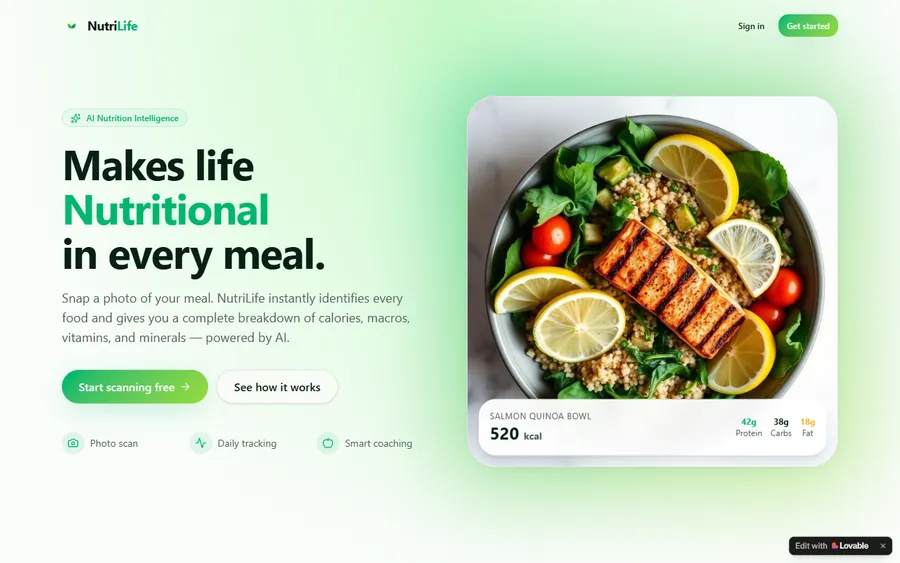
AI and ML
A nutrition assistant that reads what has been eaten and steers the user towards a target, taken from idea to public link by one student.
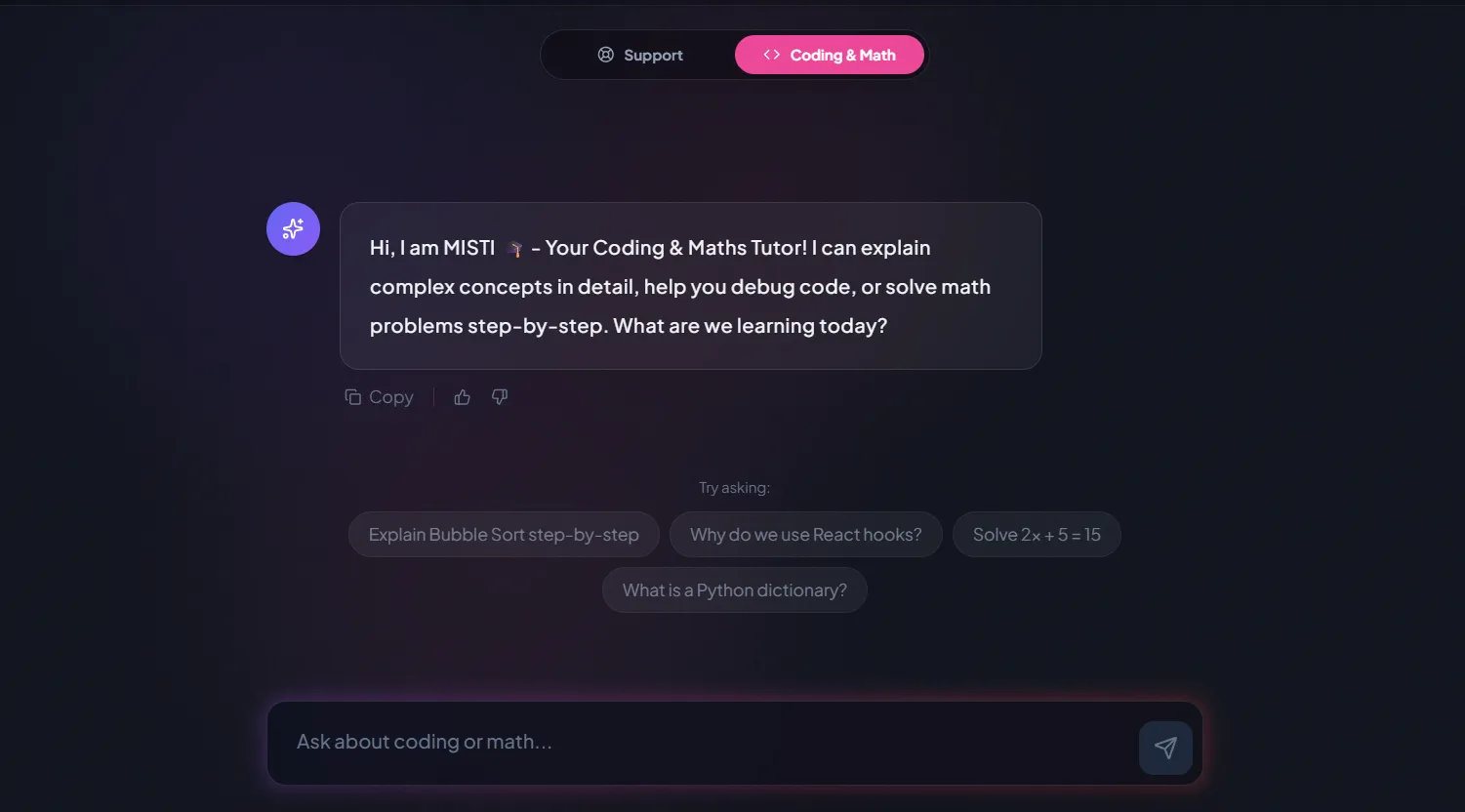
AI and ML
A tutoring chatbot that takes maths and programming questions, built and then deployed on its own domain.
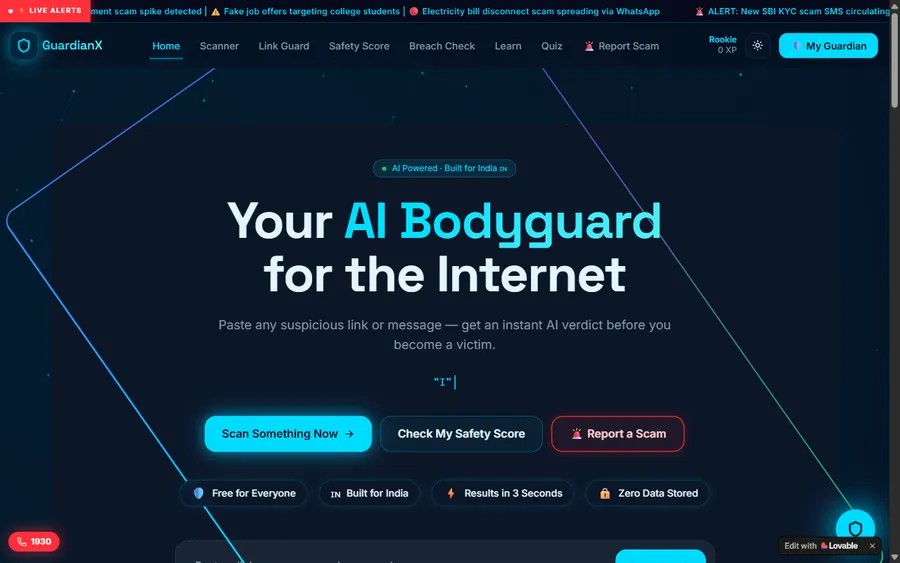
AI and ML
An assistant that helps a young person recognise an unsafe situation online, shipped end to end by a student.
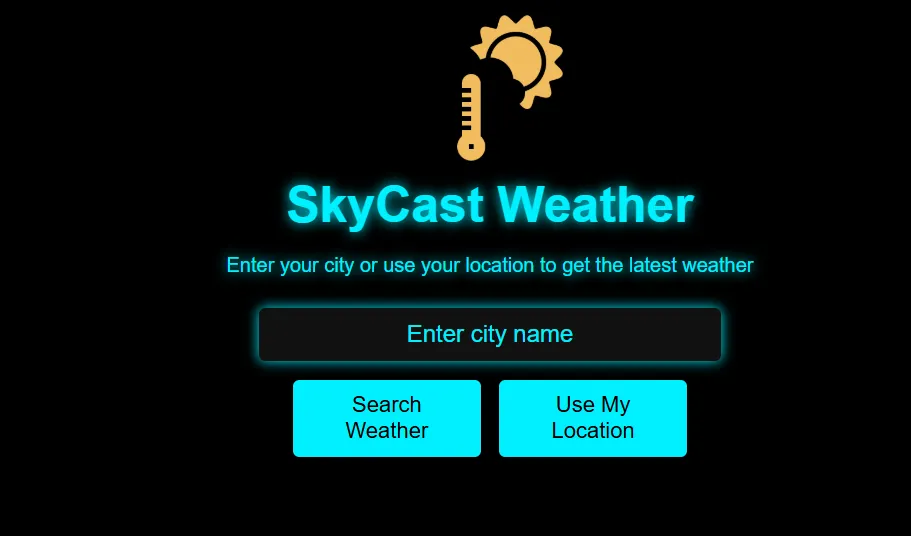
Data and forecasting
A weather application running on live data feeds, the closest relative of the rooftop solar work above.
Fees
Billing runs a rolling month at a time. Nothing is charged to join, nothing is signed for a year, and a family can stop at the end of any month. Fees are a flat USD 100 a month for a group place and USD 150 for one to one, billed in US dollars everywhere outside India.
Free first class
USD 0
No card needed
Group batch
USD 100
a month, billed in US dollars
One to one
USD 150
a month, billed in US dollars
One hundred US dollars a month is low against Australian tutoring rates, and a low number often signals a thin course sold on volume. Read the syllabus, work through the rooftop solar project, then ask whether a teenager could have produced the student applications above by prompting.
What families say
Left by families who pay us. We do not draft or commission testimonials.
★★★★★
"The one step solution for my son. Modern Age Coders make learning coding so simple that kids love it. The teachers explain complex concepts clearly with practical exercises and interactive content."
Ria Mukherjee
Parent
★★★★★
"Modern Age Coders has been a game-changer for me. I struggled to grasp IT concepts and coding before joining, but their classes transformed everything. I can now confidently write complex programs with ease."
Samriddha Mondal
Student
★★★★★
"One of the most wonderful education centres out there. Education is not limited to school syllabus but focuses on skill development. Learning here has been a wonderful journey and still continuing."
Vansh Agarwal
Student
★★★★★
"My child Dhairya is really enjoying the Modern Age Coders classes. This is his first online class and he eagerly looks forward to it. I can already see his improvement, and the teachers are very cooperative."
Sonam Oswal
Parent of Dhairya
★★★★★
"Modern Age Coders have wonderful teachers who teach in a clear, easy and practical way. The teacher boosts students' confidence and inspires them to learn without hesitation."
Sonu Goyal
Parent
★★★★★
"Coding classes here make learning very interesting and conceptual. The teachers teach us in a very easy-to-understand and efficient manner."
Arush Poddar
Student
Questions from Australia
Only for part of the country. New South Wales, Victoria, Tasmania, the ACT and South Australia change clocks on the first Sunday in October and the first Sunday in April. Your local class time does not move, but the India side of the call shifts by an hour. Queensland, Western Australia and the Northern Territory never observe daylight saving, so a Brisbane, Perth or Darwin booking holds on both ends all year.
A group place is USD 100 a month and one to one teaching is USD 150 a month, billed in US dollars everywhere outside India. We do not publish an Australian dollar price list; your bank converts the charge at its own rate. Billing is a rolling month and the first class is free.
Not as a subject, and we will not pretend otherwise, because this is not a course your state certificate scores. It supports the NSW HSC courses Software Engineering and Enterprise Computing, and it produces a portfolio an interview panel can open and use. The ATAR itself is a percentile rank from 0.00 to 99.95 in steps of 0.05, measured against the cohort in your own state.
No. A student can start the machine learning track on ordinary school mathematics, and the course teaches the statistics and linear algebra it needs as it goes. We raise Extension 1 because of admissions: UNSW Sydney lists it as assumed knowledge for its Bachelor of Science in Computer Science, and the Australian National University requires Mathematics Advanced or Mathematics Methods for its Bachelor of Advanced Computing with Honours. The mathematics line on a Year 10 selection form closes more computing degrees than any coding decision.
Both are published for the same 2026 intake of the Bachelor of Science in Computer Science, degree code 3789, UAC code 425800. The Lowest ATAR of 85.00 is the lowest raw rank that was actually admitted. The Lowest Selection Rank of 93.00 is the lowest rank once adjustment factors have been added to a raw ATAR. Families read the 93.00, decide the degree is out of reach and stop there, when the published raw floor sits eight points lower.
The certificate changes, the course does not. Australia has no national exam board: eight certificates are awarded, the HSC, VCE, QCE, SACE, NTCET, WACE, TCE and ACT Senior Secondary Certificate, and applications route through five admissions centres. We ask which certificate a student is sitting so the timetable respects the right examination period, but the syllabus is identical in Hobart and in Darwin.
The Clean Energy Regulator register of small-scale renewable installations, published by postcode, free and with no login. At 30 June 2026 it holds 4,469,120 rooftop solar systems and 438,319 home batteries. Students prove their loaded columns add up to those two totals, then predict the battery attach rate for each postcode. None of it has been tidied for teaching.
The Australian school year runs from late January to December, which inverts the northern pattern. January is the natural start of year intake and the July opening of Term 3 the mid year one; Queensland state schools began Term 3 on Monday 13 July in 2026. Avoid October and November for a Year 11 or Year 12 student, because that is when the HSC and VCE written examinations sit.
Start here
Leave a number and a mentor rings back at an hour that makes sense where you live, in your own zone rather than ours. That opening session is taught rather than sold: a teacher works through real material and finishes with a view on the level the student should start at, which is often not the level a parent expected.
Prefer to look around first? Read how we teach, browse the full course catalogue, or see what students have built in Student Labs.