TRAU / CHD / 01
Machines that learn from examples
Label, train, test, repeat.
Open the syllabusAustralia · Ages 10 and up · Build the model
Typing a request into a chatbot uses a model that someone else trained, on data someone else chose, tested in ways someone else decided. Training a model, even a tiny one, puts all three decisions in the student's hands. It is also where the most important lesson in machine learning becomes obvious: a model can only be as good as the labels it learns from. This page explains the difference between prompting and training, what the Australian Curriculum asks students to explore, and a short calculation every young model-builder should do before trusting their own results.
Live teaching since 2020 · 10,000+ students · models you train and test yourself
In short
Training AI means building a model from labelled examples and testing it on examples it has not seen, rather than prompting a model someone else built. The labels set the ceiling: two careful labellers who are each right 90% of the time agree on only about 82% of two-label examples. Students who check their own labels, hold back test data and measure honestly understand AI in a way prompting alone cannot teach.
Where to start
From labelling pictures to training in Python. The free first lesson picks the right level.
TRAU / 01
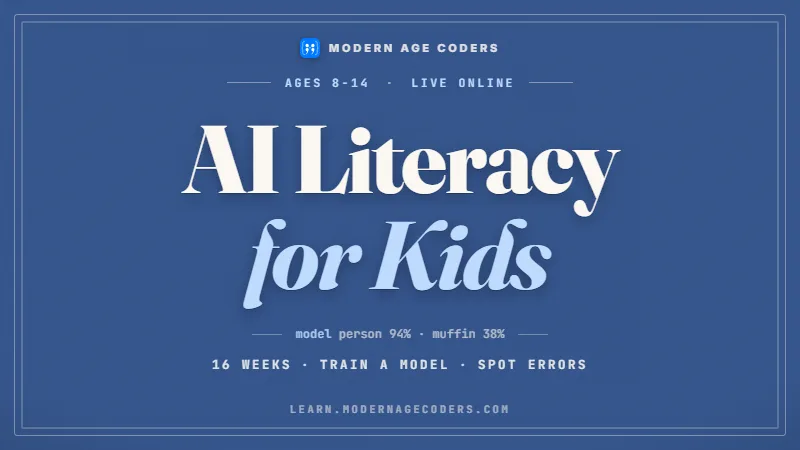
Ages 8 to 14. Collect and label examples, train a simple classifier, then try to fool it.
Open the syllabus →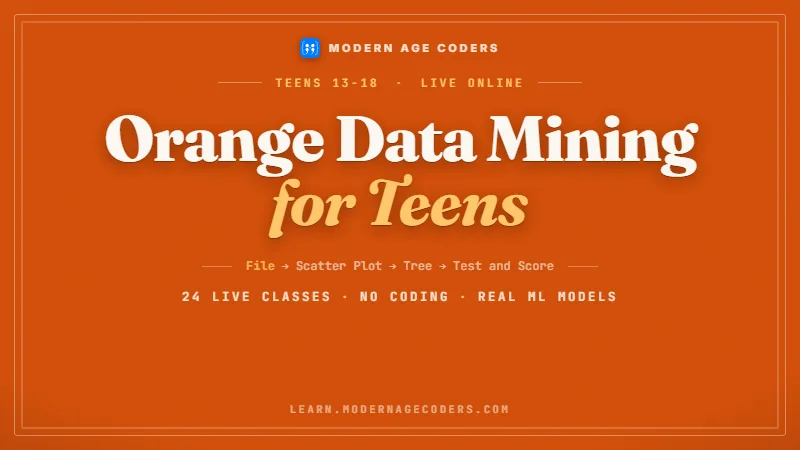
TRAU / 02
Teens. Build and test models visually, so the ideas come before the syntax.
Open the syllabus →
TRAU / 03
Teens ready for Python. Real datasets, real libraries, honest test scores.
Open the syllabus →Prompt or train
Both are useful. Only one teaches how AI actually works.
| Question | When you prompt a chatbot | When you train a model |
|---|---|---|
| Who chose the data? | The company that built it | You |
| Who decided what counts as right? | Its builders and their labellers | You and your labels |
| How was it tested? | In ways you usually cannot see | On test data you held back |
| Can you explain a wrong answer? | Rarely | Often, by inspecting your data |
| What you learn | How to ask | How AI learns, and where it fails |
Students who have trained even a small classifier read AI news differently. When a system makes a strange mistake, their first question is "what was it trained on, and who labelled it?", which is exactly the right question.
The curriculum
Training, not only prompting, is already part of the Australian Curriculum v9. The elaborations for Digital Technologies in Years 7 to 10 describe it directly.
| Years | Code | Elaboration |
|---|---|---|
| 7 and 8 | AC9TDI8P02 | "comparing the output from a classification model against data tagged manually to verify its accuracy and effectiveness" |
| 9 and 10 | AC9TDI10P02 | "exploring machine learning, a form of artificial intelligence where an algorithm is trained using a data set, for example to classify images into categories" |
| 9 and 10 | AC9TDI10P02 | "adjusting parameters of an AI model to observe the impact of different factors on predicted outcomes" |
The Years 7 and 8 example compares a model's output with "data tagged manually". That phrase hides the whole subject of this page: someone has to tag the data, and people do not always agree.
If the manual tags are unreliable, comparing a model against them measures the tags as much as the model.
The Years 9 and 10 example describes machine learning as an algorithm "trained using a data set". The data set is where the student's choices live: what to collect, how to label it, and what to keep aside for testing.
We teach those choices explicitly, because they matter more than any single algorithm.
Source, read 7 October 2026: ACARA, Australian Curriculum v9, Digital Technologies content, Years 7 to 10. Elaborations are examples, not compulsory content.
Labels first
Before training anything, ask two people to label the same examples independently and count how often they agree. Machine learning practitioners call this inter-annotator agreement, and it tells you how much your labels can be trusted.
| Each labeller is right | Agreement, by formula | Agreement, 500 simulated runs of 200 items |
|---|---|---|
| 95% of the time | 90.5% | 90.5% |
| 90% of the time | 82.0% | 82.1% |
| 80% of the time | 68.0% | 68.0% |
Two labellers agree when both are right or both are wrong in the same way. On two-label data the chance is p times p plus (1 minus p) times (1 minus p). At 90% each, that is 0.81 plus 0.01, or 82.0%.
So two people who are each careful nine times in ten still disagree on nearly one example in five. Children are usually amazed by this, and then they understand why labelled data is precious.
Test a perfect model against labels that are 90% right and it will appear to score about 90%, because the "mistakes" are in the labels. A model can never look better than its answer key.
One fix is a majority vote: three labellers at 90% each produce a majority label that is right 97.2% of the time. Better labels raise the ceiling for every model trained on them.
The scikit-learn library, which our older students use, has a ready-made measure called Cohen's kappa, which its documentation describes as "a statistic that measures inter-annotator agreement". Younger students start with simple percentage agreement, counted by hand and then by a few lines of Python.
Source, read 7 October 2026: scikit-learn, cohen_kappa_score. The agreement figures are our own calculation and simulation, labelled as such.
Testing honestly
The second habit of a real model-builder is never testing on the examples the model learned from.
The scikit-learn user guide puts it bluntly: "Learning the parameters of a prediction function and testing it on the same data is a methodological mistake."
A model that memorised its training examples would score perfectly on them and still fail on anything new.
Younger students label 40 pictures, train on 30 and test on the other 10, which they hid in a separate folder. Older students use a train and test split in Python.
Both learn the same thing: a score only means something if the model has never seen the test.
Have two people label a sample independently and count agreement before training.
Set test examples aside before training starts, and do not peek.
Adjust one setting at a time and watch the test score, just as the curriculum's example suggests.
Source, read 7 October 2026: scikit-learn User Guide, 3.1 Cross-validation.
Try it at home
Families can run the first stage of this page in half an hour with a pile of photos and two pencils. It needs no computer at all, and it makes the rest of machine learning easier to grasp.
| Step | What to do | What it teaches |
|---|---|---|
| 1. Choose a question | Pick something with two answers, such as "is this photo of a dog or a cat?" or "is this leaf from a gum tree?" | A model always starts from a clearly defined question |
| 2. Gather 30 examples | Print or collect 30 pictures, including a few awkward ones | Real data contains hard cases |
| 3. Label separately | Two family members label every picture without talking | Labels are human judgements |
| 4. Count agreement | Count how many of the 30 labels match and turn it into a percentage | Agreement is a measurement, not a feeling |
| 5. Discuss the misses | Look at every disagreement and decide what the rule should have been | Better instructions make better labels |
Most pairs agree on the easy pictures and split on the strange ones: a blurry photo, an animal half out of frame, a leaf from a garden shrub. Those disagreements are exactly the examples a model will find hard too.
Writing a one-line rule for each disputed case, then labelling again, usually raises agreement. That is how professional labelling teams work.
Once the labels are agreed, the same 30 pictures become a first training set. Children train a simple classifier on 20 and test it on the other 10, and then explain every test mistake.
The habit they carry forward is the most valuable one in the field: look hard at the data before trusting any score.
Stages
The progression we use, from a first labelled set to a tested model.
| Stage | What the student does |
|---|---|
| 1. Label | Collect and label a small set of examples, and measure agreement |
| 2. Train | Train a simple classifier in a visual tool |
| 3. Test | Hold back data, test honestly and explain the errors |
| 4. Code | Train and evaluate models in Python with real libraries |
Stages one and two use pictures, sounds and simple tools that need no adult-only accounts.
The lessons are hands-on: children see their own labelling mistakes turn into model mistakes.
Stages three and four use Python, real datasets and libraries such as scikit-learn.
For the thinking side of AI use, read our page on learning to think, not just use AI tools.
The catalogue
Grouped by age and experience. The free first lesson places each learner.
TRAU / CHD / 01
Label, train, test, repeat.
Open the syllabusTRAU / CHD / 02
First code that learns.
Open the syllabusTRAU / CHD / 03
Describe, build, then understand.
Open the syllabusTRAU / TEN / 01
Models built with blocks and charts.
Open the syllabusTRAU / TEN / 02
Real data, honest evaluation.
Open the syllabusTRAU / TEN / 03
Cleaning and labelling data well.
Open the syllabusTRAU / ADL / 01
From Python to neural networks.
Open the syllabusTRAU / ADL / 02
Data, models and evaluation.
Open the syllabusTRAU / ADL / 03
For analysts and students.
Open the syllabusHow lessons run
Students collect, label, train and test in every course. Teachers ask "how do you know?" until the answer is a measurement.
After school
Weekday afternoons in your state.
Evenings
For senior students and adults.
Weekends
Saturday and Sunday options.
Students build datasets about things they care about.
Labels are double-checked before any training.
Every model is tested on data it has never seen.
Students find out why a model got something wrong.
Fifteen to twenty learners, or one to one.
Younger students use tools that need no adult accounts.
Student work
Real work by learners who trained and tested their own models. See more on the student labs page.

AI and ML
An AI nutrition coach that reads what you eat and works you toward a target.

AI and ML
A chatbot that answers mathematics and programming questions, built and deployed by a student.

AI and ML
An assistant that helps a young person recognise unsafe situations online.

Web app
A weather forecasting site with live conditions for any location.
Fees
A monthly fee in US dollars applies to every country outside India, at one shared rate. There is no charge to start and no term-length commitment, so any month can be your last.
Free first class
USD 0
no card required
Group batch
USD 100
a month, billed in US dollars
One to one
USD 150
a month, billed in US dollars
What families say
Families' Google reviews, quoted exactly as they appear.
★★★★★
"The one step solution for my son. Modern Age Coders make learning coding so simple that kids love it. The teachers explain complex concepts clearly with practical exercises and interactive content."
Ria Mukherjee
Parent
★★★★★
"Modern Age Coders has been a game-changer for me. I struggled to grasp IT concepts and coding before joining, but their classes transformed everything. I can now confidently write complex programs with ease."
Samriddha Mondal
Student
★★★★★
"One of the most wonderful education centres out there. Education is not limited to school syllabus but focuses on skill development."
Vansh Agarwal
Student
★★★★★
"My child Dhairya is really enjoying the Modern Age Coders classes. This is his first online class and he eagerly looks forward to it. I can already see his improvement, and the teachers are very cooperative."
Sonam Oswal
Parent of Dhairya
★★★★★
"Modern Age Coders have wonderful teachers who teach in a clear, easy and practical way. The teacher boosts students' confidence and inspires them to learn without hesitation."
Sonu Goyal
Parent
★★★★★
"I highly recommend this computer coding class! The teachers are incredibly knowledgeable and passionate about coding."
Ritu Kedia
Parent
Questions from students and parents
It means building and testing machine learning models from labelled data yourself, rather than only typing requests into a chatbot that someone else trained.
Inter-annotator agreement measures how often two or more people labelling the same examples independently give the same label. It shows how reliable the labels are, and therefore how far any model trained on them can be trusted.
Because a model learns from labels and is scored against labels. If two careful labellers at 90% each agree only about 82% of the time, a model tested on those labels cannot show its true quality.
Yes. The Australian Curriculum v9 includes elaborations in Digital Technologies about exploring machine learning trained on a data set and comparing a classification model with manually tagged data.
Children from about 8 can label examples and train simple classifiers in visual tools. Training in Python usually starts from around 12 or 13.
Basic percentages are enough to begin. More maths becomes useful later, and our maths and coding courses support each other.
A test set is a group of examples kept aside and never shown to the model during training, so that its score on them shows how well it handles new data.
Not to build the models. Students train their own. Where chatbots appear, we follow each tool's minimum age in its terms.
Yes. Every lesson is live online with a teacher, in a group of fifteen to twenty or one to one, at times set for your state.
The first lesson is free. Families then pay monthly with no joining fee and no term lock-in, as shown in the fees section.
Elsewhere on this site
More on thinking with AI, AI for different ages and Python.
Our main page for Australian families.
Checking AI answers properly.
A first AI course in Python.
AI for secondary students.
Owning what you write.
Our AI hub for Australian learners.
Start here
Share a number and a time. The learner labels a few examples, trains a tiny model and tests it with a teacher, so you can see the difference between building AI and asking it.
Reading first is fine too: how a lesson runs, or the full course list.
WhatsApp us · +91 91233 66161 · connect@modernagecoders.com
WhatsApp from Australia reaches our team in India fastest; replies come from a +91 number, as we have no Australian office.
A priority demo is a full class of about 45 to 60 minutes. After the class the mentor sends a written skill report and a personal learning roadmap on WhatsApp. If you enrol, the demo fee is adjusted against your first month's fee. Share your demo Order ID with us on WhatsApp and we take it off.
Book a priority demo