OUC / BLK / 01
Scratch for kids
Loops, conditions and variables in a visual language.
Open the syllabusUnited Kingdom · Ages 10 and over · Invitation only, through Bebras
A note before anything else, because it will save you an afternoon. The round most people mean by the Oxford University Computing Challenge is now presented by UK Bebras as the Raspberry Pi Foundation Coding Challenge, and the OUCC's own pages returned errors when we checked them in September 2026. The round still exists, it still follows Bebras, and it is still the step where a young person's thinking has to survive contact with an actual program. The rest of this page is about that step: who gets in, what the two tracks are, and the particular way an auto-marked round punishes code that is nearly right.
Organiser facts, dated · No task reproduced · No promise of an invitation
In short
The coding round that follows the UK Bebras Challenge is described by UK Bebras as the Raspberry Pi Foundation Coding Challenge; most students, teachers and websites still call it the Oxford University Computing Challenge. Only schools and students who took part in the previous UK Bebras Challenge can enter, and home-educated students are contacted directly by the UK Bebras team. It is "designed to be accessible to all students aged 10+", runs as a 45-minute supervised challenge, and comes in two types, block-based and text-based programming, each with two difficulty levels. Historically the Raspberry Pi Foundation invited the students with the top ten per cent of results in the UK Bebras challenge, with four age groups from 10 to 18, Blockly for the younger two and a choice of eleven languages for the older two. We teach the programming, not the entry: the first class is free, a group place is USD 100 a month and one-to-one teaching USD 150.
Where to start
Choose by which track the student will sit, blocks or text.
OUC / 01
For the block-based track: loops, conditions and variables, in a visual language.
Open the syllabus →
OUC / 02
For a ten to thirteen year old crossing from blocks to typed code.
Open the syllabus →
OUC / 03
For the text-based track at the older age groups, including exact output and edge cases.
Open the syllabus →What it is now
Facts from UK Bebras and the Raspberry Pi Foundation, read on 20 September 2026. Where a source is historical we say so.
| Part | What the organiser says | Source |
|---|---|---|
| Who can enter | Only schools and students who took part in the previous UK Bebras Challenge; home-educated students are contacted directly by the UK Bebras team | UK Bebras, 2026 |
| Ages | "Designed to be accessible to all students aged 10+" | UK Bebras, 2026 |
| Two types | Block-based programming and text-based programming, each with two difficulty levels | UK Bebras, 2026 |
| Length | A 45-minute coding challenge, supervised by school coordinators | UK Bebras, 2026 |
| On the day | Teachers are contacted through the UK Bebras internal emailing system with instructions | UK Bebras, 2026 |
| Historic invitation | "We invited the students with the top 10% best results in the UK Bebras challenge to take part in the OUCC" | Raspberry Pi Foundation, on the OUCC |
| Historic age groups | Students aged 10 to 18 in four age groups; Blockly for the two younger cohorts, one of eleven languages Bebras supports for the older two | Raspberry Pi Foundation, on the OUCC |
| Historic scale | "Over 20,000 Bebras participants took up the invitation to the first round", with the top 20 in each of the four age groups reaching the final | Raspberry Pi Foundation, on the OUCC |
The single most important line for a parent is the first one. There is no direct entry. A student who did not sit the UK Bebras Challenge in November cannot take this round, however good they are, and no tutor, service or payment changes that. The way in is a teacher signing a school up for Bebras.
Everything else follows from that. If a child is interested in this round, the thing to do in September is ask whether the school is entering Bebras, not to buy preparation.
On the name: we could not read oucc.uk or the Bebras OUCC pages on 20 September 2026, and we do not assert that the Oxford University Computing Challenge has been renamed, retired or replaced. What we can say is what UK Bebras currently publishes, which describes the follow-on round as the Raspberry Pi Foundation Coding Challenge. Both names appear on this page so that families searching either one arrive somewhere useful.
The historical rows are labelled as historical for the same reason. A top-ten-per-cent invitation was how the OUCC worked when the Foundation wrote about it; we do not claim it is this year's rule.
Sources: UK Bebras, Raspberry Pi Foundation Coding Challenge and the Raspberry Pi Foundation's account of the Oxford University Computing Challenge, read 20 September 2026. Modern Age Coders is not connected with the Raspberry Pi Foundation, UK Bebras or the University of Oxford.
The method
A round marked by a machine compares your output with an expected output. That makes one ordinary bug much more expensive than it is at school.
Suppose a task says: print the pupils in order of score, highest first. Here are seven pupils. Ben 9, Dev 9, Gus 9, Amara 7, Cara 7, Esme 7, Finn 5. Three of them share a nine and three share a seven. Sort them by score and you have a correct answer. Sort them by score a different way and you have a different correct answer. Only one of the two matches what the marker is holding.
| Method | Output | Sorted by score? |
|---|---|---|
| Keeps equal items in their original order | Ben Dev Gus Amara Cara Esme Finn | Yes |
| A quicksort we wrote that does not | Gus Dev Ben Esme Cara Amara Finn | Yes |
| What an automatic marker does | Compares the text, character by character | It does not care which is fairer |
A sort that leaves equal items in the order they arrived is called stable. One that does not is not, and most beginners have never been told which kind their language gives them.
At school a teacher reads the answer and sees it is sorted. A machine sees two strings that differ, and marks the second one wrong.
Decide what happens to ties and say so: sort by score, then by name. Now there is only one correct output and nothing is left to chance.
This is the real difference between school programming and a marked round, and it goes well beyond sorting. Trailing spaces, capital letters, a full stop the task did not ask for, printing "6.0" where the task wanted "6": all of them are correct thinking and a failed test. None of them means a student does not understand the problem.
It is also the one thing that is genuinely worth practising before a 45-minute round, because it is invisible until it costs you.
The habit to build is to read the expected output as carefully as the question. What exactly does the task want printed, in what order, with what spacing, and what should happen when two things are equal? A student who asks those four questions before typing loses almost nothing to formatting.
And when the task does not say what to do with ties, decide anyway, write it down, and be consistent. An arbitrary rule applied everywhere beats no rule applied differently each run.
The two sorts, the seven pupils and both outputs are ours, run on 20 September 2026 to make the point. No challenge task is reproduced anywhere on this page.
How to prepare
The two tracks look different and ask for the same discipline.
| Track | What it uses | What to practise |
|---|---|---|
| Block-based | A visual language in the browser, historically Blockly for the younger age groups | Loops with a counter, conditions inside loops, and reading a block program back before running it |
| Text-based | Typed code; historically one of eleven languages Bebras supports, which covers those taught in UK schools | Input and output exactly as asked, string and number handling, and the boundary cases |
| Both | 45 minutes, supervised, auto-marked | Working out what the expected output looks like before writing any code |
For a student crossing from blocks to text, the honest advice is not to cross in the week of the round. Blocks are not a lesser track: a block program with a correct loop beats a typed program with a subtle bug, and the marker cannot tell how the answer was produced.
The most useful single exercise, in either track, is to take a task description and write out the expected output by hand before writing any code. Most lost marks are decided in that first minute.
What not to do is drill speed. Forty-five minutes is not generous, but the students who run out of time are almost always the ones who started coding before they understood the output, not the ones who type slowly.
If a student enjoys this round, the next step up is the British Informatics Olympiad, sat in school in December and January, where the programs get longer and the tests get nastier.
Getting ready
Where a student starts depends on what they can already write without help.
| Stage | Rung | The sign it is secure |
|---|---|---|
| Ages 8 to 10 | 1. Reliable blocks | Builds a loop with a counter and predicts what it prints |
| Ages 10 to 12 | 2. First typed code | Writes and fixes a twenty-line program without a template |
| Ages 12 to 15 | 3. Exact output | Produces output that matches a specification character for character |
| Ages 15 to 18 | 4. Own tests | Invents the inputs that would break the program, before anyone else does |
Practise reading task descriptions and writing the expected output by hand. Nothing else moves the needle in a week.
Stay in the track the student is fluent in. Switching from blocks to text under time pressure loses more than it gains.
Informatics olympiads are the next rung, and they reward exactly the habit this round teaches.
The competitions calendar shows every contest open to a UK student, month by month.
The full list
Grouped by where a student is now, with every syllabus a click away.
OUC / BLK / 01
Loops, conditions and variables in a visual language.
Open the syllabusOUC / BLK / 02
From first blocks through games and apps.
Open the syllabusOUC / BLK / 03
Real apps, still without typing a semicolon.
Open the syllabusOUC / TXT / 01
The first typed language, taught patiently.
Open the syllabusOUC / TXT / 02
Programs that check whether a method is right.
Open the syllabusOUC / TXT / 03
From blocks to real code in a familiar world.
Open the syllabusOUC / ADV / 01
Every core idea, with prediction before running.
Open the syllabusOUC / ADV / 02
Sorting, searching and why ties have an order.
Open the syllabusOUC / ADV / 03
Correctness under a clock, against hidden tests.
Open the syllabusOUC / SCH / 01
Taught to the board the school uses.
Open the syllabusOUC / SCH / 02
For schools and students working in Java.
Open the syllabusOUC / SCH / 03
Where the same discipline goes next.
Open the syllabusHow lessons run
Lessons are live on video from India, where the clock runs five and a half hours ahead of Britain in winter and four and a half in summer. Times are agreed in UK time and kept.
Early weekday evening
For students of primary and lower secondary age.
Later weekday evening
The usual slot for GCSE-age students and above.
Weekend morning
For a long session on one problem, start to finish.
Every task begins by writing down what the program should print, before any code is typed.
Block-based and typed code, and we do not push a student out of the one they are fluent in.
Small enough that every program gets looked at, large enough for two approaches to collide.
Written by us. No Bebras or challenge task is reproduced in a lesson.
For a student far ahead of their year, or one with a particular gap.
We cannot get a student invited to this round, and we do not claim otherwise.
Student work
Four published projects by students at our school, built outside any competition. More on the student labs page.
AI and ML
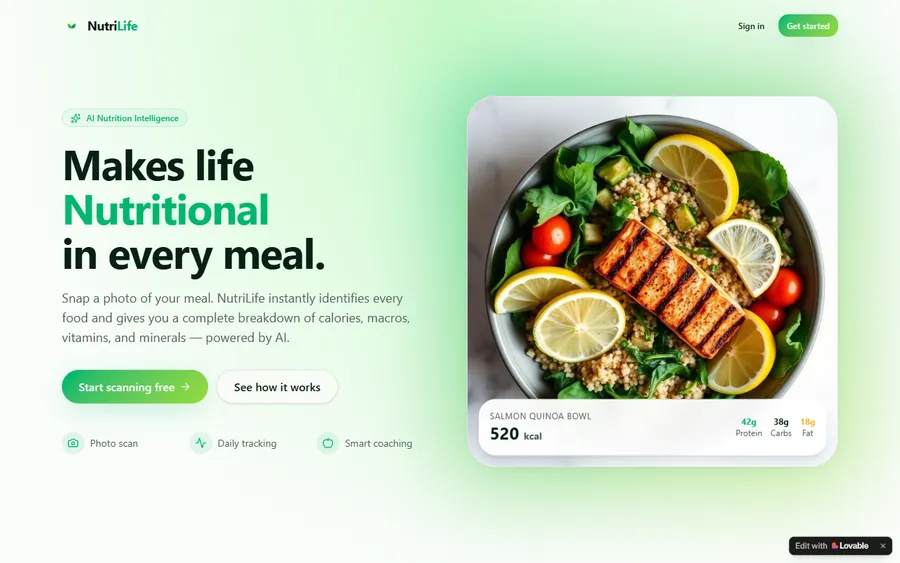
An AI nutrition coach that reads what you eat and works you toward a target.
AI and ML
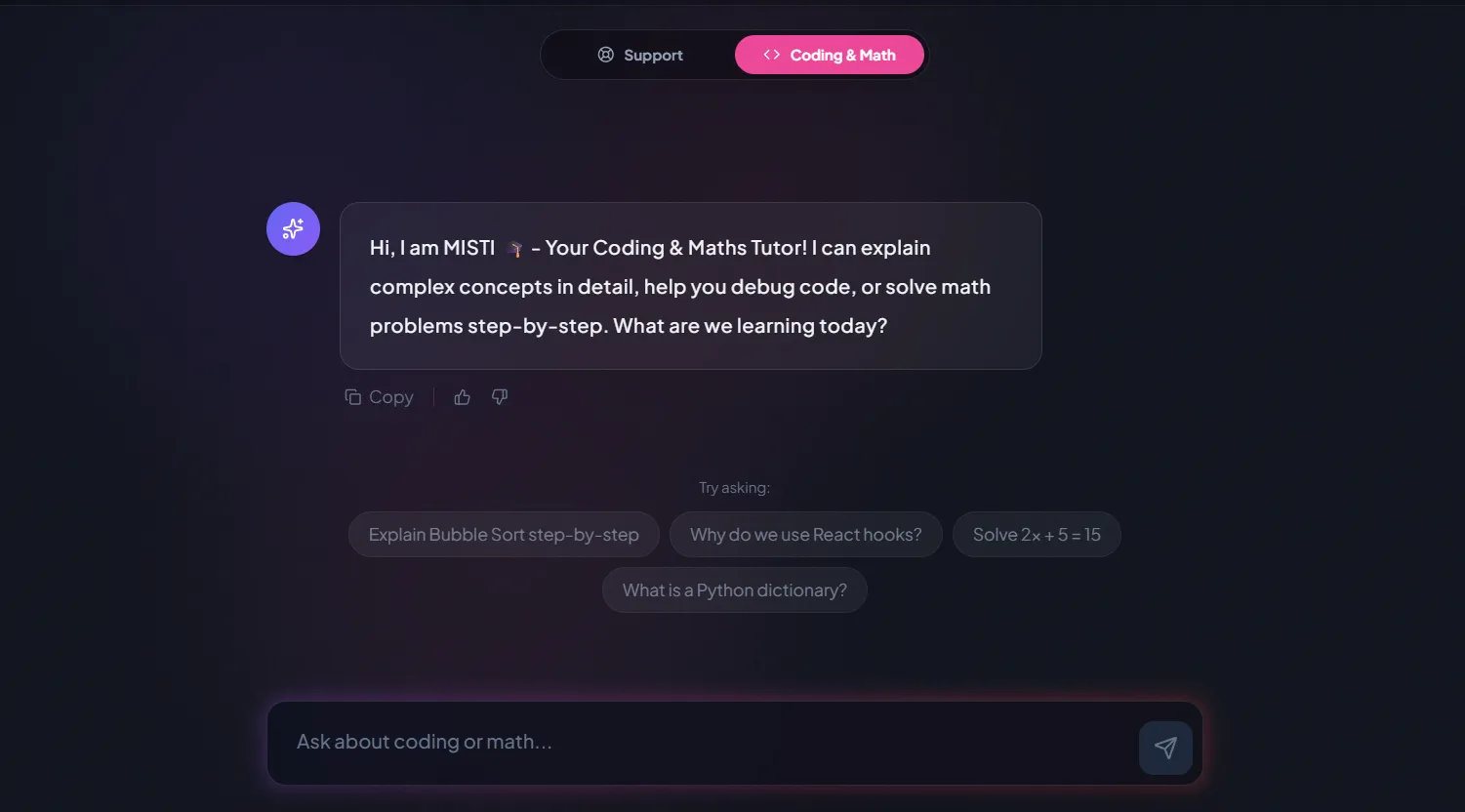
A chatbot that answers mathematics and programming questions, built and deployed by a student.
AI and ML
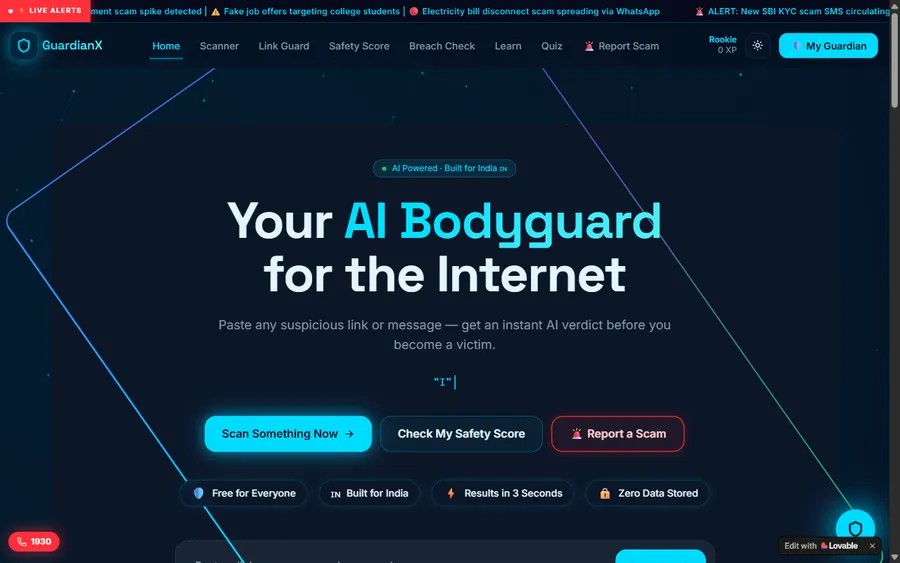
An assistant that helps a young person recognise unsafe situations online.
Web app
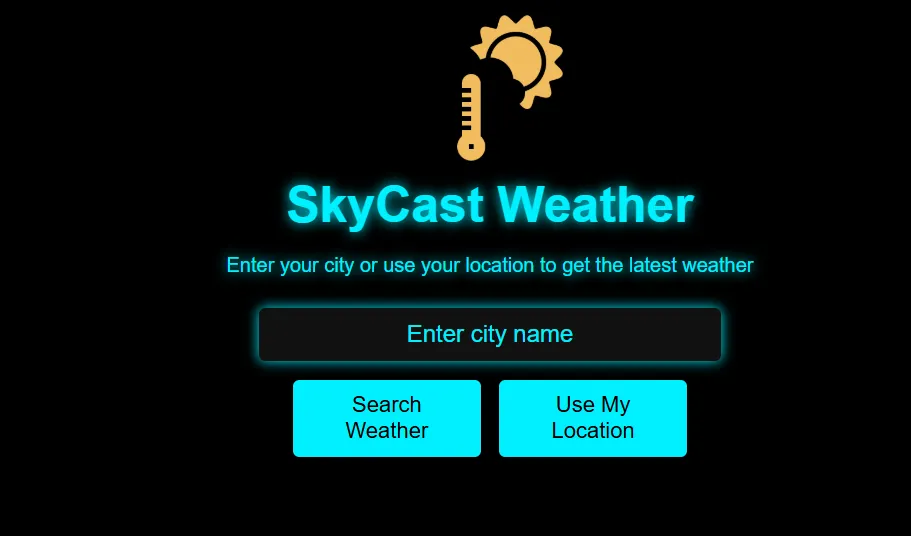
A weather forecasting site with live conditions for any location.
Fees
A monthly rate in US dollars, the same for every country outside India. Nothing to join and no term to sign.
Free first class
USD 0
no card required
Group batch
USD 100
a month, billed in US dollars
One to one
USD 150
a month, billed in US dollars
What families say
Straight from our Google profile, in the families' own words.
★★★★★
"The one step solution for my son. Modern Age Coders make learning coding so simple that kids love it. The teachers explain complex concepts clearly with practical exercises and interactive content."
Ria Mukherjee
Parent
★★★★★
"Modern Age Coders has been a game-changer for me. I struggled to grasp IT concepts and coding before joining, but their classes transformed everything. I can now confidently write complex programs with ease."
Samriddha Mondal
Student
★★★★★
"One of the most wonderful education centres out there. Education is not limited to school syllabus but focuses on skill development."
Vansh Agarwal
Student
★★★★★
"My child Dhairya is really enjoying the Modern Age Coders classes. This is his first online class and he eagerly looks forward to it. I can already see his improvement, and the teachers are very cooperative."
Sonam Oswal
Parent of Dhairya
★★★★★
"Modern Age Coders have wonderful teachers who teach in a clear, easy and practical way. The teacher boosts students' confidence and inspires them to learn without hesitation."
Sonu Goyal
Parent
★★★★★
"I highly recommend this computer coding class! The teachers are incredibly knowledgeable and passionate about coding."
Ritu Kedia
Parent
Coding challenge questions
We do not say, because we could not read the OUCC's own pages on 20 September 2026. What UK Bebras currently publishes is a follow-on round called the Raspberry Pi Foundation Coding Challenge, open to schools and students who took the previous UK Bebras Challenge.
By sitting the UK Bebras Challenge at school in November. UK Bebras says only schools and students who took part in the previous challenge can enter the coding round, and home-educated students are contacted directly by the UK Bebras team.
UK Bebras describes it as designed to be accessible to all students aged 10 and over. Historically the Raspberry Pi Foundation ran the OUCC for students aged 10 to 18 in four age groups.
There are two tracks, block-based and text-based, each with two difficulty levels. Historically the two younger OUCC cohorts used Blockly and the older two could use one of the eleven programming languages Bebras supports, which covers those taught in UK schools.
UK Bebras describes a 45-minute coding challenge, supervised by a school coordinator, with instructions sent to teachers during the challenge through the Bebras emailing system.
Usually formatting rather than logic. An automatic marker compares output as text, so a trailing space, a capital letter, an extra full stop or a different order for tied entries all count as wrong even when the thinking is right.
A sort is stable if items with equal keys stay in the order they arrived. Two sorts of the same scores can both be correct and produce different lines, and a marker comparing text will accept only one. Sorting by score and then by name removes the ambiguity.
By writing the expected output by hand before coding, practising exact input and output, and staying in whichever track they are fluent in. Speed drilling helps far less than reading the task properly.
No. Our problems are written by us in the same territory, and the organisers publish their own past material.
The first lesson is free. After that a group place is USD 100 a month and one-to-one teaching USD 150, with no joining fee and no minimum term.
Related pages
The round before this one, the olympiad after it, and the whole year in one table.
The November challenge that is the only way in.
The next rung, sat in school in December and January.
Every contest we could confirm, month by month.
The qualification most of these students are heading for.
Four school systems, and every UK page.
What to ask any provider before you pay.
Start here
Tell us the age and whether your child works in blocks or typed code. The free lesson is a real task, and afterwards we say plainly what the programming looked like.
Prefer reading? Syllabuses are on the course pages, the method on how we teach, and the order of topics on the roadmap.
WhatsApp us · +91 91233 66161 · contact@modernagecoders.com
WhatsApp is free from a UK mobile and reaches us quickest. Our number is an Indian one, which we say on every page, and there is no office in Britain.