UK / K1 / 01
Problem solving and computational thinking
Breaking problems apart and describing rules aloud, which is where all of this starts.
Open the syllabusUnited Kingdom · Ages 8 to 13 · Live online
In November 2025 the Government wrote a sentence that has not yet reached a single classroom. Responding to the Curriculum and Assessment Review, it said that through the reformed curriculum "pupils will know from a young age how computers can be trained using data". That is a commitment, and it is a good one, because training a model from data is the one thing about AI that a nine-year-old can genuinely be taught rather than merely shown. It also happens to need no chatbot, no account and no sign-up, which matters more than most parents realise. This page explains what was promised, what a lesson on it actually looks like, and why nothing we teach a primary-age child requires them to hold an account with an AI company.
Live teaching since 2020 · 10,000+ students · Written for primary and lower secondary
In short
An AI class for a British child should teach how a machine learns from examples, not how to type a prompt. The Government has said as much: its November 2025 response to the Curriculum and Assessment Review commits to pupils knowing from a young age how computers can be trained using data, alongside a replacement of GCSE Computer Science with a broader Computing GCSE. None of that has reached a classroom yet. Meanwhile Ofcom found that just over a third of eight and nine-year-olds have already used AI, and that more than half of parents of creative three to seven-year-olds say their child has used it. We teach children roughly eight to thirteen what training actually means, using data the child collects, with no accounts held with any AI company. The first lesson is free; after that a group place is USD 100 a month and one-to-one teaching USD 150.
Start here
Written for primary and lower secondary, in that order. Each card opens a full syllabus.
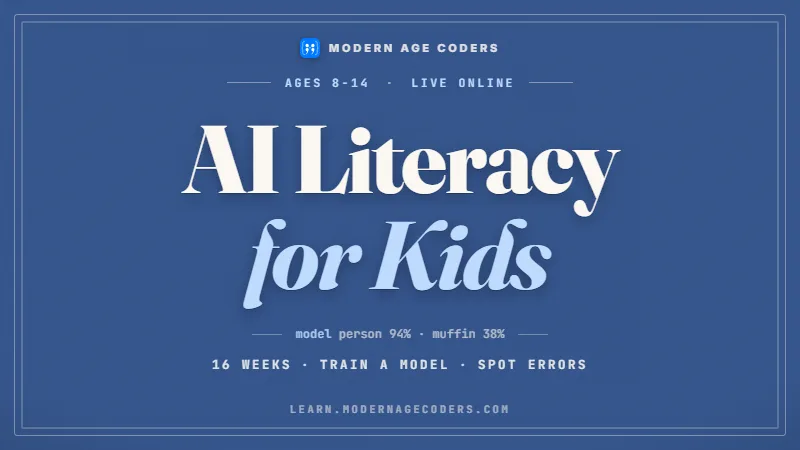
KIDS AI / 01
What a model is, what training means, and why a confident answer is not the same as a correct one.
Open the syllabus →
KIDS AI / 02
The thinking underneath all of it: breaking a problem apart, spotting a pattern, and saying the steps out loud.
Open the syllabus →
KIDS AI / 03
Typed Python for children ready to leave blocks behind, with the first models written line by line.
Open the syllabus →What was promised
The Curriculum and Assessment Review made the recommendations. The Government wrote the sentence. Both documents are public and both are quoted exactly here.
| Who said it | What it says |
|---|---|
| The Review | The Government should provide "greater clarity in the Computing curriculum about what students should be taught at each key stage so that they build the essential digital literacy required for future life and work" |
| The Review | The Government should replace "GCSE Computer Science with a Computing GCSE which reflects the full breadth of the Computing curriculum" |
| The Review | The Government should review "where digital skills and technologies have become an integral part of subject disciplines other than Computing" |
| The Government | "Through the reformed curriculum, pupils will know from a young age how computers can be trained using data and they will learn essential digital skills such as AI literacy" |
| The Government | "We will replace the computer science GCSE with a GCSE in computing that better reflects the breadth of the curriculum. We will also explore introducing a new level 3 qualification in data science and AI" |
| The Government | "We agree with the Review that the computing curriculum should be the main vehicle for teaching about digital literacy" |
It is worth being precise about who said what, because the most quoted phrase is not the Review's. The words "trained using data" appear in the Government's response, not in the Review itself. The Review argued more broadly that "the rise of artificial intelligence (AI) and trends in digital information demand heightened media literacy and critical thinking, as well as digital skills".
That distinction matters if you want to know how firm the commitment is. A recommendation is advice. A response is a department putting its own words on the record.
What none of it comes with yet is a date, a programme of study or a single lesson plan. Curricula are rewritten slowly, exam specifications follow years later, and a child in Year 4 today may well be through primary school before any of this reaches their classroom.
That is not a reason for gloom. It is a reason to know what is coming, because the idea at the centre of it can be taught now, by anybody willing to do it properly. And in England, as the England page explains, most secondary schools are not required to follow the national curriculum at all.
Sources, read 20 September 2026: Curriculum and Assessment Review, Building a world-class curriculum for all, Final Report, November 2025, and the Government response, November 2025.
Trained using data
This is the part a child can actually do, and it takes about three lessons before something clicks that never unclicks.
Start with a question a child cares about and a machine that knows nothing. Can the computer tell a drawing of a cat from a drawing of a dog? It cannot, and it will not, until somebody gives it examples. So the child draws twenty of each, labels them, and feeds them in. The machine gets better. Then they test it on a drawing it has never seen, and it gets one wrong, and the interesting lesson begins.
Why did it fail? Usually because of something in the data. All the cats were drawn facing left. All the dogs had collars, so it learnt collars rather than dogs. A nine-year-old who discovers that has understood something about AI that a great many adults have not.
From there the ideas come in a natural order and none of them need jargon first. Training and testing have to use different examples. More data usually helps and sometimes does not. A model that is right nine times in ten is still wrong once in ten, and which one it gets wrong is not random.
Then the last step, which is the whole point: the child breaks it on purpose. Feed it something ridiculous. Find the input that makes it confidently wrong. A child who has done that will never again assume a machine is right because it sounds sure.
| Stage | What they do | What they now know |
|---|---|---|
| Collect | Gather and label their own examples | A machine starts empty, and somebody chooses what it sees |
| Train | Feed the labelled examples in and watch it improve | Training is a process with inputs, not magic |
| Test | Try it on examples it has never seen | Doing well on what you practised proves nothing |
| Diagnose | Work out why a wrong answer was wrong | Most failures are in the data, not the machine |
| Break | Find the input that makes it confidently wrong | Confidence and correctness are different things |
undefined
undefined
No accounts needed
A practical point that we would rather state clearly than leave a parent to discover in a terms-of-service page.
Generative AI services set their own minimum ages, and those ages are contract terms rather than suggestions. They vary by company and by country, they change, and a great many of them sit above primary school. We are not going to list them here and risk being out of date, because the only reliable version is the one on the provider's own terms page on the day you read it.
What we will say plainly is this: nothing we teach a child of primary age needs them to hold an account with an AI company. Not one lesson. Training a model on drawings a child made does not involve a chatbot at all.
The figures suggest this is not a theoretical concern. Ofcom found that 35 per cent of eight and nine-year-olds say they have used AI, and that among parents of three to seven-year-olds who do creative activities online, more than half say their child has used AI while doing them, including one in six who say it happens often.
So for many British families the question is no longer whether a young child will meet these tools. It is whether they will meet them with any idea of how they work. A class that teaches training and testing gives a child that footing before the first chatbot conversation, not after it.
| We use | We do not use |
|---|---|
| Data the child collects or draws themselves | Accounts held by the child with any AI provider |
| Tools the teacher runs and shares on screen | Chatbots as a substitute for the child thinking |
| Python, once a child is ready for typed code | Anything that needs a child to give a company personal details |
| Work saved where the family can see it | Uploads of photographs of the child or of other children |
undefined
undefined
Progression
Where a child starts depends on what they can already do, not on their school year. Some eight-year-olds begin at step two.
| Step | What the child works on | What they can show an adult |
|---|---|---|
| 1. Patterns and rules | Sorting, classifying and describing rules in their own words | A sorting rule they invented, and a case where it breaks |
| 2. Training a model | Collecting labelled examples and training a simple classifier | A model that recognises their drawings, and one it gets wrong |
| 3. Data and bias | Why a model failed, and what was missing from the examples | A before and after: the data fixed, the model improved |
| 4. Into code | Typed Python, and models written rather than dragged | A short program that loads data, trains something, and reports how well it did |
A child who has never programmed usually starts with block-based coding for a term or two. Trying to teach training to a child who has never written a rule is teaching a word rather than an idea.
The order of everything, well past this stage, is on the coding roadmap.
A confident eleven-year-old who already types Python skips ahead and works on real datasets sooner. The free lesson is where that is decided.
Children who want somewhere to take it next often enjoy a competition; the competitions calendar lists what primary-age children can enter.
The catalogue
Arranged by where a child usually is when they start. The free lesson settles which one is right.
UK / K1 / 01
Breaking problems apart and describing rules aloud, which is where all of this starts.
Open the syllabusUK / K1 / 02
Drag-and-drop programs from about six, with plenty of talking about what each piece does.
Open the syllabusUK / K1 / 03
Characters, scores and levels, each planned on paper before a block is placed.
Open the syllabusUK / K2 / 01
Models trained from examples the child gathers, then tested on things they have never seen.
Open the syllabusUK / K2 / 02
Making games with AI assistance while keeping the child in charge of every decision.
Open the syllabusUK / K2 / 03
Something that lives on a page and does something clever, built end to end.
Open the syllabusUK / K3 / 01
The crossing from blocks to a keyboard, with the first written models.
Open the syllabusUK / K3 / 02
Real programming inside a world a child already knows, which removes the hardest part of starting.
Open the syllabusUK / K3 / 03
Taking an idea to something finished and presentable, which is a skill of its own.
Open the syllabusHow lessons work
Our teachers work from India, where clocks do not change, so the UK is five and a half hours behind in winter and four and a half in summer. Children almost always take an after-school slot.
Straight after school
The usual slot for primary-age children, while concentration is still available.
Early evening
Workable for older children and for families with a long commute.
Weekend morning
Calmer, and good for finishing a project in one go.
Children build something in every lesson. A child who has made nothing has not had a lesson.
We ask that a parent or carer is in the house and reachable. Not sitting in, just present.
Primary-age children need no account with any AI provider for anything we teach them.
Five to ten children at the same stage. Nobody is the youngest in a room of teenagers.
A child says what their program or model will do before it runs. Being wrong out loud is how the idea lands.
Every finished project is saved where the family can open it, which is usually how a parent finds out what was learnt.
Student work
Four projects from children of about this age. More are on the student labs page.
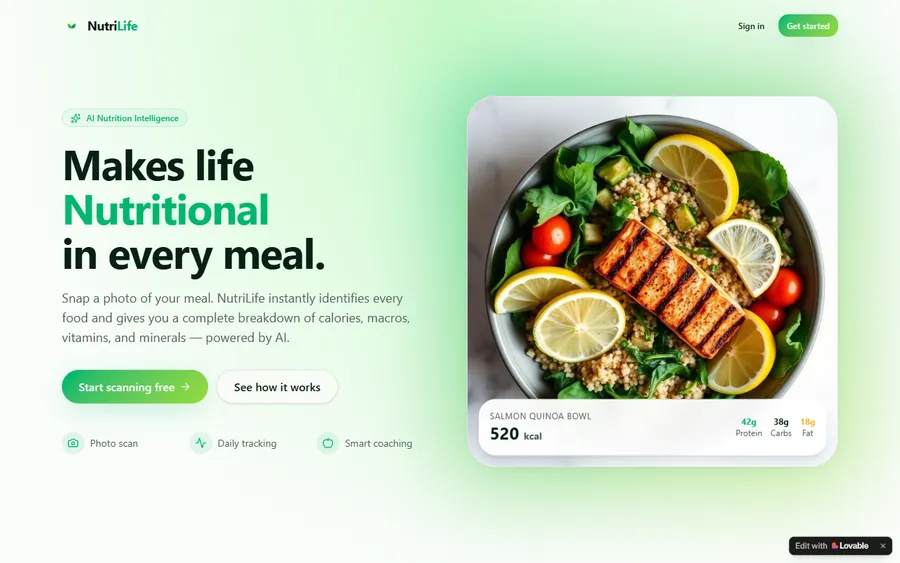
AI and ML
An AI nutrition coach that reads what you eat and works you toward a target.
AI and ML
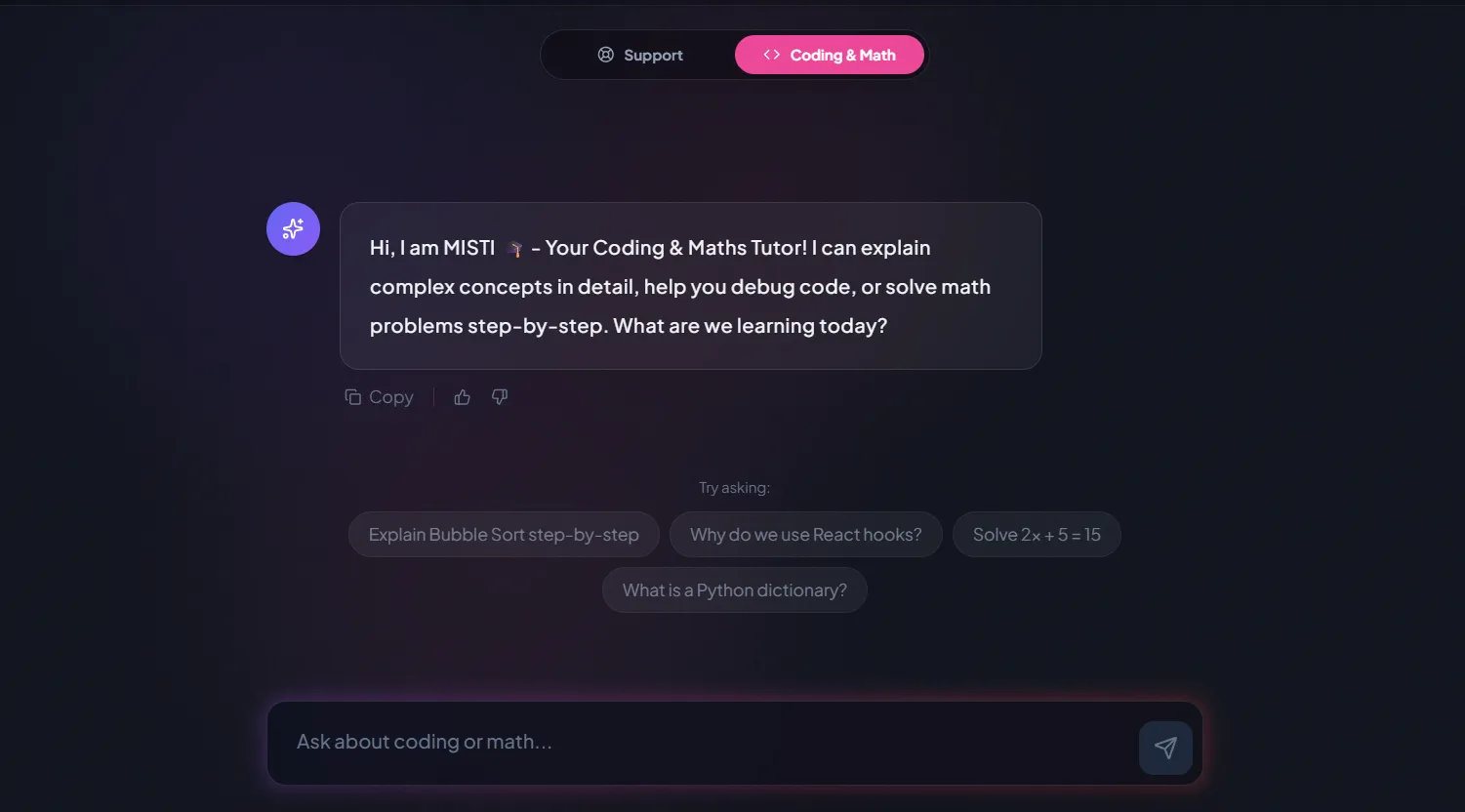
A chatbot that answers mathematics and programming questions, built and deployed by a student.
AI and ML
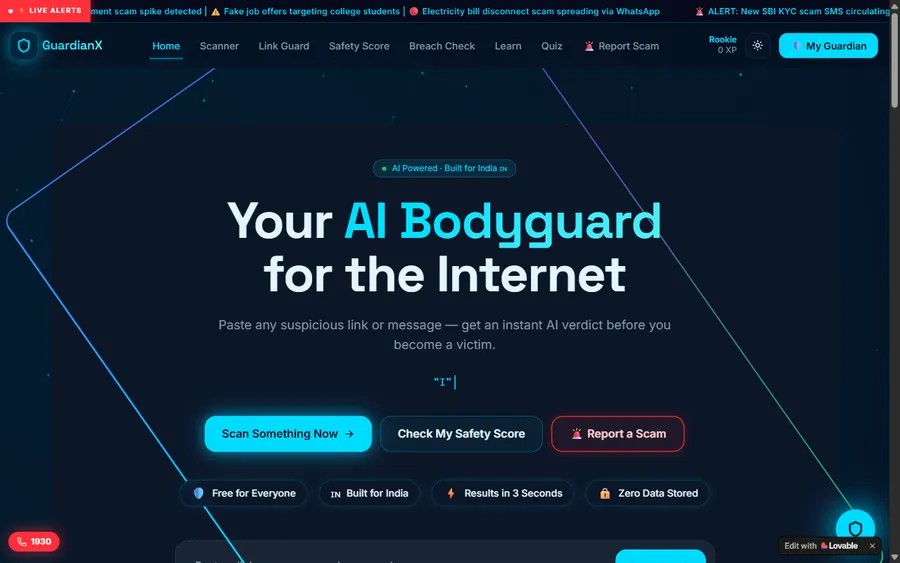
An assistant that helps a young person recognise unsafe situations online.
Web app
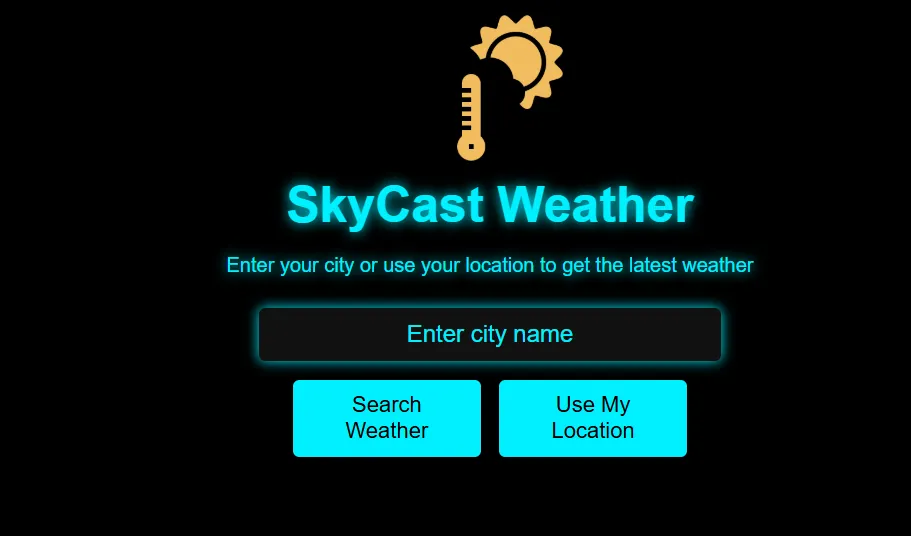
A weather forecasting site with live conditions for any location.
Fees
One monthly charge in US dollars, the same everywhere outside India. The free lesson comes first and nothing is taken before a course and a slot are agreed.
Free first class
USD 0
no card required
Group batch
USD 100
a month, billed in US dollars
One to one
USD 150
a month, billed in US dollars
What families say
Copied from Google as written, by parents who were not asked to write anything.
★★★★★
"The one step solution for my son. Modern Age Coders make learning coding so simple that kids love it. The teachers explain complex concepts clearly with practical exercises and interactive content."
Ria Mukherjee
Parent
★★★★★
"Modern Age Coders has been a game-changer for me. I struggled to grasp IT concepts and coding before joining, but their classes transformed everything. I can now confidently write complex programs with ease."
Samriddha Mondal
Student
★★★★★
"One of the most wonderful education centres out there. Education is not limited to school syllabus but focuses on skill development."
Vansh Agarwal
Student
★★★★★
"My child Dhairya is really enjoying the Modern Age Coders classes. This is his first online class and he eagerly looks forward to it. I can already see his improvement, and the teachers are very cooperative."
Sonam Oswal
Parent of Dhairya
★★★★★
"Modern Age Coders have wonderful teachers who teach in a clear, easy and practical way. The teacher boosts students' confidence and inspires them to learn without hesitation."
Sonu Goyal
Parent
★★★★★
"I highly recommend this computer coding class! The teachers are incredibly knowledgeable and passionate about coding."
Ritu Kedia
Parent
Questions from UK parents
Roughly eight to thirteen. Younger children usually start with block-based coding instead, and we will say so honestly in the free lesson rather than take a booking that will not work.
No. Nothing we teach a primary-age child requires an account with any AI provider. Training a model on drawings a child made involves no chatbot at all.
In its November 2025 response to the Curriculum and Assessment Review it committed that "pupils will know from a young age how computers can be trained using data", and said it will replace the computer science GCSE with a broader computing GCSE and explore a new level 3 qualification in data science and AI.
No date has been published. Curricula are rewritten slowly and exam specifications follow years afterwards, so a child in primary school now may be well past it before anything changes.
Ofcom found that 35 per cent of eight and nine-year-olds have already used it, so the practical question is whether they meet it understanding anything about how it works.
That a machine starts knowing nothing, learns from examples somebody chose, and is only as good as those examples. A child discovers this properly the first time their model gets something wrong for a reason they can find.
Not at this stage. Curiosity and a willingness to be wrong out loud matter far more, and the maths arrives much later and gradually.
No, but we ask that an adult is in the house and reachable. Younger children occasionally need a hand with a file or a screen share.
Short enough that a child is still concentrating at the end. The right length is agreed in the free lesson, because it differs by age and by child.
The first lesson is free. A group place is then USD 100 each month and one-to-one teaching USD 150, charged monthly with nothing taken in advance.
Elsewhere on this site
Each takes one part of this further.
The general door for children, key stage by key stage.
What the computing curriculum says, and who is actually required to follow it.
The same subject once a child is old enough to use the tools directly.
The language a child moves to once blocks run out.
What primary-age children can enter, with closing dates.
Projects children have built and published.
Start here
Leave a number and we will come back at a UK time that suits. The lesson is real teaching, the child builds something, and it ends with a straight view of the right starting step.
Happier reading first? Each course page carries a full syllabus, how we teach sets out the method and its limits, and the sequence of topics runs down the coding roadmap.
WhatsApp us · +91 91233 66161 · contact@modernagecoders.com
Most families reach us fastest on WhatsApp, which costs a UK mobile nothing. The number is registered in India and we would rather say that here than have you notice it later.