OOAU / CHD / 01
Private Scratch
Games at the child's own speed.
Open the syllabusAustralia · Ages 6 to 67 · A teacher of your own
Most of our learners do well in a small group, and we say so to families who ask. But some learners need a teacher to themselves: the child who finishes every task in five minutes, the teenager who freezes when others are watching, the adult who wants to work on their own project at their own speed. This page explains when one-to-one lessons are worth it, puts Australian school staffing figures in honest context, and uses a short simulation of mastery learning to show why two learners in the same class can need very different amounts of practice.
Live teaching since 2020 · 10,000+ students · private lessons paced by mastery
In short
A one-on-one coding tutor teaches a single learner live, so every minute goes to that learner's code and pace. Private lessons suit learners who are much faster, much quieter or working towards a specific goal. In our mastery simulation, a learner answering 85% correctly needed about 5.5 questions to pass a gate of four of the last five, while one at 50% needed 15.3, a gap a fixed class pace cannot serve.
Common private-lesson goals
Any course can be private. These are the ones families most often choose to take individually.

OOAU / 01
Ages 9 to 12. For children who outpace a group and need harder challenges.
Open the syllabus →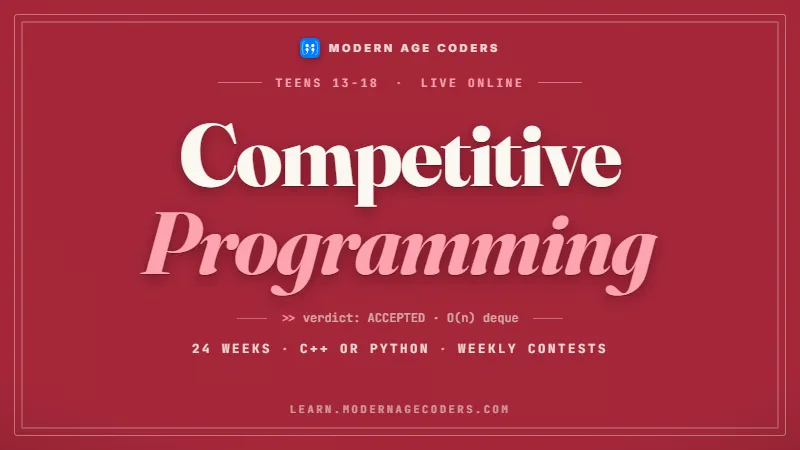
OOAU / 02
Teens. Problem sets matched to the learner's exact level.
Open the syllabus →
OOAU / 03
Adults. Built around your own idea, at your own speed.
Open the syllabus →Who it suits
One-to-one tuition costs more than a group, so it should earn its place. These are the situations where it usually does.
| Situation | Usually suits | Why |
|---|---|---|
| Learner is far ahead of others their age | One to one | A group pace would bore them |
| Learner is anxious about others watching | One to one, then a group later | Confidence first, peers second |
| Specific goal or deadline, such as a competition or school project technique | One to one | Every lesson aimed at that goal |
| Adult with their own project | One to one | The project becomes the course |
| Learner enjoys company and is at a typical level | Small group | Peers motivate and teach each other |
| Unsure | Start with the free lesson | The teacher will recommend honestly |
Groups have real advantages: children learn by explaining to each other, see other approaches and stay motivated by friends' progress. We recommend private lessons only when the learner's needs clearly differ from a group's. For a broader look at choosing a tutor and the safety checks to make, see our online coding tutor guide.
School ratios
Parents sometimes quote student to teacher ratios when weighing tuition. The ABS publishes them, and is careful about what they mean.
| Schools | Students per teacher |
|---|---|
| All schools | 12.8 students to one teacher |
| Primary | 13.9 students to one teacher |
| Secondary | 11.7 students to one teacher |
The ABS says these ratios "are an indicator of the level of staffing resources used and should not be used as a measure of class size". A ratio of 12.8 counts every teacher, including those not in front of a class at that moment.
So the figure does not tell you how many children share a teacher in a typical lesson, and we would not use it to argue for private tuition.
Australia had 325,190 full-time equivalent teaching staff in 2025, according to the ABS. Classroom teachers serve whole classes by design, and individual time for one child is necessarily limited.
One-to-one tuition does not replace that; it adds a different kind of time, focused entirely on one learner's work.
Sources, read 7 October 2026: ABS, Schools, 2025 (released 5 March 2026) and ABS, Schools methodology, 2025.
Mastery pacing
Mastery learning means a learner moves to the next idea only after showing they have the current one. A simple rule makes it concrete: keep practising until four of the last five answers are right. We simulated that rule to see how much practice different learners need.
| Chance of each answer being right | Average questions | Median | 9 in 10 learners finish within |
|---|---|---|---|
| 95% | 5.1 | 5 | 5 |
| 85% | 5.5 | 5 | 7 |
| 75% | 6.5 | 5 | 10 |
| 65% | 8.5 | 6 | 15 |
| 50% | 15.3 | 12 | 31 |
A learner who gets 85% right passes in about 5.5 questions. One who gets half right needs 15.3 on average, nearly three times as much practice, and one in ten of them needs 31 or more.
In a class moving at one pace, the first learner waits and the second is left behind. In a private lesson, the gate decides, and the teacher can change the explanation instead of simply adding questions.
The educational researcher Benjamin Bloom wrote about exactly this tension in a 1984 article in Educational Researcher titled "The 2 Sigma Problem: The Search for Methods of Group Instruction as Effective as One-to-One Tutoring".
The title itself frames the question we care about: how to make group teaching nearly as responsive as a private tutor, and when a private tutor is simply the better choice.
The simulation is ours and simplified: real learners improve as they practise, so their chance of a right answer rises over time. Learners who were stuck near 50% are exactly the ones who need a different explanation, not just more questions, and that is the strongest case for a teacher of their own. Children can write this simulation themselves in Python with a loop and a list of the last five answers.
Source: Bloom, B. S. (1984), Educational Researcher 13(6), 4 to 16, doi.org/10.3102/0013189X013006004 (title and details confirmed via Crossref). The table is our own simulation, labelled as such.
Private lessons
Every lesson is live, with the same teacher each week, and built around one learner.
The teacher moves on when the learner shows mastery, and slows down when they do not, without anyone else waiting.
Learners can bring their own idea, from a game to a school technique question to a work tool, and build it across lessons.
Lessons are set in your local time on weekday afternoons, evenings or weekends, in any Australian state.
A real teacher on the call for the whole lesson, from India, sharing the learner's screen and code.
Families of younger children can sit in on any lesson.
Learners can move between private lessons and a small group as their needs change.
Comparing costs? Our guide to coding class costs in Australia sets out the group and one-to-one arithmetic per lesson and per term.
Getting the most from it
Private tuition is a bigger commitment than a group, so it is worth setting it up well from the first week.
| Habit | Why it helps |
|---|---|
| Agree a goal in the first lesson | A clear target, such as a finished game or a competition level, lets the teacher plan backwards |
| Keep a short project log | Writing one line after each lesson shows progress and exposes ideas that need revisiting |
| Try the between-lesson task alone | Getting stuck at home produces the sharpest questions for the next lesson |
| Review every few weeks | Learner, family and teacher check the goal still fits and adjust the plan |
| Plan a move to a group | Many learners benefit from rejoining peers once a specific gap is closed |
Short, regular lessons work better than long, occasional ones. A child who codes for an hour every week usually progresses further than one who has two hours once a fortnight.
Ask your child to show you one thing they built after each lesson. Explaining it to you is itself practice, and a gentle check on understanding.
Bring real material. A spreadsheet you dread at work, a website you want to build or a dataset you are curious about makes a far better lesson plan than a generic exercise.
Tell the teacher how you like to learn. In a private lesson, the method can change to suit you, which is the whole point of having a teacher to yourself.
Stages
Milestones we watch for in one-to-one lessons.
| Stage | What it looks like |
|---|---|
| 1. Diagnose | The teacher finds exactly what the learner knows and where they wobble |
| 2. Gate | Each idea is practised until mastery is shown, then left behind |
| 3. Stretch | Harder problems arrive as soon as the learner is ready |
| 4. Own | The learner plans and builds their own project with light guidance |
Private lessons often suit very quick or very shy children first, with a move to a group later.
Parents see progress through projects their child can open at home.
Private lessons suit specific goals: competitions, technique for school projects, a career change or a work tool.
The learner's own material often becomes the lesson plan.
The catalogue
Every course can be private. These are popular with individual learners.
OOAU / CHD / 01
Games at the child's own speed.
Open the syllabusOOAU / CHD / 02
For quick young coders.
Open the syllabusOOAU / CHD / 03
Maths confidence for coders.
Open the syllabusOOAU / TEN / 01
Training at the right level.
Open the syllabusOOAU / TEN / 02
C# and shipped games.
Open the syllabusOOAU / TEN / 03
Online safety and white-hat skills.
Open the syllabusOOAU / ADL / 01
Your idea, built properly.
Open the syllabusOOAU / ADL / 02
Excel, SQL and Python.
Open the syllabusOOAU / ADL / 03
From JavaScript to production.
Open the syllabusHow lessons run
With one learner, the plan can change the moment it needs to.
After school
Weekday afternoons in your state.
Evenings
For teens and adults.
Weekends
Saturday and Sunday slots.
Move on when ready, not when the week ends.
The same teacher every week.
Their ideas become the material.
Screen and code shared throughout.
Switch to a small group any time.
We will say if a group would suit better.
Student work
Projects built in one-to-one lessons, at each learner's own pace. Browse more on the student labs page.

AI and ML
An AI nutrition coach that reads what you eat and works you toward a target.

AI and ML
A chatbot that answers mathematics and programming questions, built and deployed by a student.

AI and ML
An assistant that helps a young person recognise unsafe situations online.

Web app
A weather forecasting site with live conditions for any location.
Fees
Private and group lessons outside India are charged monthly in US dollars, with one rate for all countries. There is no joining fee and no term contract, so you may stop after any month or switch formats.
Free first class
USD 0
no card required
Group batch
USD 100
a month, billed in US dollars
One to one
USD 150
a month, billed in US dollars
What families say
Google reviews from families, copied without edits.
★★★★★
"The one step solution for my son. Modern Age Coders make learning coding so simple that kids love it. The teachers explain complex concepts clearly with practical exercises and interactive content."
Ria Mukherjee
Parent
★★★★★
"Modern Age Coders has been a game-changer for me. I struggled to grasp IT concepts and coding before joining, but their classes transformed everything. I can now confidently write complex programs with ease."
Samriddha Mondal
Student
★★★★★
"One of the most wonderful education centres out there. Education is not limited to school syllabus but focuses on skill development."
Vansh Agarwal
Student
★★★★★
"My child Dhairya is really enjoying the Modern Age Coders classes. This is his first online class and he eagerly looks forward to it. I can already see his improvement, and the teachers are very cooperative."
Sonam Oswal
Parent of Dhairya
★★★★★
"Modern Age Coders have wonderful teachers who teach in a clear, easy and practical way. The teacher boosts students' confidence and inspires them to learn without hesitation."
Sonu Goyal
Parent
★★★★★
"I highly recommend this computer coding class! The teachers are incredibly knowledgeable and passionate about coding."
Ritu Kedia
Parent
Questions from families
A one-on-one coding tutor teaches a single learner in live lessons, so the pace, material and feedback are set entirely around that learner rather than a group.
Mastery learning is an approach in which a learner moves to the next idea only after showing they have mastered the current one, rather than moving on when the class does. A simple version is a gate such as four of the last five answers correct.
Not always. Groups suit most learners and add peers to learn from. Private lessons suit learners who are much faster, much quieter or working towards a specific goal.
In our simulation, a learner who answered 85% correctly needed about 5.5 questions to pass a mastery gate, while one at 50% needed 15.3. A single class pace cannot serve both.
No. The ABS says the ratio is an indicator of staffing resources and should not be used as a measure of class size.
Yes. Learners can move between formats as their needs change, often starting privately and joining a group later.
Yes. Adults often take one-to-one lessons to build their own project, learn for a new job or work on a specific tool.
Any agreed slot on weekday afternoons, evenings or weekends in your local time, in every state and territory.
Yes. Every lesson is live online with a teacher, who shares the learner's screen and code throughout.
The first lesson is free. After that, one-to-one lessons are paid monthly with no joining fee and no term lock-in, as shown in the fees section.
Elsewhere on this site
More on tuition, costs and our Australian classes.
Our main page for Australian families.
What a tutor does and what to check.
Group and private arithmetic.
Local or online.
For learners with a goal in mind.
Our method in detail.
Start here
Give us a number and a time. The teacher works with the learner one to one, then tells you honestly whether private lessons or a small group would suit better.
Reading first? Start with how a lesson runs or all courses.
WhatsApp us · +91 91233 66161 · connect@modernagecoders.com
Use WhatsApp from Australia for the fastest reply; our India-based team answers from a +91 number, and we have no office in Australia.
A priority demo is a full class of about 45 to 60 minutes. After the class the mentor sends a written skill report and a personal learning roadmap on WhatsApp. If you enrol, the demo fee is adjusted against your first month's fee. Share your demo Order ID with us on WhatsApp and we take it off.
Book a priority demo