UK / RP1 / 01
Python for kids
The first typed language, for ages 10 to 13.
Open the syllabusUK · Ages 10 to 17 · Physical computing
Many families buy a Raspberry Pi and discover a slightly awkward truth: used with a screen and keyboard, it is a small computer that does much of what the family laptop already does. The part that makes it special sits along one edge. Raspberry Pi's official documentation puts it plainly: "You can find a 40-pin GPIO (general-purpose input/output) header on all current Raspberry Pi boards." Those pins let code reach out into the physical world, switching lights, reading buttons, measuring the room. Raspberry Pi OS comes with Python already installed, and the documentation's own example lights an LED from Python in a handful of lines using the GPIO Zero library, which is installed by default. This page is about the projects that use the pins, how to build them safely, and when a Raspberry Pi Pico is the better tool.
Live teaching since 2020 · 10,000+ students · Grounded in Raspberry Pi's official documentation
In short
A Raspberry Pi is a small computer that runs Raspberry Pi OS, a free operating system based on Debian Linux, with Python 3 and the Thonny editor included. What sets it apart from an ordinary computer is its 40-pin GPIO header, present on all current boards, which lets programs switch outputs on and off and read inputs such as buttons and sensors. The GPIO Zero Python library, installed by default, makes that approachable: the official documentation shows an LED blinking and a button being read in a few lines. The projects most worth doing for children and teenagers use those pins, with simple safety rules: resistors for LEDs, no 5V into 3.3V parts, and no motors wired straight to a pin. For small single-purpose gadgets, the Raspberry Pi Pico microcontroller runs MicroPython instead. Modern Age Coders teaches the Python these projects need, live. We do not sell hardware. The first lesson is free, then USD 100 a month in a group or USD 150 one to one.
Start here
Python for younger makers, Python for teenagers, and data for logging projects. Each card opens a syllabus.
RP / 01
The language Raspberry Pi OS ships with, taught for ages 10 to 13.
Open the syllabus →
RP / 02
From basics to structured programs, the foundation for bigger Pi projects.
Open the syllabus →
RP / 03
For teenagers logging sensor readings who want to analyse and chart them.
Open the syllabus →A computer with pins
From Raspberry Pi's official documentation, published on GitHub.
| Feature | What the documentation says |
|---|---|
| Operating system | Raspberry Pi OS is the official operating system, it is free, and it is based on Debian Linux |
| Python | Python 3 comes pre-installed |
| Editor | The default desktop edition includes the Thonny Python environment |
| Pins | A 40-pin GPIO header on all current Raspberry Pi boards |
| Outputs | A pin set as an output can be high, 3.3V, or low, 0V |
| Pin library | GPIO Zero is installed by default and provides the pinout command |
Put together, those facts mean a child can plug in a Raspberry Pi, open Thonny, and control a light or read a button from Python without installing anything. That is the Raspberry Pi's real strength for learning. A game or a website can be written on any laptop. A burglar alarm, a weather station or a reaction timer needs pins, and the Pi has them built in.
Lights and buttons: traffic lights, reaction games, a doorbell. Then sensors: temperature, motion, light.
Projects that log data over hours or days, which a laptop would not be left running for.
Games, websites and ordinary programs run fine on a Pi, but they do not need one.
A Pi used only for these is still a good cheap computer, just not the reason to buy one.
Source: Raspberry Pi's official documentation in the raspberrypi/documentation repository: the GPIO, Python, GPIO-from-Python, Raspberry Pi OS, Pico and MicroPython pages. raspberrypi.com refused automated requests when we checked, so we read the same documentation from its public source. We have no connection with Raspberry Pi.
First projects
Each project adds one idea. Together they cover what most physical computing needs.
| Project | New idea | Python it uses |
|---|---|---|
| Blink an LED | An output pin | A loop, and switching an LED on and off with GPIO Zero |
| A button-controlled light | An input pin | Reading a button and an if-statement |
| Traffic lights | Timing and sequence | Several outputs and pauses in order |
| Reaction game | Measuring time | Variables, timing, and printing a score |
| Temperature logger | Sensors and files | Reading a sensor and saving readings to a file |
| Motion alarm | Events | Responding when something happens, rather than checking constantly |
The official documentation shows the first two almost exactly: an LED on one pin blinking once a second, and a button on another pin printing whether it is pressed, then the two combined so the button lights the LED. It even shows three ways to write the combined version, from a simple loop to an event-driven style where pressing the button calls a function. That progression, from checking in a loop to responding to events, is a genuine programming idea that transfers far beyond the Pi.
An LED that obeys your code is the moment most children are hooked. It is also the simplest safe circuit.
Buttons and sensors turn a program from a show into a conversation with the world.
Logging readings to a file, then charting them, leads naturally into data science.
Safe circuits
Simple circuits are safe. A few mistakes can damage the board, and they are easy to avoid.
The documentation warns: "LEDs should have resistors to limit the current passing through them. Do not use 5V for 3.3V components. Do not connect motors directly to the GPIO pins". It recommends a motor controller board or an H-bridge circuit for motors. Those three rules cover almost every beginner accident.
| Rule | Why it matters |
|---|---|
| Use a resistor with every LED | Without one, too much current can flow and damage the LED or the pin |
| Keep 5V away from 3.3V parts | The pins work at 3.3V; a 5V signal can damage them |
| Never wire a motor straight to a pin | Motors draw far more current than a pin can supply; use a controller board |
| Check wiring before powering on | Most problems are a wire in the wrong hole, easily fixed before power flows |
Beginner kits with resistors included, a breadboard and jumper wires are enough for the first projects. An adult glance at the wiring before power goes on is a sensible habit.
Nothing at this level involves mains electricity; the Pi runs from its own low-voltage power supply.
The documentation warns that interfering with the system Python can cause problems. Extra libraries go in through the proper tools, and pip installs into a virtual environment.
For first projects, the libraries already installed are all a child needs.
Pi or Pico
Two very different devices share a name. Choosing the right one saves frustration.
| Raspberry Pi computer | Raspberry Pi Pico | |
|---|---|---|
| What it is | A full computer running Linux | A microcontroller board that does not run Linux |
| Language | Python 3, and much more | MicroPython, C or C++ |
| Needs a screen? | Usually, or remote access | No; programmed from another computer over USB |
| Good for | Projects mixing pins, screens, files and the internet | Small gadgets that do one job |
The documentation describes MicroPython as "a full implementation of the Python 3 programming language that runs directly on embedded hardware like Raspberry Pi Pico", so the Python a child learns carries straight across. A Pico is a natural choice for a single-purpose gadget, a plant monitor or a wearable light; a Raspberry Pi is better when a project needs a screen, files or a web connection.
Live Python lessons that teach the programming these projects need, with a teacher who reads the code and helps when a project stalls.
Guidance on structuring a growing project, from a single script into functions and files.
A hardware supplier or an electronics course. We do not sell or ship Raspberry Pis, Picos or kits, and we do not teach wiring in depth.
Connected with Raspberry Pi. We describe the devices from their official documentation.
Children who started on a school micro:bit may like the step after the micro:bit. Raspberry Pi computers also fly on the International Space Station through Astro Pi, and ambitious builders can take projects to student hackathons.
Progression
Placement follows what a child can already write in Python, not what hardware they own.
| Rung | Usually | What should be true |
|---|---|---|
| 1. Python basics | Ages 10 to 12 | Variables, loops and if-statements written confidently |
| 2. Outputs and inputs | Ages 11 to 13 | LEDs and buttons controlled from Python with GPIO Zero |
| 3. Sensors and data | Ages 12 to 15 | Sensor readings saved to files and charted |
| 4. A real build | Ages 13 and up | A multi-week project, planned, built and improved, with code reviewed |
Hardware is exciting, but projects stall without Python basics. A few weeks of programming first saves months of frustration.
The full order of topics is on the coding roadmap.
A finished project that does something useful at home is worth more than any number of tutorials.
It can also be something real to talk about in a later application.
The catalogue
By stage and interest. The first lesson places each learner.
UK / RP1 / 01
The first typed language, for ages 10 to 13.
Open the syllabusUK / RP1 / 02
Structured programs for bigger builds.
Open the syllabusUK / RP1 / 03
Logic that makes projects reliable.
Open the syllabusUK / RP2 / 01
Sensor data analysed and charted.
Open the syllabusUK / RP2 / 02
Where projects start to recognise things.
Open the syllabusUK / RP2 / 03
Keeping connected projects safe.
Open the syllabusUK / RP3 / 01
Blocks, MakeCode and first inventions.
Open the syllabusUK / RP3 / 02
Logic and design in blocks.
Open the syllabusUK / RP3 / 03
Inventing and presenting a project.
Open the syllabusHow lessons work
Our teachers work from India, whose clocks stay fixed, so the UK is four and a half hours behind in summer and five and a half in winter. Lessons are timed in UK hours.
After school
Time to try the code on the Pi straight after.
Evening
For teenagers with busy days.
Weekend
Longer sessions for build projects.
The Python a project needs, taught properly before the wiring gets complicated.
Learners pick what to build; the teacher shapes the skills around it.
A teacher reads each program and suggests the next improvement.
From checking in a loop to responding to events, as the official examples show.
The documentation's three rules repeated until they are automatic.
Five to ten learners at one level.
Student work
Four projects made in lessons by the learners themselves. More in student labs.
AI and ML
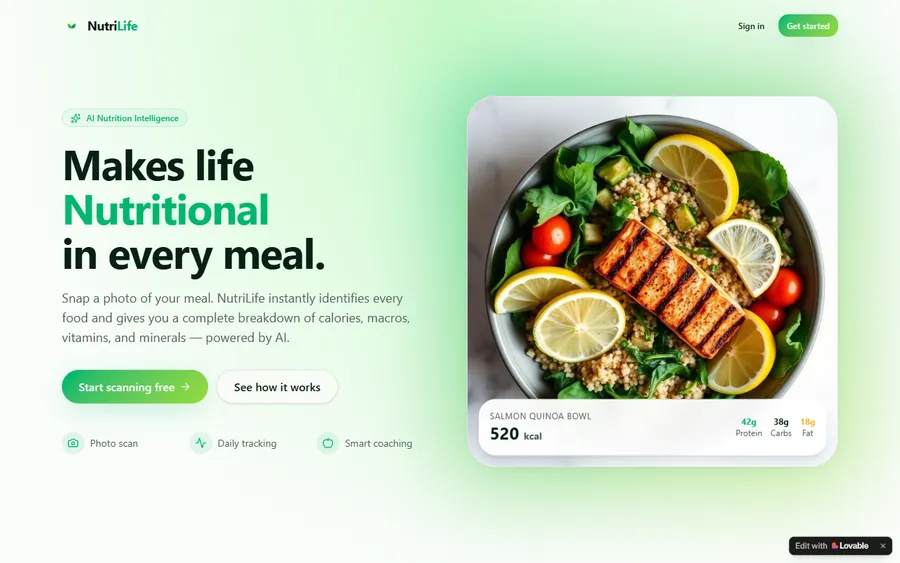
An AI nutrition coach that reads what you eat and works you toward a target.
AI and ML
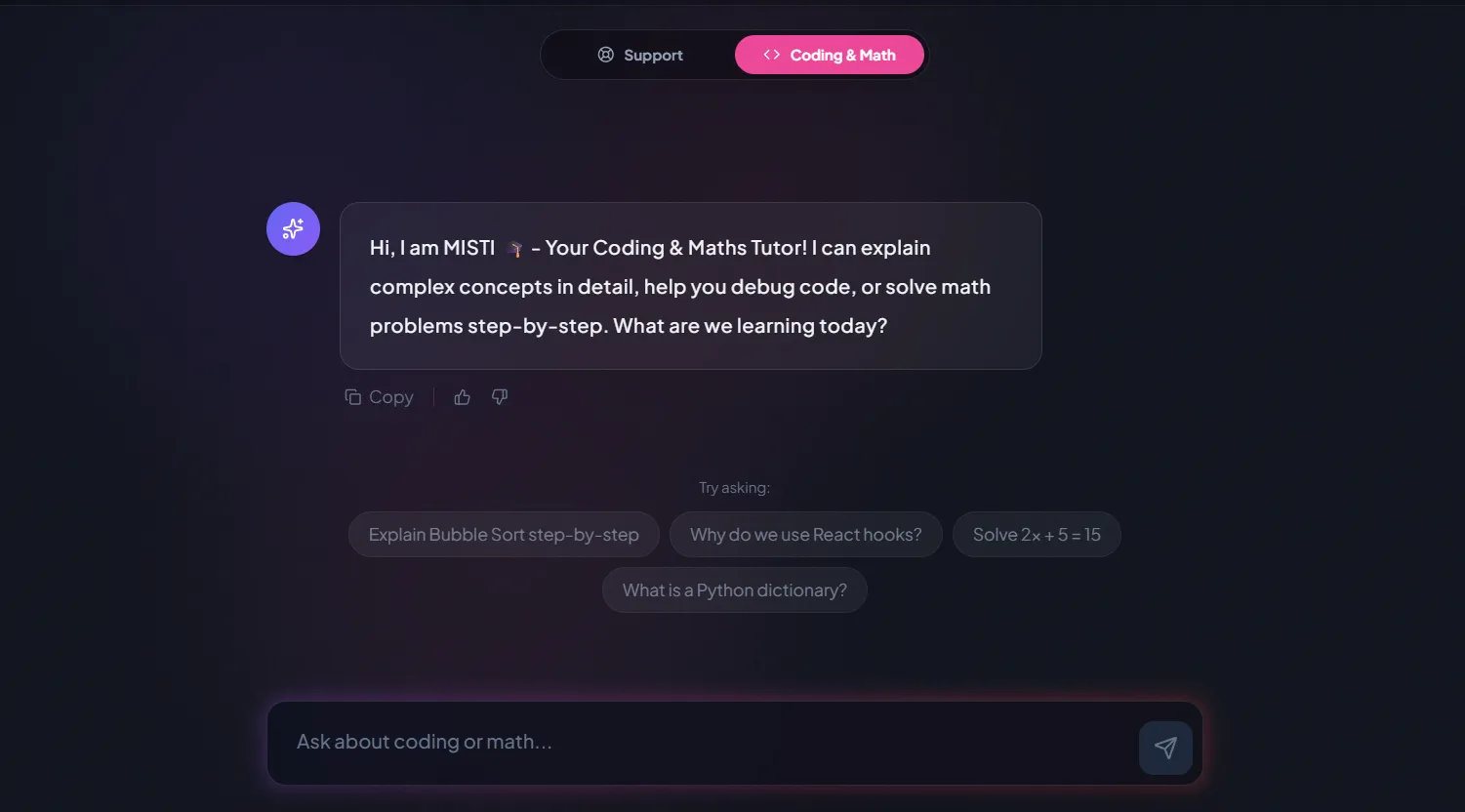
A chatbot that answers mathematics and programming questions, built and deployed by a student.
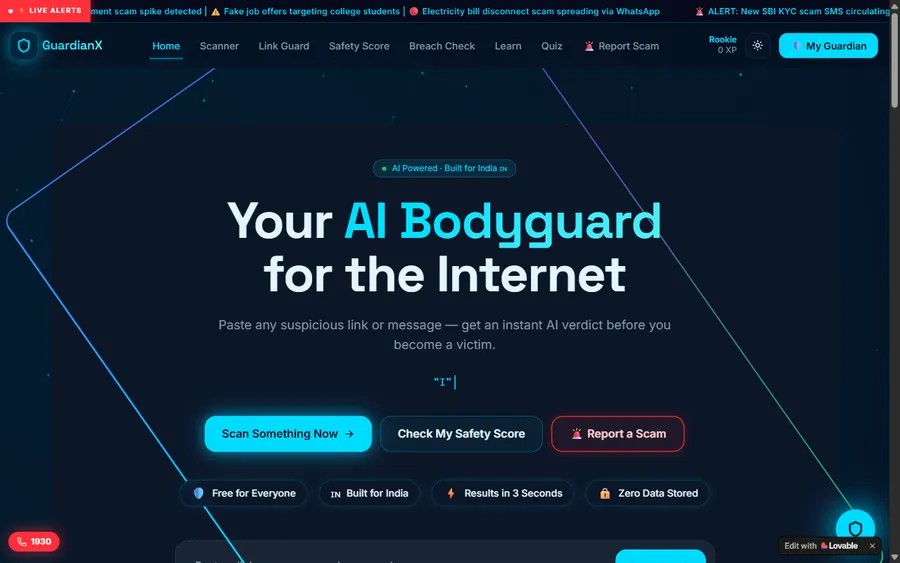
AI and ML
An assistant that helps a young person recognise unsafe situations online.
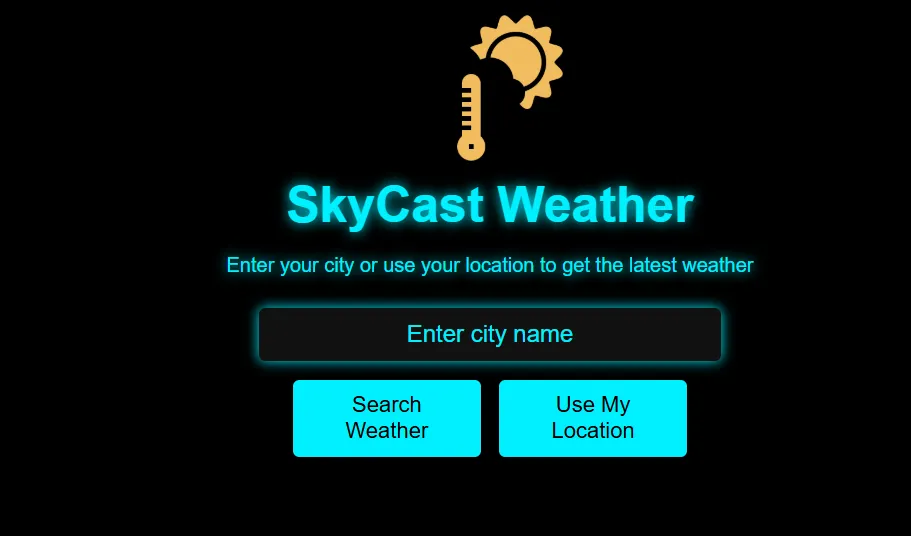
Web app
A weather forecasting site with live conditions for any location.
Fees
We bill monthly in US dollars, one price for all families outside India. The first lesson has no charge, and billing waits until you have chosen a course and a weekly time. Hardware is not included.
Free first class
USD 0
no card required
Group batch
USD 100
a month, billed in US dollars
One to one
USD 150
a month, billed in US dollars
What families say
Reviews from parents on Google, word for word.
★★★★★
"The one step solution for my son. Modern Age Coders make learning coding so simple that kids love it. The teachers explain complex concepts clearly with practical exercises and interactive content."
Ria Mukherjee
Parent
★★★★★
"Modern Age Coders has been a game-changer for me. I struggled to grasp IT concepts and coding before joining, but their classes transformed everything. I can now confidently write complex programs with ease."
Samriddha Mondal
Student
★★★★★
"One of the most wonderful education centres out there. Education is not limited to school syllabus but focuses on skill development."
Vansh Agarwal
Student
★★★★★
"My child Dhairya is really enjoying the Modern Age Coders classes. This is his first online class and he eagerly looks forward to it. I can already see his improvement, and the teachers are very cooperative."
Sonam Oswal
Parent of Dhairya
★★★★★
"Modern Age Coders have wonderful teachers who teach in a clear, easy and practical way. The teacher boosts students' confidence and inspires them to learn without hesitation."
Sonu Goyal
Parent
★★★★★
"I highly recommend this computer coding class! The teachers are incredibly knowledgeable and passionate about coding."
Ritu Kedia
Parent
Questions about Raspberry Pi projects
Anything a small computer can do, but the special part is the 40-pin GPIO header, which lets Python code control lights and read buttons and sensors. The projects worth doing use those pins.
Yes. Raspberry Pi OS comes with Python 3 pre-installed, the default desktop edition includes the Thonny editor, and the GPIO Zero library for the pins is installed by default.
Blinking an LED, then lighting it with a button. The official documentation shows both in Python in a handful of lines.
Simple circuits are safe if you follow the documentation's rules: a resistor with every LED, no 5V into 3.3V parts, and never a motor wired straight to a pin.
A Raspberry Pi is a full computer, better for projects with screens, files or the internet. A Pico is a microcontroller for small single-purpose gadgets and runs MicroPython.
Yes, largely. The documentation describes MicroPython as a full implementation of Python 3 that runs on boards like the Pico.
No. We teach Python and help with projects; families buy their own hardware.
Only the basics a project needs. Our lessons are about the programming; we do not run an electronics course.
No. We are independent and describe the devices from Raspberry Pi's official documentation.
The first lesson is free; after that, a monthly fee in US dollars, lower in a group than one to one, as shown in the fees section, and never paid in advance.
Elsewhere on this site
Other boards, space, and competitions.
From school micro:bits to Python.
The next step once club guides run out.
Code that runs on Raspberry Pi computers in space.
Building to a deadline with a team.
How we teach Python properly.
The full list of UK pages.
Start here
Leave a number and we will call at a UK time that suits. Tell us what your child wants to build; the lesson starts there and ends with a plan.
Reading first? Each course page sets out its content, how we teach explains who our lessons suit, and student labs shows real projects.
WhatsApp us · +91 91233 66161 · contact@modernagecoders.com
WhatsApp gets the quickest reply and is free from a UK phone. We are in India, so the number shows +91.