Skip to content
Math tutor, Edmonton, Alberta

Math tutor in Edmonton

Is there live math tutoring for Edmonton students online?

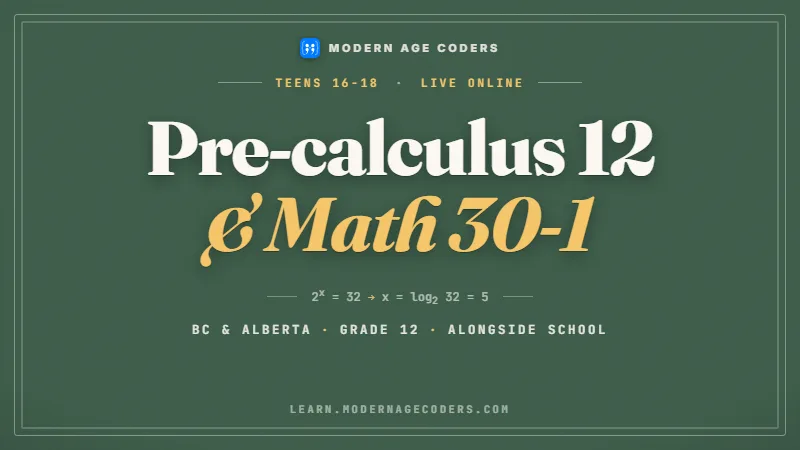
There is. Modern Age Coders teaches math to Edmonton students over live video, covering everything between Grade 1 and Math 30-1 or 30-2; a teacher works with one student, or with fifteen to twenty students placed at the same level. Younger students often start with Elementary Maths or Middle School Mathematics Mastery; Grade 12 students join our Western Canada Grade 12 Math course. Lesson one is free.

Every Edmonton child in a public school writes two provincial math tests before high school: the Grade 6 Provincial Achievement Test, with no calculator allowed in either part, and the Grade 9 test, where Part A bans calculators and Part B allows them. After Grade 9 comes the choice between the -1 and -2 courses, which decides whether a student reaches Math 30-1 and the programs that need calculus. Alberta’s curriculum is changing at the same time, with new K to 6 math already in place and new 7 to 9 math due in September 2027. This page explains those steps from Alberta’s own documents, then teaches a modelling lesson on the City’s own tree inventory, works a problem from it, and covers contests and prices.

Facts last verified 23 October 2026. Teaching is online; no Edmonton branch is claimed.

Math course picks for Edmonton

First courses for Edmonton students

Each covers a stretch of Alberta math. A free lesson confirms the choice once the teacher has seen how the student works.

Browse the course atlas for more than one hundred options and use the coding roadmap to check prerequisites.

The four we are known for

Python, AI, vibe coding and agentic coding

These run underneath everything above. Every one is live and online, placed by ability rather than by age, and the first class is free.

Alberta math in Edmonton

Two achievement tests and one big choice: Alberta math for an Edmonton student

Every public school in Edmonton follows the provincial programs of study. The facts below come from Alberta Education and Childcare’s 2026 to 2027 bulletins and schedules; each row links to our detailed page.

The Grade 6 and Grade 9 mathematics Provincial Achievement Tests for 2026 to 2027, as Alberta Education and Childcare describes them
TestPart APart BDates in 2027
Grade 6 Mathematics15 questions on number, designed for 30 minutes (up to 60); no calculator40 questions from all organizing ideas, designed for 75 minutes (up to 150); no calculatorPart A Monday 14 June; Part B Wednesday 16 June
Grade 9 Mathematics20 questions; manipulatives allowed, no calculator40 questions; calculators and manipulatives allowedPart A 22 January or 15 June; Part B 25 January or 17 June

Two details change how an Edmonton family should prepare. The Grade 6 bulletin says the use of a calculator is not permitted in Part A or Part B, so fluency with fractions, decimals and ratio is not optional. And for 2026 to 2027 only, the Grade 9 bulletin says classes in schools piloting the new Mathematics 9 curriculum will not be required to write the Grade 9 test; other classes will. Ask the school which applies. Our Grade 6 PAT page and Grade 9 PAT page have practice sets.

No coaching to the test

Alberta’s Grade 9 parent guide says Alberta Education and Childcare discourages test rehearsal and coaching. We agree: our lessons teach the mathematics the test draws on, and the test result follows from that.

A curriculum in transition

Alberta implemented new K to 6 math in 2022/2023 and plans mandatory new 7 to 9 math from September 2027. A child in Grade 5 now will meet the new Grade 7 to 9 course. Our guide to the new curriculum covers it.

Then -1 or -2

The Math 30-2 bulletin describes it as preparing students for post-secondary programs that do not require the study of calculus. Math 30-1 serves those that do. Our Math 30-1 or 30-2 page sets them side by side.

In Grade 12 both Math 30-1 and Math 30-2 end in a diploma exam that Alberta now weights at 30 percent of the final mark, with 70 percent from course work. For the senior years see our Math 30-1 tutor page. Lower down, the habit that matters most is the one both achievement tests reward: working without a calculator until the numbers make sense.

Alongside school, never instead

Our lessons follow the course an Edmonton student takes at school. We do not grant Alberta credits, and achievement test results, course marks and diploma results all come through the school and the province. We are not connected with Alberta Education and Childcare, the City of Edmonton or any Edmonton school board.

Edmonton data lesson

How fast does an Edmonton bur oak grow? A line, a curve and a warning

The City of Edmonton keeps an inventory of the boulevard and open space trees it owns, with a planting date and a trunk diameter for each. Students turn one species into a growth model, fit a straight line and an exponential curve, and discover that the curve that fits best is the one that fails first. The averages, fits and projections below are ours.

The dataset is called Trees, published by the City of Edmonton, which describes it as a map of boulevard and open space trees owned and maintained by the City, adding that not all City-owned trees are captured on this map. When we queried it on 23 October 2026 it held 482,603 trees. Rather than download every record, we asked the City’s data service for the average diameter at breast height of bur oaks, grouped by planting year.

Half the inventory shares one planting date

Before any modelling, a check: 258,504 trees, or 53.6 percent of the file, carry the planting date 1 June 1990, against 15,767 for the next most common year, 2014. Among bur oaks, 1,992 trees share that date. A single day cannot account for half a city’s trees, so we treat the date as a stand-in for “unknown” and leave 1990 out. The file does not say what the date means; that reading is ours.

Bur oaks in the City of Edmonton Trees inventory: our grouped averages by planting year (selected years), with age taken as 2026 minus the planting year. Queried 23 October 2026
Planted inAge (years)Mean diameter (cm)Trees
20042216.0169
20081812.4369
2012149.2449
2016108.01,047
202066.0975
202425.61,325
202515.61,289

We kept planting years 2004 to 2025 with at least 50 oaks each: 22 points covering 15,848 trees. A least-squares line gives d = 0.5325t + 3.337, about half a centimetre of trunk a year, with r = 0.950 and R squared 0.903. Fitting a straight line to the logarithm of the diameter gives the exponential model d = 4.697(1.0567)t, growth of about 5.67 percent a year, and its R squared is higher, 0.959. Both models come from this short program:import json, math, statistics with open("by_year_OakBur.json", encoding="utf-8") as f: years = [(int(r["yr"]), float(r["d"]), int(r["n"])) for r in json.load(f)] keep = [(2026 - y, d) for y, d, n in years if 2004 <= y <= 2025 and n >= 50] age = [a for a, _ in keep] size = [d for _, d in keep] line = statistics.linear_regression(age, size) curve = statistics.linear_regression(age, [math.log(d) for d in size]) print("linear: d =", round(line.slope, 4), "t +", round(line.intercept, 3)) print("exponential: d =", round(math.exp(curve.intercept), 3), "x", round(math.exp(curve.slope), 4), "^ t")

Our two models of bur oak trunk diameter, compared inside and far outside the 1 to 22 year range of the data
Age (years)Linear model (cm)Exponential model (cm)
108.78.2
2014.014.2
5030.074.0
10056.61,167

Inside the data

From 1 to 22 years the two models stay within about a centimetre of each other, and the curve follows the young trees slightly better, which is why its R squared is higher. On the evidence of the fit alone, a student would choose the exponential.

Outside the data

At 100 years the exponential predicts a trunk more than eleven metres across. A model that grows by the same percentage every year cannot describe a living tree for long, however well it fits the first two decades. The linear model’s 56.6 cm is at least believable.

What age really means

We took age as 2026 minus the planting year, but the file does not say when each diameter was measured. If a tree was last measured years ago, its true age at measurement is smaller. Saying so is part of the answer, not an excuse.

Contains information licensed under the Open Government Licence - City of Edmonton. The inventory is published by the City of Edmonton from its own records and used under the Open Government Licence - Edmonton, which allows commercial use (licence, dataset page). The City of Edmonton does not endorse this page or our classes.

A worked problem, ours

Worked problem: when does an oak reach 30 centimetres?

Our own problem for Math 20-1 and Math 30-1 students. It asks the same question of both oak models and shows how a logarithm settles the exponential one.

Question. Using the linear model d = 0.5325t + 3.337 and the exponential model d = 4.697(1.0567)t, with d in centimetres and t in years: (a) Check both against the age-12 average of 8.4 cm. (b) When does each predict a 30 cm trunk? (c) What is the exponential model’s doubling time, and why should that worry us?

Step 1, check one point. At t = 12 the line gives 0.5325 times 12 plus 3.337, about 9.73 cm, and the curve gives 4.697 times 1.0567 to the power 12, about 9.1 cm. The data says 8.4 cm. Both are a little high here, and the curve is closer, which matches its larger R squared.

Step 2, solve the line. 30 = 0.5325t + 3.337 gives t = (30 − 3.337) / 0.5325, about 50.1 years. That is a Grade 9 skill: undo the addition, then the multiplication.

Step 3, solve the curve with logarithms. 30 = 4.697(1.0567)t means 1.0567t = 30 / 4.697. Taking logarithms of both sides, t = log(30 / 4.697) / log 1.0567, about 33.6 years. This is the Math 30-1 move: a logarithm brings the unknown down from the exponent.

Step 4, find the doubling time. Solving 1.0567t = 2 gives t = log 2 / log 1.0567, about 12.6 years. A model that doubles a trunk every 12.6 years forever is what produced the 1,167 cm prediction at 100 years. The doubling time is the quickest way to see that an exponential model has a limited life.

Try it yourself. (1) Find the age at which the two models give the same diameter, by graphing both. (2) Rewrite the exponential model as d = 4.697ekt and find k. (3) In two sentences, say which model you would give a city forester planning 40 years ahead, and why. We go through your answers in the free lesson.

Contests for Edmonton students

Contests for younger Edmonton students, and the high school ladder

Canada’s most widely written school math contests come from CEMC, a centre at the University of Waterloo, and some are aimed at children still in elementary school. We took the dates from CEMC’s site on 22 October 2026.

CEMC options for Edmonton students in 2026 to 2027, youngest first, with the dates CEMC gives for the Americas
GradesContest or resourceWhat CEMC saysDate
Grades 6 to 8Team Up ChallengeA collaborative mathematics resource for Grades 6 to 8Tuesday 1 June 2027 or later
Grades 7 and 8GaussMotivated students in lower grades are welcome to write10 to 21 May 2027
Grades 9, 10, 11Pascal, Cayley, FermatOne hour of multiple-choice problems, one contest per grade23 and 24 February 2027

For an Edmonton Grade 6 student, the timing works neatly: the Grade 6 achievement test falls on 14 and 16 June 2027, a few weeks after Gauss and around the Team Up Challenge. A capable Grade 6 student can try Gauss early, since CEMC welcomes motivated younger writers, and the practice in number sense helps on the no-calculator achievement test too. CEMC is clear that its contests are not exams and have no pass mark.

Through the school

A child cannot sign up for a CEMC contest directly; entry always goes through a school. If the Edmonton school a child attends is not involved, CEMC advises asking a different nearby school.

Free archive

CEMC keeps ten years of past contests free online with no sign-up. Our Gauss preparation page explains how we use them for Grades 6 to 8.

Our problems only

The contest material in our lessons is original, and marked as ours. CEMC’s own papers and solutions are never copied, and we have no link with CEMC.

Math tutor price in Edmonton

Math tutor prices in Edmonton: how to tell value from a low number

Our fees are listed in the fees section in your own currency, so no figures appear here. These are the comparisons we suggest an Edmonton family makes.

Comparing math help for an Edmonton student. Our answers are ours; we do not list other providers’ rates
What to compareWith usWhat to look for elsewhere
Lessons in a monthEight live classesThe real number of sessions, not the advertised one
Group sizeFifteen to twenty at one level, or one to oneWhether groups are set by level
Alberta knowledgePATs, 20-1 and 20-2, 30-1 and 30-2A tutor who knows the -1 and -2 courses apart
Calculator habitsNo-calculator fluency taught on purposePractice that matches the Grade 6 and Grade 9 rules
TrialOne free live lessonA chance to see the teaching first

Value is the cost of a lesson divided by how much the student actually learns in it, which is hard to measure but easy to observe: does the student solve, or watch? For most Edmonton students a group class at one level keeps progress steady. One to one is the better buy for a short burst before an achievement test or a diploma sitting, or for a student moving from a -2 course to a -1 course.

Learning ladder

From counting to Math 30-1 in Edmonton

Treat the grade bands as rough guides. The free lesson decides the starting point from what the student can do.

Kindergarten to Grade 3

Number sense

Counting, place value, addition and subtraction strategies, no calculator in sight.

Early Math FoundationsMental Maths for Kids
Grades 4 to 6

Ready for Grade 6

Fractions, decimals, ratio and powers, the content of the Grade 6 test’s Part A.

Elementary Maths for Grades 1-5Mental Maths for Kids
Grades 7 to 9

Toward Grade 9

Integers, exponent laws, linear relations and equations for both parts of the Grade 9 test.

Middle School Mathematics MasteryMaths Through Coding
Grades 10 to 12

-1 or -2, then 30

Grade 10 math, then 20-1 or 20-2, then 30-1 or 30-2, with logarithm and modelling work like the oak lesson.

High School MathematicsWestern Canada Grade 12 Math
Math and AI

Should an Edmonton student let an AI build the model?

Only after they could build it themselves. Otherwise they cannot tell a good model from a bad one.

Ask an AI tool for a model of oak growth and it may pick the exponential because its R squared is higher, then predict an eleven-metre trunk without blinking. It is also unlikely to notice that half the inventory shares one planting date. A student who has built both models knows the question needs judgment, which no amount of computing power supplies.

Our teachers have Edmonton students predict, calculate and then defend a result in words. AI tools come later, and only for students of an age our policy allows, as a way of checking work already done by hand. Work submitted for marks at school stays the student’s alone.

The Grade 6 and Grade 9 tests both ban calculators for a reason: number sense is what tells you when an answer, from a person or a machine, is wrong. The longer argument is in why understanding still beats copying when AI is everywhere.

Delivery

Live online math for Edmonton students

Edmonton winters make an evening drive to a tutor hard work. Online lessons happen at home.

Scheduling

Weekdays or weekends, flexible: choose your batch, or for a very personalised plan choose 1-on-1 at your convenience, weekend mornings or weekdays.

One Alberta clock

Alberta’s official time is UTC-6 all year, so Edmonton lessons keep the same time through winter. Teachers work on India time, 11 hours 30 minutes ahead, and invitations name the Edmonton time.

Working in view

Students write each step on a board the teacher sees, so a slip in a slope or an exponent is caught where it happens.

No-calculator practice

For students facing the Grade 6 test or Part A of the Grade 9 test, lessons include calculator-free work on purpose.

Edmonton numbers

The form accepts 780, 587, 825 and 368 numbers. Enter ten digits; the +1 is already filled in.

Start free

The first lesson is free and complete, with a suggested course, level and time at the end and no card needed.

No Edmonton centre

Modern Age Coders has no learning centre in Edmonton and claims none. Lessons are live online, taught from India; a student needs a computer, a microphone and a dependable connection.

Fees

Math tutoring fees for Edmonton families

Free first lesson, then two monthly options, all priced for where you live.

First classFree

A full live lesson free of charge, ending with a suggested course and level.

Group tuition$140 CAD

The monthly fee for eight live classes in a group of fifteen to twenty at one level.

Private tuition$210 CAD

The monthly fee for eight one-to-one lessons at times that suit you.

Edmonton families pay what families anywhere in Canada pay. We bill only after the free lesson, once a course and time are agreed; the pricing page covers holidays and missed lessons.

Reviews

What Google reviewers say about our teaching

Rated 4.9 across 547 Google reviews. These are real reviews, reproduced as written.

★★★★★

"The one step solution for my son. Modern Age Coders make learning coding so simple that kids love it. The teachers explain complex concepts clearly with practical exercises and interactive content."

Ria Mukherjee

Parent

★★★★★

"Modern Age Coders has been a game-changer for me. I struggled to grasp IT concepts and coding before joining, but their classes transformed everything. I can now confidently write complex programs with ease."

Samriddha Mondal

Student

★★★★★

"One of the most wonderful education centres out there. Education is not limited to school syllabus but focuses on skill development."

Vansh Agarwal

Student

★★★★★

"My child Dhairya is really enjoying the Modern Age Coders classes. This is his first online class and he eagerly looks forward to it. I can already see his improvement, and the teachers are very cooperative."

Sonam Oswal

Parent of Dhairya

★★★★★

"Modern Age Coders have wonderful teachers who teach in a clear, easy and practical way. The teacher boosts students' confidence and inspires them to learn without hesitation."

Sonu Goyal

Parent

★★★★★

"I highly recommend this computer coding class! The teachers are incredibly knowledgeable and passionate about coding."

Ritu Kedia

Parent

Free placement class

Book a free math lesson in Edmonton

Tell us the grade and, from Grade 10, the course. A Grade 4 child might start with fraction puzzles; a Grade 11 student might start with the oak table and two models.

+1

FAQ

Edmonton math tutoring questions

Answers to the questions Edmonton families send us most.

Is there a math tutor in Edmonton with Modern Age Coders?

Yes, online. There is no Edmonton office. A teacher teaches live, either to one student or to a group of fifteen to twenty at one level.

How much does math tutoring in Edmonton cost?

Our fees appear lower on this page in your own currency: a free first lesson, then one monthly price for group classes and another for one-to-one. Nothing is paid before the free lesson.

When is the Grade 6 math achievement test?

Alberta's 2026 to 2027 schedule lists Part A on Monday 14 June 2027 and Part B on Wednesday 16 June 2027. No calculator is allowed in either part.

Does my child have to write the Grade 9 math PAT this year?

Most students do. For 2026 to 2027, classes in schools piloting the new Mathematics 9 curriculum are not required to write it. Ask the school which applies to your child.

Do you coach students for the PATs?

We teach the mathematics, not test tricks. Alberta's Grade 9 parent guide discourages test rehearsal and coaching, and teaching the content well is what helps anyway.

Should my teen take Math 30-1 or Math 30-2?

It depends on the plan after school. Alberta describes Math 30-2 as preparing students for programs that do not require calculus; Math 30-1 serves those that do. Our comparison page sets out the details.

Will these lessons count toward Alberta credits?

Not at all: we do not grant Alberta credits. The school awards credits and marks, and the province sets and runs the tests and diploma exams.

What time are lessons for Edmonton students?

Weekdays or weekends, flexible: choose your batch, or for a very personalised plan choose 1-on-1 at your convenience, weekend mornings or weekdays. Alberta does not change its clocks, so times stay the same all year.

Do you teach students in St. Albert, Sherwood Park and Spruce Grove?

We do. Families from all three communities log in to the very same live classes that Edmonton students attend.

Can a Grade 5 student try a contest?

Yes. CEMC welcomes motivated younger students at Gauss, and its Team Up Challenge is for Grades 6 to 8. We prepare students with puzzles we write ourselves.

More for Edmonton and Canada

Other pages for Edmonton math students

Two wider pages sit above this one: online math tutoring across Canada and our Alberta page. Senior students can read Math 30-1 diploma exam preparation, and younger students math classes for kids in Canada.

Free classPriority demoCall us

Keep exploring Modern Age Coders

More maths tuition

Learn more

From the blog

Start here