UK / PS1 / 01
Scratch, in sequence
Blocks used to build the model of execution, then left behind on purpose.
Open the syllabusUnited Kingdom · What the research says · All ages
Almost every coding school in Britain sells the same promise: learn to code and your child will become a better problem solver in general, at maths, at school, at life. Ofsted's own review of the research on computing education says to be careful with exactly that claim. It cites work arguing that we should "avoid exaggerated claims that it develops problem-solving skills that are transferrable to other domains", and then makes a point worth putting on a poster: the subject "does not need to be justified with tenuous claims about broader benefits". We are not going to make the claim either. What follows is what coding genuinely does build, what the research says actually makes someone better at it, and how that shapes a lesson.
Live teaching since 2020 · 10,000+ students · Sequenced knowledge, not generic skills
In short
Coding is worth learning on its own terms, and it does not need a transfer claim propping it up. Ofsted's research review on computing cites the argument that we should avoid exaggerated claims about problem-solving skills transferring to other domains, and says the subject is a worthwhile pursuit in itself. What the same review does say is that problem-solving skill "derives primarily from the accumulation of a large store of domain-specific knowledge stored in long-term memory". In other words, a learner gets better at solving computing problems by knowing more computing, sequenced properly, not by being trained in a generic skill. That is how we teach: worked examples that fade, labelled steps, and a prediction before every program runs. Groups of five to ten at one level, or one to one. The first lesson is free, then USD 100 a month in a group or USD 150 one to one.
Start here
Each one has a defined order of content rather than a promise about general benefits. Cards open the full syllabus.
SOLVE / 01
Decomposition, patterns and describing rules aloud, taught as content with a sequence rather than as a mindset.
Open the syllabus →
SOLVE / 02
The clearest example of domain knowledge doing the work: you solve these by knowing the structures, not by thinking harder.
Open the syllabus →
SOLVE / 03
The language in which most of that knowledge gets built, taught by predicting output before running anything.
Open the syllabus →The claim we refuse
From Ofsted's research review series on computing, published 16 May 2022 and applying to England. It reviews the research literature rather than setting policy, which is what makes it useful here.
The passage in full
Discussing the role of computational thinking, the review notes that "Tedre and Denning point out that we should be cautious about the scope of CT and avoid exaggerated claims that it develops problem-solving skills that are transferrable to other domains. Learning computing as a subject and the knowledge related to CT is a worthwhile pursuit in itself, and does not need to be justified with tenuous claims about broader benefits."
It matters because the transfer claim is the one most often used to sell lessons. If coding made children better at everything, it would be worth paying for whatever else was true about the teaching, and that is a comfortable position for a provider to be in.
Take the claim away and the teaching has to justify itself on what it actually delivers, which is a much harder and more honest sell.
It does not mean computing is not worth learning. The review says the opposite in the same breath: a worthwhile pursuit in itself. It means the reason to learn it is the subject, not a side effect.
Nor does it mean nothing transfers ever. It means the evidence for broad transfer is weaker than the marketing implies, and that a school which needs the claim to be true should be treated carefully.
There is a second reason the review is worth reading if you are choosing a class. It notes that computational thinking "can be seen as difficult to teach, which may be because there is no clear definition of it, or a belief that it is a generic skill", and then says research shows it is possible to teach, but that this "requires a structured curriculum, with well-defined content, instruction and activities, and suitable formative and summative assessment". A provider who cannot show you the content and the order is describing a mindset, not a course.
Source, read 20 September 2026: Ofsted, Research review series: computing, published 16 May 2022, applies to England. Quotations are the review's summaries of the literature it cites, and the named researchers are its citations, not ours.
What it does build
The review sets out what problem-solving in computing consists of, and then makes a point about how anyone actually gets better at it.
| Area | What a learner is actually doing |
|---|---|
| Logic and logical thinking | Working out what must follow, and what a condition really tests |
| Algorithms and algorithmic thinking | Describing a method precisely enough that something else can carry it out |
| Patterns and pattern recognition | Noticing that this problem is the last one wearing different clothes |
| Abstraction and generalisation | Deciding what to ignore, which is the hardest of the six |
| Evaluation | Judging whether a solution is any good, not just whether it runs |
| Automation | Handing the repetitive part to a machine, correctly |
And then the important sentence
The review says the list "does not describe how pupils become better at problem-solving in these areas. These areas do not develop through a 'learned skill'", and cites Tricot and Sweller: teaching generic skills does not work, and "learned skill, especially problem-solving skill, derives primarily from the accumulation of a large store of domain-specific knowledge stored in long-term memory".
Lessons built around thinking skills in the abstract. You cannot practise abstraction in general; you abstract something, and knowing the something is most of the work.
A sequence. Specific content, in a deliberate order, revisited until it is in long-term memory rather than in this week's notes.
Ask any provider what a learner will know in twelve weeks that they do not know now. A sequenced course answers in a list. A mindset course answers with adjectives.
The review is equally specific about one piece of knowledge that underpins the rest. Among the features of high-quality computing education it lists, the curriculum should set out "the knowledge pupils need to build a mental model of program execution". That model has a name in the literature, and it is the single most useful idea a parent can take from any of this.
The review quotes Sorva: pupils "commonly lack a viable model of program execution. In other words they fail to understand the notional machine they are learning to control". It then defines it plainly: "A notional machine is an abstracted mental model of how a program will be executed within a programming language. Put simply, it is the knowledge of what a program will do when it is run."
Du Boulay's image for learning without one is the best line in the document. It is like building with Meccano "inside a darkened room with only very limited ways of seeing the innards of one's creation working".
The statutory curriculum in England already asks for this, expecting pupils to "use logical reasoning to predict the behaviour of simple programs". A prediction is a direct readout of the learner's notional machine: it says what they believe the machine will do.
So every lesson we run asks for the prediction before the run. When the prediction is wrong, the gap is the lesson, and it is a gap in a specific piece of knowledge rather than in a general capacity.
How it is taught
The review is unusually concrete about instruction for novices. These are the techniques it describes, and they are what a lesson here is built from.
| Technique | What the research found | What we do with it |
|---|---|---|
| Worked examples | Novices benefit substantially; the benefit shrinks as expertise grows | Heavy use early, then withdrawn deliberately rather than by accident |
| Faded worked examples | Steps removed over time as pupils develop expertise, sequenced through the curriculum | Each week a little more of the example is missing, and the learner fills it |
| Labelled subgoals | Help novices tackle parts of a larger problem and see past surface features; novices completed more steps, more quickly | Problems handed over already broken into named parts, until learners break them up themselves |
| Subgoals with experts | Less useful for pupils with substantial prior knowledge | Dropped once a learner is structuring problems without being asked |
| Cognitive load | Computing content has intrinsically high demands on short-term memory | Short programs, one new idea at a time, nothing clever for its own sake |
Two things follow from that table that most classes get wrong in opposite directions. Beginners are given open-ended projects when they need worked examples, and confident learners are still being given worked examples when the research says the benefit has gone. Both waste time, and the second is the more common in a class that never regroups people by level.
The review is careful here, and so are we. Block-based languages genuinely help with syntax, but it cites research finding two habits they encourage that are "at odds with the accepted practice of computer science": a bottom-up focus on the blocks rather than on designing the algorithm, and a fine-grained style in which pupils avoid "the use of the most important structures: conditional execution and bounded loops".
The risk is that those habits travel with a pupil into a typed language. Blocks are a good beginning and a bad plateau.
We move learners from blocks to typed code deliberately, at the point where the block habits would start to cost them, rather than when a school year says so.
What that looks like in practice is on the Python classes page, and the order of topics well past that point is on the coding roadmap.
None of this is exotic. It is ordinary, sequenced teaching by somebody who knows the subject, which is unglamorous next to a promise that coding will improve a child at everything. It has the advantage of being what the evidence supports.
Progression
Each step names what a learner knows at the end of it. That is the test the research implies, so it is the test we publish.
| Stage | Knowledge gained | How you can tell |
|---|---|---|
| 1. Sequence and repetition | That order matters and that repetition can be described rather than repeated | Predicts the output of a short program before it runs, correctly, most of the time |
| 2. Decisions and data | Conditions, lists and how a value changes as a program executes | Traces a program by hand and says what each variable holds at each step |
| 3. Structure | Functions, dictionaries, files, and when each is the right choice | Chooses a structure before writing the loop, and can say why |
| 4. Real problems | Algorithms, complexity and the standard solutions to recurring problems | Recognises a new problem as an old one and reaches for the right method |
Every row names content. That is deliberate: the research says skill comes from accumulated domain knowledge, so a ladder made of adjectives would be a ladder made of nothing.
A learner who owns a stage does not repeat it. Placement is by evidence in their code, settled in the free lesson.
Stage four is where competitions start being genuinely enjoyable rather than bruising; the competitions calendar lists what is open.
For students well past it, the British Informatics Olympiad is the national round that rewards exactly this kind of accumulated knowledge.
The catalogue
Grouped by stage. Every syllabus lists what is taught and in what order, which is the point.
UK / PS1 / 01
Blocks used to build the model of execution, then left behind on purpose.
Open the syllabusUK / PS1 / 02
Typed code with short programs, so that a prediction is possible before every run.
Open the syllabusUK / PS1 / 03
Decomposition and pattern-finding taught as content, with worked examples that fade.
Open the syllabusUK / PS2 / 01
Every core construct, revisited until it sits in long-term memory rather than in notes.
Open the syllabusUK / PS2 / 02
Theory and programming to the board a school uses, sequenced across two years.
Open the syllabusUK / PS2 / 03
Real datasets, where evaluation stops being abstract and becomes a judgement you defend.
Open the syllabusUK / PS3 / 01
The standard solutions to recurring problems, worked on paper before any code.
Open the syllabusUK / PS3 / 02
Speed under constraint, which is only possible once the knowledge is automatic.
Open the syllabusUK / PS3 / 03
Models trained and broken, with evaluation as the main event rather than an afterthought.
Open the syllabusHow lessons work
Teachers work from India, where the clock never shifts, leaving the UK five and a half hours behind from October and four and a half from March. Pick a slot in UK time and it stays yours.
After school
Where most school-age learners settle.
Evening
Sixth formers, and adults once the day is done.
Weekend morning
Longer sessions for work that should be finished in one sitting.
Nothing executes until the learner has said what it will do. The answer is a direct reading of what they actually understand.
Worked examples early, with steps removed week by week, which is what the research says to do as expertise grows.
Problems arrive broken into labelled parts, until the learner starts breaking them up unprompted.
Computing content is heavy on short-term memory, so lessons add one thing and revisit three.
Five to ten at one stage, which is the only way the fading actually fits the learner in front of you.
We talk about what a learner knows and can build. Nobody in a lesson is described as having become a better thinker.
Student work
Four published projects. The student labs page has more.

AI and ML
An AI nutrition coach that reads what you eat and works you toward a target.
AI and ML
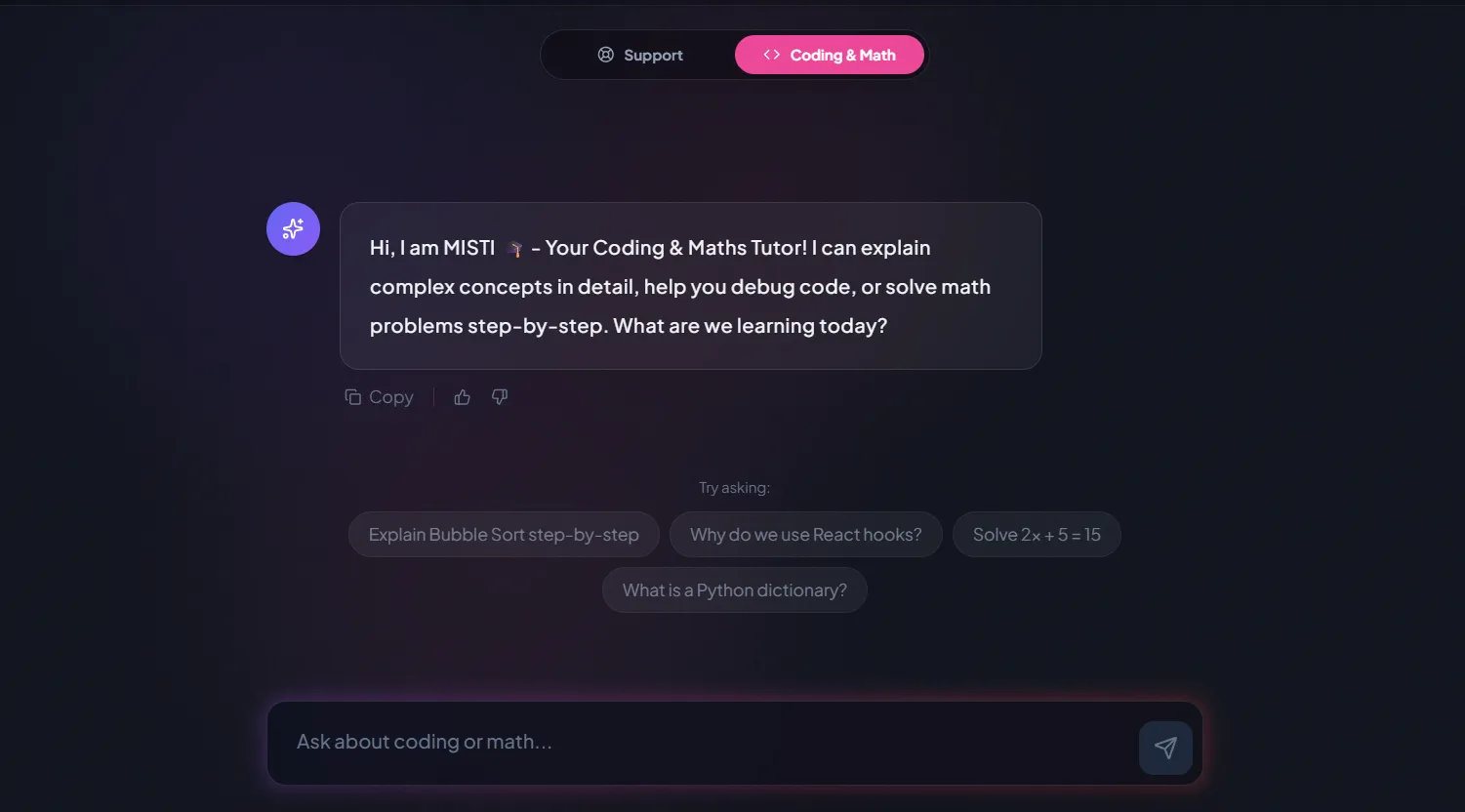
A chatbot that answers mathematics and programming questions, built and deployed by a student.

AI and ML
An assistant that helps a young person recognise unsafe situations online.

Web app
A weather forecasting site with live conditions for any location.
Fees
A single monthly figure, priced in US dollars outside India. The free lesson comes first and nothing is charged until a course and a slot are agreed.
Free first class
USD 0
no card required
Group batch
USD 100
a month, billed in US dollars
One to one
USD 150
a month, billed in US dollars
What families say
Lifted from Google word for word, by families who were never asked.
★★★★★
"The one step solution for my son. Modern Age Coders make learning coding so simple that kids love it. The teachers explain complex concepts clearly with practical exercises and interactive content."
Ria Mukherjee
Parent
★★★★★
"Modern Age Coders has been a game-changer for me. I struggled to grasp IT concepts and coding before joining, but their classes transformed everything. I can now confidently write complex programs with ease."
Samriddha Mondal
Student
★★★★★
"One of the most wonderful education centres out there. Education is not limited to school syllabus but focuses on skill development."
Vansh Agarwal
Student
★★★★★
"My child Dhairya is really enjoying the Modern Age Coders classes. This is his first online class and he eagerly looks forward to it. I can already see his improvement, and the teachers are very cooperative."
Sonam Oswal
Parent of Dhairya
★★★★★
"Modern Age Coders have wonderful teachers who teach in a clear, easy and practical way. The teacher boosts students' confidence and inspires them to learn without hesitation."
Sonu Goyal
Parent
★★★★★
"I highly recommend this computer coding class! The teachers are incredibly knowledgeable and passionate about coding."
Ritu Kedia
Parent
Questions about coding and problem solving
We are not going to claim it does. Ofsted's research review cites work advising caution about claims that computational thinking develops problem-solving skills transferrable to other domains, and says computing is worth learning in itself.
Because the subject is worth knowing, because it is assessed at every stage of UK education, and because the ability to build working things is useful on its own terms. None of that needs a transfer claim.
The review cites a definition of it as, in part, an approach to solving problems in a way that can be implemented with a computer, and lists six areas: logic, algorithms, patterns, abstraction, evaluation and automation.
By accumulating domain knowledge. The review cites the argument that problem-solving skill derives primarily from a large store of domain-specific knowledge in long-term memory, rather than from training a generic skill.
The review defines it as an abstracted mental model of how a program will be executed, or put simply, the knowledge of what a program will do when it is run. Pupils who lack one tend to develop misconceptions.
Because the prediction is a readout of the notional machine, and because the statutory curriculum in England asks pupils to use logical reasoning to predict the behaviour of simple programs.
No, but it is a beginning rather than a destination. The review cites research finding that block languages can encourage habits at odds with accepted computer science practice, including avoiding conditional execution and bounded loops.
Ask what a learner will know in twelve weeks that they do not know now. A sequenced course answers with a list of content. A course built on mindset answers with adjectives.
We teach to whichever qualification a learner is working towards, across the English boards, Scottish Nationals and Highers, WJEC and CCEA, and we use each system's own vocabulary.
The opening lesson is free. After that a group place is USD 100 a month and a teacher to yourself is USD 150, charged monthly with nothing taken up front.
Elsewhere on this site
Each page takes one strand of this somewhere specific.
The national page, and the index of every UK page we publish.
What the awarding bodies say about AI, and why declared work earns nothing.
The examined subset, and the work that sits above it.
What the computing curriculum requires and who has to follow it.
The method set out in full, including where it does not suit a learner.
The sequence of topics, published in order.
Start here
Send a number and we will reply at a British hour that suits you. The lesson is real teaching, and it ends by naming the stage the learner is actually on.
Prefer to read? Every course page publishes its syllabus in order, how we teach explains the method and its limits, and the coding roadmap lays out the whole sequence.
WhatsApp us · +91 91233 66161 · contact@modernagecoders.com
WhatsApp is the fastest route and costs nothing from a British mobile. The number belongs to our office in India, which we would rather state than have you work out.