Kuwait City · Live online · Ages 6 to 67

AI and machine learning classes in Kuwait City, where the student trains the model

Kuwait has no shortage of people who can talk to a chatbot. It has a shortage of people who can open a dataset, train something on it and say honestly how wrong the result is. Our students in Kuwait City, Salmiya, Hawally, Jabriya and Fahaheel learn the second thing, in Python, on data they can check against the country they live in. Live classes, the same teacher every week, timetabled to a Sunday to Thursday school week.

Teaching since 2020 · 10,000+ students across 25+ countries · no recordings sold as classes

In short

Modern Age Coders runs live online AI and machine learning classes for students in Kuwait City, ages 6 to 67, in small batches of five to eight or one to one. Students write Python, meet the mathematics sitting under every model, and leave having trained something and measured its error themselves. Classes are timetabled to Kuwait's Sunday to Thursday week. Fees are KD 12.312 a month for a group batch, which is USD 40, and the first class is free.

The catalogue

Twelve live courses, placed by what a learner can already do

Ability sets the entry point here, not age. The three bands below are different curricula, not one course at three speeds, and they end in different places. Each card leads to the complete schedule, with fees and timings attached.

I

Children, ages 6 to 12

First real code, and an honest account of what AI is

KWC / KIDS / 01

Python and AI for Kids

Real Python from the first week, not blocks dragged across a screen. Children write code, draw with turtle graphics, get small games working, then meet the idea that a machine can work out a rule from examples.

Open the syllabus

KWC / KIDS / 02

AI Literacy for Kids

Where an AI answer comes from, why a fluent answer can still be wrong, and how to check one against something real. At this age the habit of checking is worth more than any tool.

Open the syllabus

KWC / KIDS / 03

Vibe Coding for Kids

Children give an AI tool an instruction, then read what came back and repair what is broken. Asking is the easy half. Spotting the fault is the half we assess.

Open the syllabus
II

Teenagers, ages 13 to 18

From first syntax to a model whose error you can quote

KWC / TEEN / 01

AI and Machine Learning for Teens

The main route on this page. Python, the statistics and linear algebra the subject genuinely needs, classification and regression, neural networks, computer vision and language models, with a trained model at the end of every stage.

Open the syllabus

KWC / TEEN / 02

Data Science for Teens

Most of machine learning happens before the model. Loading awkward files, fixing encodings, joining tables that disagree, plotting until the shape of the data is obvious, and only then predicting.

Open the syllabus

KWC / TEEN / 03

Python for Teens

Two years from the first line to properly advanced Python: functions, objects, files, APIs and testing. The right start for a teenager with no code behind them who wants the AI track on firm ground.

Open the syllabus

KWC / TEEN / 04

Vibe Coding for Teens

Shipping real web and Python projects with an AI assistant alongside, and learning to review what the assistant wrote before it goes near a live link. Teens finish able to build fast and defend every line.

Open the syllabus
III

University students and working professionals

Depth, generative systems, and production

KWC / PRO / 01

AI and Machine Learning Masterclass

The full engineering route. Supervised and unsupervised learning, deep networks, training discipline, evaluation that holds up when someone questions it, and the deployment step most courses leave out.

Open the syllabus

KWC / PRO / 02

Generative AI: LLMs, RAG and Agents

How large language models are trained, fine tuned and grounded against your own documents, and how agents are constrained so they fail loudly instead of quietly. Relevant to any Kuwaiti organisation now building on cloud platforms.

Open the syllabus

KWC / PRO / 03

Python and AI Automation

For working professionals in Kuwait who want the applied half first. Machine learning and language processing pointed at the reports, spreadsheets and pipelines already sitting on your desk.

Open the syllabus

KWC / PRO / 04

Data Science Masterclass

The job shaped route. Statistics, SQL, feature engineering, modelling, and the harder skill of explaining a result to someone who will never read your code. It ends in a portfolio built for a hiring manager.

Open the syllabus

KWC / PRO / 05

Data Structures and Algorithms

The interview gate for every serious engineering role, and the reason a pipeline that works on ten thousand rows still works on ten million. Taught as problem solving, not memorised patterns.

Open the syllabus

KWC / ALL / 06

Browse the full catalogue

We also teach mathematics at every level, web and app building, game development, and preparation for the boards families here actually sit. All of it live, all of it on the Kuwaiti week.

Open all courses

What you actually build

Toz Watch, a dust storm early warning model for Kuwait International Airport

Every market we teach in gets a first project built on data from that country, because a model you can argue about with your own family is a model you remember. In Kuwait the subject is dust. The country sits at the head of the Gulf on the Mesopotamian dust corridor, and dust closes the airport: on 23 May 2022 flights at Kuwait International Airport were suspended and the Interior Ministry warned that visibility had fallen to around 100 metres. The question put to the student is simple and hard. Given the last three hours of weather, can you see the collapse coming?

Training rows, station OKKK, 23 May 2022, times in UTC
TimeTemp, FWind dirWind, ktVisibility, miCode
11:00114.8240123.73none
12:00104.0300180.06DS
13:00100.4030180.16DS
14:0098.6310210.25DS
15:0098.6310220.43DS
16:0095.0310230.50DS
17:0093.2310190.68BLDU
20:0087.8320150.81DU
23:0084.2330150.93DU

Those rows are not an illustration. They are real hourly observations from the Iowa Environmental Mesonet archive for station OKKK, which has recorded since 1 August 1945 and is still running. A pull for 2014 to 2023 returns roughly 87,600 hourly rows, and the label the student needs is already inside the file: the present weather column carries DS for duststorm, BLDU for blowing dust, DU for widespread dust and HZ for haze.

Read the twelfth hour. In sixty minutes the temperature falls 10.8 degrees F, from 46.0 to 40.0 degrees C, the wind veers from 240 to 300 degrees and rises from 12 to 18 knots, and visibility collapses from 3.73 miles to 0.06, which is 97 metres and matches the Interior Ministry warning that day. That is a gust front, and a gust front is learnable.

There is a second signature. On 16 May 2022 at the same station the dewpoint jumps from 39.2 to 50.0 degrees F in one hour as the outflow arrives, while visibility falls from 4.97 miles to 0.19. Two events, two different tells, one model that has to catch both.

pandasscikit-learn matplotliblogistic regression gradient boostingprecision and recall PR-AUCtime based split

The independent check: Kuwait Meteorological Center dusty days at Kuwait International Airport
YearDust stormBlowing dustDust hazeHaze
201484548236
201586876276
201625443256
201726247292
2018188697291
201946393295
2020260101315
202176672306
202248497317
202315358305
  1. Pull ten years of hourly weather, then fix the clock

    One CSV request to the Iowa Environmental Mesonet archive for station OKKK, 2014 to 2023, with temperature, dewpoint, wind direction, wind speed, visibility and present weather. Timestamps arrive in UTC. The student adds a Kuwait local column at UTC+3 and learns something immediately: the 12:00 UTC collapse was three in the afternoon in Kuwait, in daylight, mid working day.

  2. Clean the encodings before touching a model

    Missing values arrive as the letter M and traces as the letter T, not as blanks pandas understands. Worse, the 05:00 row on 23 May 2022 reads wind direction 0 and speed 0 while a dust code is active. Zero is the calm wind convention, not a bearing of due north, and feeding it in as north poisons the direction features for every calm hour in ten years. The student decides how calm and missing are handled, and writes the decision down.

  3. Build the label, then shift it forward

    The target is dust_next_3h, a binary flag: 1 if any observation in the following three hours carries DS, BLDU or DU and reports visibility below 1.0 statute mile, 0 otherwise. Building it forces the student to state exactly what they are predicting and when, and it reveals the shape of the problem, because 2022 had four dust storm days against 365.

  4. Reconcile against the Met Center, category by category

    Collapse the hourly labels to calendar days, count dust storm days, blowing dust days and dust haze days as three separate series, and compare each against its own column above. For 2018 the published counts are 18, 86 and 97, and for 2023 they are 1, 53 and 58. Expect agreement in magnitude rather than exact matches, because the observers use their own day classification and no visibility gate. A 2018 dust storm count of 15 or 21 means the parser is fine. A count of 3 means it is broken.

  5. Engineer features that mean something in Kuwait

    Visibility and its one hour and three hour change. Wind speed and its change. Wind direction as sine and cosine, plus a shamal flag for 290 to 360 degrees, so that 350 degrees and 10 degrees sit next to each other rather than at opposite ends of a number line. Temperature and its change, which is the gust front drop. Dewpoint depression and its change. Hour of day as sine and cosine, month, day of year, and rolling 24 hour maximum wind. Convert Fahrenheit to Celsius and knots to kilometres per hour.

  6. Split by time, and refuse the flattering metric

    Train on 2014 to 2021, validate on 2022, test on 2023. A random split drops hours from inside the 23 May storm into the training set and hands back a fake 0.99. Fit logistic regression as the baseline, then gradient boosting. Because dust hours are one to two per cent of all rows, score with precision, recall and PR-AUC and never with plain accuracy: a model that always answers no dust is 98 per cent accurate and useless. Tune the threshold on the 2022 validation year.

  7. Write the case study and defend a threshold

    How many hours of warning does the model give before the 12:00 UTC collapse on 23 May 2022, and what does it do on the quieter 16 May event? Then the trade off, in Kuwaiti terms. A false alarm puts a Jazeera Airways or Kuwait Airways flight into a hold it did not need and burns fuel. A missed alarm puts an aircraft into a go around in 100 metre visibility. The student picks a threshold, writes down why, and publishes the notebook at a link anyone can open.

The distinction

Two different educations are being sold under one name

We teach both, in that order, and we are straight with parents about which one holds its value. Prompting is tied to one product, and products get replaced. Model building rests on mathematics, and mathematics is not deprecated.

Using AI tools

  • Write a prompt, read the answer, change the wording, try again
  • Memorise the controls of this year's popular product
  • Success means an answer that looks plausible
  • Transfers badly when the tool, the pricing or the regional access changes
  • Worth about six weeks of anyone's time
  • Taught here in weeks, properly, including how to spot a confident error

Building AI

  • Gather and clean data, then justify every decision taken over it
  • Pick a model and understand the assumption it makes on your behalf
  • Train it, then measure the error in units a non specialist can check
  • Work out whether the fault lies in the data, the features or the model
  • Deploy it and watch it decay against inputs nobody predicted
  • Stands on statistics, linear algebra and code, none of it perishable

In Kuwait this distinction has a concrete edge, because the country's biggest bank and biggest telecom operator are jointly paying to teach the second column. KFAS launched TechEdge on 19 February 2025 in strategic partnership with the National University of Singapore, NBK and Zain, covering artificial intelligence, data science, cybersecurity, financial technology, data analytics, digital payments, digital innovation, ethics in technology, and scripting and programming, with Emad Al-Ablani of NBK and Nawal Bourisli of Zain Kuwait named as sponsors. NBK separately runs the NBK Tech Academy. When employers fund a curriculum themselves, they are telling you what they intend to hire.

Why now, in Kuwait

A draft national strategy, real money, and a grid that sets the limit

The Kuwait National AI Strategy 2025 to 2028 was published as a draft in January 2025. It names five pillars: establishing Kuwait as an AI hub, AI driven sectoral transformation, AI governance with privacy and security, empowering the workforce, and building a strong AI ecosystem. The phasing is explicit. Year one, 2025, sets up an AI Centre of Excellence, targeted pilots and a KPI framework. Years two and three scale the pilots that worked and upskill the workforce. By 2028 the aim is broad integration plus indigenous AI capability. It is anchored to Kuwait Vision 2035, whose development roadmap was revamped in August 2025 specifically to accelerate AI.

On the regulatory side, CITRA announced on 8 February 2025 that Kuwait had adopted a practical, action oriented approach to AI governance and digital information integrity. Its Cloud First Policy has been in force since 2021 and requires government agencies to prefer cloud based products over traditional IT, with sensitive data stored inside Kuwait's national boundaries.

The money is not theoretical. The Kuwait Investment Authority has allocated USD 9 billion to digital services and AI over the past five years, and in June 2026 joined the USD 30 billion AI Infrastructure Partnership led by BlackRock, Microsoft and MGX. Kuwait Oil Company allocated USD 800 million in 2025 for a five year digital transformation. A government collaboration with Microsoft Azure launched in March 2026, Google Cloud opened a Kuwait office around 2025, and Ooredoo Kuwait announced an Nvidia GPU upgrade to its data centre in November 2025.

Now the honest part, and it is the thread that ties this market together. As of February 2026 Kuwait had five data centres. The UAE had 57, Saudi Arabia 51, Oman 15, Qatar 11 and Bahrain 8. Kuwait has no live hyperscale cloud region, training datasets are limited, there is no unified AI liability law and licensing is slow. The constraint named explicitly is physical: seasonal electricity grid instability is limiting data centre development.

That constraint has a number on it. The Ministry of Electricity, Water and Renewable Energy reported a summer 2025 peak load of 17,610 MW, 30 MW below the 2024 record, reached despite temperatures of 51 degrees C and against planning studies that had forecast a 4 per cent rise. Earlier peaks were 16,940 MW on 2 August 2023 and 16,180 MW in 2022. Build out is under way, with Shagaya Renewable Energy Park Phase 1 at 1,100 MW launched in June 2025, Phase 2 at 500 MW approved, Phases 3 and 4 at 3,000 MW combined, Al Zour North adding 2,700 MW and a Nuwaiseeb target of 7,200 MW, against a ministry target of a further 14,050 MW and 228 million imperial gallons of fresh water a day by 2031.

Read those two paragraphs together and the conclusion is uncomfortable but useful. Kuwait's AI ambition is capped by the same summer load that peaked at 17,610 MW, and no amount of imported software fixes that. What it needs is load forecasting, demand side machine learning and operational models built by people who understand the system they are modelling. Those are building jobs. A student who is twelve today will be twenty two when the 2031 capacity targets fall due, which is the whole reason this page exists and the reason we will not sell a prompt engineering course as an AI education.

5

Data centres in Kuwait as of February 2026, against 57 in the UAE and 51 in Saudi Arabia

17,610 MW

Summer 2025 peak electricity load, 30 MW below the 2024 record

USD 9bn

Kuwait Investment Authority allocation to digital services and AI over five years

520,271

Students in Kuwait's school system, across 1,141 public and private schools

School and university

How this lines up with the school your child attends

The system, and the boards inside it

The Ministry of Education presented its 2025-2026 strategic plan on 11 September 2025. It counts 520,271 students, 422,744 of them in public schools and 97,527 in private schools, across 1,141 schools, 950 public and 191 private, with 131,969 teaching and administrative staff. Ten new schools opened, seven in Al Mutlaa, one in Ishbiliya and two specialised, staffed with 800 teachers and 183 administrators, and 687 principals and assistant principals were appointed. Acting Undersecretary Eng. Mohammad Al-Khaldi and Assistant Undersecretary for Educational Affairs Eng. Hamad Al-Hamad are named on it.

Inside that system a Kuwait City family can be sitting any of six routes: the Ministry of Education national certificate, Shahadat Al-Thanawiya Al-Amma; CBSE; Cambridge and Pearson Edexcel IGCSE and A Level; the United States high school diploma with AP; and the International Baccalaureate. We teach across all of them, which matters here because the exam months do not line up with each other.

The Indian and CBSE schools

This is the largest single demand pool in the country. Indians are Kuwait's largest expatriate community at roughly 1.06 million people, about 20 per cent of the population according to PACI figures for the end of June 2026, and at least 20 CBSE affiliated schools operate in Kuwait. The Indian Community School Kuwait, established in 1959 and now running four branches, entered 535 candidates for the 2025-26 CBSE Class XII exams, reported as the largest batch in Kuwait, of whom 99.25 per cent scored above 70 per cent and 186 scored above 90 per cent. The New Indian School, Carmel School founded in 1969, United Indian School, Jabriya Indian School, Gulf Indian School, Integrated Indian School which opened in April 2004, and Bhavans Kuwait sit alongside it.

British, American and IB schools

The British School of Kuwait expanded its Upper School in 2025 to more than 715 pupils, and Kuwait English School and Kuwait National English School run the same curriculum. Among IB World Schools teaching in English, the American International School Kuwait is authorised for the Primary Years, Middle Years and Diploma Programmes, American Creativity Academy runs the Diploma Programme, Kuwait Bilingual School runs the Primary and Middle Years Programmes, and Reborn Kids Education Academy is also authorised. The American School of Kuwait runs the United States diploma track.

What the Ministry has already put in the classroom

On 11 February 2025 the Ministry of Education announced that artificial intelligence had been added to part two of the Grade 10 computer development textbook, announced by Mona Salem Awad, General Technical Supervisor of Computers. The 2025-2026 strategic plan then extended AI across the computer science curriculum for grades 10 and 11, alongside 88 revised textbooks and the Ma'a Hamad Chat AI tool for students, teachers and parents. A textbook chapter can say what a neural network is. It cannot give a student the experience of watching their own model be wrong and working out why.

Kuwait University and the degree route

Kuwait University launched its first specialised Data Science and Artificial Intelligence programme, in the College of Life Sciences, from the 2025-2026 academic year. It was announced by Dr Nawaf Al-Hajri, Acting Dean of the College of Life Sciences, framed around big data and AI and aligned to New Kuwait 2035. It is genuinely new, so the first cohorts started in 2025-26 and there is no long track record to lean on yet.

The admissions mechanics are worth reading before your child chooses subjects. Kuwait University admits on an equivalent grade point average that combines the secondary school percentage with an academic aptitude test result, used across most colleges. The College of Science and the College of Law are the exceptions, where the high school GPA alone decides eligibility. The published minimum high school GPA is 70 per cent for the Science track and 78 per cent for the Arts track, and the College of Engineering and Petroleum requires the aptitude test. The university's Computer Engineering department was established in 1985, is ABET accredited, and reports 16 laboratories and 44 faculty.

Elsewhere, the Gulf University for Science and Technology runs Computer Science and Computer Engineering degrees whose stated coverage includes artificial intelligence, algorithms, data structures and database management, and the American University of Kuwait offers a Bachelor of Engineering in Computer Engineering with a dedicated artificial intelligence track. The Australian University of Kuwait, Kuwait College of Science and Technology, Arab Open University Kuwait, PAAET and American International University Kuwait complete the usual application set.

So a student sitting the new AI unit in Grade 10 or 11 is roughly two years from an admissions system that scores them on a secondary percentage plus an aptitude test, applying to a degree that has no graduating cohorts behind it yet. What makes an application legible in that situation is not a certificate. It is a project an admissions reader can open, run and question.
How the classes run

Built on the Kuwaiti week first, and the clock second

Kuwait City runs on Arabia Standard Time, UTC+3, with no daylight saving at any point in the year, exactly 2 hours 30 minutes behind Indian Standard Time where our teaching operation sits. The gap never shifts, so a timetable set once holds all year. The harder fact is not the clock but the week. Kuwait's school and working week runs Sunday to Thursday and the weekend is Friday and Saturday, so an Indian roster built around a Saturday and Sunday weekend collides with Kuwait twice over: Sunday is a school day here, and Friday is not.

Sun to Thu, 17:00 to 18:30

Kuwait time, 19:30 to 21:00 IST. The standard after school weekday slot. The private school day is capped at seven hours and most stages run six, so children are home well before this.

Sun to Thu, 19:00 to 20:30

Kuwait time, 21:30 to 23:00 IST. The later option for teenagers with tuition or sport earlier in the evening. It is a late finish for the instructor in India, so places are limited.

Fri or Sat, 10:00 to 11:30

Kuwait time, 12:30 to 14:00 IST. The strongest of the three and the anchor of our Kuwait timetable. It falls on the real weekend, and it survives Ramadan intact.

What a session is

Ninety minutes on live video with a teacher who can say, without checking notes, what your child struggled with last week. Screens are shared both ways, so the teacher watches the code being written and stops the student at the moment the mistake happens rather than marking it three days later. Batches are five to eight students, or one to one.

Homework here is a build rather than an exercise sheet. Make something, break it, return with questions. Questions during the week go to the same teacher rather than to a support queue, and nothing on this page is pre-recorded.

The Kuwaiti school year

Kuwait has no unified national school calendar, and that is the most important scheduling fact on this page. The Ministry of Education sets the public schools and every private curriculum sets its own start date. For 2026-27, Kuwait English School returns on Sunday 30 August 2026, CBSE Indian schools go back in the second half of August 2026 with some staggering by grade, IGCSE schools are expected in early September and American curriculum schools in the first half of September. Exam months are equally scattered: CBSE runs February to March, IGCSE and A Level in May and June with a second series in October and November, and AP and IB Diploma in May.

The fixed points in the civil year are Kuwait National Day on Thursday 25 February 2027, commemorating Sheikh Abdullah Al-Salem Al-Sabah's accession in 1950, and Liberation Day on Friday 26 February 2027, marking liberation from Iraqi occupation in 1991. They run back to back. Ramadan 1448 is expected to begin on Monday 8 February 2027, subject to the crescent sighting the previous evening, and the Ministry has proposed suspending classes for the last ten days. Eid al-Fitr is expected around Tuesday 9 March 2027 and Eid al-Adha around Sunday 16 May 2027. Those Islamic dates are confirmed locally by moon sighting, so we finalise the timetable when the sighting is announced.

June to August is when Kuwait empties. We plan for that rather than pretend otherwise, and summer students are moved into whichever batch suits the time zone they are travelling in.

Student work

What students here have put on the internet

Not one of these is a mockup or a screenshot. Each runs at a public address, written by a student, and left up for anyone to inspect. Explore more in Student Labs.

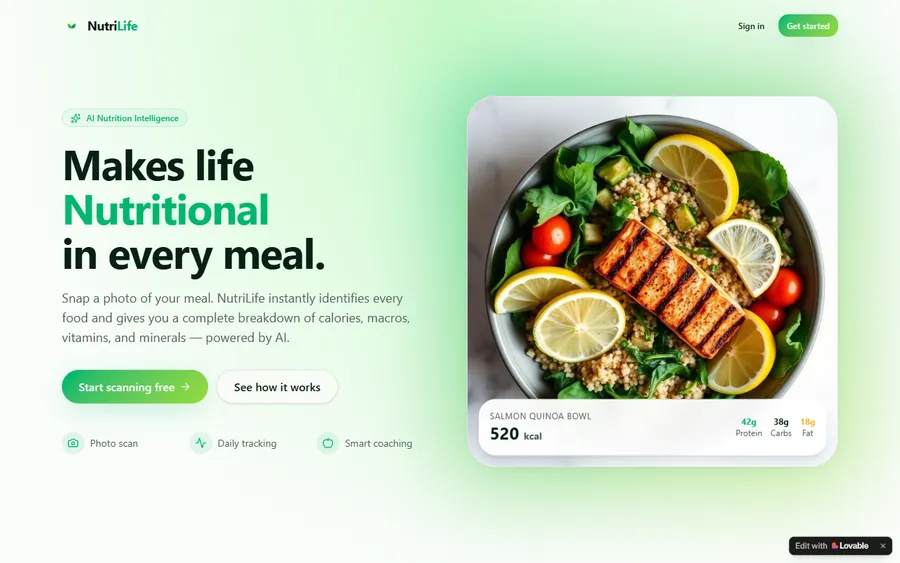
NutriLife AI nutrition coach project screenshot

AI and ML

NutriLife, an AI nutrition coach

A nutrition assistant that reads what you eat and coaches you toward a target, built end to end by a student.

by Bhavya · Open the live project

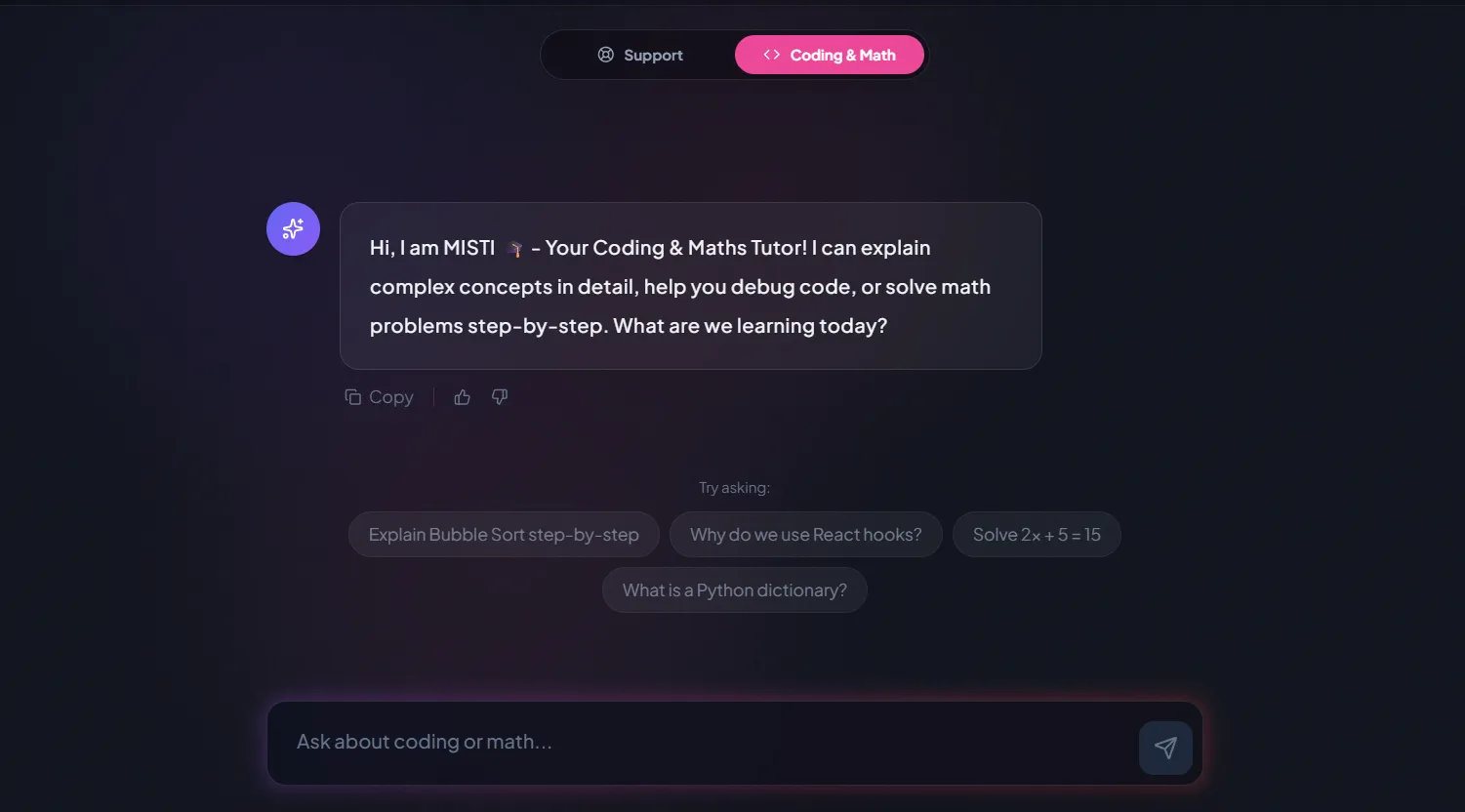
Misti AI chatbot for maths and coding screenshot

AI and ML

Misti, an AI chatbot for maths and coding

A tutoring chatbot that answers maths and programming questions, written and deployed by a student.

by Harshit · Open the live project

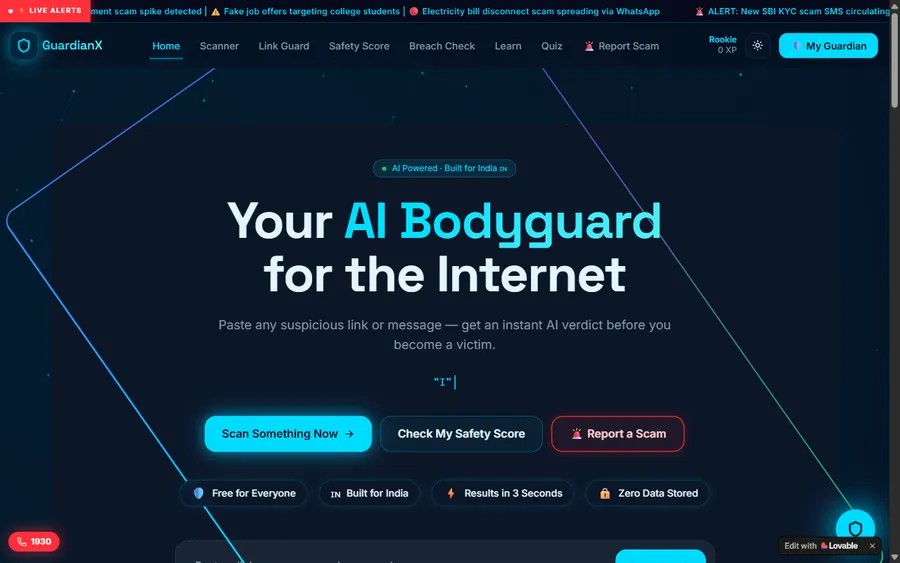
GuardianX AI internet safety assistant screenshot

AI and ML

GuardianX, an AI safety assistant

An assistant that helps a young person spot unsafe situations online, designed and shipped by a student.

by Vivaan · Open the live project

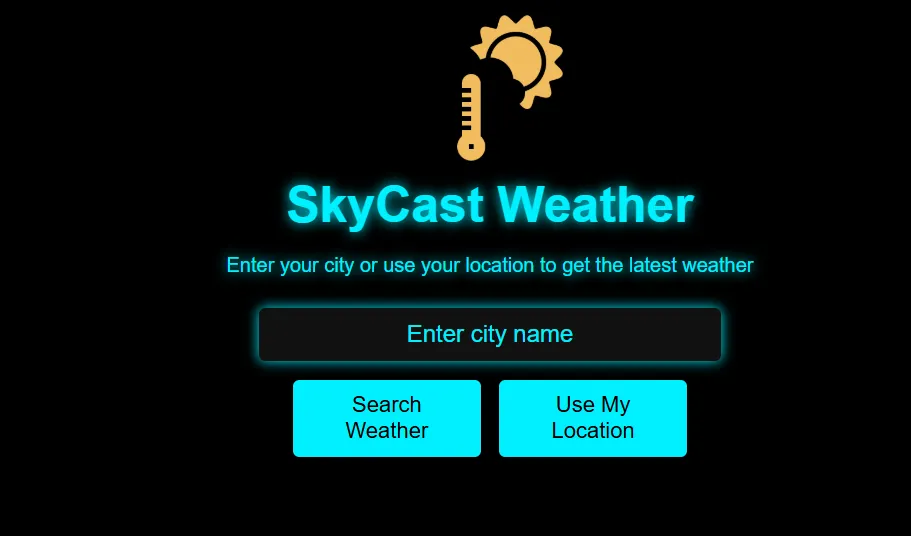
SkyCast weather forecast app screenshot

Web and data

SkyCast, a weather forecast app

A working forecast application that pulls live weather data and renders it, the nearest cousin to the dust project above.

by Krish · Open the live project

Fees

What it costs a family in Kuwait City

Prices are quoted in dinars first, because that is the currency you pay in. The dinar divides into 1,000 fils, so KD 12.312 reads as twelve dinars and 312 fils. The figures below use the Central Bank of Kuwait official rate of USD 1 to KD 0.3078, published on 23 July 2026. The dinar is pegged to an undisclosed weighted basket of currencies under Decree No. 147/2007, in force since 20 May 2007, and not to the US dollar, so a dollar price drifts slightly against the dinar over time and we confirm the dinar figure at enrolment. Billing is month to month. Nothing is charged to join, and nothing ties you to a year.

Free first class

KD 0.000

USD 0, no card needed

  • A real class, not a sales call
  • Doubles as a placement check so the teacher pitches the level correctly
  • You watch, and decide afterwards
Book it

Group batch

KD 12.312

USD 40 a month

  • Five to eight students, same teacher every week
  • Live video, never a recording
  • Weekly build tasks and teacher review
  • Certificate on completion
Start here

One to one

KD 30.780

USD 100 a month

  • Private teaching, your pace and your schedule
  • Best for board exam years and for adults with limited evenings
  • Syllabus adapted to your goal
Enquire

What families say

Rated 4.9 across 547 Google reviews

These are real reviews left by real families. We do not write testimonials and we do not commission them.

★★★★★

"The one step solution for my son. Modern Age Coders make learning coding so simple that kids love it. The teachers explain complex concepts clearly with practical exercises and interactive content."

Ria Mukherjee

Parent

★★★★★

"Modern Age Coders has been a game-changer for me. I struggled to grasp IT concepts and coding before joining, but their classes transformed everything. I can now confidently write complex programs with ease."

Samriddha Mondal

Student

★★★★★

"One of the most wonderful education centres out there. Education is not limited to school syllabus but focuses on skill development."

Vansh Agarwal

Student

★★★★★

"My child Dhairya is really enjoying the Modern Age Coders classes. This is his first online class and he eagerly looks forward to it. I can already see his improvement, and the teachers are very cooperative."

Sonam Oswal

Parent of Dhairya

★★★★★

"Modern Age Coders have wonderful teachers who teach in a clear, easy and practical way. The teacher boosts students' confidence and inspires them to learn without hesitation."

Sonu Goyal

Parent

★★★★★

"Coding classes here make learning very interesting and conceptual. The teachers teach us in a very easy-to-understand and efficient way."

Arush Poddar

Student

Questions from Kuwait

What families in Kuwait City ask us first

Our children are at school Sunday to Thursday and our weekend is Friday and Saturday. Do your class times actually fit the Kuwaiti week?

Yes. The timetable is built on a Sunday to Thursday week with Friday and Saturday as the weekend, which is how Kuwait runs. Weekday batches start at 5:00 pm or 7:00 pm Kuwait time, after a school day that is capped at seven hours for private school staff and runs six hours for most stages. We also offer a Friday or Saturday 10:00 am slot, because that is when families are free and children are fresh rather than tired from school. It is an option, never a requirement.

Your teachers are in India. What time does a class actually start for us in Kuwait City, and does that change during the year?

Kuwait City runs on Arabia Standard Time, UTC+3, with no daylight saving at any point in the year, so the gap to Indian Standard Time is a fixed 2 hours 30 minutes and it never moves. A 6:00 pm class in Kuwait City is 8:30 pm for the teacher in India, and a 10:00 am Kuwait class is 12:30 pm in India. Because neither country changes its clocks, a timetable agreed in September still holds in March. The only planned adjustments are around Ramadan and the February national holidays, agreed with the batch in advance.

What is the fee in Kuwaiti dinars, and can we pay from a Kuwaiti bank card rather than being quoted in dollars?

A group batch is KD 12.312 a month, twelve dinars and 312 fils, which is USD 40. One to one teaching is KD 30.780, thirty dinars and 780 fils, which is USD 100. Those figures use the Central Bank of Kuwait official rate of USD 1 to KD 0.3078, published on 23 July 2026. The dinar is not pegged to the dollar. Since 20 May 2007, under Decree No. 147/2007, it has been pegged to an undisclosed weighted basket of currencies, so a dollar price drifts slightly against the dinar rather than being fixed, and we confirm the dinar figure at enrolment. We take payment from cards issued by Kuwaiti banks including NBK, Kuwait Finance House and Boubyan.

My child is in Grade 10 at a Kuwait Ministry of Education school and AI has just been added to the computer development textbook. Does your course support that unit?

Yes. The Ministry of Education added artificial intelligence to part two of the Grade 10 computer development textbook, announced on 11 February 2025 by Mona Salem Awad, General Technical Supervisor of Computers, and the 2025-2026 strategic plan extended AI across the computer science curriculum for grades 10 and 11. Our teens track covers the same ideas and then keeps going: what a model is, how it is trained on data, how its error is measured, and what it cannot do. A student who has trained a classifier of their own reads that textbook chapter very differently.

We are at ICSK, Carmel, BSK or the American International School. CBSE boards fall in February and March, IGCSE in May and June, and AP and IB in May. How do you handle the exam term?

We plan each student's year around the board they actually sit, because the calendars in Kuwait do not agree with each other. CBSE board exams run February to March. Cambridge and Pearson Edexcel IGCSE and A Level run in May and June, with a second series in October and November. AP and IB Diploma exams fall in May. In the weeks before a student's own exam window we cut back to one session, stop introducing new material and turn the time into revision, or pause the batch and resume afterwards.

My child is 11. Several AI tools carry a 13 plus or 18 plus age floor in their terms. Which tools will you actually let a child that age use?

We read the terms of service for every tool we put in front of a class, and where the terms set an age floor above the child's age, the child does not get an account. That rule is not negotiable. What replaces the tool is more teaching, not less: the child writes Python on their own machine, works with datasets locally, and sees any age restricted service only as a demonstration driven by the teacher on the teacher's account. At 6 to 12 the thing worth learning is how a machine works out a rule from examples, and that is taught in code.

Ramadan is expected to start around 8 February 2027 and the Ministry has proposed suspending classes for the last ten days. Do your classes pause, shift or carry on through the National Day and Liberation Day holidays?

We shift rather than push through. Ramadan 1448 is expected to begin on Monday 8 February 2027, subject to the crescent sighting after sunset on Sunday 7 February, running to about 8 March, with Eid al-Fitr around Tuesday 9 March. The Ministry of Education has proposed suspending classes for the last ten days. Through that month we move weekday evening batches clear of iftar and lean on the Friday and Saturday morning slot, which survives the month intact. Kuwait National Day on Thursday 25 February 2027 and Liberation Day on Friday 26 February 2027 are holidays for us too. Islamic dates are confirmed locally by moon sighting, so the timetable is finalised once the sighting is announced.

We leave Kuwait every July and August because of the heat. Can our child keep attending from India, the UK or wherever we are travelling?

Yes, and much of our July and August teaching is already built for travelling families. The class is live video and it belongs to a person rather than a place, so a student joins from Kochi, London, Istanbul or anywhere with a connection. What changes is the clock, not the course. Tell us the destination before you leave and we move the student into whichever batch lands at a sensible local hour there, then move them back in September. Kuwait summers reached 51 degrees C in 2025, so we expect the July and August exodus and plan around it.

Start here

Book the free first class

Leave a number and a mentor calls you back, usually within a few hours, at an hour that suits Kuwait. The opening session is genuine teaching, and it fixes your child's starting band before any commitment.

Prefer to look around first? Read how we teach, browse the full course catalogue, or see what students have built in Student Labs.

No card. No obligation. We call, we do not spam.