Skip to content
Idaho, United States

Coding and AI classes in Idaho

What is the new Idaho Digital Literacy graduation credit?

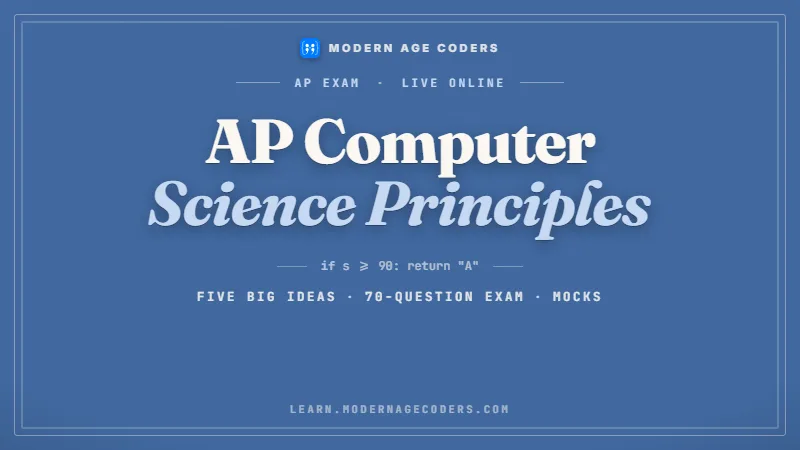
It is a one-credit, stand-alone high school course, set in IDAPA 08.02.03.105.01.j and required for any Idaho student graduating after January 1, 2028. Only eight approved course options count, one of them AP Computer Science Principles. Modern Age Coders teaches the programming, AI and data skills behind it in live online classes for grades K to 12.

For years an Idaho diploma asked for math, science, English and social studies, and computer skills were left to whichever electives a district happened to offer. The 2025 legislative session changed that. Idaho now lists one credit of Digital Literacy among the state minimums, and the Idaho Department of Education has published exactly what that credit must contain: writing a program with input and output, designing algorithms with selection and iteration, weighing the effects of artificial intelligence, and managing a digital identity. This page sets out the rule as the department words it, the standards behind it, the published figures on how many Idaho high schools teach computer science, and a data project built on Boise’s own park inventory, where the average park turns out to be nothing like the typical one.

Facts last verified 18 October 2026. Teaching is online; no Idaho branch is claimed.

Courses for Idaho students

Four courses that line up with what Idaho now asks for

Each course runs as a group batch or one-to-one. A free trial lesson decides the level before anyone commits to anything.
Browse the course atlas for more than one hundred options and use the coding roadmap to check prerequisites.

The four we are known for

Python, AI, vibe coding and agentic coding

These run underneath everything above. Every one is live and online, placed by ability rather than by age, and the first class is free.

The new diploma credit

Idaho’s Digital Literacy credit, as the Department of Education defines it

From the department’s Digital Literacy Course Guidance Document, updated February 20, 2026, and its graduation requirements page, both read on 18 October 2026.

The Digital Literacy requirement in IDAPA 08.02.03.105.01.j, summarized from the Idaho Department of Education
QuestionWhat the department says
Where the rule livesChanges to IDAPA 08.02.03.105 were accepted by the legislature during the 2025 legislative session; the credit itself is IDAPA 08.02.03.105.01.j
Who must take itThe requirement pertains to all students in grades 9 through 12 and is required for any student graduating after January 1, 2028
Size and shapeA one-credit, stand-alone course; it cannot be delivered over a series of courses or pathways
Which courses countOnly eight stand-alone course options, from Digital Literacy (ISEE Code 10011) to Introduction to Cybersecurity and Digital Citizenship and AP Computer Science Principles
PrerequisitesNone are allowed, including when AP Computer Science Principles is the course used
On the transcriptTaken for high school credit, transcribed, and assigned the matching ISEE code

The AP route

ISEE Code 10019, AP Computer Science Principles, can meet the credit only when taken for the full year. One semester or trimester is coded 10011 for Digital Literacy and the other counts as AP credit.

Many course designs

The guidance allows titles such as Computer Science Digital Literacy, Website Design Digital Literacy or Building Gaming Apps Digital Literacy, as long as each one teaches every essential standard.

Free online versions

For districts without a course of their own, the department and the Idaho STEM Action Center point to free courses on Code.org and CodeHS and a course run by the Idaho Digital Learning Alliance (IDLA).

Where Digital Literacy sits in the Idaho state minimums (Idaho Department of Education, High School Graduation Requirements)
AreaState minimum
TotalA minimum of 46 high school credits, which include 30 credits in core subjects
Mathematics and scienceSix credits of each
Language Arts and CommunicationsNine credits
Social StudiesFive credits
Fine Arts and World LanguagesTwo credits
Health and WellnessOne credit
Digital LiteracyOne credit
Beyond creditsA Future Readiness project and a Civics Exam

The department adds that local districts may set graduation requirements above the state minimum, and that districts must offer at least one advanced opportunity such as concurrent credit, Advanced Placement or tech prep. Students who want a heavier technical record can also look at the STEM Diploma under Idaho Statute 33-532. Your school counselor has the final word on how any of this applies to one student.

What the course must teach

The essential standards, and how a live class practises each one

The guidance lists the standards that are to be explicitly taught and assessed more than once. Here are six of them, quoted by code, with our own note on where they appear in our classes.

9-12.CS.1.4Create or modify a program that uses different forms of input and output.
Ours: the first Python unit reads keyboard input and a CSV file, then writes results back to the screen and to a new file.
9-12.CS.5.2Design algorithms using sequence, selection, iteration and recursion (recursion is left to an upper course).
Ours: students plan an algorithm on paper before typing it, then trace it line by line with a teacher.
9-12.CS.3.8Research and explain the social, moral, ethical, and legal impacts of artificial intelligence systems.
Ours: every AI unit ends with a short written case: who a model serves, who it misreads, and who is accountable.
9-12.CS.2.6Compare viewpoints on cybersecurity from security experts, privacy advocates and the government.
Ours: the teen cybersecurity course runs a structured debate on one real policy question per term.
9-12.ICT.2.1Develop and manage a digital identity and understand the permanence of digital actions.
Ours: younger students audit a pretend profile; teens review what their own public projects say about them.
9-12.CS.1.6Create a model of how embedded systems sense, process, and interact in a given environment.
Ours: a simulated thermostat or traffic light in code, before any hardware is involved.

The wider 9-12 standards

Idaho’s 9-12 Computer Science Standards document is marked as created on May 1, 2024, and is organized in five strands: Computing Systems, Data and Analysis, Impacts of Computing, Networks and the Internet, and Algorithms and Programming.

AI written into the standards

Standard 9-12.CS.3.7 reads, in full, “Understand and define artificial intelligence.” The department’s computer science page goes further: “AI is not a separate discipline.” It treats AI as an extension of computer science.

Number systems too

Standard 9-12.CS.2.8 asks students to convert between binary, decimal, octal and hexadecimal. It is a short, concrete skill and a good early win in our high school classes.

Below high school, the department lists free classroom programs rather than a required course: CodeHop by CodeHS and Launch Pad by Skill Struck for kindergarten to fifth grade, both described as aligned with Idaho’s K-5 Computer Science Standards, and Learning Blade, a 20-hour introduction for grades 5 to 9 that ends with students programming robots. We are not connected with any of these providers or with the department.

Signature project

How big is a typical Boise park? Mean and median from the city’s own files

The City of Boise publishes the parks and reserves it manages as an open feature service. Students download the Acreage column and discover that one word, average, can describe two very different parks.

Boise managed parks and reserves, Acreage field (our calculations from the city’s polygon layer, 116 records, downloaded 17 October 2026)
MeasureOur result
Records (the service’s own count matched our download)116
Mean acreage64.45 acres
Median acreage7.76 acres
Records larger than the mean16 of 116
Largest single recordStack Rock Reserve, 2,172.96 acres
Mean and median with Stack Rock Reserve removed46.12 and 7.67 acres

1. Two answers to one question

The mean says a Boise park covers about 64 acres. The median says under 8. Only 16 of the 116 records are bigger than the mean, so the mean describes almost no real park.

2. Find what pulls the mean

Sorting by acreage shows the foothills reserves at the top: Stack Rock Reserve, Military Reserve, Noble Reserve. Removing the single biggest one drops the mean by about 18 acres and barely moves the median.

3. Split, then summarize

Grouped by Park_Type, the 22 Open Space records have a mean of 274.30 and a median of 69.09, while the 38 Neighborhood parks sit at 6.64 and 7.15. Inside a group the two measures finally agree.

These are our numbers, not the city’s

Every figure above is our own arithmetic on one download of the Acreage field. The City of Boise says it makes no warranty about the data and that it changes over time, and a mapped polygon area is not the same thing as an official park size. Saying what a statistic measures, and what it leaves out, is the skill this project is really about.

The project fits the Data and Analysis strand of the Idaho standards and takes about three sessions: one to fetch and inspect the data, one to compute and compare the two measures with plain Python before checking against the statistics module, and one to write a short paragraph explaining which number a parks brochure should print and why.

Published figures

How many Idaho high schools teach computer science today

Two outside sources measure Idaho from different angles: Code.org counts high schools that teach the subject, and the College Board counts schools giving AP exams. We read both on 17 October 2026.

Idaho public high schools offering foundational computer science (Code.org, 2025, Access Percent over the Years and Most Recent Access Data)
School yearShare offering CS
2019 to 202038%
2020 to 202140%
2021 to 202238%
2022 to 202338%
2023 to 202445.8%
2024 to 202544.0%, which is 117 of 266 high schools (state education agency data)
Students and AP in Idaho
MeasureIdahoWhere it comes from
High school students enrolled in CS1,751 of 99,336, or 1.76%Code.org (2025), Most Recent Participation Data; the share matches its 2024 to 2025 value, and the student total is the NCES Fall 2022 count
Idaho schools giving any AP exam in 2023105College Board state-by-state AP school report for 2023-24
The same count one year later, 2024104Same College Board report

Read together, the figures show why the new credit matters. Fewer than half of Idaho’s high schools offered a foundational computer science course in 2024 to 2025, and fewer than two in every hundred high school students were enrolled in one. A required Digital Literacy course will put every student in front of programming and AI concepts at least once; students who want to go further than one credit will usually need a second route, whether an elective, AP or classes outside school.

Cite the high school and enrollment figures as Code.org (2025). 2025 State of AI + CS Education. Only single Idaho values are quoted here; the full sheet stays with Code.org.

Class times

One state, two clocks: Mountain in the south, Pacific in the panhandle

Idaho is split between two time zones, and the IANA time zone database names exactly where the line falls.

Southern Idaho

Boise, Idaho Falls and the rest of the south use America/Boise, listed in the database as Mountain time for southern Idaho and eastern Oregon. By our arithmetic India is 11 hours 30 minutes ahead in summer and 12 hours 30 minutes ahead in winter.

The northern counties

Benewah, Bonner, Boundary, Clearwater, Kootenai, Latah, Lewis, Nez Perce and Shoshone counties, and Idaho County north of the Salmon River, follow US Pacific time with America/Los_Angeles, one hour behind Boise.

Choosing a time

Weekdays or weekends, flexible: choose your batch, or for a very personalised plan choose 1-on-1 at your convenience, weekend mornings or weekdays. We always confirm a class in your own zone, Mountain or Pacific.

A bug worth finding on purpose

A reminder app that assumes all of Idaho shares one clock will be an hour wrong in Coeur d’Alene. Students who store America/Boise and America/Los_Angeles as named zones, rather than fixed offsets, see the problem vanish, including across the clock change on November 1, 2026.

A path through school

From early puzzles to the Digital Literacy credit and AP

Grade bands are a starting guess; the trial lesson places each student properly.

Grades K to 5

Thinking in steps

Puzzles, patterns and block code, close to what the K-5 programs on the department’s list cover.

Problem Solving and Computational Thinking for KidsScratch Coding for Kids
Grades 5 to 8

Typed code and AI basics

First Python and a clear picture of what AI tools do, the age band Learning Blade aims at.

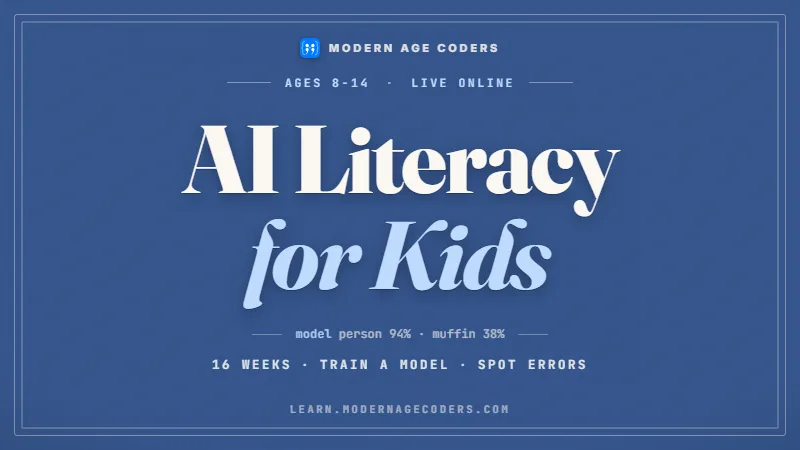
Python and AI for KidsAI Literacy for Kids (Ages 8 to 14)
Grades 9 to 10

The credit year

Input and output, algorithms, cybersecurity viewpoints and digital identity, alongside the school course.

Python for TeensCybersecurity for Teens
Grades 11 to 12

AP and data

AP Computer Science Principles, then data science projects like the Boise acreage study.

AP Computer Science PrinciplesData Science for Teens
Coding and AI

Idaho calls AI part of computer science. Here is why that is right

A tool can produce an answer; judging the answer still takes someone who understands how it was made.

Ask an AI assistant for the average size of a Boise park and it may well hand back 64 acres, correctly computed and quite misleading. The arithmetic is not the hard part. Knowing that a few huge foothills reserves drag the mean upward, and that a median would serve a reader better, is.

That is why the department’s view that AI is an extension of computer science, rather than a separate subject, makes sense for students. Writing the calculation by hand once teaches what to check when a model does it next time, and it turns standard 9-12.CS.3.8 from a discussion topic into a habit.

A Digital Literacy credit gives every Idaho student the vocabulary; practice with real data gives them the judgment. The longer argument is in why learning to code still matters when a model can write it.

How classes run

Coeur d’Alene to Pocatello, the same live classroom

Idaho is big and rural in places; a class on a screen does not care how far the nearest town is.

At the kitchen table

Students in Sandpoint, Twin Falls and Meridian can sit in the same session without anyone driving to a center after school.

Built around Idaho school

Teachers plan in US grades and the Idaho calendar, and can tie projects to the Digital Literacy course or AP. Anything a school grades is done by the student alone.

A trial lesson first

A teacher sets a real task, watches how the student approaches it, then suggests a course and a level. No card details are taken.

Group batches

Fifteen to twenty students working at the same level, drawn from across the United States.

One-to-one

A single teacher for a single student, for anyone racing ahead, catching up, or preparing for the AP exam.

Two zones handled

Every time is confirmed in Mountain or Pacific time, whichever your part of Idaho uses.

Online only, said plainly

Modern Age Coders has no office or classroom in Idaho. Teachers work live from India, and a student needs a computer, a microphone and headphones, and a steady internet connection.

Fees

Fees for Idaho families

The trial is free; after that there are two monthly options.

First classUSD 0

One complete trial lesson with a teacher, ending in a recommended course, level and class time.

Group tuitionUSD 100

A monthly place in a batch of fifteen to twenty students at a similar stage.

Private tuitionUSD 150

A monthly plan with one teacher working only with your student.

Every family outside India is billed in US dollars at one rate, whether you live in Boise or Bonners Ferry. Nothing is charged until after the trial lesson and only once you have agreed a course and time; the pricing page covers breaks, holidays and missed sessions.

Reviews

Reviews from families, as posted on Google

Rated 4.9 across 547 Google reviews. These are real reviews, reproduced as written.

★★★★★

"The one step solution for my son. Modern Age Coders make learning coding so simple that kids love it. The teachers explain complex concepts clearly with practical exercises and interactive content."

Ria Mukherjee

Parent

★★★★★

"Modern Age Coders has been a game-changer for me. I struggled to grasp IT concepts and coding before joining, but their classes transformed everything. I can now confidently write complex programs with ease."

Samriddha Mondal

Student

★★★★★

"One of the most wonderful education centres out there. Education is not limited to school syllabus but focuses on skill development."

Vansh Agarwal

Student

★★★★★

"My child Dhairya is really enjoying the Modern Age Coders classes. This is his first online class and he eagerly looks forward to it. I can already see his improvement, and the teachers are very cooperative."

Sonam Oswal

Parent of Dhairya

★★★★★

"Modern Age Coders have wonderful teachers who teach in a clear, easy and practical way. The teacher boosts students' confidence and inspires them to learn without hesitation."

Sonu Goyal

Parent

★★★★★

"I highly recommend this computer coding class! The teachers are incredibly knowledgeable and passionate about coding."

Ritu Kedia

Parent

Free placement class

Book a free trial lesson for an Idaho student

Tell us the grade and the goal. A fourth grader might start with a pattern puzzle, an eighth grader with a first Python program, and a junior with the Boise park statistics.

+1

FAQ

Idaho questions from parents and students

Short answers, each tied to the department’s own pages where a rule is involved.

Which Idaho students need the Digital Literacy credit?

The Idaho Department of Education says the credit is required for any student graduating after January 1, 2028, and that the requirement pertains to all students in grades 9 through 12.

Can a district split the credit across two courses?

No. The guidance calls it a one-credit, stand-alone course and says it cannot be delivered over a series of courses or pathways.

Does AP Computer Science Principles count?

It can, when taken for the full year. One portion is coded 10011 for Digital Literacy and the other portion counts as AP Computer Science Principles, and the course may not have a prerequisite.

How many credits does an Idaho diploma need?

The state minimum is 46 high school credits, 30 of them in core subjects, plus a Future Readiness project and a Civics Exam. Districts may require more.

Does Idaho mention AI in its computer science standards?

Yes. Standard 9-12.CS.3.7 asks students to understand and define artificial intelligence, and 9-12.CS.3.8 covers its social, moral, ethical and legal impacts.

What share of Idaho high schools offered computer science in 2024 to 2025?

Code.org (2025) reports 117 of 266 Idaho high schools, or about 44%, using state education agency data.

Can a class with you replace the school course?

No. Only the eight approved course options, taught for high school credit, meet the requirement. Our lessons add practice and depth alongside school, and graded work stays the student's own.

When can my child have lessons?

Weekdays or weekends, flexible: choose your batch, or for a very personalised plan choose 1-on-1 at your convenience, weekend mornings or weekdays.

We live in north Idaho. Which time will you use?

Northern counties such as Kootenai and Bonner run on Pacific time, so we confirm the lesson in Pacific time; southern Idaho families get Mountain time.

Do you teach in person anywhere in Idaho?

No. Every lesson is live online with a teacher in India, and we have no Idaho office or classroom.

Keep reading

More guides for Idaho students and parents

Compare Idaho with other states in our computer science graduation requirements by state. Students taking the AP route to the credit can use the AP CSP Create task guide, and families with younger children can start from AI literacy for elementary students. North Carolina’s approach is set out on our North Carolina page.

Free classPriority demoCall us

Keep exploring Modern Age Coders

Coding classes in nearby places

Learn more

Free resources

From the blog

Start here