PROJ / START / 01
Python and AI for Kids
For children of nine to twelve: typed Python, small datasets and a first program that learns from examples.
Open the syllabusNetherlands · Project work · Live online
A tutorial project uses a tidy dataset that someone else cleaned years ago, answers a question nobody asked and ends when the notebook does. A real project is different in three ways: the data comes from somewhere that matters, the rules that come with that data are respected, and the result is written up so that someone else could check it. The Netherlands makes the first part unusually easy. The national statistics office publishes every one of its StatLine tables as open data, the meteorological institute publishes weather observations taken every ten minutes, and the government's data register lists tens of thousands of entries. The other two parts, the licences and limits and the honest write-up, are what we teach. This page is for learners in the Netherlands, from confident teenagers to working adults, who want to build AI projects on real Dutch data, live online and in English.
Live classes since 2020 · more than 10,000 learners · projects built with a teacher, never alone with a video
In short
Modern Age Coders teaches learners in the Netherlands to build AI and data projects on real Dutch open data, live online. Learners fetch data from CBS StatLine, the KNMI Data Platform and the government data register, clean it, model it and publish the result with its licence, its limits and its sources written down. Teenagers usually start once they can write Python; students and adults can start at any rung. Groups hold five to ten learners at one level, or lessons are one to one. The opening lesson is free; after it a group place is USD 100 a month and one-to-one lessons USD 150.
Start here
A data course for teenagers, a full data science course for students and adults, and an automation course for turning a project into something that runs by itself. Each card opens its own syllabus and timetable.
PROJ / 01
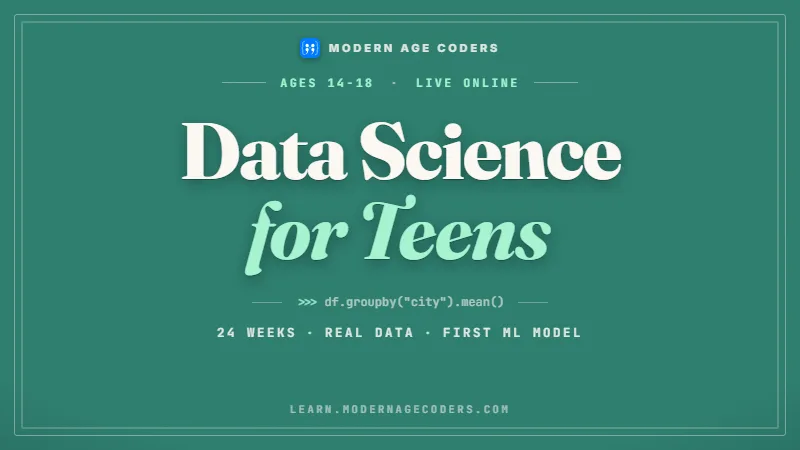
A teenager fetches a real CBS table, cleans it, plots it and builds a first model, then writes down what the data cannot say.
Open the syllabus →
PROJ / 02
Statistics, SQL, APIs and modelling for students and adults, ending in a portfolio project on public data that an employer can open and rerun.
Open the syllabus →
PROJ / 03
Scheduled scripts that fetch new observations, refresh a model and publish the result, so a project keeps working after the lesson ends.
Open the syllabus →Dutch open data
Three public sources carry most of our learners' projects. Each was read at its own page on 15 September 2026, and each comes with rules of its own.
| Source | What it offers | How learners reach it | The rule to respect |
|---|---|---|---|
| data.overheid.nl, the Dataregister van de Nederlandse Overheid | The national register of government data, listing both open and closed data; its search showed 26,986 results across datasets, data services, applications and organisations | Search the register, then follow each entry to its publisher | Check each dataset's own licence and whether it is open at all |
| CBS StatLine | Every StatLine table from the national statistics office, published as open data | A catalogue service, a standard API and a feed, built on OData 3 with OData 4 in development | The standard API returns at most 10,000 cells per request; larger downloads go through the feed |
| KNMI Data Platform | 10-minute observations, hourly to yearly ground-based weather observations, and the HARMONIE weather model | Datasets in the platform's catalogue, downloaded through its APIs | CC BY 4.0: users must state that the data comes from the KNMI |
The breadth matters for learners. A teenager interested in climate can work with ten-minute weather observations. A student interested in housing, work or population can pull CBS tables for every municipality. An adult interested in their own sector can search the government register for what their ministry or province publishes.
None of these sources was designed for a school project, which is exactly why they teach so well. The columns have official names, the units are stated, the documentation is written for professionals, and the data arrives with the quirks real data has.
Each source also brings a rule, and meeting it is part of the project rather than an obstacle to it. A learner who has respected an attribution licence, designed around an API limit and checked whether a dataset is actually open has learned more about working with data than any clean practice set could teach.
The same approach runs through the city academy pages: Amsterdam reads the public algorithm register, and Rotterdam scores forecasts against what happened.
Sources: data.overheid.nl; CBS, StatLine als open data; KNMI Data Platform, open data. Read 15 September 2026; counts and services may change after that date. We have no connection with any of these organisations.
Three constraints
Every project on our track is built around the same three questions. They are simple to ask and easy to skip, and skipping them is what turns a real dataset back into a toy.
KNMI publishes its open data under CC BY 4.0, which allows reuse on one condition: the user must say that the data comes from the KNMI. The government register lists open and closed data side by side, so each dataset has to be checked before it is used. A learner writes the licence and the attribution into the project before writing any model.
The standard StatLine API returns at most 10,000 cells in a single request, while the feed has no maximum number of records. A project that needs a large table therefore has to be designed for it: download through the feed, or request the data in pieces and join them. Learning to read an API's limits before writing the code is a professional habit worth starting young.
Public data changes as tables are revised and observations added. A project records which table or dataset it used, when it was downloaded and what was removed during cleaning, and keeps the raw download next to the cleaned version. Without that record, nobody, including the learner a month later, can check the result.
| Project | Data | The AI or data step | The constraint it teaches |
|---|---|---|---|
| Rain and your own measurements | KNMI daily observations joined to data the learner collects | A simple model relating weather to the learner's variable | Attribution under CC BY 4.0 |
| A municipality comparison | CBS StatLine tables for several municipalities | Clustering municipalities by their figures | The 10,000-cell API limit |
| A dataset nobody has used yet | An entry found on data.overheid.nl | Cleaning, a first chart and a baseline model | Checking whether the data is open |
| A weekly refresh | Any of the above, fetched on a schedule | Automation that retrains and republishes | Recording versions and download dates |
The rules in this section are quoted from the source pages listed above. The project ideas are our own teaching examples and make no claim about what the data will show.
Publishing
A project on our track is not finished when the model runs. It is finished when a stranger could open it, understand it and rerun it.
Every project ends in a public repository with a short write-up: the question, the data and its licence, the steps taken, the result with its error, and the limits, the things the data cannot say. For teenagers, that write-up is often the most impressive part of a university application; for adults, it is the part an employer reads first.
For ideas at school level, see AI projects for high school students and AI science fair project ideas.
For students and adults, AI and ML projects for students goes further into model-driven projects, and vibe coding projects shows what can be built quickly with AI help, and what still needs checking.
The national AI and Python Academy sets out the full ladder that these projects sit on.
The rungs for project builders
A good project needs each rung beneath it. The model is the exciting part, but the download, the cleaning and the write-up decide whether anyone should believe it.
| Rung | Usually | What the learner can do |
|---|---|---|
| 1. Python by hand | Age 11 and up, or any adult beginner | Read a file, loop through it, make a first chart |
| 2. Real data | Once Python is comfortable | Fetch from an API, respect its limits, clean and record |
| 3. Models | Upper school, students, adults | Fit a model, compare it with a baseline, state its error |
| 4. Automation | After the first model | Refresh data and results on a schedule, safely |
| 5. Publishing | At every stage | A repository with licence, sources, results and limits |
Fetching and cleaning real data is where most of the time goes, in learner projects and in professional ones. We do not skip it with pre-cleaned files, because that is where the real learning happens.
The order of every subject we teach is on the coding roadmap.
Teenagers often build one project a term, timed around school tests. Adults usually choose a project close to their work and use their own sector's public data.
Younger children work with simpler data first, in the kids courses, and reach these projects later.
The catalogue
Grouped by stage. Each card opens the full course with its own timetable and fee; the free lesson settles where a learner starts.
PROJ / START / 01
For children of nine to twelve: typed Python, small datasets and a first program that learns from examples.
Open the syllabusPROJ / START / 02
The Python foundation, including files, loops and functions, that every later project depends on.
Open the syllabusPROJ / START / 03
Reading, cleaning and plotting real datasets, then a first model with its error stated.
Open the syllabusPROJ / ML / 01
From statistics to neural networks, each model trained on real data and compared with a simple baseline.
Open the syllabusPROJ / ML / 02
Statistics, SQL, APIs, modelling and a portfolio built on public data.
Open the syllabusPROJ / ML / 03
Classical methods to deep learning, with evaluation and deployment given proper weight.
Open the syllabusPROJ / RUN / 01
Scheduled fetching, retraining and publishing, so a project updates itself.
Open the syllabusPROJ / RUN / 02
Storing downloads and results properly, with versions and dates kept.
Open the syllabusPROJ / RUN / 03
Version control and public repositories, the home of every finished project.
Open the syllabusPROJ / RUN / 04
The same habits for teenagers, from the first commit to a public portfolio.
Open the syllabusHow the classes run
Our teachers are in India, where clocks do not change for summer, so they sit three and a half hours ahead of the Netherlands in the Dutch summer and four and a half ahead in winter. Project lessons usually happen in the late afternoon, evening or at the weekend, at a fixed time agreed in the free lesson.
Late afternoon
Dutch time, for teenagers building projects after school.
Evening
Dutch time, by arrangement, for students and working adults.
Weekend
Longer sessions on Saturday or Sunday, popular for project work.
The first lesson starts a small project on real data, so both learner and teacher see how the learner works before anything is decided.
Learners at the same level, often working on different projects with the same data sources, which makes for useful comparison.
For a school profile project, a thesis, a portfolio piece for an application, or an adult's work-related project.
Shared screens mean the teacher catches a wrong join or a missed licence line while it is still easy to fix.
Lessons are in English, while the data itself often has Dutch column names; learners get used to working across both.
Raw downloads, cleaned data, code, results and the write-up all live in the learner's own GitHub repository.
Student work
Four live projects built by our students. Try them, then look at how they were made; the student labs page has many more.
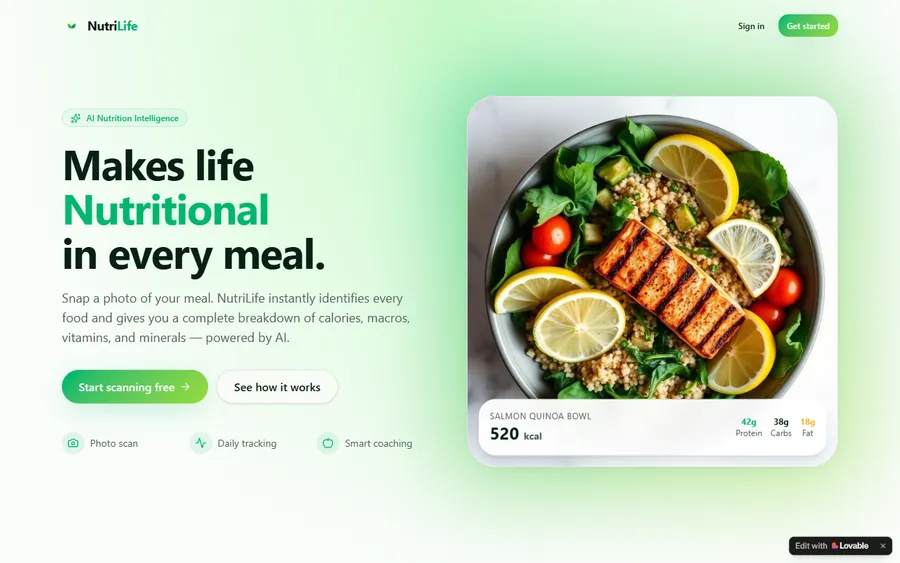
AI and ML
An AI nutrition coach that reads what you eat and works you toward a target.
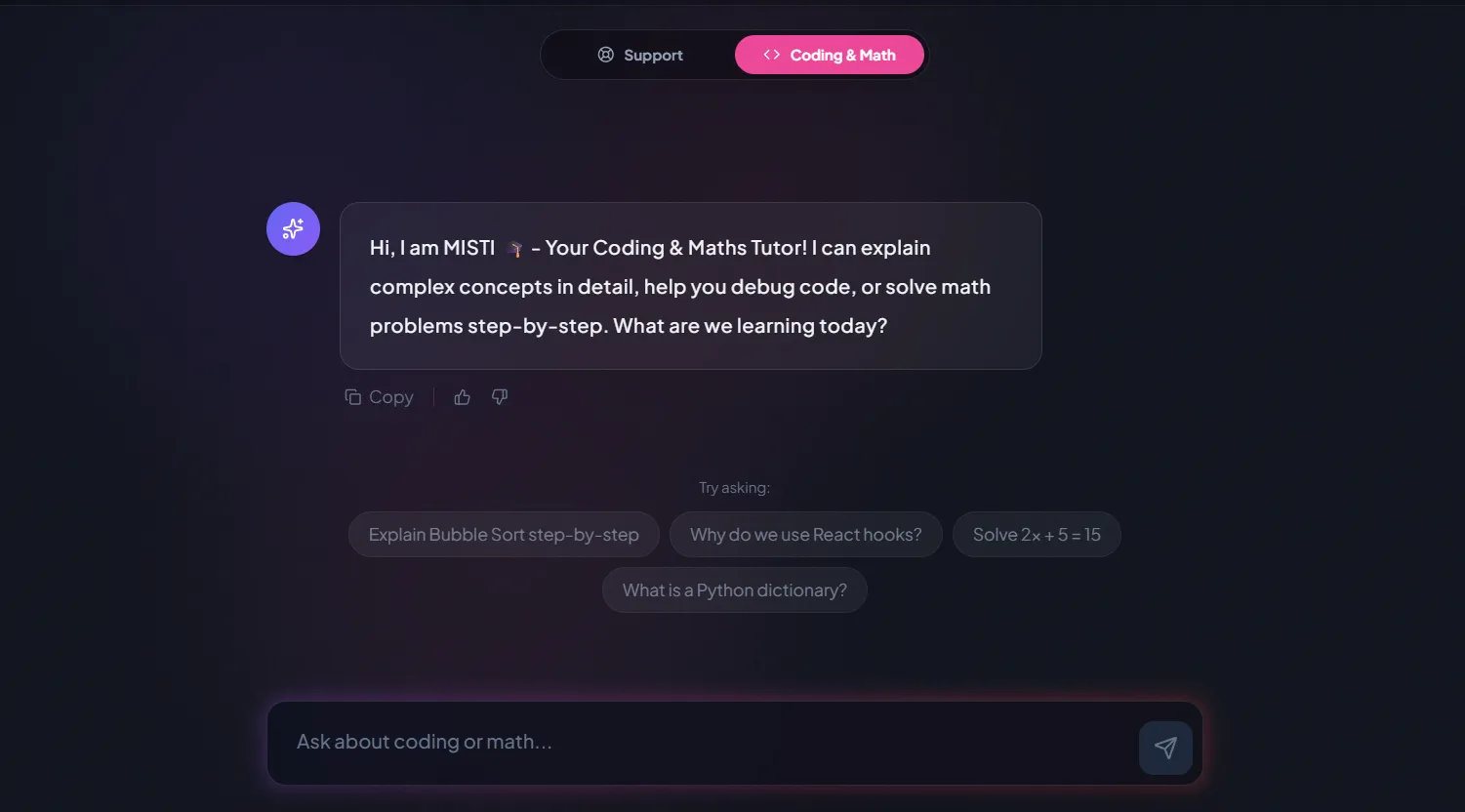
AI and ML
A chatbot that answers mathematics and programming questions, built and deployed by a student.
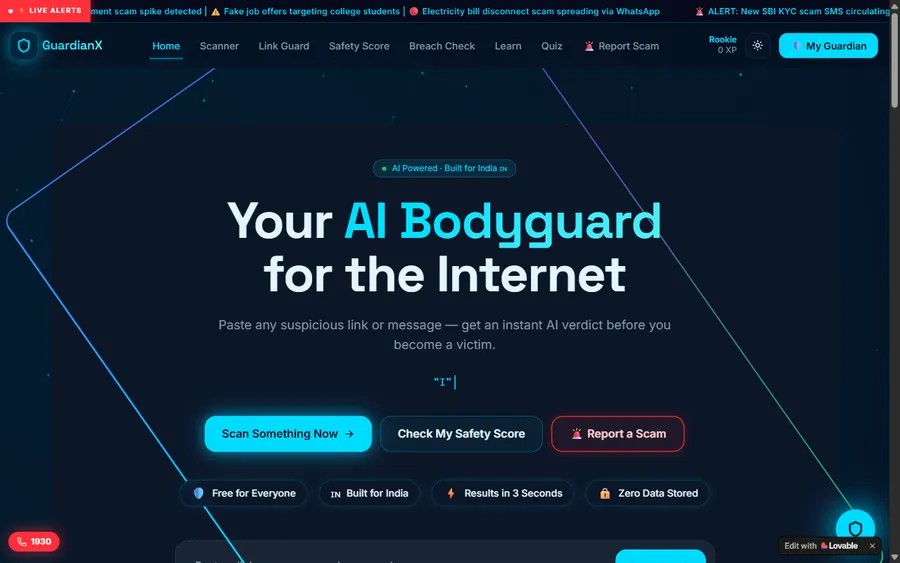
AI and ML
An assistant that helps a young person recognise unsafe situations online.
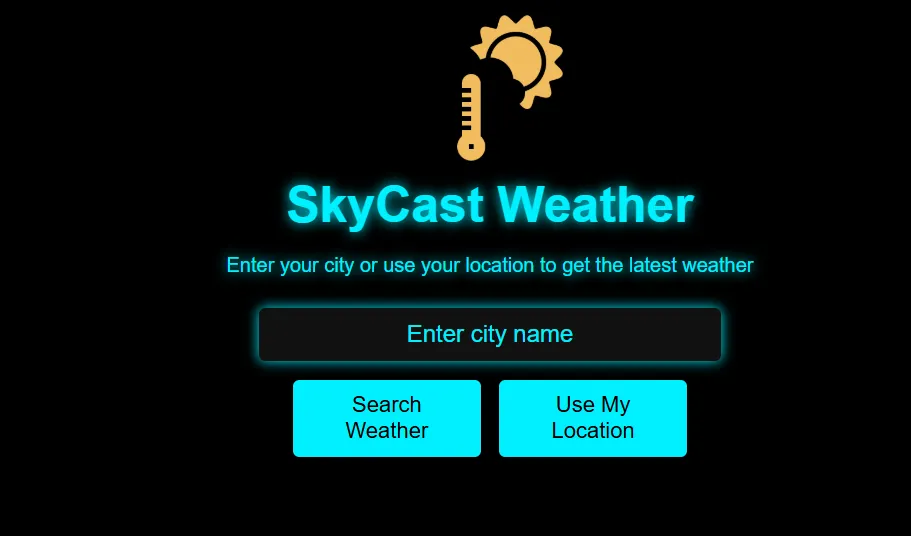
Web app
A weather forecasting site with live conditions for any location.
Fees
Charged monthly in US dollars, the same in every country outside India. There is no separate project fee, no enrolment charge and no annual contract. Copilot Studio courses, which are taught one to one only, use the one-to-one rate.
Free first class
USD 0
no card required
Group batch
USD 100
a month, billed in US dollars
One to one
USD 150
a month, billed in US dollars
What families say
Word for word from Google. We do not write, reward or alter reviews.
★★★★★
"The one step solution for my son. Modern Age Coders make learning coding so simple that kids love it. The teachers explain complex concepts clearly with practical exercises and interactive content."
Ria Mukherjee
Parent
★★★★★
"Modern Age Coders has been a game-changer for me. I struggled to grasp IT concepts and coding before joining, but their classes transformed everything. I can now confidently write complex programs with ease."
Samriddha Mondal
Student
★★★★★
"One of the most wonderful education centres out there. Education is not limited to school syllabus but focuses on skill development."
Vansh Agarwal
Student
★★★★★
"My child Dhairya is really enjoying the Modern Age Coders classes. This is his first online class and he eagerly looks forward to it. I can already see his improvement, and the teachers are very cooperative."
Sonam Oswal
Parent of Dhairya
★★★★★
"Modern Age Coders have wonderful teachers who teach in a clear, easy and practical way. The teacher boosts students' confidence and inspires them to learn without hesitation."
Sonu Goyal
Parent
★★★★★
"I highly recommend this computer coding class! The teachers are incredibly knowledgeable and passionate about coding."
Ritu Kedia
Parent
Questions about projects
Much of it is, but not all. KNMI open data is published under CC BY 4.0, which requires crediting the KNMI. The government data register lists open and closed data together, so each dataset's own terms must be checked. Our projects always record the licence.
The database of the national statistics office, CBS. All its tables are available as open data through a catalogue service, a standard API that returns at most 10,000 cells per request, and a feed for larger downloads.
It helps a little, because many column names are Dutch, but teachers help learners work with them. The lessons themselves are in English.
Most teenagers are ready once they can write basic Python, usually from about thirteen. Younger children start with simpler data in the kids courses. Students and adults can start at any rung.
Yes. Many learners use one for a profile project, an application portfolio or a thesis. We teach the skills; the work and the conclusions are the learner's own.
Usually yes, in the learner's own GitHub repository, because a published project is worth far more. Learners decide, and nothing personal or confidential is ever published.
No. We use their public data under its published terms, like any other user.
A group place is USD 100 a month and one-to-one lessons are USD 150 a month, billed in US dollars, with no enrolment fee and no yearly contract. The opening lesson is free.
Late afternoons, evenings or weekends, Dutch time. The teacher is three and a half hours ahead of Dutch summer time and four and a half ahead of winter time.
We phone at a Dutch hour to set up the first project lesson. It costs nothing, and payment only comes up if you decide to continue.
Elsewhere on this site
Related pages for project ideas and for the wider route.
Project ideas pitched at secondary-school level.
Model-driven projects for students.
Ideas that suit a school fair or profile project.
The national ladder these projects sit on.
For students building portfolios alongside a degree.
For teenagers still building their Python foundation.
Start here
Leave a number and we will ring at a Dutch hour to fix a time. In the free lesson you start a small project on real Dutch data with a teacher, and by the end you know which rung to build on.
Want to look around first? The student labs show finished work, how we teach describes a lesson, and the course list has every syllabus.
WhatsApp us · +91 91233 66161 · contact@modernagecoders.com
From a Dutch phone, a WhatsApp message costs nothing and usually gets the quickest answer. The number is Indian, and we have no office or premises in the Netherlands.